
Project 1 Proposal Describe the problem you propose
• Project • • 1. Proposal. Describe the problem you propose to analyze. Include Background: describe the problem you intend to analyze, give motivation for doing the analysis, cite literature. Objective: Describe what you intend to achieve as a result of doing the simulation Method: Describe the analysis you will conduct. This should include a description of the mathematical problem, including governing equation, boundary and initial conditions, parameters, and geometry. – – – • • Verification: Describe existing analyses you would use to verify your results. This could be an analytical solution or existing numerical solution. Validation or calibration: Describe data that you would use to calibrate your simulation. Identify the approach you would use for calibration. Approach: Outline 3 -5 analyses of increasing complexity that ends with the final goal. Results: Describe the results you expect to get from the analyses. References: Identify and cite at least 3 papers Clemson Hydro
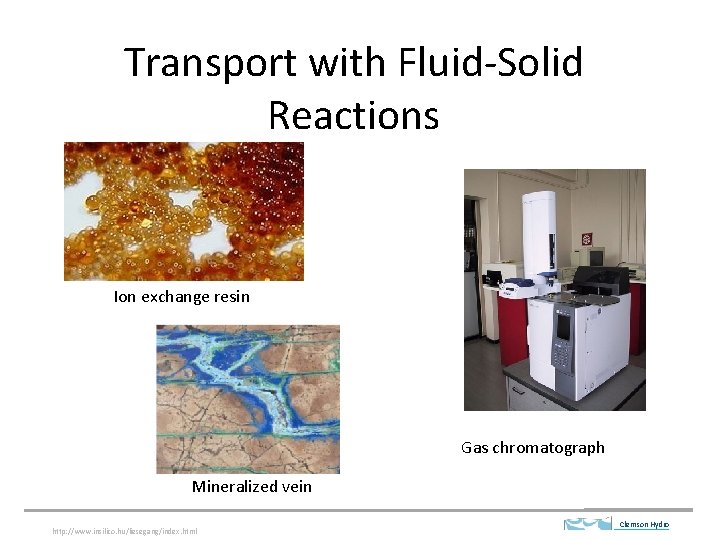
Transport with Fluid-Solid Reactions Ion exchange resin Gas chromatograph Mineralized vein http: //www. insilico. hu/liesegang/index. html Clemson Hydro
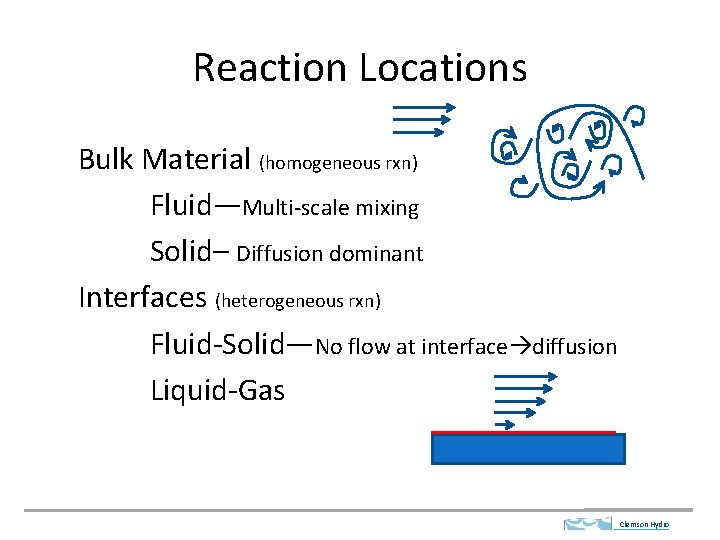
Reaction Locations Bulk Material (homogeneous rxn) Fluid—Multi-scale mixing Solid– Diffusion dominant Interfaces (heterogeneous rxn) Fluid-Solid—No flow at interface diffusion Liquid-Gas Clemson Hydro
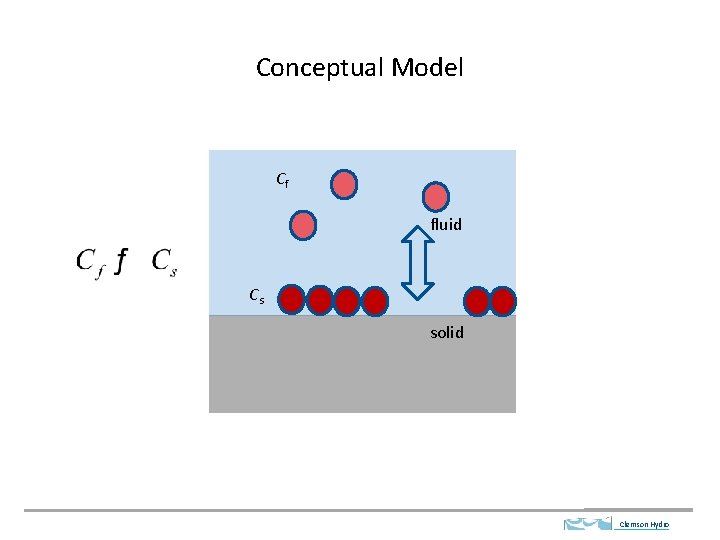
Conceptual Model Cf fluid Cs solid Clemson Hydro
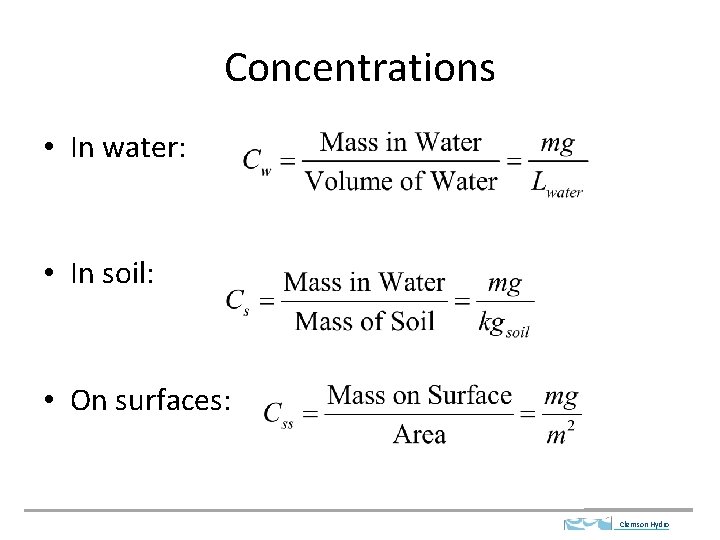
Concentrations • In water: • In soil: • On surfaces: Clemson Hydro
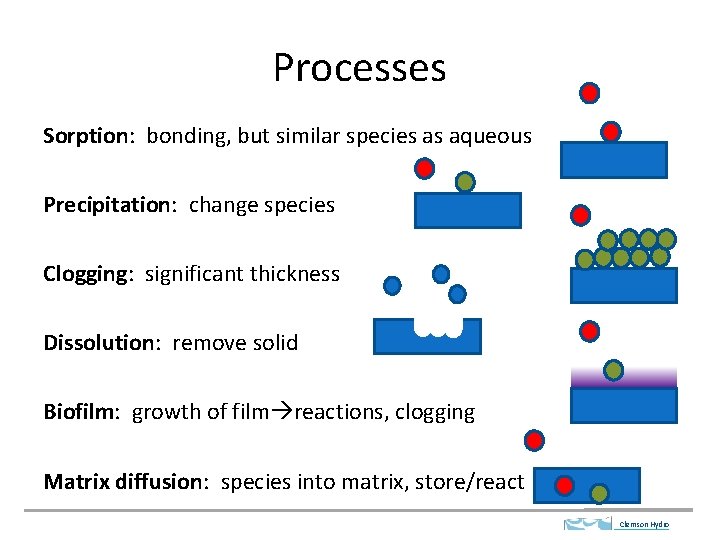
Processes Sorption: bonding, but similar species as aqueous Precipitation: change species Clogging: significant thickness Dissolution: remove solid Biofilm: growth of film reactions, clogging Matrix diffusion: species into matrix, store/react Clemson Hydro
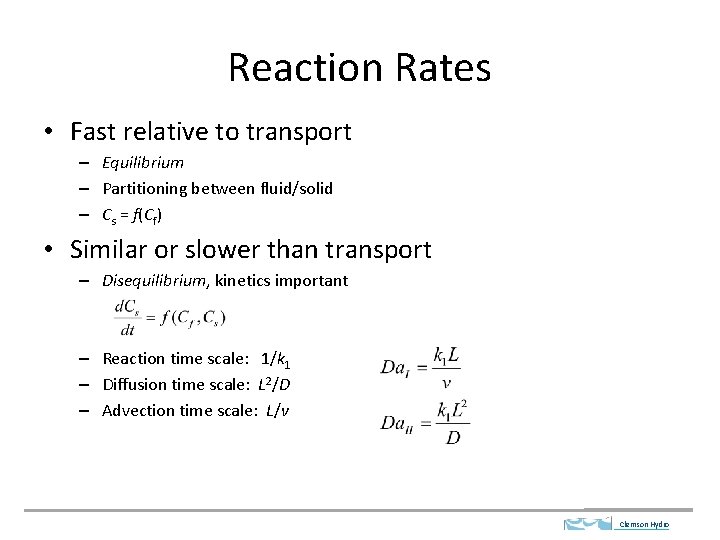
Reaction Rates • Fast relative to transport – Equilibrium – Partitioning between fluid/solid – Cs = f(Cf) • Similar or slower than transport – Disequilibrium, kinetics important – Reaction time scale: 1/k 1 – Diffusion time scale: L 2/D – Advection time scale: L/v Clemson Hydro
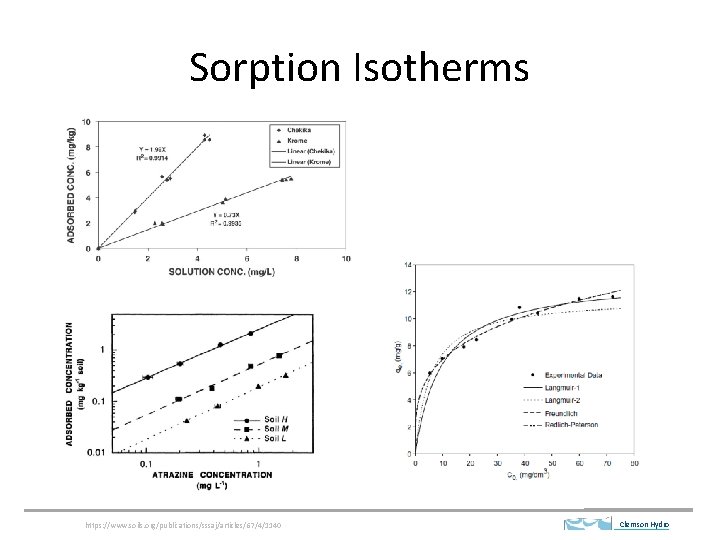
Sorption Isotherms https: //www. soils. org/publications/sssaj/articles/67/4/1140 Clemson Hydro
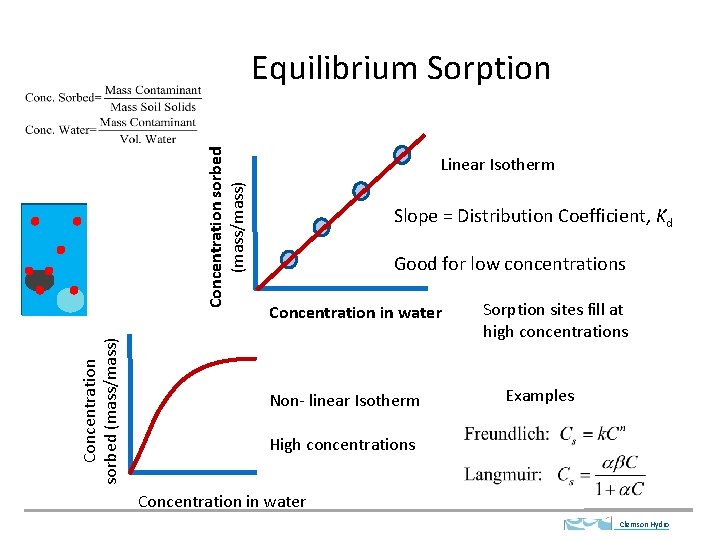
Concentration sorbed (mass/mass) Equilibrium Sorption Linear Isotherm Slope = Distribution Coefficient, Kd Good for low concentrations Concentration in water Non- linear Isotherm Sorption sites fill at high concentrations Examples High concentrations Concentration in water Clemson Hydro
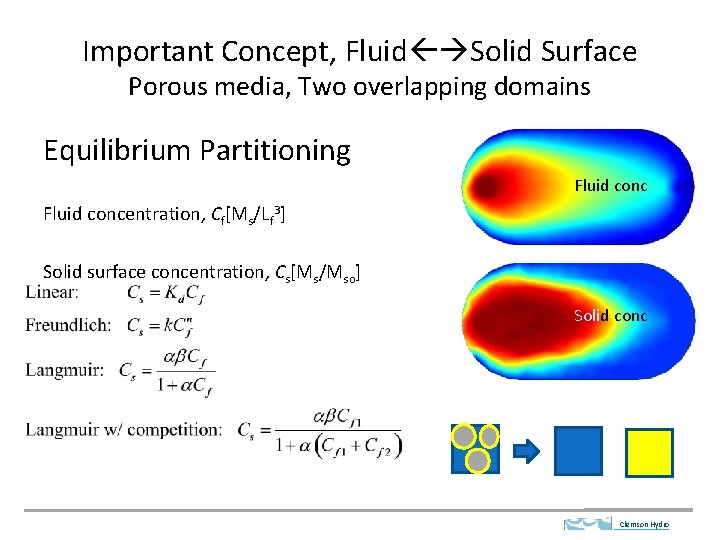
Important Concept, Fluid Solid Surface Porous media, Two overlapping domains Equilibrium Partitioning Fluid concentration, Cf[Ms/Lf 3] Solid surface concentration, Cs[Ms/Mso] Solid conc Clemson Hydro
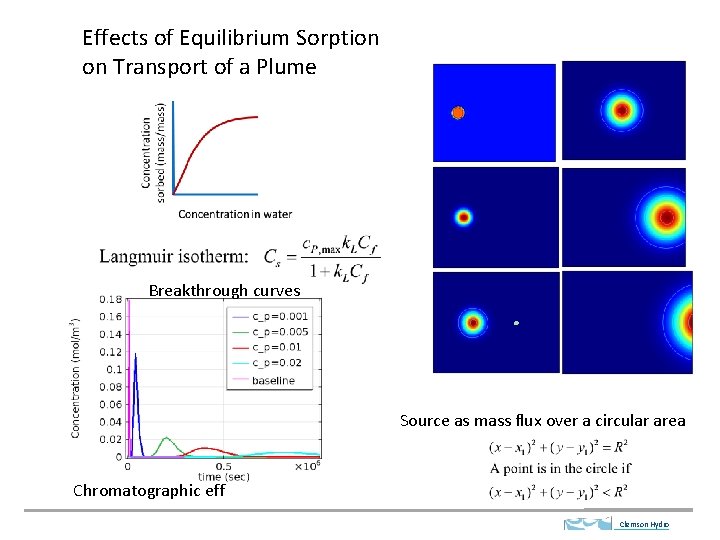
Effects of Equilibrium Sorption on Transport of a Plume Breakthrough curves Source as mass flux over a circular area Chromatographic eff Clemson Hydro

Application of pulse test to determine ne and R Average linear flow velocity v=L/tm, w tm=9215 s (from first moment, conservative tracer) L=300 m (from set up) v=300 m/9215 s =0. 032 m/s L Effective porosity Flux = q =0. 01 m/s (specified in model) Effective porosity =q/v = 0. 01/0. 032 = 0. 31 Compare to porosity specified in model=0. 3 Retardation factor vc=L/tm, c tm=20700 s (from first moment sorbing compound) v=300 m/20700 s =0. 014 m/s Chromatographic effect R=vw/vc= 0. 032/0. 014=2. 3 Clemson Hydro
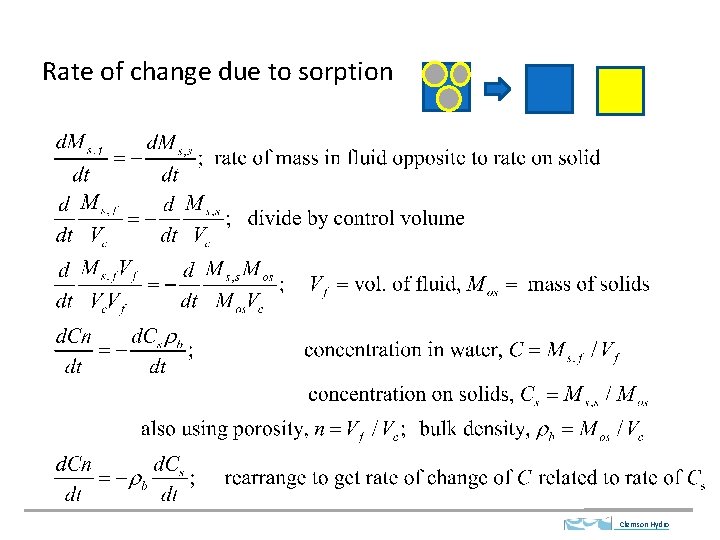
Rate of change due to sorption Clemson Hydro
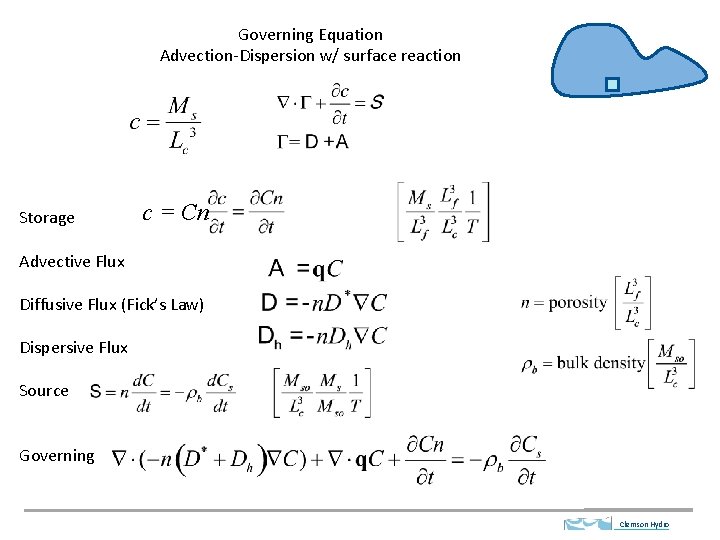
Governing Equation Advection-Dispersion w/ surface reaction Storage c = Cn Advective Flux Diffusive Flux (Fick’s Law) Dispersive Flux Source Governing Clemson Hydro
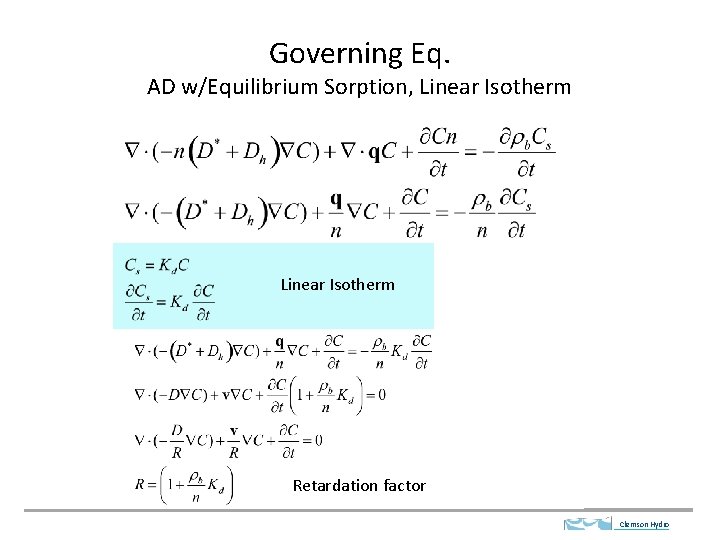
Governing Eq. AD w/Equilibrium Sorption, Linear Isotherm Retardation factor Clemson Hydro
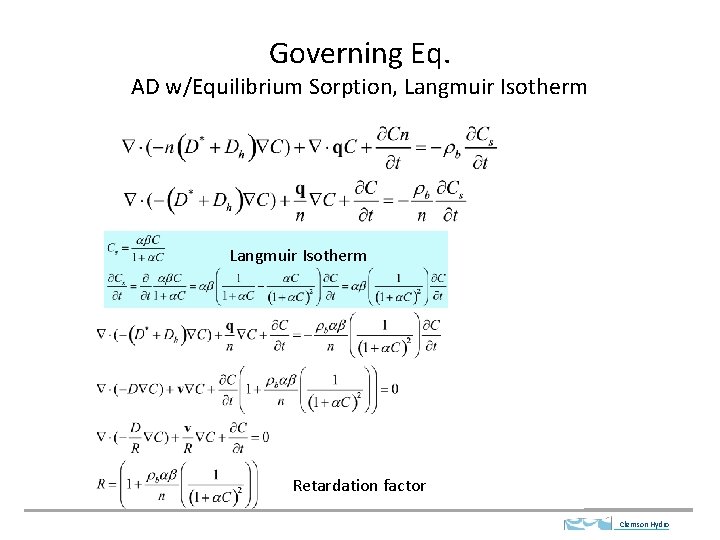
Governing Eq. AD w/Equilibrium Sorption, Langmuir Isotherm Retardation factor Clemson Hydro
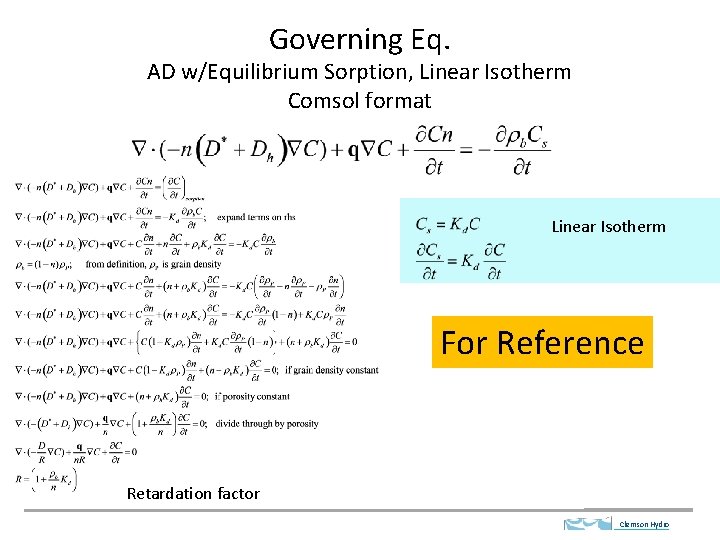
Governing Eq. AD w/Equilibrium Sorption, Linear Isotherm Comsol format Linear Isotherm For Reference Retardation factor Clemson Hydro
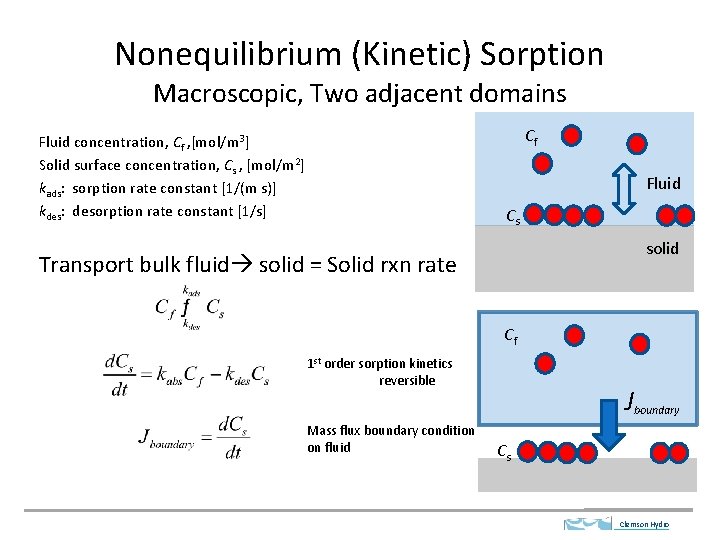
Nonequilibrium (Kinetic) Sorption Macroscopic, Two adjacent domains Cf Fluid concentration, Cf , [mol/m 3] Solid surface concentration, Cs , [mol/m 2] kads: sorption rate constant [1/(m s)] kdes: desorption rate constant [1/s] Fluid Cs solid Transport bulk fluid solid = Solid rxn rate Cf 1 st order sorption kinetics reversible Mass flux boundary condition on fluid Jboundary Cs Clemson Hydro
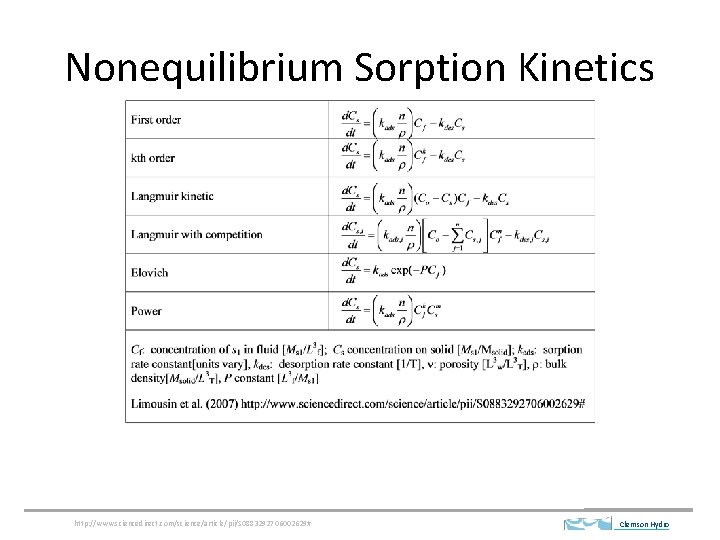
Nonequilibrium Sorption Kinetics http: //www. sciencedirect. com/science/article/pii/S 0883292706002629# Clemson Hydro
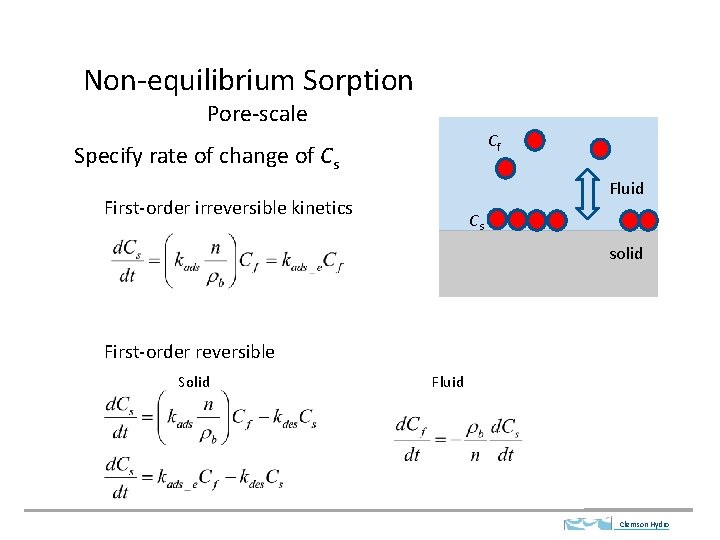
Non-equilibrium Sorption Pore-scale Cf Specify rate of change of Cs First-order irreversible kinetics Fluid Cs solid First-order reversible Solid Fluid Clemson Hydro
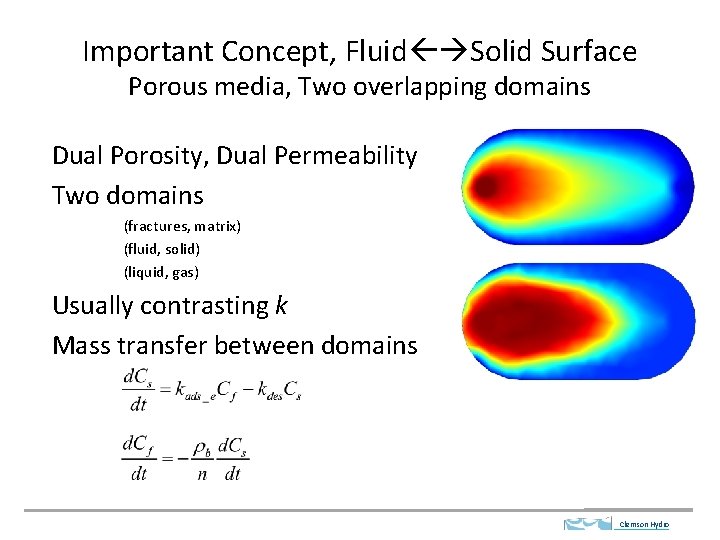
Important Concept, Fluid Solid Surface Porous media, Two overlapping domains Dual Porosity, Dual Permeability Two domains (fractures, matrix) (fluid, solid) (liquid, gas) Usually contrasting k Mass transfer between domains Clemson Hydro
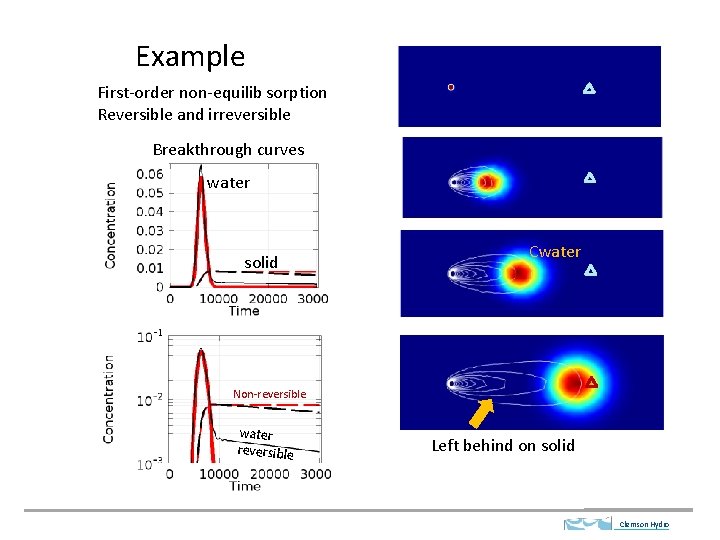
Example First-order non-equilib sorption Reversible and irreversible Breakthrough curves water solid Cwater Non-reversible water reversible Left behind on solid Clemson Hydro
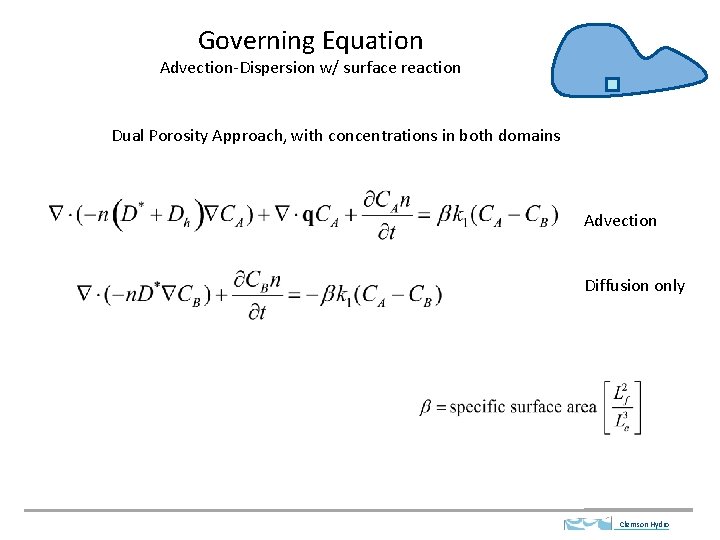
Governing Equation Advection-Dispersion w/ surface reaction Dual Porosity Approach, with concentrations in both domains Advection Diffusion only Clemson Hydro
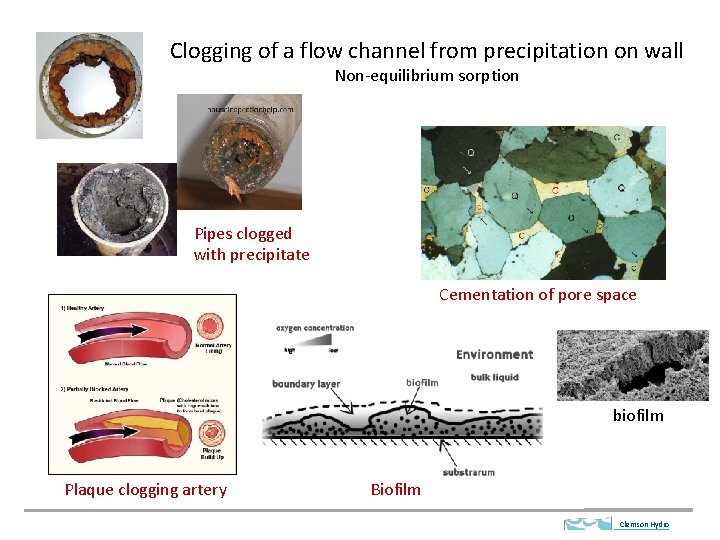
Clogging of a flow channel from precipitation on wall Non-equilibrium sorption Pipes clogged with precipitate Cementation of pore space biofilm Plaque clogging artery Biofilm Clemson Hydro
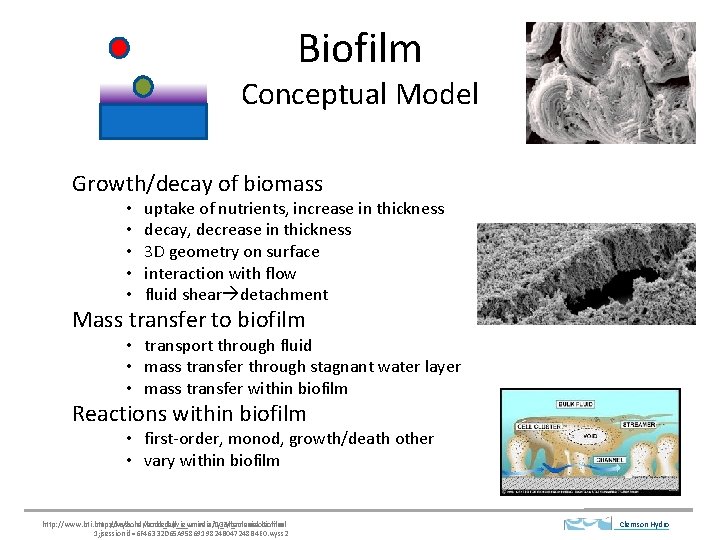
Biofilm Conceptual Model Growth/decay of biomass • uptake of nutrients, increase in thickness • decay, decrease in thickness • 3 D geometry on surface • interaction with flow • fluid shear detachment Mass transfer to biofilm • transport through fluid • mass transfer through stagnant water layer • mass transfer within biofilm Reactions within biofilm • first-order, monod, growth/death other • vary within biofilm http: //wyss. harvard. edu/viewmedia/133/bacterial-biofilmhttp: //www. bti. umn. edu/bond_lab___university_of_minnesota. html 1; jsessionid=6 F 46332 D 65 A 9586919824 B 047248 B 4 E 0. wyss 2 Clemson Hydro
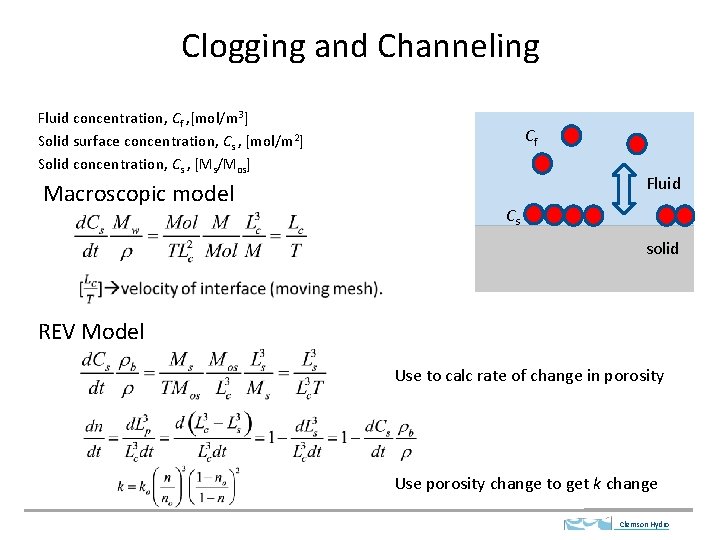
Clogging and Channeling Fluid concentration, Cf , [mol/m 3] Solid surface concentration, Cs , [mol/m 2] Solid concentration, Cs , [Ms/Mos] Macroscopic model Cf Fluid Cs solid REV Model Use to calc rate of change in porosity Use porosity change to get k change Clemson Hydro
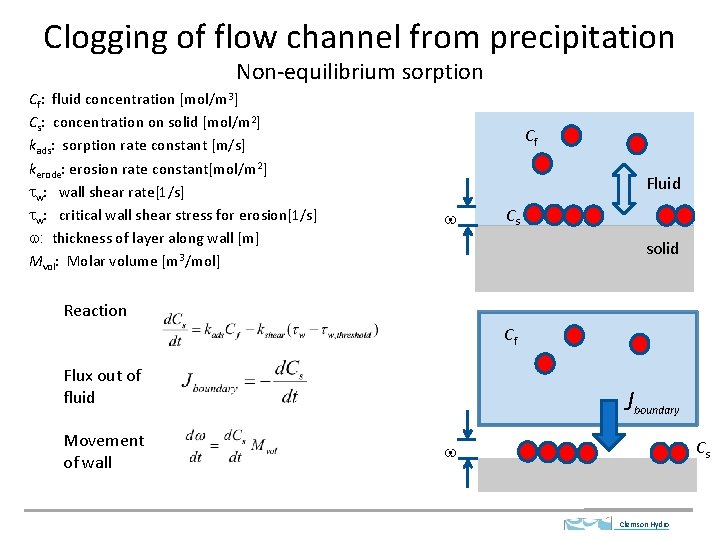
Clogging of flow channel from precipitation Non-equilibrium sorption Cf: fluid concentration [mol/m 3] Cs: concentration on solid [mol/m 2] kads: sorption rate constant [m/s] kerode: erosion rate constant[mol/m 2] tw : wall shear rate[1/s] tw: critical wall shear stress for erosion[1/s] w: thickness of layer along wall [m] Mvol: Molar volume [m 3/mol] Cf Fluid w Cs solid Reaction Cf Flux out of fluid Movement of wall Jboundary Cs w Clemson Hydro
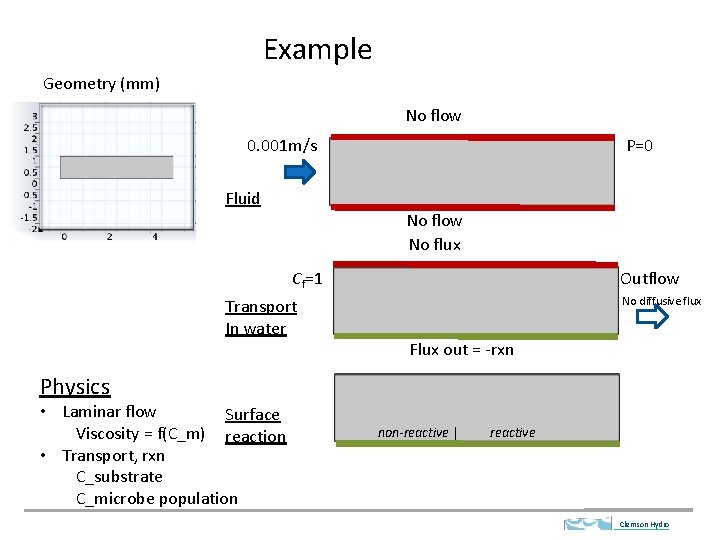
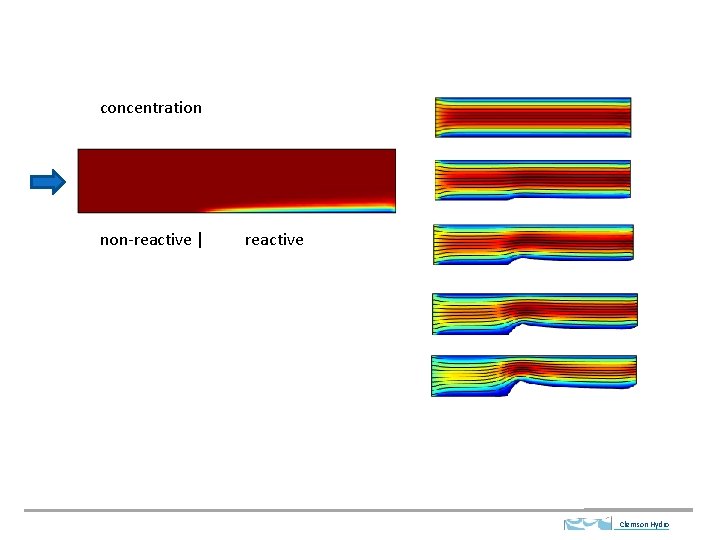
Example Geometry (mm) No flow 0. 001 m/s P=0 Fluid No flow No flux Cf=1 Outflow Transport No diffusive flux In water Flux out = -rxn Physics • Laminar flow Surface Viscosity = f(C_m) reaction • Transport, rxn C_substrate C_microbe population non-reactive | reactive Clemson Hydro
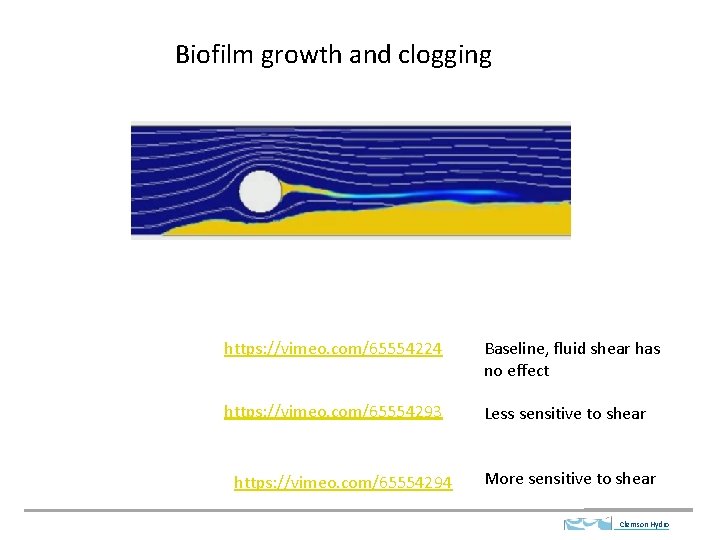
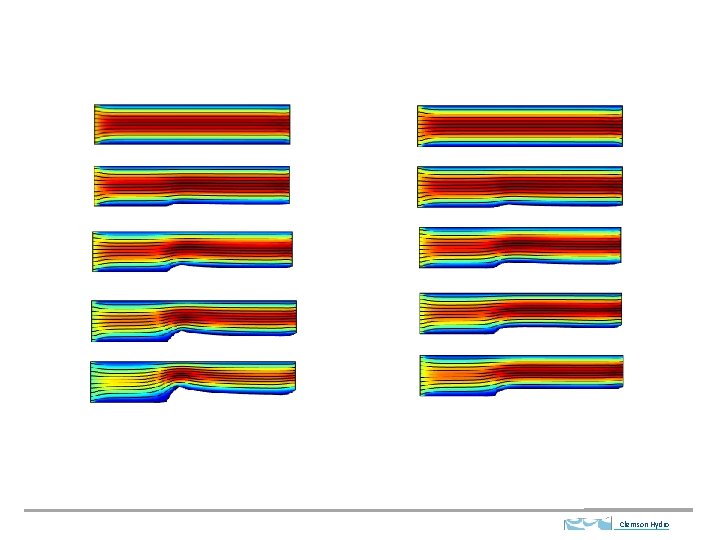
Biofilm growth and clogging https: //vimeo. com/65554224 Baseline, fluid shear has no effect https: //vimeo. com/65554293 Less sensitive to shear https: //vimeo. com/65554294 More sensitive to shear Clemson Hydro
Clemson Hydro
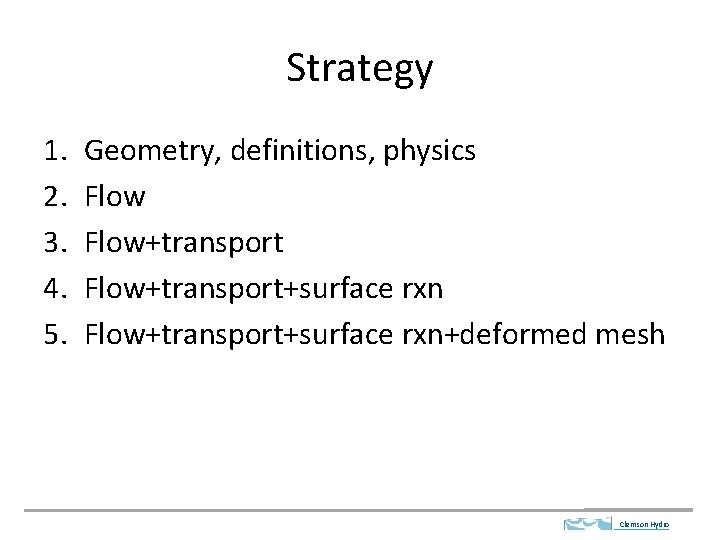
Strategy 1. 2. 3. 4. 5. Geometry, definitions, physics Flow+transport+surface rxn+deformed mesh Clemson Hydro
concentration non-reactive | reactive Clemson Hydro
Clemson Hydro
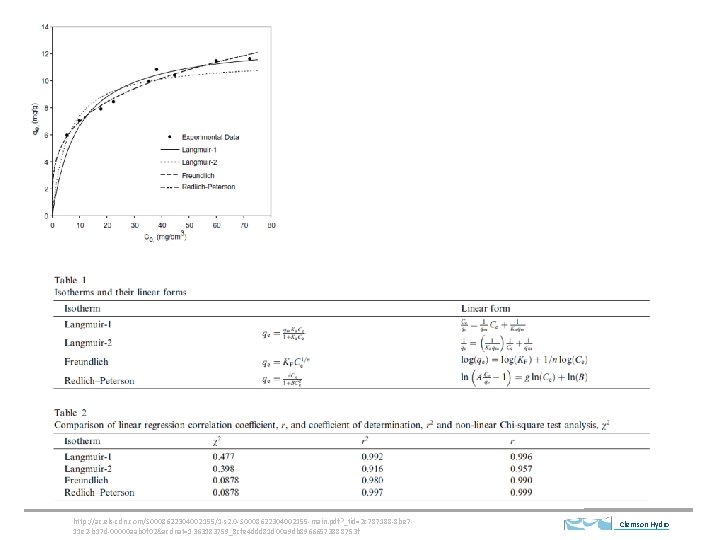
http: //ac. els-cdn. com/S 0008622304002155/1 -s 2. 0 -S 0008622304002155 -main. pdf? _tid=2 c 787188 -8 be 711 e 2 -b 17 d-00000 aab 0 f 02&acdnat=1363183759_8 cfe 4 ddd 81 d 00 a 9 db 89666573888753 f Clemson Hydro
Clemson Hydro
Clemson Hydro
- Slides: 36