
Project 1 Improved RF Signal Propagation through Water

- Slides: 16
Project #1 Improved RF Signal Propagation through Water via Waveforms Student: Ritesh J. Patel Electrical and Compute Engineering ACCEND Justin Jantzen Aerospace Engineering Mentor: Dr. Dharma Agrawal, D. Sc. Anagha Jamthe Distinguished Professor Graduate Student Mentor NSF Type 1 STEP Grant Sponsored By The National Science Foundation Grant ID No. : DUE-0756921 College of Engineering and Applied Science University of Cincinnati
Index �Experiment Purpose �Background �Materials �Test Method �Test Results �Conclusion
3 Experiment Purpose �Improvement in RF (Radio Frequency) signal propagation between a wireless transmitter/receiver pair through a pipe filled with air vs. RF signal propagation through water �A hollow pipe can be used to propagate signal through air rather than water and could significantly improve the signal quality and transmission range
Background 4 �RF waves are used by cell phones to communicate with a microwave tower �Such signals attenuates quickly in water due to absorption/attenuation properties �Such wireless devices communicating with RF signals could be used in off-shore oil-drilling platforms, submarines, and marine life applications �A hollow pipe can be used to propagate signal through air rather than water and could significantly improve the signal quality and transmission range #
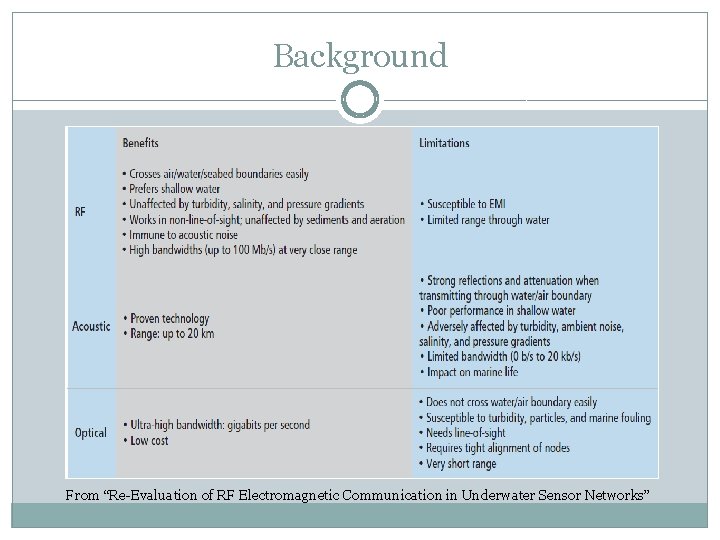
5 Background � 3 Major Methods of Transmission Radio Frequency Acoustic Optical
Background From “Re-Evaluation of RF Electromagnetic Communication in Underwater Sensor Networks”
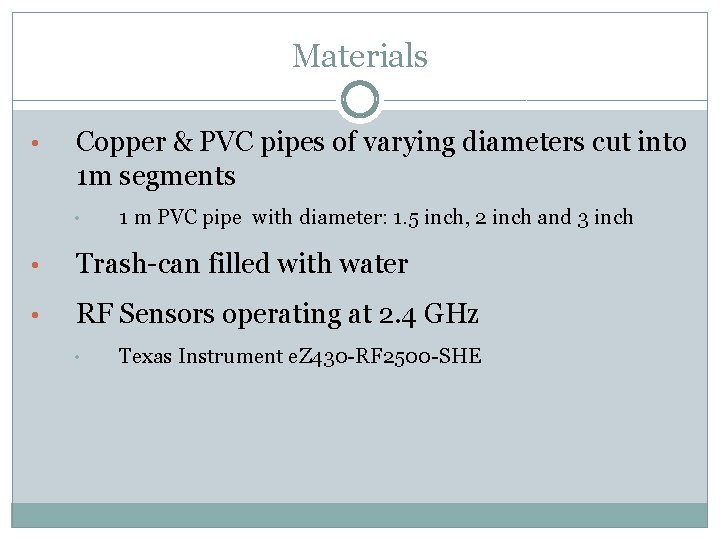
Materials • Copper & PVC pipes of varying diameters cut into 1 m segments • 1 m PVC pipe with diameter: 1. 5 inch, 2 inch and 3 inch • Trash-can filled with water • RF Sensors operating at 2. 4 GHz • Texas Instrument e. Z 430 -RF 2500 -SHE
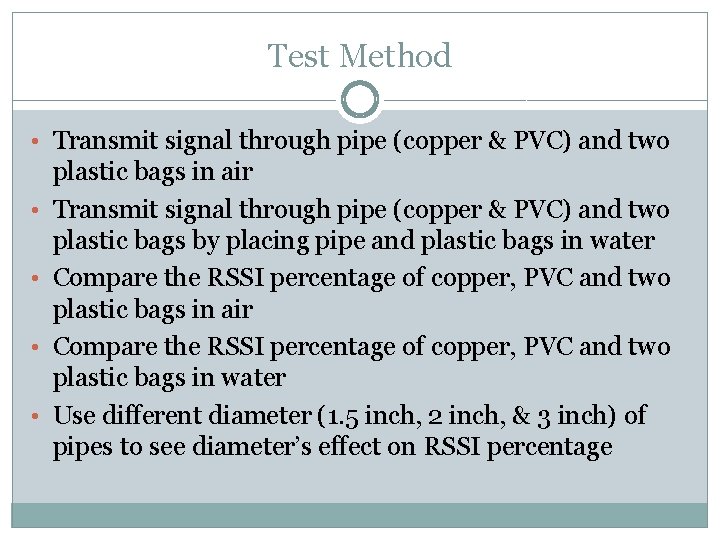
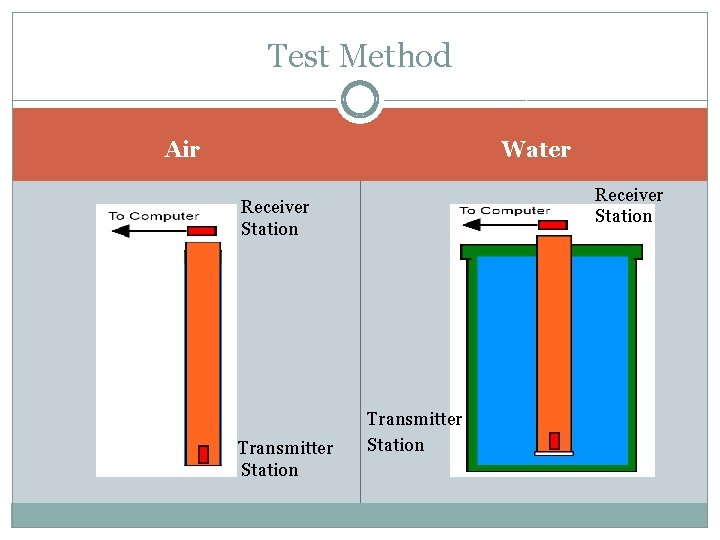
Test Method • Transmit signal through pipe (copper & PVC) and two • • plastic bags in air Transmit signal through pipe (copper & PVC) and two plastic bags by placing pipe and plastic bags in water Compare the RSSI percentage of copper, PVC and two plastic bags in air Compare the RSSI percentage of copper, PVC and two plastic bags in water Use different diameter (1. 5 inch, 2 inch, & 3 inch) of pipes to see diameter’s effect on RSSI percentage
Test Method Water Air Receiver Station Transmitter Station
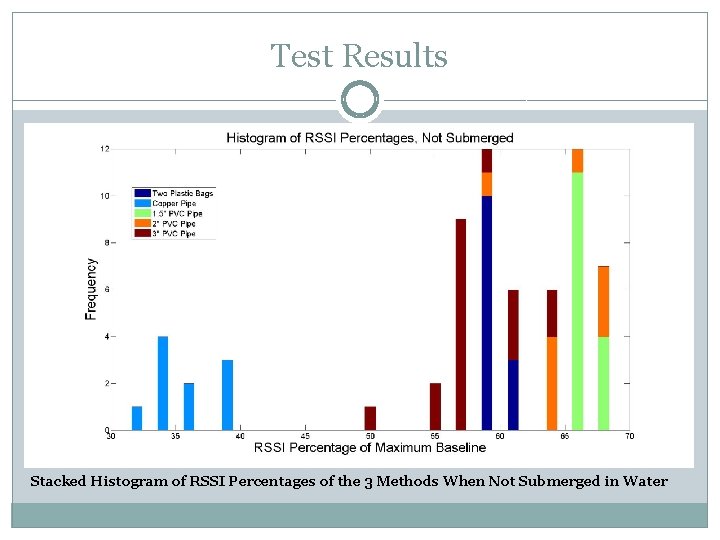
Test Results Stacked Histogram of RSSI Percentages of the 3 Methods When Not Submerged in Water
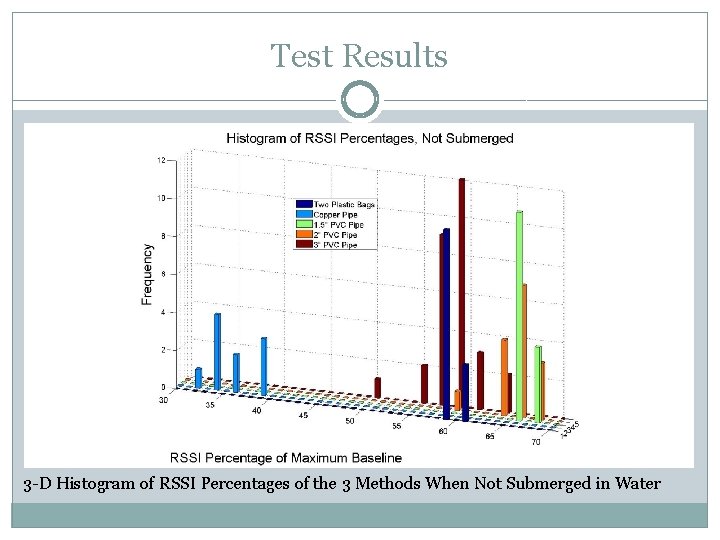
Test Results 3 -D Histogram of RSSI Percentages of the 3 Methods When Not Submerged in Water
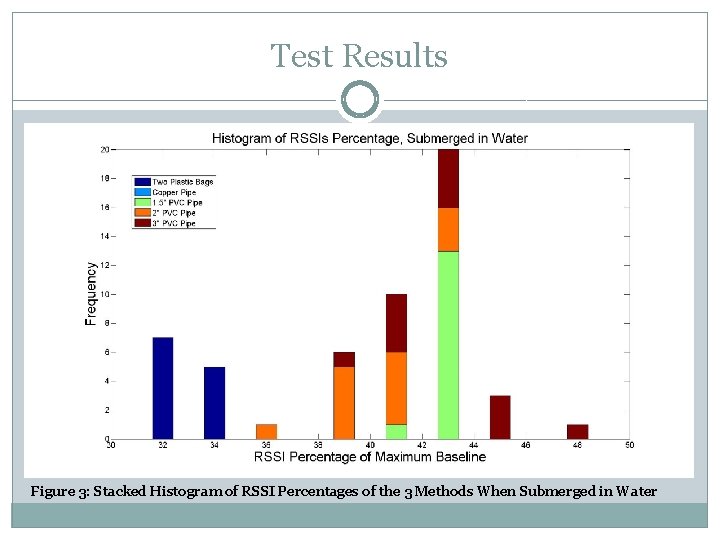
Test Results Figure 3: Stacked Histogram of RSSI Percentages of the 3 Methods When Submerged in Water
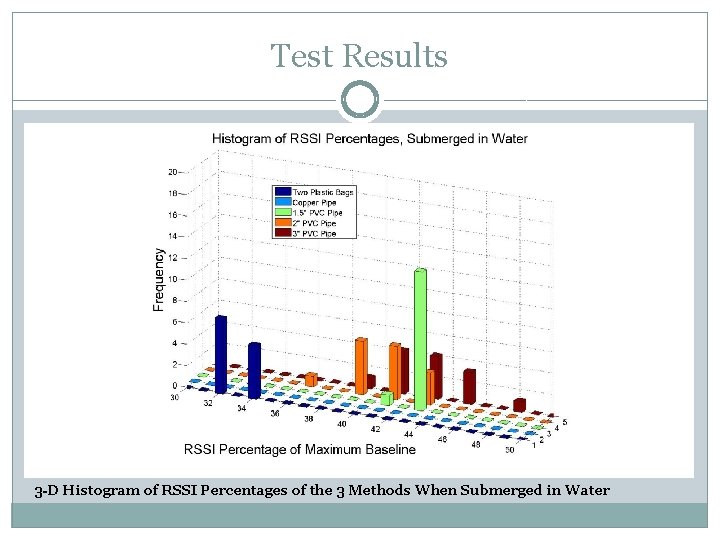
Test Results 3 -D Histogram of RSSI Percentages of the 3 Methods When Submerged in Water
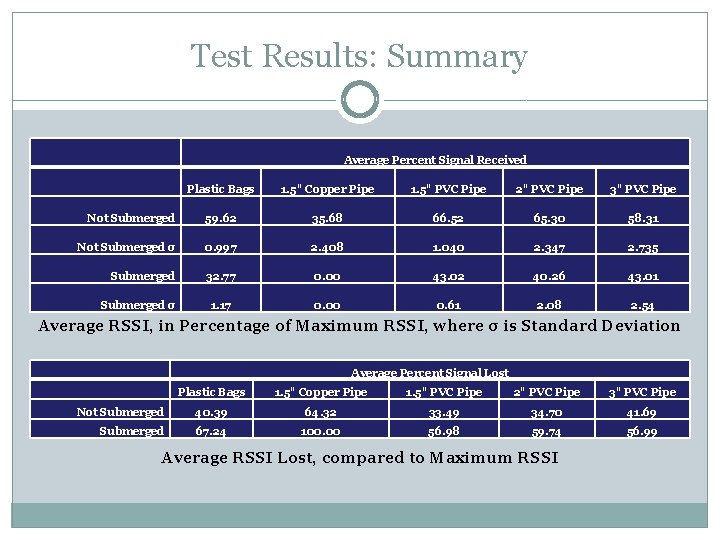
Test Results: Summary Average Percent Signal Received Plastic Bags 1. 5" Copper Pipe 1. 5" PVC Pipe 2" PVC Pipe 3" PVC Pipe Not Submerged 59. 62 35. 68 66. 52 65. 30 58. 31 Not Submerged σ 0. 997 2. 408 1. 040 2. 347 2. 735 Submerged 32. 77 0. 00 43. 02 40. 26 43. 01 1. 17 0. 00 0. 61 2. 08 2. 54 Submerged σ Average RSSI, in Percentage of Maximum RSSI, where σ is Standard Deviation Average Percent Signal Lost Plastic Bags 1. 5" Copper Pipe 1. 5" PVC Pipe 2" PVC Pipe 3" PVC Pipe Not Submerged 40. 39 64. 32 33. 49 34. 70 41. 69 Submerged 67. 24 100. 00 56. 98 59. 74 56. 99 Average RSSI Lost, compared to Maximum RSSI
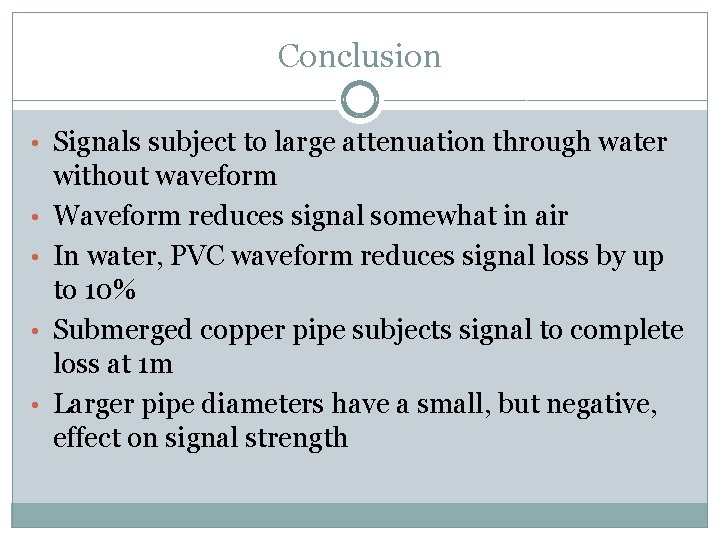
Conclusion • Signals subject to large attenuation through water • • without waveform Waveform reduces signal somewhat in air In water, PVC waveform reduces signal loss by up to 10% Submerged copper pipe subjects signal to complete loss at 1 m Larger pipe diameters have a small, but negative, effect on signal strength
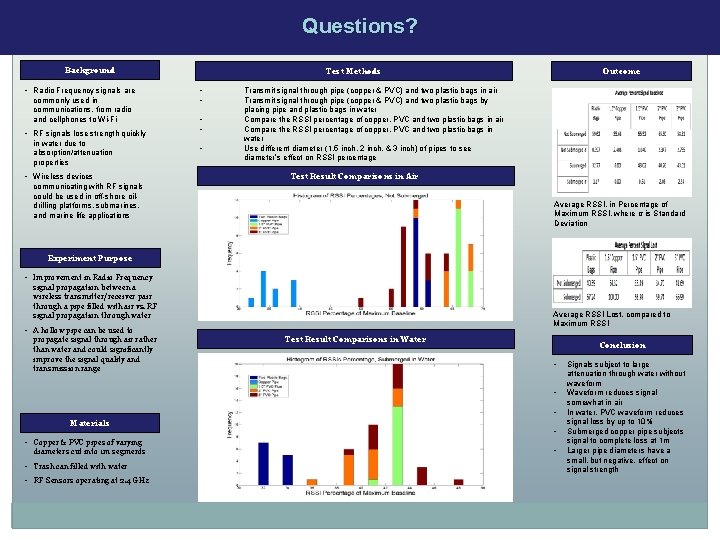
Questions? Background • Radio Frequency signals are commonly used in communications, from radio and cellphones to Wi-Fi • RF signals lose strength quickly in water due to absorption/attenuation properties • Wireless devices Test Methods • • • Outcome Transmit signal through pipe (copper & PVC) and two plastic bags in air Transmit signal through pipe (copper & PVC) and two plastic bags by placing pipe and plastic bags in water Compare the RSSI percentage of copper, PVC and two plastic bags in air Compare the RSSI percentage of copper, PVC and two plastic bags in water Use different diameter (1. 5 inch, 2 inch, & 3 inch) of pipes to see diameter’s effect on RSSI percentage Test Result Comparisons in Air communicating with RF signals could be used in off-shore oildrilling platforms, submarines, and marine life applications Average RSSI, in Percentage of Maximum RSSI, where σ is Standard Deviation Experiment Purpose • Improvement in Radio Frequency signal propagation between a wireless transmitter/receiver pair through a pipe filled with air vs. RF signal propagation through water • A hollow pipe can be used to propagate signal through air rather than water and could significantly improve the signal quality and transmission range Average RSSI Lost, compared to Maximum RSSI Test Result Comparisons in Water Conclusion • • • Materials • Copper & PVC pipes of varying diameters cut into 1 m segments • Trash can filled with water • RF Sensors operating at 2. 4 GHz • • Signals subject to large attenuation through water without waveform Waveform reduces signal somewhat in air In water, PVC waveform reduces signal loss by up to 10% Submerged copper pipe subjects signal to complete loss at 1 m Larger pipe diameters have a small, but negative, effect on signal strength