
Project 1 2 3 Student Data Sheet SEX


- Slides: 33
Project 1. 2. 3: Student Data Sheet
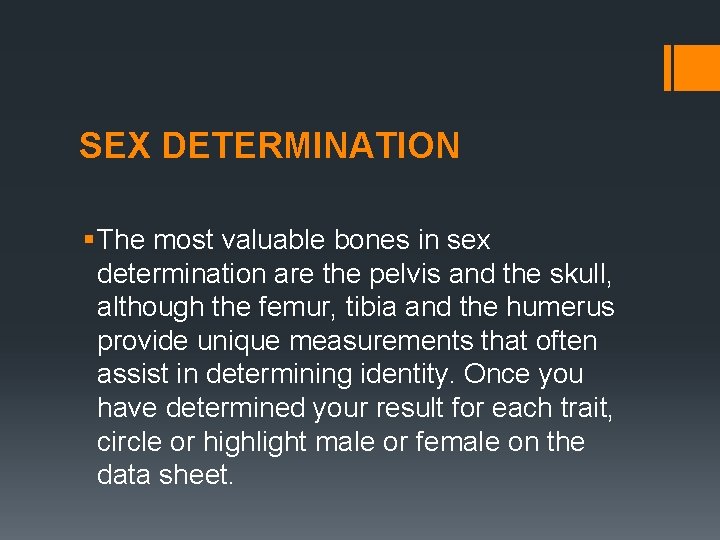
SEX DETERMINATION § The most valuable bones in sex determination are the pelvis and the skull, although the femur, tibia and the humerus provide unique measurements that often assist in determining identity. Once you have determined your result for each trait, circle or highlight male or female on the data sheet.
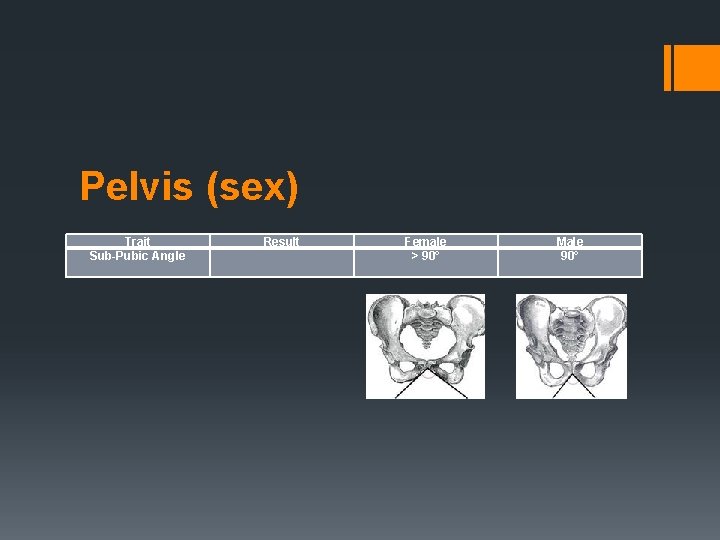
Pelvis (sex) Trait Sub-Pubic Angle Result Female > 90° Male 90°
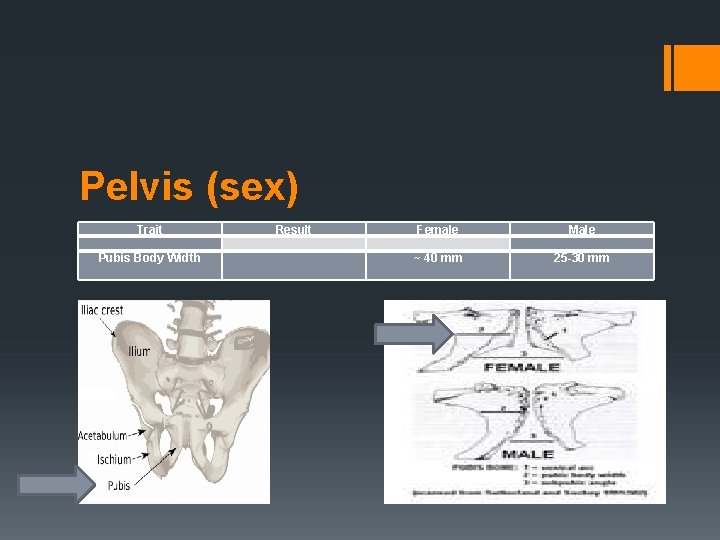
Pelvis (sex) Trait Pubis Body Width Result Female Male ~ 40 mm 25 -30 mm
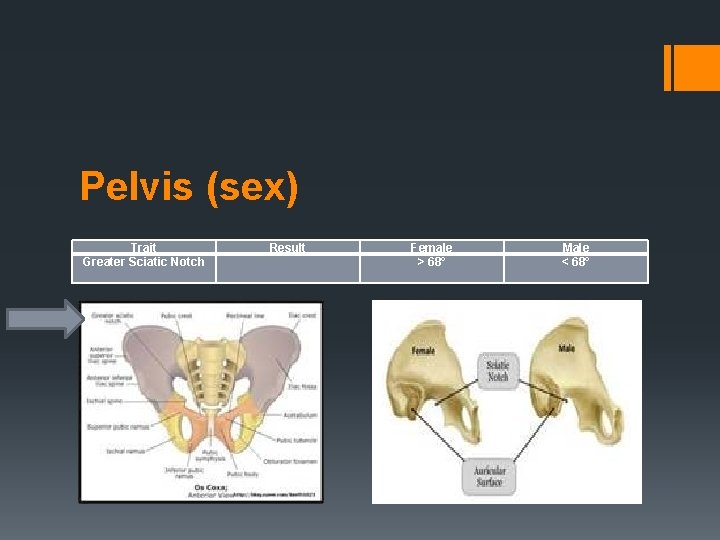
Pelvis (sex) Trait Greater Sciatic Notch Result Female > 68° Male < 68°
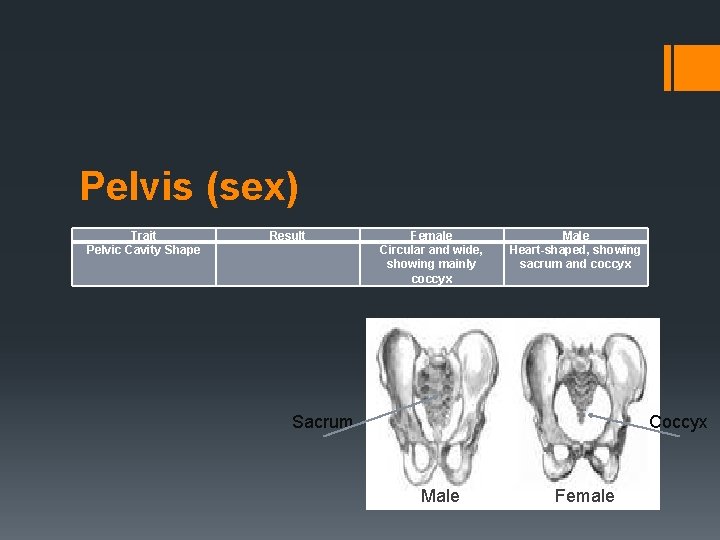
Pelvis (sex) Trait Pelvic Cavity Shape Result Female Circular and wide, showing mainly coccyx Male Heart-shaped, showing sacrum and coccyx Sacrum Coccyx Male Female
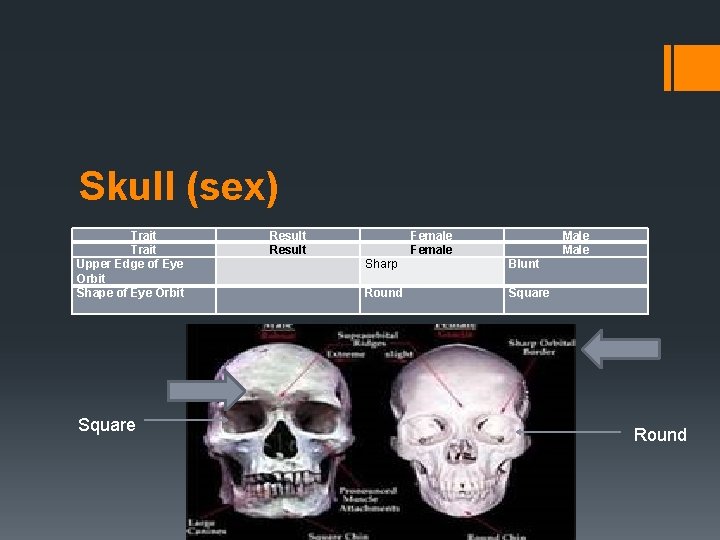
Skull (sex) Trait Upper Edge of Eye Orbit Shape of Eye Orbit Square Result Female Male Sharp Blunt Round Square Round
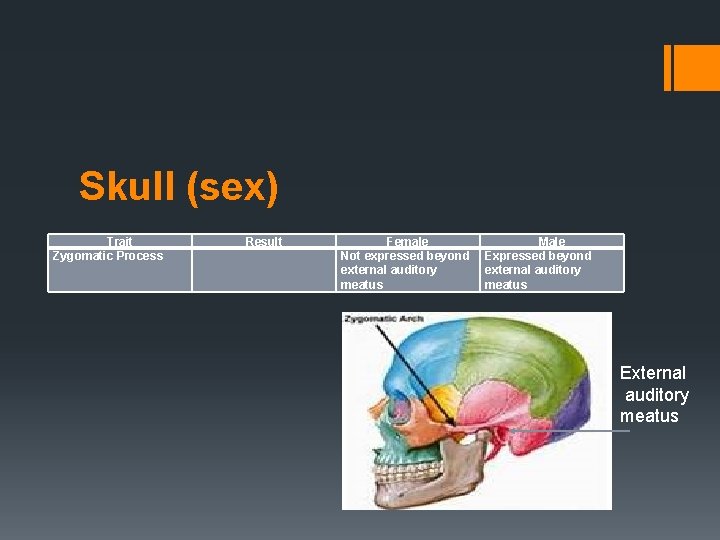
Skull (sex) Trait Zygomatic Process Result Female Not expressed beyond external auditory meatus Male Expressed beyond external auditory meatus External auditory meatus
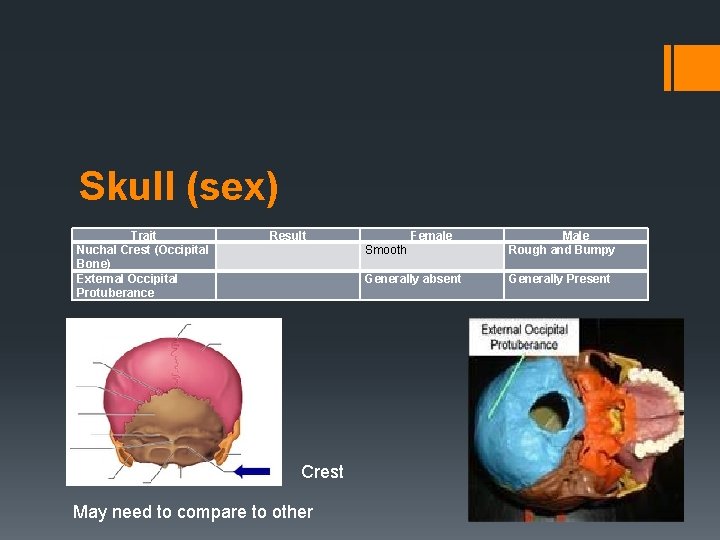
Skull (sex) Trait Nuchal Crest (Occipital Bone) External Occipital Protuberance Result Crest May need to compare to other Female Smooth Male Rough and Bumpy Generally absent Generally Present
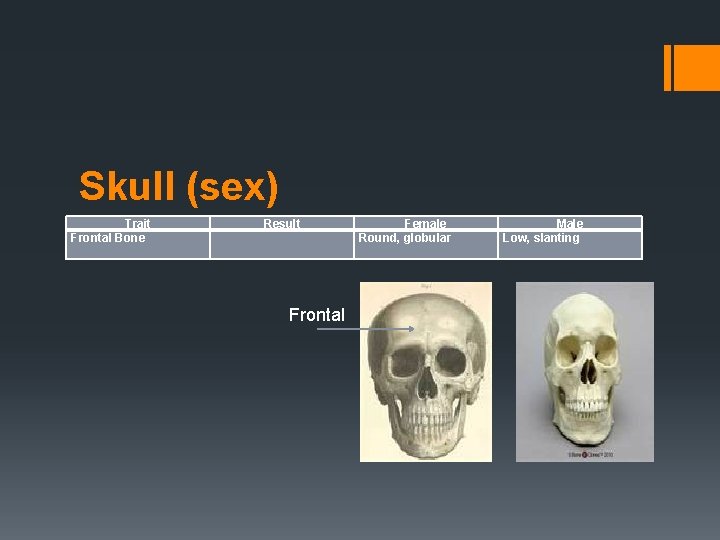
Skull (sex) Trait Frontal Bone Result Frontal Female Round, globular Male Low, slanting
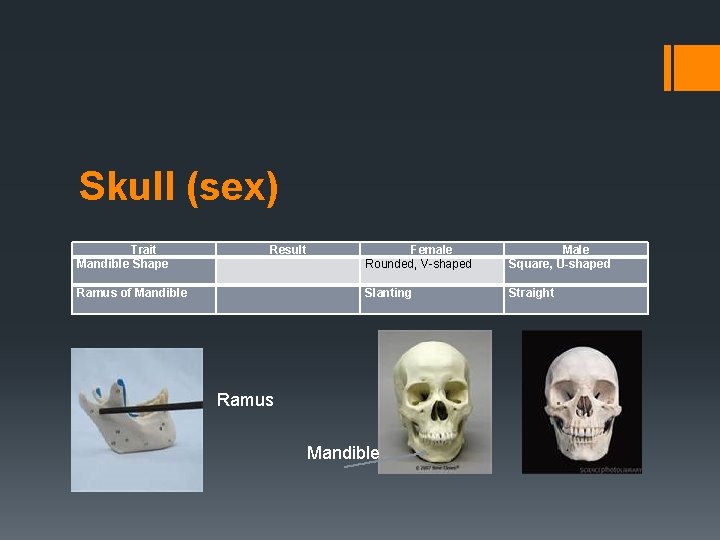
Skull (sex) Trait Mandible Shape Ramus of Mandible Result Female Rounded, V-shaped Male Square, U-shaped Slanting Straight Ramus Mandible
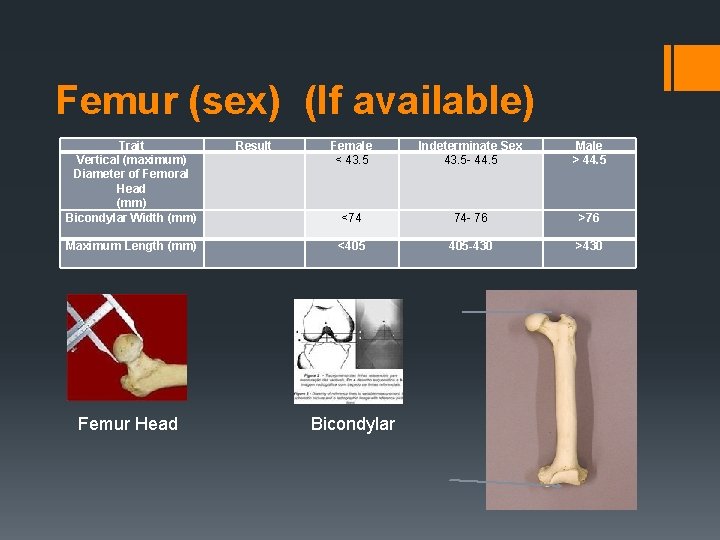
Femur (sex) (If available) Trait Vertical (maximum) Diameter of Femoral Head (mm) Bicondylar Width (mm) Maximum Length (mm) Femur Head Result Female < 43. 5 Indeterminate Sex 43. 5 - 44. 5 Male > 44. 5 <74 74 - 76 >76 <405 405 -430 >430 Bicondylar
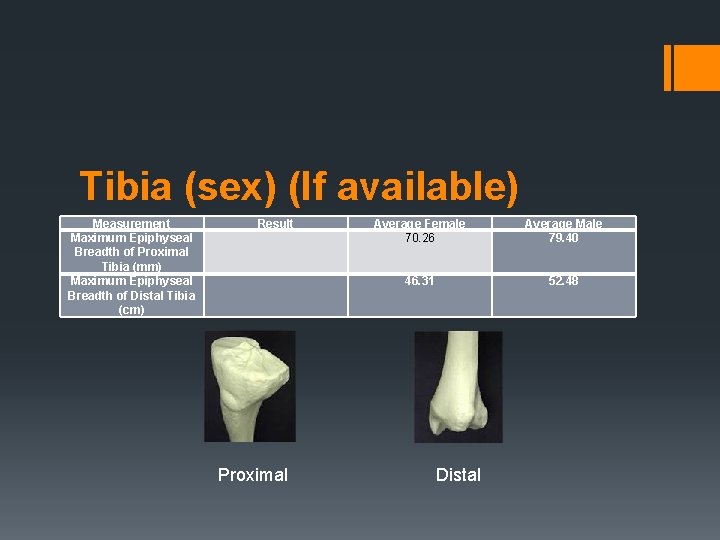
Tibia (sex) (If available) Measurement Maximum Epiphyseal Breadth of Proximal Tibia (mm) Maximum Epiphyseal Breadth of Distal Tibia (cm) Result Average Female 70. 26 Average Male 79. 40 46. 31 52. 48 Proximal Distal
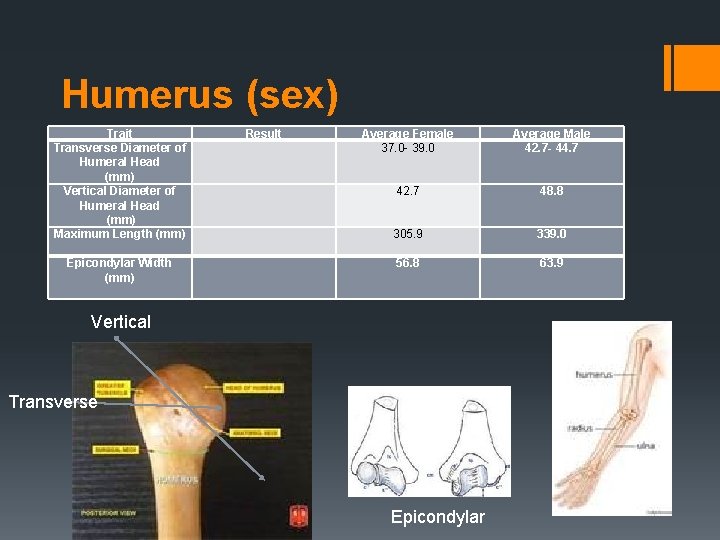
Humerus (sex) Trait Transverse Diameter of Humeral Head (mm) Vertical Diameter of Humeral Head (mm) Maximum Length (mm) Epicondylar Width (mm) Result Average Female 37. 0 - 39. 0 Average Male 42. 7 - 44. 7 42. 7 48. 8 305. 9 339. 0 56. 8 63. 9 Vertical Transverse Epicondylar
FINAL SEX DETERMINATION § ________________________
RACE DETERMINATION § Forensic anthropologists generally use a three-race model to characterize skeletal remains: White (European), Asian and Black (African). The skull is often the most valuable bone in tracing origins, and various measurements around the face reveal information about ancestry and heritage.
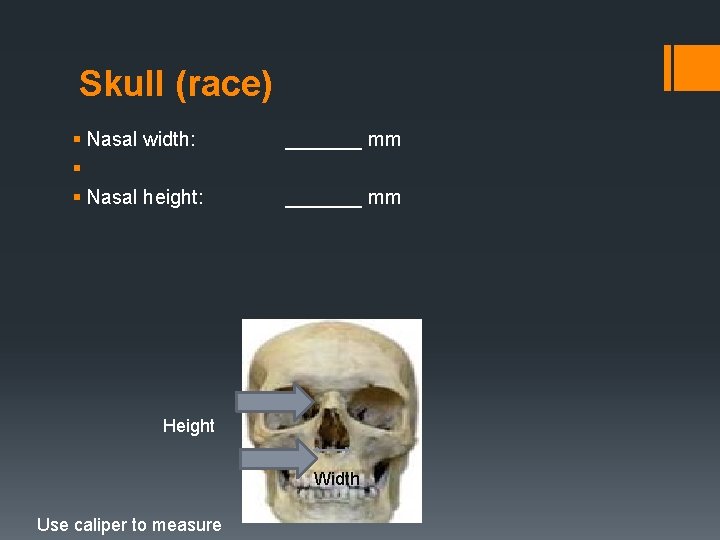
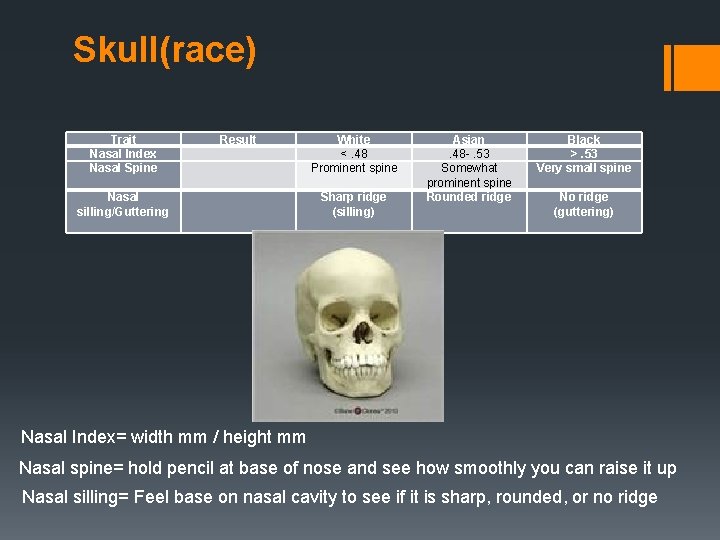
Skull (race) § Nasal width: § § Nasal height: _______ mm Height Width Use caliper to measure
Skull(race) Trait Nasal Index Nasal Spine Result White <. 48 Prominent spine Nasal silling/Guttering Sharp ridge (silling) Asian. 48 -. 53 Somewhat prominent spine Rounded ridge Black >. 53 Very small spine No ridge (guttering) Nasal Index= width mm / height mm Nasal spine= hold pencil at base of nose and see how smoothly you can raise it up Nasal silling= Feel base on nasal cavity to see if it is sharp, rounded, or no ridge
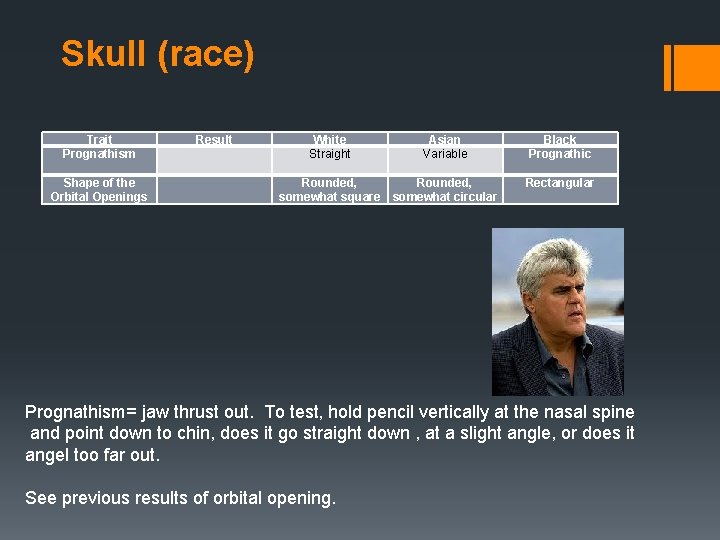
Skull (race) Trait Prognathism Shape of the Orbital Openings Result White Straight Asian Variable Rounded, somewhat square somewhat circular Black Prognathic Rectangular Prognathism= jaw thrust out. To test, hold pencil vertically at the nasal spine and point down to chin, does it go straight down , at a slight angle, or does it angel too far out. See previous results of orbital opening.
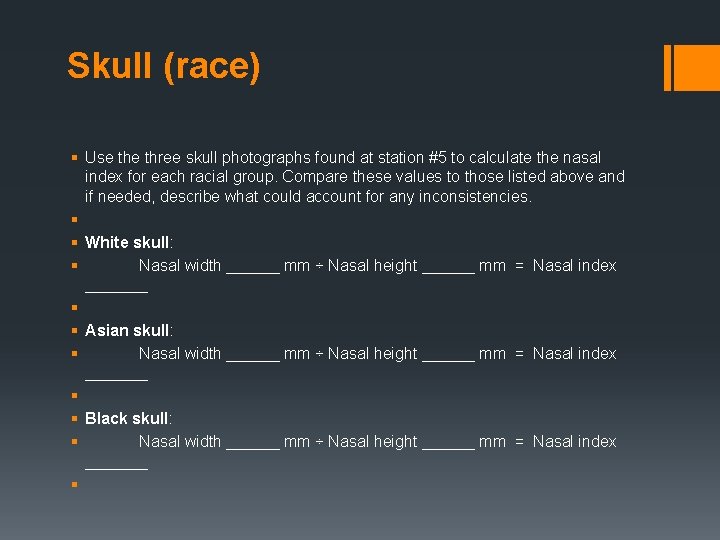
Skull (race) § Use three skull photographs found at station #5 to calculate the nasal index for each racial group. Compare these values to those listed above and if needed, describe what could account for any inconsistencies. § § White skull: § Nasal width ______ mm ÷ Nasal height ______ mm = Nasal index _______ § § Asian skull: § Nasal width ______ mm ÷ Nasal height ______ mm = Nasal index _______ § § Black skull: § Nasal width ______ mm ÷ Nasal height ______ mm = Nasal index _______ §
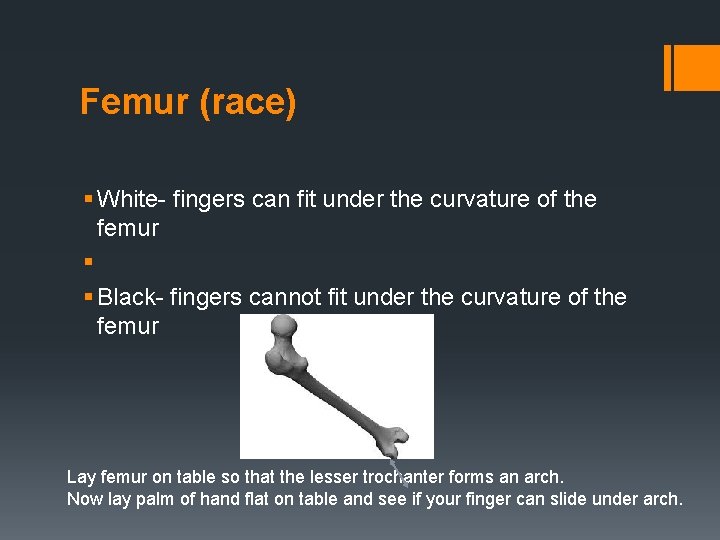
Femur (race) § White- fingers can fit under the curvature of the femur § § Black- fingers cannot fit under the curvature of the femur Lay femur on table so that the lesser trochanter forms an arch. Now lay palm of hand flat on table and see if your finger can slide under arch.
FINAL RACE DETERMINATION ______________
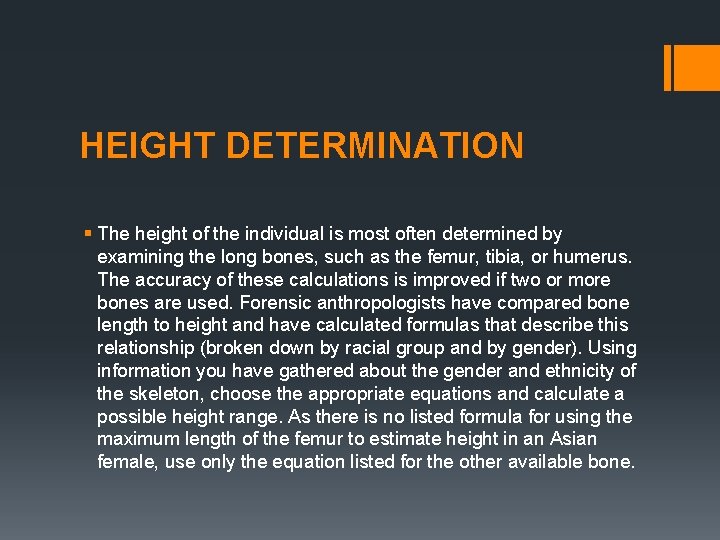
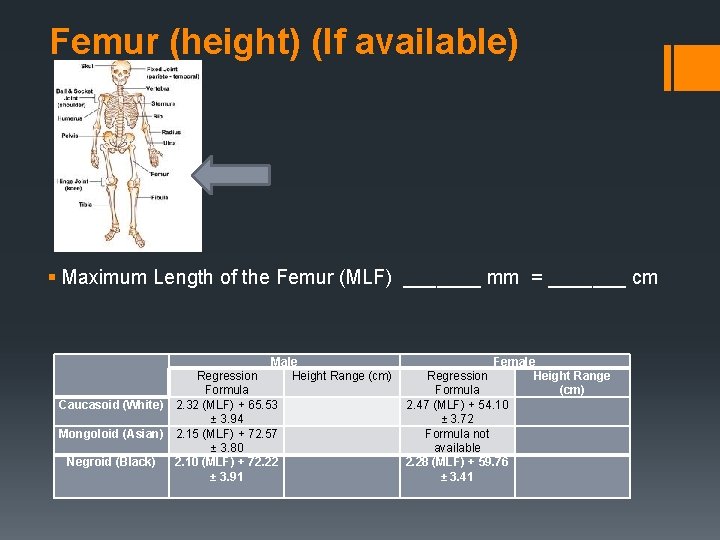
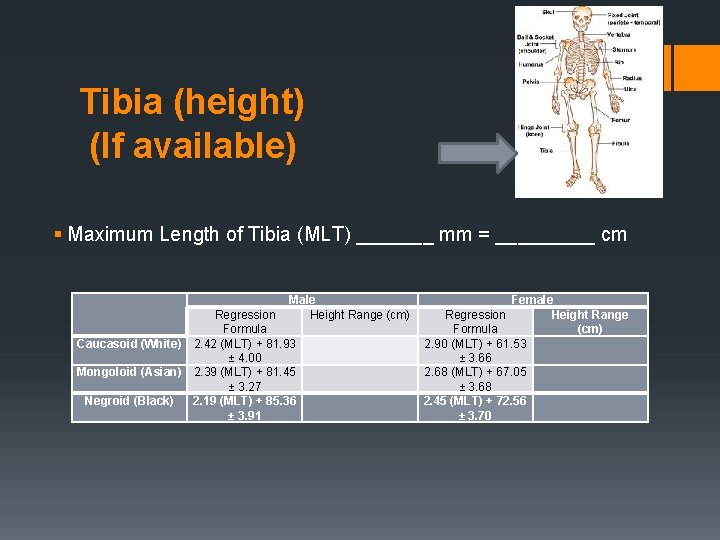
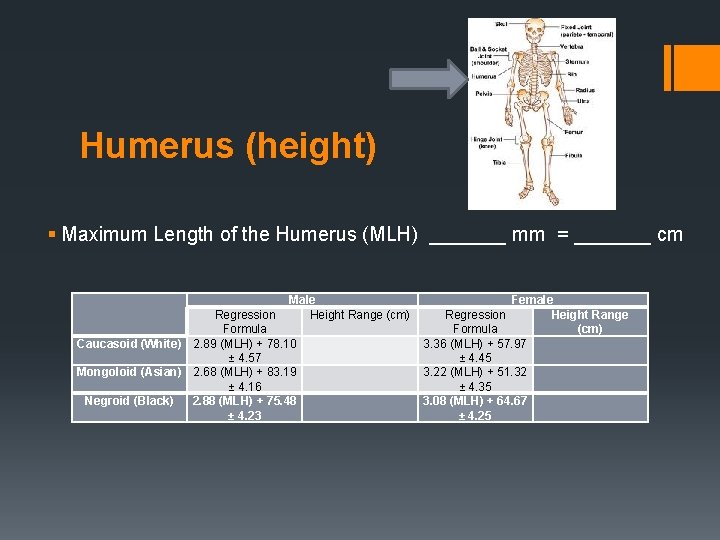
HEIGHT DETERMINATION § The height of the individual is most often determined by examining the long bones, such as the femur, tibia, or humerus. The accuracy of these calculations is improved if two or more bones are used. Forensic anthropologists have compared bone length to height and have calculated formulas that describe this relationship (broken down by racial group and by gender). Using information you have gathered about the gender and ethnicity of the skeleton, choose the appropriate equations and calculate a possible height range. As there is no listed formula for using the maximum length of the femur to estimate height in an Asian female, use only the equation listed for the other available bone.
Femur (height) (If available) § Maximum Length of the Femur (MLF) _______ mm = _______ cm Male Regression Height Range (cm) Formula Caucasoid (White) 2. 32 (MLF) + 65. 53 ± 3. 94 Mongoloid (Asian) 2. 15 (MLF) + 72. 57 ± 3. 80 Negroid (Black) 2. 10 (MLF) + 72. 22 ± 3. 91 Female Regression Height Range Formula (cm) 2. 47 (MLF) + 54. 10 ± 3. 72 Formula not available 2. 28 (MLF) + 59. 76 ± 3. 41
Tibia (height) (If available) § Maximum Length of Tibia (MLT) _______ mm = _____ cm Male Regression Height Range (cm) Formula Caucasoid (White) 2. 42 (MLT) + 81. 93 ± 4. 00 Mongoloid (Asian) 2. 39 (MLT) + 81. 45 ± 3. 27 Negroid (Black) 2. 19 (MLT) + 85. 36 ± 3. 91 Female Regression Height Range Formula (cm) 2. 90 (MLT) + 61. 53 ± 3. 66 2. 68 (MLT) + 67. 05 ± 3. 68 2. 45 (MLT) + 72. 56 ± 3. 70
Humerus (height) § Maximum Length of the Humerus (MLH) _______ mm = _______ cm Male Regression Height Range (cm) Formula Caucasoid (White) 2. 89 (MLH) + 78. 10 ± 4. 57 Mongoloid (Asian) 2. 68 (MLH) + 83. 19 ± 4. 16 Negroid (Black) 2. 88 (MLH) + 75. 48 ± 4. 23 Female Regression Height Range Formula (cm) 3. 36 (MLH) + 57. 97 ± 4. 45 3. 22 (MLH) + 51. 32 ± 4. 35 3. 08 (MLH) + 64. 67 ± 4. 25
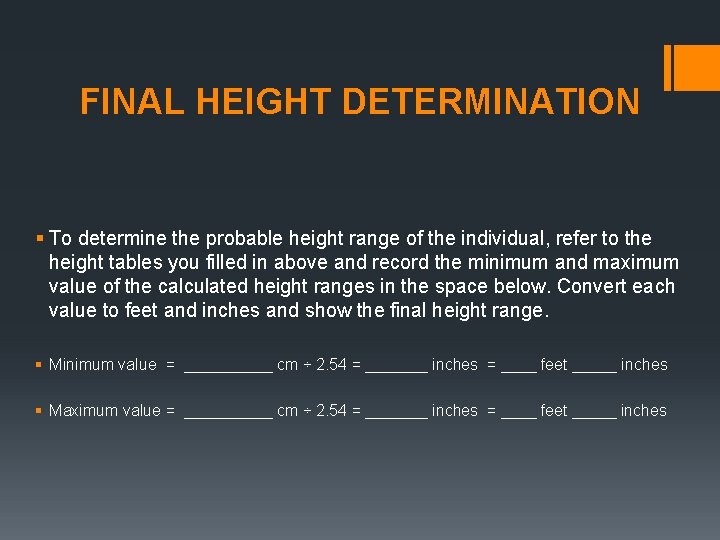
FINAL HEIGHT DETERMINATION § To determine the probable height range of the individual, refer to the height tables you filled in above and record the minimum and maximum value of the calculated height ranges in the space below. Convert each value to feet and inches and show the final height range. § Minimum value = _____ cm ÷ 2. 54 = _______ inches = ____ feet _____ inches § Maximum value = _____ cm ÷ 2. 54 = _______ inches = ____ feet _____ inches
AGE DETERMINATION § Make sure to refer to the photograph of the pelvic bones while completing your analysis. Remember, you are looking for landmarks that occur as a human ages. At birth, humans have about 405 bones. These bones will eventually fuse and form the 206 bones we see in an adult skeleton
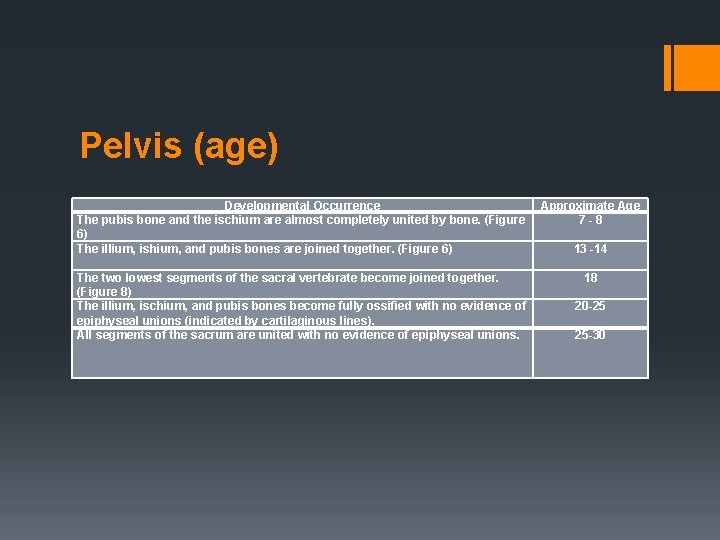
Pelvis (age) Developmental Occurrence Approximate Age The pubis bone and the ischium are almost completely united by bone. (Figure 7 - 8 6) The illium, ishium, and pubis bones are joined together. (Figure 6) 13 -14 The two lowest segments of the sacral vertebrate become joined together. 18 (Figure 8) The illium, ischium, and pubis bones become fully ossified with no evidence of 20 -25 epiphyseal unions (indicated by cartilaginous lines). All segments of the sacrum are united with no evidence of epiphyseal unions. 25 -30
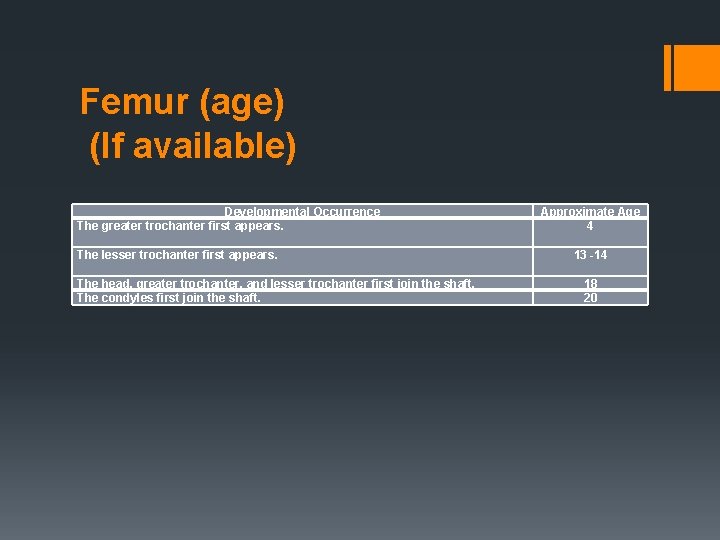
Femur (age) (If available) Developmental Occurrence The greater trochanter first appears. The lesser trochanter first appears. The head, greater trochanter, and lesser trochanter first join the shaft. The condyles first join the shaft. Approximate Age 4 13 -14 18 20
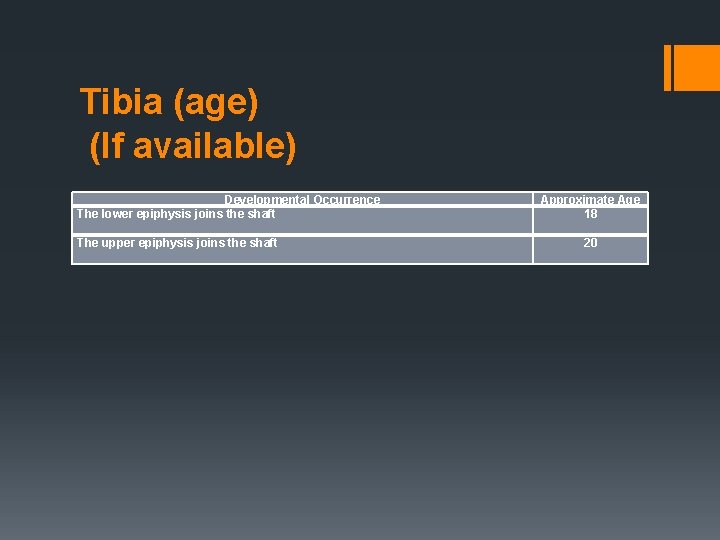
Tibia (age) (If available) Developmental Occurrence The lower epiphysis joins the shaft The upper epiphysis joins the shaft Approximate Age 18 20
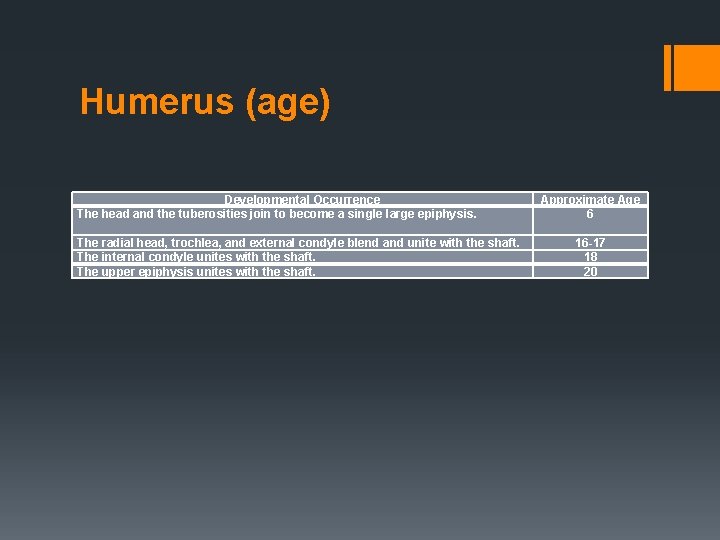
Humerus (age) Developmental Occurrence The head and the tuberosities join to become a single large epiphysis. The radial head, trochlea, and external condyle blend and unite with the shaft. The internal condyle unites with the shaft. The upper epiphysis unites with the shaft. Approximate Age 6 16 -17 18 20
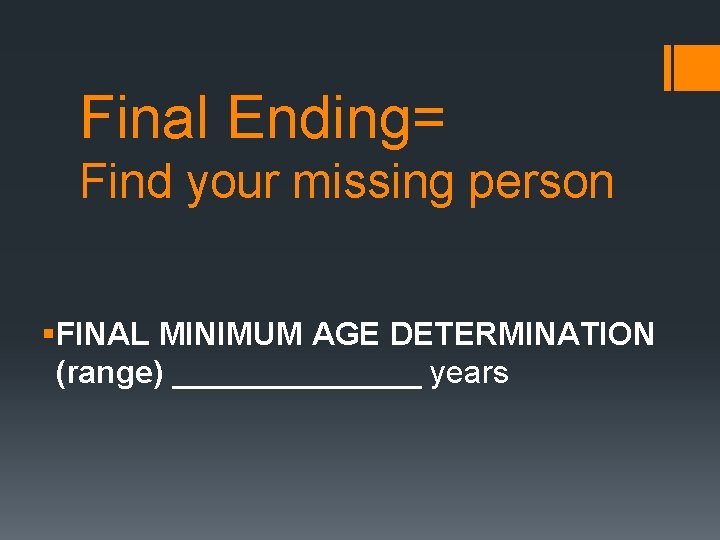
Final Ending= Find your missing person §FINAL MINIMUM AGE DETERMINATION (range) _______ years