
Progressive waves Specification Oscillation of the particles of

- Slides: 21
Progressive waves Specification Oscillation of the particles of the medium; amplitude, frequency, wavelength, speed, phase difference, c = f λ f = 1/T Phase difference may be measured as angles (radians and degrees) or as fractions of a cycle.
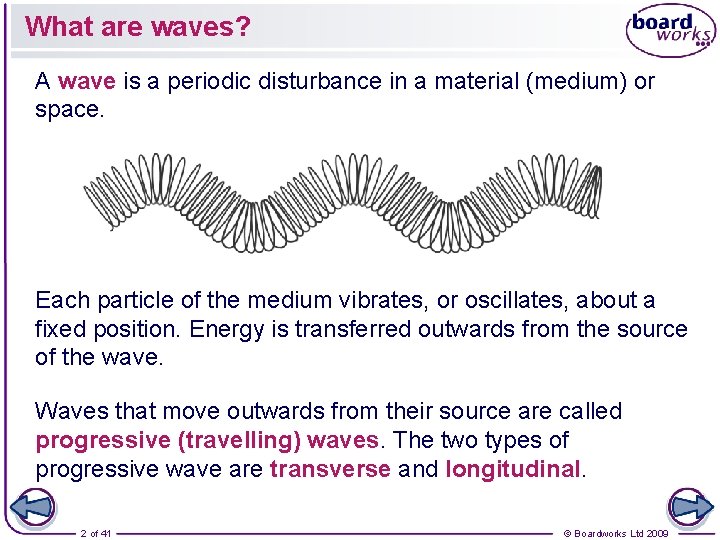
What are waves? A wave is a periodic disturbance in a material (medium) or space. Each particle of the medium vibrates, or oscillates, about a fixed position. Energy is transferred outwards from the source of the wave. Waves that move outwards from their source are called progressive (travelling) waves. The two types of progressive wave are transverse and longitudinal. 2 of 41 © Boardworks Ltd 2009
Transverse and longitudinal waves 3 of 41 © Boardworks Ltd 2009
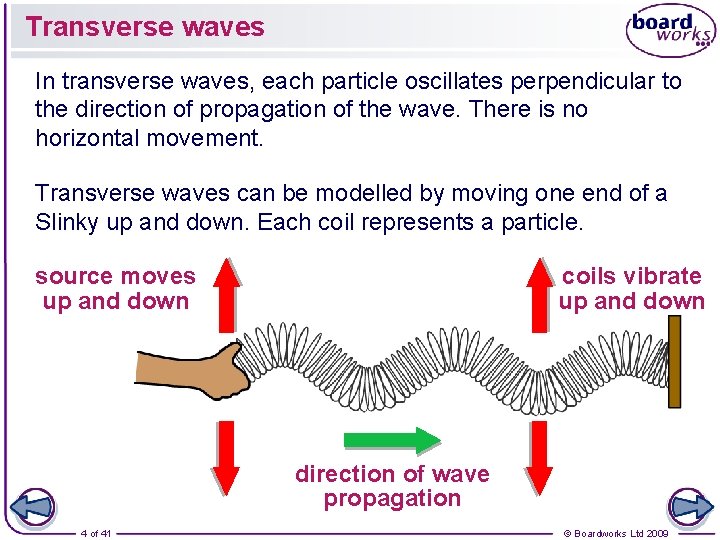
Transverse waves In transverse waves, each particle oscillates perpendicular to the direction of propagation of the wave. There is no horizontal movement. Transverse waves can be modelled by moving one end of a Slinky up and down. Each coil represents a particle. source moves up and down coils vibrate up and down direction of wave propagation 4 of 41 © Boardworks Ltd 2009
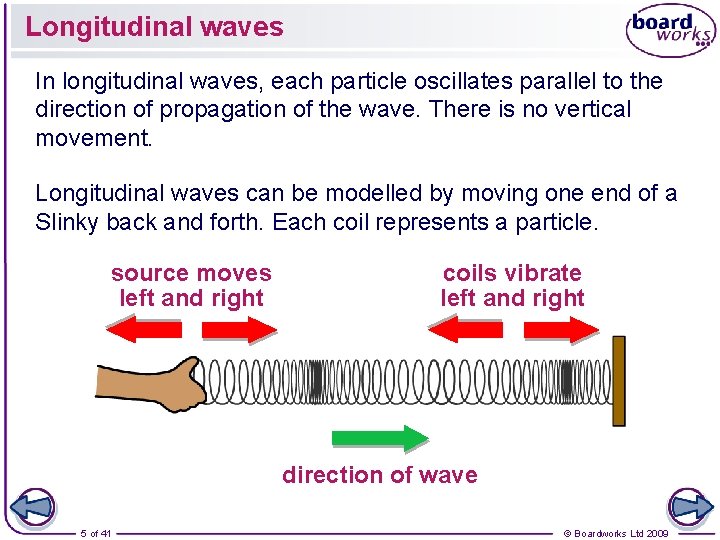
Longitudinal waves In longitudinal waves, each particle oscillates parallel to the direction of propagation of the wave. There is no vertical movement. Longitudinal waves can be modelled by moving one end of a Slinky back and forth. Each coil represents a particle. source moves left and right coils vibrate left and right direction of wave 5 of 41 © Boardworks Ltd 2009
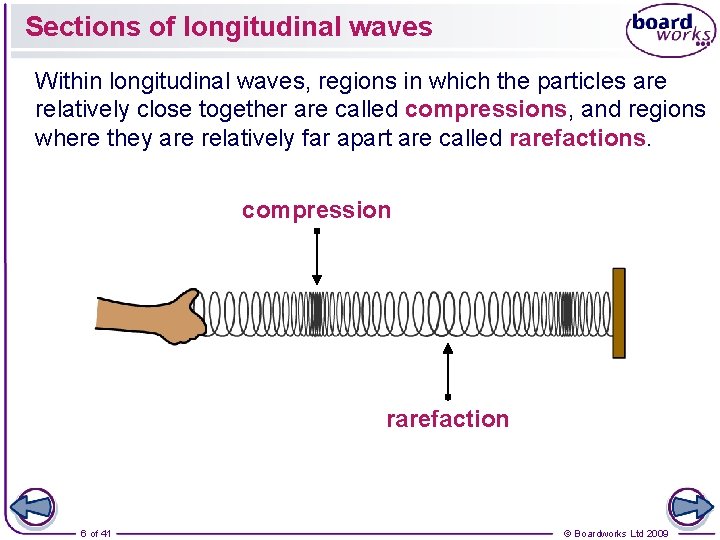
Sections of longitudinal waves Within longitudinal waves, regions in which the particles are relatively close together are called compressions, and regions where they are relatively far apart are called rarefactions. compression rarefaction 6 of 41 © Boardworks Ltd 2009
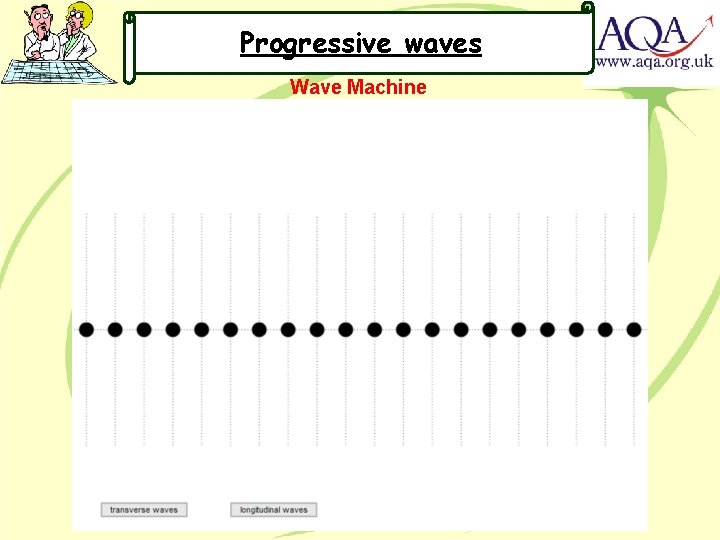
Progressive waves Wave Machine
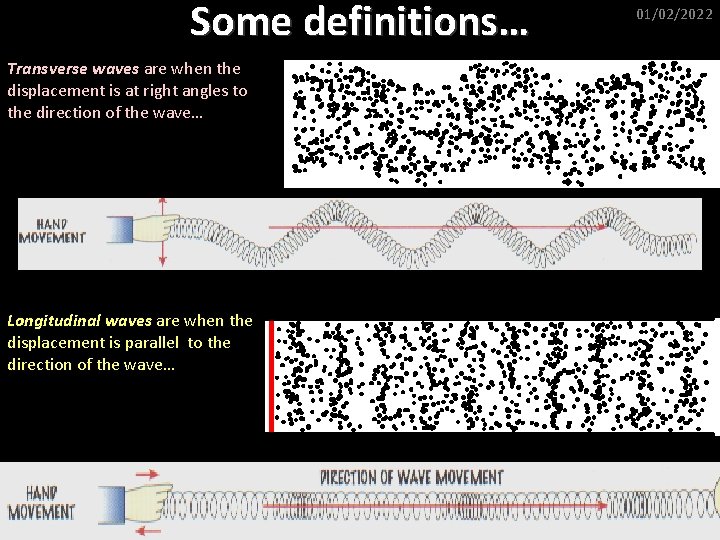
Some definitions… Transverse waves are when the displacement is at right angles to the direction of the wave… Longitudinal waves are when the displacement is parallel to the direction of the wave… 01/02/2022
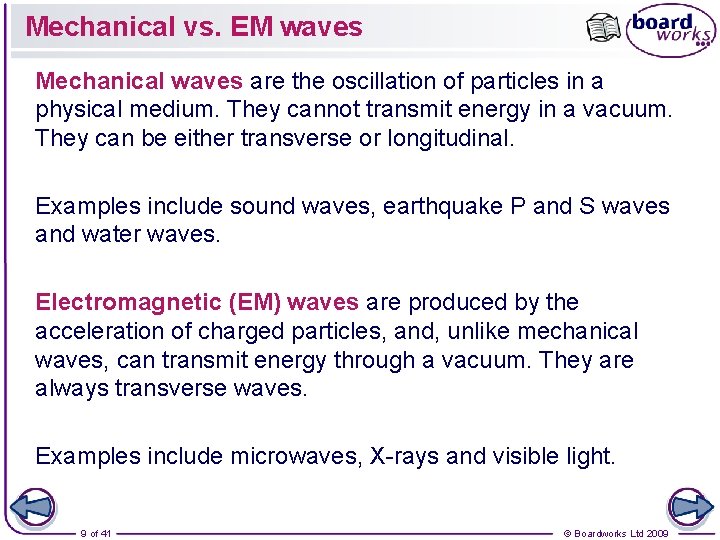
Mechanical vs. EM waves Mechanical waves are the oscillation of particles in a physical medium. They cannot transmit energy in a vacuum. They can be either transverse or longitudinal. Examples include sound waves, earthquake P and S waves and water waves. Electromagnetic (EM) waves are produced by the acceleration of charged particles, and, unlike mechanical waves, can transmit energy through a vacuum. They are always transverse waves. Examples include microwaves, X-rays and visible light. 9 of 41 © Boardworks Ltd 2009
Examples of waves 10 of 41 © Boardworks Ltd 2009
Transverse or longitudinal? 11 of 41 © Boardworks Ltd 2009
Describing waves 12 of 41 © Boardworks Ltd 2009
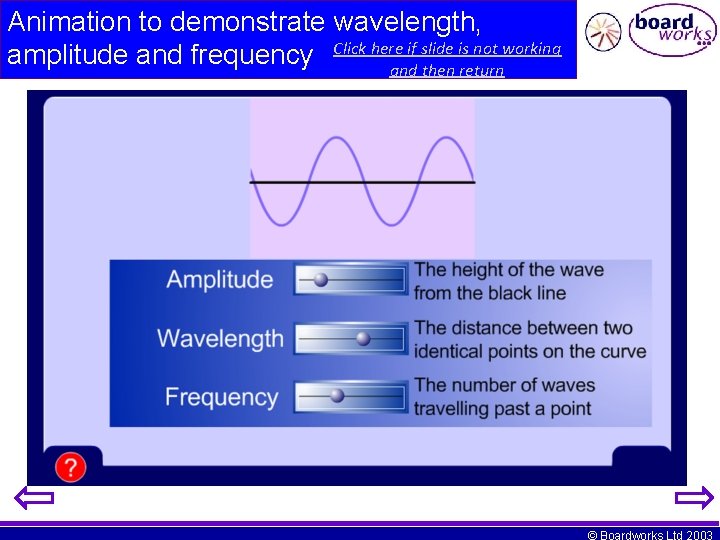
Animation to demonstrate wavelength, is not working amplitude and frequency Click hereandif slide then return © Boardworks Ltd 2003
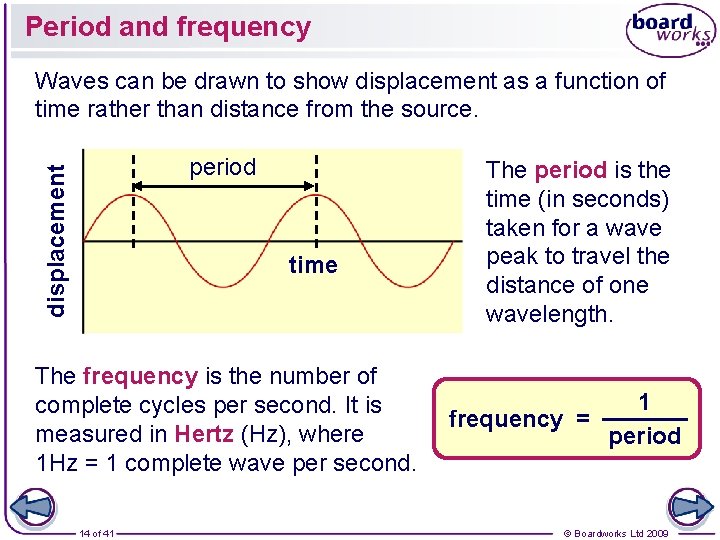
Period and frequency Waves can be drawn to show displacement as a function of time rather than distance from the source. displacement period time The frequency is the number of complete cycles per second. It is measured in Hertz (Hz), where 1 Hz = 1 complete wave per second. 14 of 41 The period is the time (in seconds) taken for a wave peak to travel the distance of one wavelength. 1 frequency = period © Boardworks Ltd 2009
Phase difference 15 of 41 © Boardworks Ltd 2009
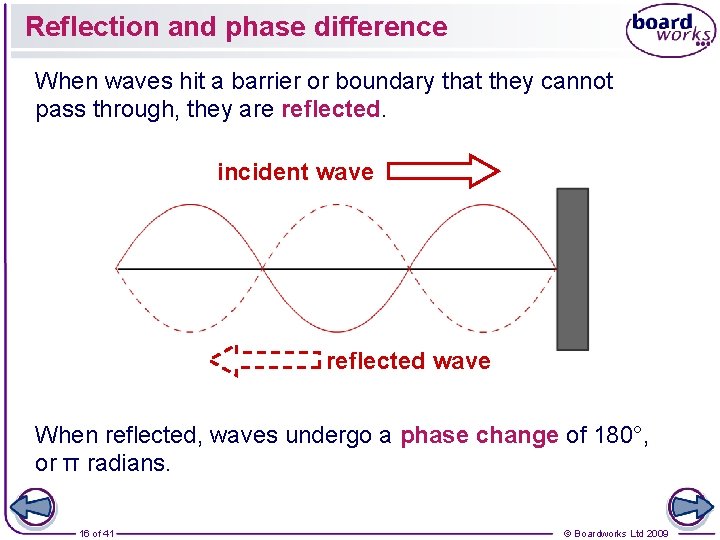
Reflection and phase difference When waves hit a barrier or boundary that they cannot pass through, they are reflected. incident wave reflected wave When reflected, waves undergo a phase change of 180°, or π radians. 16 of 41 © Boardworks Ltd 2009
What’s the phase difference? 17 of 41 © Boardworks Ltd 2009
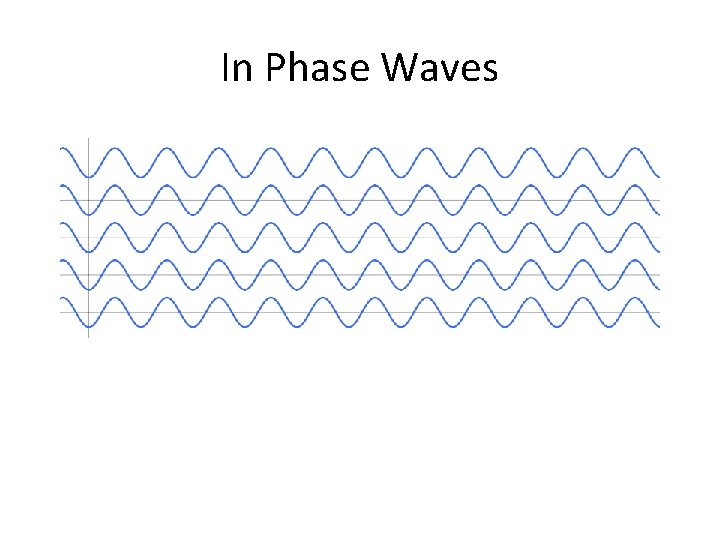
In Phase Waves
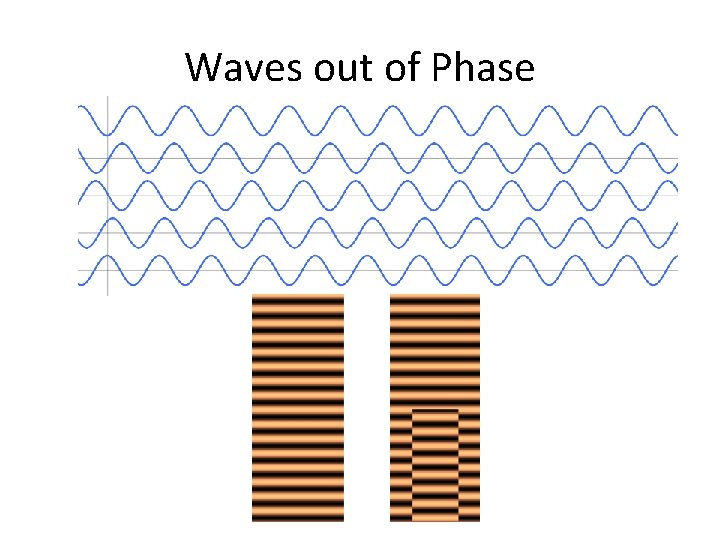
Waves out of Phase
Wave calculations: worked examples 20 of 41 © Boardworks Ltd 2009
Wave calculations 21 of 41 © Boardworks Ltd 2009