
Progressive Source Transmissions using Joint SourceChannel Coding JSCC
- Slides: 34
Progressive Source Transmissions using Joint Source-Channel Coding (JSCC) and Hierarchical Modulation in Packetized Networks Suayb S. Arslan, Pamela C. Cosman and Laurence B. Milstein Department of Electrical and Computer Engineering University of California, San Diego 12/03/2009 Hilton Hawaiian Village, Honolulu, Hawaii, USA Preliminary Exam 1
Outline o o Progressive Sources UEP techniques n o o o A new UEP technique based on packetization System Model & Optimization Numerical Results Conclusion & Future work Exam IEEEPreliminary GLOBECOM 2009 2
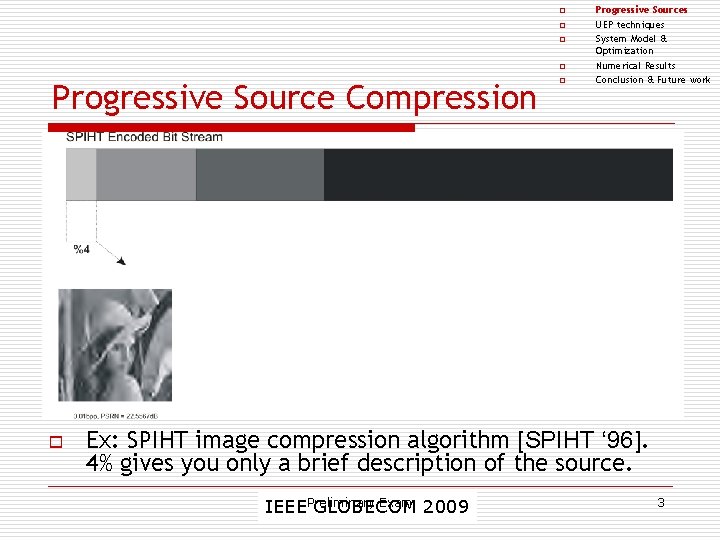
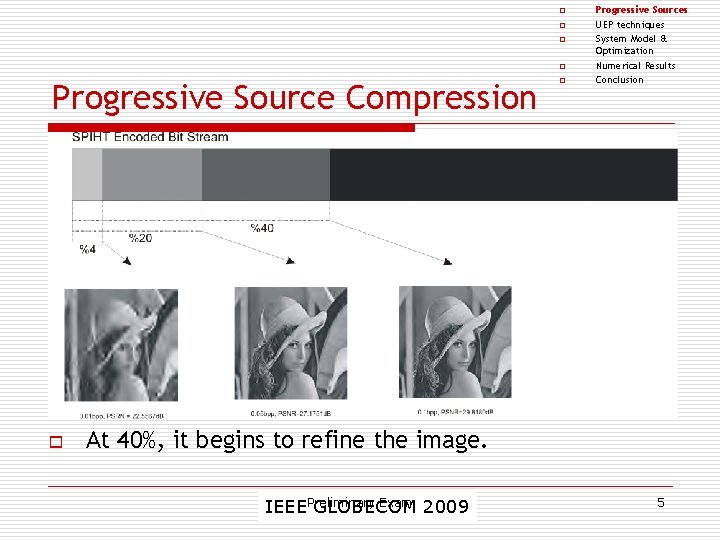
o o Progressive Source Compression o o Progressive Sources UEP techniques System Model & Optimization Numerical Results Conclusion & Future work Ex: SPIHT image compression algorithm [SPIHT ‘ 96]. 4% gives you only a brief description of the source. Exam IEEEPreliminary GLOBECOM 2009 3
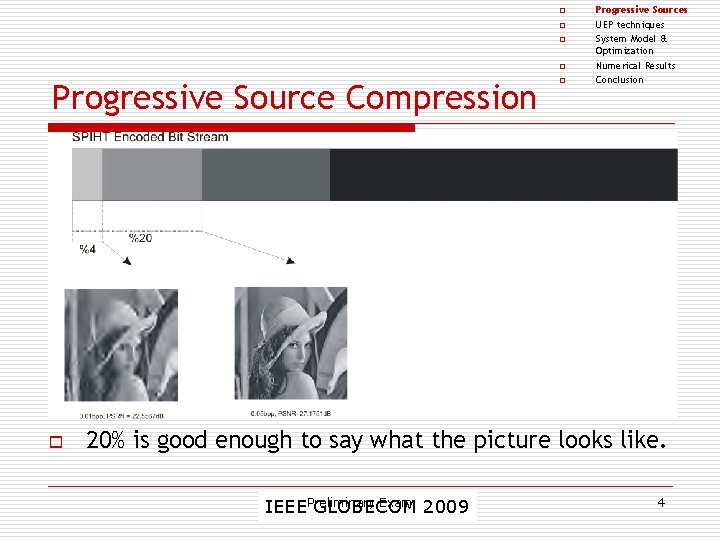
o o Progressive Source Compression o o Progressive Sources UEP techniques System Model & Optimization Numerical Results Conclusion 20% is good enough to say what the picture looks like. Exam IEEEPreliminary GLOBECOM 2009 4
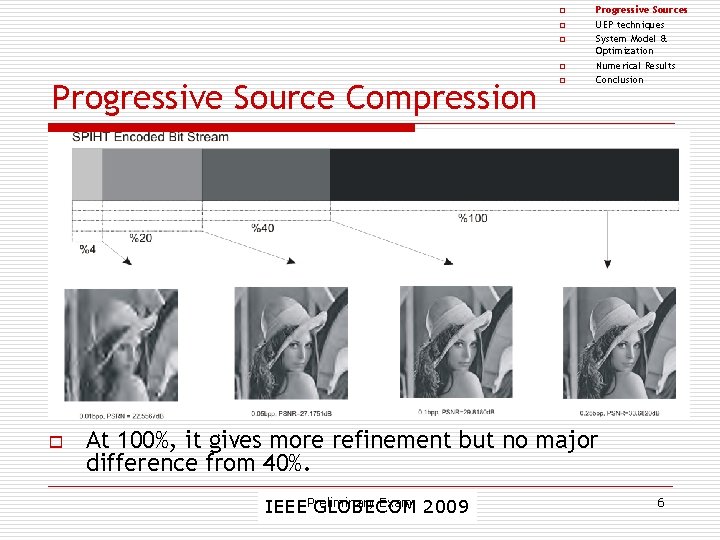
o o Progressive Source Compression o o Progressive Sources UEP techniques System Model & Optimization Numerical Results Conclusion At 40%, it begins to refine the image. Exam IEEEPreliminary GLOBECOM 2009 5
o o Progressive Source Compression o o Progressive Sources UEP techniques System Model & Optimization Numerical Results Conclusion At 100%, it gives more refinement but no major difference from 40%. Exam IEEEPreliminary GLOBECOM 2009 6
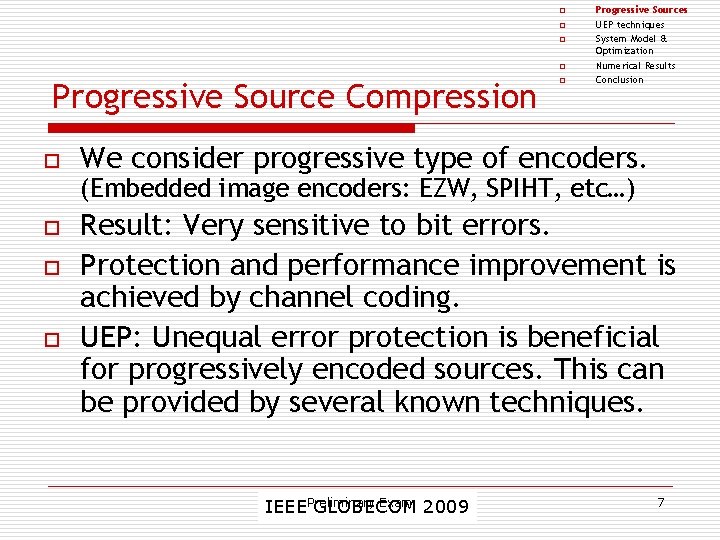
o o Progressive Source Compression o o Progressive Sources UEP techniques System Model & Optimization Numerical Results Conclusion We consider progressive type of encoders. (Embedded image encoders: EZW, SPIHT, etc…) o o o Result: Very sensitive to bit errors. Protection and performance improvement is achieved by channel coding. UEP: Unequal error protection is beneficial for progressively encoded sources. This can be provided by several known techniques. Exam IEEEPreliminary GLOBECOM 2009 7
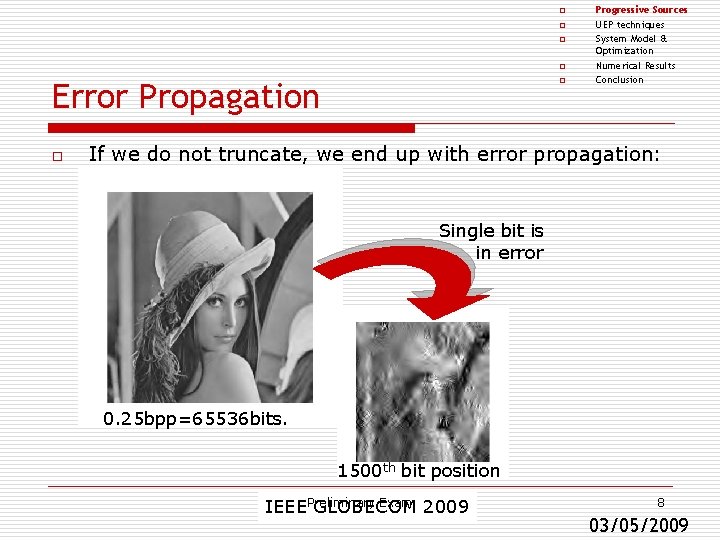
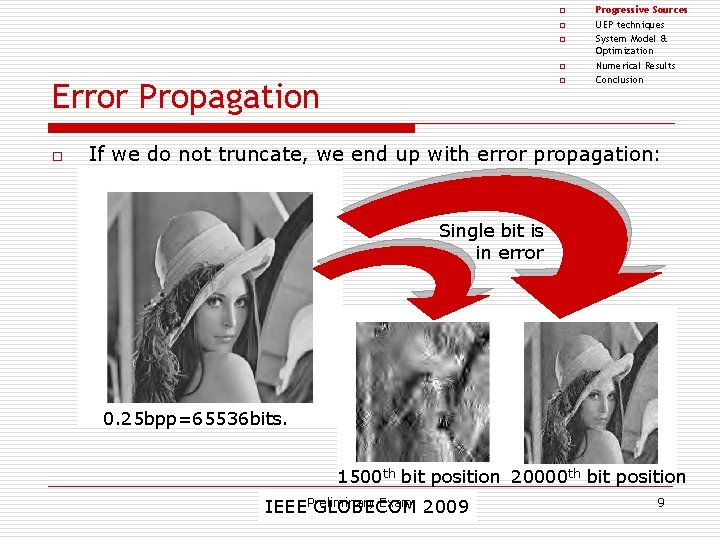
o o Error Propagation o o Progressive Sources UEP techniques System Model & Optimization Numerical Results Conclusion If we do not truncate, we end up with error propagation: Single bit is in error 0. 25 bpp=65536 bits. 1500 th bit position Exam IEEEPreliminary GLOBECOM 2009 8 03/05/2009
o o Error Propagation o o Progressive Sources UEP techniques System Model & Optimization Numerical Results Conclusion If we do not truncate, we end up with error propagation: Single bit is in error 0. 25 bpp=65536 bits. 1500 th bit position 20000 th bit position Exam IEEEPreliminary GLOBECOM 2009 9
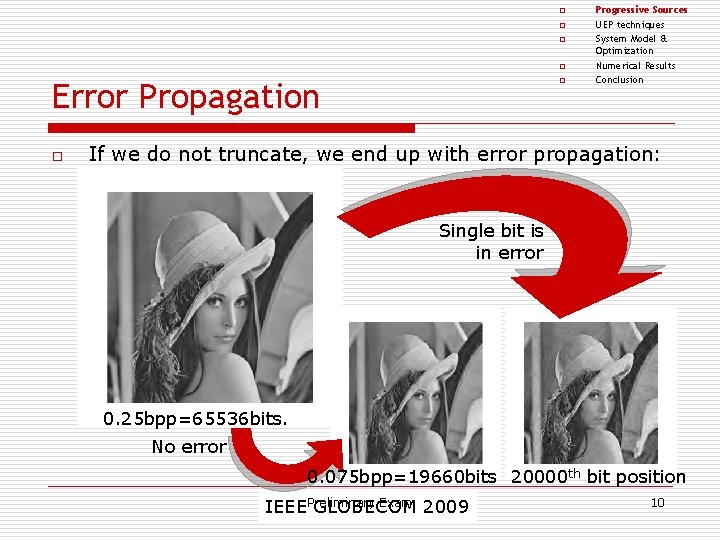
o o Error Propagation o o Progressive Sources UEP techniques System Model & Optimization Numerical Results Conclusion If we do not truncate, we end up with error propagation: Single bit is in error 0. 25 bpp=65536 bits. No error 0. 075 bpp=19660 bits 20000 th bit position Exam IEEEPreliminary GLOBECOM 2009 10
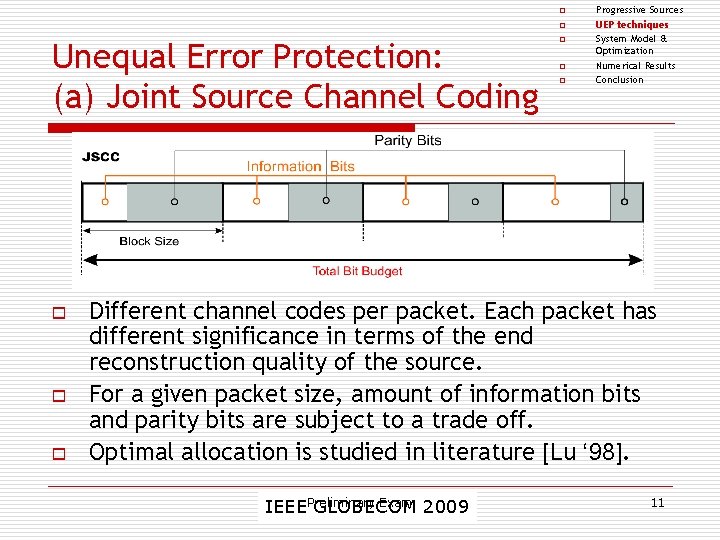
o o Unequal Error Protection: (a) Joint Source Channel Coding o o o Progressive Sources UEP techniques System Model & Optimization Numerical Results Conclusion Different channel codes per packet. Each packet has different significance in terms of the end reconstruction quality of the source. For a given packet size, amount of information bits and parity bits are subject to a trade off. Optimal allocation is studied in literature [Lu ‘ 98]. Exam IEEEPreliminary GLOBECOM 2009 11
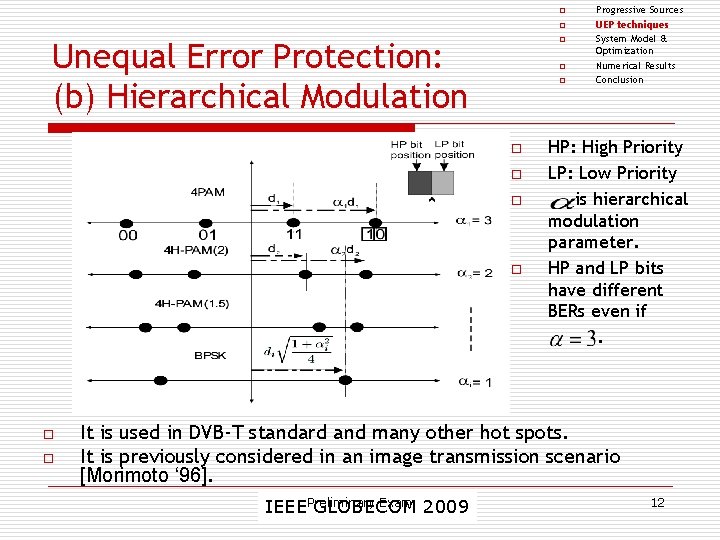
o o Unequal Error Protection: (b) Hierarchical Modulation o o o o o Progressive Sources UEP techniques System Model & Optimization Numerical Results Conclusion HP: High Priority LP: Low Priority is hierarchical modulation parameter. HP and LP bits have different BERs even if. It is used in DVB-T standard and many other hot spots. It is previously considered in an image transmission scenario [Morimoto ‘ 96]. Exam IEEEPreliminary GLOBECOM 2009 12
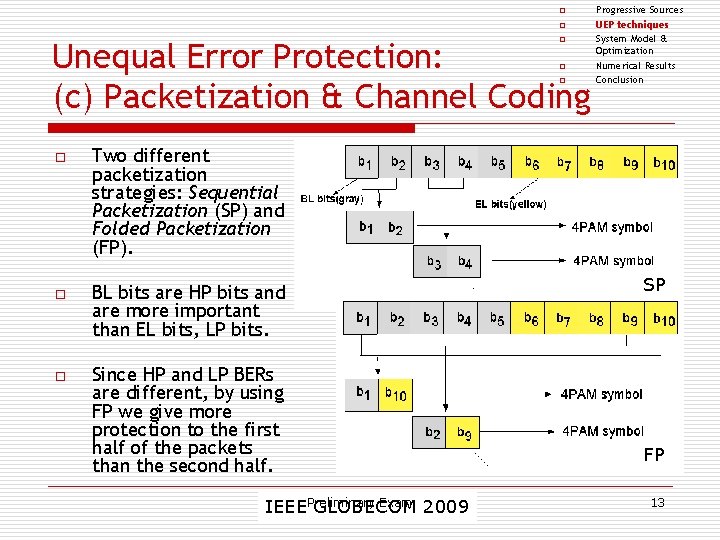
o o Unequal Error Protection: (c) Packetization & Channel Coding o o Two different packetization strategies: Sequential Packetization (SP) and Folded Packetization (FP). o BL bits are HP bits and are more important than EL bits, LP bits. o Since HP and LP BERs are different, by using FP we give more protection to the first half of the packets than the second half. Exam IEEEPreliminary GLOBECOM 2009 Progressive Sources UEP techniques System Model & Optimization Numerical Results Conclusion SP FP 13
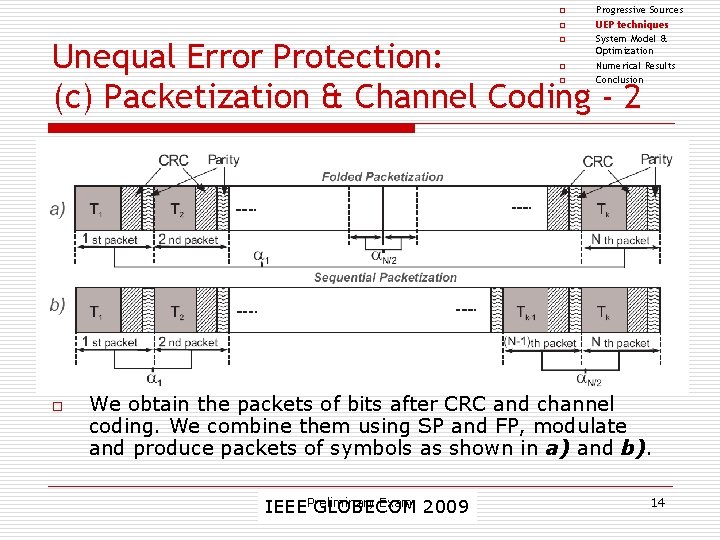
o o Progressive Sources UEP techniques System Model & Optimization Numerical Results Conclusion Unequal Error Protection: (c) Packetization & Channel Coding - 2 o o We obtain the packets of bits after CRC and channel coding. We combine them using SP and FP, modulate and produce packets of symbols as shown in a) and b). Exam IEEEPreliminary GLOBECOM 2009 14
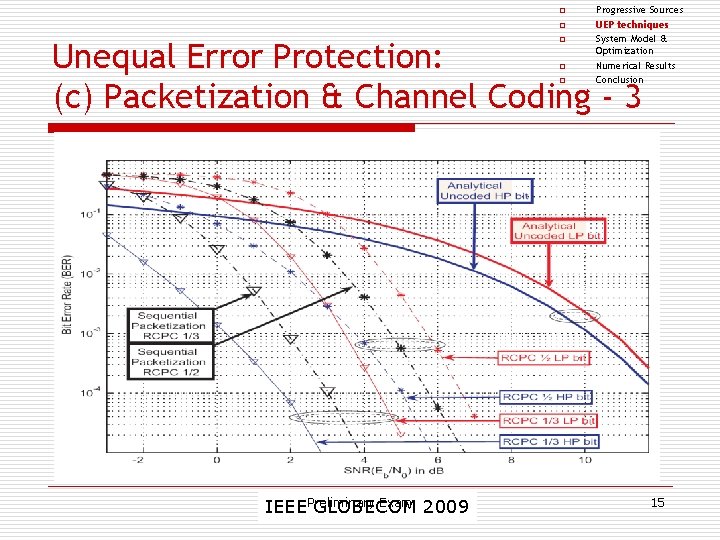
o o Progressive Sources UEP techniques System Model & Optimization Numerical Results Conclusion Unequal Error Protection: (c) Packetization & Channel Coding - 3 o o o Exam IEEEPreliminary GLOBECOM 2009 15
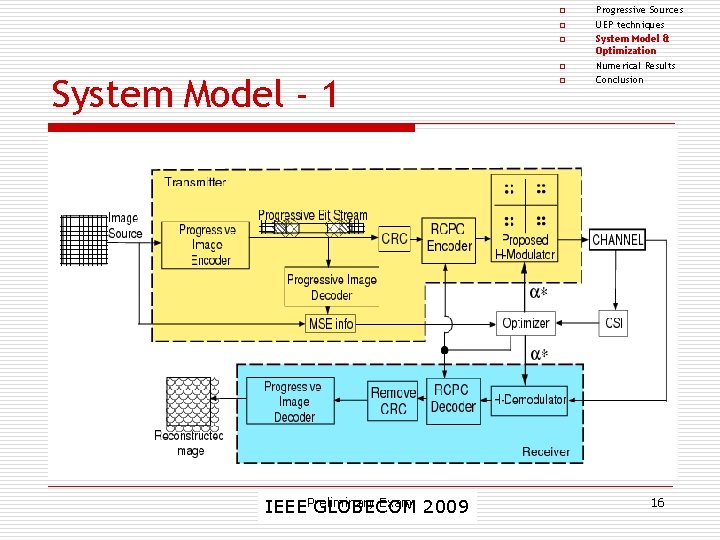
o o System Model - 1 Exam IEEEPreliminary GLOBECOM 2009 o Progressive Sources UEP techniques System Model & Optimization Numerical Results Conclusion 16
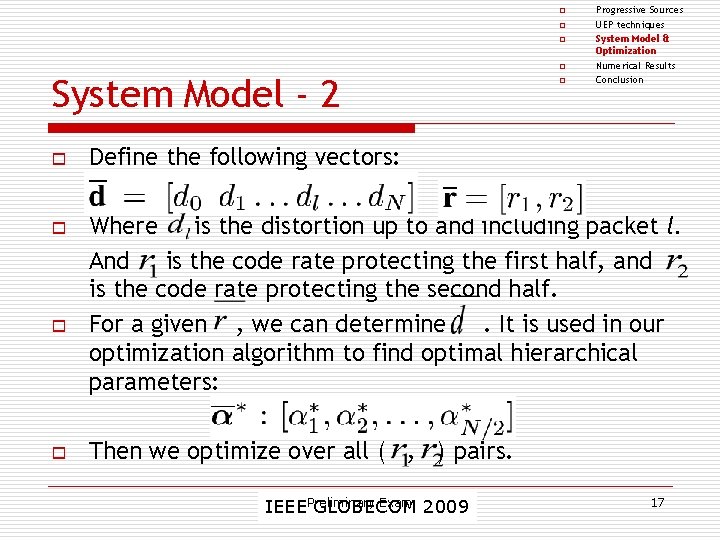
o o System Model - 2 o o o Progressive Sources UEP techniques System Model & Optimization Numerical Results Conclusion Define the following vectors: Where is the distortion up to and including packet l. And is the code rate protecting the first half, and is the code rate protecting the second half. For a given , we can determine. It is used in our optimization algorithm to find optimal hierarchical parameters: Then we optimize over all ( , ) pairs. Exam IEEEPreliminary GLOBECOM 2009 17
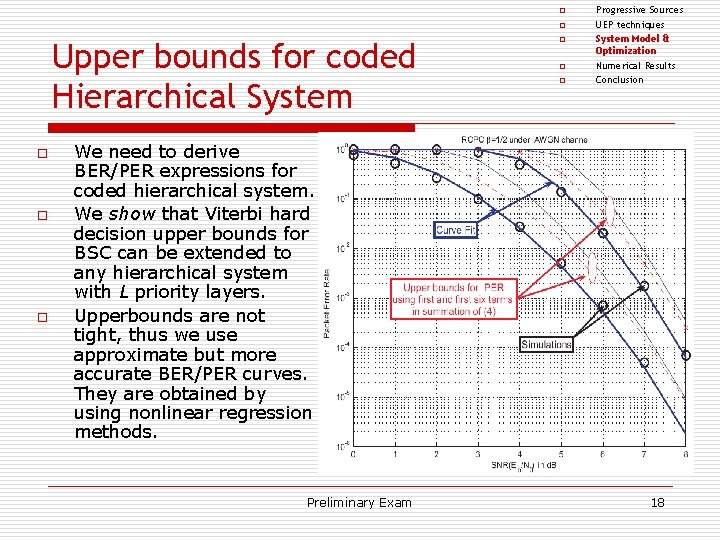
o o Upper bounds for coded Hierarchical System o o o Progressive Sources UEP techniques System Model & Optimization Numerical Results Conclusion We need to derive BER/PER expressions for coded hierarchical system. We show that Viterbi hard decision upper bounds for BSC can be extended to any hierarchical system with L priority layers. Upperbounds are not tight, thus we use approximate but more accurate BER/PER curves. They are obtained by using nonlinear regression methods. Preliminary Exam 18
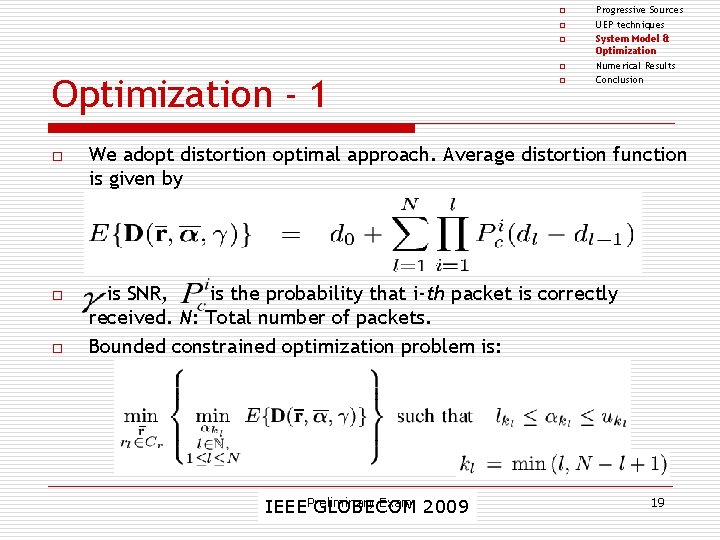
o o Optimization - 1 o Progressive Sources UEP techniques System Model & Optimization Numerical Results Conclusion o We adopt distortion optimal approach. Average distortion function is given by o is SNR, is the probability that i-th packet is correctly received. N: Total number of packets. Bounded constrained optimization problem is: o Exam IEEEPreliminary GLOBECOM 2009 19
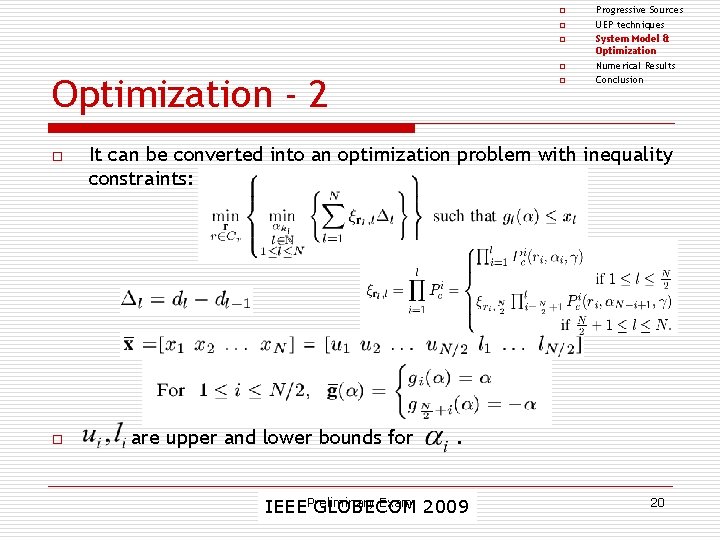
o o Optimization - 2 o o o Progressive Sources UEP techniques System Model & Optimization Numerical Results Conclusion It can be converted into an optimization problem with inequality constraints: are upper and lower bounds for . Exam IEEEPreliminary GLOBECOM 2009 20
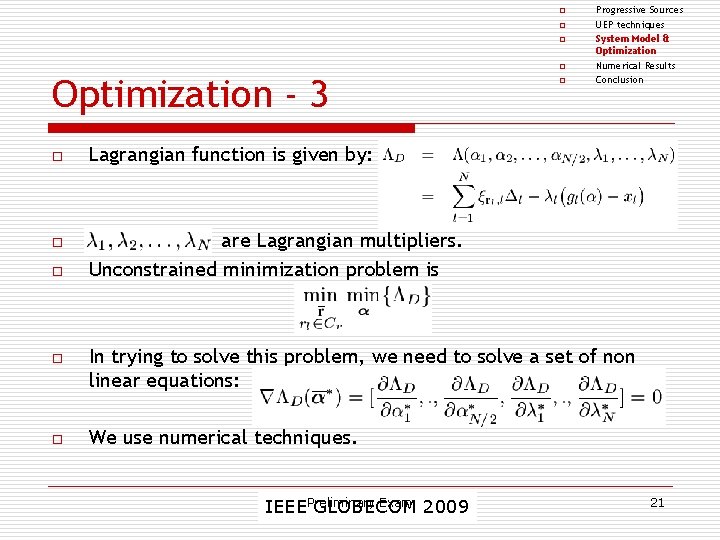
o o Optimization - 3 o Lagrangian function is given by: o are Lagrangian multipliers. Unconstrained minimization problem is o o Progressive Sources UEP techniques System Model & Optimization Numerical Results Conclusion o In trying to solve this problem, we need to solve a set of non linear equations: o We use numerical techniques. Exam IEEEPreliminary GLOBECOM 2009 21
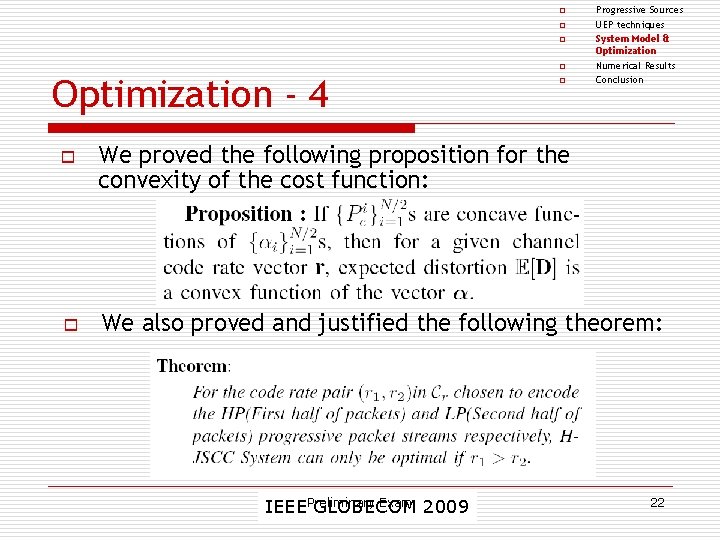
o o Optimization - 4 o o o Progressive Sources UEP techniques System Model & Optimization Numerical Results Conclusion We proved the following proposition for the convexity of the cost function: We also proved and justified the following theorem: Exam IEEEPreliminary GLOBECOM 2009 22
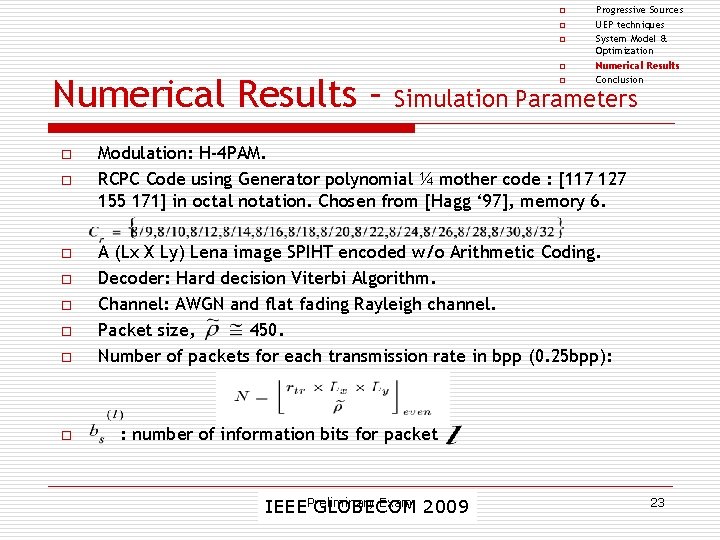
o o Numerical Results – o o o o o Progressive Sources UEP techniques System Model & Optimization Numerical Results Conclusion Simulation Parameters Modulation: H-4 PAM. RCPC Code using Generator polynomial ¼ mother code : [117 127 155 171] in octal notation. Chosen from [Hagg ‘ 97], memory 6. A (Lx X Ly) Lena image SPIHT encoded w/o Arithmetic Coding. Decoder: Hard decision Viterbi Algorithm. Channel: AWGN and flat fading Rayleigh channel. Packet size, 450. Number of packets for each transmission rate in bpp (0. 25 bpp): : number of information bits for packet Exam IEEEPreliminary GLOBECOM 2009 23
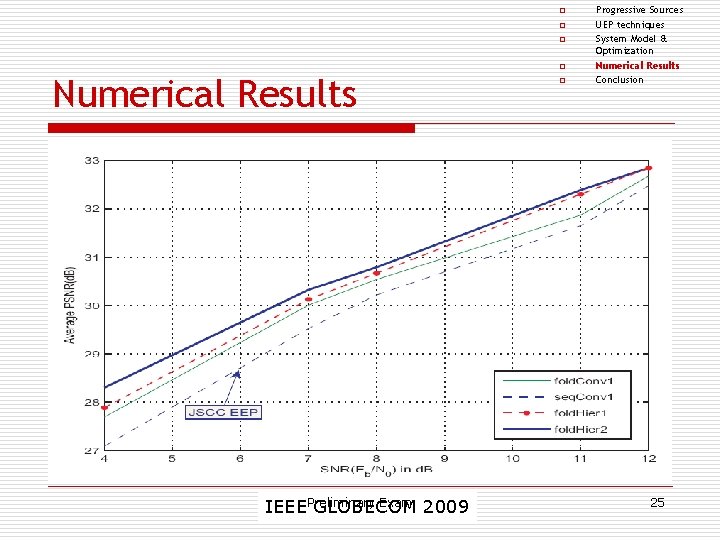
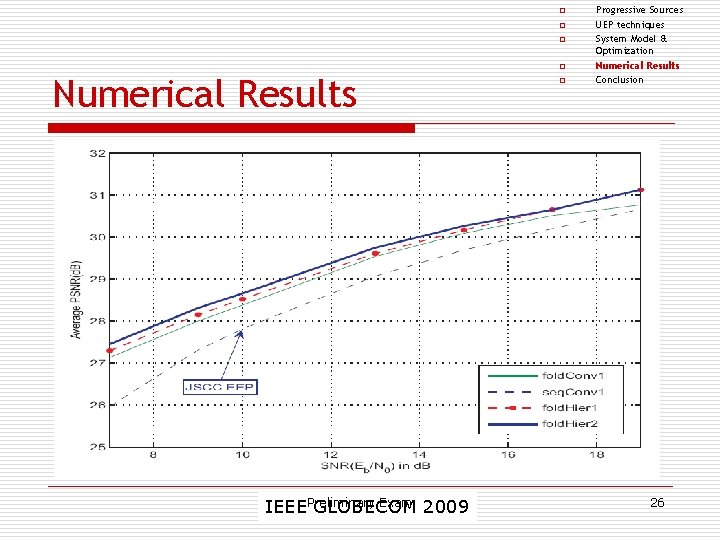
o o Numerical Results o Systems In an image transmission system (SPIHT), we have the following systems: n n o o Progressive Sources UEP techniques System Model & Optimization Numerical Results Conclusion seq. Conv 1: Sequential Packetization with optimal Code rate using conventional 4 PAM. (EEP scheme) fold. Conv 1: Folded Packetization with optimal Code rate using conventional 4 PAM. fold. Hier 1: Folded Packetization with optimal Code rate using hierarchical 4 PAM. fold. Hier 2: Folded Packetization with two optimal Code rates, using hierarchical 4 PAM. Note that fold. Conv 1, fold. Hier 2 are UEP schemes. Exam IEEEPreliminary GLOBECOM 2009 24
o o Numerical Results Exam IEEEPreliminary GLOBECOM 2009 o Progressive Sources UEP techniques System Model & Optimization Numerical Results Conclusion 25
o o Numerical Results Exam IEEEPreliminary GLOBECOM 2009 o Progressive Sources UEP techniques System Model & Optimization Numerical Results Conclusion 26
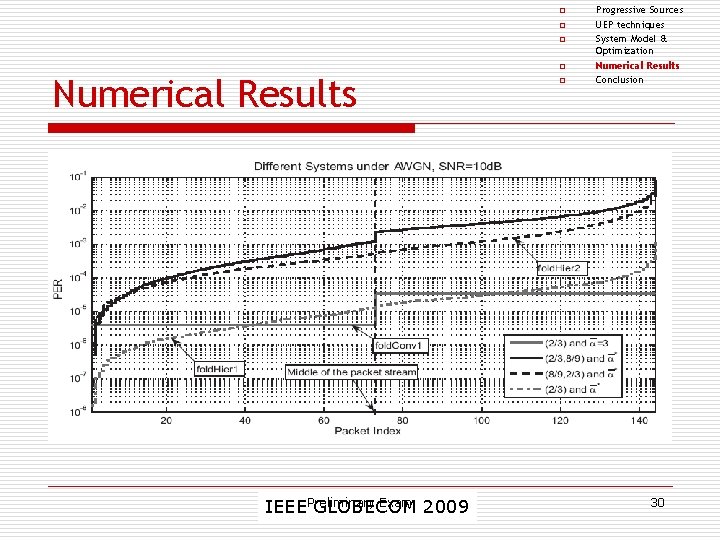
o o Numerical Results o o o o Progressive Sources UEP techniques System Model & Optimization Numerical Results Conclusion UEP schemes perform better than EEP schemes. The non-concave behavior of these curves are a consequence that the code rate set is discrete. The discrete nature of the code set is also the cause of non uniform gains going from one UEP scheme to another. At low SNRs, the gap between the curves becomes more pronounceable as UEP makes more sense when the channel degrades. Hierarchical parameter determines the BER for each packet in the first and second half of the packet stream simultaneously. fold. Hier 2 is introduced to alleviate the constraints of hierarchical parameter and code rate set. Exam IEEEPreliminary GLOBECOM 2009 27
o o Numerical Results Exam IEEEPreliminary GLOBECOM 2009 o Progressive Sources UEP techniques System Model & Optimization Numerical Results Conclusion 28
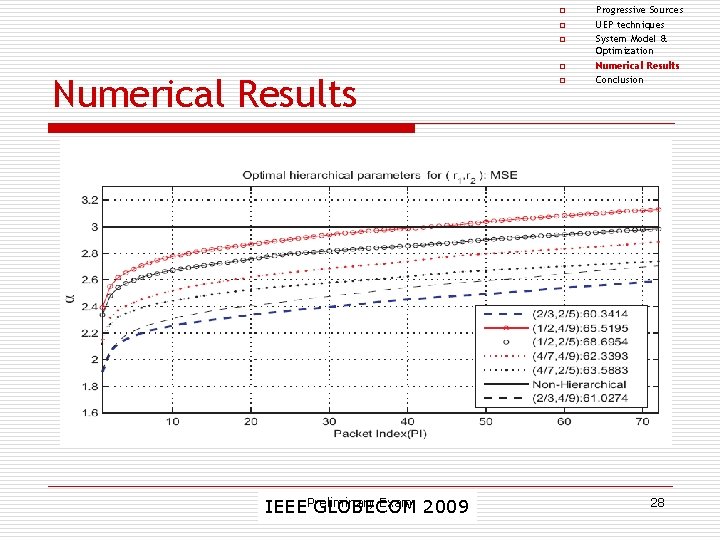
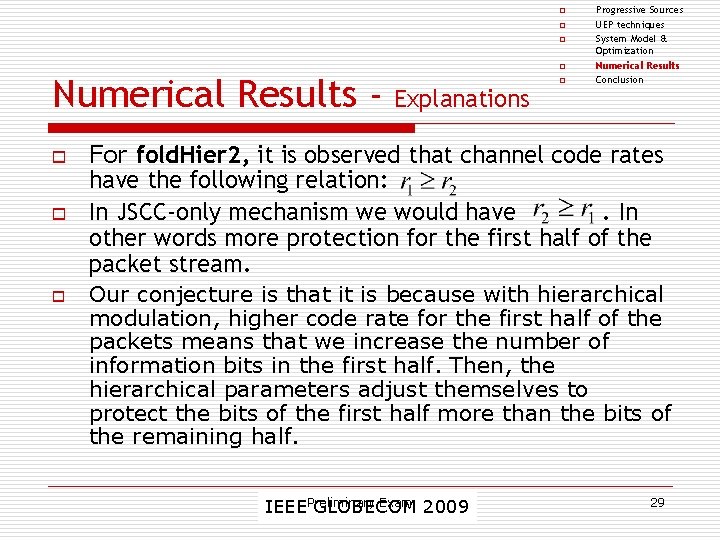
o o Numerical Results o o Explanations Progressive Sources UEP techniques System Model & Optimization Numerical Results Conclusion For fold. Hier 2, it is observed that channel code rates have the following relation: In JSCC-only mechanism we would have. In other words more protection for the first half of the packet stream. Our conjecture is that it is because with hierarchical modulation, higher code rate for the first half of the packets means that we increase the number of information bits in the first half. Then, the hierarchical parameters adjust themselves to protect the bits of the first half more than the bits of the remaining half. Exam IEEEPreliminary GLOBECOM 2009 29
o o Numerical Results Exam IEEEPreliminary GLOBECOM 2009 o Progressive Sources UEP techniques System Model & Optimization Numerical Results Conclusion 30
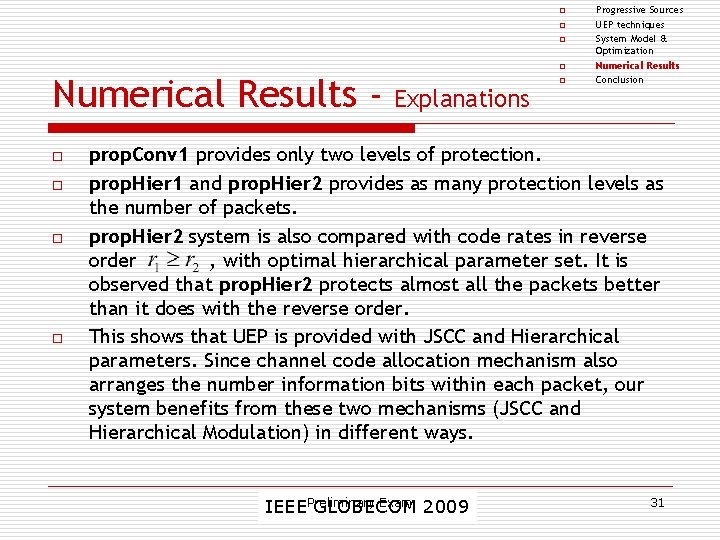
o o Numerical Results o o o Explanations Progressive Sources UEP techniques System Model & Optimization Numerical Results Conclusion prop. Conv 1 provides only two levels of protection. prop. Hier 1 and prop. Hier 2 provides as many protection levels as the number of packets. prop. Hier 2 system is also compared with code rates in reverse order , with optimal hierarchical parameter set. It is observed that prop. Hier 2 protects almost all the packets better than it does with the reverse order. This shows that UEP is provided with JSCC and Hierarchical parameters. Since channel code allocation mechanism also arranges the number information bits within each packet, our system benefits from these two mechanisms (JSCC and Hierarchical Modulation) in different ways. Exam IEEEPreliminary GLOBECOM 2009 31
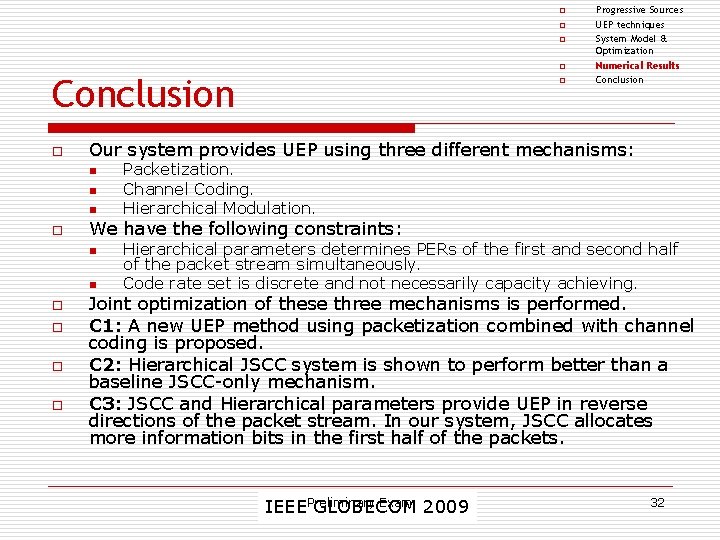
o o Conclusion o Our system provides UEP using three different mechanisms: n n n o o o Packetization. Channel Coding. Hierarchical Modulation. We have the following constraints: n o o Progressive Sources UEP techniques System Model & Optimization Numerical Results Conclusion Hierarchical parameters determines PERs of the first and second half of the packet stream simultaneously. Code rate set is discrete and not necessarily capacity achieving. Joint optimization of these three mechanisms is performed. C 1: A new UEP method using packetization combined with channel coding is proposed. C 2: Hierarchical JSCC system is shown to perform better than a baseline JSCC-only mechanism. C 3: JSCC and Hierarchical parameters provide UEP in reverse directions of the packet stream. In our system, JSCC allocates more information bits in the first half of the packets. Exam IEEEPreliminary GLOBECOM 2009 32
o o Final Remarks o o Progressive Sources UEP techniques System Model & Optimization Numerical Results Conclusion This work was supported by Intel Inc. , the Center for Wireless Communications (CWC) at UCSD, and the UC Discovery Grant program of the state of California. Exam IEEEPreliminary GLOBECOM 2009 33
o o References o o o o o Progressive Sources UEP techniques System Model & Optimization Numerical Results Conclusion [SPIHT ‘ 96], Said A. and Pearlman W. A. , “A New Fast and Efficient Image Codec Based on Set Partitioning in Hierarchical Trees, ” IEEE Transactions on Circuits and Systems for Video Technology, vol. 6, pp. 243 -250, June 1996. [Morimoto ‘ 96], Morimoto, M. , Okada, M. , and Komaki, S. , “A Hierarchical System for Miltimedia Mobile Communication, ” First International Workshop on Wireless Image/Video Communications, Sep. 1996. [Lu ‘ 98] J. Lu, A. Nosratinia, and B. Aazhang, “Progressive source channel coding of images over bursty error channels, ” in Proc. International Conference on Image Processing, Chicago, Ill, USA, October 1998. Kleider J. E. and Abousleman G. P. , Robust Image Transmission using Source Adaptive Modulation and Trellis-Coded Quantization, Image Processing, 1999. ICIP 99. Proceedings. , Vol. 1 pp. 396 - 400 1999. Pei, Y. Modestino, J. W. , “Multi-layered video transmission over wireless channels using an adaptive modulation and coding scheme”, Proceedings of IEEE International Conference on Image Processing , vol. 2, pp. 10091012, Thessaloniki, Greece, October 2001. P. G. Sherwood and K. Zeger, “Progressive Image Coding for Noisy Channels, ” IEEE Signal Processing Letters, vol. 4, No. 7, pp. 189 -191, July. 1997 [Hagg ‘ 97] Hagenauer, J. “Rate-Compatible Punctured Convolutional Codes(RCPC Codes) and Their Applications, ” IEEE Transactions on Communications, vol. 36, No. 4, pp. 389 -400, April. 1997. J. G. Proakis, Digital Communications, 3 rd edition, New York: Mc-Graw Hill, 1995. Exam IEEEPreliminary GLOBECOM 2009 34