
Progressive Era 1890 1920 Vocabulary Quiz Monday 13
Progressive Era 1890 -1920

Vocabulary Quiz – Monday (13 th) Will not cover people’s names Will not cover key questions Only KEY TERMS Progressivism Unit Test - Wednesday (15 th) Will have some vocabulary questions Will have some multiple choice for general knowledge Most of the questions will be primary sources document questions
Progressive Era 1890 - 1920
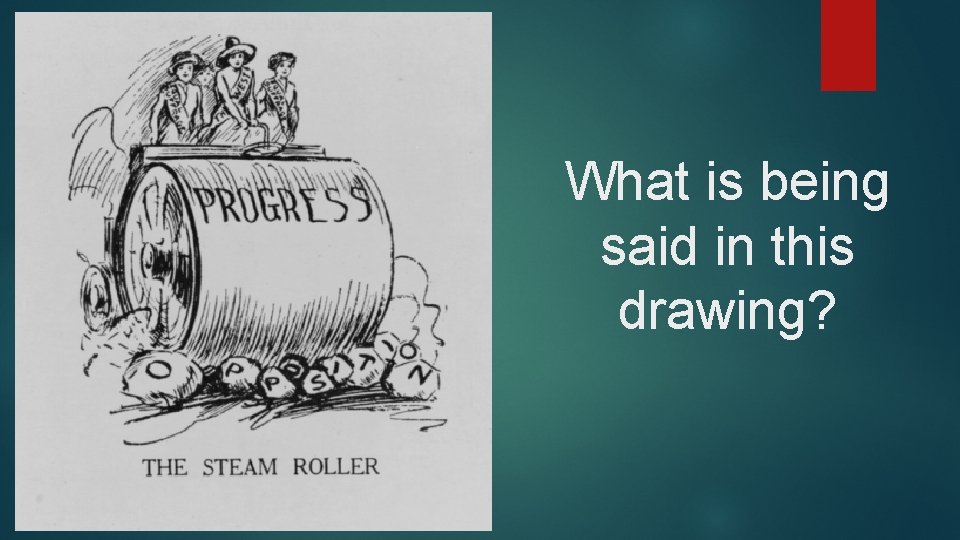
What is being said in this drawing?

Definition of Progressivism is the support for or advocacy of social reform. As a philosophy, it is based on the idea of progress, which asserts that advancements in science, technology, economic development and social organization are vital to the improvement of the human condition.
The Roots of Progressivism The Rise of Progressivism • The era in American history from about 1890 to 1920 is known as the Progressive Era • Progressivism was a collection of different ideas and activities about how to fix the problems within American society
The Roots of Progressivism Who Were the Progressives? • Belonged to both major political parties • Usually were urban, educated middle-class Americans • Many worked as journalists, social workers, educators, politicians, and members of the clergy
The Roots of Progressivism What Did Progressives Believe? • Generally agreed that industrialization and urbanization had created many social problems • Most agreed that the government should take a more active role in solving society’s problems
The Roots of Progressivism Why Did the Movement Begin? • Began partly as a reaction against laissez-faire (“hands off”) economics, in which the government stays completely out of the business world • They doubted that the government, in its present form, could fix the problems of poverty, crime, filth, disease, etc • They concluded that the government had to be fixed first before it could be used to fix other problems
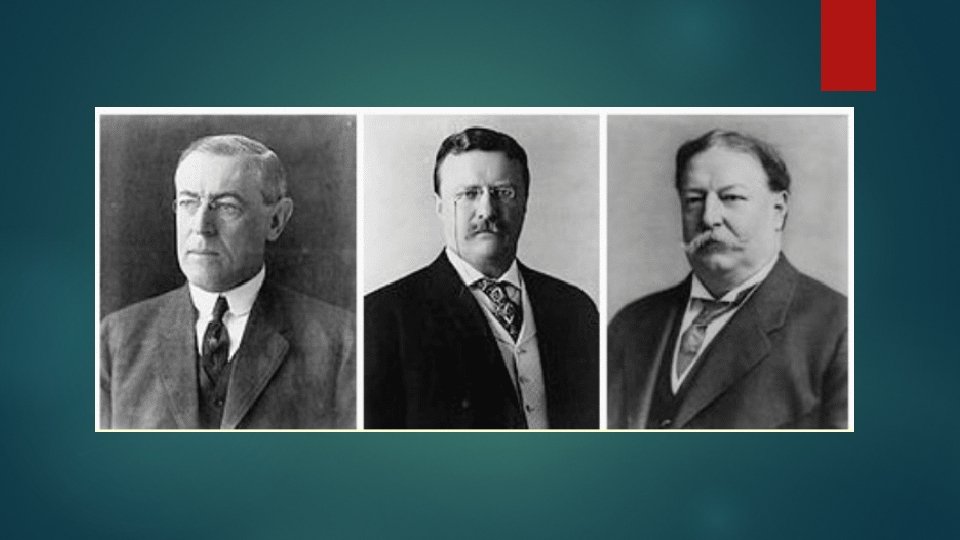
The Roots of Progressivism Progressive Presidents The Progressive Movement involved 3 Presidents: 1) Theodore Roosevelt (R) 2) William Howard Taft (R) 3) Woodrow Wilson (D)
The Roots of Progressivism The Muckrakers • Helped start the progressive movement • The muckrakers were a group of journalists who investigated social conditions and political corruption • Muckrakers uncovered corruption in many areas (government, unfair business practices, social problems)
The Roots of Progressivism Muckrakers Lincoln Steffens: Reported on vote stealing and other corrupt practices of urban political machines (The Shame of the Cities) Jacob Riis: Mostly though photography, described the poverty, disease, and crime that affected many immigrant neighborhoods in NYC (How the Other Half Lives)
The Roots of Progressivism Muckrakers Ida Tarbell: Published a series of articles critical of Rockefeller’s Standard Oil Company Frank Norris: Published the book The Octopus: A Story of California where he examines the struggle of California wheat farmers in the San Joaquin valley against the powerful Pacific and Southwestern Railroad monopoly
The Roots of Progressivism Muckrakers Upton Sinclair • Exposed the horrible conditions of the meat packing industry in his book The Jungle • Led to the passage of the Meat Inspection Act and the Pure Food and Drug Act • Famous Quote: “I aimed at the public’s heart, and by accident, I hit it in the stomach. ”
The Roots of Progressivism What Was the Impact of the Muckrakers? They put pressure on politicians to introduce new reforms
Government Reforms Problem State governments were often run by corrupt governors and representatives Solution Robert La Follette: – Governor of Wisconsin • Most famous progressive governor • Wisconsin became know as “Laboratory of Democracy
Government Reforms Direct Primary: allows all party members to vote for a candidate to run in the general election • In the past, political machines often controlled which candidates were chosen to run in elections (corruption) Initiative: allowed a group of citizens to propose new laws, by petition, and required the state legislatures to vote on it Referendum: allowed laws passed by the state legislatures to be submitted to voters for approval or rejection Recall: allowed voters to demand a special-called election to remove an elected official from office before his/her term ends
Government Reforms 17 th Amendment (1912) provides for the direct election of U. S. Senators • In the past, U. S. Senators were chosen by the state legislatures (corruption) Impact These state reforms led to a more democratic society (meaning, citizens had more of a “voice” in politics)
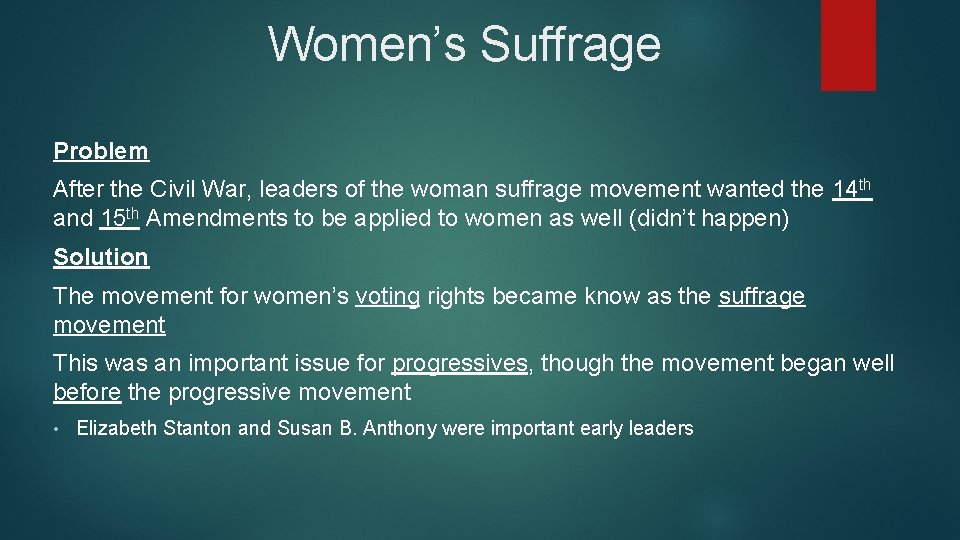
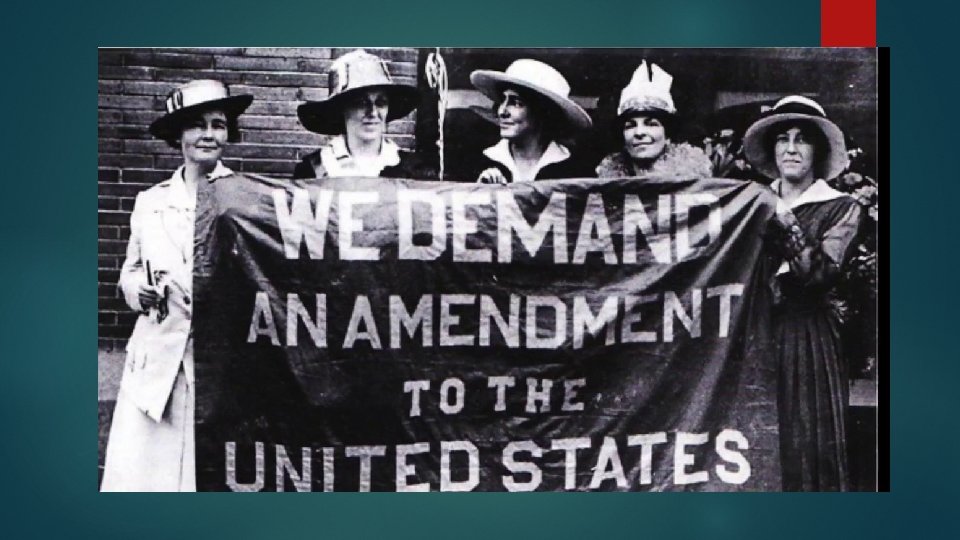
Women’s Suffrage Problem After the Civil War, leaders of the woman suffrage movement wanted the 14 th and 15 th Amendments to be applied to women as well (didn’t happen) Solution The movement for women’s voting rights became know as the suffrage movement This was an important issue for progressives, though the movement began well before the progressive movement • Elizabeth Stanton and Susan B. Anthony were important early leaders
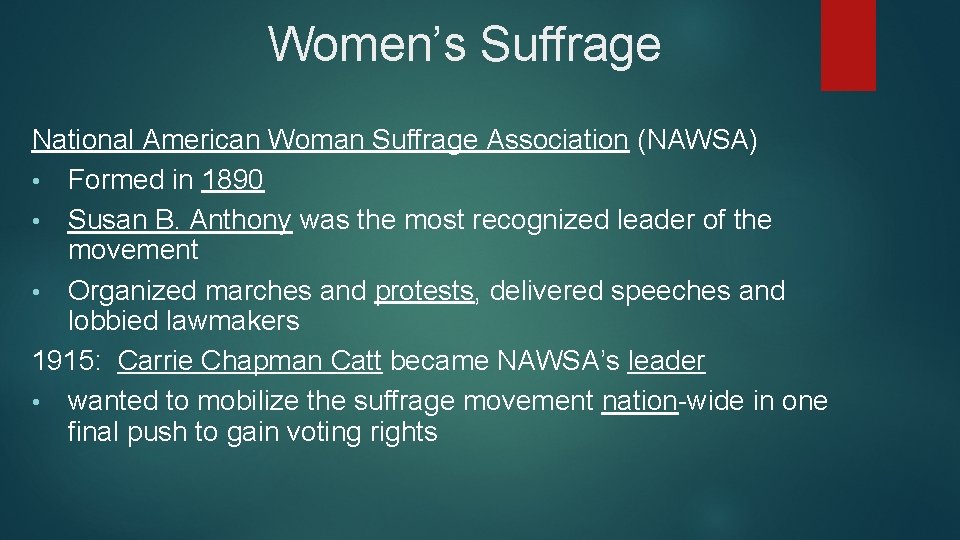
Women’s Suffrage National American Woman Suffrage Association (NAWSA) • Formed in 1890 • Susan B. Anthony was the most recognized leader of the movement • Organized marches and protests, delivered speeches and lobbied lawmakers 1915: Carrie Chapman Catt became NAWSA’s leader • wanted to mobilize the suffrage movement nation-wide in one final push to gain voting rights
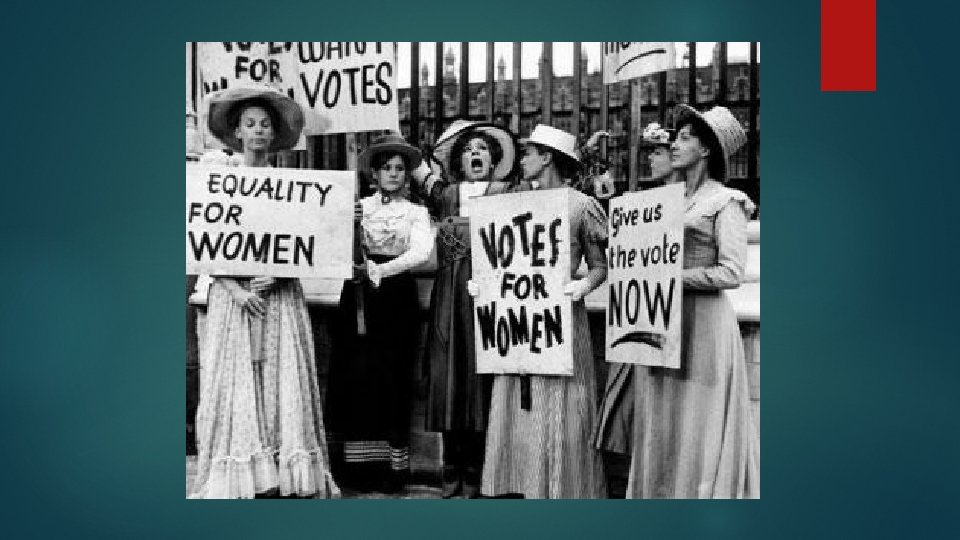
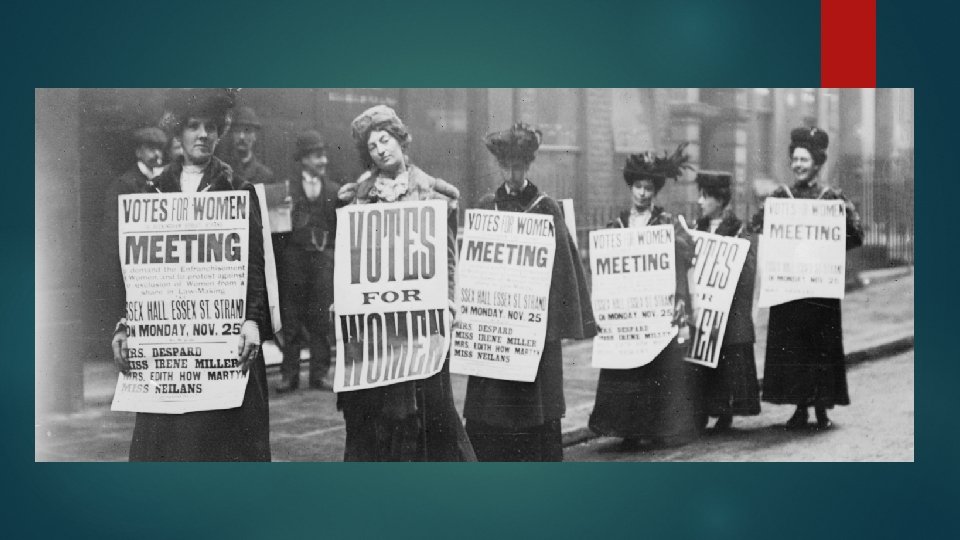
Women’s Suffrage Anti-suffragism was a political movement composed of both men and women that began in the late 19 th century in order to campaign against women's suffrage Quotes “We are not merely against feminism, but for the family. We cannot reconcile feminism and the family. We hope to hear the sound of women’s feet, walking away from the factory and back to the home. ”- Mrs. Martin “Suffrage is not a natural right. No class of the community can insist upon the right to vote as it could upon the right to life and liberty. I am opposed to woman suffrage because I believe it would throw an additional strain upon the efficiency of government. ” - Henry L. Stilton, former Secretary of State
Women’s Suffrage 19 th Amendment The 19 th Amendment (1920) to the Constitution of the United States provides men and women with equal voting rights. The amendment states that the right of citizens to vote "shall not be denied or abridged by the United States or by any State on account of sex. "
Prohibition Problem Alcohol abuse was considered by many to be the cause of many of society’s problems Solution The Temperance Movement called for the moderation or elimination of alcohol • The movement was led by the Women’s Christian Temperance Union • Temperance is abstinence from alcoholic drink 18 th Amendment (Prohibition) established the prohibition of "intoxicating liquors" in the United States.
Child Labor Problem 1900: Over 1. 7 million under the age of 16 worked outside the home • EX: “breaker boys” in the coal mines were paid 60 cents for a 10 hour day – the work bent their backs permanently
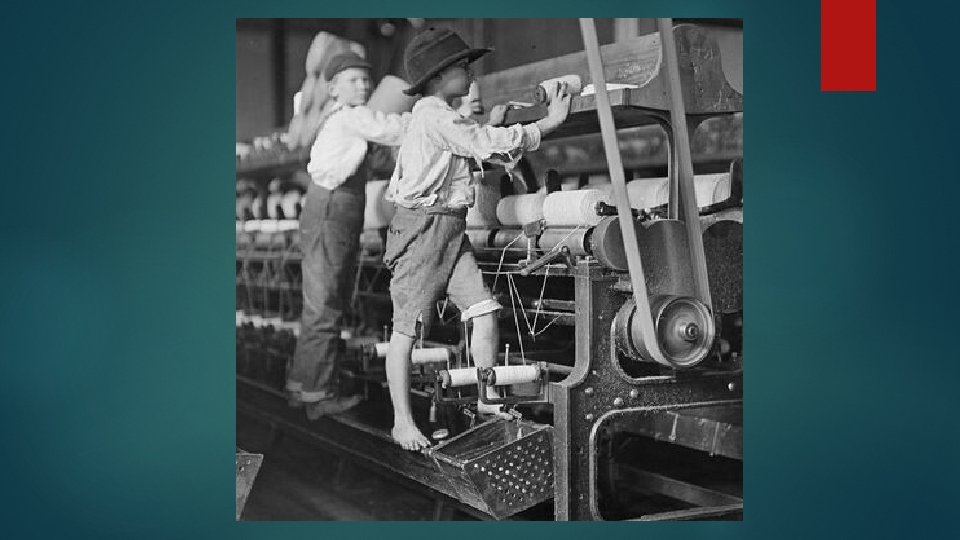
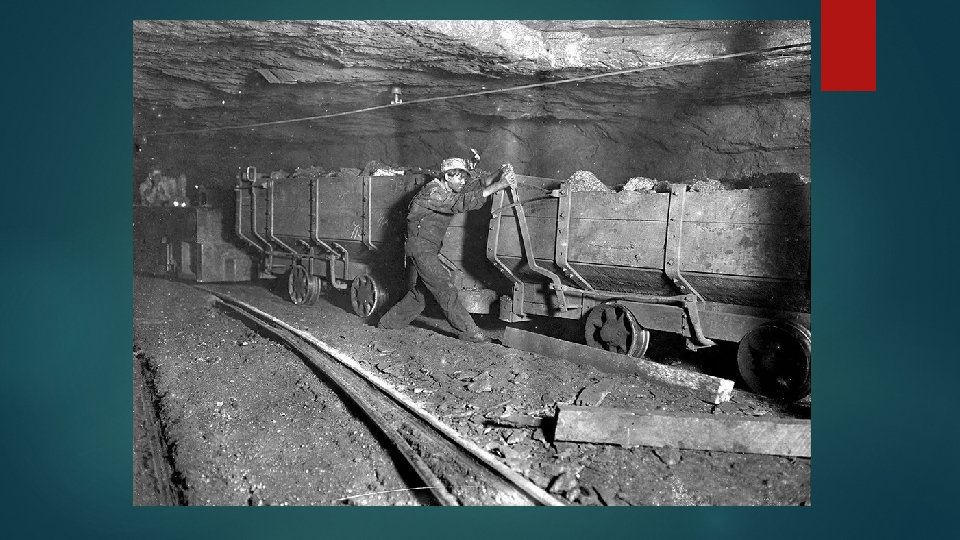
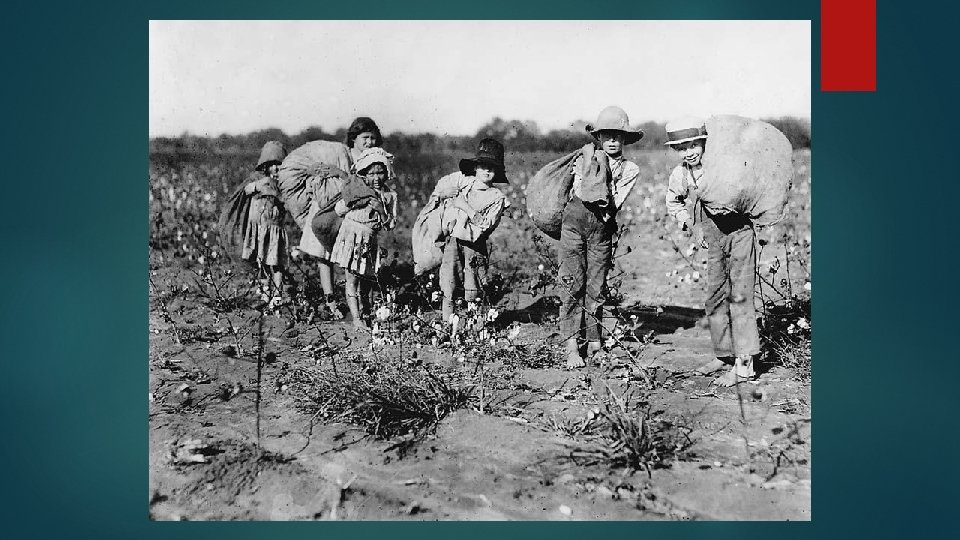
Child Labor Solution • Progressives established a National Child Labor Committee in 1904 to work to abolish child labor • Reports by muckrakers convinced states to pass laws to limit the hours children could work – age limits also put into place • Some states began to pass compulsory education laws, requiring children to be in school and not at work Impact • By the early 1900 s, the number of child laborers had declined • Women also began to work outside the home because the children could not
Roosevelt Reforms Presidents during the Progressive Era (esp. Teddy Roosevelt) often used their authority to break up businesses that had monopolies. • Roosevelt was sometimes called the “Trust-Buster” • A trust was a way of organizing a business by merging together rival companies. By eliminating competition, trusts could charge whatever price they chose. • Theodore Roosevelt’s reform program was known as “Square Deal” = meaning a fairer system.
Roosevelt Reforms Northern Securities Co. v. United States Great Northern and Northern Pacific railroad companies, formed a monopoly called the Northern Securities Company. the U. S. Supreme Court held that a holding company formed to create a railroad monopoly violated the Sherman Antitrust Law. The government's victory in the case helped solidify President Theodore Roosevelt's reputation as a “trustbuster. ”
Roosevelt Reforms Coal Strike of 1902: • United Mine Workers called a strike to protest low wages • T. Roosevelt. acted as a 3 rd party between the union and owners • Arbitration is the use of an arbitrator to settle a dispute. • 1 st example of federal gov’t supporting labor (i. e. workers)
Roosevelt Reforms Hepburn Act: required railroads to get permission from the U. S. gov’t before raising rates • (strengthened the Interstate Commerce Commission) National Park Service: protected and ran the national parks Environmental conservation: is an umbrella term that defines anything we do to protect our planet and conserve its natural resources so that every living thing can have an improved quality of life. Newlands Reclamation Act: allowed the government to apply federal funds to irrigation projects intended to transform arid areas into land that could be farmed. Meat Inspection Act and the Pure Food and Drug Act: legislation that would prevent “the manufacture, sale, or transportation of adulterated or misbranded or poisonous or deleterious foods, drugs or medicines, and liquors. ” • But it wasn't until the public outcry following the publication of Upton Sinclair's The Jungle that Congress moved
Taft Reforms The 1910 Mann-Elkins Act gave authority of the Interstate Commerce Commission (ICC) to set railroad rates and regulate the telecommunications industry. President William Howard Taft signed into law legislation establishing a Children's Bureau to “investigate and report…upon all matters pertaining to the welfare of children and child life among all classes of our people. ” The Sixteenth Amendment (Amendment XVI) to the United States Constitution allows Congress to levy an income tax without apportioning it among the states on the basis of population.
Taft Angers Republicans Payne-Aldrich Tariff Raised tariffs = but it caused a rift in the republican party. This rift caused a loss in the 1910 congressional elections. Ballinger-Pinchot Scandal • Taft hired Richard Ballinger who progressives thought was against Roosevelt. • Taft fired Progressive conservationist Gifford Pinchot, the head of the forestry division in the Department of Agriculture (who Roosevelt hired). • There was a scandal dealing with defrauding the public and many thought Taft administration was involved. • The Ballinger-Pinchot Scandal contributed to the rift between the conservative and progressive factions in the Republican Party.
Election of 1912 United States presidential election of 1912 in which Democrat Woodrow Wilson defeated Bull Moose (Progressive) candidate and former Republican president Theodore Roosevelt and Republican incumbent president William Howard Taft. Progressive Party (Bull Moose) = Theodore Roosevelt led progressive elements out of the Republican Party. Roosevelt had made no secret of his low opinion of President William H. Taft and felt he could not support the ticket. Taft had particularly angered Roosevelt, an ardent conservationist, by removing Gifford Pinchot as chief forester. Wilson won due to the split in the republican party
Election of 1912 The New Nationalism (Roosevelt) This broad plan called for reform in every area of American life, with the notable exception of race relations. The ideas behind The New Nationalism required involvement by the national government in many areas of American life. Roosevelt argued that the nation needed change and that it was going to take the federal government to get it done. New Freedom (Wilson) 1. Lowering the protective tariff 2. Creating a better banking system 3. Strengthening antitrust laws Wilson contended that if these three reforms passed, control by monopolies would end and freedom would be restored. The New Freedom plan offered no provisions for social justice reforms. Wilson asserted that people did not want the government to take care of them; they simply wanted competition restored so the free enterprise system could work and citizens thrive.
Wilson Reforms Underwood Tariff re-established a federal income tax in the United States and substantially lowered tariff rates. Federal Reserve Act The Act intended to establish a form of economic stability in the United States through Central Banking, which would be in charge of monetary policy. Clayton Antitrust Act Meant to further promote competition in U. S. businesses and discourage the formation of monopolies. This act prohibited price discrimination, price fixing, and exclusive sales contracts. Adamson Act The Adamson Act was a United States federal law passed in 1916 that established an eight-hour workday, with additional pay for overtime work, for interstate railroad workers.
NAACP • The progressives largely ignored minority rights. • The NAACP or National Association for the Advancement of Colored People was established in 1909 and is America’s oldest and largest civil rights organization. • The National Association for the Advancement of Colored People (NAACP) was an organization founded as a result of a meeting between W. E. B. Du Bois and a group of African American and white progressives regarding the lynching of two African American men in Springfield, Illinois, the previous year. • In the NAACP’s early decades, its anti-lynching campaign was central to its agenda.
Was the Progressive movement successful? • The Progressive Era was a time of major reform and change in the United States, that began from 1890 to 1920. • The Progressive Era changed the U. S in many ways that are still in use to this day. • Child Labor Laws including free/mandatory education. • Women’s right to vote. • Protection of vast amounts of nature. • Government and election reforms. • Limits on businesses. • Rise of unions = YES!
- Slides: 43