
Progression toolkits Based on research evidence The best
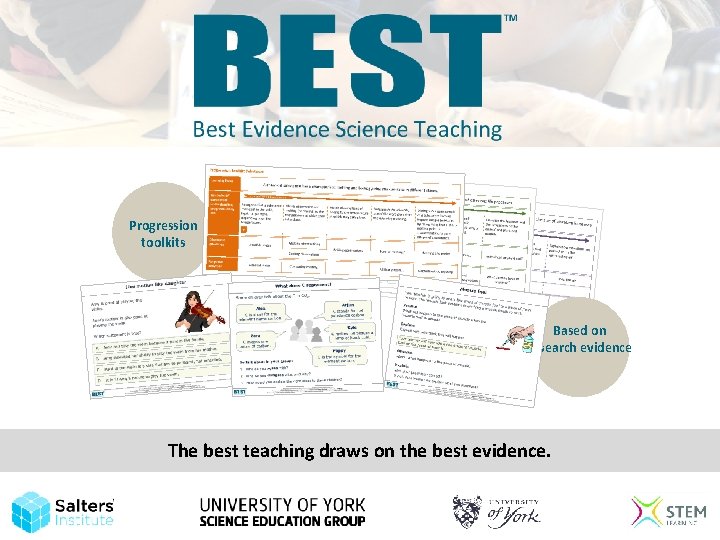
Progression toolkits Based on research evidence The best teaching draws on the best evidence.

What’s ?
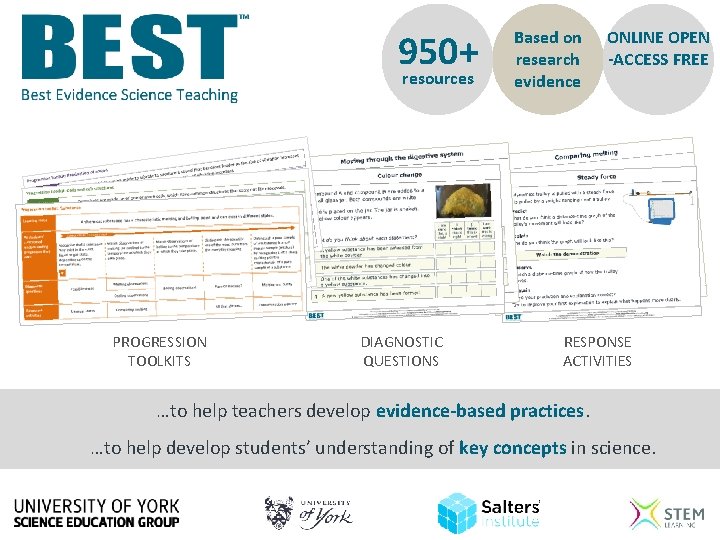
950+ resources PROGRESSION TOOLKITS DIAGNOSTIC QUESTIONS Based on research evidence ONLINE OPEN -ACCESS FREE RESPONSE ACTIVITIES …to help teachers develop evidence-based practices. …to help develop students’ understanding of key concepts in science.
Why ?
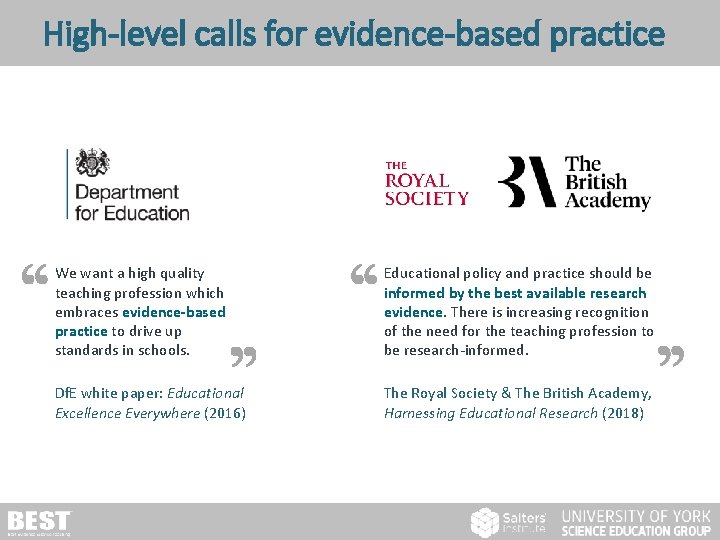
High-level calls for evidence-based practice We want a high quality teaching profession which embraces evidence-based practice to drive up standards in schools. Educational policy and practice should be informed by the best available research evidence. There is increasing recognition of the need for the teaching profession to be research-informed. Df. E white paper: Educational Excellence Everywhere (2016) The Royal Society & The British Academy, Harnessing Educational Research (2018)
The challenges of transforming evidence into practice Teachers will not take up attractivesounding ideas, albeit based on extensive research, if these are presented as general principles. . . their classroom lives are too busy for this to be possible. What they need is a variety of living examples of implementation. Teachers are seeking to develop strategies that make best use of evidence. Research organisations and intermediary bodies need to transform evidence for practice [if it is to be effectively utilised by teachers]. Paul Black and Dylan Wiliam, Inside the Black Box (1998) NFER, Using Evidence in the Classroom: What Works and Why? (2014)

example
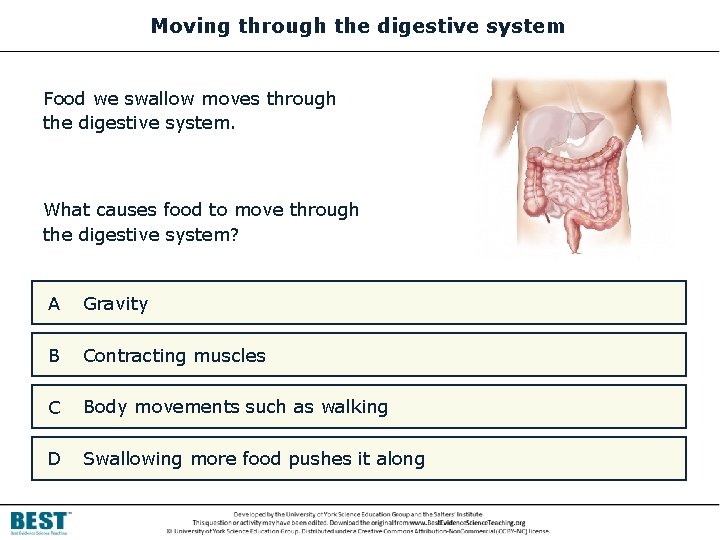
Moving through the digestive system Food we swallow moves through the digestive system. What causes food to move through the digestive system? A Gravity B Contracting muscles C Body movements such as walking D Swallowing more food pushes it along
Research evidence • When children up to age 15 were asked to draw what is inside the human body, most drew organs but very few drew muscles, and when muscles were drawn they were commonly depicted in the limbs. Reiss, M. J. , et al. (2002). An international study of young peoples' drawings of what is inside themselves. Journal of Biological Education, 36(2), 58 -64. Bartoszeck, A. B. , Machado, D. Z. and Amann-Gainotti, M. (2011). Graphic representation of organs and organ systems: psychological view and developmental patterns. EURASIA Journal of Mathematics, Science & Technology Education, 7(1), 41 -51. • Rosalind Driver’s review of the research literature suggested that there was no evidence that school-age children recognise the involvement of muscles in the digestive, circulatory and respiratory systems. Driver, R. , et al. (1994). Making Sense of Secondary Science: Research into Children's Ideas, London, UK: Routledge. • Several studies have found that children from ages 4 to 10 do not appreciate that food is pushed through the digestive tract by waves of muscle contraction (peristalsis), believing instead that gravity and body movements such as walking and bending are responsible. Teixeira, F. M. (2000). What happens to the food we eat? Children's conceptions of the structure and function of the digestive system. International Journal of Science Education, 22(5), 507 -520. AHİ, B. (2017). Thinking about digestive system in early childhood: a comparative study about biological knowledge. Cogent Education, 4(1).
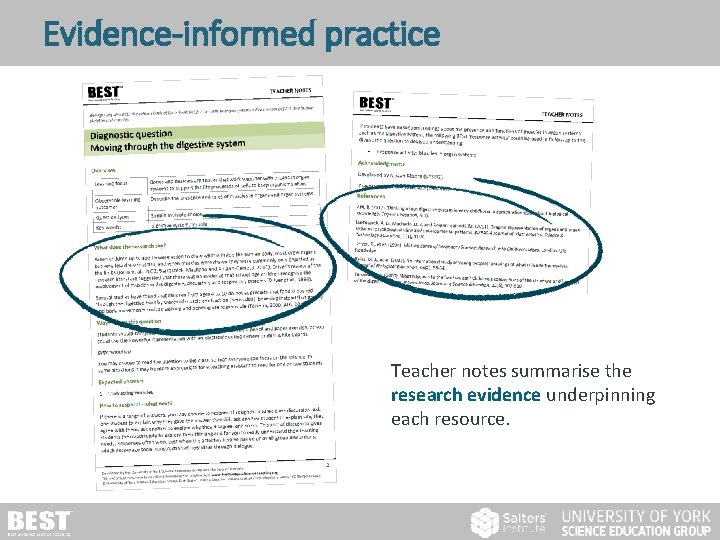
Evidence-informed practice Teacher notes summarise the research evidence underpinning each resource.
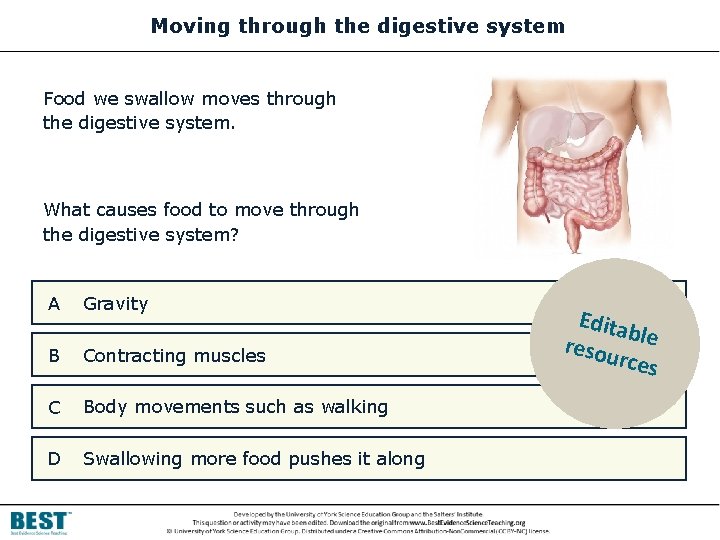
Moving through the digestive system Food we swallow moves through the digestive system. What causes food to move through the digestive system? A Gravity B Contracting muscles C Body movements such as walking D Swallowing more food pushes it along Edita ble resou rces
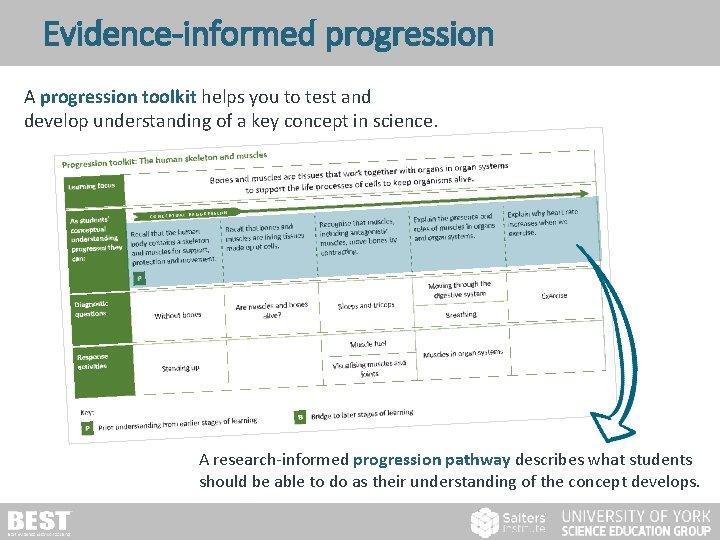
Evidence-informed progression A progression toolkit helps you to test and develop understanding of a key concept in science. A research-informed progression pathway describes what students should be able to do as their understanding of the concept develops.

Diagnostic questions help you to collect: • evidence of preconceptions and misunderstandings • evidence of where your students are in their conceptual progression. They can be used formatively to decide what happens next.
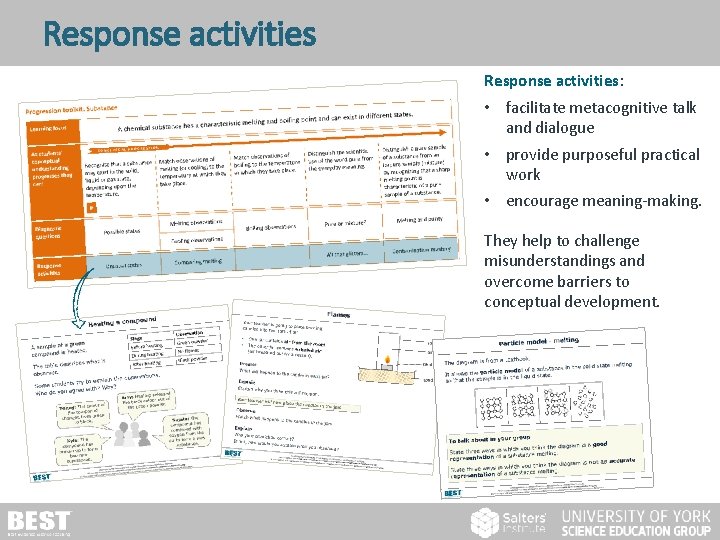
Response activities: • facilitate metacognitive talk and dialogue • provide purposeful practical work • encourage meaning-making. They help to challenge misunderstandings and overcome barriers to conceptual development.
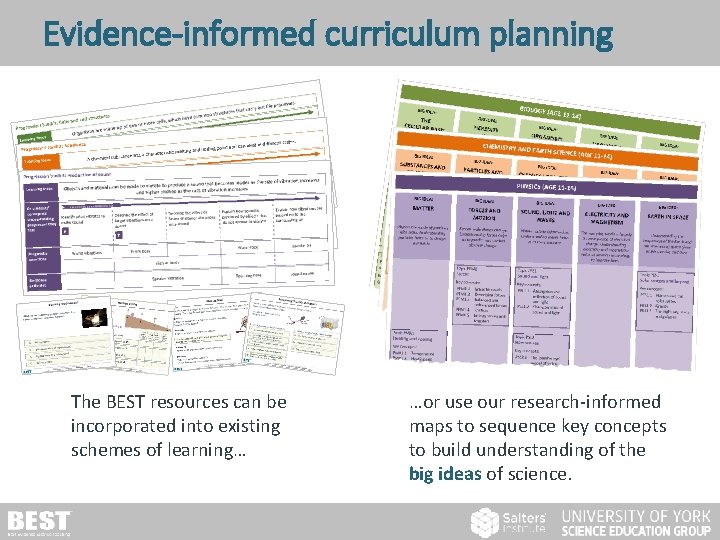
Evidence-informed curriculum planning The BEST resources can be incorporated into existing schemes of learning… …or use our research-informed maps to sequence key concepts to build understanding of the big ideas of science.
and Improving Secondary Science
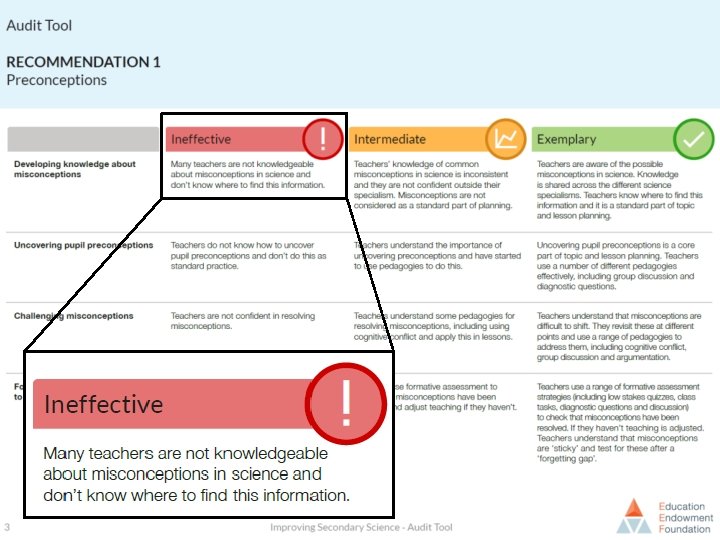
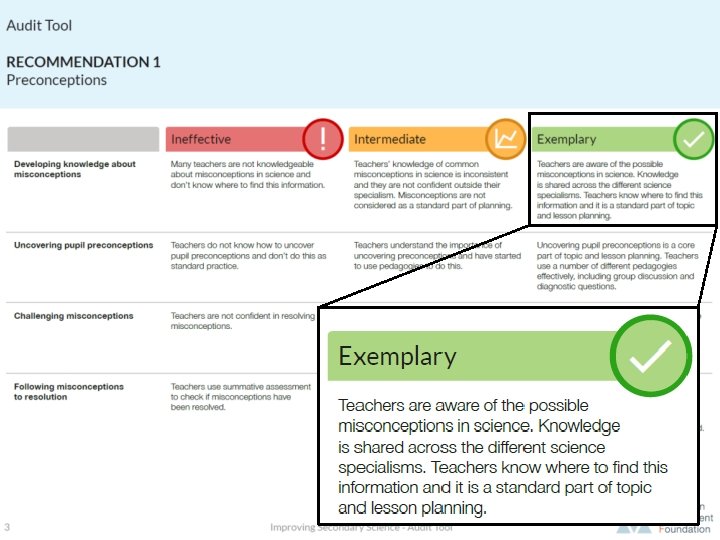
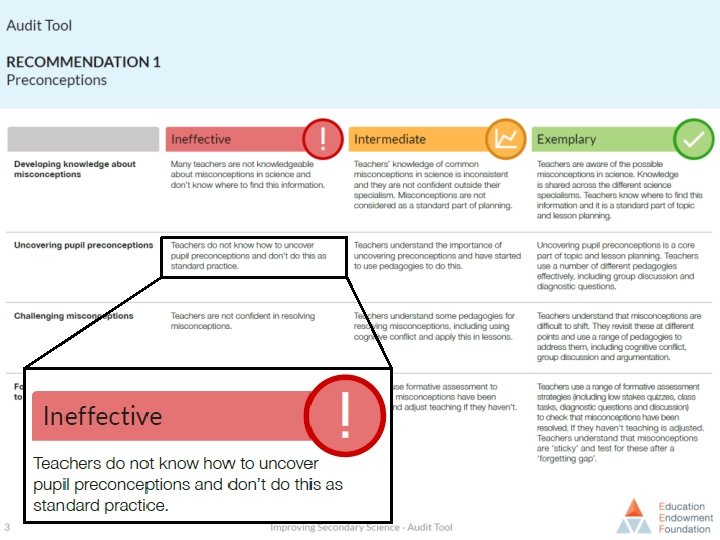
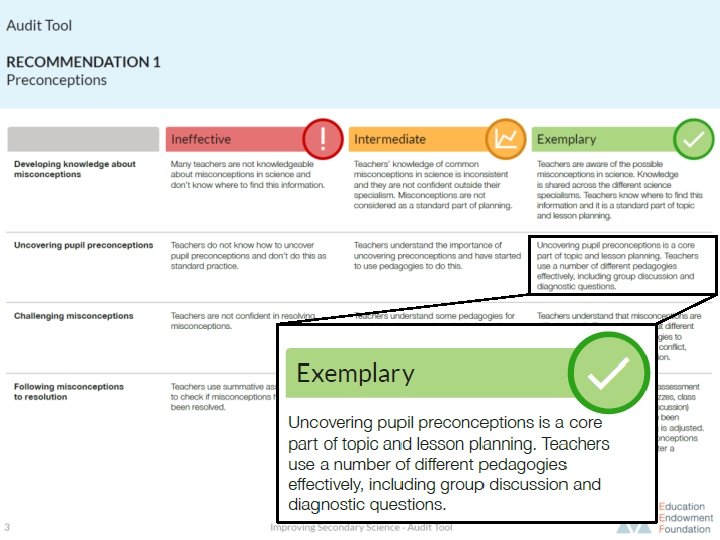
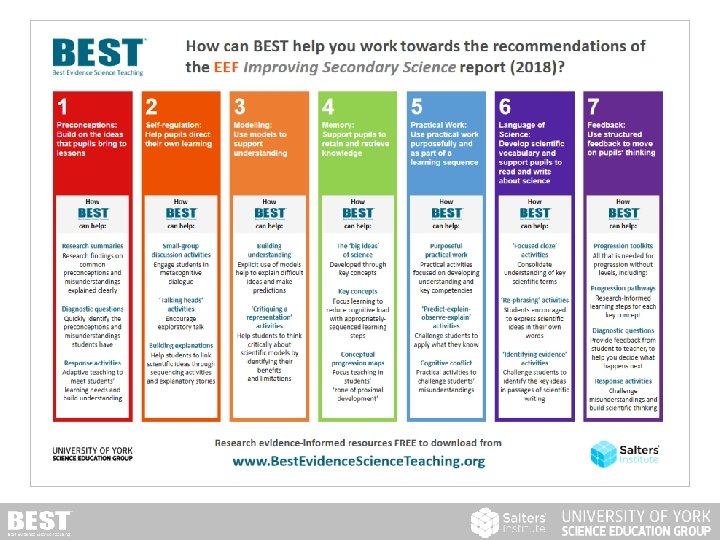
The Education Endowment Foundation (EEF) published a guidance report in 2018 titled ‘Improving Secondary Science’ The report cites Best Evidence Science Teaching as a good source of: • diagnostic questions • activities that promote metacognitive talk and dialogue The report makes seven main recommendations…
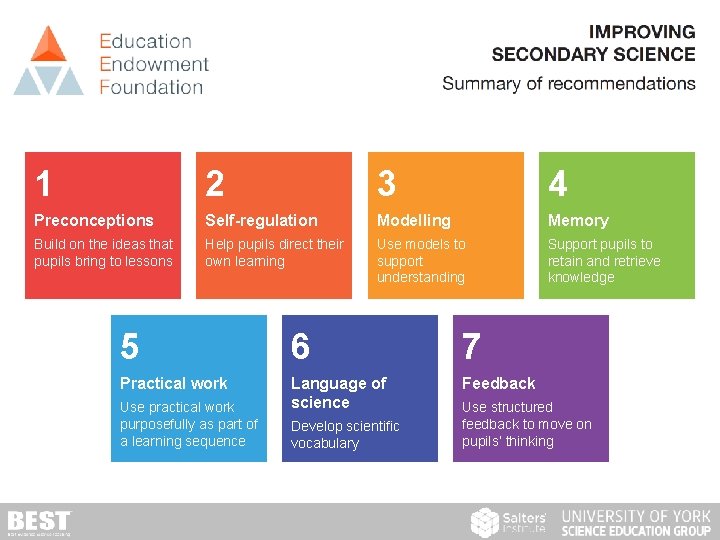
1 2 3 4 Preconceptions Self-regulation Modelling Memory Build on the ideas that pupils bring to lessons Help pupils direct their own learning Use models to support understanding Support pupils to retain and retrieve knowledge 5 6 7 Practical work Language of science Feedback Use practical work purposefully as part of a learning sequence Develop scientific vocabulary Use structured feedback to move on pupils’ thinking
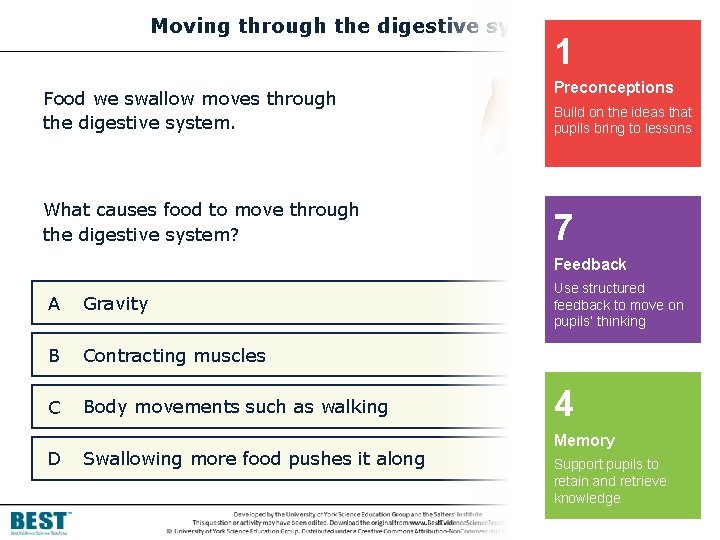
Moving through the digestive system 1 Food we swallow moves through the digestive system. What causes food to move through the digestive system? Preconceptions Build on the ideas that pupils bring to lessons 7 Feedback A Gravity B Contracting muscles C Body movements such as walking D Swallowing more food pushes it along Use structured feedback to move on pupils’ thinking 4 Memory Support pupils to retain and retrieve knowledge
diagnostic questions
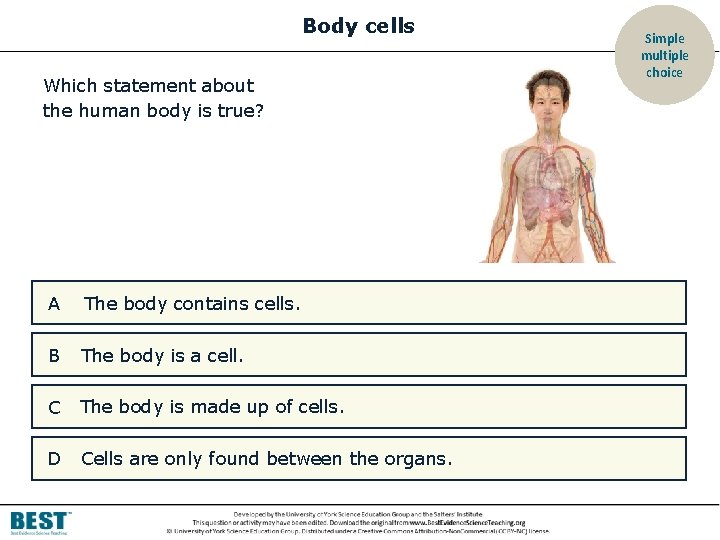
Body cells Which statement about the human body is true? A The body contains cells. B The body is a cell. C The body is made up of cells. D Cells are only found between the organs. Simple multiple choice
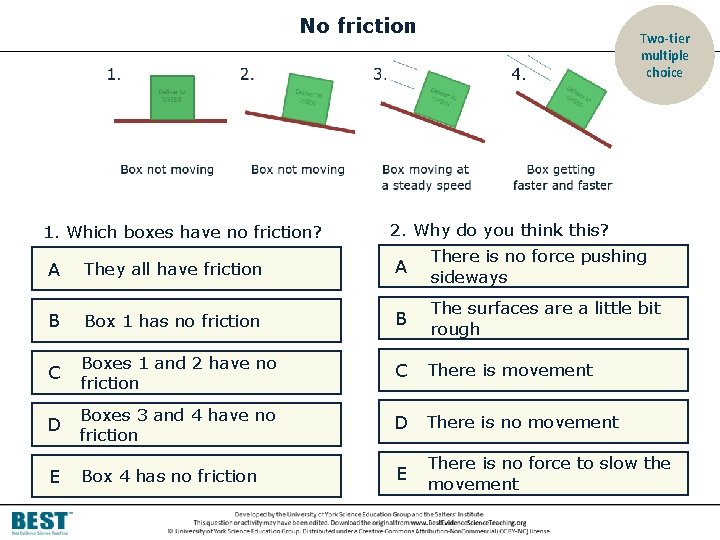
No friction Two-tier multiple choice 1. Which boxes have no friction? 2. Why do you think this? Intro A They all have friction Intro A B Box 1 has no friction B The surfaces are a little bit rough C Boxes 1 and 2 have no friction C There is movement D Boxes 3 and 4 have no friction D There is no movement E Box 4 has no friction E There is no force to slow the movement There is no force pushing sideways
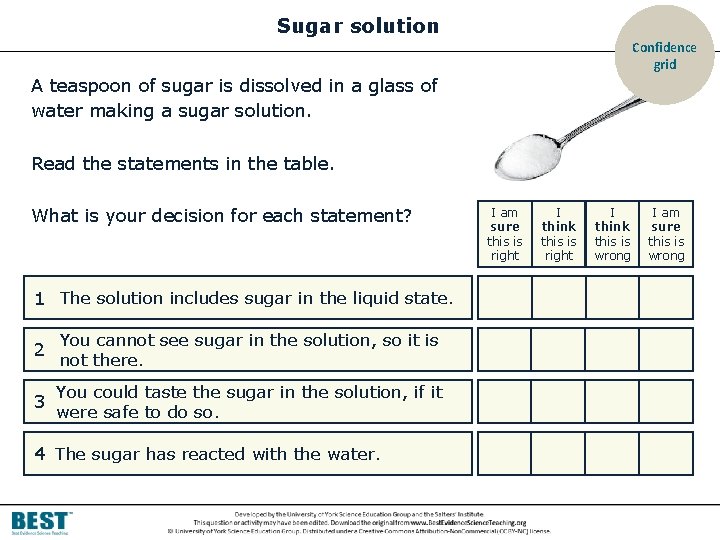
Sugar solution Confidence grid A teaspoon of sugar is dissolved in a glass of water making a sugar solution. Read the statements in the table. What is your decision for each statement? 1 The solution includes sugar in the liquid state. 2 You cannot see sugar in the solution, so it is not there. 3 You could taste the sugar in the solution, if it were safe to do so. 4 The sugar has reacted with the water. I am sure this is right I think this is wrong I am sure this is wrong
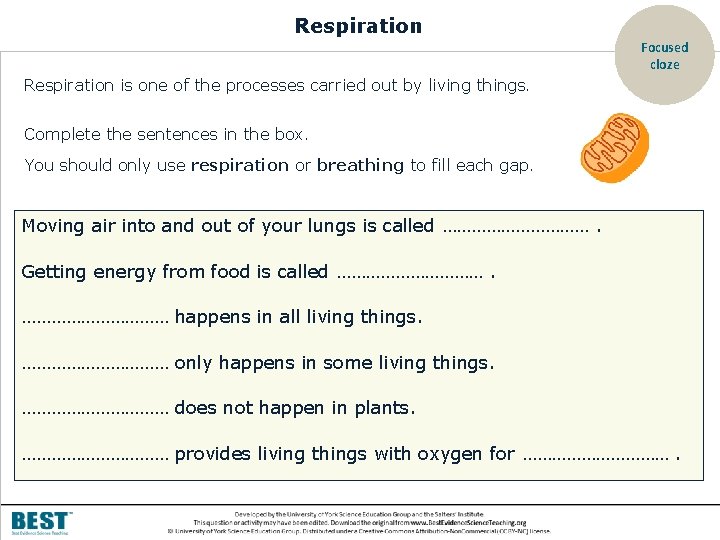
Respiration Focused cloze Respiration is one of the processes carried out by living things. Complete the sentences in the box. You should only use respiration or breathing to fill each gap. Moving air into and out of your lungs is called ……………. Getting energy from food is called …………… happens in all living things. …………… only happens in some living things. …………… does not happen in plants. …………… provides living things with oxygen for …………….
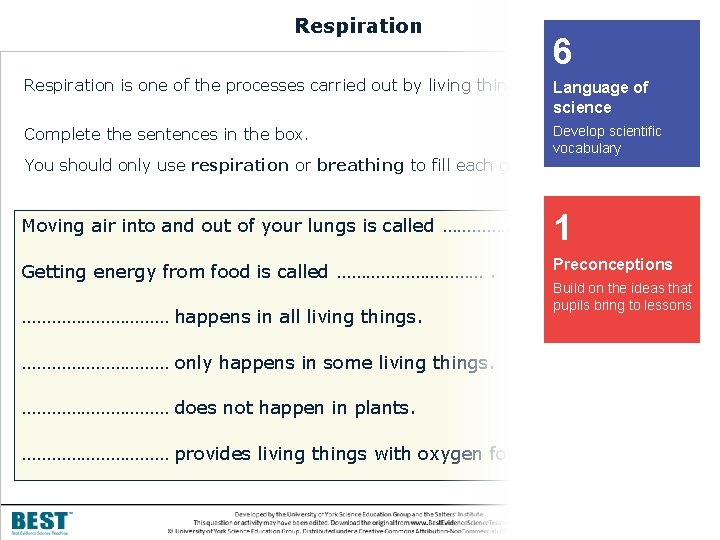
Respiration 6 Focused cloze Respiration is one of the processes carried out by living things. Language of science Complete the sentences in the box. Develop scientific vocabulary You should only use respiration or breathing to fill each gap. 1 Moving air into and out of your lungs is called ……………. Getting energy from food is called …………… happens in all living things. Preconceptions Build on the ideas that pupils bring to lessons …………… only happens in some living things. …………… does not happen in plants. …………… provides living things with oxygen for …………….
response activities
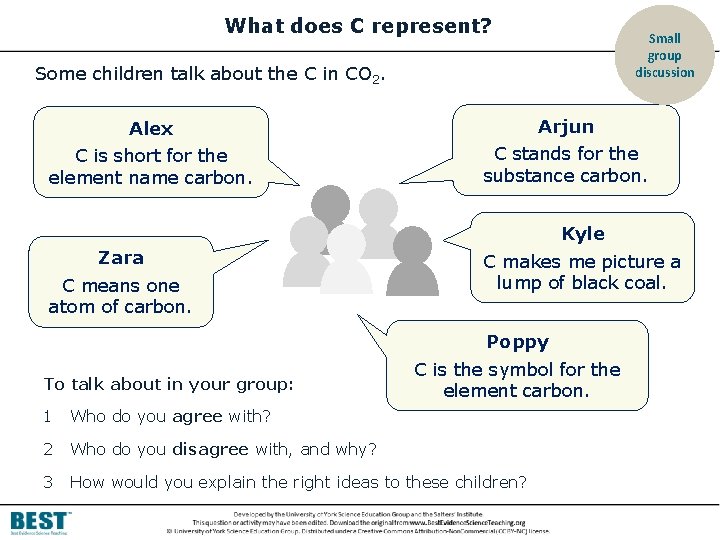
What does C represent? Small group discussion Some children talk about the C in CO 2. Alex Arjun C is short for the element name carbon. C stands for the substance carbon. Kyle Zara C means one atom of carbon. C makes me picture a lump of black coal. Poppy To talk about in your group: C is the symbol for the element carbon. 1 Who do you agree with? 2 Who do you disagree with, and why? 3 How would you explain the right ideas to these children?
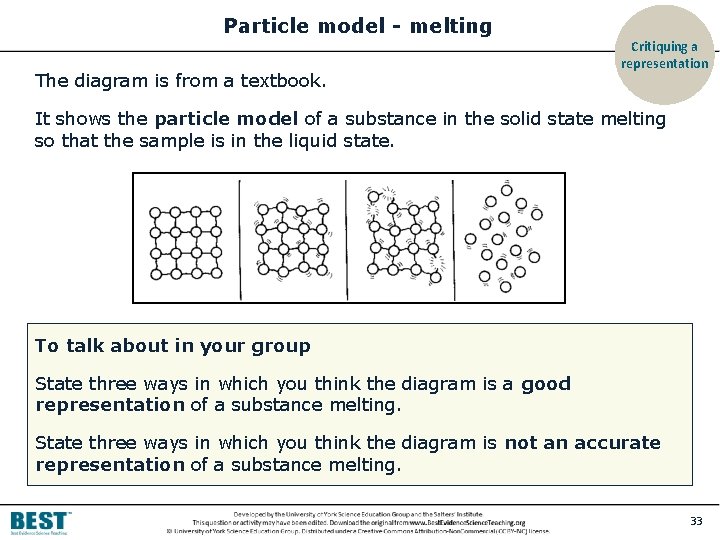
Particle model - melting The diagram is from a textbook. Critiquing a representation It shows the particle model of a substance in the solid state melting so that the sample is in the liquid state. To talk about in your group State three ways in which you think the diagram is a good representation of a substance melting. State three ways in which you think the diagram is not an accurate representation of a substance melting. 33
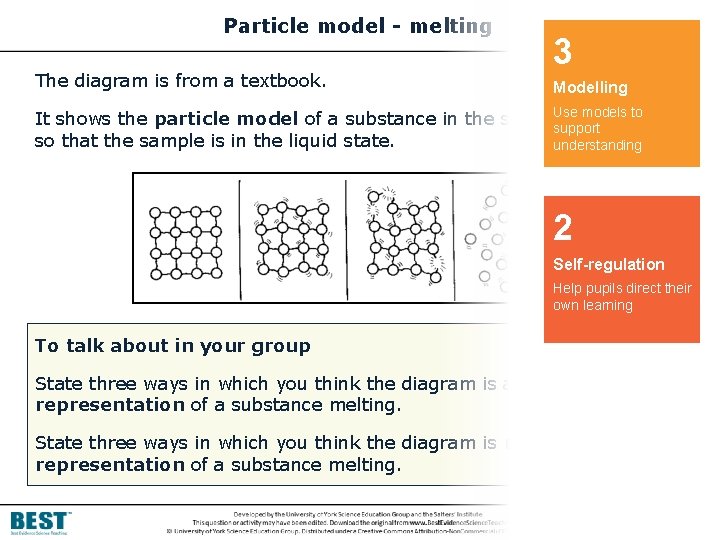
Particle model - melting The diagram is from a textbook. 3 Critiquing a representation Modelling Use models to It shows the particle model of a substance in the solid state melting support so that the sample is in the liquid state. understanding 2 Self-regulation Help pupils direct their own learning To talk about in your group State three ways in which you think the diagram is a good representation of a substance melting. State three ways in which you think the diagram is not an accurate representation of a substance melting. 34
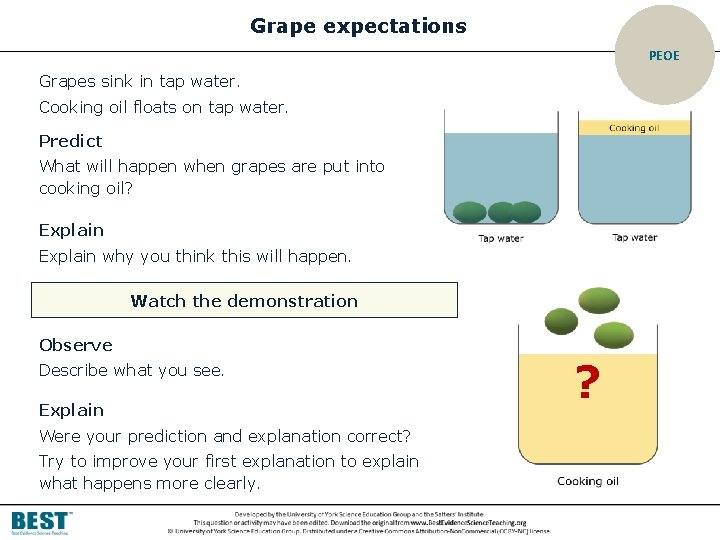
Grape expectations PEOE Grapes sink in tap water. Cooking oil floats on tap water. Predict What will happen when grapes are put into cooking oil? Explain why you think this will happen. Watch the demonstration Observe Describe what you see. Explain Were your prediction and explanation correct? Try to improve your first explanation to explain what happens more clearly. ?
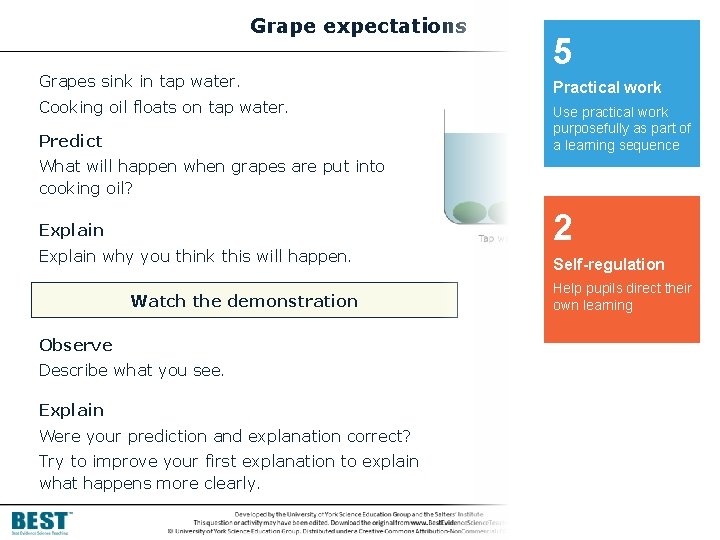
Grape expectations Grapes sink in tap water. Cooking oil floats on tap water. Predict 5 PEOE Practical work Use practical work purposefully as part of a learning sequence What will happen when grapes are put into cooking oil? Explain why you think this will happen. Watch the demonstration Observe Describe what you see. Explain Were your prediction and explanation correct? Try to improve your first explanation to explain what happens more clearly. 2 Self-regulation Help pupils direct their own learning ?

The team
BEST development partners The Salters’ Institute was founded in 1918. It plays a major role in the support of science teaching and the encouragement of young people to pursue careers in science. The University of York Science Education Group (UYSEG) was established in 1983 and has an international reputation for science education research and research-informed curriculum development. We are providing FREE online access to the resources in collaboration with STEM Learning to support science teaching.
BEST development team Department of Education Project Director Biology Lead Chemistry Lead Physics Lead Professor Judith Bennett Alistair Moore Helen Harden Peter Fairhurst
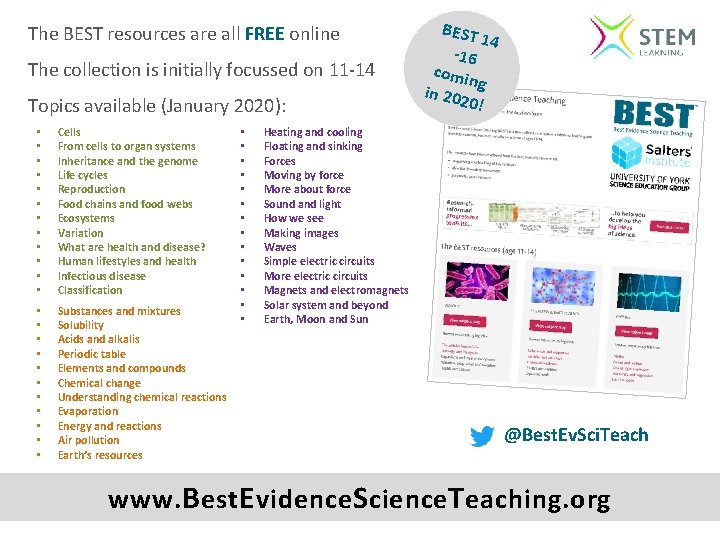
The BEST resources are all FREE online The collection is initially focussed on 11 -14 Topics available (January 2020): • • • Cells From cells to organ systems Inheritance and the genome Life cycles Reproduction Food chains and food webs Ecosystems Variation What are health and disease? Human lifestyles and health Infectious disease Classification • • • Substances and mixtures Solubility Acids and alkalis Periodic table Elements and compounds Chemical change Understanding chemical reactions Evaporation Energy and reactions Air pollution Earth’s resources • • • • BEST 14 -16 comi n in 20 g 20! Heating and cooling Floating and sinking Forces Moving by force More about force Sound and light How we see Making images Waves Simple electric circuits More electric circuits Magnets and electromagnets Solar system and beyond Earth, Moon and Sun @Best. Ev. Sci. Teach www. B est E vidence S cience T eaching. org
- Slides: 40