
Progression Step 2 Progression Step 2 Years 3
- Slides: 18
Progression Step 2
Progression Step 2 Years 3 and 4 “This matters to us” NHS and the census Helping us to be healthy
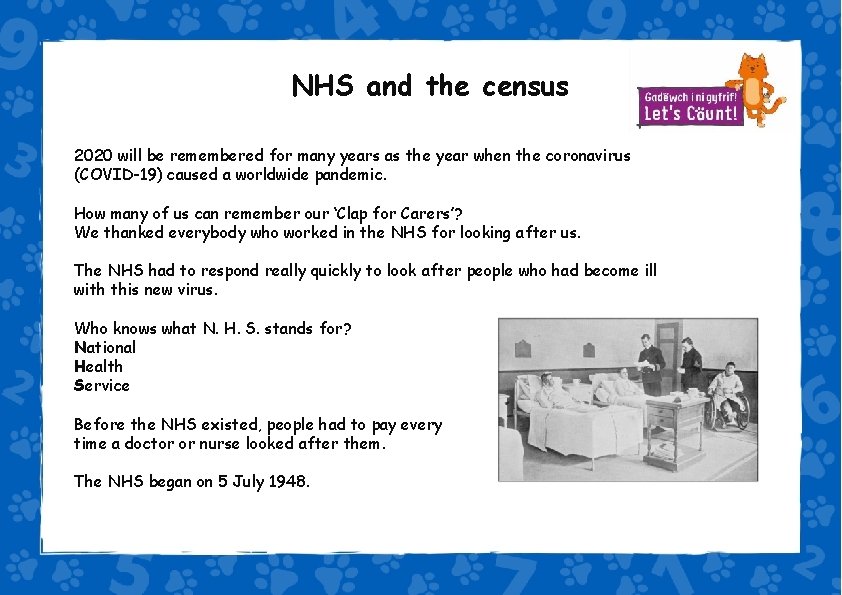
Key Stage 1 NHS and the census 2020 will be remembered for many years as the year when the coronavirus (COVID-19) caused a worldwide pandemic. How many of us can remember our ‘Clap for Carers’? We thanked everybody who worked in the NHS for looking after us. The NHS had to respond really quickly to look after people who had become ill with this new virus. Who knows what N. H. S. stands for? National Health Service Before the NHS existed, people had to pay every time a doctor or nurse looked after them. The NHS began on 5 July 1948.
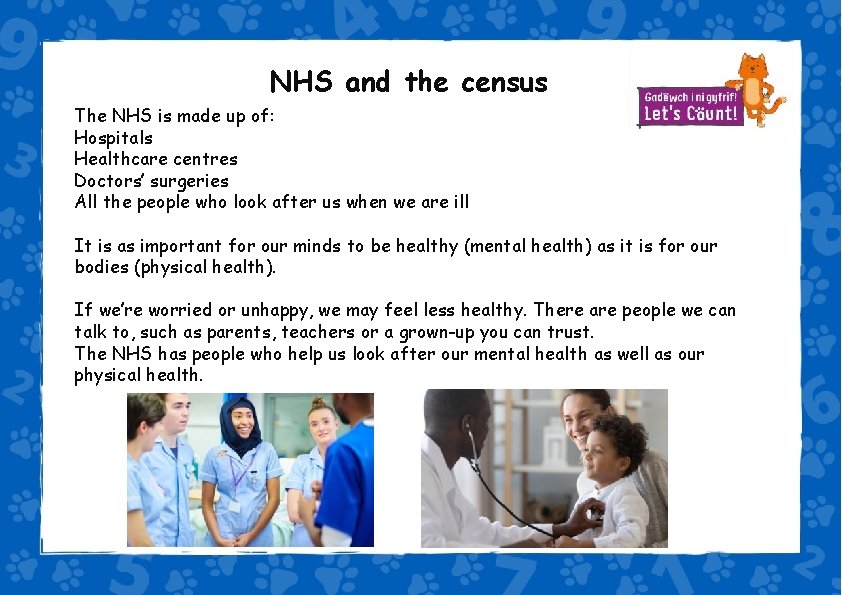
NHS and the census The NHS is made up of: Hospitals Healthcare centres Doctors’ surgeries All the people who look after us when we are ill It is as important for our minds to be healthy (mental health) as it is for our bodies (physical health). If we’re worried or unhappy, we may feel less healthy. There are people we can talk to, such as parents, teachers or a grown-up you can trust. The NHS has people who help us look after our mental health as well as our physical health.
NHS and the census To help the NHS plan for this, the NHS needs information. The government gives them this information. Does anybody know how the government finds out the information it needs to help plan for the NHS? From the census! Does anybody remember who runs the census? The Office for National Statistics (ONS)! Their job is to find out information and analyse statistics about the population, society and economy of England Wales.
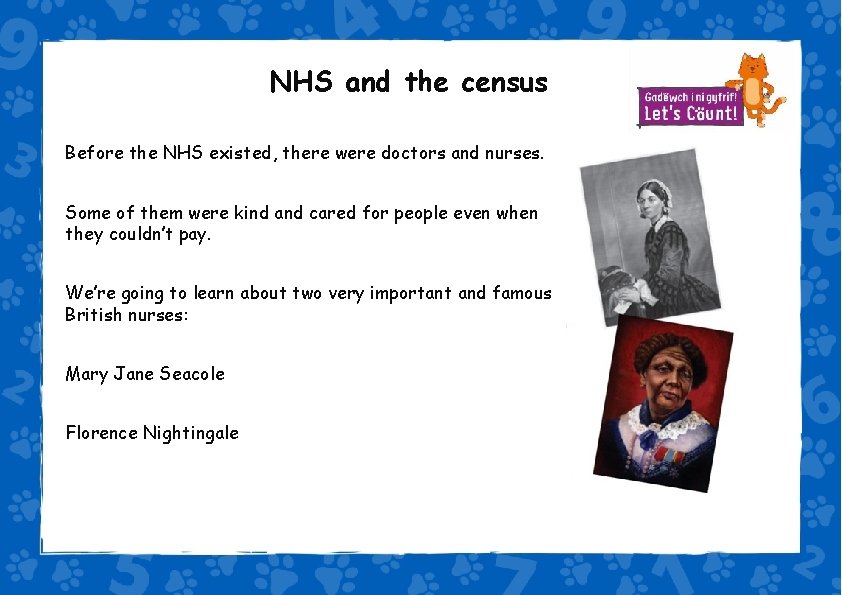
NHS and the census Before the NHS existed, there were doctors and nurses. Some of them were kind and cared for people even when they couldn’t pay. We’re going to learn about two very important and famous British nurses: Mary Jane Seacole Florence Nightingale
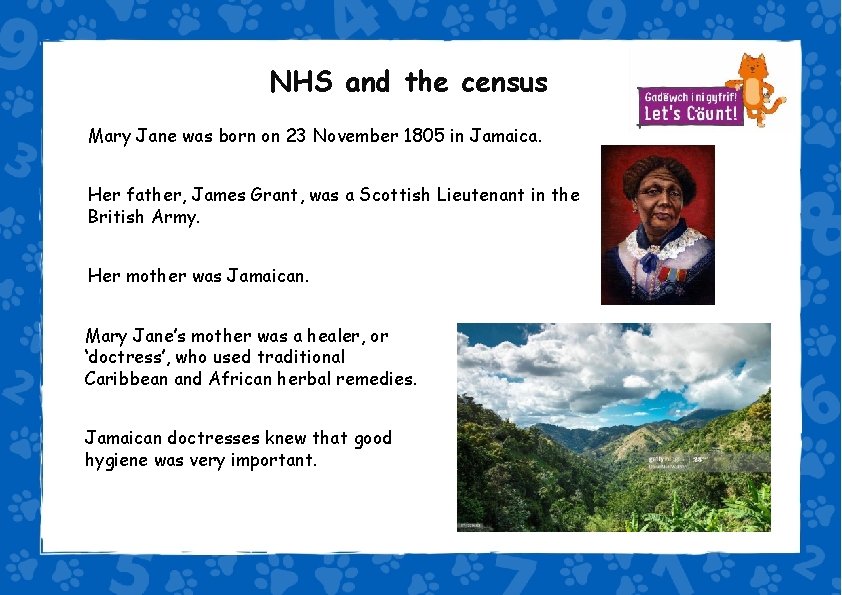
NHS and the census Mary Jane was born on 23 November 1805 in Jamaica. Her father, James Grant, was a Scottish Lieutenant in the British Army. Her mother was Jamaican. Mary Jane’s mother was a healer, or ‘doctress’, who used traditional Caribbean and African herbal remedies. Jamaican doctresses knew that good hygiene was very important.
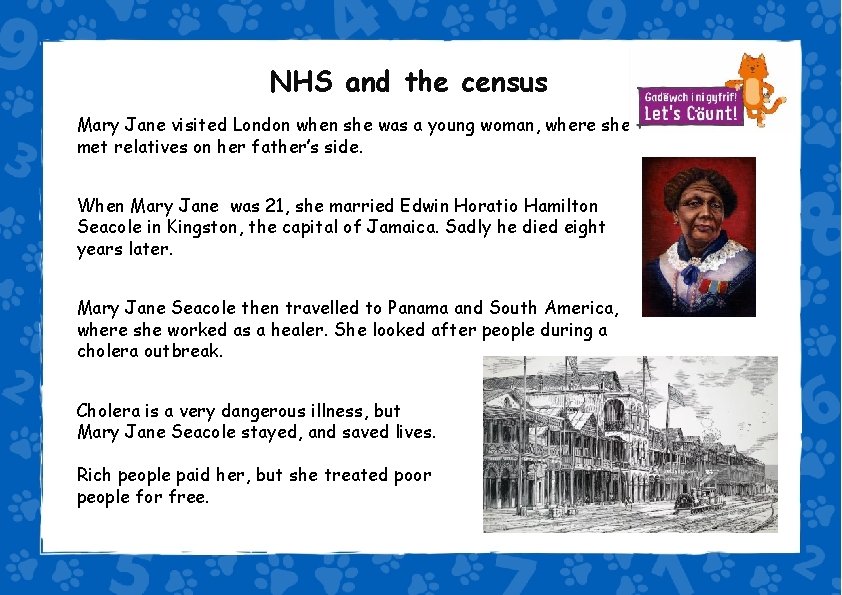
NHS and the census Mary Jane visited London when she was a young woman, where she met relatives on her father’s side. When Mary Jane was 21, she married Edwin Horatio Hamilton Seacole in Kingston, the capital of Jamaica. Sadly he died eight years later. Mary Jane Seacole then travelled to Panama and South America, where she worked as a healer. She looked after people during a cholera outbreak. Cholera is a very dangerous illness, but Mary Jane Seacole stayed, and saved lives. Rich people paid her, but she treated poor people for free.
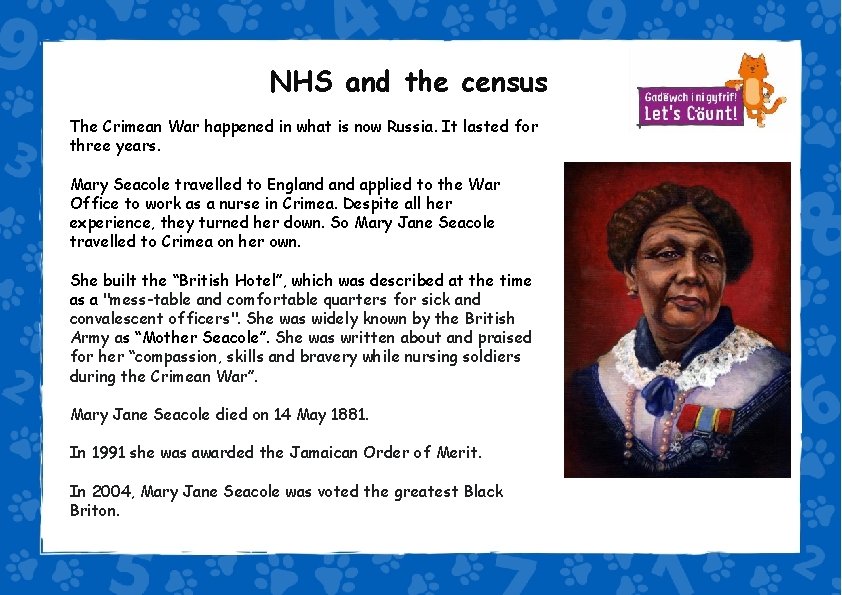
NHS and the census The Crimean War happened in what is now Russia. It lasted for three years. Mary Seacole travelled to England applied to the War Office to work as a nurse in Crimea. Despite all her experience, they turned her down. So Mary Jane Seacole travelled to Crimea on her own. She built the “British Hotel”, which was described at the time as a "mess-table and comfortable quarters for sick and convalescent officers". She was widely known by the British Army as “Mother Seacole”. She was written about and praised for her “compassion, skills and bravery while nursing soldiers during the Crimean War”. Mary Jane Seacole died on 14 May 1881. In 1991 she was awarded the Jamaican Order of Merit. In 2004, Mary Jane Seacole was voted the greatest Black Briton.
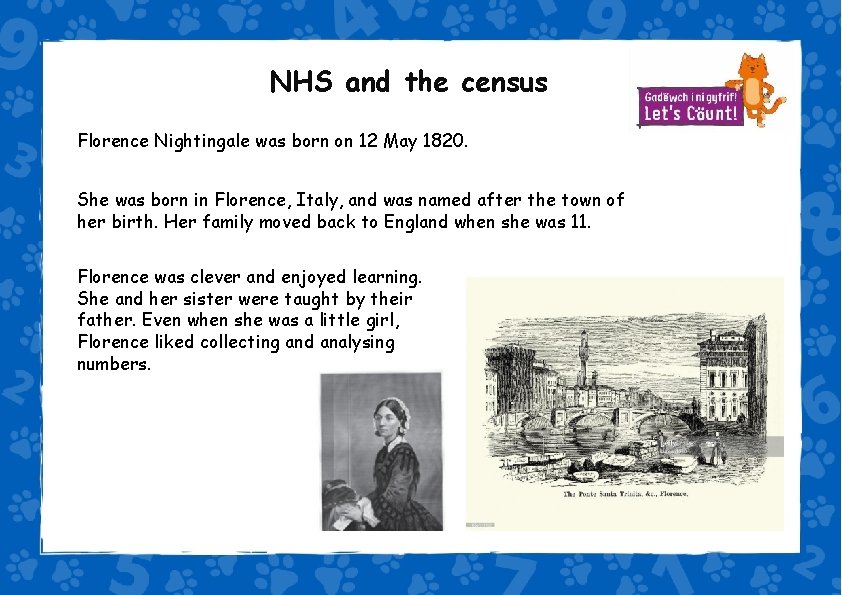
NHS and the census. Florence Nightingale was born on 12 May 1820. She was born in Florence, Italy, and was named after the town of her birth. Her family moved back to England when she was 11. Florence was clever and enjoyed learning. She and her sister were taught by their father. Even when she was a little girl, Florence liked collecting and analysing numbers.
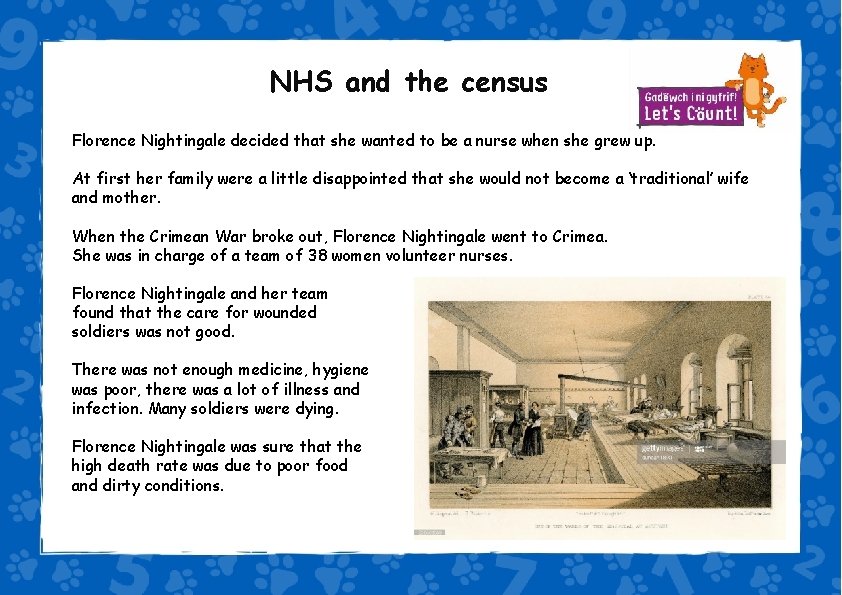
NHS and the census Florence Nightingale decided that she wanted to be a nurse when she grew up. At first her family were a little disappointed that she would not become a ‘traditional’ wife and mother. When the Crimean War broke out, Florence Nightingale went to Crimea. She was in charge of a team of 38 women volunteer nurses. Florence Nightingale and her team found that the care for wounded soldiers was not good. There was not enough medicine, hygiene was poor, there was a lot of illness and infection. Many soldiers were dying. Florence Nightingale was sure that the high death rate was due to poor food and dirty conditions.
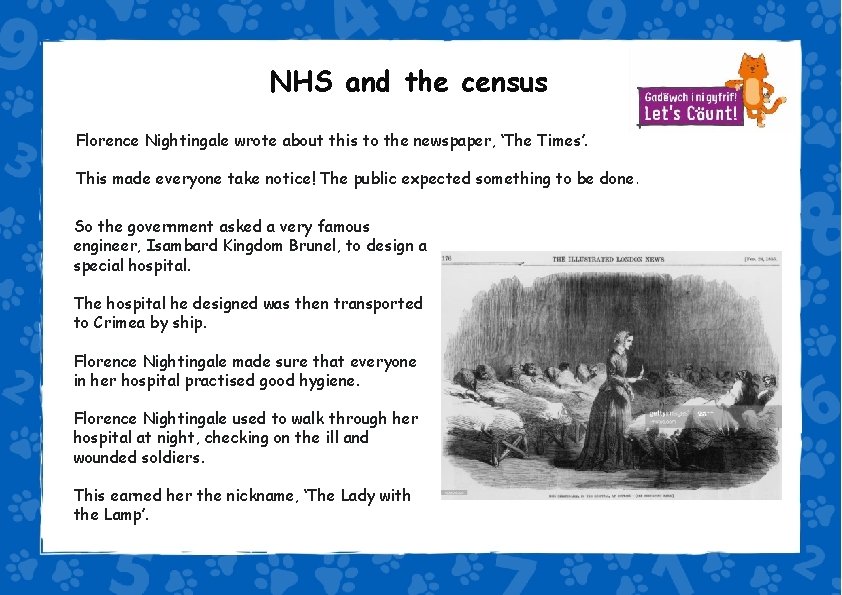
NHS and the census Florence Nightingale wrote about this to the newspaper, ‘The Times’. This made everyone take notice! The public expected something to be done. So the government asked a very famous engineer, Isambard Kingdom Brunel, to design a special hospital. The hospital he designed was then transported to Crimea by ship. Florence Nightingale made sure that everyone in her hospital practised good hygiene. Florence Nightingale used to walk through her hospital at night, checking on the ill and wounded soldiers. This earned her the nickname, ‘The Lady with the Lamp’.
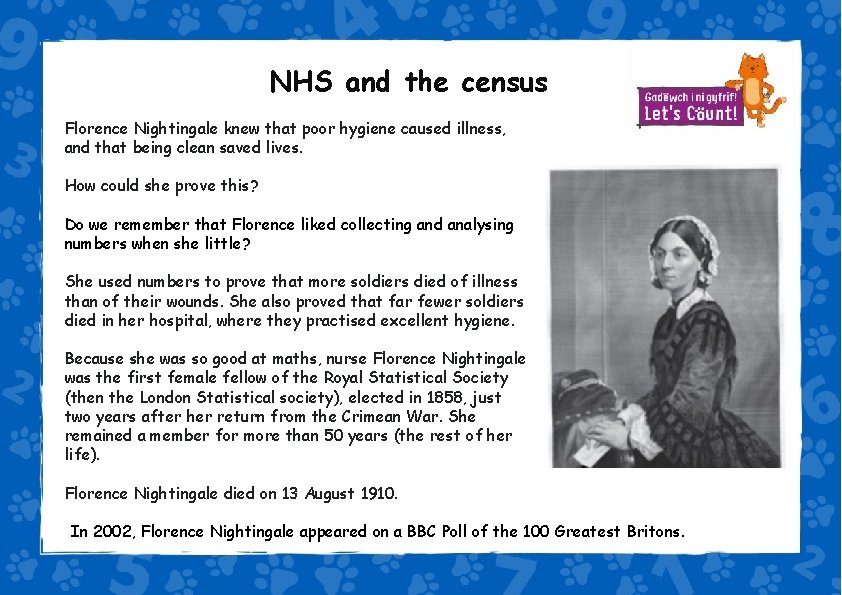
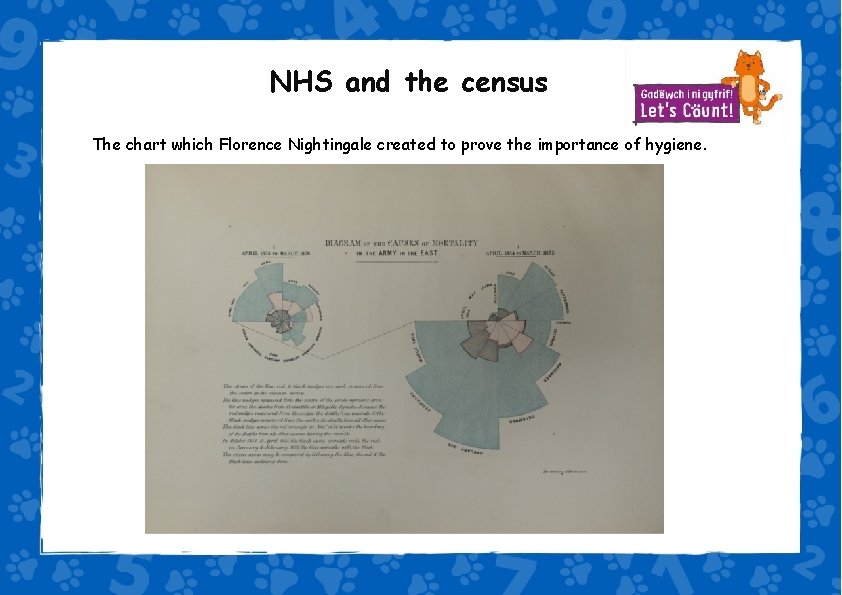
NHS and the census Florence Nightingale knew that poor hygiene caused illness, and that being clean saved lives. How could she prove this? Do we remember that Florence liked collecting and analysing numbers when she little? She used numbers to prove that more soldiers died of illness than of their wounds. She also proved that far fewer soldiers died in her hospital, where they practised excellent hygiene. Because she was so good at maths, nurse Florence Nightingale was the first female fellow of the Royal Statistical Society (then the London Statistical society), elected in 1858, just two years after her return from the Crimean War. She remained a member for more than 50 years (the rest of her life). Florence Nightingale died on 13 August 1910. In 2002, Florence Nightingale appeared on a BBC Poll of the 100 Greatest Britons.
NHS and the census The chart which Florence Nightingale created to prove the importance of hygiene.
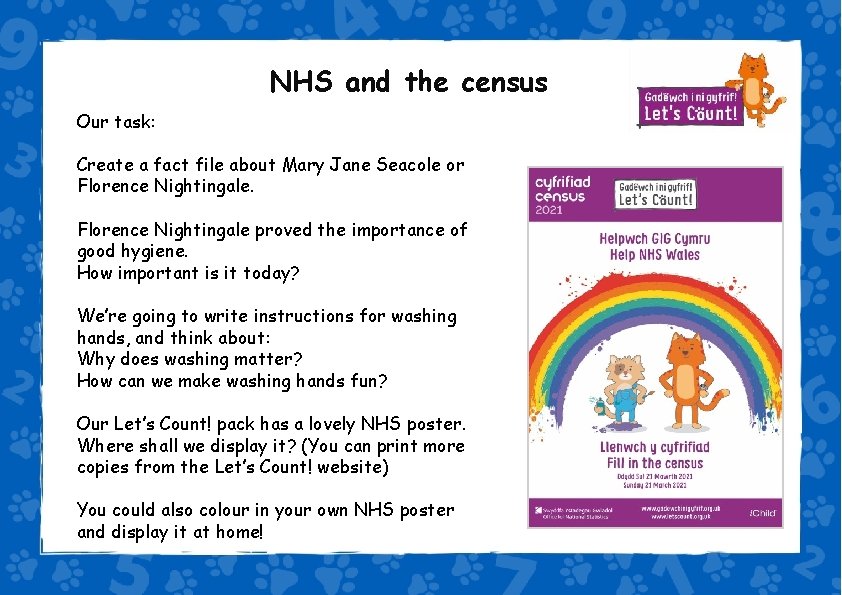
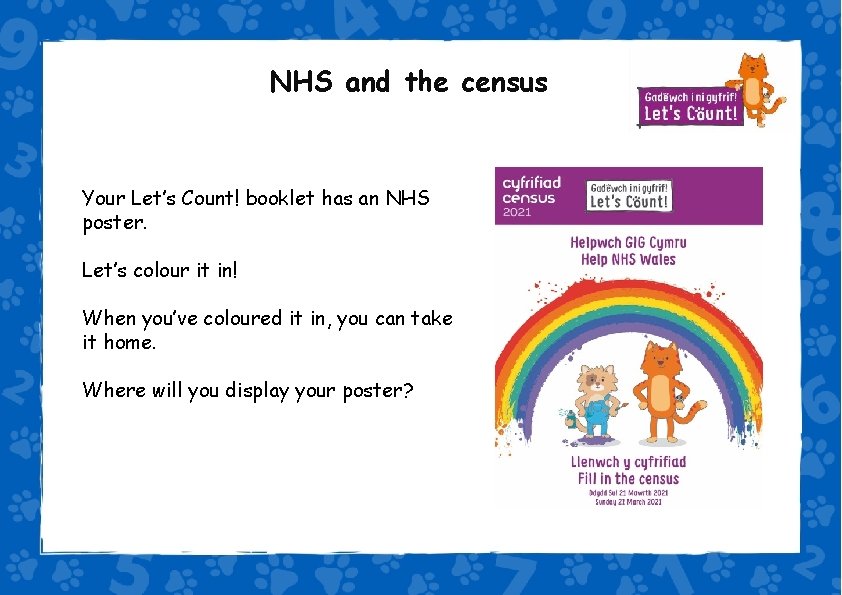
NHS and the census Our task: Create a fact file about Mary Jane Seacole or Florence Nightingale proved the importance of good hygiene. How important is it today? We’re going to write instructions for washing hands, and think about: Why does washing matter? How can we make washing hands fun? Our Let’s Count! pack has a lovely NHS poster. Where shall we display it? (You can print more copies from the Let’s Count! website) You could also colour in your own NHS poster and display it at home!
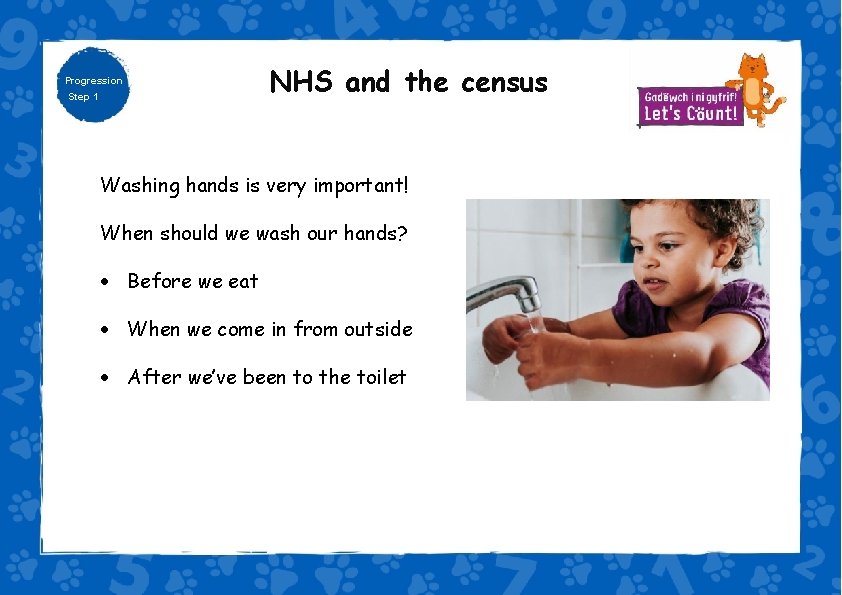
Progression Step 1 NHS and the census Washing hands is very important! When should we wash our hands? Before we eat When we come in from outside After we’ve been to the toilet
NHS and the census Your Let’s Count! booklet has an NHS poster. Let’s colour it in! When you’ve coloured it in, you can take it home. Where will you display your poster?