
PROGRESS WITH THE FOOD SAFETY COOPERATION FORUM FSCF
- Slides: 27
PROGRESS WITH THE FOOD SAFETY CO-OPERATION FORUM (FSCF) MRL INITIATIVE Steve J. Crossley B. Sc. , M. Sc. , CChem FRSC. , FIFST. Manager - Scientific Strategy, International and Food Surveillance Food Standards Australia New Zealand, Canberra, Australia 16/09/2020 1
OVERVIEW 1. What is the Food Safety Cooperation Forum (FSCF)? 2. Background to MRL harmonisation work 3. Outcomes of the two MRL Workshops 4. Guideline for import MRL harmonisation 5. Next steps
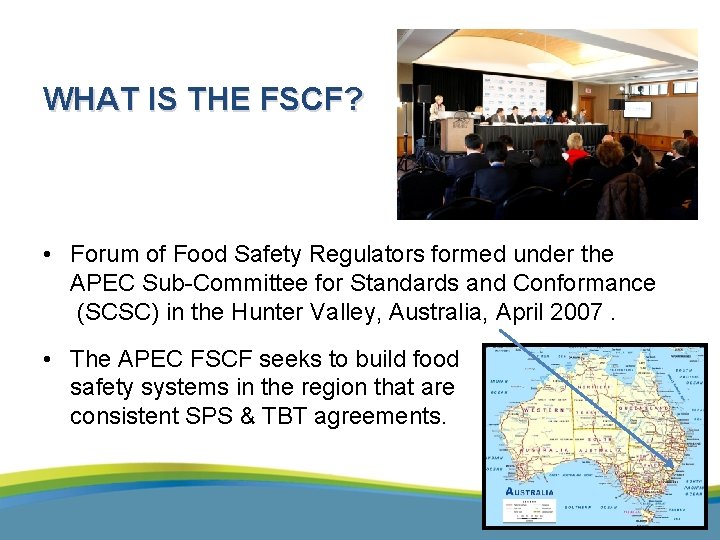
WHAT IS THE FSCF? • Forum of Food Safety Regulators formed under the APEC Sub-Committee for Standards and Conformance (SCSC) in the Hunter Valley, Australia, April 2007. • The APEC FSCF seeks to build food safety systems in the region that are consistent SPS & TBT agreements.
WHAT IS THE FSCF? (CONTINUED) • APEC member economies agreed to work together to build robust food safety systems; to accelerate harmonisation with international standards to improve public health and facilitate trade, strengthen capacity building activities & information sharing. • The APEC FSCF is co-chaired by Australia (FSANZ) and China (AQSIQ). • Since the APEC FSCF was formed, food safety has been recognised as a high priority for APEC.
BACKGROUND TO THE MRL HARMONISATION WORK APEC Pesticide MRL Roadmap • Development of a MRLs Roadmap document in June 2014, proposed initial 2 year timeframe • Aligns with APEC Regulatory Cooperation Implementation Action Plan
APEC Pesticide MRL Roadmap (continued) • Aims for greater regulatory convergence of MRLs across APEC region, consistent with alignment to international standards • Developed a set of 4 broad principles for agreement and adoption to progress harmonisation of pesticide MRLs • Principles agreed at Beijing FSCF 2014
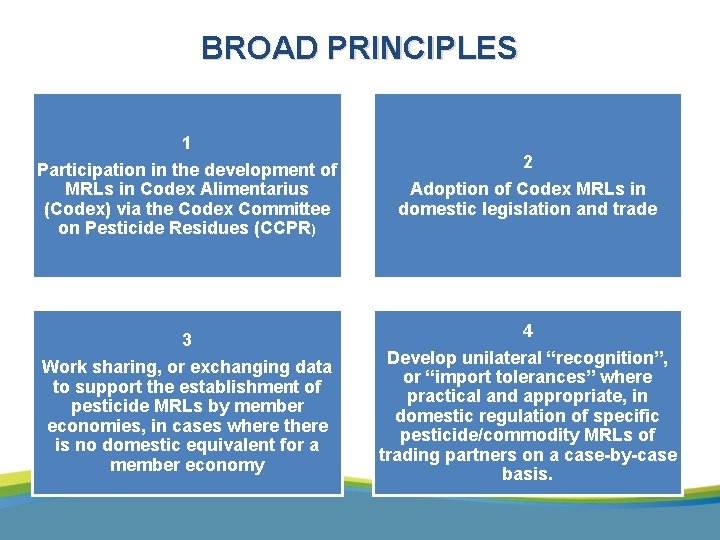
BROAD PRINCIPLES 1 Participation in the development of MRLs in Codex Alimentarius (Codex) via the Codex Committee on Pesticide Residues (CCPR) 3 Work sharing, or exchanging data to support the establishment of pesticide MRLs by member economies, in cases where there is no domestic equivalent for a member economy 2 Adoption of Codex MRLs in domestic legislation and trade 4 Develop unilateral “recognition”, or “import tolerances” where practical and appropriate, in domestic regulation of specific pesticide/commodity MRLs of trading partners on a case-by-case basis.
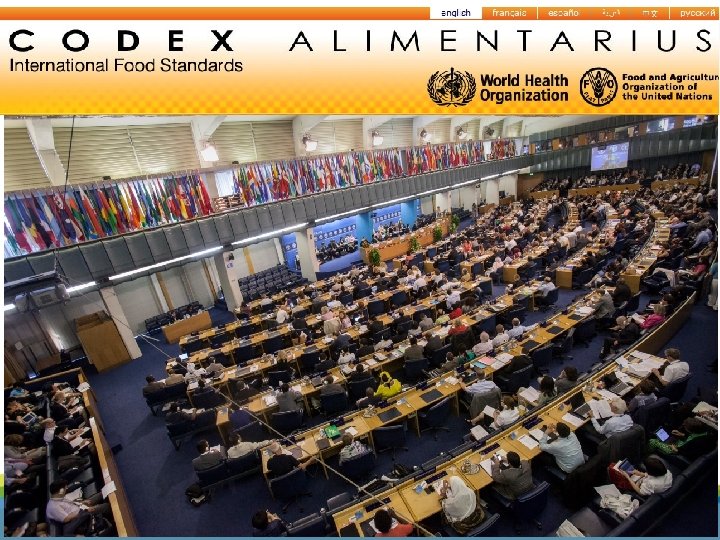
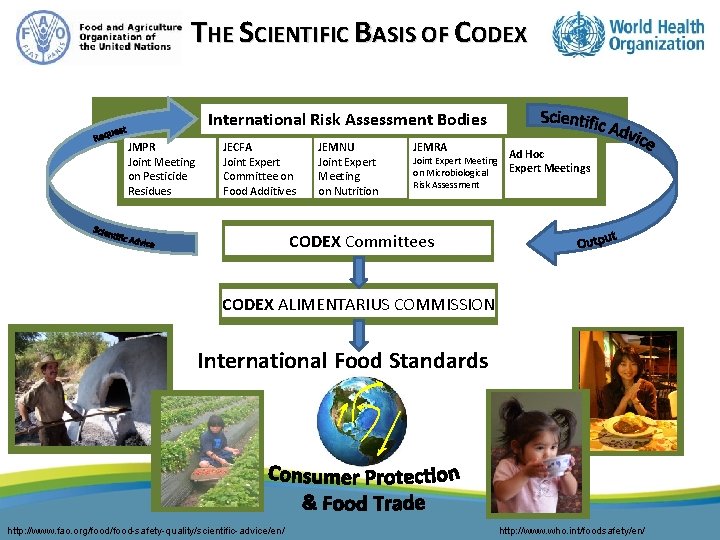
THE SCIENTIFIC BASIS OF CODEX International Risk Assessment Bodies JMPR Joint Meeting on Pesticide Residues JECFA Joint Expert Committee on Food Additives JEMNU Joint Expert Meeting on Nutrition JEMRA Joint Expert Meeting on Microbiological Risk Assessment Ad Hoc Expert Meetings CODEX Committees CODEX ALIMENTARIUS COMMISSION International Food Standards http: //www. fao. org/food-safety-quality/scientific-advice/en/ http: //www. who. int/foodsafety/en/
HARMONISING IMPORT MRLS • Two years project funded by Australia (2015 -16) • Pilot project on harmonisation of wine/wine grape MRLs • Second pilot project on tropical fruit (mango) MRLs • Facilitating work through development of Guideline on harmonisation of MRLs for imported foods in APEC member economies • The outcomes of this project are being fed into the broader APEC FSCF Regulatory Cooperation work. •
LINKAGES • Complements work being undertaken by APEC Wine Regulatory Forum • Links to work of the World Wine Trade Group • Builds on the consistent international standard development framework for pesticides promoted by Codex Alimentarius Commission • Complements objectives of APEC FSCF Partnership Training Institute Network (PTIN)
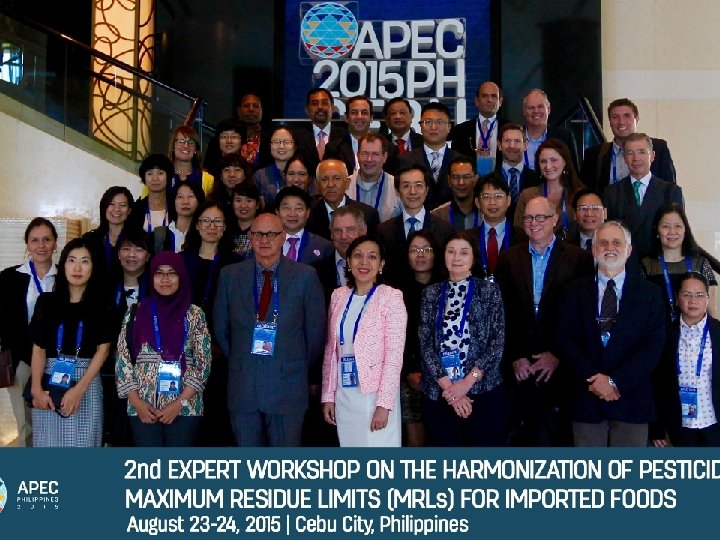
OUTCOMES OF 1 ST EXPERT WORKSHOP, SYDNEY - APRIL 2015 Within APEC economies: • Identified trade barriers and impacts when different MRLs for pesticide/food commodities • Identified key factors and/or impediments around harmonising MRLs within economies • Agreed on principles, definitions, processes and minimum data for guideline on harmonisation of MRLs • Agreed on benefits, components and structure of a guideline • Prepared and consulted on draft guideline document
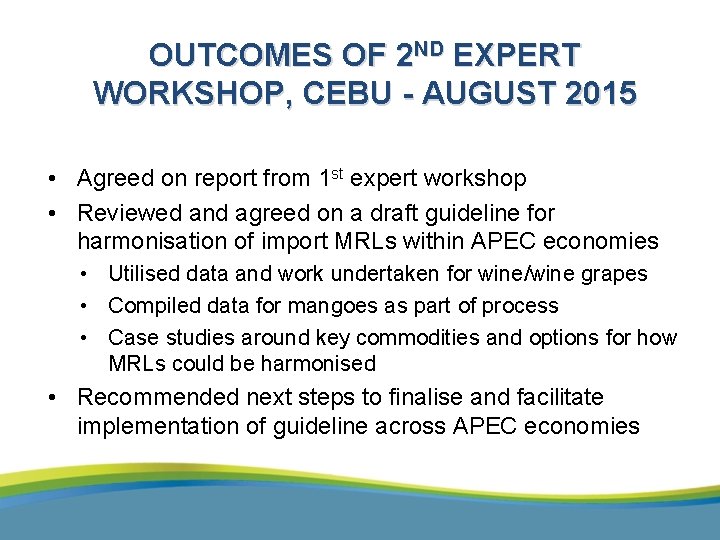
OUTCOMES OF 2 ND EXPERT WORKSHOP, CEBU - AUGUST 2015 • Agreed on report from 1 st expert workshop • Reviewed and agreed on a draft guideline for harmonisation of import MRLs within APEC economies • Utilised data and work undertaken for wine/wine grapes • Compiled data for mangoes as part of process • Case studies around key commodities and options for how MRLs could be harmonised • Recommended next steps to finalise and facilitate implementation of guideline across APEC economies
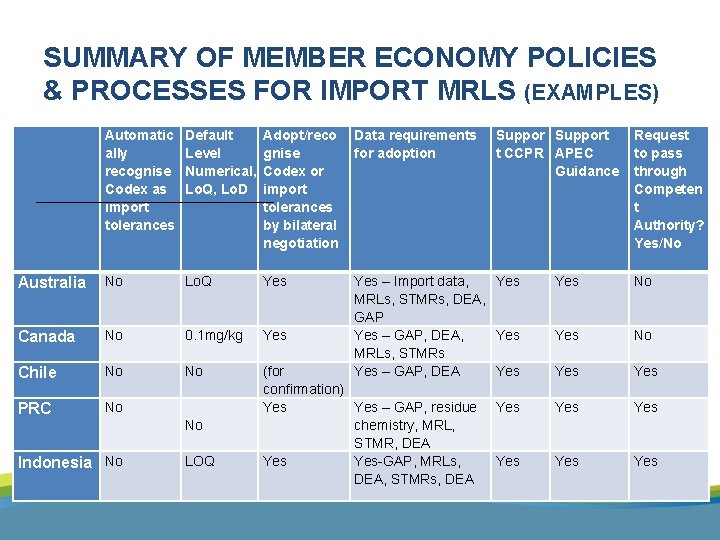
SUMMARY OF MEMBER ECONOMY POLICIES & PROCESSES FOR IMPORT MRLS (EXAMPLES) Automatic ally recognise Codex as import tolerances Default Level Numerical, Lo. Q, Lo. D Adopt/reco gnise Codex or import tolerances by bilateral negotiation Data requirements for adoption Australia No Lo. Q Yes No Canada No 0. 1 mg/kg Yes No Chile No No Yes – Import data, Yes MRLs, STMRs, DEA, GAP Yes – GAP, DEA, Yes MRLs, STMRs Yes – GAP, DEA Yes Yes PRC No (for confirmation) Yes – GAP, residue chemistry, MRL, STMR, DEA Yes-GAP, MRLs, DEA, STMRs, DEA Yes Yes Yes Indonesia No LOQ Support t CCPR APEC Guidance Request to pass through Competen t Authority? Yes/No
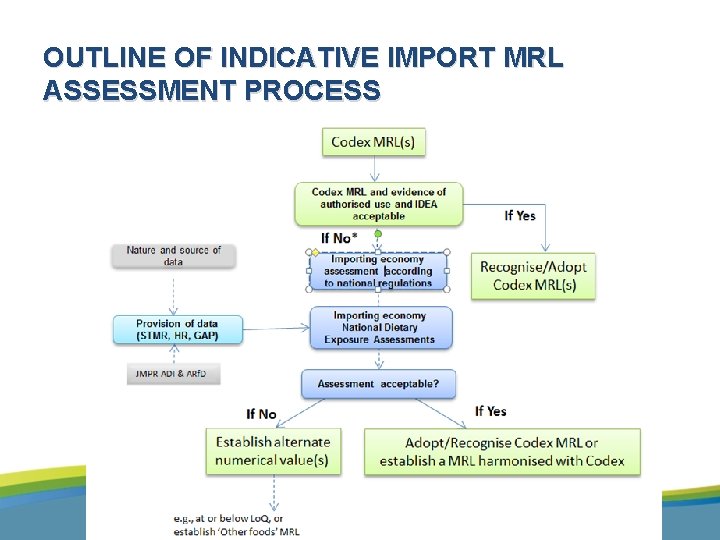
GUIDELINES FOR IMPORT MRL HARMONISATION “Framework within which science-based standards can be developed and applied uniformly and transparently across APEC economies”
OUTLINE OF INDICATIVE IMPORT MRL ASSESSMENT PROCESS
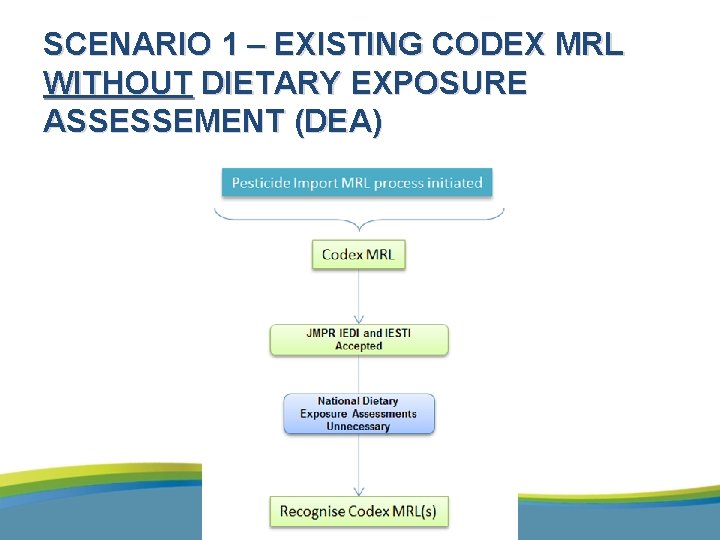
SCENARIO 1 – EXISTING CODEX MRL WITHOUT DIETARY EXPOSURE ASSESSEMENT (DEA)
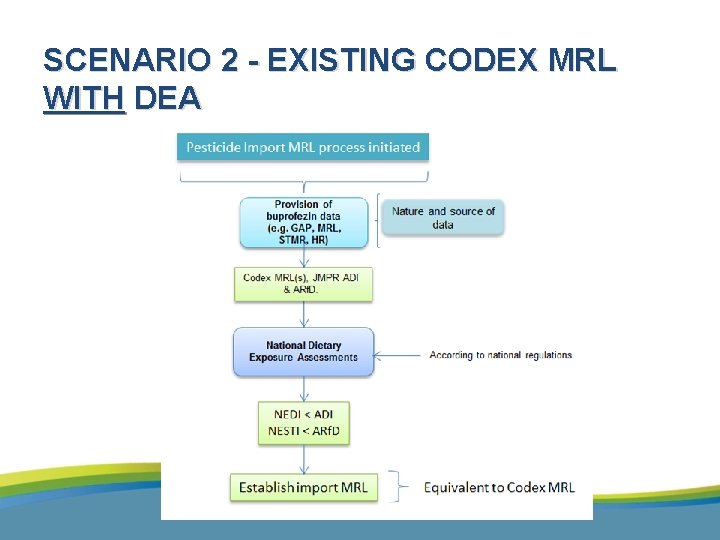
SCENARIO 2 - EXISTING CODEX MRL WITH DEA
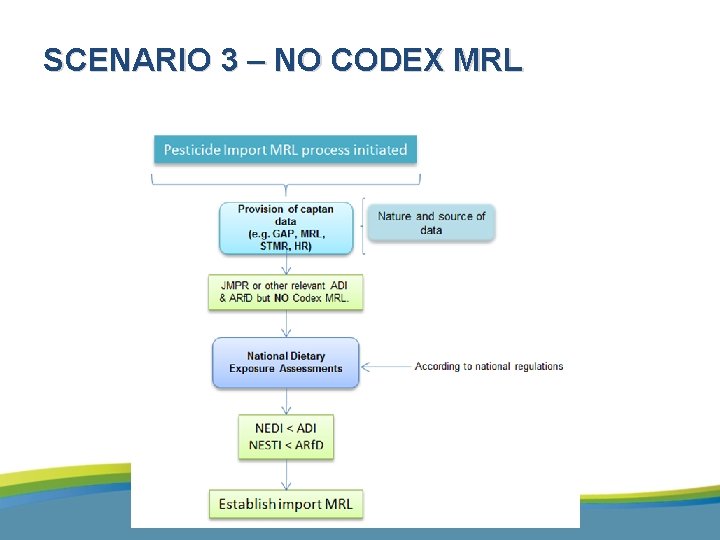
SCENARIO 3 – NO CODEX MRL
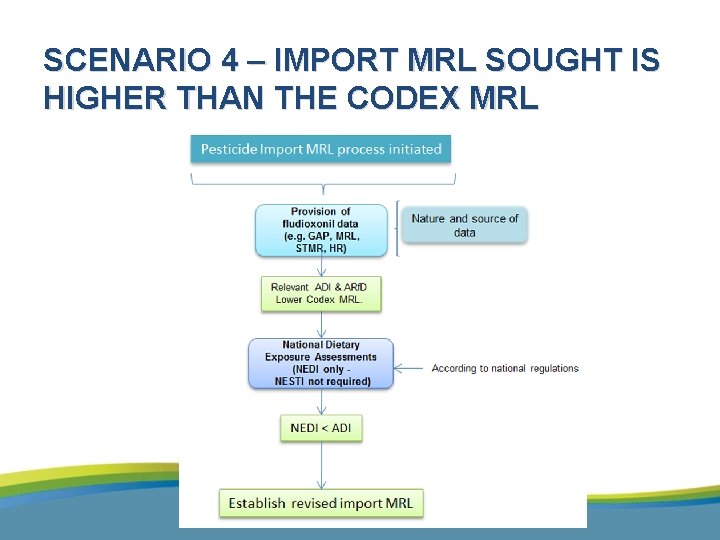
SCENARIO 4 – IMPORT MRL SOUGHT IS HIGHER THAN THE CODEX MRL
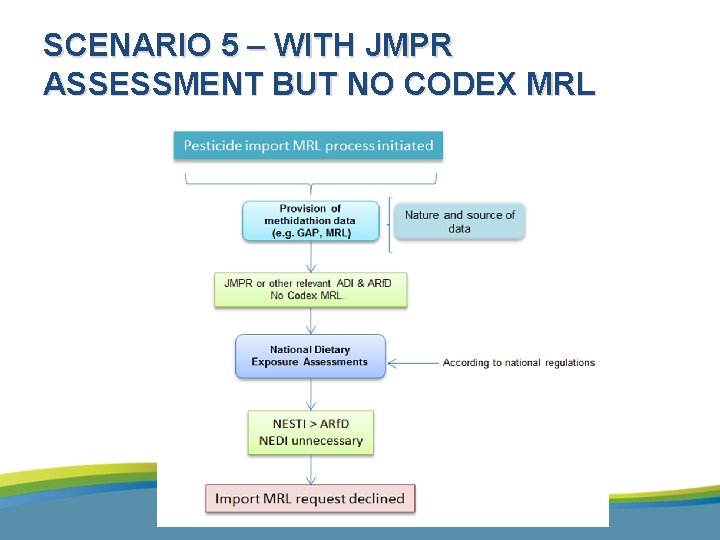
SCENARIO 5 – WITH JMPR ASSESSMENT BUT NO CODEX MRL
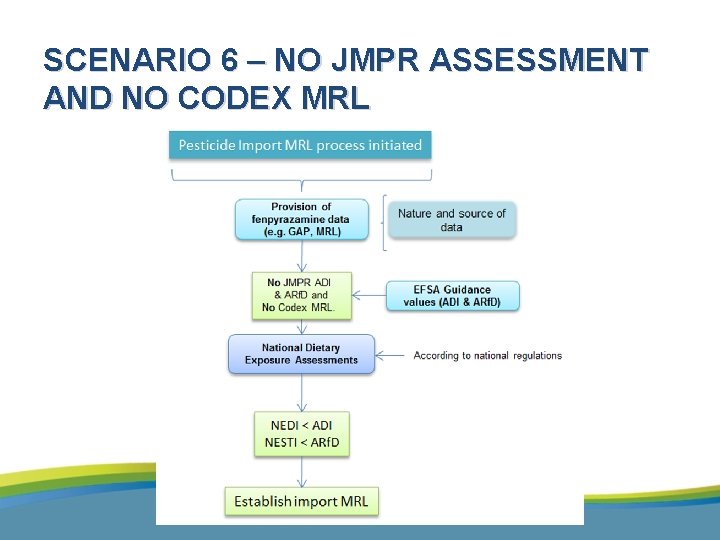
SCENARIO 6 – NO JMPR ASSESSMENT AND NO CODEX MRL
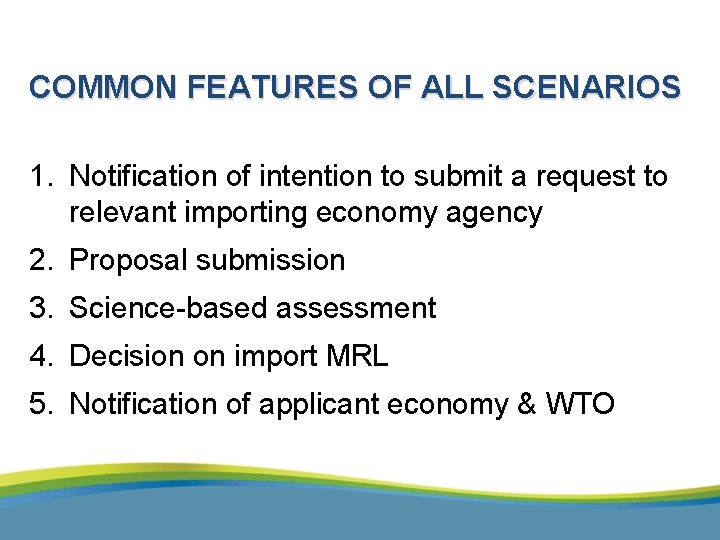
COMMON FEATURES OF ALL SCENARIOS 1. Notification of intention to submit a request to relevant importing economy agency 2. Proposal submission 3. Science-based assessment 4. Decision on import MRL 5. Notification of applicant economy & WTO
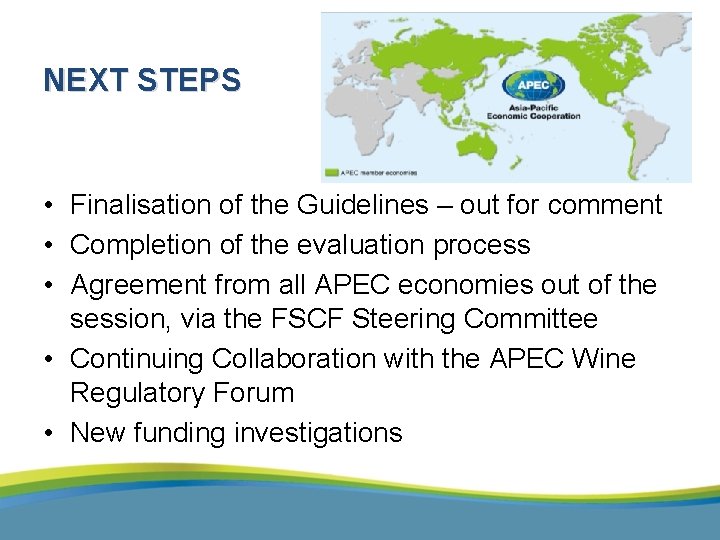
NEXT STEPS • Finalisation of the Guidelines – out for comment • Completion of the evaluation process • Agreement from all APEC economies out of the session, via the FSCF Steering Committee • Continuing Collaboration with the APEC Wine Regulatory Forum • New funding investigations
IMPLEMENTATION (UNDER CONSIDERATION) • Technical capacity building eg. DEA workshop • Translation of the Guidelines? • Further work on pilot commodities (ie. wine & wine grapes, mango) • Identify other import MRL priorities • Road test with economies • Impediments • Legislative issues • Information requirements
Any Questions or comments? Thanks to many including: Lisa Tengdahl, Paul Brent, Kevin Broderick, Scott Crerar, Marion Healy.