
Progress Towards a Medical Image through CFD Analysis
- Slides: 1
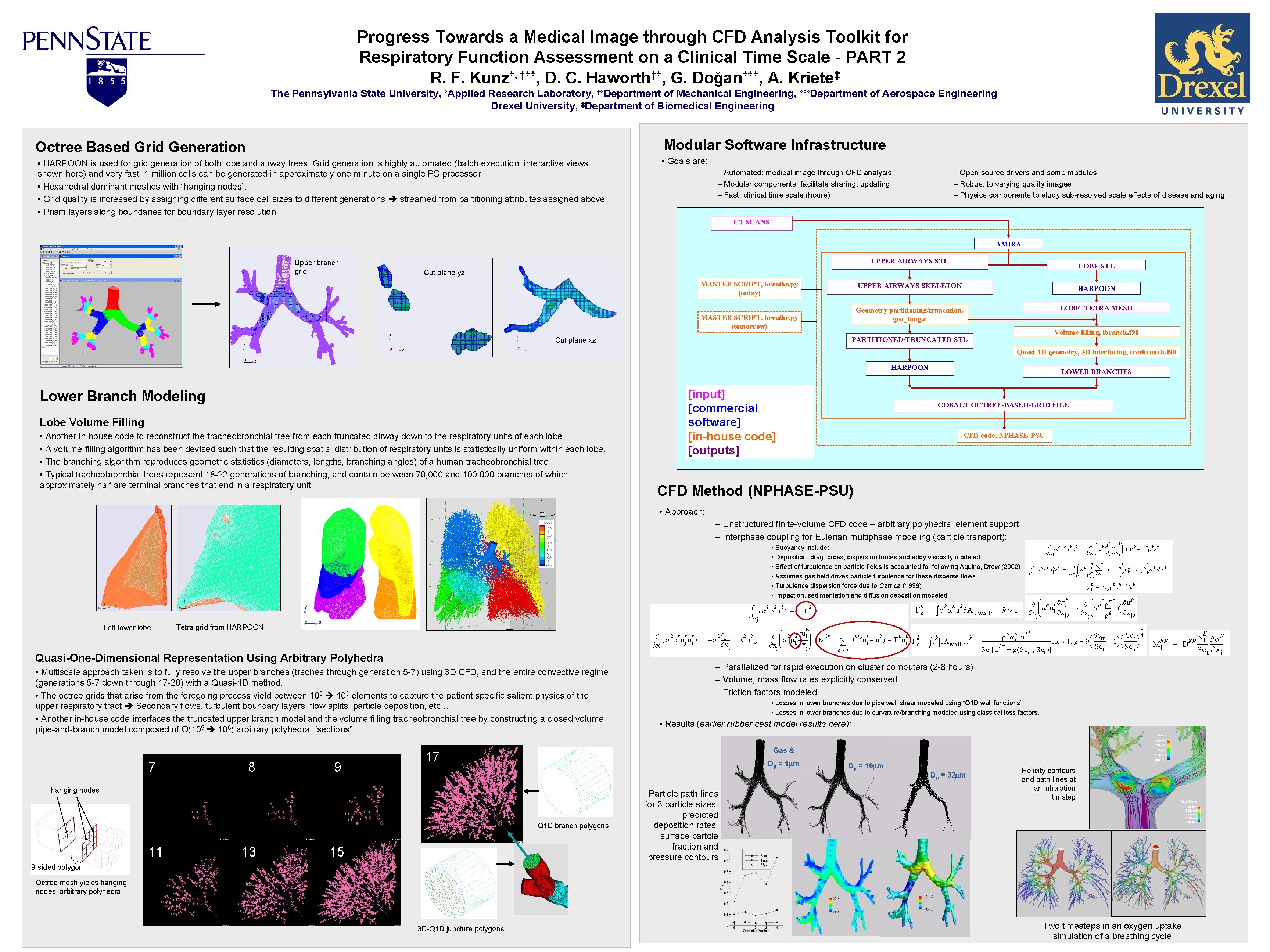
Progress Towards a Medical Image through CFD Analysis Toolkit for Respiratory Function Assessment on a Clinical Time Scale - PART 2 R. F. Kunz†, †††, D. C. Haworth††, G. Doğan†††, A. Kriete‡ The Pennsylvania State University, †Applied Research Laboratory, ††Department of Mechanical Engineering, †††Department of Aerospace Engineering Drexel University, ‡Department of Biomedical Engineering Octree Based Grid Generation Modular Software Infrastructure • HARPOON is used for grid generation of both lobe and airway trees. Grid generation is highly automated (batch execution, interactive views shown here) and very fast: 1 million cells can be generated in approximately one minute on a single PC processor. • Hexahedral dominant meshes with “hanging nodes”. • Grid quality is increased by assigning different surface cell sizes to different generations streamed from partitioning attributes assigned above. • Prism layers along boundaries for boundary layer resolution. • Goals are: – Automated: medical image through CFD analysis – Modular components: facilitate sharing, updating – Fast: clinical time scale (hours) – Open source drivers and some modules – Robust to varying quality images – Physics components to study sub-resolved scale effects of disease and aging CT SCANS AMIRA Upper branch grid UPPER AIRWAYS STL LOBE STL Cut plane yz MASTER SCRIPT, breathe. py (today) MASTER SCRIPT, breathe. py (tomorrow) UPPER AIRWAYS SKELETON HARPOON Geometry partitioning/truncation, geo_lung. c LOBE TETRA MESH Volume filling, lbranch. f 90 PARTITIONED/TRUNCATED STL Cut plane xz Quasi-1 D geometry, 3 D interfacing, treebranch. f 90 HARPOON Lower Branch Modeling Lobe Volume Filling • Another in-house code to reconstruct the tracheobronchial tree from each truncated airway down to the respiratory units of each lobe. • A volume-filling algorithm has been devised such that the resulting spatial distribution of respiratory units is statistically uniform within each lobe. • The branching algorithm reproduces geometric statistics (diameters, lengths, branching angles) of a human tracheobronchial tree. • Typical tracheobronchial trees represent 18 -22 generations of branching, and contain between 70, 000 and 100, 000 branches of which approximately half are terminal branches that end in a respiratory unit. [input] [commercial software] [in-house code] [outputs] LOWER BRANCHES COBALT OCTREE-BASED-GRID FILE CFD code, NPHASE-PSU CFD Method (NPHASE-PSU) • Approach: – Unstructured finite-volume CFD code – arbitrary polyhedral element support – Interphase coupling for Eulerian multiphase modeling (particle transport): • Buoyancy included • Deposition, drag forces, dispersion forces and eddy viscosity modeled • Effect of turbulence on particle fields is accounted for following Aquino, Drew (2002) • Assumes gas field drives particle turbulence for these disperse flows • Turbulence dispersion force due to Carrica (1999) • Impaction, sedimentation and diffusion deposition modeled Left lower lobe Tetra grid from HARPOON Quasi-One-Dimensional Representation Using Arbitrary Polyhedra • Multiscale approach taken is to fully resolve the upper branches (trachea through generation 5 -7) using 3 D CFD, and the entire convective regime (generations 5 -7 down through 17 -20) with a Quasi-1 D method. • The octree grids that arise from the foregoing process yield between 105 106 elements to capture the patient specific salient physics of the upper respiratory tract Secondary flows, turbulent boundary layers, flow splits, particle deposition, etc… • Another in-house code interfaces the truncated upper branch model and the volume filling tracheobronchial tree by constructing a closed volume pipe-and-branch model composed of O(105 106) arbitrary polyhedral “sections”. 7 8 9 • Results (earlier rubber cast model results here): 17 Dp = 1 mm Q 1 D branch polygons 13 • Losses in lower branches due to pipe wall shear modeled using “Q 1 D wall functions” • Losses in lower branches due to curvature/branching modeled using classical loss factors. Gas & hanging nodes 11 – Parallelized for rapid execution on cluster computers (2 -8 hours) – Volume, mass flow rates explicitly conserved – Friction factors modeled: 15 Particle path lines for 3 particle sizes, predicted deposition rates, surface partcle fraction and pressure contours Dp = 16 mm Dp = 32 mm Helicity contours and path lines at an inhalation timstep 9 -sided polygon Octree mesh yields hanging nodes, arbitrary polyhedra 3 D-Q 1 D juncture polygons Two timesteps in an oxygen uptake simulation of a breathing cycle