
Progress report Performance of BSW magnets powering for


Progress report Performance of BSW magnets powering for PSB injection chicane T. Todorčević and D. Aguglia TE-EPC-FPC Acknowledgments: Luis Miguel de Paco Soto and Achille Nicoletti 9 th of October 2019 2
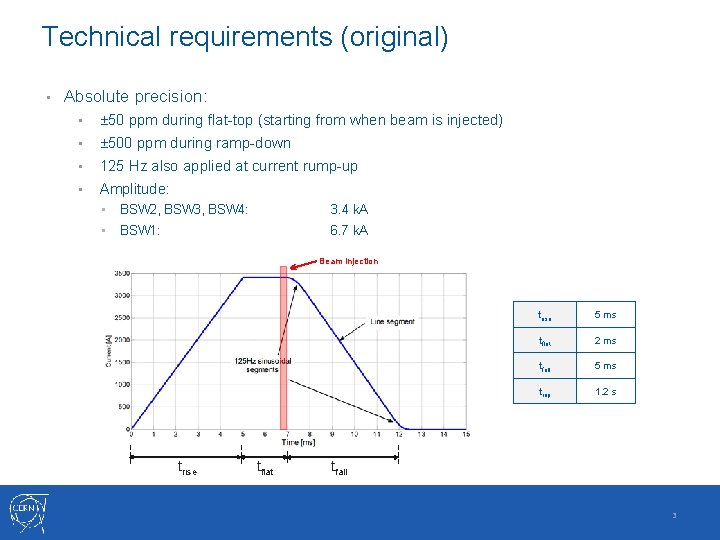
Technical requirements (original) • Absolute precision: • ± 50 ppm during flat-top (starting from when beam is injected) • ± 500 ppm during ramp-down • 125 Hz also applied at current rump-up • Amplitude: • BSW 2, BSW 3, BSW 4: 3. 4 k. A • BSW 1: 6. 7 k. A Beam injection trise tflat trise 5 ms tflat 2 ms tfall 5 ms trep 1. 2 s tfall 3
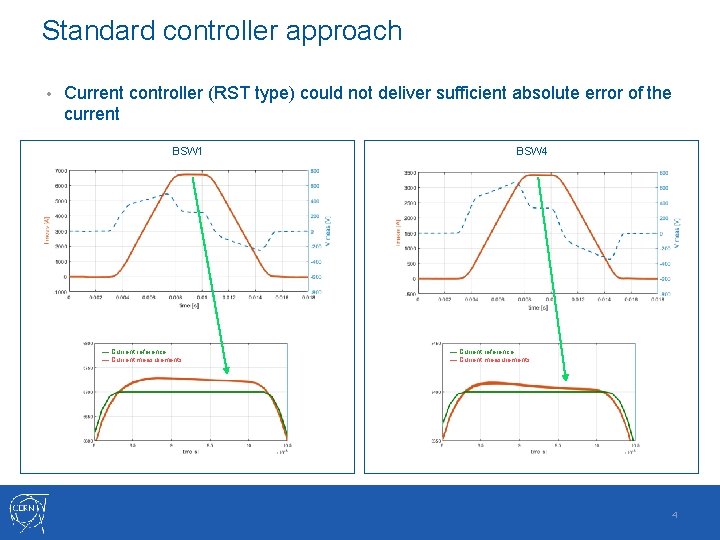
Standard controller approach • Current controller (RST type) could not deliver sufficient absolute error of the current BSW 1 ― Current reference ― Current measurements BSW 4 ― Current reference ― Current measurements 4
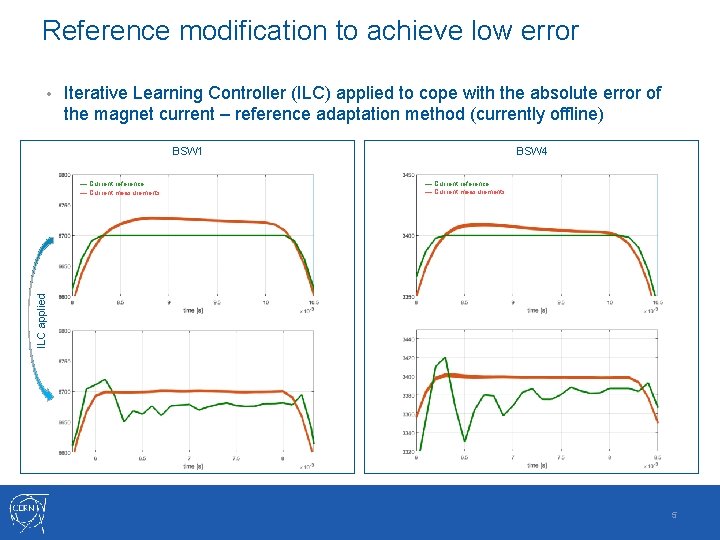
Reference modification to achieve low error • Iterative Learning Controller (ILC) applied to cope with the absolute error of the magnet current – reference adaptation method (currently offline) BSW 1 ― Current reference ― Current measurements ILC applied ― Current reference ― Current measurements BSW 4 5
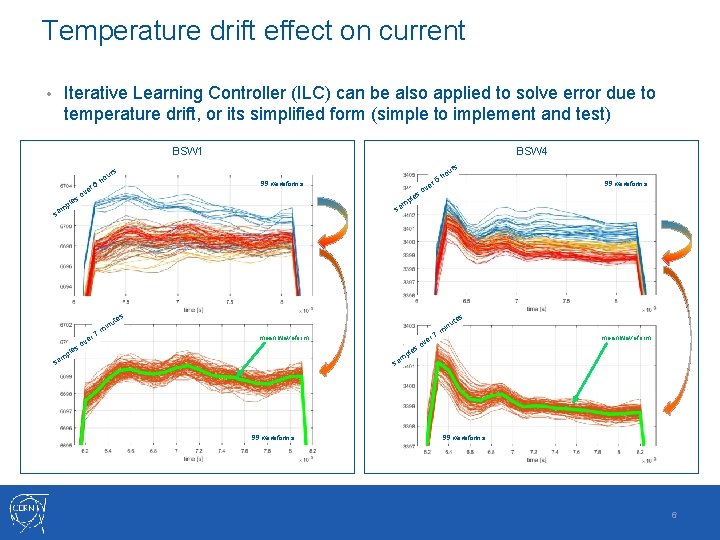
Temperature drift effect on current Iterative Learning Controller (ILC) can be also applied to solve error due to temperature drift, or its simplified form (simple to implement and test) • BSW 1 er v so rs ou 6 h BSW 4 99 waveforms le mp r 7 ve rs ou 99 waveforms e ov m sa sa o les s ple h r 5 tes nu i m mean waveform mp r 7 nu mi tes ve so ple mean waveform m sa sa 99 waveforms 6
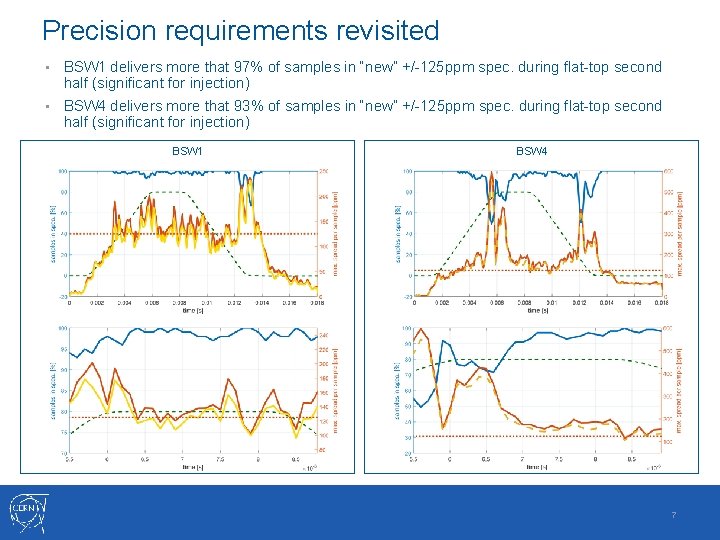
Precision requirements revisited • BSW 1 delivers more that 97% of samples in “new” +/-125 ppm spec. during flat-top second half (significant for injection) • BSW 4 delivers more that 93% of samples in “new” +/-125 ppm spec. during flat-top second half (significant for injection) BSW 1 BSW 4 7
Conclusions • Iterative Learning Controller (ILC) is able to deliver low absolute error, including error due to temperature drift • ILC doesn’t have to be implemented in its sample-to-sample form – heavy for the controller and implementation, but rather as a simple correction factor applied on the flat-top • Achieved precision for BSW 1 is in range of +/-150 ppm (>97% in +/-125 ppm spec. ) for the 2 nd half of the flat-top; and +/-240 ppm over the entire current pulse • Achieved precision for BSW 4 is in range of +/-200 ppm (>93% in +/-125 ppm spec. ) for the 2 nd half of the flat-top; and +/-420 ppm over the 2 nd half of the current pulse • Voltage measurement to be checked deeply for effect on current repeatability 8

- Slides: 9