
Progress Report of OFDMbased Agile Baseband Transceiver for
Progress Report of OFDM-based Agile Baseband Transceiver for Spectrum Pooling Wireless Systems Advisor : Tzi-Dar Chiueh Student : Jui-Ping Lien Date : Nov 29 th , 2004 NTU Confidential
Outline • Overview of Spectrum Pooling System – Feature – Specification • Transmit Power Spectrum – Two approaches of reducing signal sidelobe • Simulation Result – SISO perfect channel estimation in AWGN • Conclusion • Future Work • Reference NTU Confidential 2
Overview of Spectrum Pooling System NTU Confidential
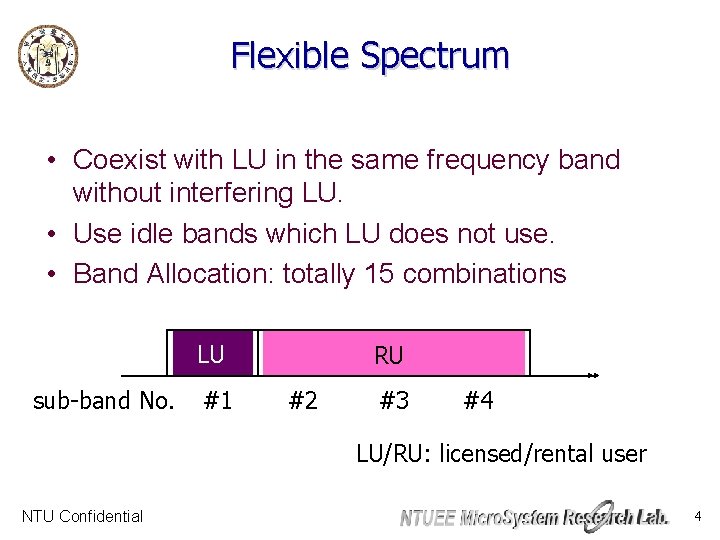
Flexible Spectrum • Coexist with LU in the same frequency band without interfering LU. • Use idle bands which LU does not use. • Band Allocation: totally 15 combinations sub-band No. LU RU LU LU RU RU RU LU #1 #2 #3 #4 LU/RU: licensed/rental user NTU Confidential 4
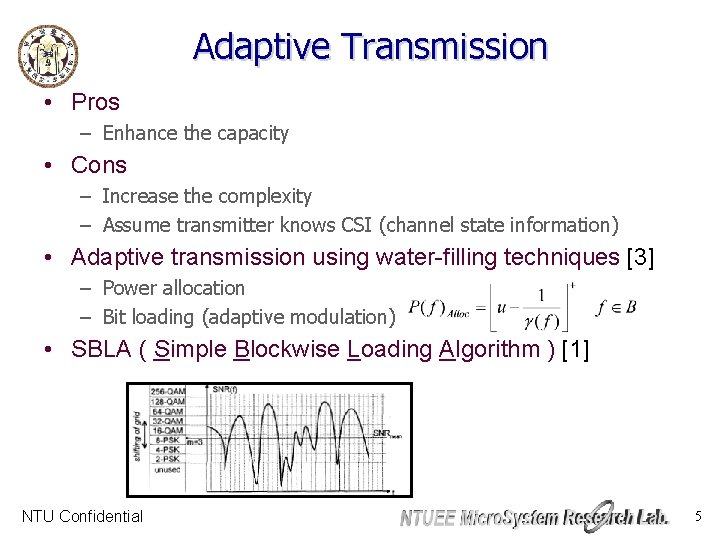
Adaptive Transmission • Pros – Enhance the capacity • Cons – Increase the complexity – Assume transmitter knows CSI (channel state information) • Adaptive transmission using water-filling techniques [3] – Power allocation – Bit loading (adaptive modulation) • SBLA ( Simple Blockwise Loading Algorithm ) [1] NTU Confidential 5
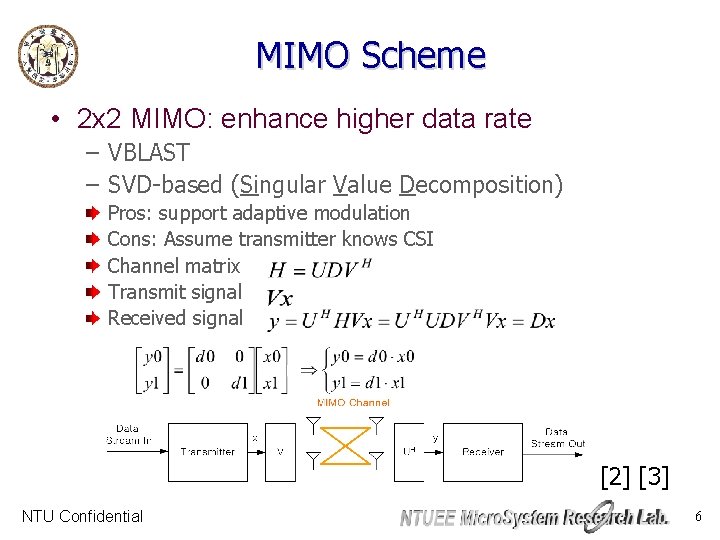
MIMO Scheme • 2 x 2 MIMO: enhance higher data rate – VBLAST – SVD-based (Singular Value Decomposition) Pros: support adaptive modulation Cons: Assume transmitter knows CSI Channel matrix Transmit signal Received signal [2] [3] NTU Confidential 6
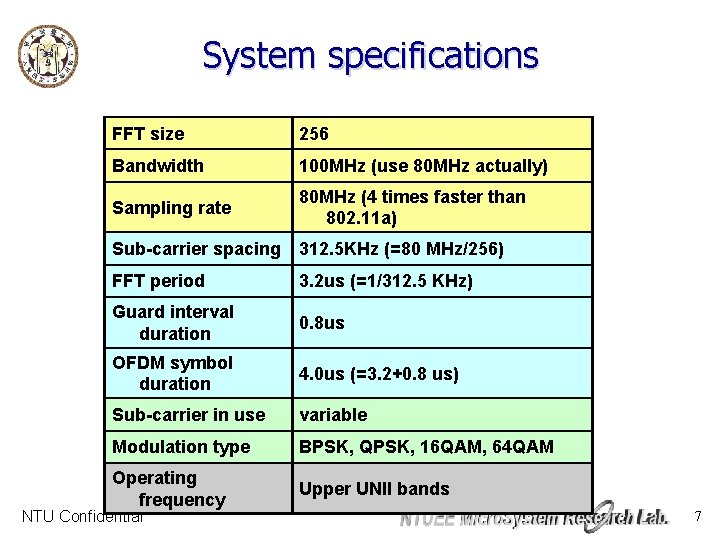
System specifications FFT size 256 Bandwidth 100 MHz (use 80 MHz actually) Sampling rate 80 MHz (4 times faster than 802. 11 a) Sub-carrier spacing 312. 5 KHz (=80 MHz/256) FFT period 3. 2 us (=1/312. 5 KHz) Guard interval duration 0. 8 us OFDM symbol duration 4. 0 us (=3. 2+0. 8 us) Sub-carrier in use variable Modulation type BPSK, QPSK, 16 QAM, 64 QAM Operating frequency Upper UNII bands NTU Confidential 7
Transmit Power Spectrum Analysis NTU Confidential
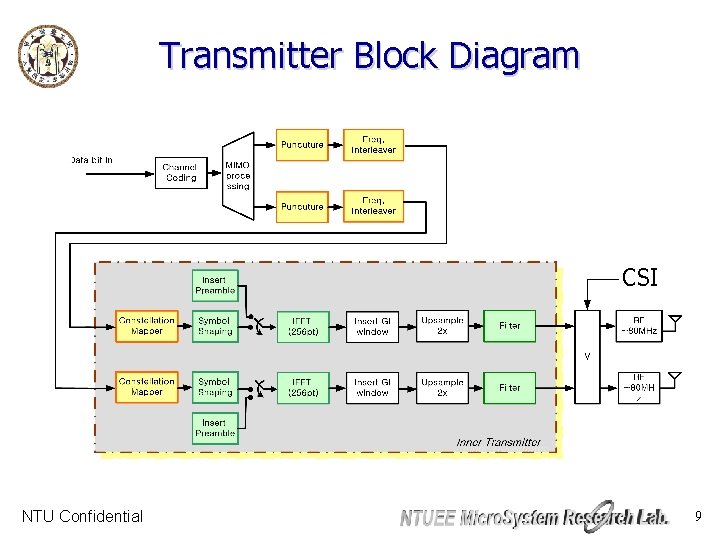
Transmitter Block Diagram CSI NTU Confidential 9
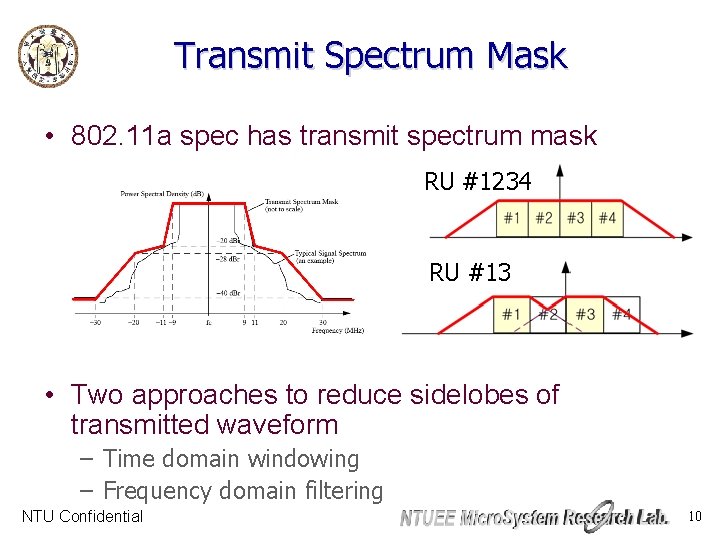
Transmit Spectrum Mask • 802. 11 a spec has transmit spectrum mask RU #1234 RU #13 • Two approaches to reduce sidelobes of transmitted waveform – Time domain windowing – Frequency domain filtering NTU Confidential 10
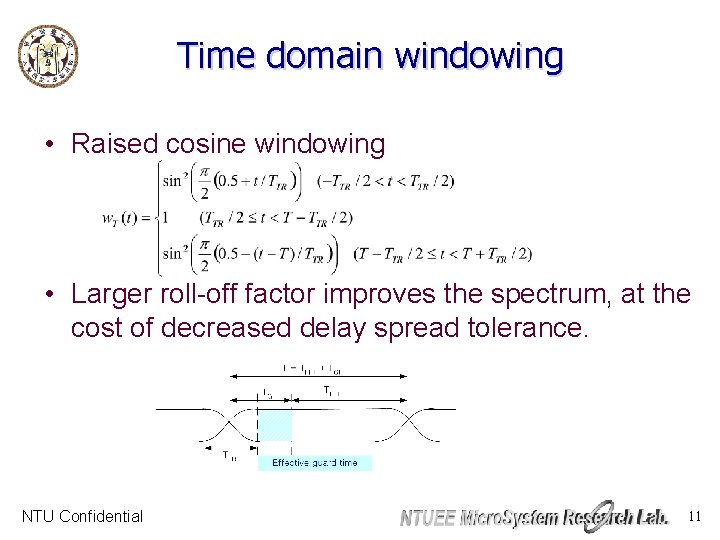
Time domain windowing • Raised cosine windowing • Larger roll-off factor improves the spectrum, at the cost of decreased delay spread tolerance. NTU Confidential 11
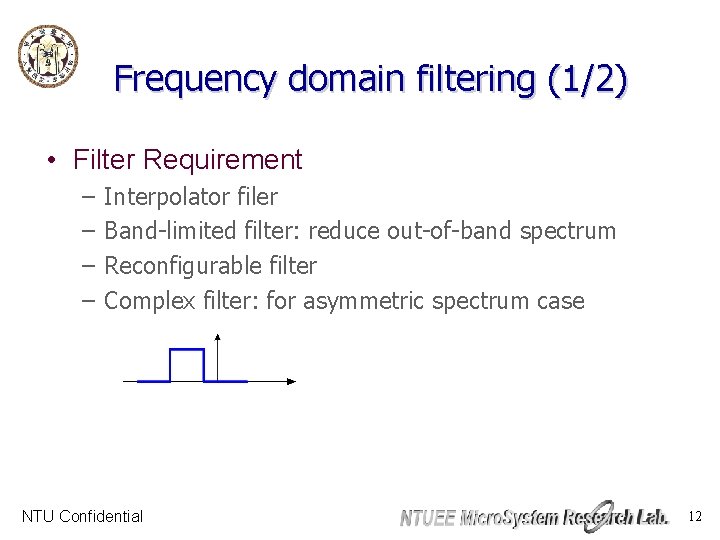
Frequency domain filtering (1/2) • Filter Requirement – – Interpolator filer Band-limited filter: reduce out-of-band spectrum Reconfigurable filter Complex filter: for asymmetric spectrum case NTU Confidential 12
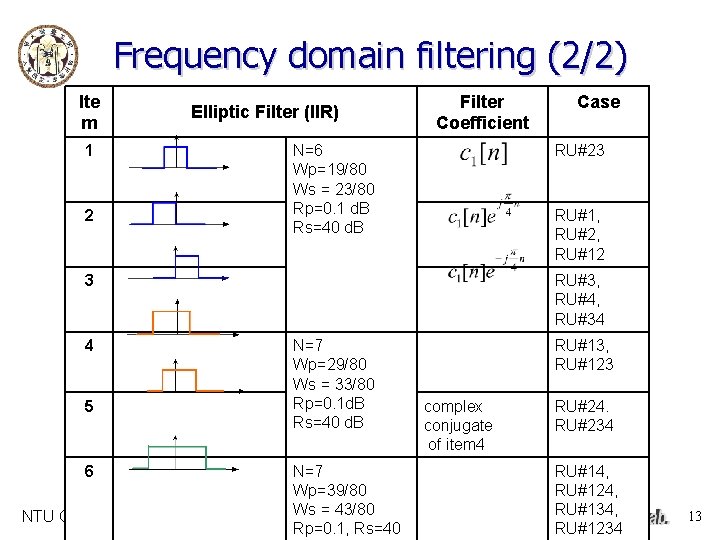
Frequency domain filtering (2/2) Ite m 1 2 Elliptic Filter (IIR) Filter Coefficient N=6 Wp=19/80 Ws = 23/80 Rp=0. 1 d. B Rs=40 d. B RU#23 RU#1, RU#2, RU#12 3 4 5 6 NTU Confidential Case RU#3, RU#4, RU#34 N=7 Wp=29/80 Ws = 33/80 Rp=0. 1 d. B Rs=40 d. B N=7 Wp=39/80 Ws = 43/80 Rp=0. 1, Rs=40 RU#13, RU#123 complex conjugate of item 4 RU#24. RU#234 RU#14, RU#124, RU#134, RU#1234 13
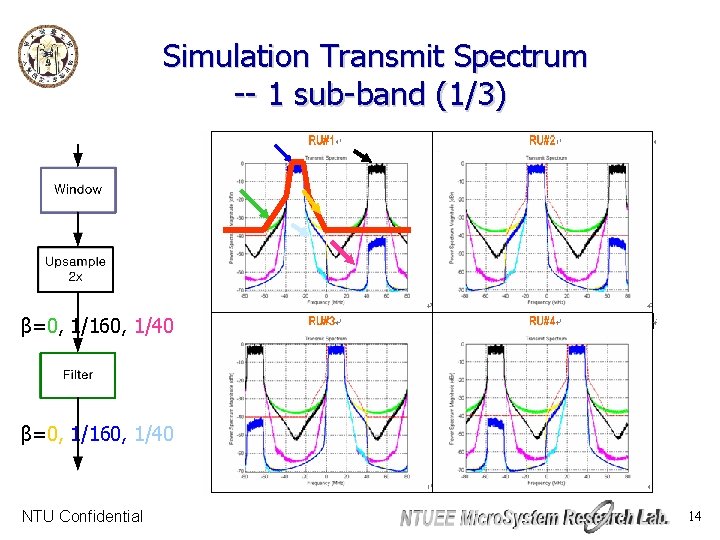
Simulation Transmit Spectrum -- 1 sub-band (1/3) β=0, 1/160, 1/40 NTU Confidential 14

Simulation Transmit Spectrum -- 2 sub-bands (2/3) NTU Confidential 15
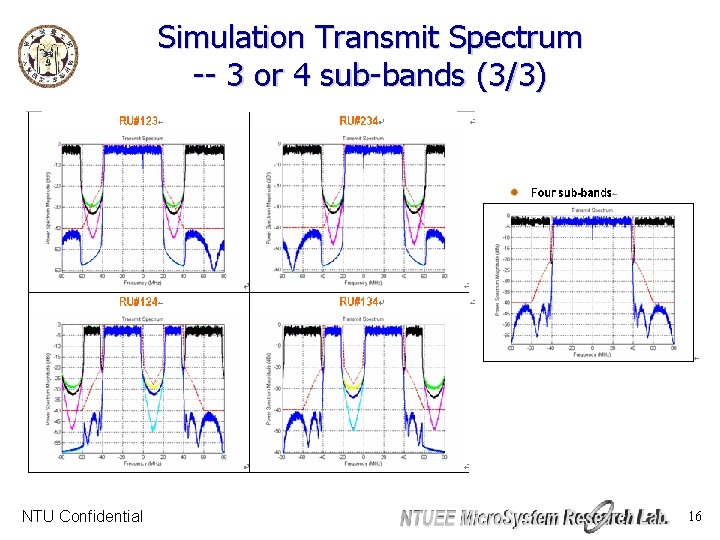
Simulation Transmit Spectrum -- 3 or 4 sub-bands (3/3) NTU Confidential 16
Simulation of Perfect Channel Estimation in AWGN NTU Confidential
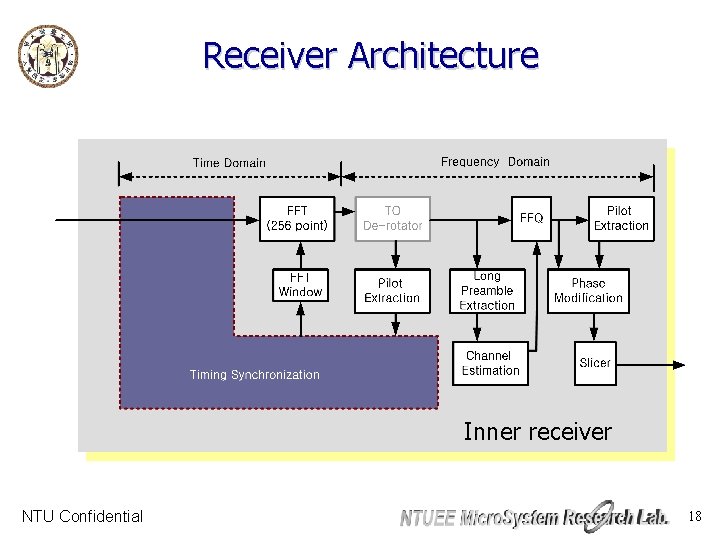
Receiver Architecture Inner receiver NTU Confidential 18
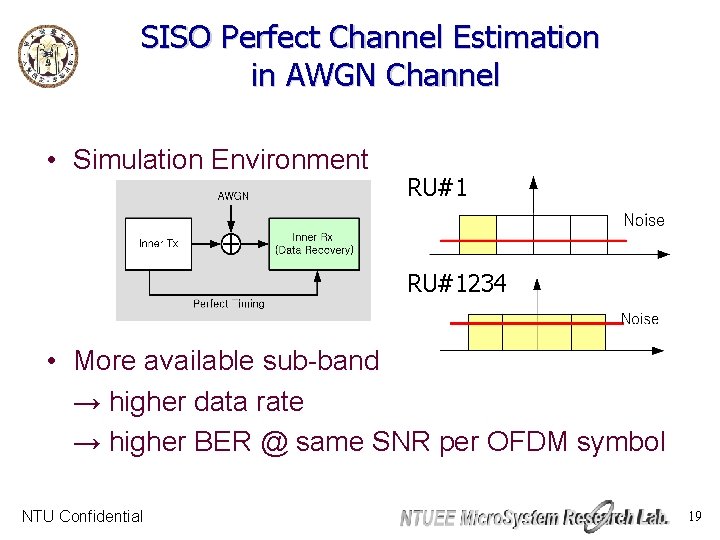
SISO Perfect Channel Estimation in AWGN Channel • Simulation Environment RU#1234 • More available sub-band → higher data rate → higher BER @ same SNR per OFDM symbol NTU Confidential 19
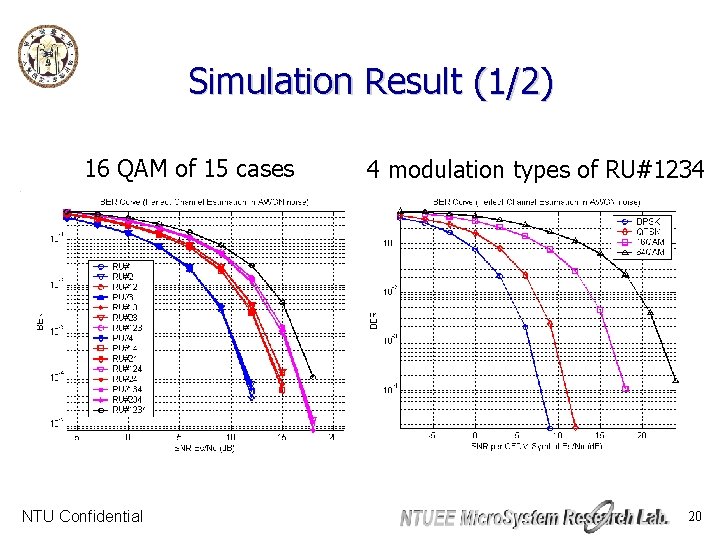
Simulation Result (1/2) 16 QAM of 15 cases NTU Confidential 4 modulation types of RU#1234 20
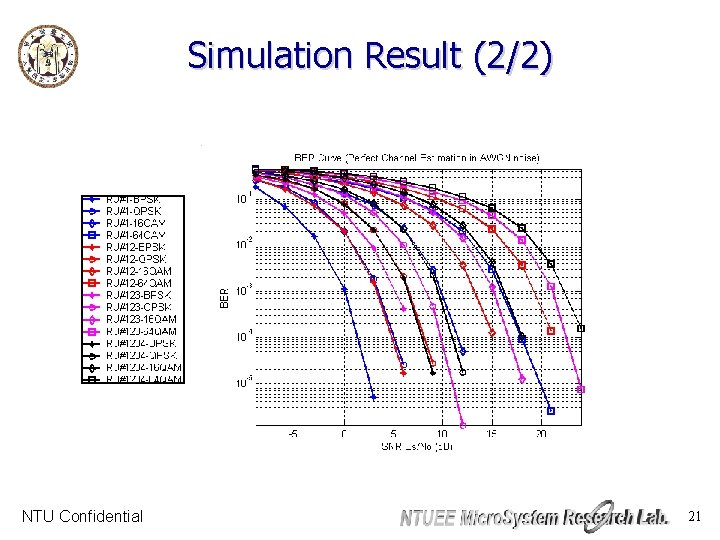
Simulation Result (2/2) NTU Confidential 21
Conclusion • Features of SP system has been introduced. • Since transmit power spectrum should achieve the mask requirement, we use both techniques – time domain raised cosine windowing (overlap 1 pt ) – frequency domain filtering • SISO perfect channel estimation in AWGN has been simulated. NTU Confidential 22
Future Work • • Extend SISO to MIMO scheme Build up timing recovery block of receiver Support adaptive modulation System modification according to final specification NTU Confidential 23
![Reference • [1] Rainer Gr¨unheid, Edgar Bolinth, and Hermann Rohling, “A Blockwise Loading Algorithm](http://slidetodoc.com/presentation_image_h2/442782fa0108c51e486c3bffe8256162/image-24.jpg "Reference • [1] Rainer Gr¨unheid, Edgar Bolinth, and Hermann Rohling, “A Blockwise Loading Algorithm")
Reference • [1] Rainer Gr¨unheid, Edgar Bolinth, and Hermann Rohling, “A Blockwise Loading Algorithm for the Adaptive Modulation Technique in OFDM Systems, ” in IEEE VTC-2001, Atlantic City, USA, October 2001. • [2] http: //www. tgnsync. org/techdocs/tgnsync-proposal-technicalspecification. pdf • [3] Juha Heikala, John Terry, “OFDM Wireless LANs: A Theoretical and Practical Guide” 2002 NTU Confidential 24
- Slides: 24