
PROGRESS ON THE IMPLEMENTATION OF THE NATIONAL DEVELOPMENT




- Slides: 41
PROGRESS ON THE IMPLEMENTATION OF THE NATIONAL DEVELOPMENT PLAN 2030 ROUNDTABLE DISCUSSION WITH South African Insurance Association (SAIA) JOHANNESBURG | 10 May 2017
CONTEXT OF THE PRESENTATION ➢ We are gathered here in the midst of heightened discourse in South Africa, in which economics and politics have become intertwined, and each influences the other. The recent announcement of credit downgrades by ratings agencies and others gives expression to this, and is a major setback in our journey towards creating a better and more prosperous South Africa. ➢ These unfortunate circumstances call for all the major stakeholders including government, business, labour and civil society, to recommit themselves to improving business confidence in our economy. ➢ We must all put our shoulders to the wheel and accelerate inclusive growth and development so that we can reverse the triple challenges of poverty, unemployment and inequality. The National Development Plan (NDP), our Vision 2030, provides a comprehensive framework for South Africa’s growth strategy. 2
CONTEXT OF THE PRESENTATION ➢ National Development Plan (NDP) 2030 seeks to ensure change through a virtuous cycle of development, and places great emphasis on partnerships. ➢ NDP 2030 requires that a Social Compact be developed and entered into between government and all sectors of society: ❑ business; ❑ labour; ❑ civil society; ❑ academic institutions; ❑ research organisations; ❑ student and youth movements; ❑ emerging and commercial farmers; ➢ Government attaches great value to interactions and engagements with all stakeholders in the implementation of the NDP 2030. ➢ Roundtable with the SAIA (South African Insurance Association) is of strategic importance. 3
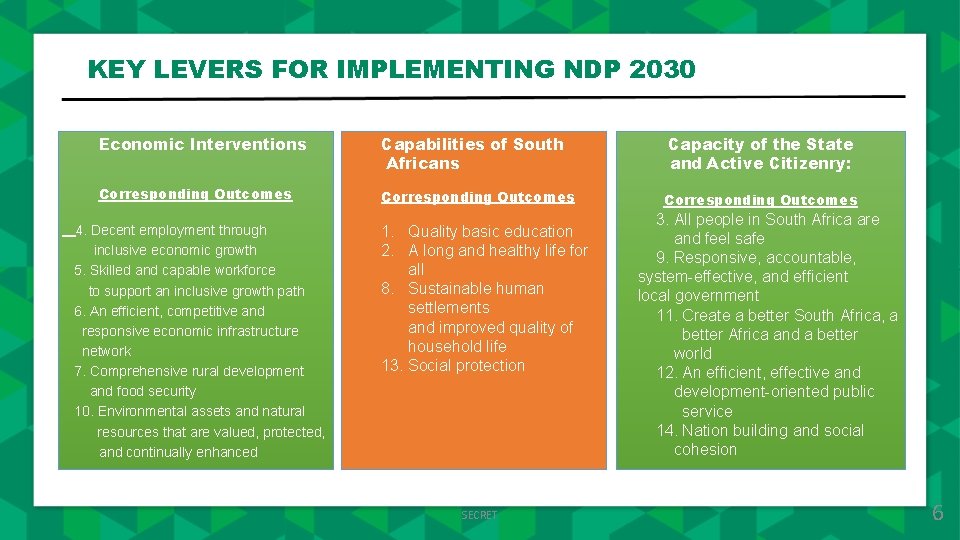
APPROACH OF THE PRESENTATION ➢ The NDP is the programme to advance radical economic transformation through three key levers namely: ❑ Economic interventions ❑ Capabilities of South Africans ❑ Capacity of the State & Active Citizenry ➢ The NDP is implemented through the MTSF 2014 -2019, which guides the implementation of 14 government Outcomes. ➢ All 14 Outcomes of government are important and are monitored quarterly. ➢ This presentation focuses on key areas which require more determined implementation: Mining; Manufacturing; Financial Services; Agriculture and Land Reform; Higher Education and Skills; SMMEs and Cooperatives; and fighting Corruption. SECRET 4
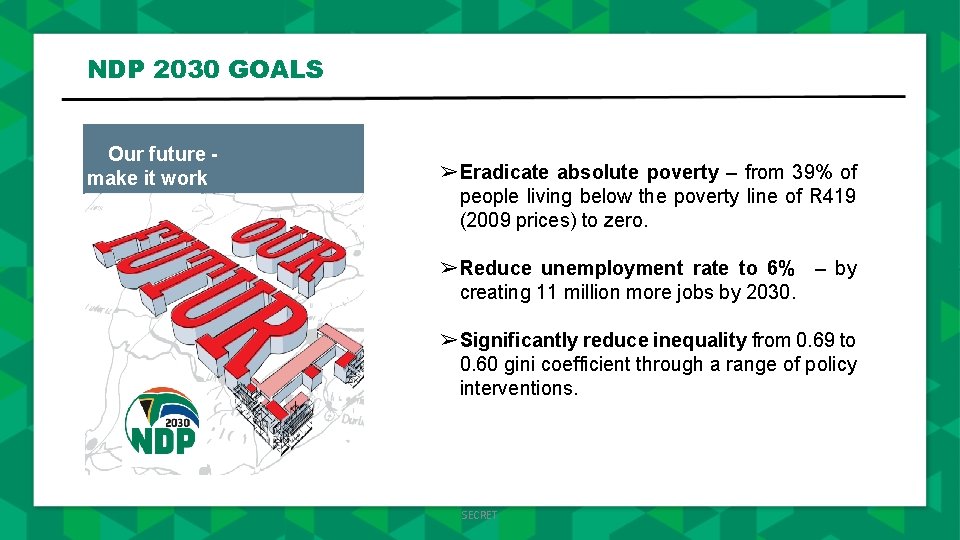
NDP 2030 GOALS Our future - make it work ➢Eradicate absolute poverty – from 39% of people living below the poverty line of R 419 (2009 prices) to zero. ➢Reduce unemployment rate to 6% – by creating 11 million more jobs by 2030. ➢Significantly reduce inequality from 0. 69 to 0. 60 gini coefficient through a range of policy interventions. SECRET
KEY LEVERS FOR IMPLEMENTING NDP 2030 Economic Interventions Capabilities of South Africans Capacity of the State and Active Citizenry: Corresponding Outcomes 4. Decent employment through inclusive economic growth 5. Skilled and capable workforce to support an inclusive growth path 6. An efficient, competitive and responsive economic infrastructure network 7. Comprehensive rural development and food security 10. Environmental assets and natural resources that are valued, protected, and continually enhanced 1. Quality basic education 2. A long and healthy life for all 8. Sustainable human settlements and improved quality of household life 13. Social protection SECRET 3. All people in South Africa are and feel safe 9. Responsive, accountable, system-effective, and efficient local government 11. Create a better South Africa, a better Africa and a better world 12. An efficient, effective and development-oriented public service 14. Nation building and social cohesion 6
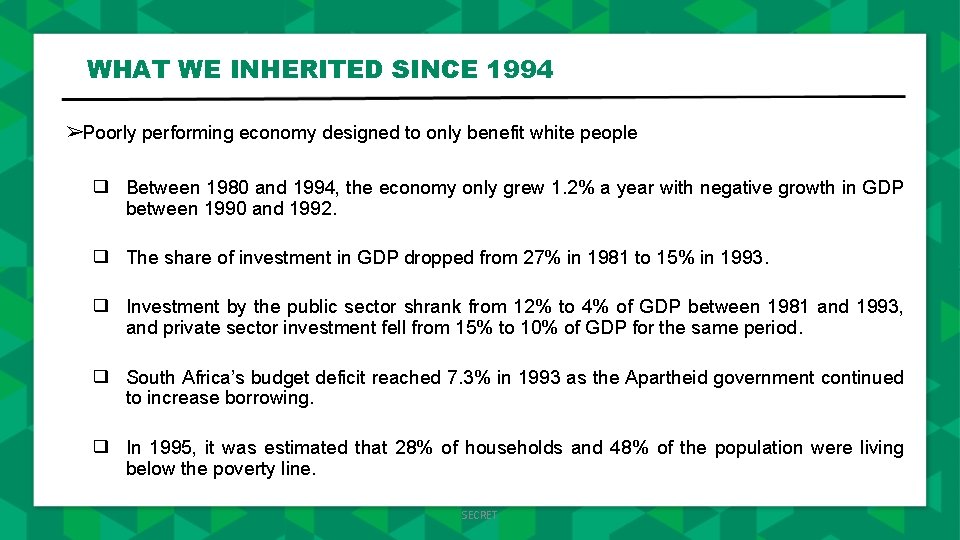
WHAT WE INHERITED SINCE 1994 ➢Poorly performing economy designed to only benefit white people ❑ Between 1980 and 1994, the economy only grew 1. 2% a year with negative growth in GDP between 1990 and 1992. ❑ The share of investment in GDP dropped from 27% in 1981 to 15% in 1993. ❑ Investment by the public sector shrank from 12% to 4% of GDP between 1981 and 1993, and private sector investment fell from 15% to 10% of GDP for the same period. ❑ South Africa’s budget deficit reached 7. 3% in 1993 as the Apartheid government continued to increase borrowing. ❑ In 1995, it was estimated that 28% of households and 48% of the population were living below the poverty line. SECRET
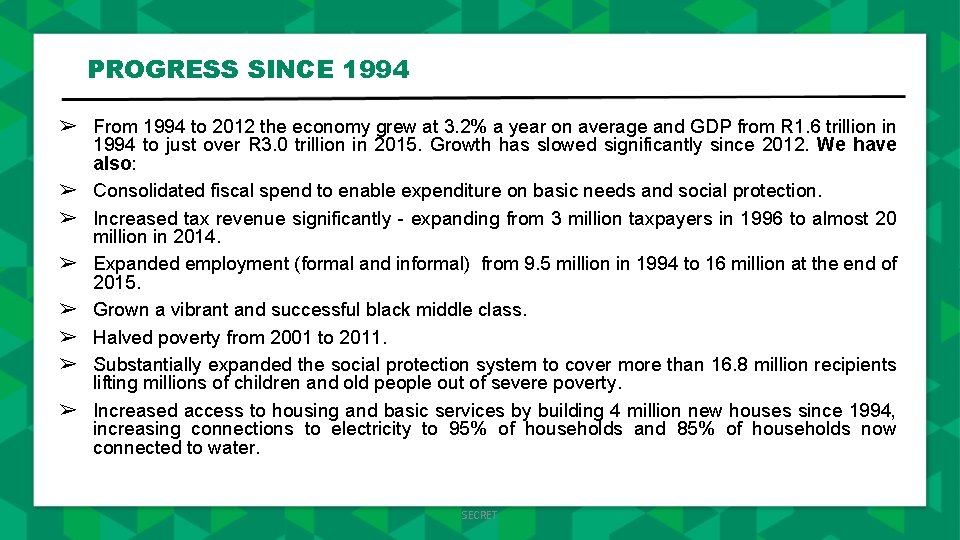
PROGRESS SINCE 1994 ➢ From 1994 to 2012 the economy grew at 3. 2% a year on average and GDP from R 1. 6 trillion in 1994 to just over R 3. 0 trillion in 2015. Growth has slowed significantly since 2012. We have also: ➢ Consolidated fiscal spend to enable expenditure on basic needs and social protection. ➢ Increased tax revenue significantly - expanding from 3 million taxpayers in 1996 to almost 20 million in 2014. ➢ Expanded employment (formal and informal) from 9. 5 million in 1994 to 16 million at the end of 2015. ➢ Grown a vibrant and successful black middle class. ➢ Halved poverty from 2001 to 2011. ➢ Substantially expanded the social protection system to cover more than 16. 8 million recipients lifting millions of children and old people out of severe poverty. ➢ Increased access to housing and basic services by building 4 million new houses since 1994, increasing connections to electricity to 95% of households and 85% of households now connected to water. SECRET
HIGHLIGHTS OF PROGRESS TOWARDS THE NDP 2030 QUALITY BASIC EDUCATION ➢ Almost universal access to basic education: 98. 8% of 7 to 15 year olds are attending education institutions (GHS 2015). ➢ Mathematics in the Trends in International Mathematics and Science Study (TIMSS) scores have improved the most from 285 in 2003 to 372 in 2015. The international midpoint is 400. ➢ Southern and Eastern African Consortium for Monitoring Educational Quality (SACMEQ) scores have improved from 494. 8 in 2010 to 587. 2 in 2015. SECRET
HIGHLIGHTS OF PROGRESS TOWARDS THE NDP 2030 HEALTH ➢ Total Life expectancy at birth has increased from 61, 2 years in 2012 to 63. 3 years in 2015. ➢ Child health has improved, with Under-5 mortality decreasing from 41 deaths per 1000 live births in 2012 to 37 deaths per 1000 live births in 2015. ➢ Maternal Mortality Ratio has improved from 200 deaths per 100, 000 live-births in 2011 to 119 deaths 2015 per 100 000 live births. SECRET
HIGHLIGHTS OF PROGRESS TOWARDS THE NDP 2030 HIGHER EDUCATION AND TRAINING ➢ Number of qualifying TVET students obtaining financial assistance annually has increased from 188 182 in 2012 to 235 988 in 2015. ➢ Number of students enrolled in public higher education studies at universities has increased from 950 000 in 2012 to 985 212 in 2015. SECRET
HIGHLIGHTS OF PROGRESS TOWARDS THE NDP 2030 HUMAN SETTLEMENTS ➢ From 2014 to 2016, access to Housing has improved: ❑ ❑ Housing delivered by the state has increased by 273 000 additional units. 200 000 households in informal settlements have been upgraded. 163 000 title deeds have been transferred to homeowners, thereby reducing the previous backlog of 820 000. 217 000 loans have been issued into the gap market by the DFIs and the Banks (40% of target at a 4: 1 ratio). SECRET
HIGHLIGHTS OF PROGRESS TOWARDS THE NDP 2030 AND ➢ Operation Phakisa and Ocean economy has since 2014, unlocked R 7 billion in investments and created 6, 903 jobs. OCEAN ECONOMY SECRET
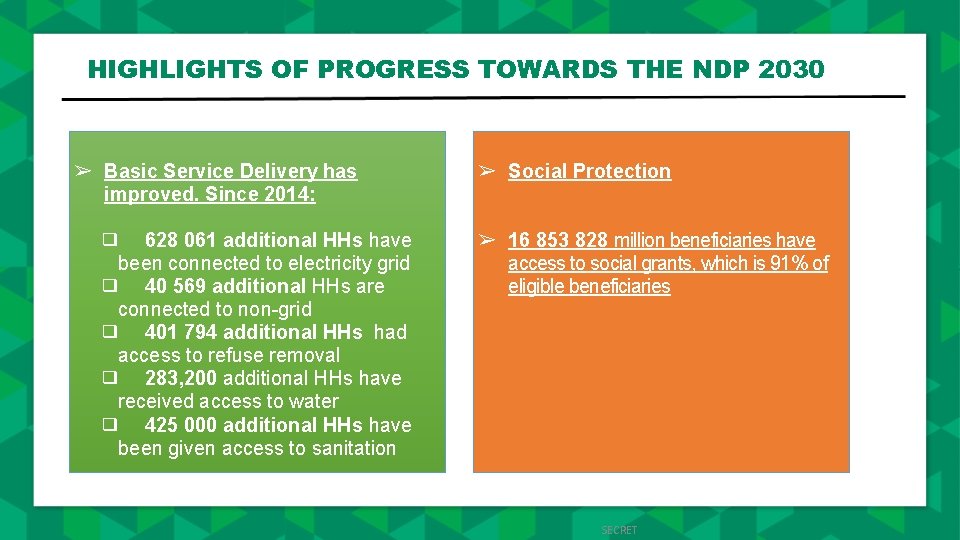
HIGHLIGHTS OF PROGRESS TOWARDS THE NDP 2030 ➢ Basic Service Delivery has improved. Since 2014: ❑ 628 061 additional HHs have been connected to electricity grid ❑ 40 569 additional HHs are connected to non-grid ❑ 401 794 additional HHs had access to refuse removal ❑ 283, 200 additional HHs have received access to water ❑ 425 000 additional HHs have been given access to sanitation ➢ Social Protection ➢ 16 853 828 million beneficiaries have access to social grants, which is 91% of eligible beneficiaries SECRET
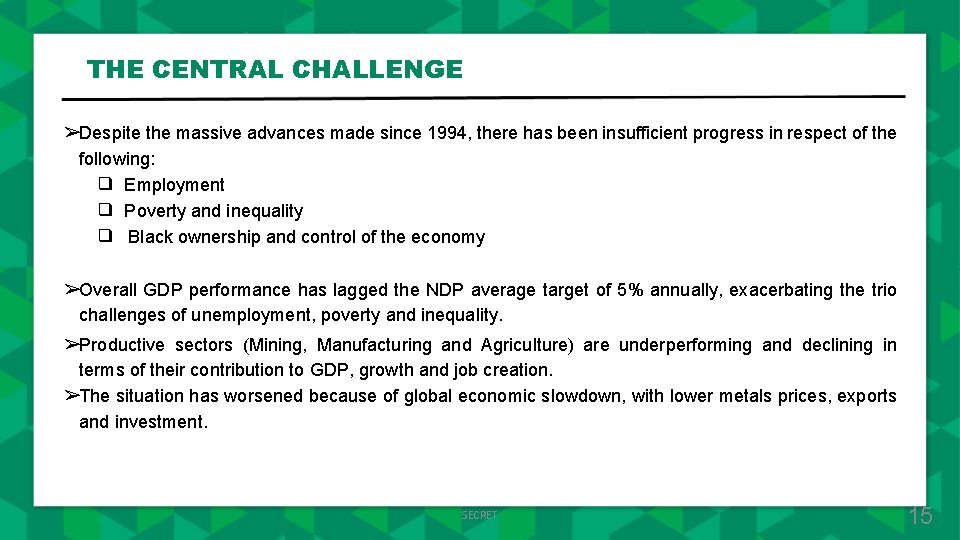
THE CENTRAL CHALLENGE ➢Despite the massive advances made since 1994, there has been insufficient progress in respect of the following: ❑ Employment ❑ Poverty and inequality ❑ Black ownership and control of the economy ➢Overall GDP performance has lagged the NDP average target of 5% annually, exacerbating the trio challenges of unemployment, poverty and inequality. ➢Productive sectors (Mining, Manufacturing and Agriculture) are underperforming and declining in terms of their contribution to GDP, growth and job creation. ➢The situation has worsened because of global economic slowdown, with lower metals prices, exports and investment. SECRET 15
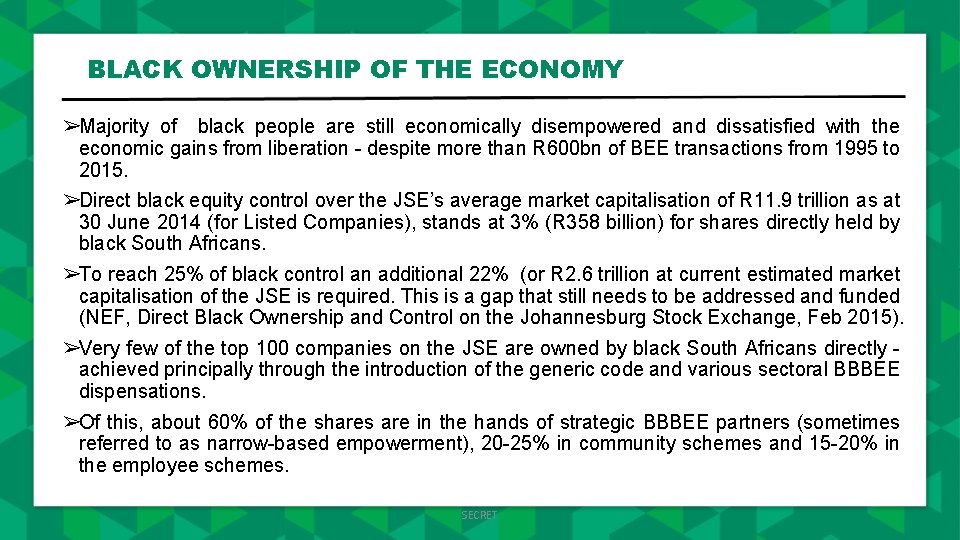
BLACK OWNERSHIP OF THE ECONOMY ➢Majority of black people are still economically disempowered and dissatisfied with the economic gains from liberation - despite more than R 600 bn of BEE transactions from 1995 to 2015. ➢Direct black equity control over the JSE’s average market capitalisation of R 11. 9 trillion as at 30 June 2014 (for Listed Companies), stands at 3% (R 358 billion) for shares directly held by black South Africans. ➢To reach 25% of black control an additional 22% (or R 2. 6 trillion at current estimated market capitalisation of the JSE is required. This is a gap that still needs to be addressed and funded (NEF, Direct Black Ownership and Control on the Johannesburg Stock Exchange, Feb 2015). ➢Very few of the top 100 companies on the JSE are owned by black South Africans directly - achieved principally through the introduction of the generic code and various sectoral BBBEE dispensations. ➢Of this, about 60% of the shares are in the hands of strategic BBBEE partners (sometimes referred to as narrow-based empowerment), 20 -25% in community schemes and 15 -20% in the employee schemes. SECRET
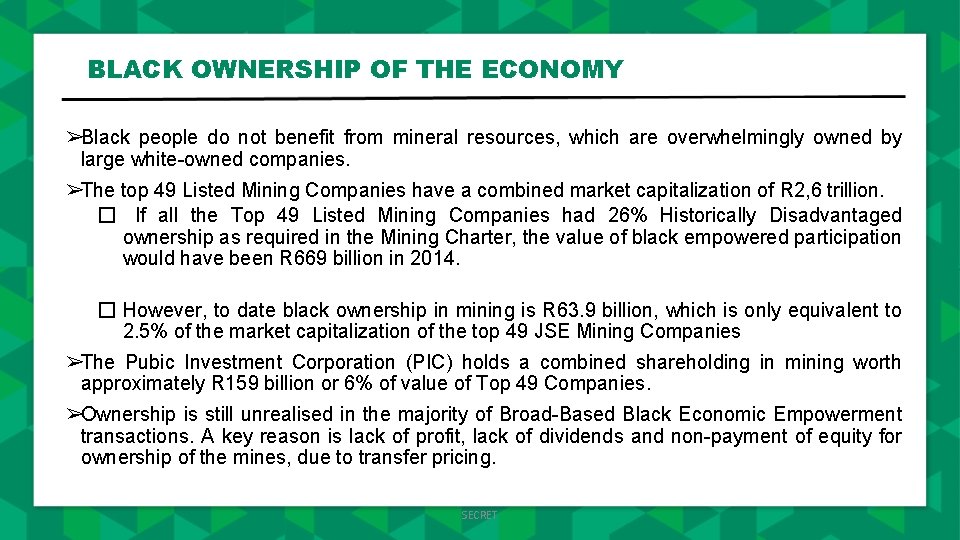
BLACK OWNERSHIP OF THE ECONOMY ➢Black people do not benefit from mineral resources, which are overwhelmingly owned by large white-owned companies. ➢The top 49 Listed Mining Companies have a combined market capitalization of R 2, 6 trillion. � If all the Top 49 Listed Mining Companies had 26% Historically Disadvantaged ownership as required in the Mining Charter, the value of black empowered participation would have been R 669 billion in 2014. � However, to date black ownership in mining is R 63. 9 billion, which is only equivalent to 2. 5% of the market capitalization of the top 49 JSE Mining Companies ➢The Pubic Investment Corporation (PIC) holds a combined shareholding in mining worth approximately R 159 billion or 6% of value of Top 49 Companies. ➢Ownership is still unrealised in the majority of Broad-Based Black Economic Empowerment transactions. A key reason is lack of profit, lack of dividends and non-payment of equity for ownership of the mines, due to transfer pricing. SECRET
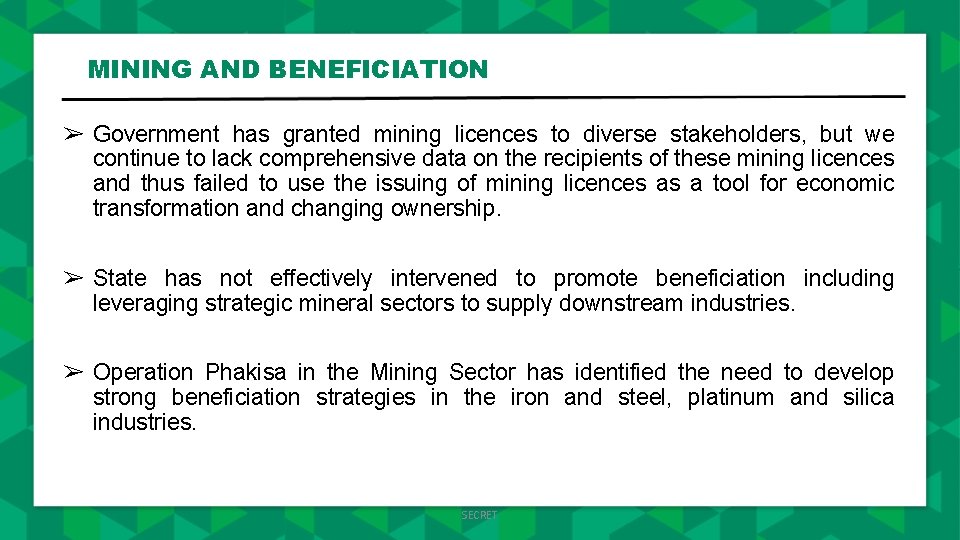
MINING AND BENEFICIATION ➢ Government has granted mining licences to diverse stakeholders, but we continue to lack comprehensive data on the recipients of these mining licences and thus failed to use the issuing of mining licences as a tool for economic transformation and changing ownership. ➢ State has not effectively intervened to promote beneficiation including leveraging strategic mineral sectors to supply downstream industries. ➢ Operation Phakisa in the Mining Sector has identified the need to develop strong beneficiation strategies in the iron and steel, platinum and silica industries. SECRET
MINING AND BENEFICIATION: WHAT NEEDS TO BE DONE ➢ Revised Mining Charter to be finalised by July 2017; be fully aligned to the BBBEE Codes and include improved enforcement and reporting mechanisms. ➢ Consolidate and leverage the state’s mineral holdings (State Mining Company, Alexkor, state’s equity holdings in PIC and IDC) to improve transformation. ➢ Promulgate the amended MPRDA. ➢ Utilise mining licence regime to increase transformation and participation of emerging miners and broad-based ownership. ➢ Track who has benefitted from mining licences since 1994: ❑ Ensure transparency in the issuing of mining licences. ❑ Conduct a baseline audit of all mining licences issued to date. ❑ Establish a monitoring and reporting system for mining licences. ➢ Utilise IDC and the DFI investments to support minerals beneficiation in the platinum and iron and steel sector. ➢ Implement the Operation Phakisa Delivery Lab initiatives to support mining investment, transformation and beneficiation. SECRET
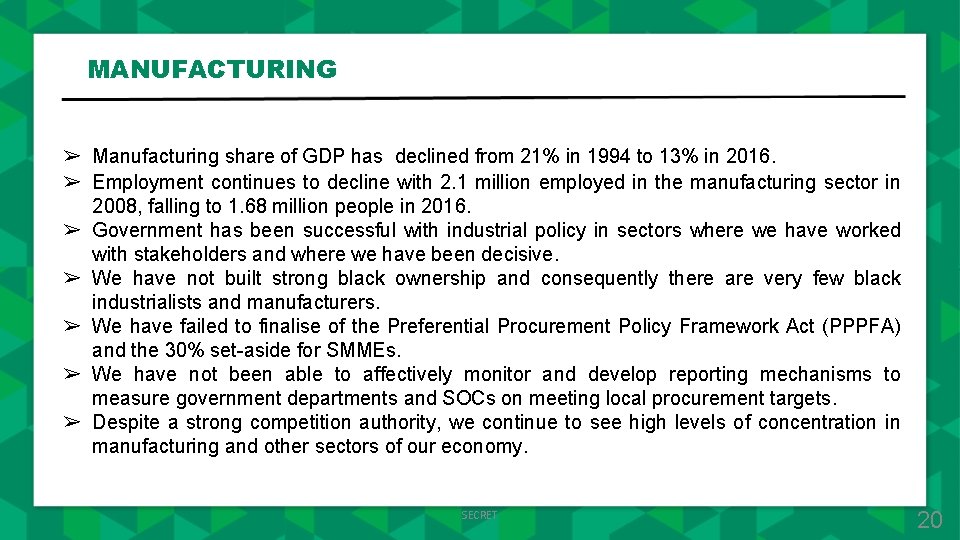
MANUFACTURING ➢ Manufacturing share of GDP has declined from 21% in 1994 to 13% in 2016. ➢ Employment continues to decline with 2. 1 million employed in the manufacturing sector in 2008, falling to 1. 68 million people in 2016. ➢ Government has been successful with industrial policy in sectors where we have worked with stakeholders and where we have been decisive. ➢ We have not built strong black ownership and consequently there are very few black industrialists and manufacturers. ➢ We have failed to finalise of the Preferential Procurement Policy Framework Act (PPPFA) and the 30% set-aside for SMMEs. ➢ We have not been able to affectively monitor and develop reporting mechanisms to measure government departments and SOCs on meeting local procurement targets. ➢ Despite a strong competition authority, we continue to see high levels of concentration in manufacturing and other sectors of our economy. SECRET 20
MANUFACTURING: WHAT NEEDS TO BE DONE ➢ Better implementation of industrialisation strategies. ➢ Speed-up rollout of Black Industrialists’ Programme. ➢ Drive Local Procurement through amended PPPFA (new Procurement Bill), 30% set-asides for SMMEs, and other preferential provisions for local suppliers of government and SOCs, and monitor this vigorously ➢ Enforce revised BBBEE Codes and Charters to promote greater participation of black-owned business in manufacturing. ➢ Enforce Competition law to open up manufacturing value chains to new entrants. Consider the need to amend the Act to strengthen powers to combat collusion and cartels. ➢ Increase Research and Development spend as part of budget reprioritisation in order to strengthen Innovation capacity in the economy. SECRET
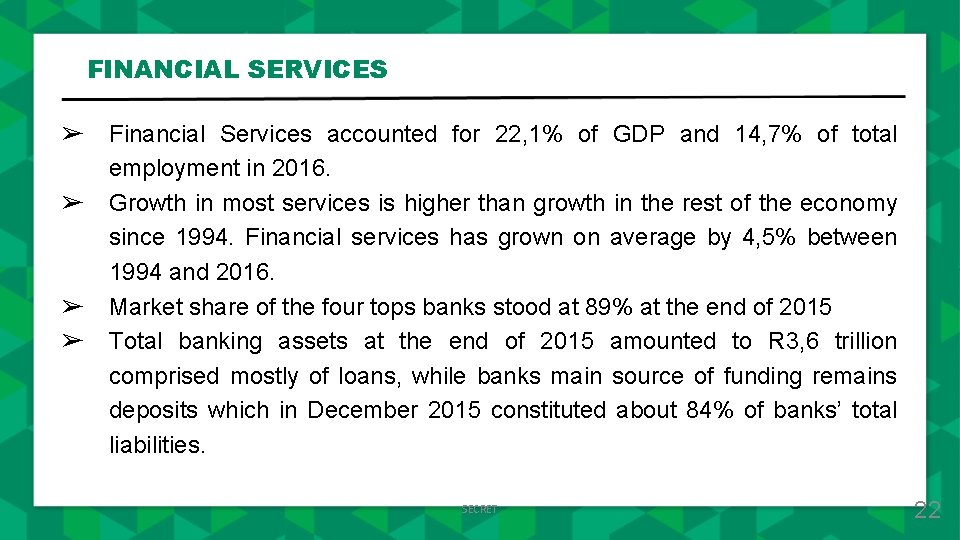
FINANCIAL SERVICES ➢ ➢ Financial Services accounted for 22, 1% of GDP and 14, 7% of total employment in 2016. Growth in most services is higher than growth in the rest of the economy since 1994. Financial services has grown on average by 4, 5% between 1994 and 2016. Market share of the four tops banks stood at 89% at the end of 2015 Total banking assets at the end of 2015 amounted to R 3, 6 trillion comprised mostly of loans, while banks main source of funding remains deposits which in December 2015 constituted about 84% of banks’ total liabilities. SECRET 22
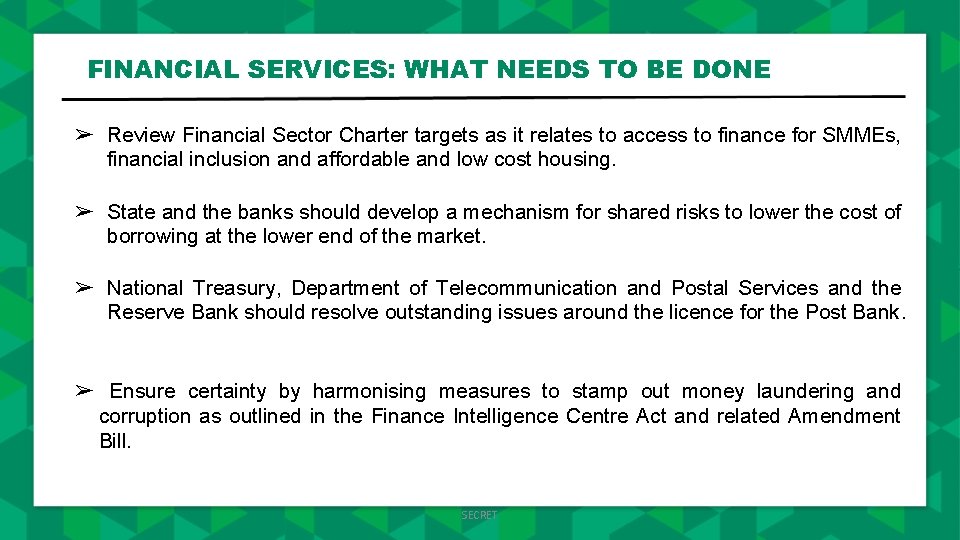
FINANCIAL SERVICES: WHAT NEEDS TO BE DONE ➢ Review Financial Sector Charter targets as it relates to access to finance for SMMEs, financial inclusion and affordable and low cost housing. ➢ State and the banks should develop a mechanism for shared risks to lower the cost of borrowing at the lower end of the market. ➢ National Treasury, Department of Telecommunication and Postal Services and the Reserve Bank should resolve outstanding issues around the licence for the Post Bank. ➢ Ensure certainty by harmonising measures to stamp out money laundering and corruption as outlined in the Finance Intelligence Centre Act and related Amendment Bill. SECRET
GROWTH AND ACCESS TO MARKETS FOR SMMES AND COOPERATIVES ➢ The SMME sector contributes 42% of GDP and 47% of employment. ➢ SMMEs have the potential to be major drivers of growth and employment. ➢ Support for the sector remains highly fragmented and requires increased resources to ensure its sustainability and growth. ➢ High levels of concentration impedes the sector’s growth. SECRET
GROWTH AND ACCESS TO MARKETS FOR SMMES AND COOPERATIVES WHAT NEEDS TO BE DONE ➢ Consolidate and strengthen differentiated business support for SMMEs and cooperatives. ➢ Strengthen access to finance for SMMEs and cooperatives from DFIs and private banks by setting clear targets by DFIs and utilising the Financial Sector Charter for private banks. ➢ Implement the 30% set-aside regulations for SMMEs and cooperatives with a particular focus on vulnerable groups such as women, youth and people with disabilities. ➢ Improve monitoring and reporting mechanism on SMMEs and cooperatives supported through local procurement. ➢ Ensure that SOC’s set clear targets and reporting for SMMEs and cooperatives. ➢ Invest more money into infrastructure projects, prioritising townships and rural areas.
SOCS AND DFIs - PRESIDENTIAL REVIEW COMMITTEE ON SOE’S ➢ Presidential Review Committee (PRC) has made 31 recommendations to improve the efficiency and role of SOE’s over the short and long term. ➢ Some of the key recommendations include: ❑ Government must have a vision and strategy that recognises SOEs are critical in attaining the objectives of the Developmental State. ❑ The mandates of SOEs should be subject to critical strategic review every five years. ❑ SOEs should ensure that the procurement process is transformational. ❑ Government should rationalise its holdings by focusing on those SOEs that provide public goods and those deemed to be strategic. ❑ Government should develop a consolidated funding model for commercial SOEs and DFIs, including private sector participation in partnering with SOEs to deliver on the provision of both economic and social infrastructure should be encouraged and expanded. ❑ Government should develop an integrated reporting, monitoring and evaluation capacity for SOEs across all spheres of Government.
SOCs AND DFIs ➢ Government is in the process of resolving challenges in SOEs as part of confidence building and ensuring SOE delivery is in line with national priorities. ➢ This will require strengthening oversight, governance, financial management, reporting and alignment with NDP. ➢ A more focused intervention is required to maximise the role and impact of DFIs and SOEs (building on the PRC review). ➢ DFIs and SOEs should play a more catalytic role through increased riskguarantee provisions and strengthen coordination between DFIs and SOEs. ➢ Reposition the DFIs and SOEs from reacting to market and environmental forces to being at the centre of industrialisation.
SOCs AND DFIs and SOCs have a critical role to play in advancing the NDP. To leverage this potential government will: ➢ Ensure lending practices in DFIs promote access to finance by black people at affordable rates. ➢ Ensure closer monitoring/evaluation of impact of DFI support to companies with clear targets aligned to the NDP. ➢ Through the IMC on SOCs accelerate the reform and rationalisation of SOCs and implement the Presidential Review report recommendations. SECRET
SOCs AND DFIs ➢ A need exists to review the funding model of public entities to ensure that the potential burden on the budget is limited. ➢ A need also exists to enhance Public Private Partnerships. ➢ Shareholder compacts must be strengthened and effectively monitored. ➢ DPME is in the process of developing a monitoring and performance tool that will: ❑ Ensure SOE planning and investment is in line with the NDP targets ❑ Track the implementation of the PRC recommendations, ❑ Provide a quarterly monitoring and performance report to Cabinet on the progress in implementing PRC recommendations, and ❑ Recommend remedial action were progress is slow or absent.
INFRASTRUCTURE ➢ Infrastructure investment is critical for growth. ➢ Government has prioritised key projects for water (dams, water pipelines and household connections), transport (road, rail and port), energy (generation, transmission and distribution), broadband rollout and social infrastructure (health, education and sanitation). ➢ Renewable Energy Independent Power Producers Programme (REIPPP) is important and will remain a growing component of our overall energy mix, having secured R 200 bn of investment thus far. SECRET
INFRASTRUCTURE: WHAT NEEDS TO BE DONE Government is in the process of: ➢ Reprioritising spending to ensure delivery on critical and key infrastructure projects and maintenance programmes. ➢ Ensuring policy certainty and direction by reaffirming renewable energy as part of our overall energy mix and ensure financing of REIPPP projects is clarified. ➢ Developing a revised timetable for digital migration with clear accountability mechanisms instituted if targets are not reached. ➢ Ensuring that the broadband spectrum dispute is resolved urgently. ➢ Increasing investment in socio-economic infrastructure (meeting basic human needs focusing on townships and rural areas). SECRET
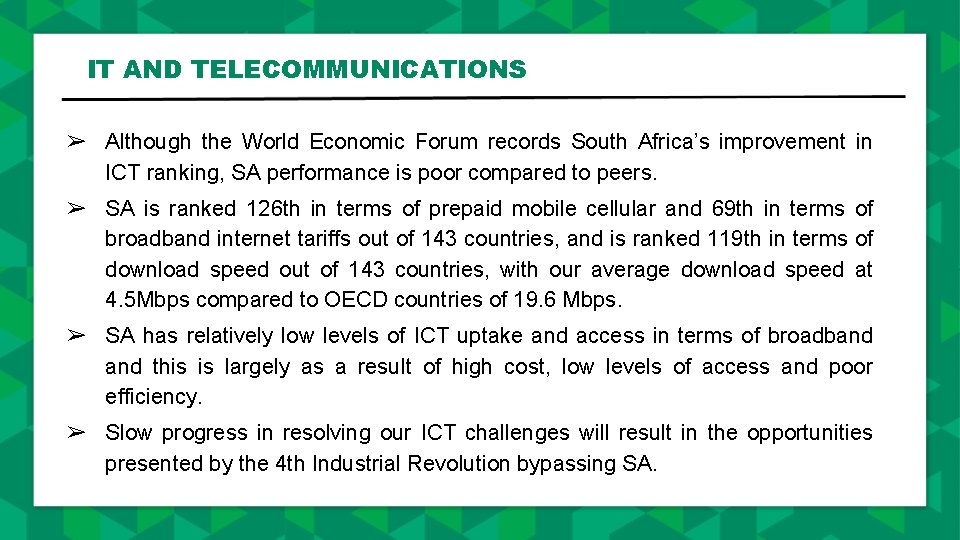
IT AND TELECOMMUNICATIONS ➢ Although the World Economic Forum records South Africa’s improvement in ICT ranking, SA performance is poor compared to peers. ➢ SA is ranked 126 th in terms of prepaid mobile cellular and 69 th in terms of broadband internet tariffs out of 143 countries, and is ranked 119 th in terms of download speed out of 143 countries, with our average download speed at 4. 5 Mbps compared to OECD countries of 19. 6 Mbps. ➢ SA has relatively low levels of ICT uptake and access in terms of broadband this is largely as a result of high cost, low levels of access and poor efficiency. ➢ Slow progress in resolving our ICT challenges will result in the opportunities presented by the 4 th Industrial Revolution bypassing SA.
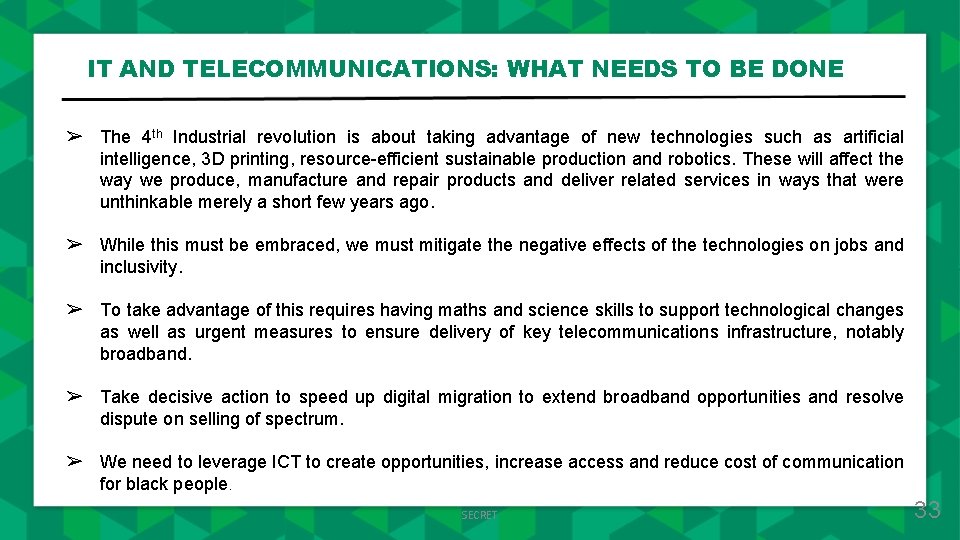
IT AND TELECOMMUNICATIONS: WHAT NEEDS TO BE DONE ➢ The 4 th Industrial revolution is about taking advantage of new technologies such as artificial intelligence, 3 D printing, resource-efficient sustainable production and robotics. These will affect the way we produce, manufacture and repair products and deliver related services in ways that were unthinkable merely a short few years ago. ➢ While this must be embraced, we must mitigate the negative effects of the technologies on jobs and inclusivity. ➢ To take advantage of this requires having maths and science skills to support technological changes as well as urgent measures to ensure delivery of key telecommunications infrastructure, notably broadband. ➢ Take decisive action to speed up digital migration to extend broadband opportunities and resolve dispute on selling of spectrum. ➢ We need to leverage ICT to create opportunities, increase access and reduce cost of communication for black people. SECRET 33
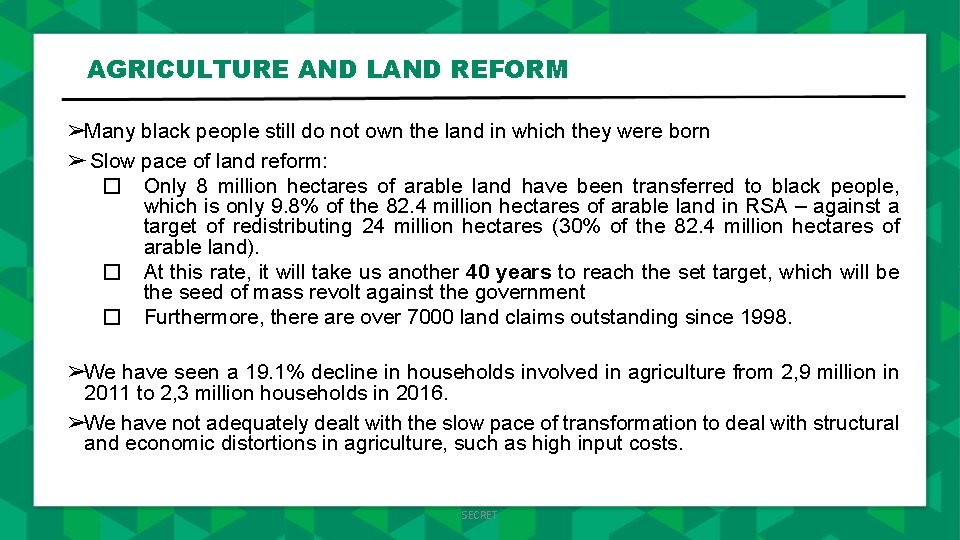
AGRICULTURE AND LAND REFORM ➢Many black people still do not own the land in which they were born ➢ Slow pace of land reform: � Only 8 million hectares of arable land have been transferred to black people, which is only 9. 8% of the 82. 4 million hectares of arable land in RSA – against a target of redistributing 24 million hectares (30% of the 82. 4 million hectares of arable land). � At this rate, it will take us another 40 years to reach the set target, which will be the seed of mass revolt against the government � Furthermore, there are over 7000 land claims outstanding since 1998. ➢We have seen a 19. 1% decline in households involved in agriculture from 2, 9 million in 2011 to 2, 3 million households in 2016. ➢We have not adequately dealt with the slow pace of transformation to deal with structural and economic distortions in agriculture, such as high input costs. SECRET
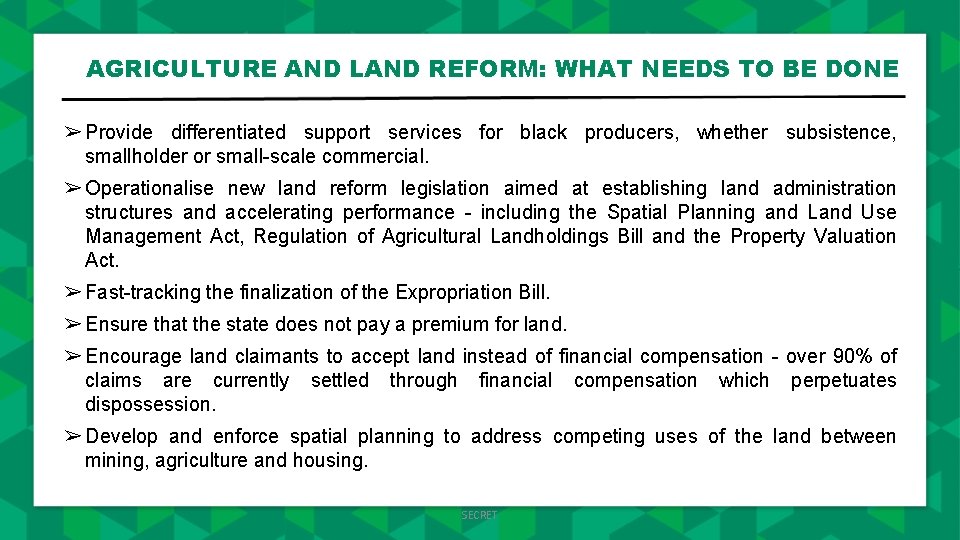
AGRICULTURE AND LAND REFORM: WHAT NEEDS TO BE DONE ➢ Provide differentiated support services for black producers, whether subsistence, smallholder or small-scale commercial. ➢ Operationalise new land reform legislation aimed at establishing land administration structures and accelerating performance - including the Spatial Planning and Land Use Management Act, Regulation of Agricultural Landholdings Bill and the Property Valuation Act. ➢ Fast-tracking the finalization of the Expropriation Bill. ➢ Ensure that the state does not pay a premium for land. ➢ Encourage land claimants to accept land instead of financial compensation - over 90% of claims are currently settled through financial compensation which perpetuates dispossession. ➢ Develop and enforce spatial planning to address competing uses of the land between mining, agriculture and housing. SECRET
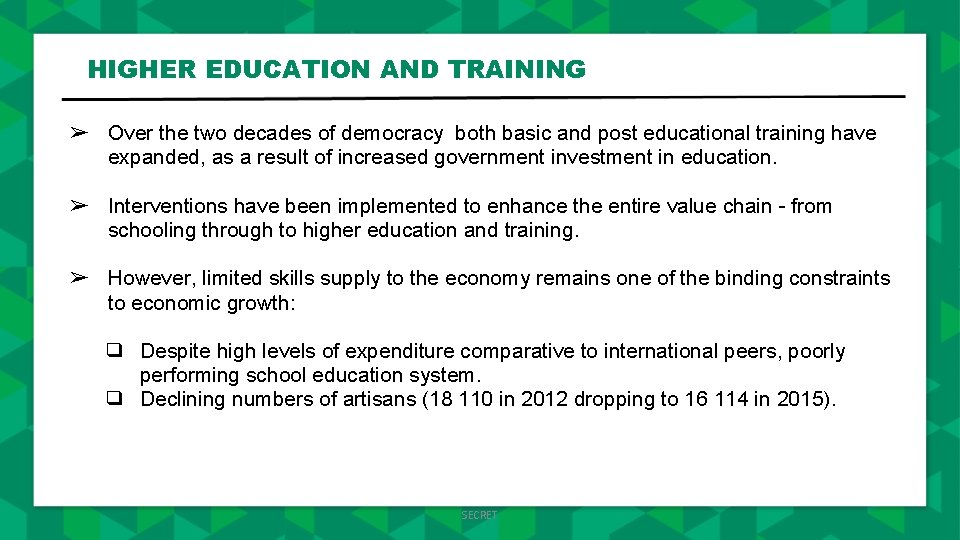
HIGHER EDUCATION AND TRAINING ➢ Over the two decades of democracy both basic and post educational training have expanded, as a result of increased government investment in education. ➢ Interventions have been implemented to enhance the entire value chain - from schooling through to higher education and training. ➢ However, limited skills supply to the economy remains one of the binding constraints to economic growth: ❑ Despite high levels of expenditure comparative to international peers, poorly performing school education system. ❑ Declining numbers of artisans (18 110 in 2012 dropping to 16 114 in 2015). SECRET
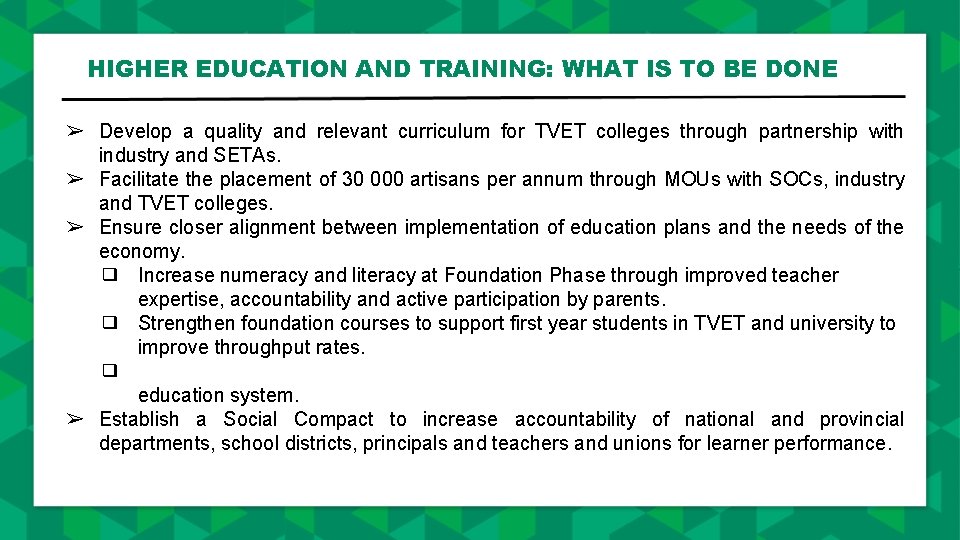
HIGHER EDUCATION AND TRAINING: WHAT IS TO BE DONE ➢ Develop a quality and relevant curriculum for TVET colleges through partnership with industry and SETAs. ➢ Facilitate the placement of 30 000 artisans per annum through MOUs with SOCs, industry and TVET colleges. ➢ Ensure closer alignment between implementation of education plans and the needs of the economy. ❑ Increase numeracy and literacy at Foundation Phase through improved teacher expertise, accountability and active participation by parents. ❑ Strengthen foundation courses to support first year students in TVET and university to improve throughput rates. ❑ education system. ➢ Establish a Social Compact to increase accountability of national and provincial departments, school districts, principals and teachers and unions for learner performance.
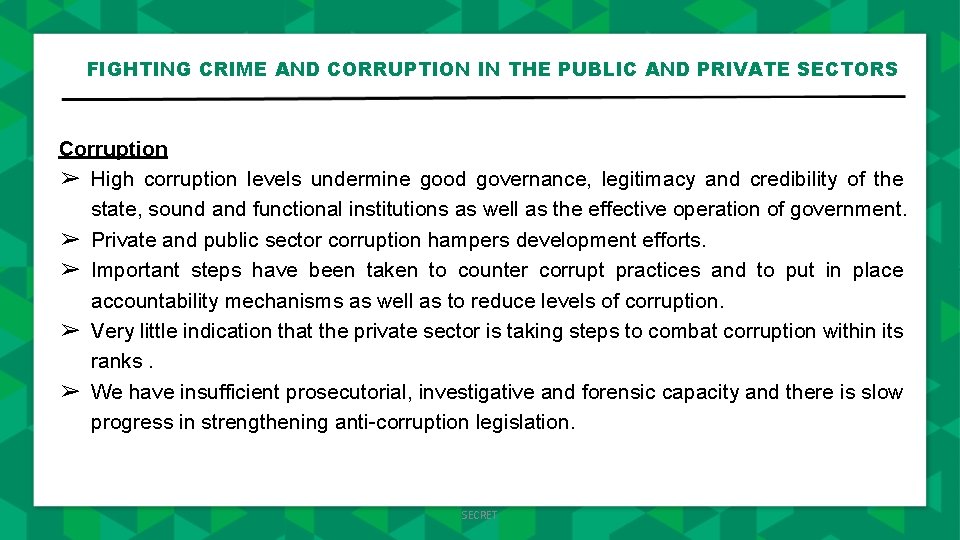
FIGHTING CRIME AND CORRUPTION IN THE PUBLIC AND PRIVATE SECTORS Corruption ➢ High corruption levels undermine good governance, legitimacy and credibility of the state, sound and functional institutions as well as the effective operation of government. ➢ Private and public sector corruption hampers development efforts. ➢ Important steps have been taken to counter corrupt practices and to put in place accountability mechanisms as well as to reduce levels of corruption. ➢ Very little indication that the private sector is taking steps to combat corruption within its ranks. ➢ We have insufficient prosecutorial, investigative and forensic capacity and there is slow progress in strengthening anti-corruption legislation. SECRET
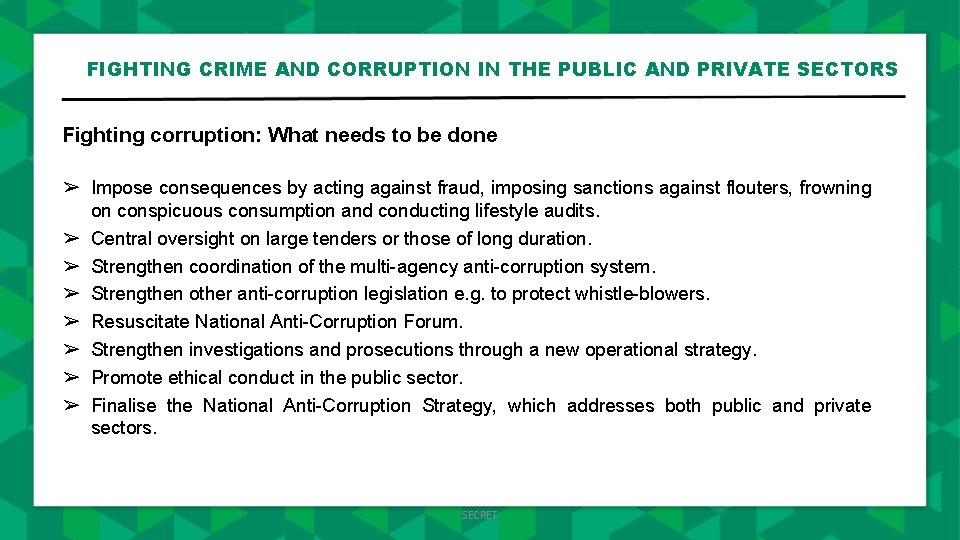
FIGHTING CRIME AND CORRUPTION IN THE PUBLIC AND PRIVATE SECTORS Fighting corruption: What needs to be done ➢ Impose consequences by acting against fraud, imposing sanctions against flouters, frowning on conspicuous consumption and conducting lifestyle audits. ➢ Central oversight on large tenders or those of long duration. ➢ Strengthen coordination of the multi-agency anti-corruption system. ➢ Strengthen other anti-corruption legislation e. g. to protect whistle-blowers. ➢ Resuscitate National Anti-Corruption Forum. ➢ Strengthen investigations and prosecutions through a new operational strategy. ➢ Promote ethical conduct in the public sector. ➢ Finalise the National Anti-Corruption Strategy, which addresses both public and private sectors. SECRET
CONCLUSION ➢ Despite the progress made over the last two decades, income poverty remains high, and inequality is severe as ever. ➢ We have a long way to go to reach the NDP targets, dropping poverty from 39% to zero, creating 11 million jobs, and reducing the gini coefficient measure of inequality to 0, 60. ➢ We have it within our means to achieve the transformation we are seeking. The state needs to play a leading role and use the levers at its disposal to accelerate change. A number of practical steps are suggested which must be taken forward vigorously. ➢ To realise economic transformation it cannot be business as usual ➢ In the spirit and letter of the NDP, government and all stakeholders must establish effective partnerships to create a virtuous cycle of development – to achieve the triple goals of the NDP 2030. SECRET