
Progress on ITER DiagnosticRadial XRay Camera Preliminary design
- Slides: 1
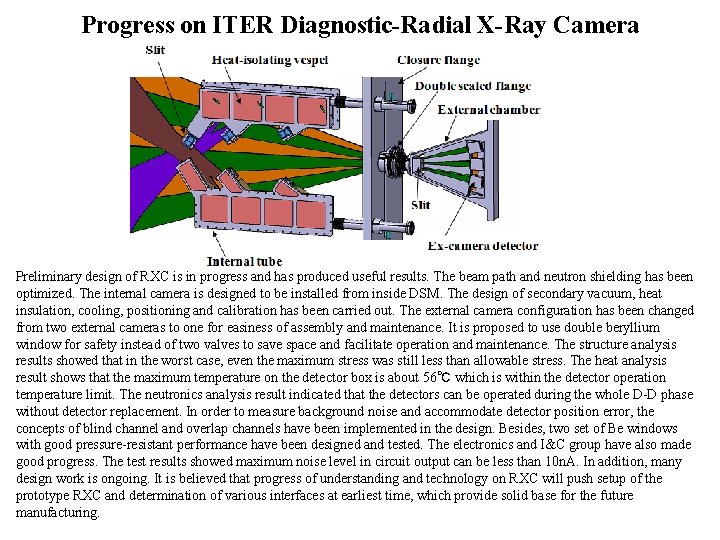
Progress on ITER Diagnostic-Radial X-Ray Camera Preliminary design of RXC is in progress and has produced useful results. The beam path and neutron shielding has been optimized. The internal camera is designed to be installed from inside DSM. The design of secondary vacuum, heat insulation, cooling, positioning and calibration has been carried out. The external camera configuration has been changed from two external cameras to one for easiness of assembly and maintenance. It is proposed to use double beryllium window for safety instead of two valves to save space and facilitate operation and maintenance. The structure analysis results showed that in the worst case, even the maximum stress was still less than allowable stress. The heat analysis result shows that the maximum temperature on the detector box is about 56℃ which is within the detector operation temperature limit. The neutronics analysis result indicated that the detectors can be operated during the whole D-D phase without detector replacement. In order to measure background noise and accommodate detector position error, the concepts of blind channel and overlap channels have been implemented in the design. Besides, two set of Be windows with good pressure-resistant performance have been designed and tested. The electronics and I&C group have also made good progress. The test results showed maximum noise level in circuit output can be less than 10 n. A. In addition, many design work is ongoing. It is believed that progress of understanding and technology on RXC will push setup of the prototype RXC and determination of various interfaces at earliest time, which provide solid base for the future manufacturing.