
PROGRESS IN THE IMPLEMENTATION OF INCLUSIVE EDUCATION Portfolio





- Slides: 58
PROGRESS IN THE IMPLEMENTATION OF INCLUSIVE EDUCATION Portfolio Committee on Basic Education Mr HM Mweli Acting DDG: Curriculum Policy, Monitoring and Support Date: 9 September 2014
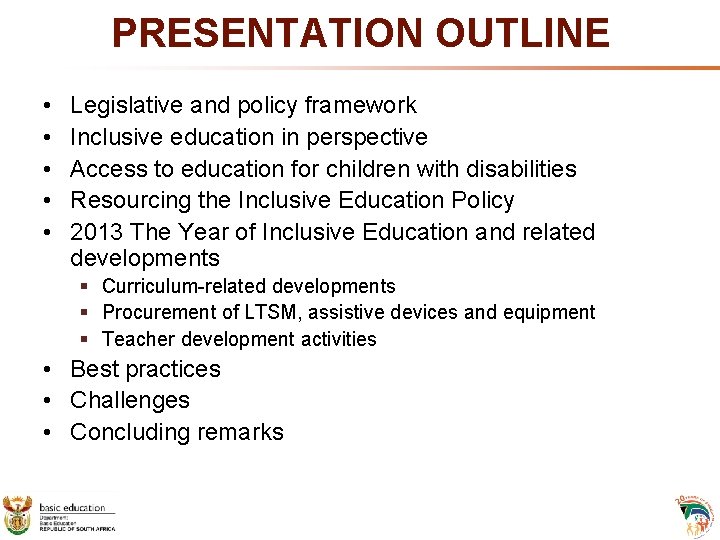
PRESENTATION OUTLINE • • • Legislative and policy framework Inclusive education in perspective Access to education for children with disabilities Resourcing the Inclusive Education Policy 2013 The Year of Inclusive Education and related developments § Curriculum-related developments § Procurement of LTSM, assistive devices and equipment § Teacher development activities • Best practices • Challenges • Concluding remarks
LEGISLATIVE AND POLICY FRAMEWORK Website: www. education. gov. za Call Centre: 0800 202 933 | callcentre@dbe. gov. za Twitter: @DBE_SA | Facebook: DBE SA
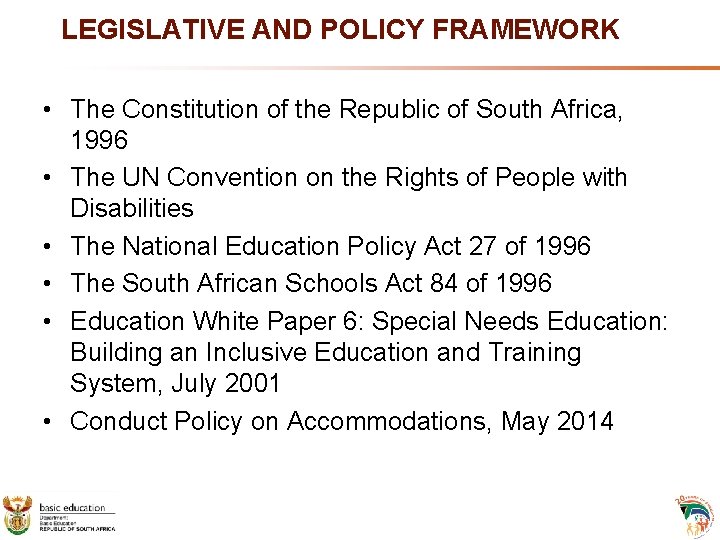
LEGISLATIVE AND POLICY FRAMEWORK • The Constitution of the Republic of South Africa, 1996 • The UN Convention on the Rights of People with Disabilities • The National Education Policy Act 27 of 1996 • The South African Schools Act 84 of 1996 • Education White Paper 6: Special Needs Education: Building an Inclusive Education and Training System, July 2001 • Conduct Policy on Accommodations, May 2014
NATIONAL DEVELOPMENT PLAN - 2030 • Providing Inclusive Education that enables everyone to participate effectively in a free society • Education to provide knowledge and skills that people with disabilities can use to exercise human rights • Ensuring that all children with disabilities have access to quality education will help South Africa meet its employment equity goals in the long run
WP 6 POLICY DIRECTIVES • Education White Paper 6 makes the following provisions for the implementation of Inclusive Education: § § § § Building capacity in all education departments; Establishing district-based support teams (DBSTs); Establishing school-based support teams (SBSTs); Identifying, designating and establishing full service schools (FSSs); Establishing mechanisms for the early identification of learning difficulties using SIAS( Screening, Identification, Assessment & Support); Developing professional capacity of all educators in curriculum development and assessment e. g. Curriculum Differentiation Mobilizing public support; and Developing an appropriate funding strategy 6
INCLUSIVE EDUCATION IN PERSPECTIVE Website: www. education. gov. za Call Centre: 0800 202 933 | callcentre@dbe. gov. za Twitter: @DBE_SA | Facebook: DBE SA
INCLUSION CONCEPTUALISED • Humphrey (2008) acknowledges absence of universally agreed upon definition and isolates the following constructs: § Presence: promotion of visibility of persons (recognition) who are normally excluded from activities of peers in a normal learning context without withdrawal to “special classes or integrated segregation” § Acceptance: degree to which communities and societies acknowledge the diversity and rights of those who are different from them to operate in similar educational and social settings § Participation: involvement of persons with differentiated needs in the quality of their learning experiences § Achievement: promotion of higher academic progress with better socio-emotional interactions in inclusive settings
INCLUSION DEFINED Inclusion is a process of addressing and responding to students’ diversity by increasing their participation in learning, cultures and communities, and reducing exclusion within and from education (UNESCO, November 2005)
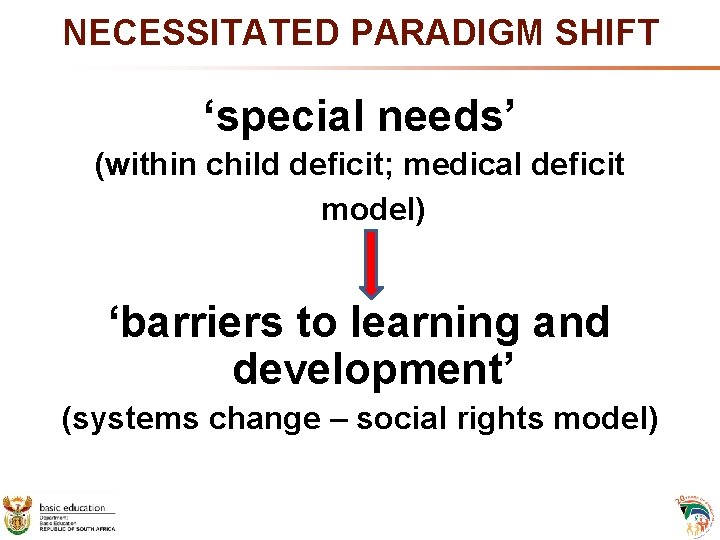
NECESSITATED PARADIGM SHIFT ‘special needs’ (within child deficit; medical deficit model) ‘barriers to learning and development’ (systems change – social rights model)
ACCESS TO EDUCATION FOR CHILDREN WITH DISABILITIES Website: www. education. gov. za Call Centre: 0800 202 933 | callcentre@dbe. gov. za Twitter: @DBE_SA | Facebook: DBE SA
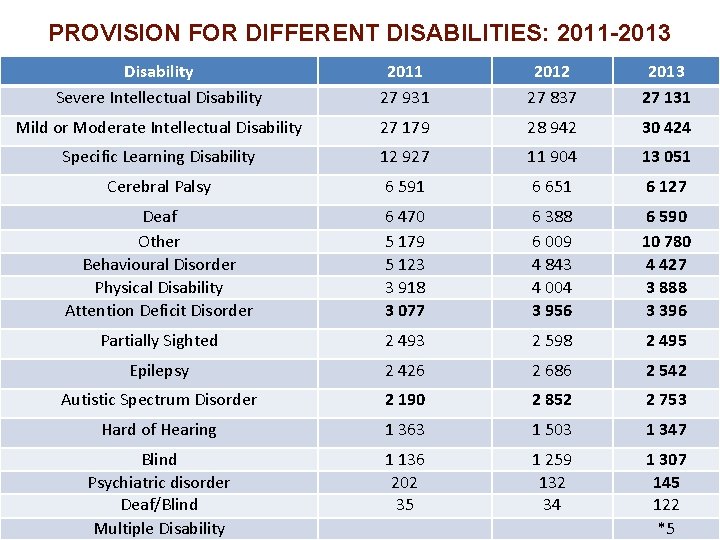
PROVISION FOR DIFFERENT DISABILITIES: 2011 -2013 Disability Severe Intellectual Disability 2011 27 931 2012 27 837 2013 27 131 27 179 28 942 30 424 Specific Learning Disability 12 927 11 904 13 051 Cerebral Palsy 6 591 6 651 6 127 6 470 5 179 5 123 3 918 3 077 6 388 6 009 4 843 4 004 3 956 6 590 10 780 4 427 3 888 3 396 2 493 2 598 2 495 2 426 2 686 2 542 Autistic Spectrum Disorder 2 190 2 852 2 753 Hard of Hearing 1 363 1 503 1 347 Blind Psychiatric disorder Deaf/Blind Multiple Disability 1 136 202 35 1 259 132 34 1 307 145 122 *5 Mild or Moderate Intellectual Disability Deaf Other Behavioural Disorder Physical Disability Attention Deficit Disorder Partially Sighted Epilepsy
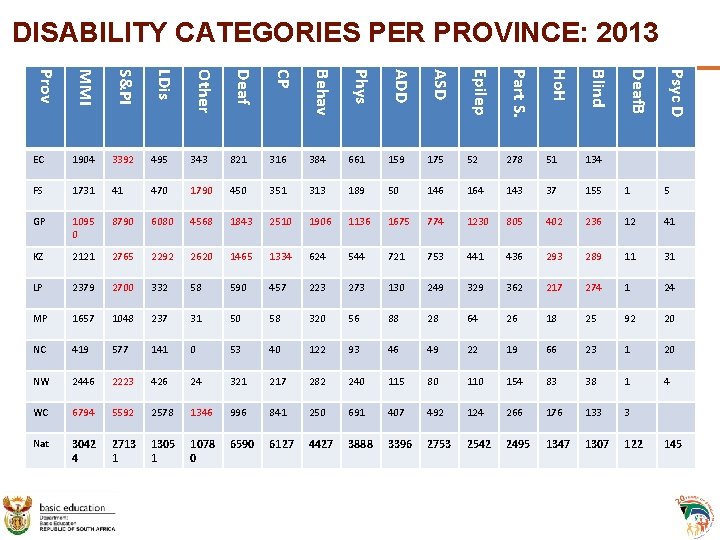
DISABILITY CATEGORIES PER PROVINCE: 2013 Psyc D Deaf. B Blind Ho. H Part S. Epilep ASD ADD Phys Behav CP Deaf Other S&PI LDis MMI Prov EC 1904 3392 495 343 821 316 384 661 159 175 52 278 51 134 FS 1731 41 470 1790 450 351 313 189 50 146 164 143 37 155 1 5 GP 1095 0 8790 6080 4568 1843 2510 1906 1136 1675 774 1230 805 402 236 12 41 KZ 2121 2765 2292 2620 1465 1334 624 544 721 753 441 436 293 289 11 31 LP 2379 2700 332 58 590 457 223 273 130 249 329 362 217 274 1 24 MP 1657 1048 237 31 50 58 320 56 88 28 64 26 18 25 92 20 NC 419 577 141 0 53 40 122 93 46 49 22 19 66 23 1 20 NW 2446 2223 426 24 321 217 282 240 115 80 110 154 83 38 1 4 WC 6794 5592 2578 1346 996 841 250 691 407 492 124 266 176 133 3 Nat 3042 4 2713 1 1305 1 1078 0 6590 6127 4427 3888 3396 2753 2542 2495 1347 1307 122 145
DISTRIBUTION IRO CATEGORIES OF DISABILITIES • Intellectual disability in its various forms constitutes the highest prevalence compared to all disabilities • Albeit the high prevalence of intellectual disability, intervention and support are not resource-intensive but require Curriculum Differentiation in the main • Disabilities such as deafness, blindness and Autism Spectrum Disorder do not constitute large numbers but because of their complex nature require highly specialised interventions
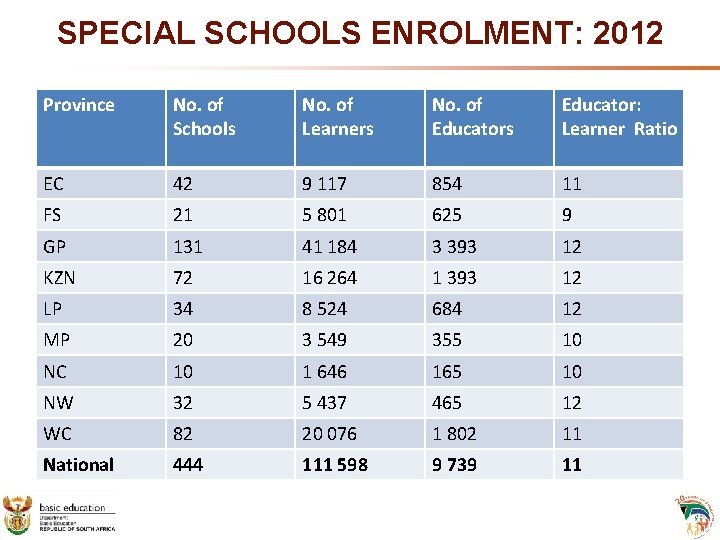
SPECIAL SCHOOLS ENROLMENT: 2012 Province No. of Schools No. of Learners No. of Educators Educator: Learner Ratio EC 42 9 117 854 11 FS 21 5 801 625 9 GP 131 41 184 3 393 12 KZN 72 16 264 1 393 12 LP 34 8 524 684 12 MP 20 3 549 355 10 NC 10 1 646 165 10 NW 32 5 437 465 12 WC 82 20 076 1 802 11 National 444 111 598 9 739 11
SPECIAL NEEDS ENROLMENT IN SSs • The number of special schools is steadily increasing over time – new specials are being built by PEDs • The educator: learner ration in special schools averages 1: 11 fluctuating between 10 and 12 • Essentially, teachers in special schools are expected to provide individual attention to learners with minimal difficulty which is what is required for this learner population • On the contrary the quality of education in special schools remains challenging and has to be investigated
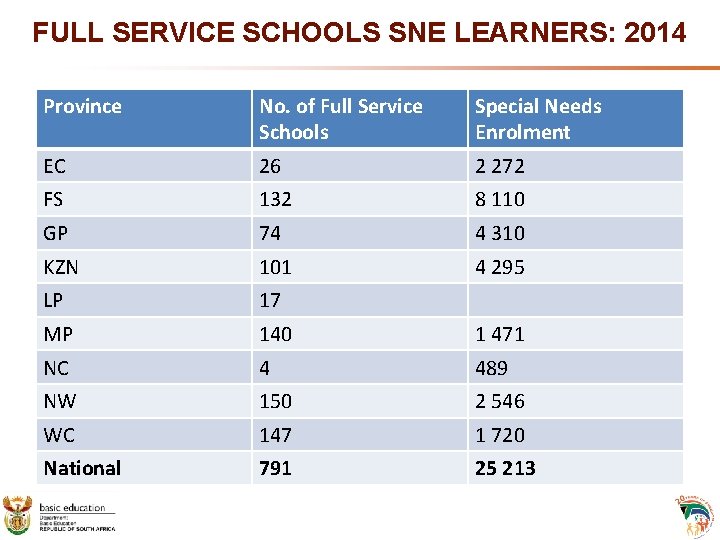
FULL SERVICE SCHOOLS SNE LEARNERS: 2014 Province No. of Full Service Schools Special Needs Enrolment EC 26 2 272 FS 132 8 110 GP 74 4 310 KZN 101 4 295 LP 17 MP 140 1 471 NC 4 489 NW 150 2 546 WC 147 1 720 National 791 25 213
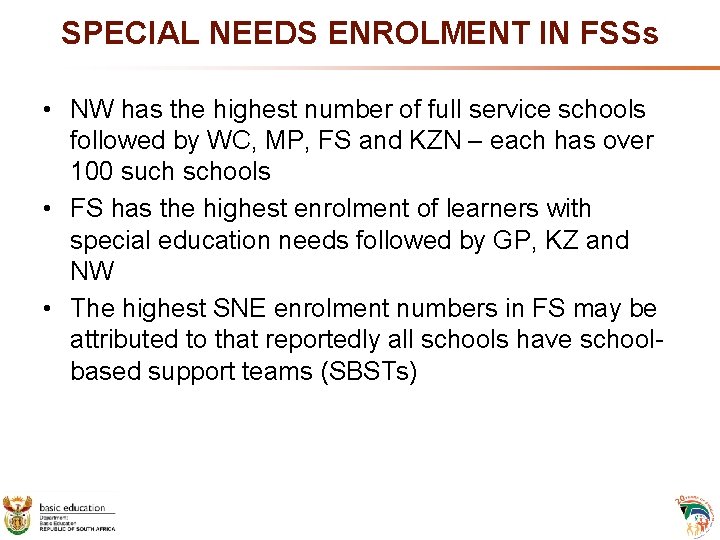
SPECIAL NEEDS ENROLMENT IN FSSs • NW has the highest number of full service schools followed by WC, MP, FS and KZN – each has over 100 such schools • FS has the highest enrolment of learners with special education needs followed by GP, KZ and NW • The highest SNE enrolment numbers in FS may be attributed to that reportedly all schools have schoolbased support teams (SBSTs)
ACCESS FOR CHILDREN AGED 0 -4 YEARS Province 2009 2010 2011 2012 2013 Eastern Cape 32. 2 35. 5 34. 2 40. 3 46. 2 Free State 34. 1 34. 0 31. 0 40. 6 55. 0 Gauteng Kwa. Zulu. Natal 39. 7 45. 7 44. 9 63. 7 23. 6 21. 7 22. 6 25. 3 32. 2 Limpopo 32. 0 28. 6 44. 8 39. 1 44. 5 Mpumalanga 32. 2 27. 6 30. 3 34. 5 32. 4 North West Northern Cape Western Cape 20. 8 27. 1 27. 6 38. 2 46. 6 18. 8 20. 5 27. 3 34. 9 18. 2 41. 0 35. 1 39. 4 SA 28. 3 31. 5 33. 9 36. 7 43. 7
ACCESS FOR CHILDREN AGED 0 -4 YEARS… • There has been a steady growth in 0 -4 year old children with disabilities receiving ECD programmes from 28. 3% in 2009 to 43. 7% in 2013 • The growth pattern however varies from province to province • Availability of facilities and resources could be responsible for the disparities across provinces • Much still needs to be done to conscientise communities about the importance of early access to education programmes particularly those who Deaf, Blind and with Autistic Spectrum Disorder
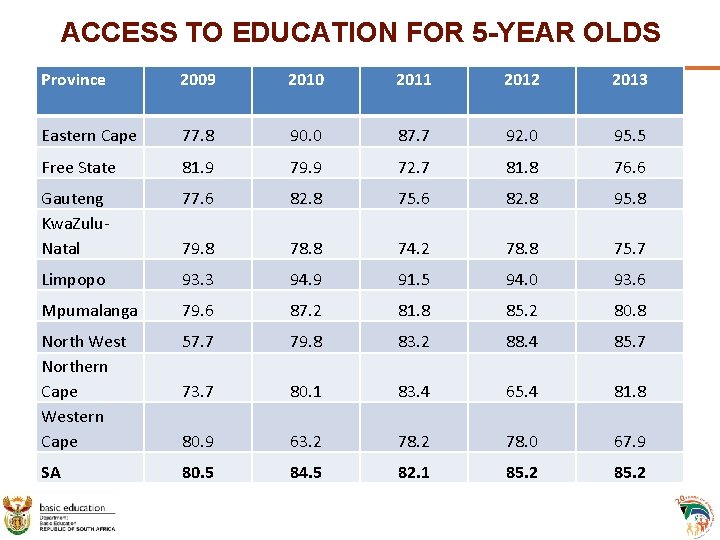
ACCESS TO EDUCATION FOR 5 -YEAR OLDS Province 2009 2010 2011 2012 2013 Eastern Cape 77. 8 90. 0 87. 7 92. 0 95. 5 Free State 81. 9 79. 9 72. 7 81. 8 76. 6 Gauteng Kwa. Zulu. Natal 77. 6 82. 8 75. 6 82. 8 95. 8 79. 8 78. 8 74. 2 78. 8 75. 7 Limpopo 93. 3 94. 9 91. 5 94. 0 93. 6 Mpumalanga 79. 6 87. 2 81. 8 85. 2 80. 8 North West Northern Cape Western Cape 57. 7 79. 8 83. 2 88. 4 85. 7 73. 7 80. 1 83. 4 65. 4 81. 8 80. 9 63. 2 78. 0 67. 9 SA 80. 5 84. 5 82. 1 85. 2
ACCESS TO EDUCATION FOR 5 -YEAR OLDS… • A marked national growth in the percentage of 5 yearolds attending grade R in educational institutions recorded 80. 5% in 2009 and 85. 2% in 2013 • The growth has however not been steady throughout the period • Variations across provinces are evident in this group too • Attendance of above 90% in 2013 was recorded in the EC, GP, and LP probably for various reasons • LP and EC being largely rural provinces could have recorded these percentages due to poverty whilst GP could be having a large number of private education institutions which could add to the numbers
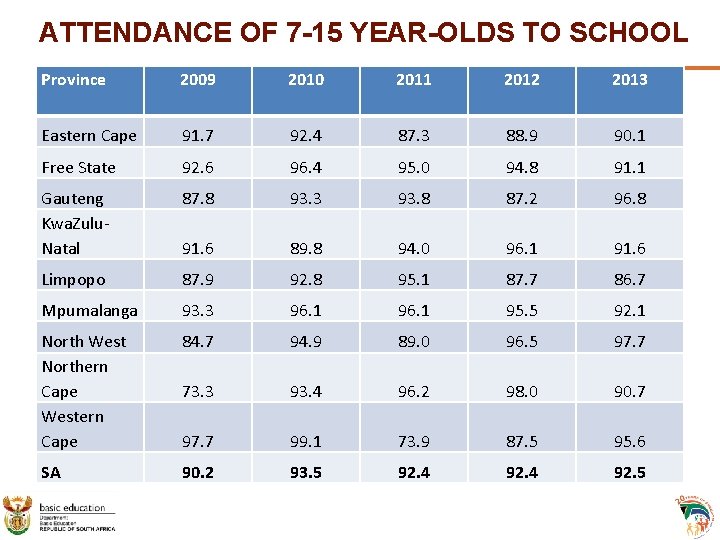
ATTENDANCE OF 7 -15 YEAR-OLDS TO SCHOOL Province 2009 2010 2011 2012 2013 Eastern Cape 91. 7 92. 4 87. 3 88. 9 90. 1 Free State 92. 6 96. 4 95. 0 94. 8 91. 1 Gauteng Kwa. Zulu. Natal 87. 8 93. 3 93. 8 87. 2 96. 8 91. 6 89. 8 94. 0 96. 1 91. 6 Limpopo 87. 9 92. 8 95. 1 87. 7 86. 7 Mpumalanga 93. 3 96. 1 95. 5 92. 1 North West Northern Cape Western Cape 84. 7 94. 9 89. 0 96. 5 97. 7 73. 3 93. 4 96. 2 98. 0 90. 7 97. 7 99. 1 73. 9 87. 5 95. 6 SA 90. 2 93. 5 92. 4 92. 5
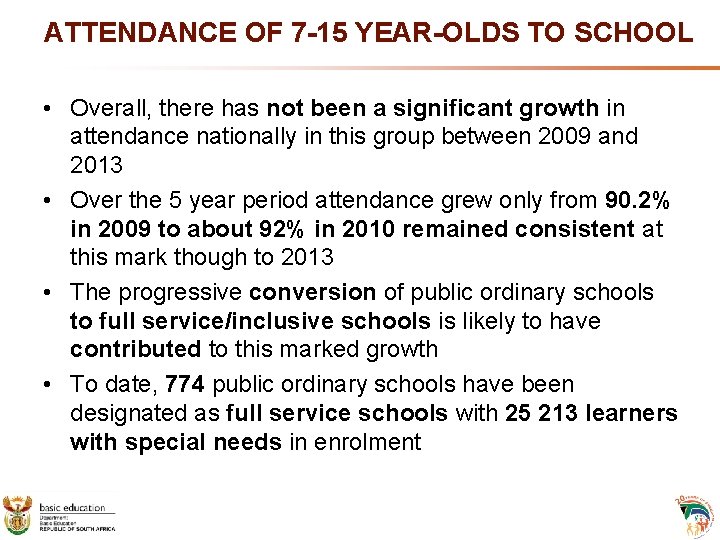
ATTENDANCE OF 7 -15 YEAR-OLDS TO SCHOOL • Overall, there has not been a significant growth in attendance nationally in this group between 2009 and 2013 • Over the 5 year period attendance grew only from 90. 2% in 2009 to about 92% in 2010 remained consistent at this mark though to 2013 • The progressive conversion of public ordinary schools to full service/inclusive schools is likely to have contributed to this marked growth • To date, 774 public ordinary schools have been designated as full service schools with 25 213 learners with special needs in enrolment
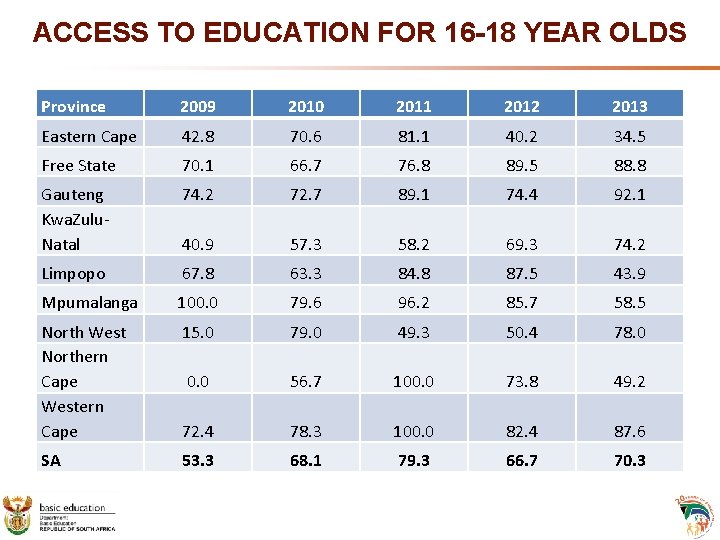
ACCESS TO EDUCATION FOR 16 -18 YEAR OLDS Province 2009 2010 2011 2012 2013 Eastern Cape 42. 8 70. 6 81. 1 40. 2 34. 5 Free State 70. 1 66. 7 76. 8 89. 5 88. 8 Gauteng Kwa. Zulu. Natal 74. 2 72. 7 89. 1 74. 4 92. 1 40. 9 57. 3 58. 2 69. 3 74. 2 Limpopo 67. 8 63. 3 84. 8 87. 5 43. 9 Mpumalanga 100. 0 79. 6 96. 2 85. 7 58. 5 North West Northern Cape Western Cape 15. 0 79. 0 49. 3 50. 4 78. 0 0. 0 56. 7 100. 0 73. 8 49. 2 72. 4 78. 3 100. 0 82. 4 87. 6 SA 53. 3 68. 1 79. 3 66. 7 70. 3
16 -18 YEAR OLDS IN EDUCATIONAL INSTITUTIONS • Notwithstanding the overall significant growth in participation of 16 -18 year-olds with disabilities in education, the growth rate remains lower than that of children without disabilities • Access rate has been fluctuating albeit in an upward trend from 53. 3% in 2009 to 70. 3% in 2013, overall • The fluctuation in numbers could be due to data quality resulting from disability definitions • The improvement in the participation could be attributed to the improved implementation of the IE policy • The implementation of IE has increasingly been coupled with mobilisation of stakeholders
RESOURCING THE INCLUSIVE EDUCATION POLICY Website: www. education. gov. za Call Centre: 0800 202 933 | callcentre@dbe. gov. za Twitter: @DBE_SA | Facebook: DBE SA
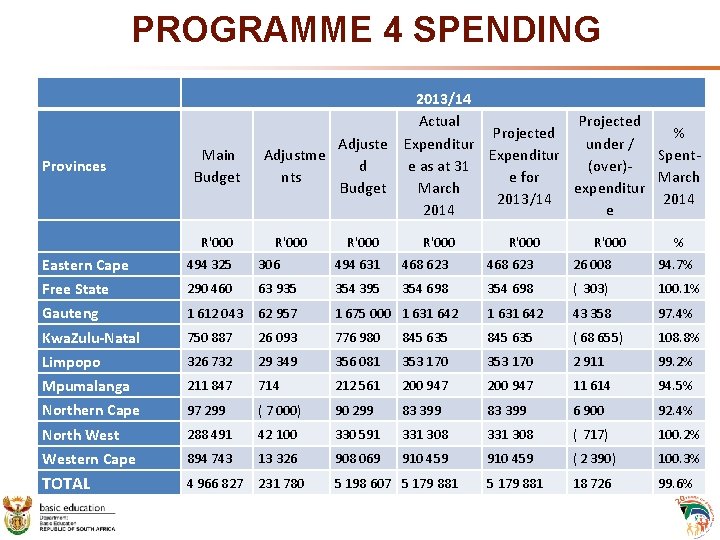
PROGRAMME 4 SPENDING Provinces Main Budget Adjustme nts Adjuste d Budget R'000 2013/14 Actual Projected % Expenditur under / Expenditur Spente as at 31 (over)e for March expenditur 2013/14 2014 e Eastern Cape 494 325 306 494 631 468 623 26 008 94. 7% Free State 290 460 63 935 354 395 354 698 ( 303) 100. 1% Gauteng 1 612 043 62 957 1 675 000 1 631 642 43 358 97. 4% Kwa. Zulu-Natal 750 887 26 093 776 980 845 635 ( 68 655) 108. 8% Limpopo 326 732 29 349 356 081 353 170 2 911 99. 2% Mpumalanga 211 847 714 212 561 200 947 11 614 94. 5% Northern Cape 97 299 ( 7 000) 90 299 83 399 6 900 92. 4% North West 288 491 42 100 330 591 331 308 ( 717) 100. 2% Western Cape 894 743 13 326 908 069 910 459 ( 2 390) 100. 3% TOTAL 4 966 827 231 780 5 198 607 5 179 881 18 726 99. 6% R'000 %
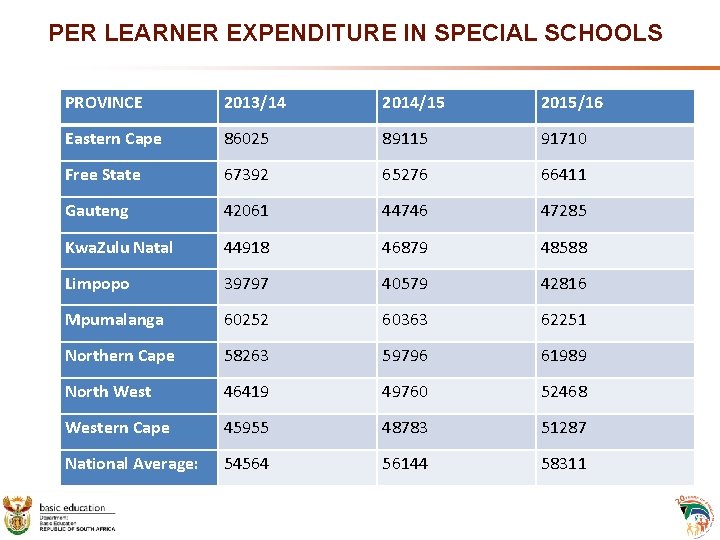
PER LEARNER EXPENDITURE IN SPECIAL SCHOOLS PROVINCE 2013/14 2014/15 2015/16 Eastern Cape 86025 89115 91710 Free State 67392 65276 66411 Gauteng 42061 44746 47285 Kwa. Zulu Natal 44918 46879 48588 Limpopo 39797 40579 42816 Mpumalanga 60252 60363 62251 Northern Cape 58263 59796 61989 North West 46419 49760 52468 Western Cape 45955 48783 51287 National Average: 54564 56144 58311
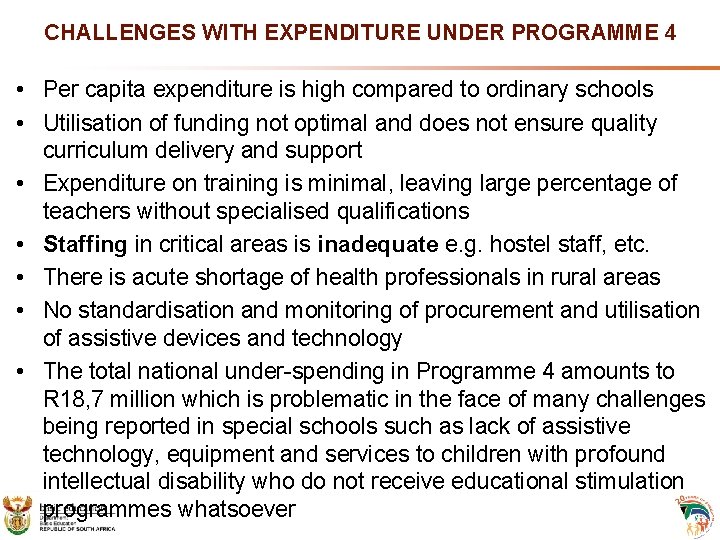
CHALLENGES WITH EXPENDITURE UNDER PROGRAMME 4 • Per capita expenditure is high compared to ordinary schools • Utilisation of funding not optimal and does not ensure quality curriculum delivery and support • Expenditure on training is minimal, leaving large percentage of teachers without specialised qualifications • Staffing in critical areas is inadequate e. g. hostel staff, etc. • There is acute shortage of health professionals in rural areas • No standardisation and monitoring of procurement and utilisation of assistive devices and technology • The total national under-spending in Programme 4 amounts to R 18, 7 million which is problematic in the face of many challenges being reported in special schools such as lack of assistive technology, equipment and services to children with profound intellectual disability who do not receive educational stimulation programmes whatsoever
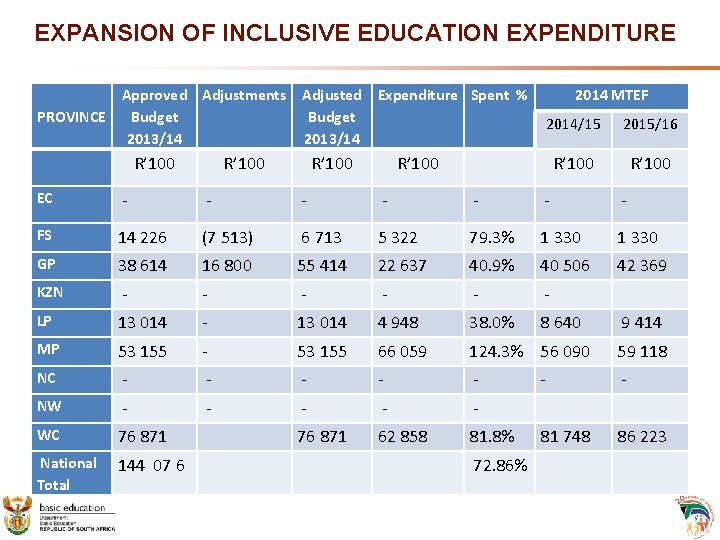
EXPANSION OF INCLUSIVE EDUCATION EXPENDITURE Approved Adjustments Adjusted Expenditure Spent % PROVINCE Budget 2013/14 R’ 100 2014 MTEF 2014/15 2015/16 R’ 100 EC - - FS 14 226 (7 513) 6 713 5 322 79. 3% 1 330 GP 38 614 16 800 55 414 22 637 40. 9% 40 506 42 369 KZN - - - - LP 13 014 - 13 014 4 948 38. 0% 8 640 9 414 MP 53 155 - 53 155 66 059 124. 3% 56 090 59 118 NC - - - NW - - - WC 76 871 62 858 81. 8% 81 748 86 223 National Total 144 07 6 72. 86%
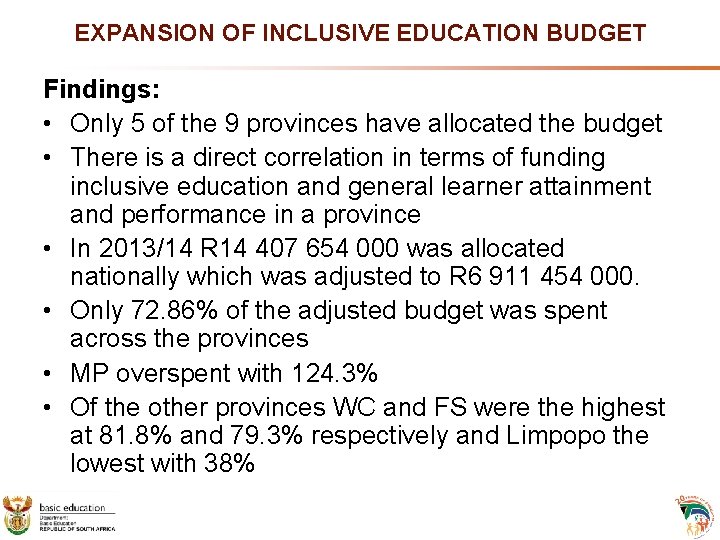
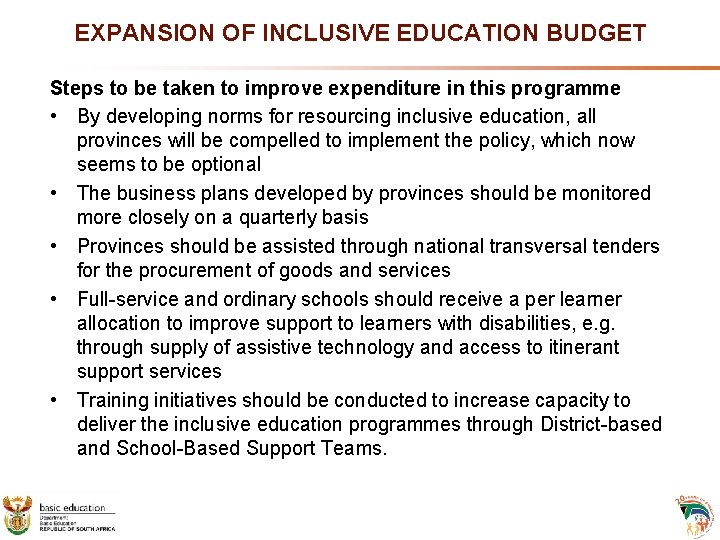
EXPANSION OF INCLUSIVE EDUCATION BUDGET Findings: • Only 5 of the 9 provinces have allocated the budget • There is a direct correlation in terms of funding inclusive education and general learner attainment and performance in a province • In 2013/14 R 14 407 654 000 was allocated nationally which was adjusted to R 6 911 454 000. • Only 72. 86% of the adjusted budget was spent across the provinces • MP overspent with 124. 3% • Of the other provinces WC and FS were the highest at 81. 8% and 79. 3% respectively and Limpopo the lowest with 38%
EXPANSION OF INCLUSIVE EDUCATION BUDGET Steps to be taken to improve expenditure in this programme • By developing norms for resourcing inclusive education, all provinces will be compelled to implement the policy, which now seems to be optional • The business plans developed by provinces should be monitored more closely on a quarterly basis • Provinces should be assisted through national transversal tenders for the procurement of goods and services • Full-service and ordinary schools should receive a per learner allocation to improve support to learners with disabilities, e. g. through supply of assistive technology and access to itinerant support services • Training initiatives should be conducted to increase capacity to deliver the inclusive education programmes through District-based and School-Based Support Teams.
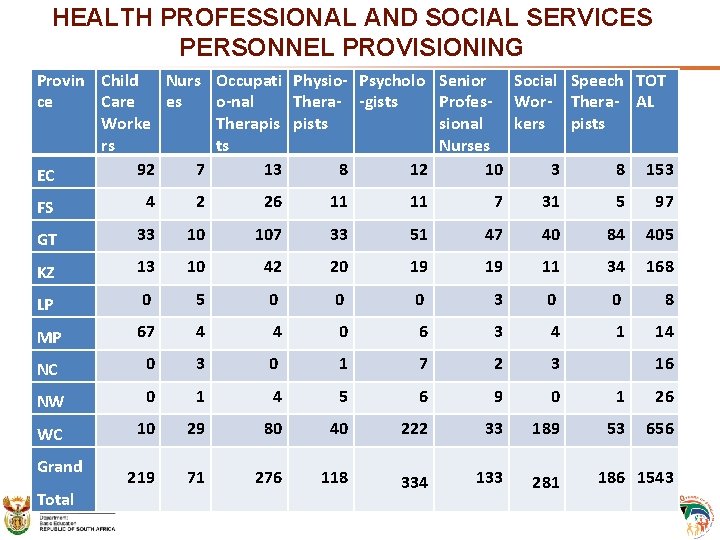
HEALTH PROFESSIONAL AND SOCIAL SERVICES PERSONNEL PROVISIONING Provin Child Nurs Occupati Physio- Psycholo ce Care es o-nal Thera- -gists Worke Therapis pists rs ts 92 7 13 8 12 EC Senior Social Speech TOT Profes- Wor- Thera- AL sional kers pists Nurses 10 3 8 153 FS 4 2 26 11 11 7 31 5 97 GT 33 10 107 33 51 47 40 84 405 KZ 13 10 42 20 19 19 11 34 168 LP 0 5 0 0 0 3 0 0 8 MP 67 4 4 0 6 3 4 1 14 NC 0 3 0 1 7 2 3 16 NW 0 1 4 5 6 9 0 1 26 WC 10 29 80 40 222 33 189 53 656 219 71 276 118 334 133 281 Grand Total 186 1543
2013 THE YEAR OF INCLUSIVE EDUCATION AND RELATED DEVELOPMENTS Website: www. education. gov. za Call Centre: 0800 202 933 | callcentre@dbe. gov. za Twitter: @DBE_SA | Facebook: DBE SA
CURRICULUM RELATED DEVELOPMENTS Website: www. education. gov. za Call Centre: 0800 202 933 | callcentre@dbe. gov. za Twitter: @DBE_SA | Facebook: DBE SA
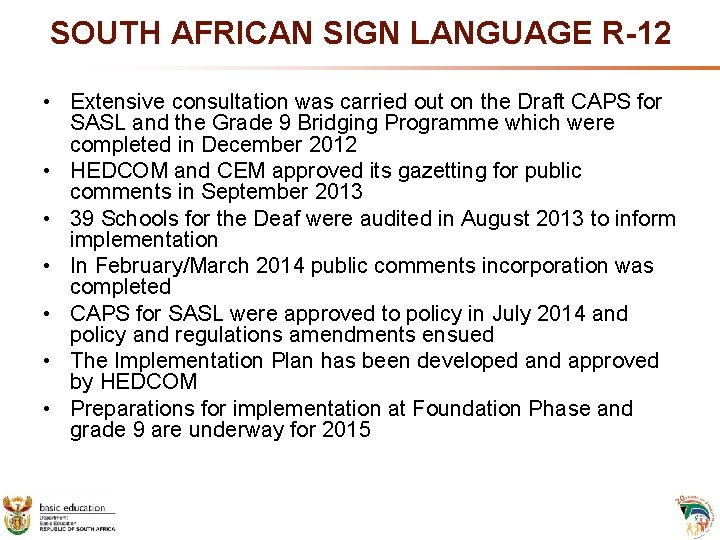
SOUTH AFRICAN SIGN LANGUAGE R-12 • Extensive consultation was carried out on the Draft CAPS for SASL and the Grade 9 Bridging Programme which were completed in December 2012 • HEDCOM and CEM approved its gazetting for public comments in September 2013 • 39 Schools for the Deaf were audited in August 2013 to inform implementation • In February/March 2014 public comments incorporation was completed • CAPS for SASL were approved to policy in July 2014 and policy and regulations amendments ensued • The Implementation Plan has been developed and approved by HEDCOM • Preparations for implementation at Foundation Phase and grade 9 are underway for 2015
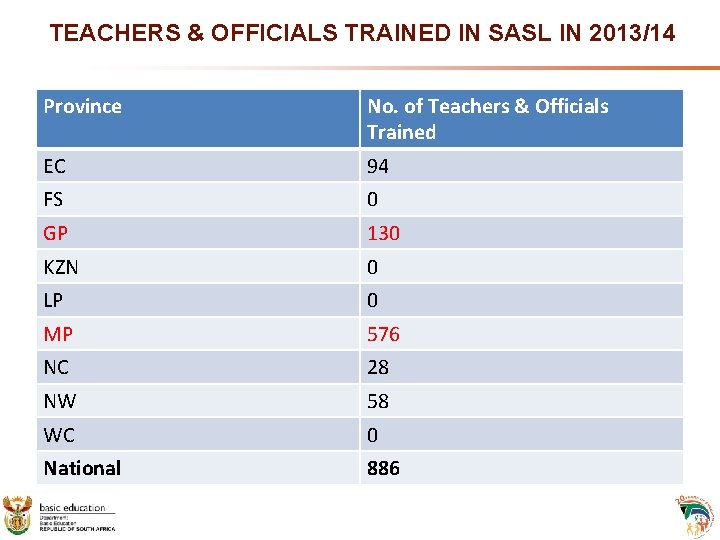
TEACHERS & OFFICIALS TRAINED IN SASL IN 2013/14 Province No. of Teachers & Officials Trained EC 94 FS 0 GP 130 KZN 0 LP 0 MP 576 NC 28 NW 58 WC 0 National 886
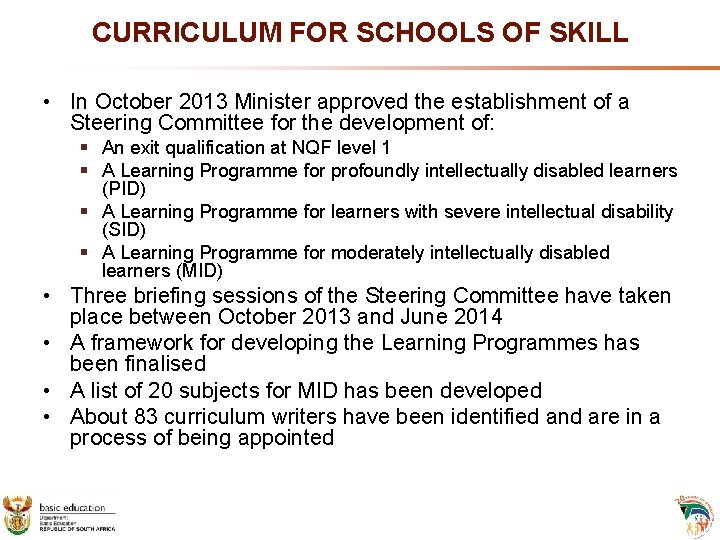
CURRICULUM FOR SCHOOLS OF SKILL • In October 2013 Minister approved the establishment of a Steering Committee for the development of: § An exit qualification at NQF level 1 § A Learning Programme for profoundly intellectually disabled learners (PID) § A Learning Programme for learners with severe intellectual disability (SID) § A Learning Programme for moderately intellectually disabled learners (MID) • Three briefing sessions of the Steering Committee have taken place between October 2013 and June 2014 • A framework for developing the Learning Programmes has been finalised • A list of 20 subjects for MID has been developed • About 83 curriculum writers have been identified and are in a process of being appointed
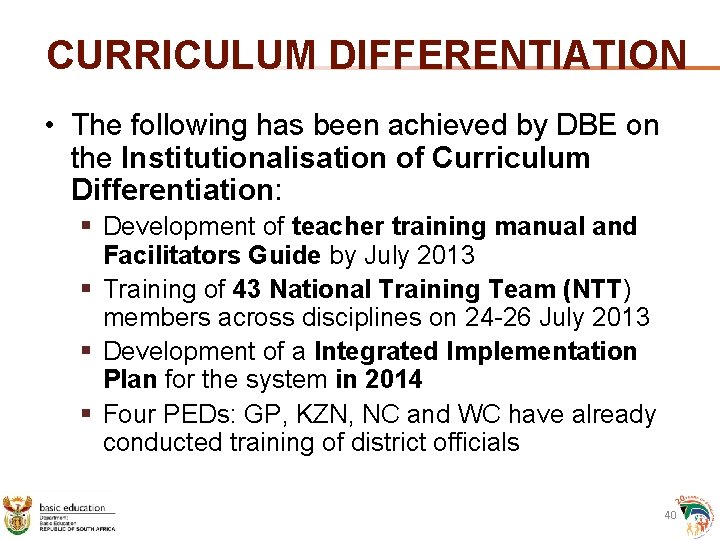
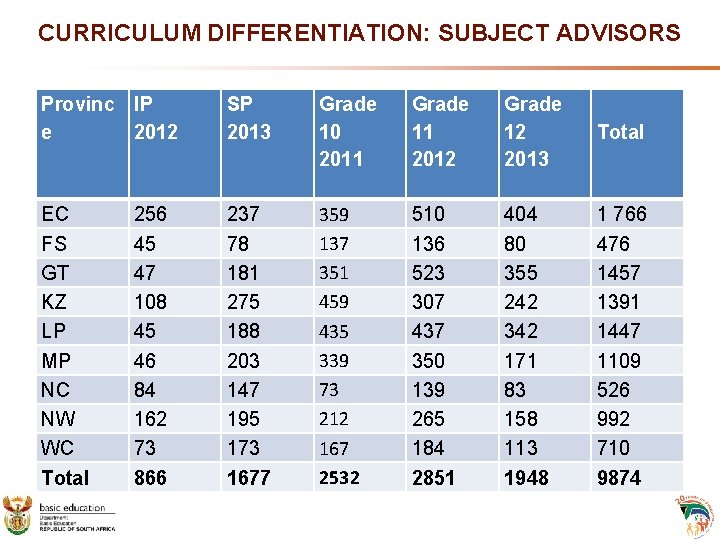
CURRICULUM DIFFERENTIATION • The following has been achieved by DBE on the Institutionalisation of Curriculum Differentiation: § Development of teacher training manual and Facilitators Guide by July 2013 § Training of 43 National Training Team (NTT) members across disciplines on 24 -26 July 2013 § Development of a Integrated Implementation Plan for the system in 2014 § Four PEDs: GP, KZN, NC and WC have already conducted training of district officials 40
CURRICULUM DIFFERENTIATION: SUBJECT ADVISORS Provinc IP e 2012 SP 2013 Grade 10 2011 EC FS GT KZ LP MP NC NW WC Total 237 78 181 275 188 203 147 195 173 1677 359 137 351 459 435 339 73 212 167 2532 256 45 47 108 45 46 84 162 73 866 Grade 11 2012 510 136 523 307 437 350 139 265 184 2851 Grade 12 2013 Total 404 80 355 242 342 171 83 158 113 1948 1 766 476 1457 1391 1447 1109 526 992 710 9874
PROCUREMENT OF LTSM, ASSISTIVE DEVICES AND EQUIPMENT Website: www. education. gov. za Call Centre: 0800 202 933 | callcentre@dbe. gov. za Twitter: @DBE_SA | Facebook: DBE SA
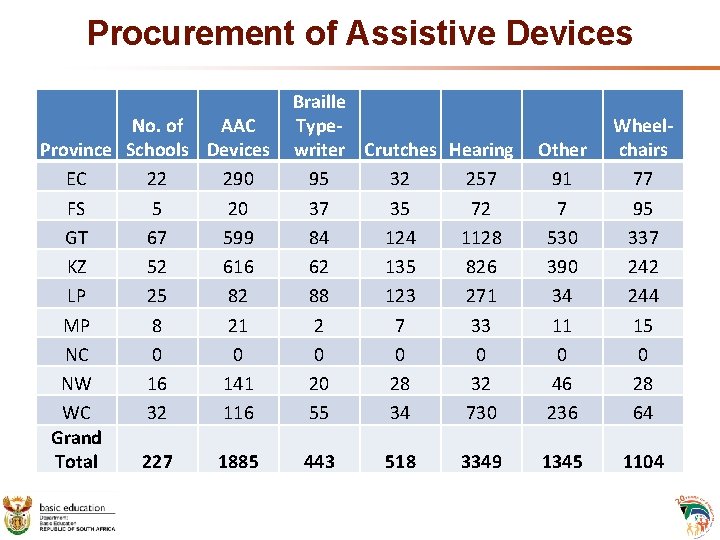
Procurement of Assistive Devices No. of AAC Province Schools Devices EC 22 290 FS 5 20 GT 67 599 KZ 52 616 LP 25 82 MP 8 21 NC 0 0 NW 16 141 WC 32 116 Grand 227 1885 Total Braille Typewriter Crutches Hearing 95 32 257 37 35 72 84 124 1128 62 135 826 88 123 271 2 7 33 0 0 0 20 28 32 55 34 730 443 518 3349 Other 91 7 530 390 34 11 0 46 236 Wheelchairs 77 95 337 242 244 15 0 28 64 1345 1104
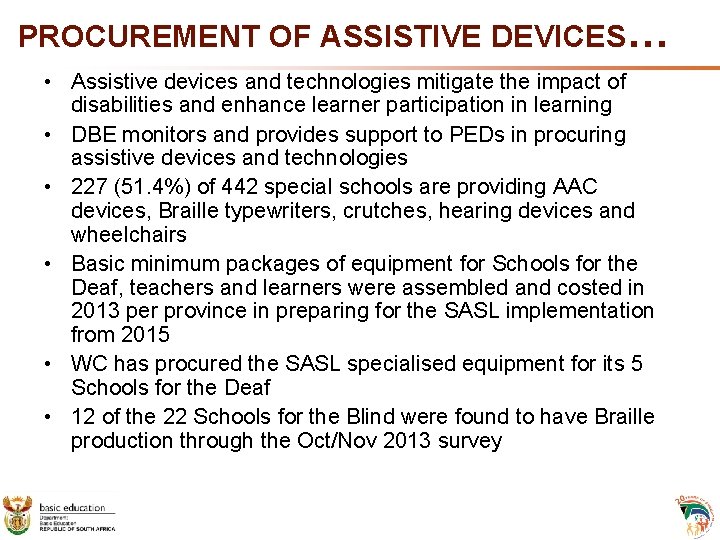
PROCUREMENT OF ASSISTIVE DEVICES… • Assistive devices and technologies mitigate the impact of disabilities and enhance learner participation in learning • DBE monitors and provides support to PEDs in procuring assistive devices and technologies • 227 (51. 4%) of 442 special schools are providing AAC devices, Braille typewriters, crutches, hearing devices and wheelchairs • Basic minimum packages of equipment for Schools for the Deaf, teachers and learners were assembled and costed in 2013 per province in preparing for the SASL implementation from 2015 • WC has procured the SASL specialised equipment for its 5 Schools for the Deaf • 12 of the 22 Schools for the Blind were found to have Braille production through the Oct/Nov 2013 survey
ADAPTATION OF WORKBOOKS • Grades R-9 mathematics and language workbooks were adapted for Braille and large print production in 2013 • Adapted workbooks for visually impaired are being Brailled, printed and distributed • Teacher Guides have been developed on the utilisation of workbooks for AAC learners • Guidelines have been developed for teachers on the adaptation of LTSM and utilisation of assistive devices • A Teacher Guide on the utilisation of workbooks with Deaf learners was finalised
PROCUREMENT AND DISTRIBUTION OF BRAILLE LTSM • In 2013 DBE distributed 500 grades 1 -6 Mathematics workbooks and toolkits to all 22 Schools for the Blind • In 2014 DBE distributed grades 1 -3 Home Language workbooks and toolkits in 11 official languages • Workbooks are accompanied by Teacher Guides • Master copies are being developed for other grades • In December 2013 a textbook selection for Senior Phase and grade 12 was conducted for the catalogue • PEDs are procuring Braille textbooks as they become available from Pioneer Printers in the WC • FS, MP, NC, NW and WC have already submitted procurement orders to DBE • DBE has considered ICT to expedite access to information for visually impaired learners
TEACHER DEVELOPMENT ACTIVITIES Website: www. education. gov. za Call Centre: 0800 202 933 | callcentre@dbe. gov. za Twitter: @DBE_SA | Facebook: DBE SA
MECHANISMS FOR EARLY IDENTIFICATION AND INTERVENTION IN LEARNING DIFFICULTIES • DBE has conducted a review of the screening, identification, assessment and support (SIAS) • PEDs started preparation for SAIS policy implementation in 2013 • PEDs have trained an excess of 13 000 existing SIAS • DBE finalised the review of SIAS in July 2013 • Consultations ensued and involved Do. H, DSD, HEDCOM, CEM • CEM approved the draft for gazetting for public comment in 2014 • SAIS is in the process of being approved to policy • Through DBE – DST partnership an e-Health project piloted at Cofimvaba district in the EC • This innovation seeks to improved ISHP implementation • The e-Health project has potential to provide relief in SIAS policy implementation if rolled out in largely rural provinces 48
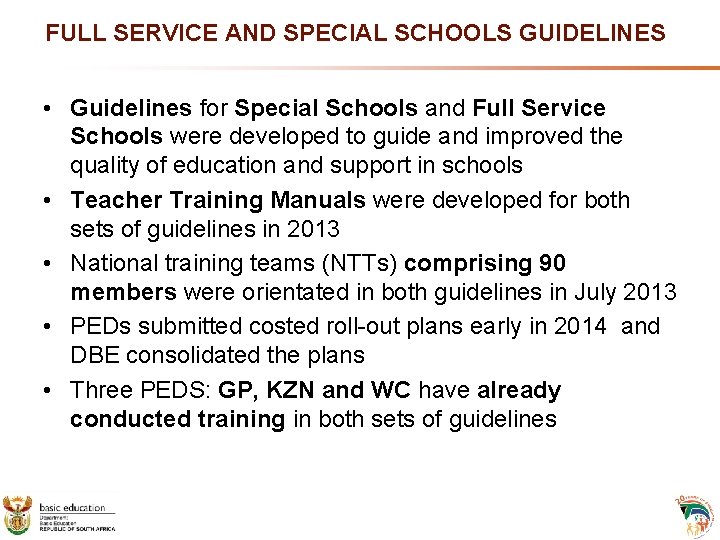
FULL SERVICE AND SPECIAL SCHOOLS GUIDELINES • Guidelines for Special Schools and Full Service Schools were developed to guide and improved the quality of education and support in schools • Teacher Training Manuals were developed for both sets of guidelines in 2013 • National training teams (NTTs) comprising 90 members were orientated in both guidelines in July 2013 • PEDs submitted costed roll-out plans early in 2014 and DBE consolidated the plans • Three PEDS: GP, KZN and WC have already conducted training in both sets of guidelines
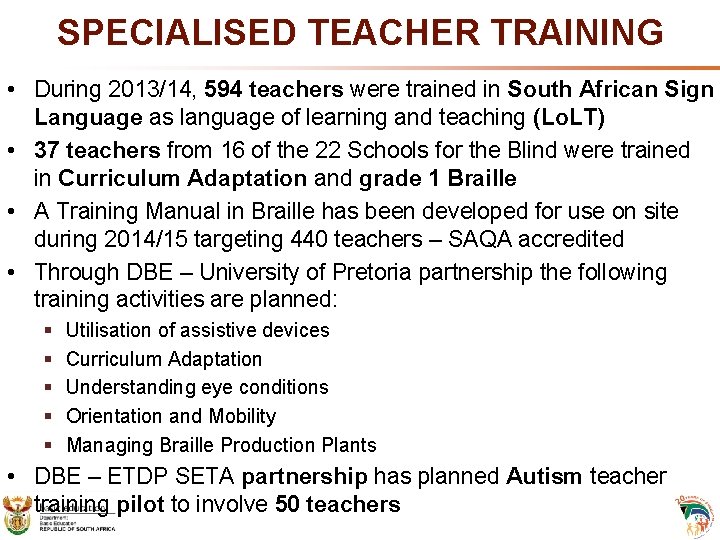
SPECIALISED TEACHER TRAINING • During 2013/14, 594 teachers were trained in South African Sign Language as language of learning and teaching (Lo. LT) • 37 teachers from 16 of the 22 Schools for the Blind were trained in Curriculum Adaptation and grade 1 Braille • A Training Manual in Braille has been developed for use on site during 2014/15 targeting 440 teachers – SAQA accredited • Through DBE – University of Pretoria partnership the following training activities are planned: § § § Utilisation of assistive devices Curriculum Adaptation Understanding eye conditions Orientation and Mobility Managing Braille Production Plants • DBE – ETDP SETA partnership has planned Autism teacher training pilot to involve 50 teachers
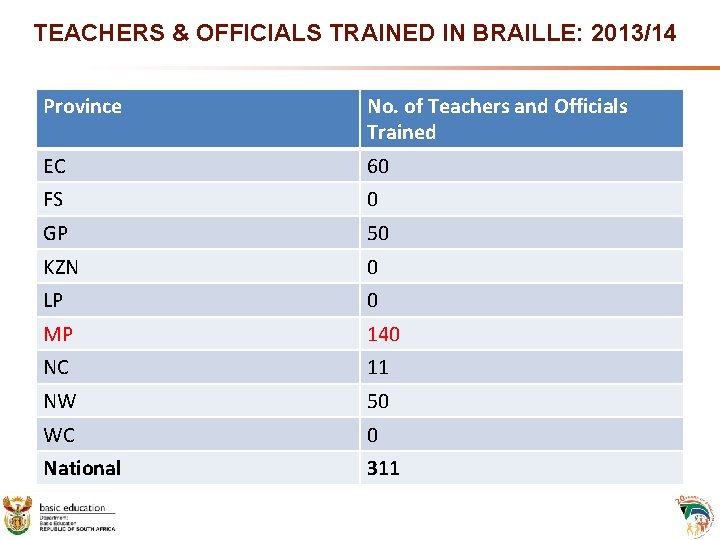
TEACHERS & OFFICIALS TRAINED IN BRAILLE: 2013/14 Province No. of Teachers and Officials Trained EC 60 FS 0 GP 50 KZN 0 LP 0 MP 140 NC 11 NW 50 WC 0 National 311
BEST PRACTICES Website: www. education. gov. za Call Centre: 0800 202 933 | callcentre@dbe. gov. za Twitter: @DBE_SA | Facebook: DBE SA
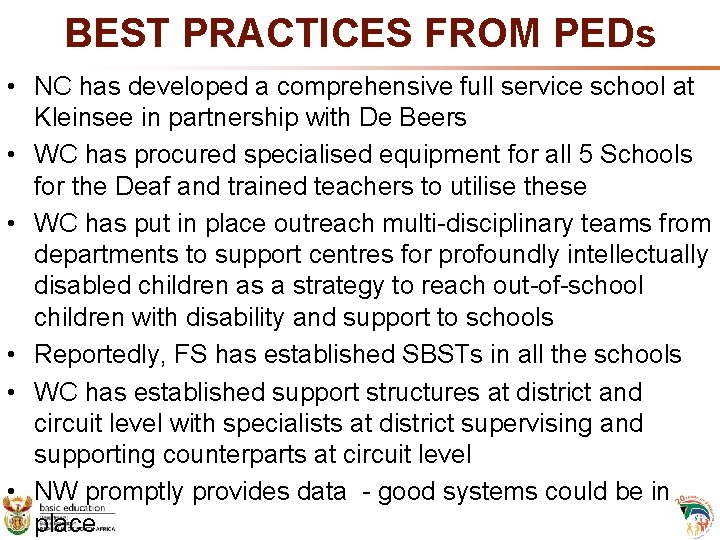
BEST PRACTICES FROM PEDs • NC has developed a comprehensive full service school at Kleinsee in partnership with De Beers • WC has procured specialised equipment for all 5 Schools for the Deaf and trained teachers to utilise these • WC has put in place outreach multi-disciplinary teams from departments to support centres for profoundly intellectually disabled children as a strategy to reach out-of-school children with disability and support to schools • Reportedly, FS has established SBSTs in all the schools • WC has established support structures at district and circuit level with specialists at district supervising and supporting counterparts at circuit level • NW promptly provides data - good systems could be in place
CHALLENGES Website: www. education. gov. za Call Centre: 0800 202 933 | callcentre@dbe. gov. za Twitter: @DBE_SA | Facebook: DBE SA
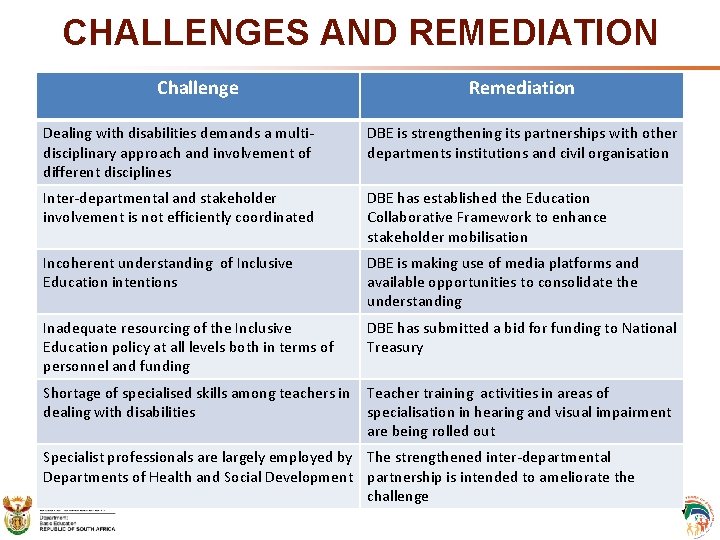
CHALLENGES AND REMEDIATION Challenge Remediation Dealing with disabilities demands a multidisciplinary approach and involvement of different disciplines DBE is strengthening its partnerships with other departments institutions and civil organisation Inter-departmental and stakeholder involvement is not efficiently coordinated DBE has established the Education Collaborative Framework to enhance stakeholder mobilisation Incoherent understanding of Inclusive Education intentions DBE is making use of media platforms and available opportunities to consolidate the understanding Inadequate resourcing of the Inclusive Education policy at all levels both in terms of personnel and funding DBE has submitted a bid for funding to National Treasury Shortage of specialised skills among teachers in Teacher training activities in areas of dealing with disabilities specialisation in hearing and visual impairment are being rolled out Specialist professionals are largely employed by The strengthened inter-departmental Departments of Health and Social Development partnership is intended to ameliorate the challenge
CONCLUDING REMARKS Website: www. education. gov. za Call Centre: 0800 202 933 | callcentre@dbe. gov. za Twitter: @DBE_SA | Facebook: DBE SA
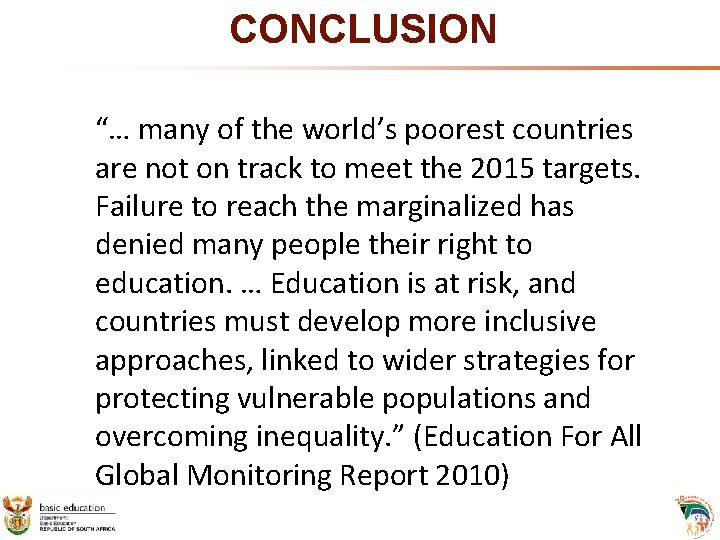
CONCLUSION “… many of the world’s poorest countries are not on track to meet the 2015 targets. Failure to reach the marginalized has denied many people their right to education. … Education is at risk, and countries must develop more inclusive approaches, linked to wider strategies for protecting vulnerable populations and overcoming inequality. ” (Education For All Global Monitoring Report 2010)
THANK YOU Website: www. education. gov. za Call Centre: 0800 202 933 | callcentre@dbe. gov. za Twitter: @DBE_SA | Facebook: DBE SA