
Progress in Electron Cooling Simulations and Code Development

- Slides: 32
Progress in Electron Cooling Simulations and Code Development He Zhang JLEIC Collaboration Meeting, 03/29/2016
Outline I. Staged cooling scheme II. Simulation results III. Simulation program development He Zhang ---2 ---
I. Staged cooling scheme He Zhang ---3 ---
MEIC Design Strategy • The JLEIC conceptual design aims for reaching ultra high luminosity up to 10 34 cm-2 s-1 per interaction point • The JLEIC luminosity concept is based on high repetition rate crab- crossing colliding beams. • This design concept relies on strong cooling of protons & ions • Achieving small transverse emittance (small spot size at IP) • Achieving short bunch (with strong SRF) • Enabling ultra strong final focusing (low β*) and crab crossing • Suppressing IBS, expanding high luminosity lifetime • JLEIC design adopts traditional electron cooling • JLEIC design adopts a multi-phase cooling scheme for high cooling efficiency He Zhang ---4 ---
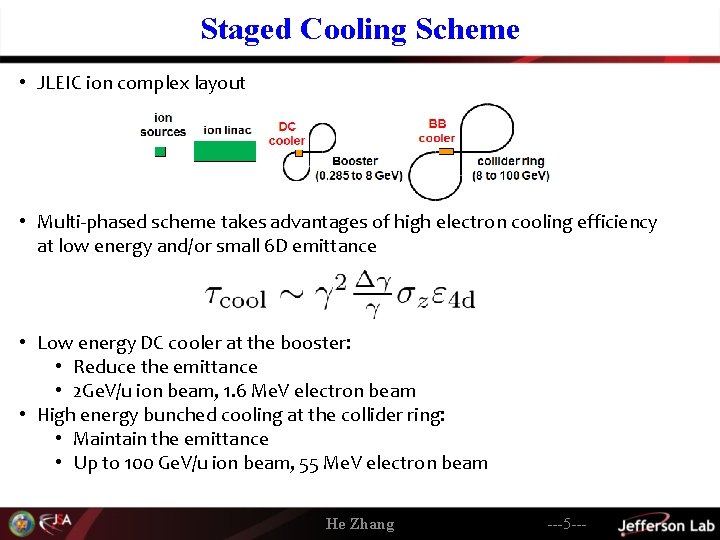
Staged Cooling Scheme • JLEIC ion complex layout • Multi-phased scheme takes advantages of high electron cooling efficiency at low energy and/or small 6 D emittance • Low energy DC cooler at the booster: • Reduce the emittance • 2 Ge. V/u ion beam, 1. 6 Me. V electron beam • High energy bunched cooling at the collider ring: • Maintain the emittance • Up to 100 Ge. V/u ion beam, 55 Me. V electron beam He Zhang ---5 ---
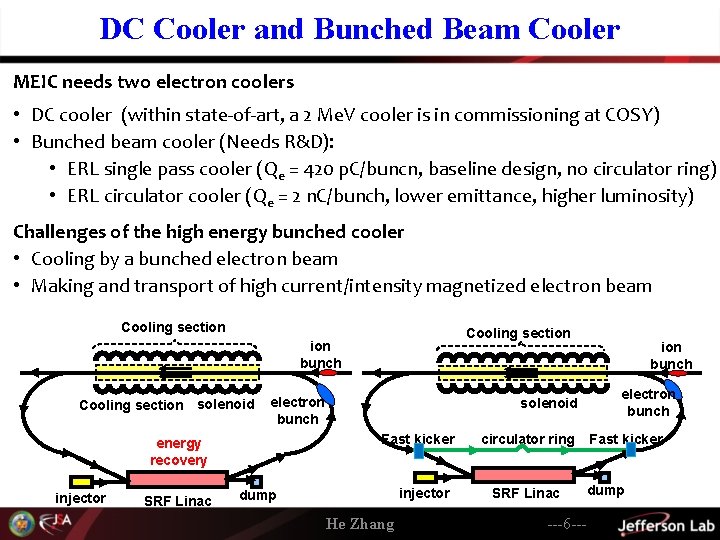
DC Cooler and Bunched Beam Cooler MEIC needs two electron coolers • DC cooler (within state-of-art, a 2 Me. V cooler is in commissioning at COSY) • Bunched beam cooler (Needs R&D): • ERL single pass cooler (Qe = 420 p. C/buncn, baseline design, no circulator ring) • ERL circulator cooler (Qe = 2 n. C/bunch, lower emittance, higher luminosity) Challenges of the high energy bunched cooler • Cooling by a bunched electron beam • Making and transport of high current/intensity magnetized electron beam Cooling section ion bunch Cooling section solenoid electron bunch Fast kicker energy recovery injector SRF Linac solenoid injector dump He Zhang circulator ring SRF Linac ---6 --- ion bunch electron bunch Fast kicker dump
II. Electron cooling simulation results He Zhang ---7 ---
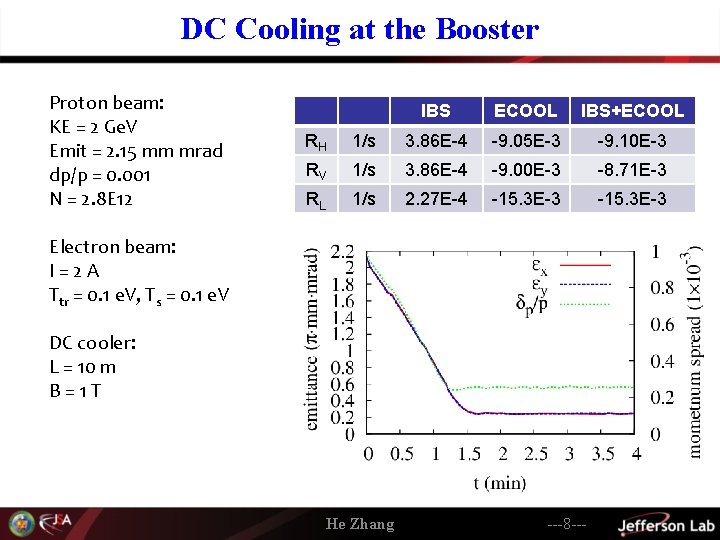
DC Cooling at the Booster Proton beam: KE = 2 Ge. V Emit = 2. 15 mm mrad dp/p = 0. 001 N = 2. 8 E 12 IBS ECOOL IBS+ECOOL RH 1/s 3. 86 E-4 -9. 05 E-3 -9. 10 E-3 RV 1/s 3. 86 E-4 -9. 00 E-3 -8. 71 E-3 RL 1/s 2. 27 E-4 -15. 3 E-3 Electron beam: I=2 A Ttr = 0. 1 e. V, Ts = 0. 1 e. V DC cooler: L = 10 m B=1 T He Zhang ---8 ---
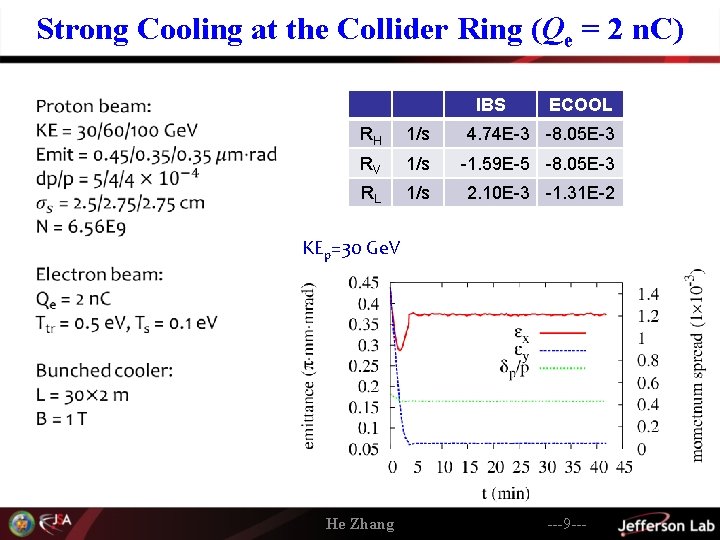
Strong Cooling at the Collider Ring (Qe = 2 n. C) IBS ECOOL RH 1/s 4. 74 E-3 -8. 05 E-3 RV 1/s -1. 59 E-5 -8. 05 E-3 RL 1/s 2. 10 E-3 -1. 31 E-2 KEp=30 Ge. V He Zhang ---9 ---
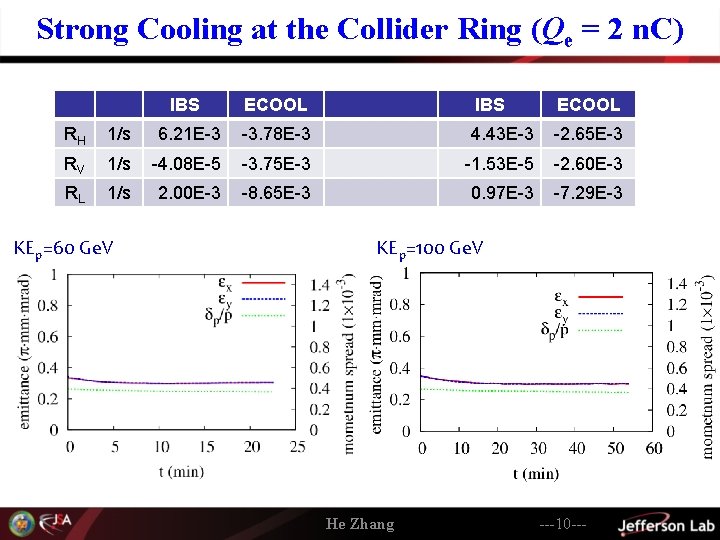
Strong Cooling at the Collider Ring (Qe = 2 n. C) IBS ECOOL RH 1/s 6. 21 E-3 -3. 78 E-3 4. 43 E-3 -2. 65 E-3 RV 1/s -4. 08 E-5 -3. 75 E-3 -1. 53 E-5 -2. 60 E-3 RL 1/s 2. 00 E-3 -8. 65 E-3 0. 97 E-3 -7. 29 E-3 KEp=60 Ge. V KEp=100 Ge. V He Zhang ---10 ---
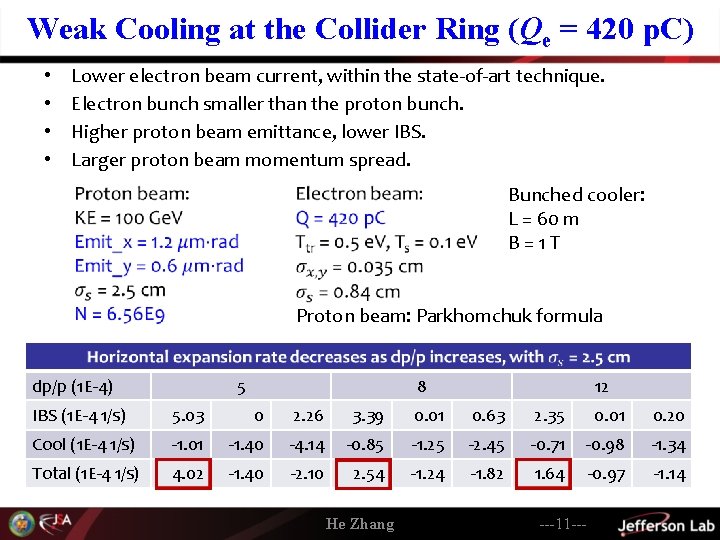
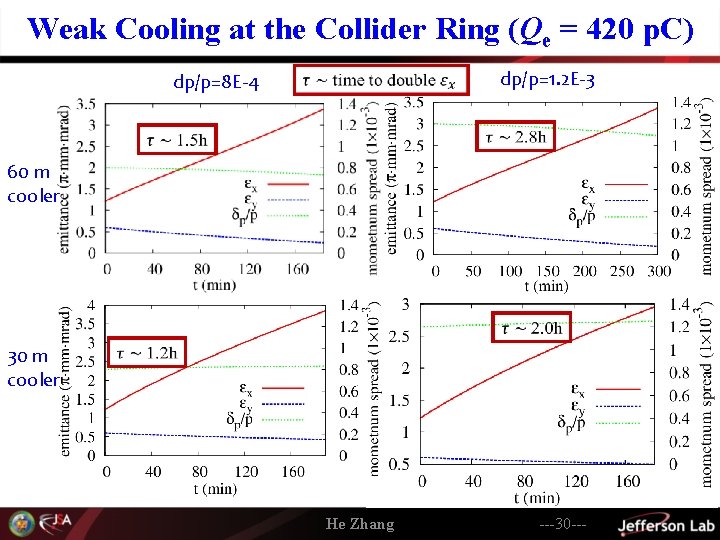
Weak Cooling at the Collider Ring (Qe = 420 p. C) • • Lower electron beam current, within the state-of-art technique. Electron bunch smaller than the proton bunch. Higher proton beam emittance, lower IBS. Larger proton beam momentum spread. Bunched cooler: L = 60 m B=1 T Proton beam: Parkhomchuk formula dp/p (1 E-4) 5 8 12 IBS (1 E-4 1/s) 5. 03 0 2. 26 3. 39 0. 01 0. 63 2. 35 0. 01 0. 20 Cool (1 E-4 1/s) -1. 01 -1. 40 -4. 14 -0. 85 -1. 25 -2. 45 -0. 71 -0. 98 -1. 34 Total (1 E-4 1/s) 4. 02 -1. 40 -2. 10 2. 54 -1. 24 -1. 82 1. 64 -0. 97 -1. 14 He Zhang ---11 ---
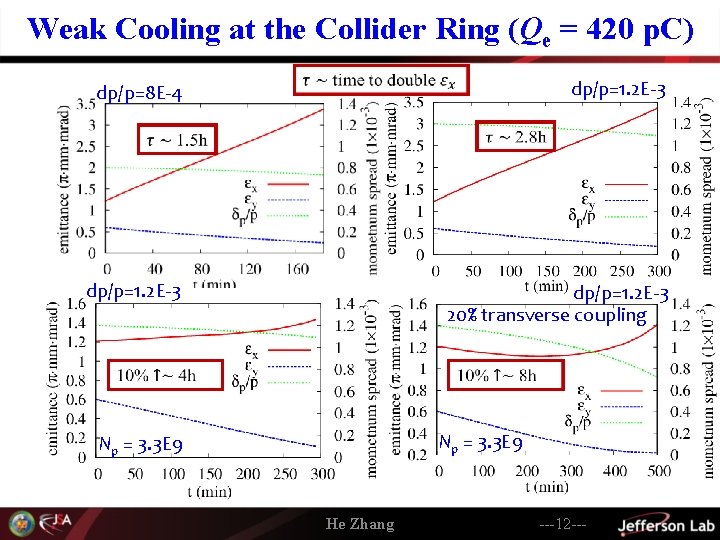
Weak Cooling at the Collider Ring (Qe = 420 p. C) dp/p=8 E-4 dp/p=1. 2 E-3 20% transverse coupling Np = 3. 3 E 9 He Zhang ---12 ---
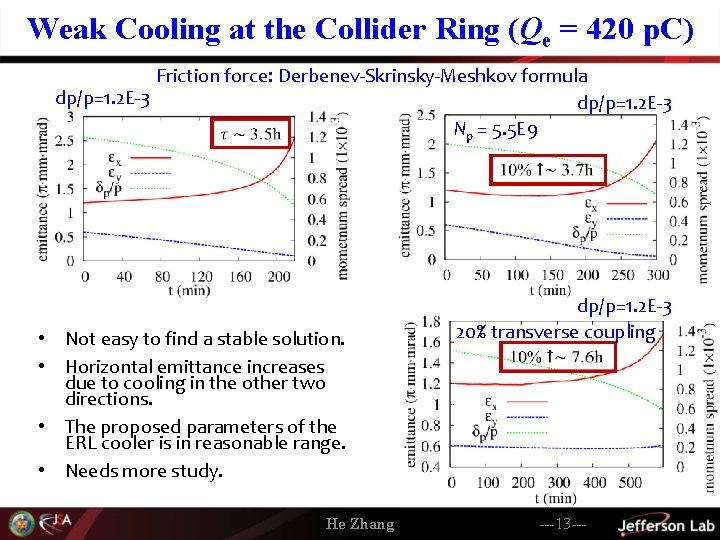
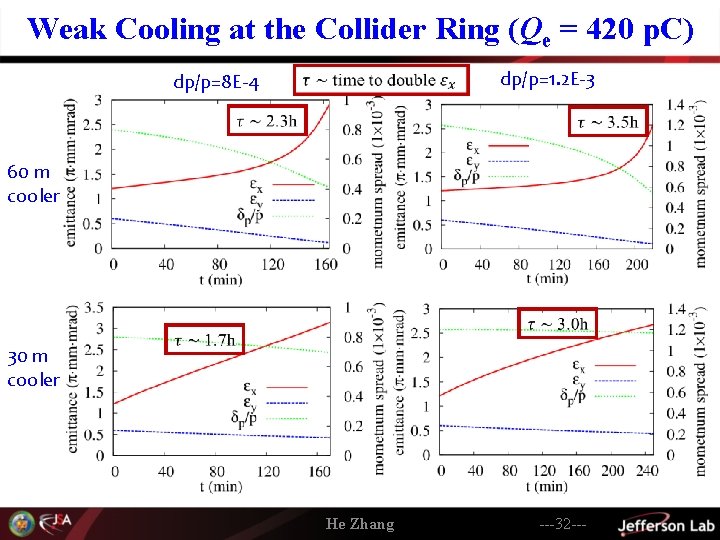
Weak Cooling at the Collider Ring (Qe = 420 p. C) Friction force: Derbenev-Skrinsky-Meshkov formula dp/p=1. 2 E-3 Np = 5. 5 E 9 • Not easy to find a stable solution. • Horizontal emittance increases due to cooling in the other two directions. • The proposed parameters of the ERL cooler is in reasonable range. • Needs more study. He Zhang dp/p=1. 2 E-3 20% transverse coupling ---13 ---
III. Electron cooling simulation program development He Zhang ---14 ---
Goals and Approach Goals: • Enhance the simulation capability for electron cooling in JLEIC project • Different scenarios: DC cooling, bunched electron to bunched ion cooling, bunched electron to coasting ion cooling • More flexibility, higher efficiency. Approaches: • Following the models in BETACOOL whenever applicable • Revise the models whenever needed • Improve the efficiency by strategically arrange the computation • Take advantage for modern multi-core hardware Formulas and models implemented: • IBS: Martini model (no vertical dispersion lattice) • Friction force: Parkhomchuk formula (magnetized cooling) • Cooling rate: single particle model, Monte Carlo model • Cooling dynamics: RMS method (with single particle model or Monte Carlo model), model beam method He Zhang ---15 ---
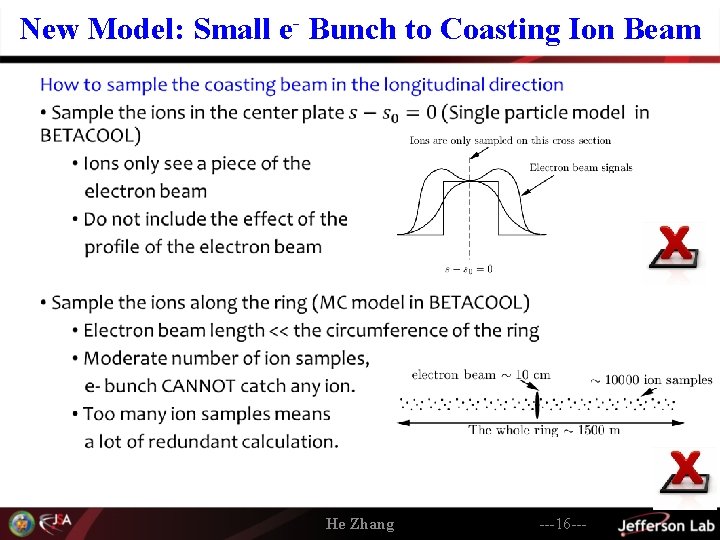
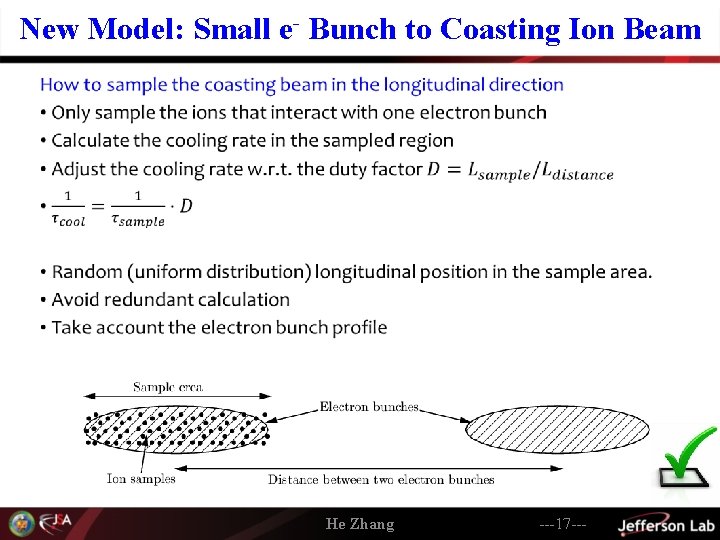
New Model: Small e- Bunch to Coasting Ion Beam • He Zhang ---16 ---
New Model: Small e- Bunch to Coasting Ion Beam • He Zhang ---17 ---
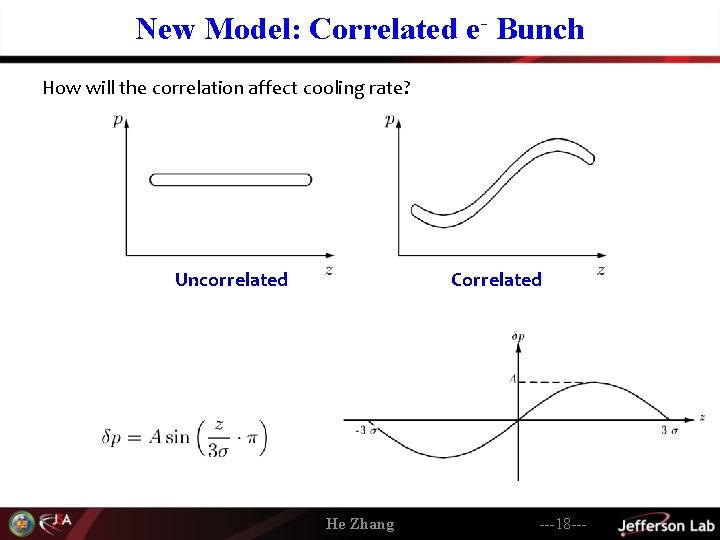
New Model: Correlated e- Bunch How will the correlation affect cooling rate? Uncorrelated Correlated He Zhang ---18 ---
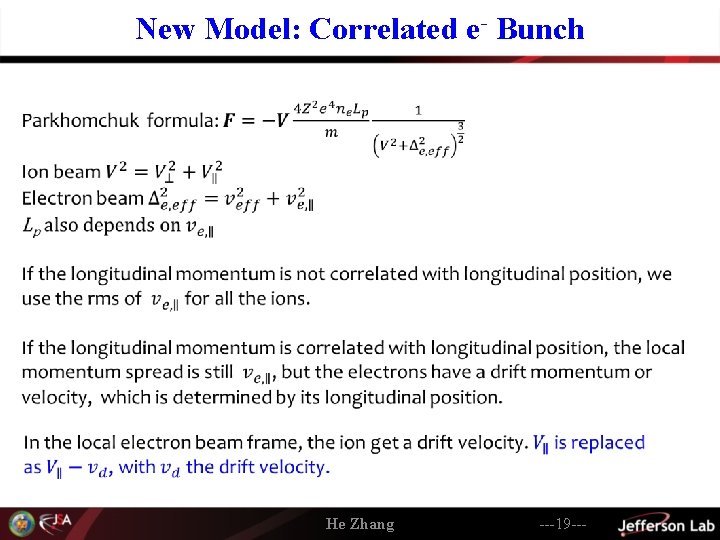
New Model: Correlated e- Bunch He Zhang ---19 ---
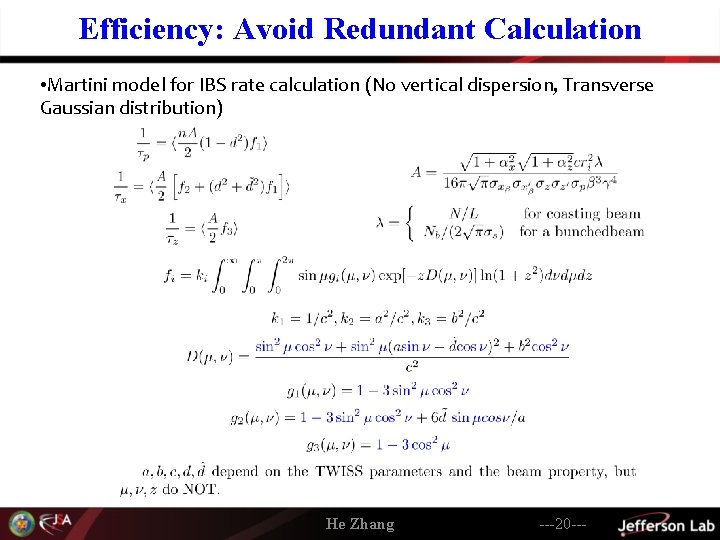
Efficiency: Avoid Redundant Calculation • Martini model for IBS rate calculation (No vertical dispersion, Transverse Gaussian distribution) He Zhang ---20 ---
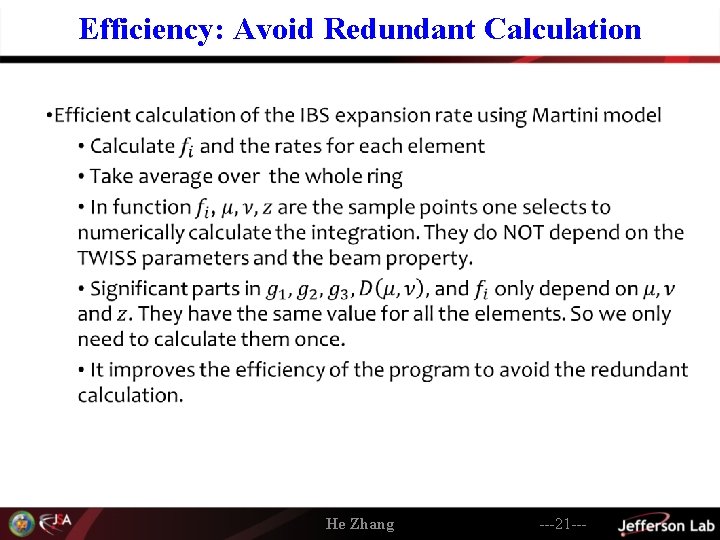
Efficiency: Avoid Redundant Calculation • He Zhang ---21 ---
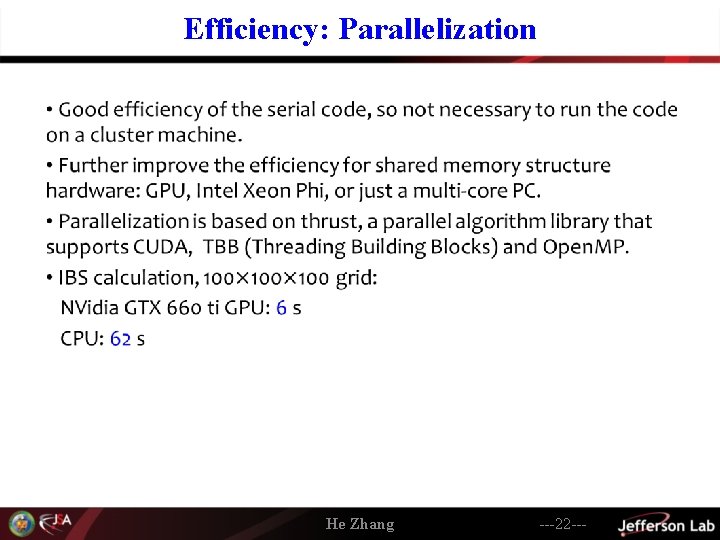
Efficiency: Parallelization • He Zhang ---22 ---
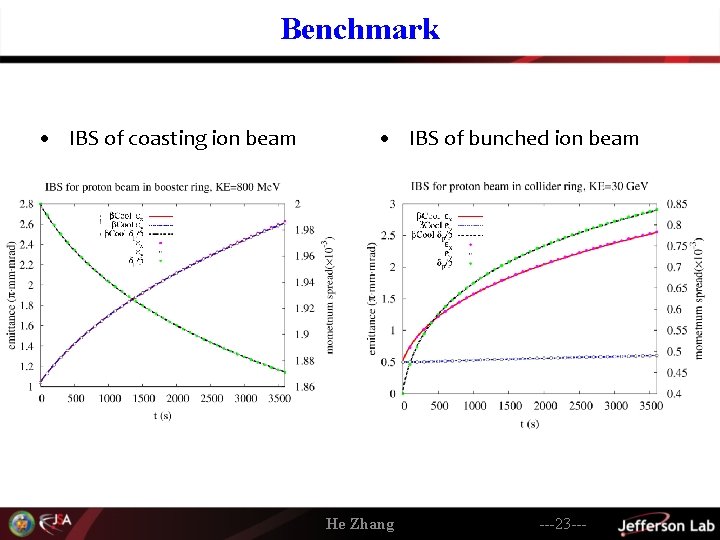
Benchmark • IBS of coasting ion beam • IBS of bunched ion beam He Zhang ---23 ---
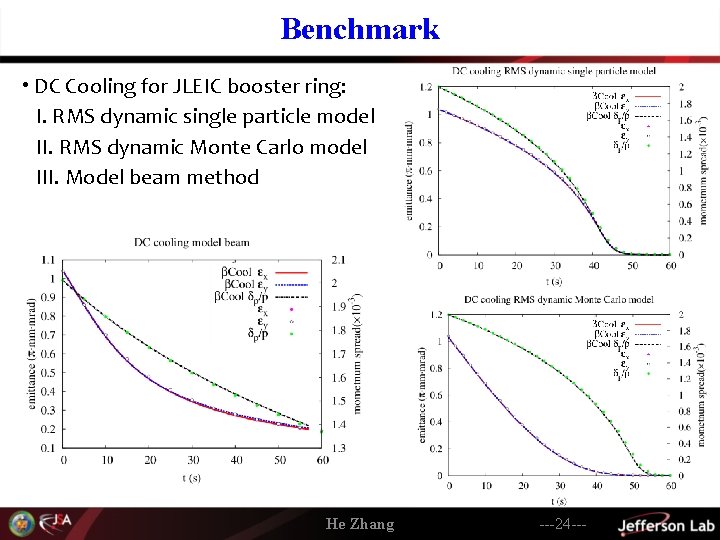
Benchmark • DC Cooling for JLEIC booster ring: I. RMS dynamic single particle model II. RMS dynamic Monte Carlo model III. Model beam method He Zhang ---24 ---
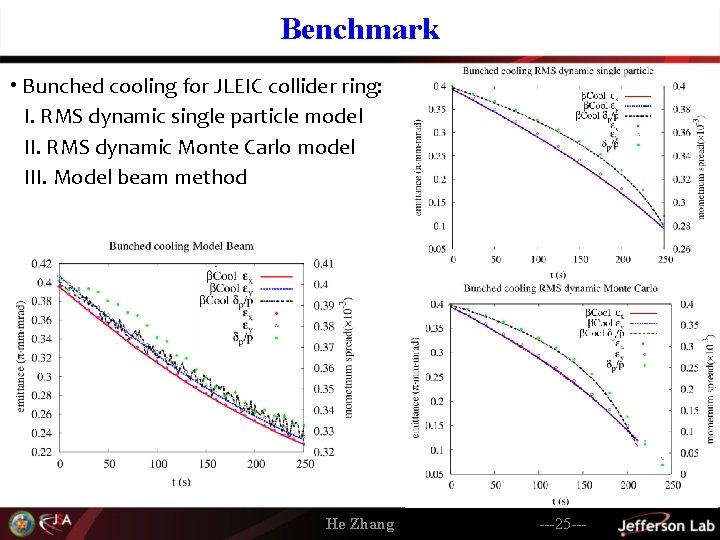
Benchmark • Bunched cooling for JLEIC collider ring: I. RMS dynamic single particle model II. RMS dynamic Monte Carlo model III. Model beam method He Zhang ---25 ---
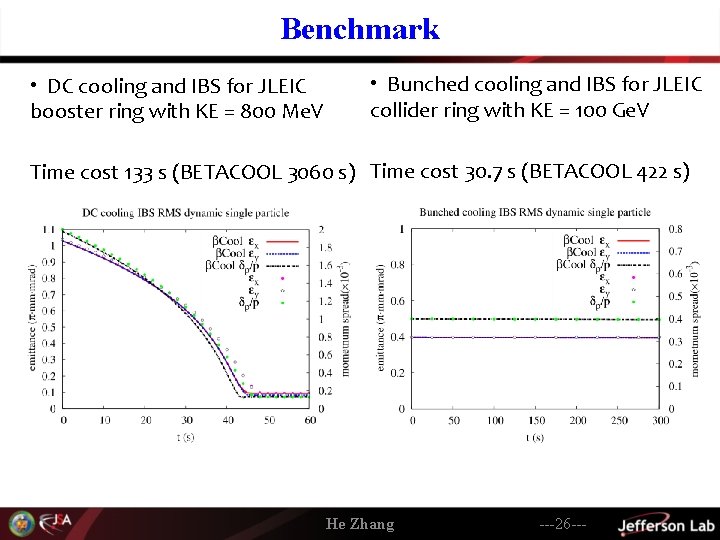
Benchmark • DC cooling and IBS for JLEIC booster ring with KE = 800 Me. V • Bunched cooling and IBS for JLEIC collider ring with KE = 100 Ge. V Time cost 133 s (BETACOOL 3060 s) Time cost 30. 7 s (BETACOOL 422 s) He Zhang ---26 ---
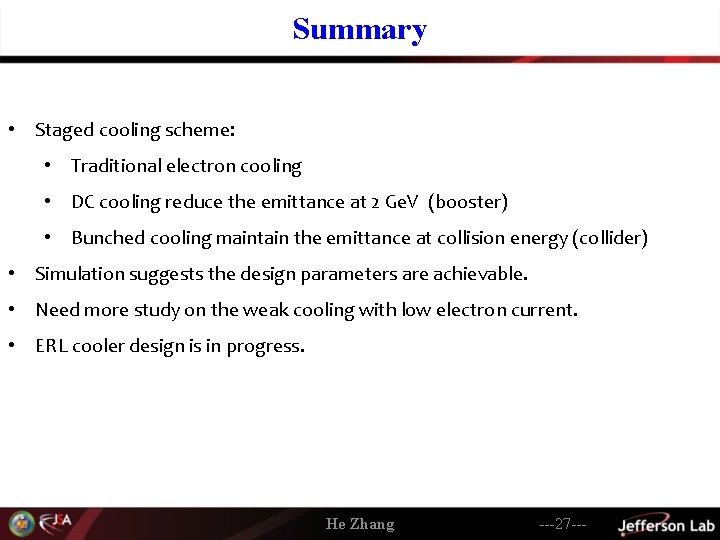
Summary • Staged cooling scheme: • Traditional electron cooling • DC cooling reduce the emittance at 2 Ge. V (booster) • Bunched cooling maintain the emittance at collision energy (collider) • Simulation suggests the design parameters are achievable. • Need more study on the weak cooling with low electron current. • ERL cooler design is in progress. He Zhang ---27 ---
He Zhang --28 --
Backup He Zhang --29 --
Weak Cooling at the Collider Ring (Qe = 420 p. C) dp/p=1. 2 E-3 dp/p=8 E-4 60 m cooler 30 m cooler He Zhang ---30 ---
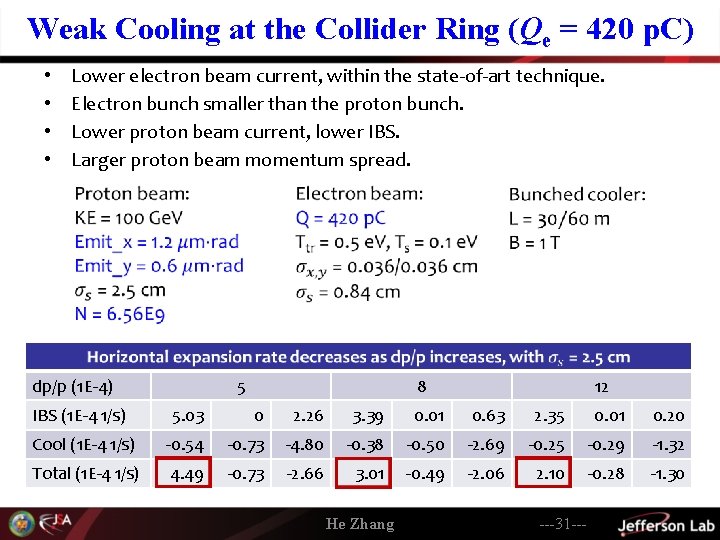
Weak Cooling at the Collider Ring (Qe = 420 p. C) • • Lower electron beam current, within the state-of-art technique. Electron bunch smaller than the proton bunch. Lower proton beam current, lower IBS. Larger proton beam momentum spread. dp/p (1 E-4) 5 8 12 IBS (1 E-4 1/s) 5. 03 0 2. 26 3. 39 0. 01 0. 63 2. 35 0. 01 0. 20 Cool (1 E-4 1/s) -0. 54 -0. 73 -4. 80 -0. 38 -0. 50 -2. 69 -0. 25 -0. 29 -1. 32 Total (1 E-4 1/s) 4. 49 -0. 73 -2. 66 3. 01 -0. 49 -2. 06 2. 10 -0. 28 -1. 30 He Zhang ---31 ---
Weak Cooling at the Collider Ring (Qe = 420 p. C) dp/p=1. 2 E-3 dp/p=8 E-4 60 m cooler 30 m cooler He Zhang ---32 ---