
Progress and Strategic Directions in the Pacific Brussels
Progress and Strategic Directions in the Pacific Brussels, 07 July 2014 Michael Bonte-Grapentin, Senior DRM specialist
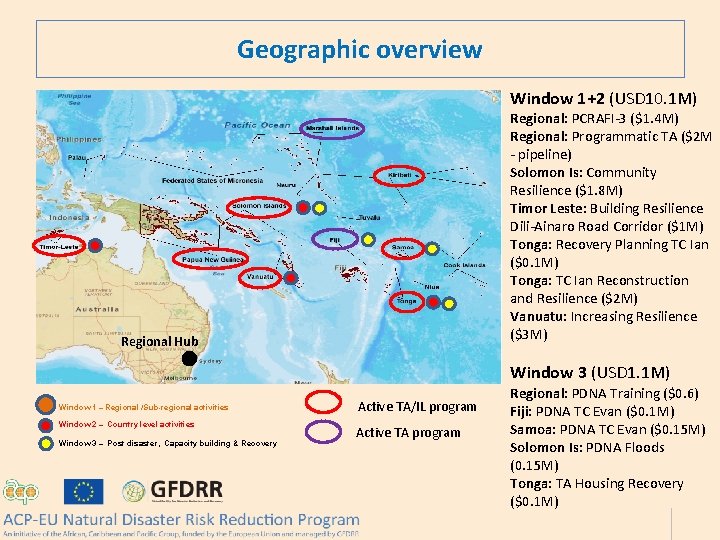
Geographic overview Window 1+2 (USD 10. 1 M) Regional: PCRAFI-3 ($1. 4 M) Regional: Programmatic TA ($2 M - pipeline) Solomon Is: Community Resilience ($1. 8 M) Timor Leste: Building Resilience Dili-Ainaro Road Corridor ($1 M) Tonga: Recovery Planning TC Ian ($0. 1 M) Tonga: TC Ian Reconstruction and Resilience ($2 M) Vanuatu: Increasing Resilience ($3 M) Regional Hub Window 3 (USD 1. 1 M) Window 1 – Regional /Sub-regional activities Window 2 – Country level activities Window 3 – Post disaster, Capacity building & Recovery Active TA/IL program Active TA program Regional: PDNA Training ($0. 6) Fiji: PDNA TC Evan ($0. 1 M) Samoa: PDNA TC Evan ($0. 15 M) Solomon Is: PDNA Floods (0. 15 M) Tonga: TA Housing Recovery ($0. 1 M)
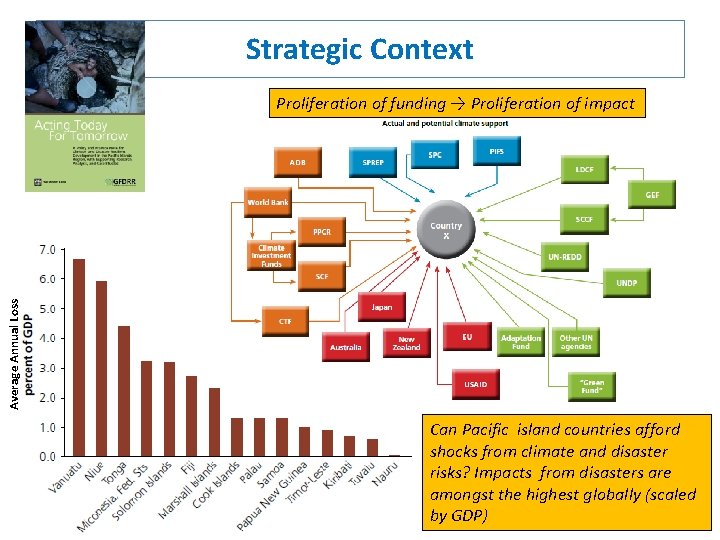
Strategic Context Average Annual Loss Proliferation of funding → Proliferation of impact Can Pacific island countries afford shocks from climate and disaster risks? Impacts from disasters are amongst the highest globally (scaled by GDP) 3/12
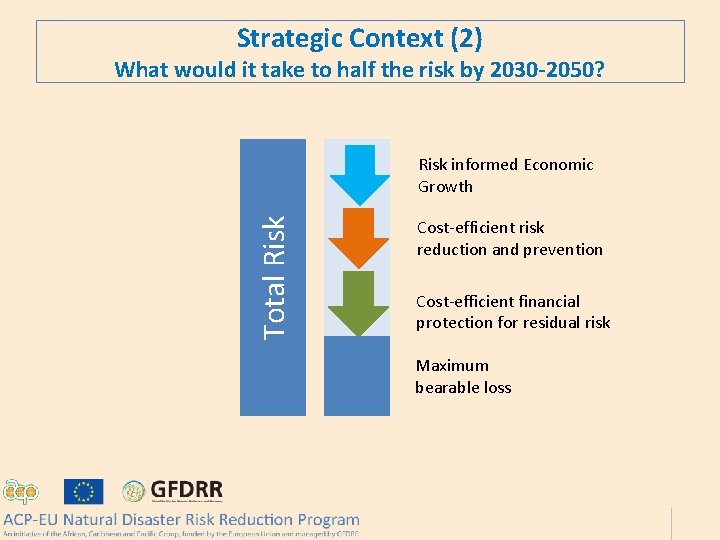
Strategic Context (2) What would it take to half the risk by 2030 -2050? Total Risk informed Economic Growth Cost-efficient risk reduction and prevention Cost-efficient financial protection for residual risk Maximum bearable loss
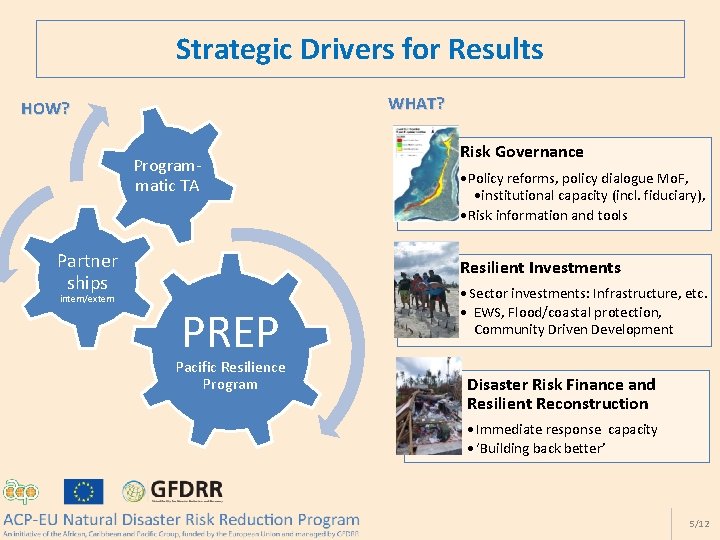
Strategic Drivers for Results WHAT? HOW? Programmatic TA Partner ships intern/extern Risk Governance • Policy reforms, policy dialogue Mo. F, • institutional capacity (incl. fiduciary), • Risk information and tools Resilient Investments PREP Pacific Resilience Program • Sector investments: Infrastructure, etc. • EWS, Flood/coastal protection, Community Driven Development Disaster Risk Finance and Resilient Reconstruction • Immediate response capacity • ‘Building back better’ 5/12
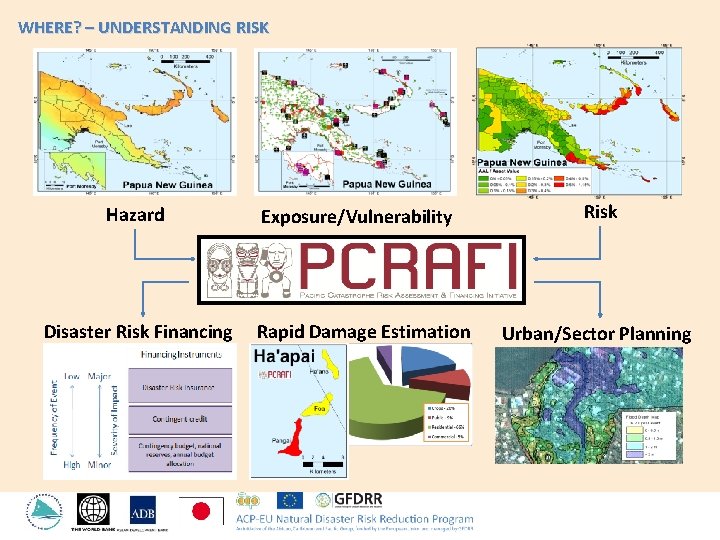
WHERE? – UNDERSTANDING RISK Hazard Risk Exposure/Vulnerability Pacific Risk Information System http: //pacris. sopac. org Disaster Risk Financing Rapid Damage Estimation Urban/Sector Planning
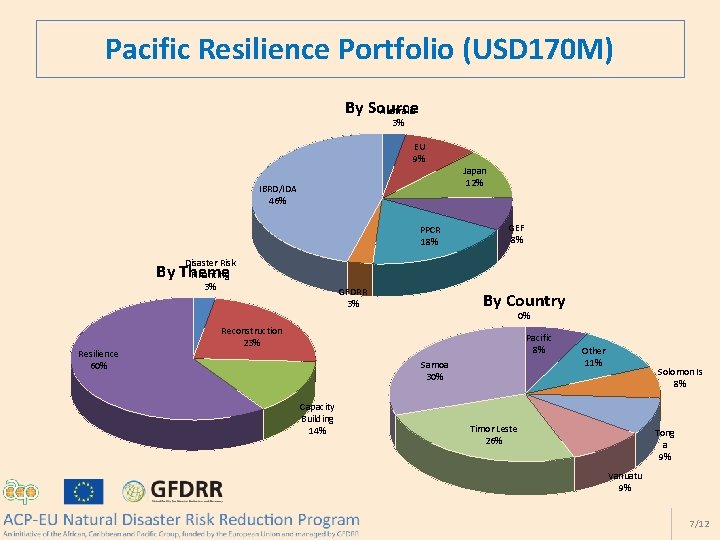
Pacific Resilience Portfolio (USD 170 M) By Source Australia 3% EU 9% IBRD/IDA 46% PPCR 18% Japan 12% GEF 8% Disaster Risk By Theme Financing 3% Resilience 60% GFDRR 3% By Country 0% Reconstruction 23% Pacific 8% Samoa 30% Capacity Building 14% Other 11% Solomon Is 8% Timor Leste 26% Tong a 9% Vanuatu 9% 7/12
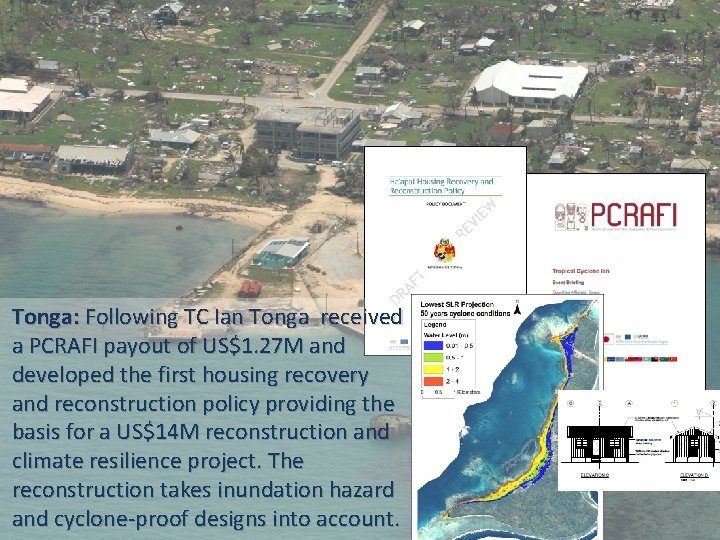
Tonga: Following TC Ian Tonga received a PCRAFI payout of US$1. 27 M and developed the first housing recovery and reconstruction policy providing the basis for a US$14 M reconstruction and climate resilience project. The reconstruction takes inundation hazard and cyclone-proof designs into account. 8/12
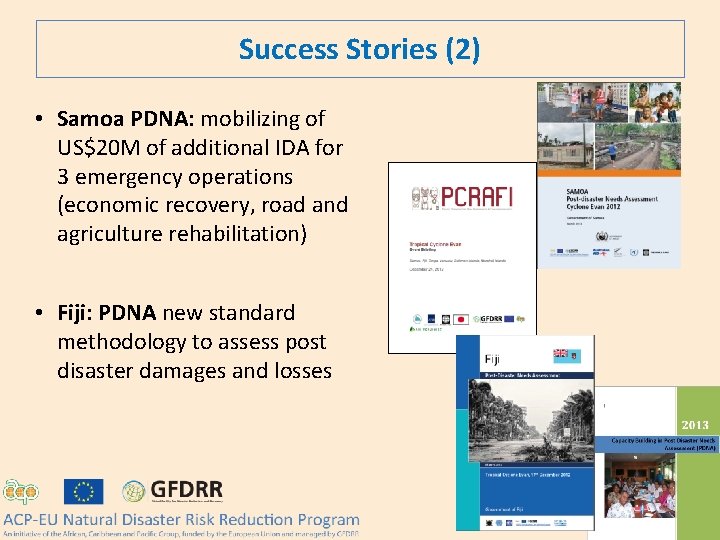
Success Stories (2) • Samoa PDNA: mobilizing of US$20 M of additional IDA for 3 emergency operations (economic recovery, road and agriculture rehabilitation) • Fiji: PDNA new standard methodology to assess post disaster damages and losses 9/12
Pacific Resilience Program (PREP): Guiding principles • Combine financial protection with investments on resilience (and not standalone disaster risk financing project) • Promote a regional approach to reduce insurance costs, improve early warning and build common approaches on DRM • Leverage resources (national IDA, regional IDA, donor funding, climate funds. . ) to scale up resilience • A phased approach which will allow countries to join when they are ready
Pacific Resilience Program (PREP): Results • Expected results: – Improved early warning for the population at risk (speed and coverage) => Ultimately save lives – Increased resilience of targeted investments => Ultimately reduce economic losses when a disaster happens – Increased financial resilience and reduced cost of insurance premium (regional pool) => Improve relief activities and protect fiscal balance • Participating countries: – At this stage: 7 countries in two phases: Federated States of Micronesia (FSM), Fiji, the Republic of Marshall Islands (RMI), Samoa, Solomon Islands, Tonga and Vanuatu
Pacific Resilience Program (PREP): Program Description At the country level: • Component 1: Increased Resilience • Component 2: Disaster Risk Financing and Insurance At the regional level • Component 3: Regional Technical Assistance and Institutional Capacity Building • Component 4: Project Implementation Support and Program Management
- Slides: 12