
Progress 8 an explanation What is Progress 8


- Slides: 23
Progress 8: an explanation
What is Progress 8? • Progress 8 is a new secondary accountability measure aimed at measuring the progress of pupils across a selected set of 8 subjects. • It is a type of value added measure, meaning that pupils’ results are compared to the actual achievements of other pupils with the same prior attainment. • It has been introduced alongside another new accountability measure; Attainment 8 – the two are linked and will be explained in later slides.
When does Progress 8 come into effect? • The Progress 8 measure will be introduced for all schools in 2016. From this point, the floor standard will be based solely on schools’ exam results on the Progress 8 measure. • The Progress 8 score and the Attainment 8 score will be published in performance tables from late 2016/early 2017. • Schools are able to ‘opt in’ early to Progress 8 if they wish. If so they will be held to account on the new performance measures one year early (based on 2015 exam results)
Determining the Progress 8 score • The Progress 8 score is based on pupils performance across 8 subjects – this performance score is known as the “Attainment 8” score. • Therefore, to understand Progress 8 it is necessary to first understand Attainment 8. • Attainment 8 will also be published in performance tables alongside the Progress 8 measure.
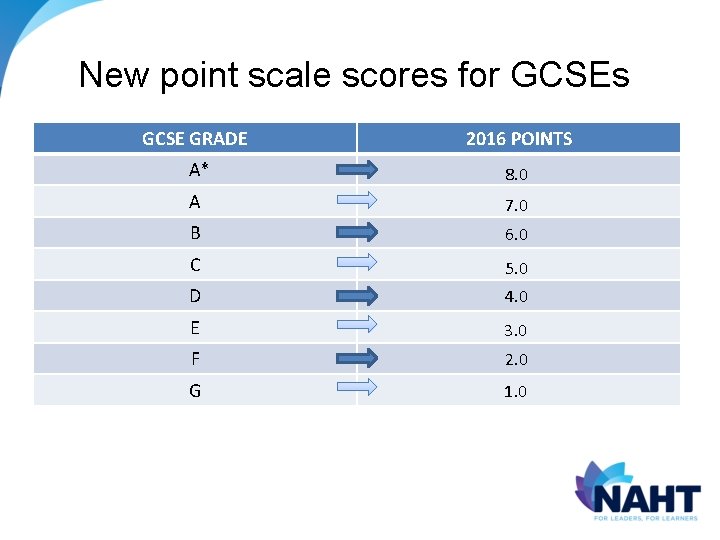
Attainment 8 • Attainment 8 is a measure of a pupil’s average grade across a set suite of eight subjects. • Grades will be measured on a 1 -8 point score scale, rather than the current 16 -58 scale. • On this new scale, 1 is equivalent to a Grade G GCSE. An increase in one point will represent an increase of one GCSE grade up to 8, which is equivalent to an A* GCSE.
New point scale scores for GCSEs GCSE GRADE 2016 POINTS A* 8. 0 A 7. 0 B 6. 0 C 5. 0 D 4. 0 E 3. 0 F 2. 0 G 1. 0
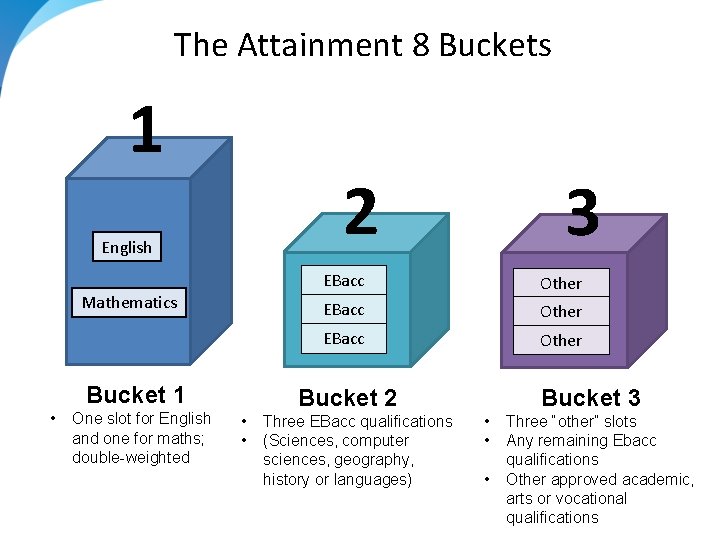
The Attainment 8 “buckets” • The Attainment 8 measure will take the average of a pupils points across a set of their best 8 subjects. • The 8 qualifications that count towards the Attainment 8 measure must fall into one of three “buckets. ” If a qualification does not fall into one of these buckets, it is not counted in the attainment 8 (or progress 8) measure.
The Attainment 8 Buckets 1 2 English Mathematics Bucket 1 • One slot for English and one for maths; double-weighted 3 EBacc Other Bucket 3 Bucket 2 • • Three EBacc qualifications (Sciences, computer sciences, geography, history or languages) • • • Three “other” slots Any remaining Ebacc qualifications Other approved academic, arts or vocational qualifications
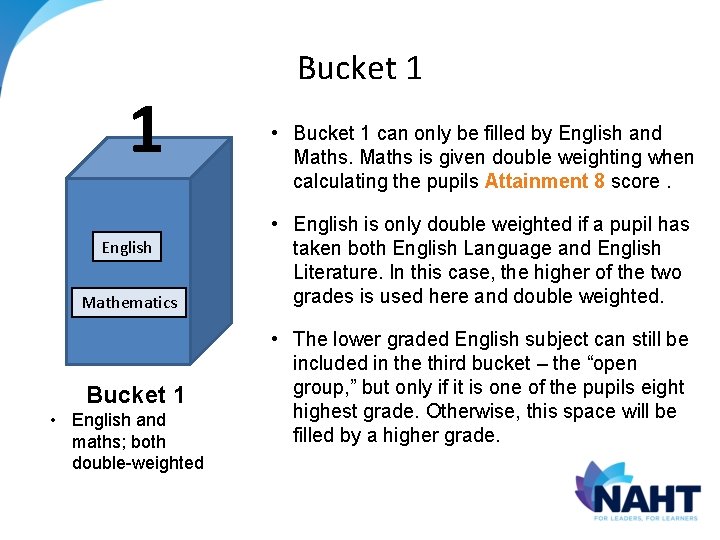
1 English Mathematics Bucket 1 • English and maths; both double-weighted Bucket 1 • Bucket 1 can only be filled by English and Maths is given double weighting when calculating the pupils Attainment 8 score. • English is only double weighted if a pupil has taken both English Language and English Literature. In this case, the higher of the two grades is used here and double weighted. • The lower graded English subject can still be included in the third bucket – the “open group, ” but only if it is one of the pupils eight highest grade. Otherwise, this space will be filled by a higher grade.
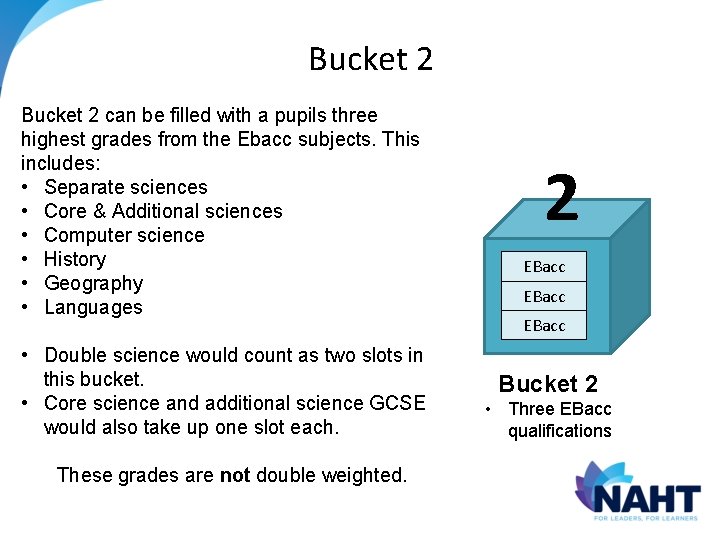
Bucket 2 can be filled with a pupils three highest grades from the Ebacc subjects. This includes: • Separate sciences • Core & Additional sciences • Computer science • History • Geography • Languages • Double science would count as two slots in this bucket. • Core science and additional science GCSE would also take up one slot each. These grades are not double weighted. 2 EBacc Bucket 2 • Three EBacc qualifications
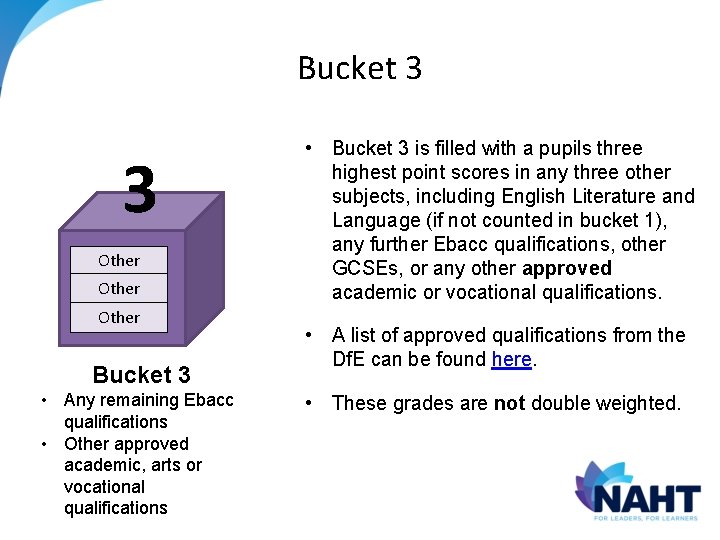
Bucket 3 3 Other Bucket 3 • Any remaining Ebacc qualifications • Other approved academic, arts or vocational qualifications • Bucket 3 is filled with a pupils three highest point scores in any three other subjects, including English Literature and Language (if not counted in bucket 1), any further Ebacc qualifications, other GCSEs, or any other approved academic or vocational qualifications. • A list of approved qualifications from the Df. E can be found here. • These grades are not double weighted.
8 Qualifications? • The 8 grades from the three buckets are added together and divided by 10 to produce a students Attainment 8 score. The maths grade in bucket 1 is given double weighting, as is English if the pupil has taken both English Literature and English Language. • No matter how full or empty the three buckets are, a students score is always divided by 10 to produce an average score (10 representing the 8 subject slots, with English & Maths double weighted) • It is not mandatory for students to fill the three buckets or take 8 qualifications. • If a student has fewer than 8 qualifications, or if some of their qualifications do not fit into one of the three buckets then they will score 0 points for the unfilled slots. • Consider the following examples:
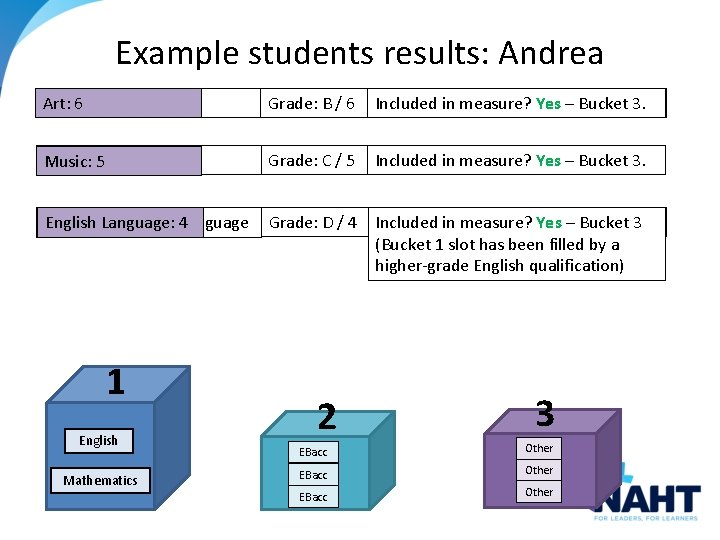
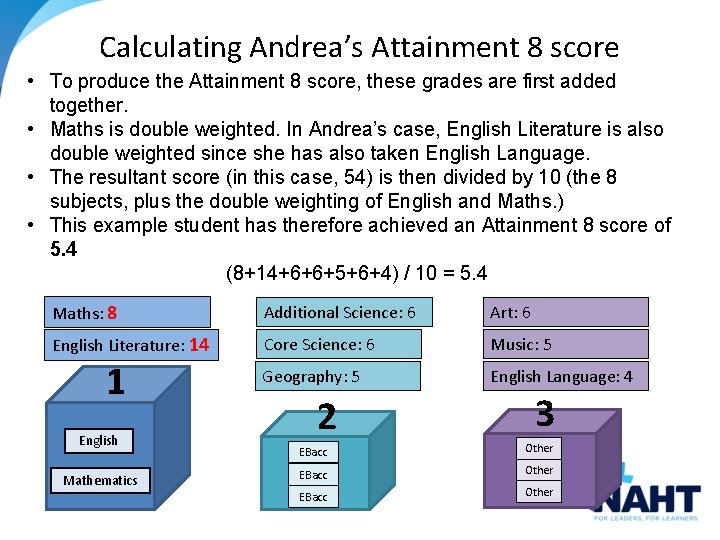
Example students results: Andrea Art: Core 6 Science: 4: 1: Art Core English 6 Science Literature Subject English Literature: 8: 7 A / 67 Included in measure? Yes – Bucket 3. 2. 1. Grade: B Maths: 547: 5: 2: Music Additional Maths D // 564 Included in measure? Yes – Bucket 3. B 1. 2. Subject Additional Science: 6 Science Grade: C Music: Geography: 3: Geography 5 Subject English Language: 6: English 4 Language 1 English Mathematics Grade: D C / 54 Included in measure? Yes – Bucket 32 (Bucket 1 slot has been filled by a higher-grade English qualification) 2 3 EBacc Other
Calculating Andrea’s Attainment 8 score • To produce the Attainment 8 score, these grades are first added together. • Maths is double weighted. In Andrea’s case, English Literature is also double weighted since she has also taken English Language. • The resultant score (in this case, 54) is then divided by 10 (the 8 subjects, plus the double weighting of English and Maths. ) • This example student has therefore achieved an Attainment 8 score of 5. 4 (8+14+6+6+5+6+4) / 10 = 5. 4 Maths: 4 8 Additional Science: 6 Art: 6 English Literature: 714 Core Science: 6 Music: 5 Geography: 5 English Language: 4 1 English Mathematics 2 3 EBacc Other
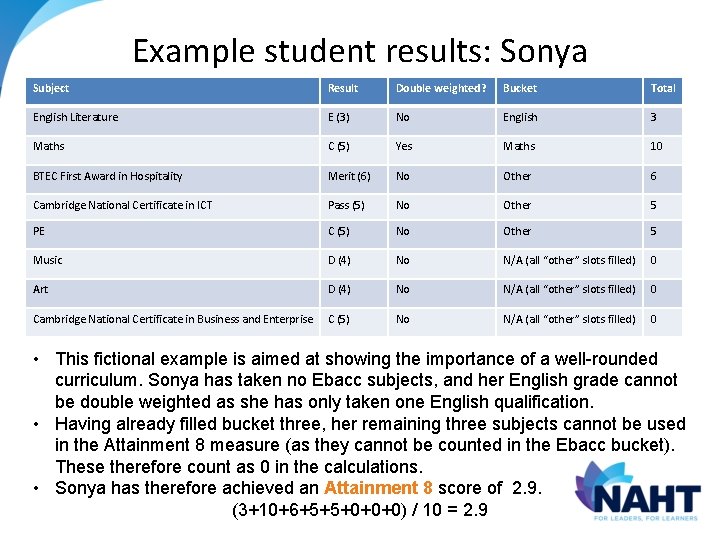
Example student results: Sonya Subject Result Double weighted? Bucket Total English Literature E (3) No English 3 Maths C (5) Yes Maths 10 BTEC First Award in Hospitality Merit (6) No Other 6 Cambridge National Certificate in ICT Pass (5) No Other 5 PE C (5) No Other 5 Music D (4) No N/A (all “other” slots filled) 0 Art D (4) No N/A (all “other” slots filled) 0 Cambridge National Certificate in Business and Enterprise C (5) No N/A (all “other” slots filled) 0 • This fictional example is aimed at showing the importance of a well-rounded curriculum. Sonya has taken no Ebacc subjects, and her English grade cannot be double weighted as she has only taken one English qualification. • Having already filled bucket three, her remaining three subjects cannot be used in the Attainment 8 measure (as they cannot be counted in the Ebacc bucket). These therefore count as 0 in the calculations. • Sonya has therefore achieved an Attainment 8 score of 2. 9. (3+10+6+5+5+0+0+0) / 10 = 2. 9
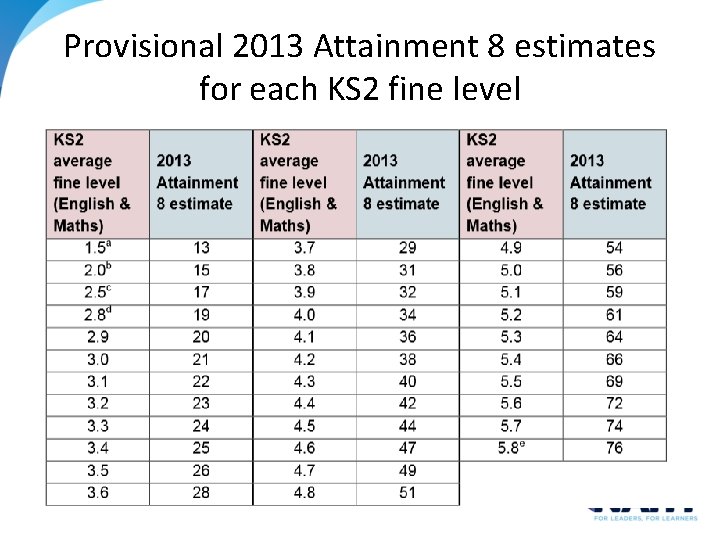
Calculating Progress 8 • A pupil’s Progress 8 score will be published in performance tables, replacing the current system of pupils being expected to make three levels of progress from KS 2 to KS 4. • It is defined as a pupil’s actual Attainment 8 score, minus their estimated Attainment 8 score. • The estimated Attainment 8 score is the average Attainment 8 score of all pupils nationally with the same prior attainment at key stage 2. • This prior attainment is taken as the average of a pupils KS 2 English and mathematics results, in fine graded levels. • 2013 Attainment estimates are shown on the next slide, and are also available on page 17 of the Df. E’s Progress 8 Technical Guide here
Provisional 2013 Attainment 8 estimates for each KS 2 fine level
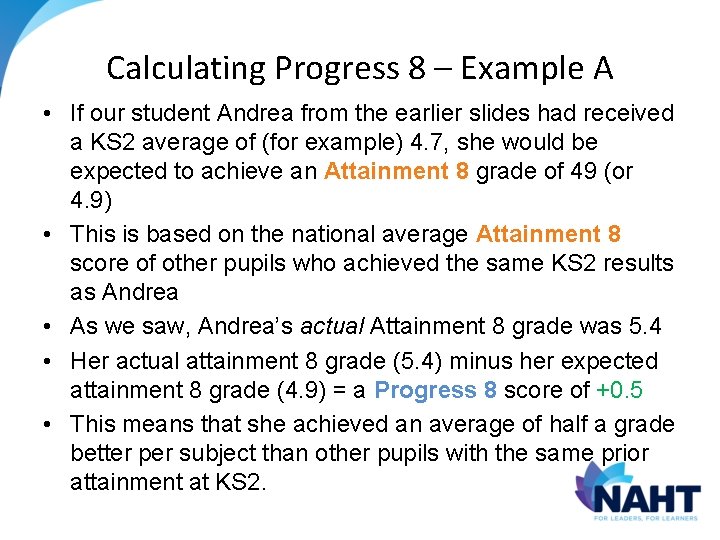
Calculating Progress 8 – Example A • If our student Andrea from the earlier slides had received a KS 2 average of (for example) 4. 7, she would be expected to achieve an Attainment 8 grade of 49 (or 4. 9) • This is based on the national average Attainment 8 score of other pupils who achieved the same KS 2 results as Andrea • As we saw, Andrea’s actual Attainment 8 grade was 5. 4 • Her actual attainment 8 grade (5. 4) minus her expected attainment 8 grade (4. 9) = a Progress 8 score of +0. 5 • This means that she achieved an average of half a grade better per subject than other pupils with the same prior attainment at KS 2.
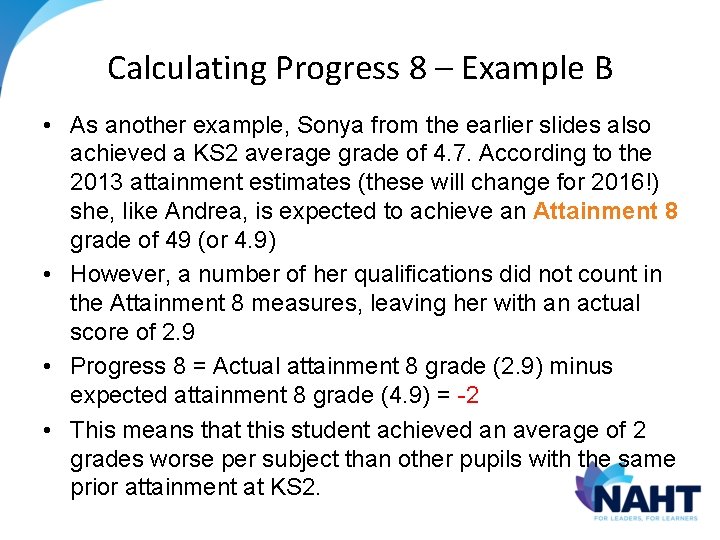
Calculating Progress 8 – Example B • As another example, Sonya from the earlier slides also achieved a KS 2 average grade of 4. 7. According to the 2013 attainment estimates (these will change for 2016!) she, like Andrea, is expected to achieve an Attainment 8 grade of 49 (or 4. 9) • However, a number of her qualifications did not count in the Attainment 8 measures, leaving her with an actual score of 2. 9 • Progress 8 = Actual attainment 8 grade (2. 9) minus expected attainment 8 grade (4. 9) = -2 • This means that this student achieved an average of 2 grades worse per subject than other pupils with the same prior attainment at KS 2.
Calculating Progress 8 for schools • The school’s Progress 8 score is the mean average of its pupils’ Progress 8 scores. • This is therefore calculated by adding each individual pupil’s Progress 8 score, and then dividing this total by the number of pupils. • For example…
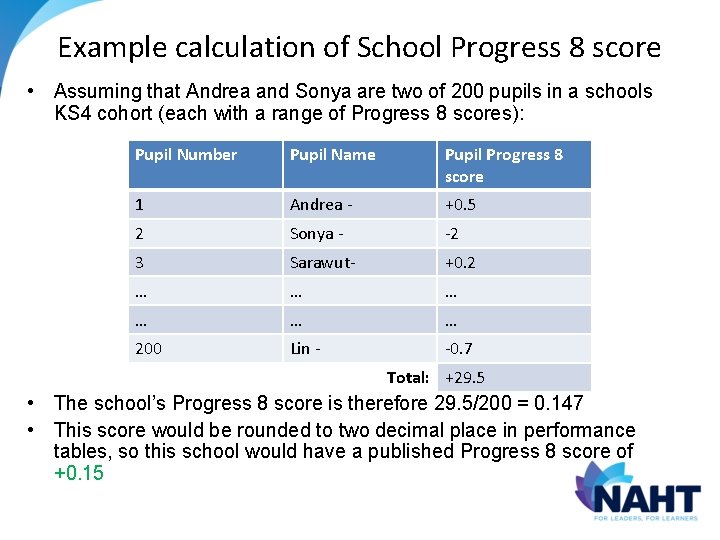
Example calculation of School Progress 8 score • Assuming that Andrea and Sonya are two of 200 pupils in a schools KS 4 cohort (each with a range of Progress 8 scores): Pupil Number Pupil Name Pupil Progress 8 score 1 Andrea - +0. 5 2 Sonya - -2 3 Sarawut- +0. 2 … … … 200 Lin - -0. 7 Total: +29. 5 • The school’s Progress 8 score is therefore 29. 5/200 = 0. 147 • This score would be rounded to two decimal place in performance tables, so this school would have a published Progress 8 score of +0. 15
How is Progress 8 used? • The Progress 8 measure will be the only measure used for floor standards. • A school will fall below the new floor standard if their Progress 8 score is below -0. 5 • This score would indicate that the average achievement of a school’s pupils is half a grade worse per subject than the national average of other pupils with the same prior attainment. • If schools fall below this floor standard, this will trigger an Ofsted inspection.