
Programovac jazyky F a OCaml Chapter 6 Sequence

- Slides: 29
Programovací jazyky F# a OCaml Chapter 6. Sequence expressions and computation expressions (aka monads)
Sequence expressions 1. (generating sequences)
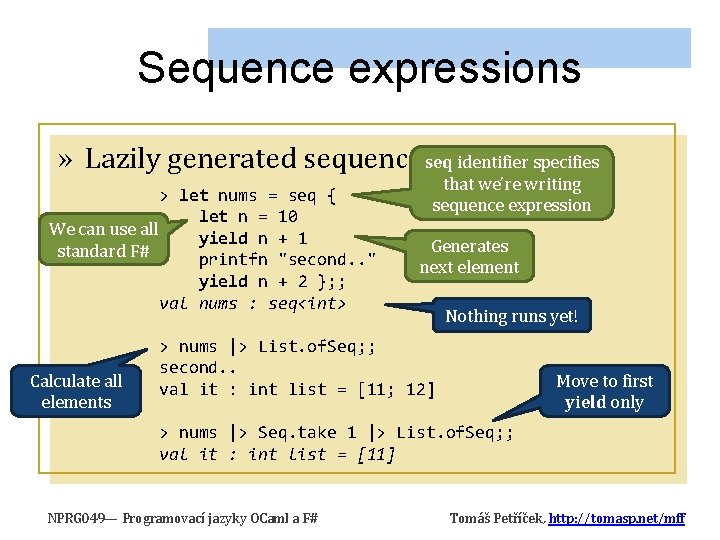
Sequence expressions » Lazily generated sequencesseqofidentifier values specifies > let nums = seq { let n = 10 We can use all yield n + 1 standard F# printfn "second. . " yield n + 2 }; ; val nums : seq<int> Calculate all elements that we’re writing sequence expression Generates next element Nothing runs yet! > nums |> List. of. Seq; ; second. . val it : int list = [11; 12] Move to first yield only > nums |> Seq. take 1 |> List. of. Seq; ; val it : int list = [11] NPRG 049— Programovací jazyky OCaml a F# Tomáš Petříček, http: //tomasp. net/mff
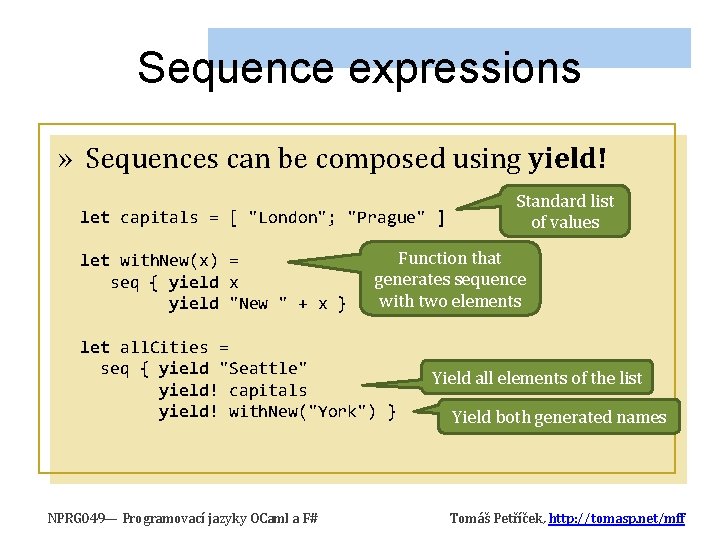
Sequence expressions » Sequences can be composed using yield! let capitals = [ "London"; "Prague" ] let with. New(x) = seq { yield x yield "New " + x } Function that generates sequence with two elements let all. Cities = seq { yield "Seattle" yield! capitals yield! with. New("York") } NPRG 049— Programovací jazyky OCaml a F# Standard list of values Yield all elements of the list Yield both generated names Tomáš Petříček, http: //tomasp. net/mff
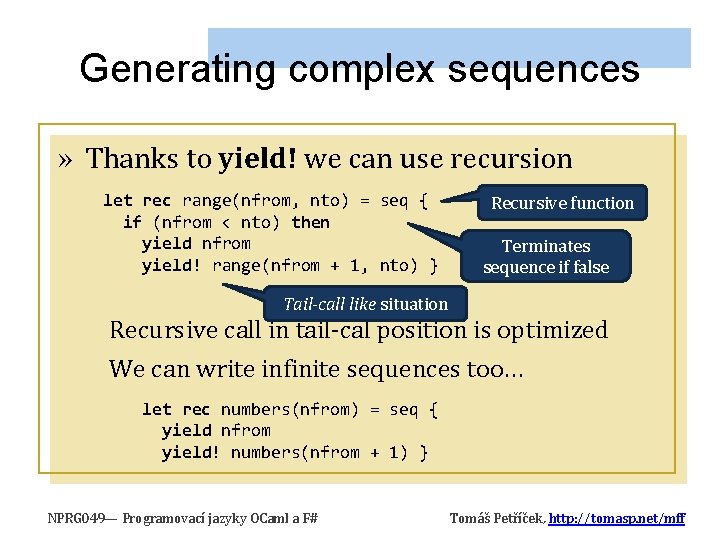
Generating complex sequences » Thanks to yield! we can use recursion let rec range(nfrom, nto) = seq { if (nfrom < nto) then yield nfrom yield! range(nfrom + 1, nto) } Recursive function Terminates sequence if false Tail-call like situation Recursive call in tail-cal position is optimized We can write infinite sequences too… let rec numbers(nfrom) = seq { yield nfrom yield! numbers(nfrom + 1) } NPRG 049— Programovací jazyky OCaml a F# Tomáš Petříček, http: //tomasp. net/mff
DEMO Working with sequences using HOFs, working with infinite sequences NPRG 049— Programovací jazyky OCaml a F# Tomáš Petříček, http: //tomasp. net/mff
Sequence expressions 2. (processing sequences)
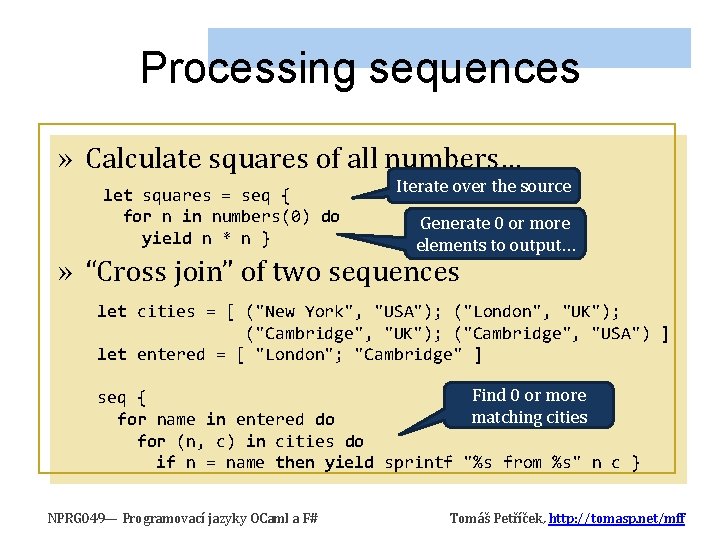
Processing sequences » Calculate squares of all numbers… let squares = seq { for n in numbers(0) do yield n * n } Iterate over the source Generate 0 or more elements to output… » “Cross join” of two sequences let cities = [ ("New York", "USA"); ("London", "UK"); ("Cambridge", "USA") ] let entered = [ "London"; "Cambridge" ] Find 0 or more seq { matching cities for name in entered do for (n, c) in cities do if n = name then yield sprintf "%s from %s" n c } NPRG 049— Programovací jazyky OCaml a F# Tomáš Petříček, http: //tomasp. net/mff
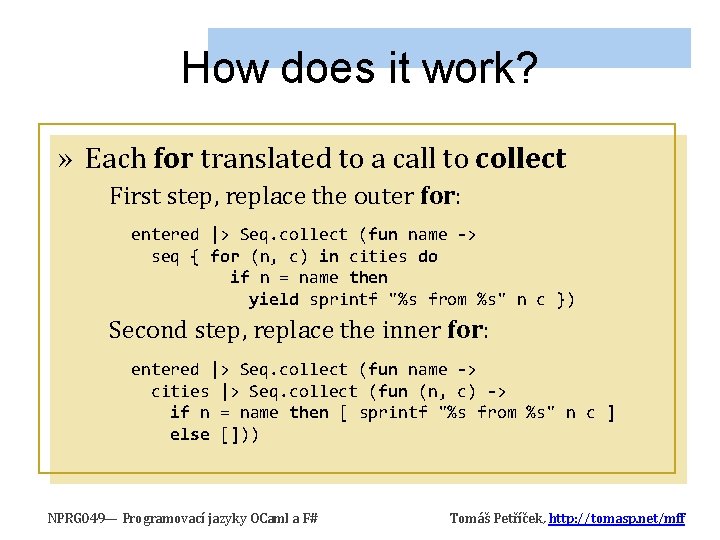
How does it work? » Each for translated to a call to collect First step, replace the outer for: entered |> Seq. collect (fun name -> seq { for (n, c) in cities do if n = name then yield sprintf "%s from %s" n c }) Second step, replace the inner for: entered |> Seq. collect (fun name -> cities |> Seq. collect (fun (n, c) -> if n = name then [ sprintf "%s from %s" n c ] else [])) NPRG 049— Programovací jazyky OCaml a F# Tomáš Petříček, http: //tomasp. net/mff
Computation expressions
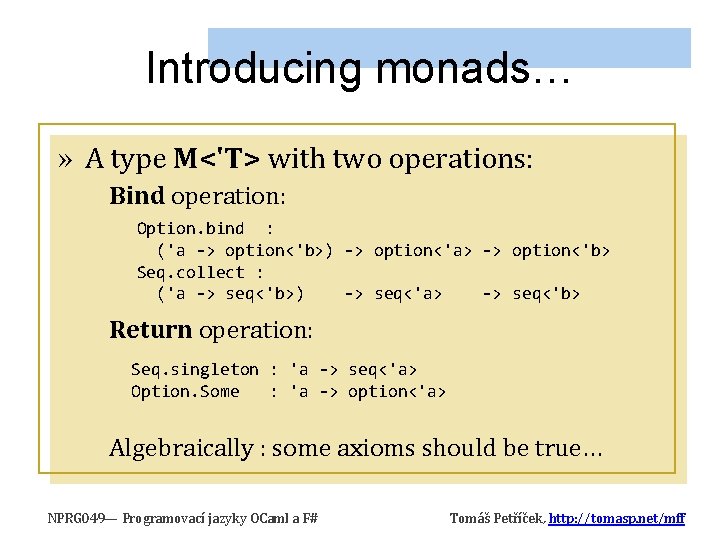
Introducing monads… » A type M<'T> with two operations: Bind operation: Option. bind : ('a -> option<'b>) -> option<'a> -> option<'b> Seq. collect : ('a -> seq<'b>) -> seq<'a> -> seq<'b> Return operation: Seq. singleton : 'a -> seq<'a> Option. Some : 'a -> option<'a> Algebraically : some axioms should be true… NPRG 049— Programovací jazyky OCaml a F# Tomáš Petříček, http: //tomasp. net/mff
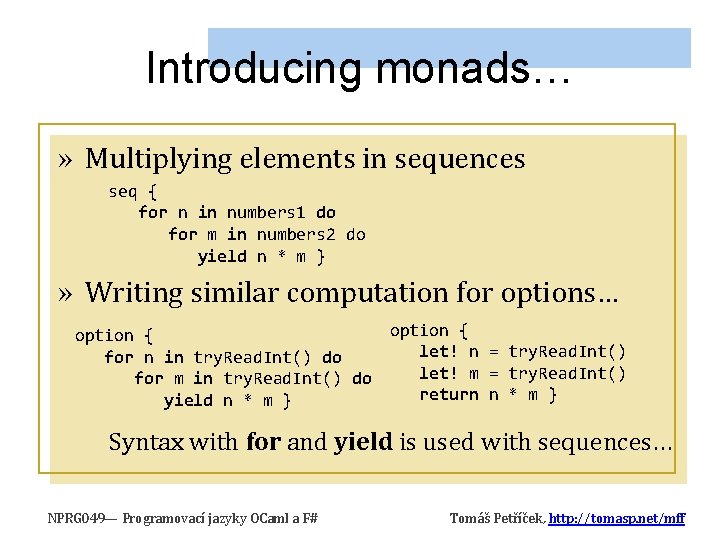
Introducing monads… » Multiplying elements in sequences seq { for n in numbers 1 do for m in numbers 2 do yield n * m } » Writing similar computation for options… option { for n in try. Read. Int() do for m in try. Read. Int() do yield n * m } option { let! n = try. Read. Int() let! m = try. Read. Int() return n * m } Syntax with for and yield is used with sequences… NPRG 049— Programovací jazyky OCaml a F# Tomáš Petříček, http: //tomasp. net/mff
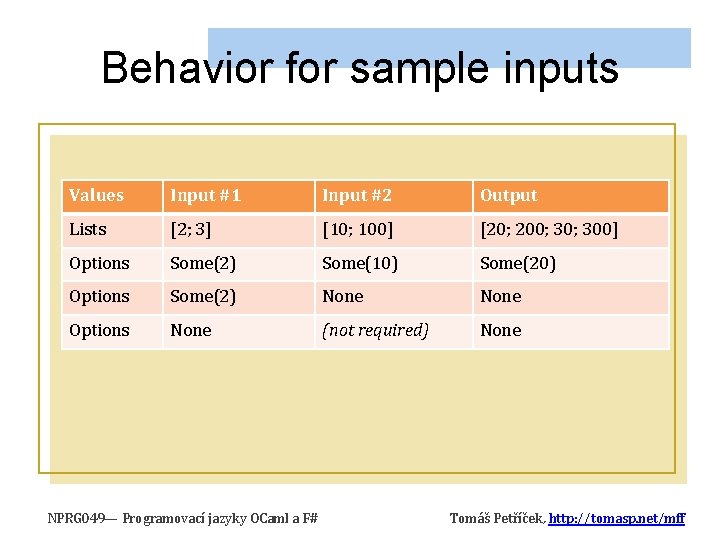
Behavior for sample inputs Values Input #1 Input #2 Output Lists [2; 3] [10; 100] [20; 200; 300] Options Some(2) Some(10) Some(20) Options Some(2) None Options None (not required) None NPRG 049— Programovací jazyky OCaml a F# Tomáš Petříček, http: //tomasp. net/mff
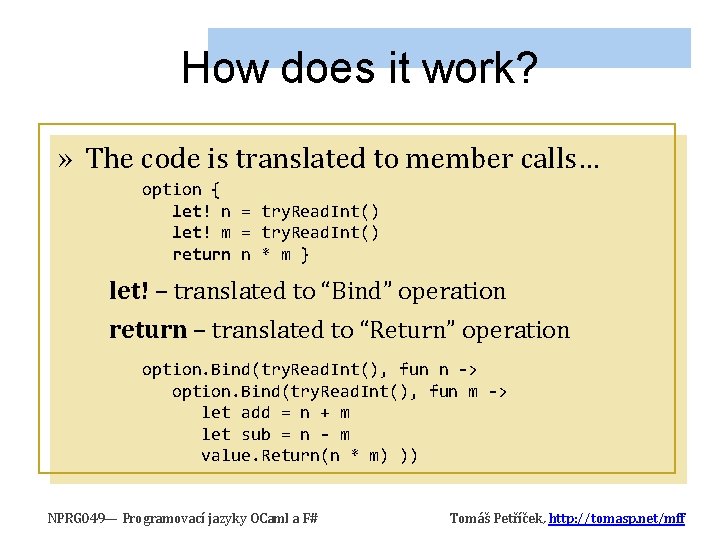
How does it work? » The code is translated to member calls… option { let! n = try. Read. Int() let! m = try. Read. Int() return n * m } let! – translated to “Bind” operation return – translated to “Return” operation option. Bind(try. Read. Int(), fun n -> option. Bind(try. Read. Int(), fun m -> let add = n + m let sub = n - m value. Return(n * m) )) NPRG 049— Programovací jazyky OCaml a F# Tomáš Petříček, http: //tomasp. net/mff
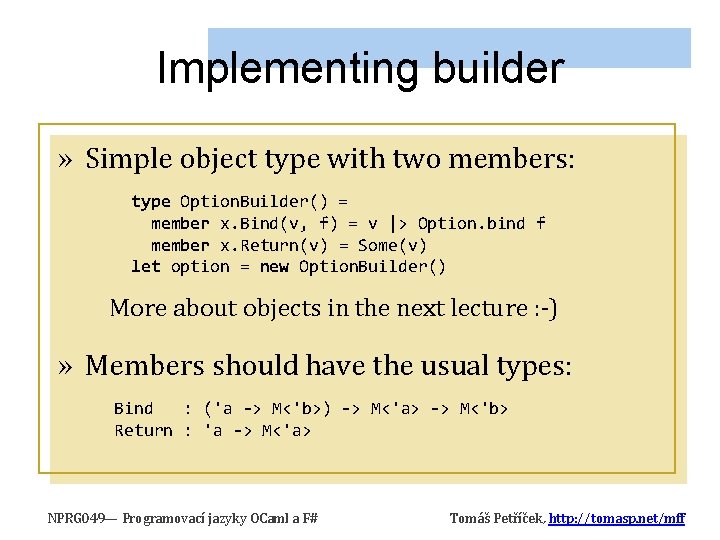
Implementing builder » Simple object type with two members: type Option. Builder() = member x. Bind(v, f) = v |> Option. bind f member x. Return(v) = Some(v) let option = new Option. Builder() More about objects in the next lecture : -) » Members should have the usual types: Bind : ('a -> M<'b>) -> M<'a> -> M<'b> Return : 'a -> M<'a> NPRG 049— Programovací jazyky OCaml a F# Tomáš Petříček, http: //tomasp. net/mff
Computation expression for “resumptions”
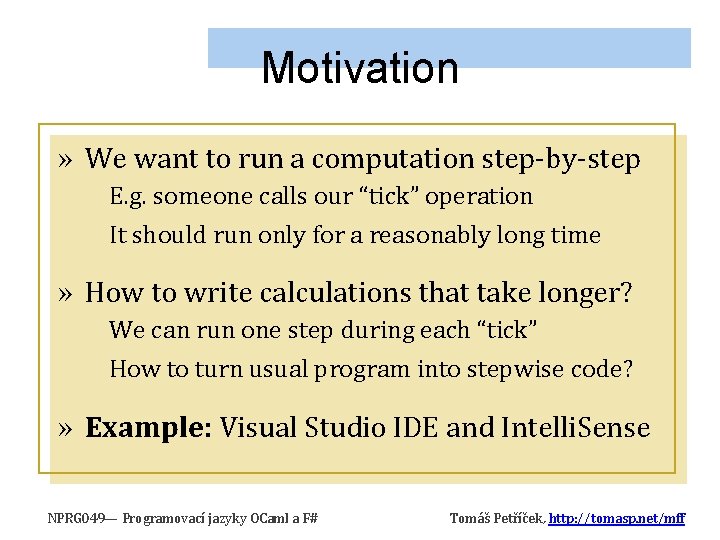
Motivation » We want to run a computation step-by-step E. g. someone calls our “tick” operation It should run only for a reasonably long time » How to write calculations that take longer? We can run one step during each “tick” How to turn usual program into stepwise code? » Example: Visual Studio IDE and Intelli. Sense NPRG 049— Programovací jazyky OCaml a F# Tomáš Petříček, http: //tomasp. net/mff
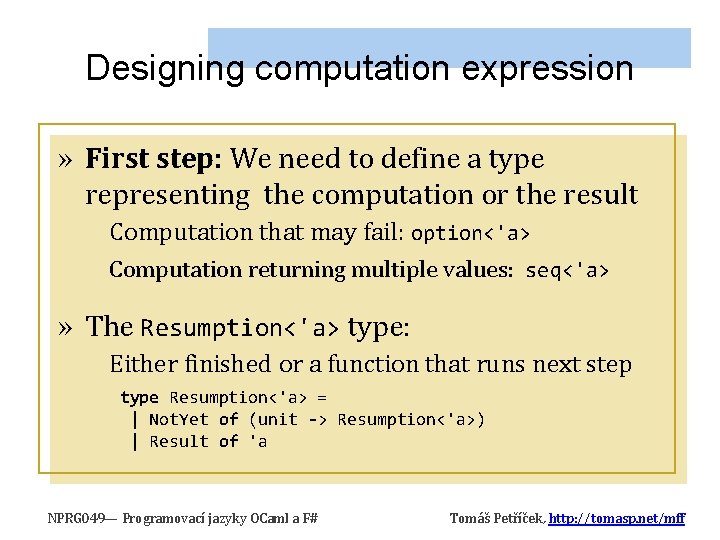
Designing computation expression » First step: We need to define a type representing the computation or the result Computation that may fail: option<'a> Computation returning multiple values: seq<'a> » The Resumption<'a> type: Either finished or a function that runs next step type Resumption<'a> = | Not. Yet of (unit -> Resumption<'a>) | Result of 'a NPRG 049— Programovací jazyky OCaml a F# Tomáš Petříček, http: //tomasp. net/mff
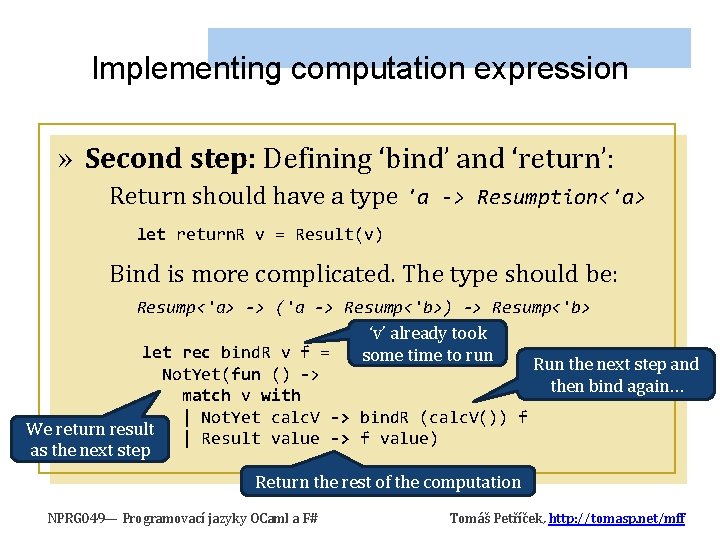
Implementing computation expression » Second step: Defining ‘bind’ and ‘return’: Return should have a type 'a -> Resumption<'a> let return. R v = Result(v) Bind is more complicated. The type should be: Resump<'a> -> ('a -> Resump<'b>) -> Resump<'b> ‘v’ already took let rec bind. R v f = some time to run Run the next step and Not. Yet(fun () -> then bind again… match v with | Not. Yet calc. V -> bind. R (calc. V()) f We return result | Result value -> f value) as the next step Return the rest of the computation NPRG 049— Programovací jazyky OCaml a F# Tomáš Petříček, http: //tomasp. net/mff
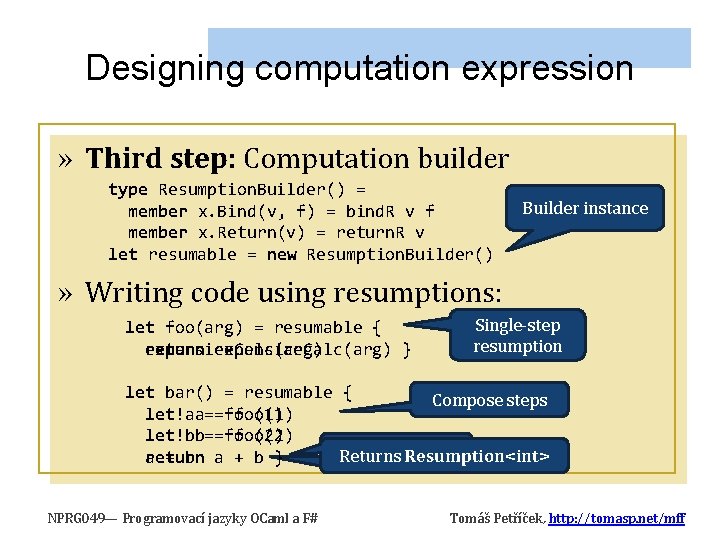
Designing computation expression » Third step: Computation builder type Resumption. Builder() = member x. Bind(v, f) = bind. R v f member x. Return(v) = return. R v let resumable = new Resumption. Builder() Builder instance » Writing code using resumptions: let foo(arg) = resumable { expensice. Calc(arg) return expensice. Calc(arg) } Single-step resumption let bar() = resumable { Compose steps let aa==foo(1) let! foo(1) let bb==foo(2) let! foo(2) Returns. Resumption<int> ‘int’ Returns a return + b a + b } NPRG 049— Programovací jazyky OCaml a F# Tomáš Petříček, http: //tomasp. net/mff
DEMO Programming with resumptions NPRG 049— Programovací jazyky OCaml a F# Tomáš Petříček, http: //tomasp. net/mff
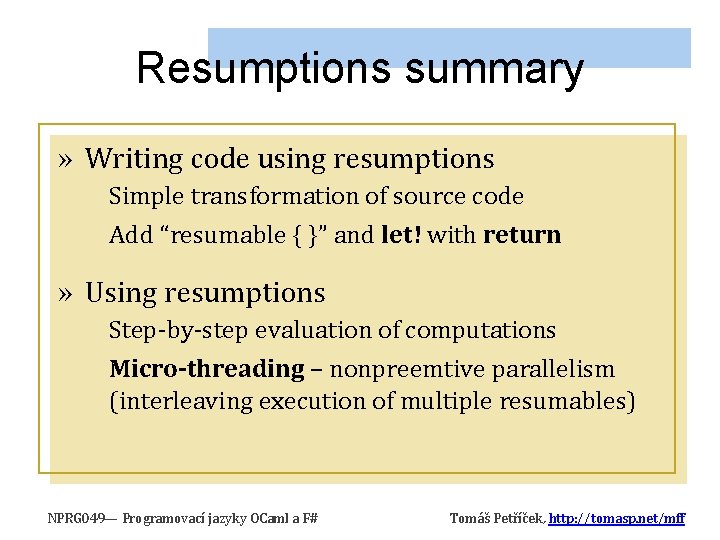
Resumptions summary » Writing code using resumptions Simple transformation of source code Add “resumable { }” and let! with return » Using resumptions Step-by-step evaluation of computations Micro-threading – nonpreemtive parallelism (interleaving execution of multiple resumables) NPRG 049— Programovací jazyky OCaml a F# Tomáš Petříček, http: //tomasp. net/mff
Asynchronous workflows
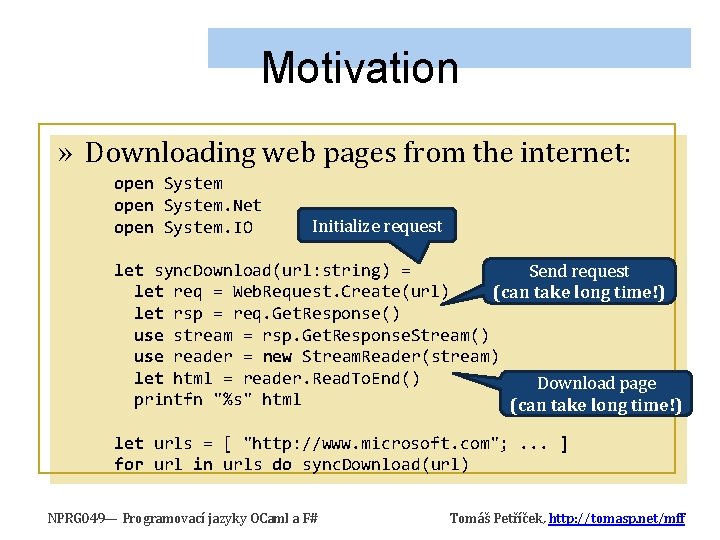
Motivation » Downloading web pages from the internet: open System. Net open System. IO Initialize request let sync. Download(url: string) = Send request let req = Web. Request. Create(url) (can take long time!) let rsp = req. Get. Response() use stream = rsp. Get. Response. Stream() use reader = new Stream. Reader(stream) let html = reader. Read. To. End() Download page printfn "%s" html (can take long time!) let urls = [ "http: //www. microsoft. com"; . . . ] for url in urls do sync. Download(url) NPRG 049— Programovací jazyky OCaml a F# Tomáš Petříček, http: //tomasp. net/mff
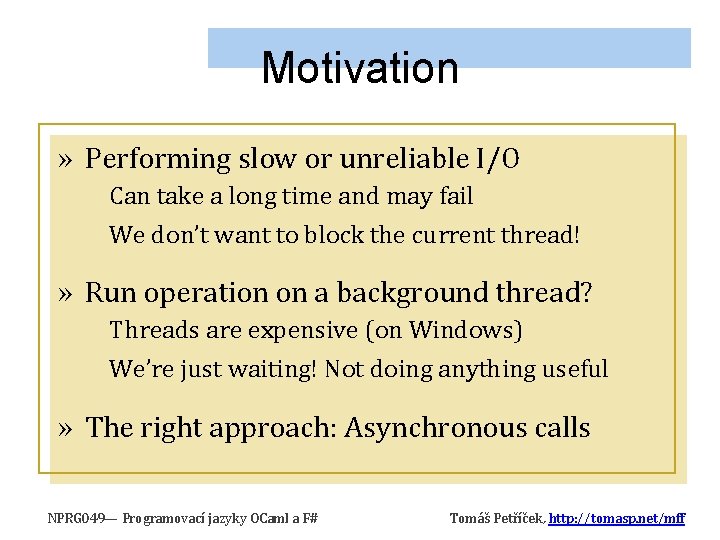
Motivation » Performing slow or unreliable I/O Can take a long time and may fail We don’t want to block the current thread! » Run operation on a background thread? Threads are expensive (on Windows) We’re just waiting! Not doing anything useful » The right approach: Asynchronous calls NPRG 049— Programovací jazyky OCaml a F# Tomáš Petříček, http: //tomasp. net/mff
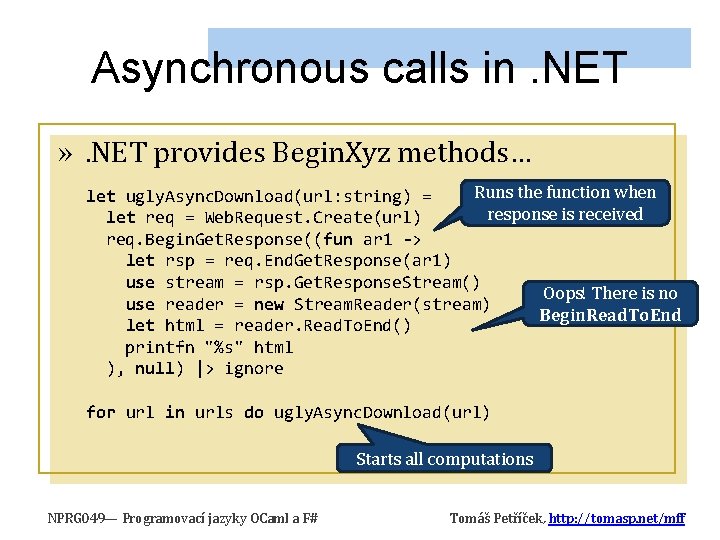
Asynchronous calls in. NET » . NET provides Begin. Xyz methods… Runs the function when let ugly. Async. Download(url: string) = response is received let req = Web. Request. Create(url) req. Begin. Get. Response((fun ar 1 -> let rsp = req. End. Get. Response(ar 1) use stream = rsp. Get. Response. Stream() Oops! There is no use reader = new Stream. Reader(stream) Begin. Read. To. End let html = reader. Read. To. End() printfn "%s" html ), null) |> ignore for url in urls do ugly. Async. Download(url) Starts all computations NPRG 049— Programovací jazyky OCaml a F# Tomáš Petříček, http: //tomasp. net/mff
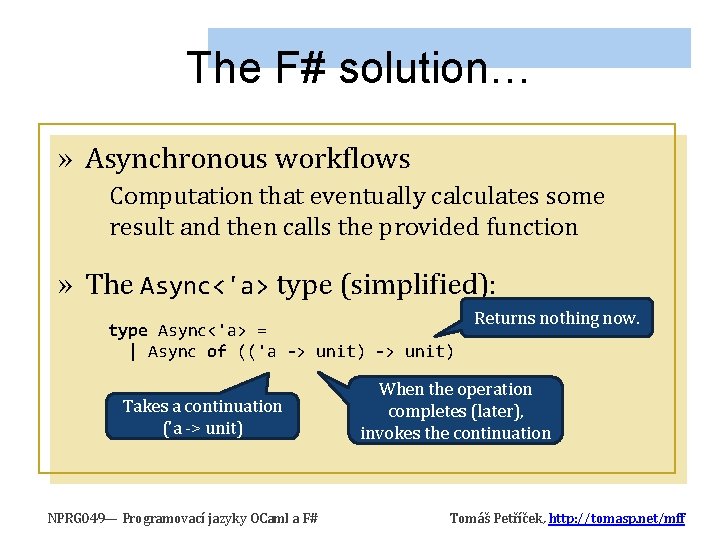
The F# solution… » Asynchronous workflows Computation that eventually calculates some result and then calls the provided function » The Async<'a> type (simplified): type Async<'a> = | Async of (('a -> unit) Takes a continuation ('a -> unit) NPRG 049— Programovací jazyky OCaml a F# Returns nothing now. When the operation completes (later), invokes the continuation Tomáš Petříček, http: //tomasp. net/mff
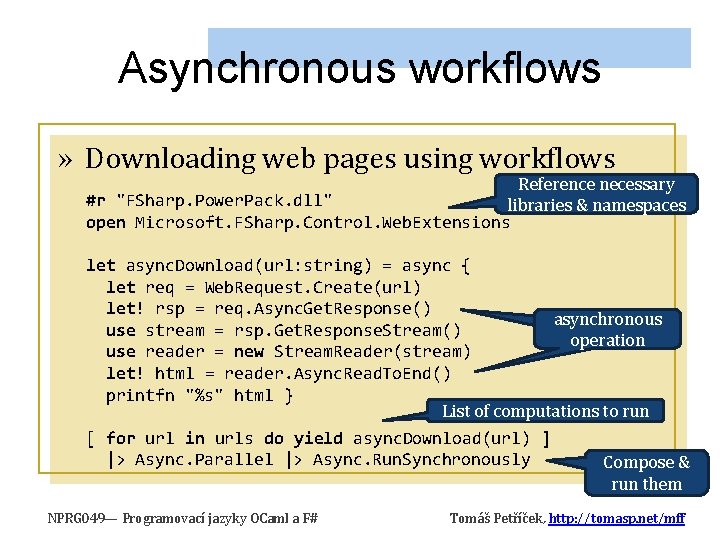
Asynchronous workflows » Downloading web pages using workflows Reference necessary #r "FSharp. Power. Pack. dll" libraries & namespaces open Microsoft. FSharp. Control. Web. Extensions let async. Download(url: string) = async { let req = Web. Request. Create(url) let! rsp = req. Async. Get. Response() asynchronous use stream = rsp. Get. Response. Stream() operation use reader = new Stream. Reader(stream) let! html = reader. Async. Read. To. End() printfn "%s" html } List of computations to run [ for url in urls do yield async. Download(url) ] |> Async. Parallel |> Async. Run. Synchronously Compose & run them NPRG 049— Programovací jazyky OCaml a F# Tomáš Petříček, http: //tomasp. net/mff
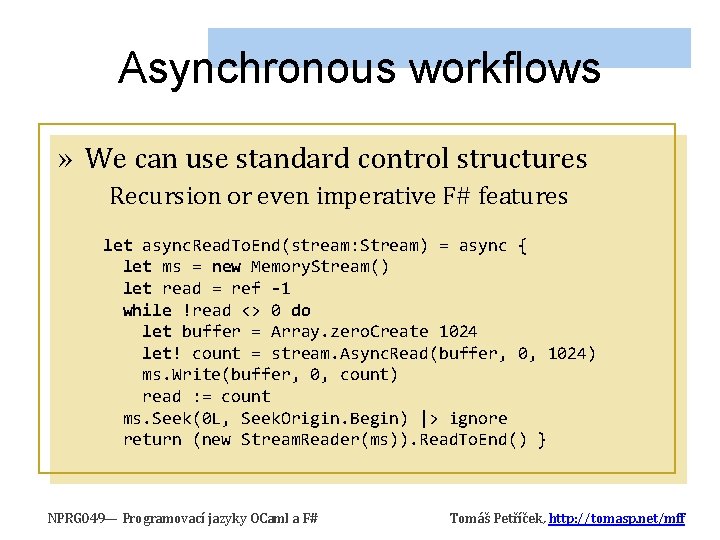
Asynchronous workflows » We can use standard control structures Recursion or even imperative F# features let async. Read. To. End(stream: Stream) = async { let ms = new Memory. Stream() let read = ref -1 while !read <> 0 do let buffer = Array. zero. Create 1024 let! count = stream. Async. Read(buffer, 0, 1024) ms. Write(buffer, 0, count) read : = count ms. Seek(0 L, Seek. Origin. Begin) |> ignore return (new Stream. Reader(ms)). Read. To. End() } NPRG 049— Programovací jazyky OCaml a F# Tomáš Petříček, http: //tomasp. net/mff