
Programming with CUDA WS 0809 Lecture 5 Thu





















- Slides: 54
Programming with CUDA WS 08/09 Lecture 5 Thu, 6 Nov, 2008
Previously CUDA programming model CUDA hardware model
Today CAJ registration CUDA use cases The CUDA API
CAJ Registration Needed to get a grade for the course No grade wanted <=> do not register
Some Use Cases A few videos – Neural simulation – Geo-physical computations – Bio-medical computations
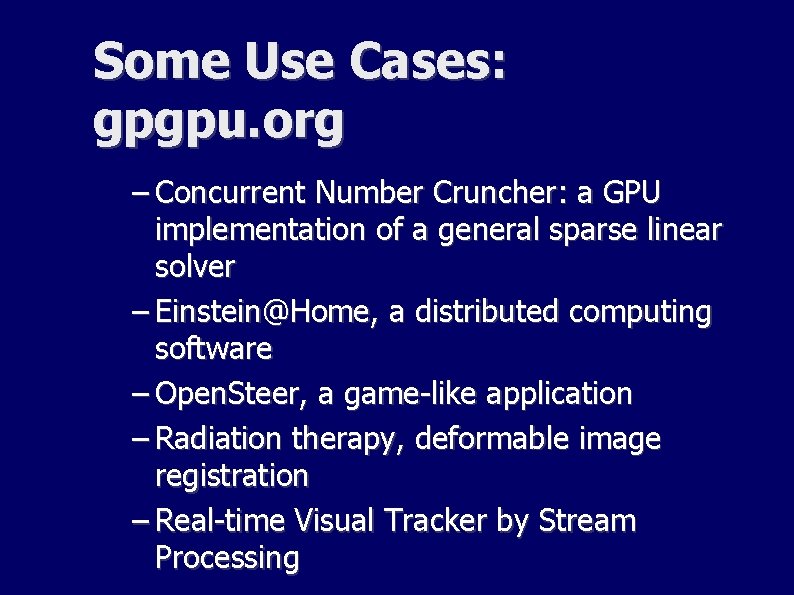
Some Use Cases: gpgpu. org – Concurrent Number Cruncher: a GPU implementation of a general sparse linear solver – Einstein@Home, a distributed computing software – Open. Steer, a game-like application – Radiation therapy, deformable image registration – Real-time Visual Tracker by Stream Processing
Some Use Cases http: //www. nvidia. com/object/io_12093 86593154. html – Molecular visualization and analysis – Computational fluid dynamics – Molecular dynamics
Some Use Cases CUDA is being presented and promoted at – Universities: talks, scholarship kits, courses – Supercomputing conferences International Supercomputing Conference 2008, Dresden, Germany Supercomputing 2008, Texas, USA
The CUDA API
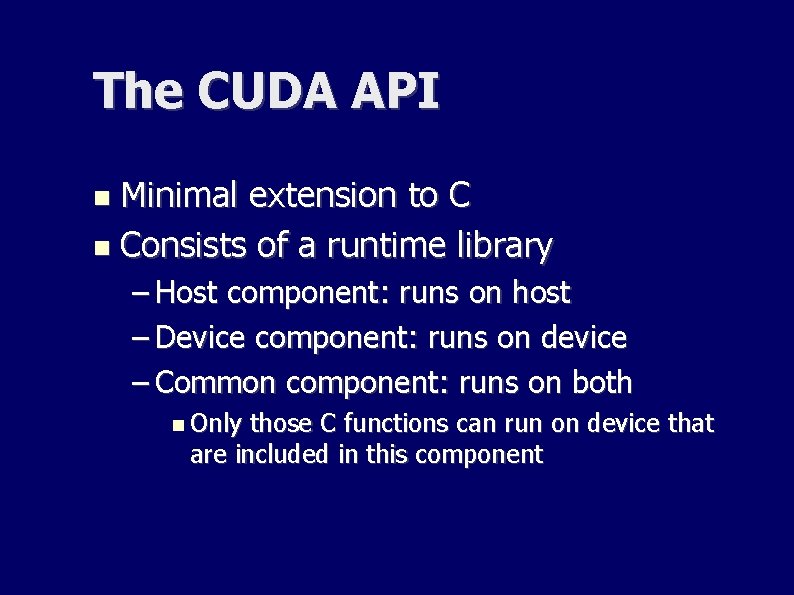
The CUDA API Minimal extension to C Consists of a runtime library – Host component: runs on host – Device component: runs on device – Common component: runs on both Only those C functions can run on device that are included in this component
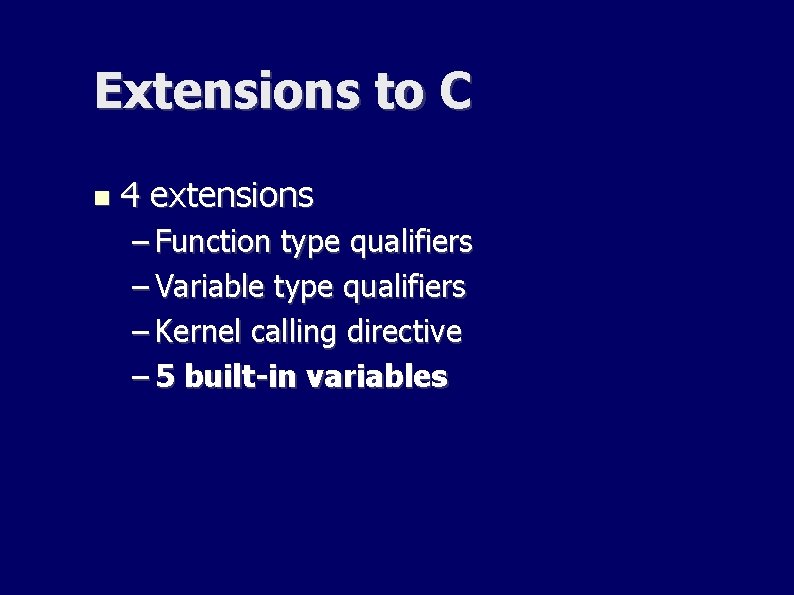
Extensions to C 4 extensions – Function type qualifiers – Variable type qualifiers – Kernel calling directive – 5 built-in variables
Extensions to C 4 extensions – Function type qualifiers – Variable type qualifiers – Kernel calling directive – 5 built-in variables
Function type qualifiers Specify – Where a function executes – Where can a function be called from
Function type qualifiers __global__ – Specifies a kernel – Callable from host only – Executes on the device – Must return void
Function type qualifiers __device__ – Callable from device only – Executes on device
Function type qualifiers __host__ – Callable from host only – Executes on host – The qualifier is optional – Can be combined with __device__ to compile for both host and device
Function type qualifiers Table for function qualifiers (on board)
Function type qualifiers caveats __host__ and __device__ can be used together __host__ and __global__ cannot be used together Function pointers to __device__ functions are not allowed
Function type qualifiers caveats Functions that execute on the device (__device__, __global__) cannot – Support recursion – Declare static variables – Have a variable number of arguments
Function type qualifiers caveats __global__ functions – Must return void – Must be called using the kernel calling directive – Are called asynchronously Command returns to host immediately – Have a parameter size limit of 256 bytes Device pointer takes 8 bytes
Extensions to C 4 extensions – Function type qualifiers – Variable type qualifiers – Kernel calling directive – 4 built-in variables
Variable type qualifiers Specify – Where a variable resides in device memory Lifetime of the variable Where the variable can be accessed from
Variable type qualifiers __device__ – Resides in global memory Lifetime of the application Accessible from – All threads in the grid – Host – Can be used with __constant__ or __shared__
Variable type qualifiers __constant__ – Resides in constant memory Lifetime of the application Accessible from – All threads in the grid – Host – Can be used with __device__
Variable type qualifiers __shared__ – Resides in shared memory Lifetime of the block Accessible from – All threads in the block – Can be used with __device__ – Values assigned to __shared__ variables are guaranteed to be visible to other threads in the block only after a call to __syncthreads()
Variable type qualifiers caveats Qualifiers not allowed on – Members of struct and union – Local variables of host functions __device__ can be used with one other qualifier __shared__ and __constant__ variables are static
Variable type qualifiers caveats __constant__ variables are read only from device code – Can be set through host __shared__ variables cannot be initialized on declaration Unqualified variables in device code are created in registers – Large structures may be placed in local memory, SLOW
Extensions to C 4 extensions – Function type qualifiers – Variable type qualifiers – Kernel calling directive – 5 built-in variables
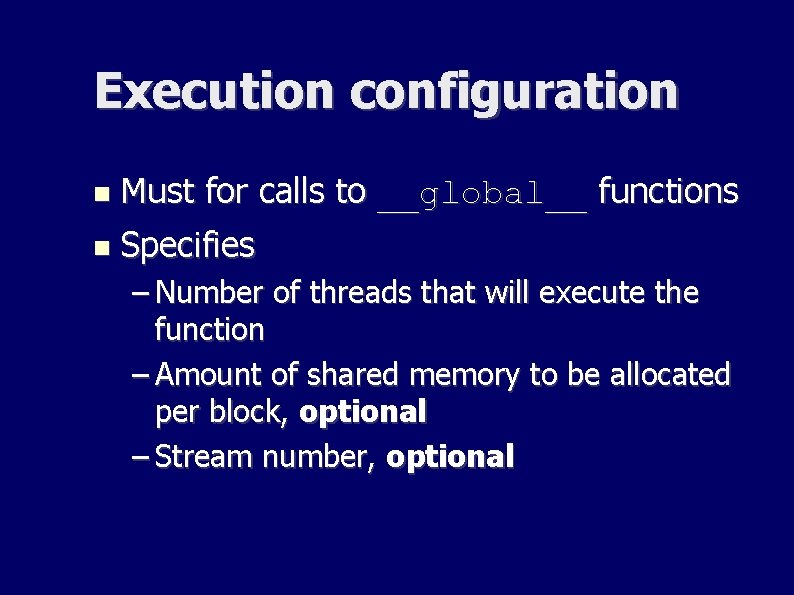
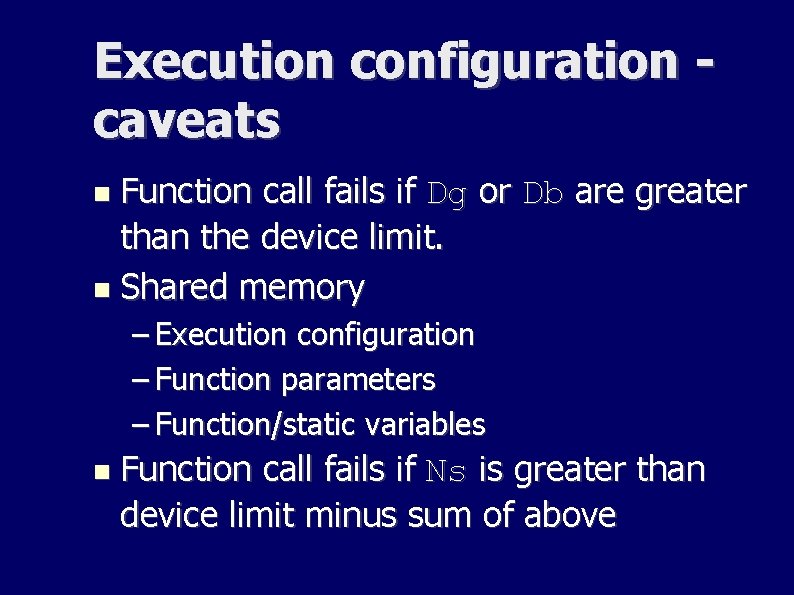
Execution configuration Must for calls to __global__ functions Specifies – Number of threads that will execute the function – Amount of shared memory to be allocated per block, optional – Stream number, optional
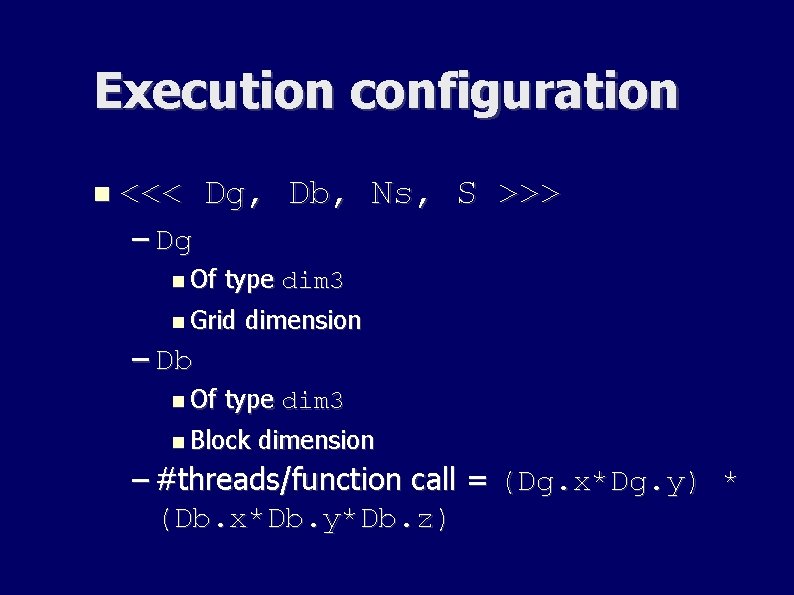
Execution configuration <<< Dg, Db, Ns, S >>> – Dg Of type dim 3 Grid dimension – Db Of type dim 3 Block dimension – #threads/function call = (Dg. x*Dg. y) * (Db. x*Db. y*Db. z)
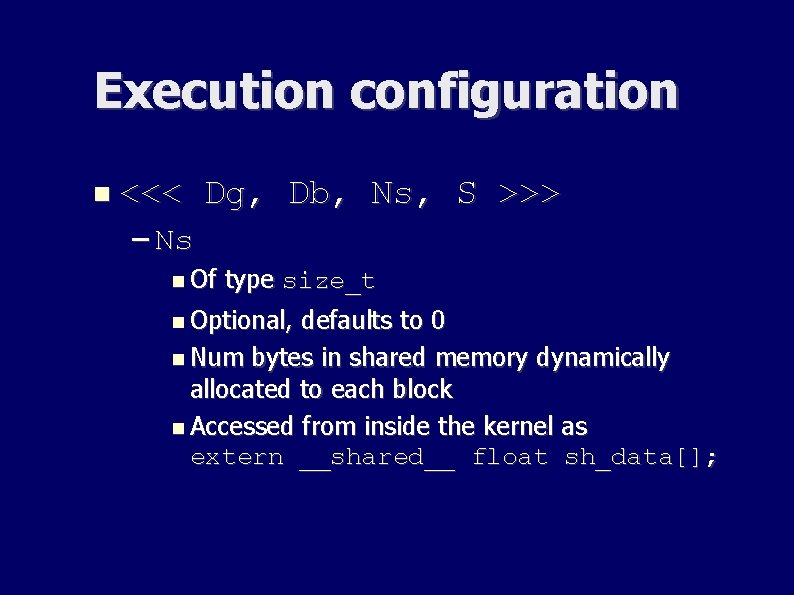
Execution configuration <<< Dg, Db, Ns, S >>> – Ns Of type size_t Optional, defaults to 0 Num bytes in shared memory dynamically allocated to each block Accessed from inside the kernel as extern __shared__ float sh_data[];
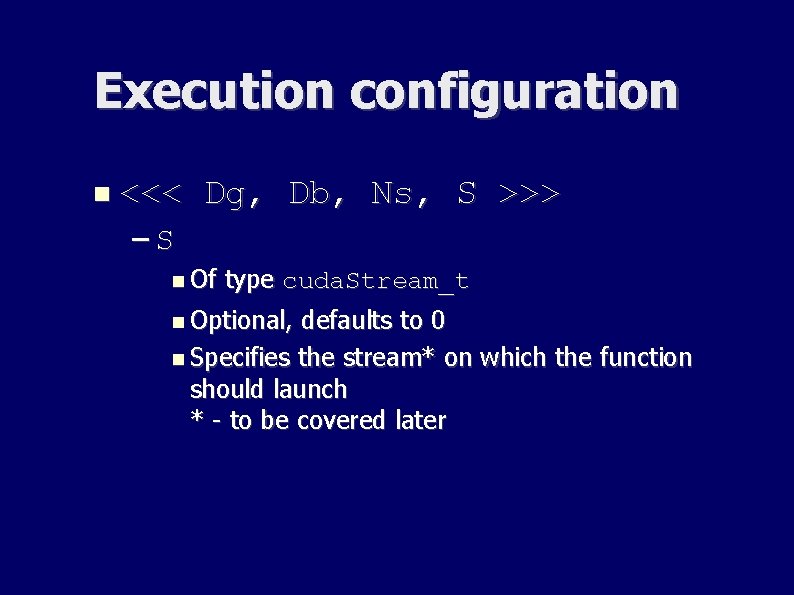
Execution configuration <<< Dg, Db, Ns, S >>> –S Of type cuda. Stream_t Optional, defaults to 0 Specifies the stream* on which the function should launch * - to be covered later
Execution configuration caveats Function call fails if Dg or Db are greater than the device limit. Shared memory – Execution configuration – Function parameters – Function/static variables Function call fails if Ns is greater than device limit minus sum of above
Extensions to C 4 extensions – Function type qualifiers – Variable type qualifiers – Kernel calling directive – 5 built-in variables
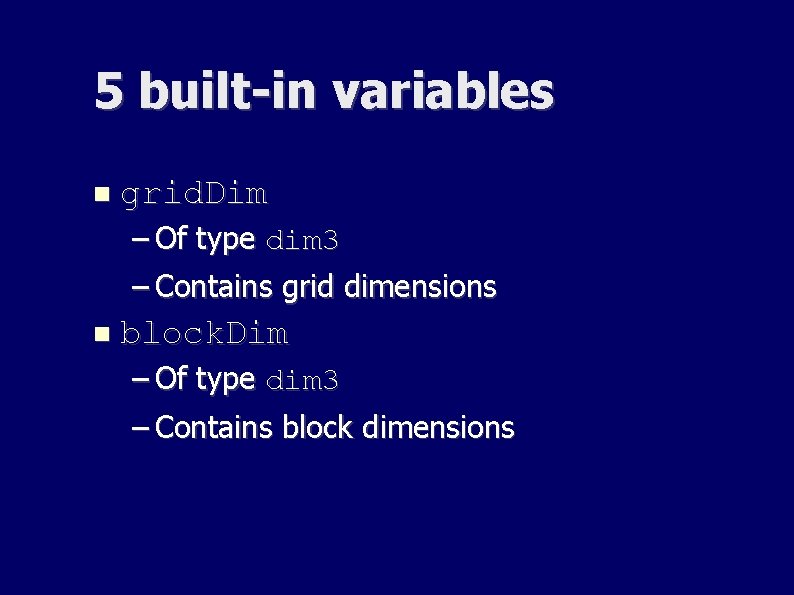
5 built-in variables grid. Dim – Of type dim 3 – Contains grid dimensions block. Dim – Of type dim 3 – Contains block dimensions
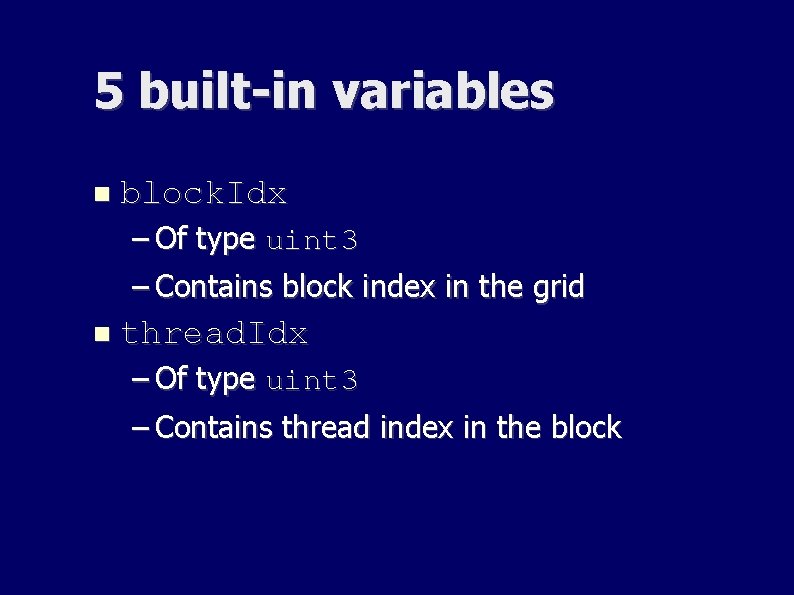
5 built-in variables block. Idx – Of type uint 3 – Contains block index in the grid thread. Idx – Of type uint 3 – Contains thread index in the block
5 built-in variables warp. Size – Of type int – Contains #threads in a warp
5 built-in variables caveats Cannot have pointers to these variables Cannot assign values to these variables
The NVCC compiler Separates device code and host code Compiles device code into binary, cubin object Host code is compiled by some other tool, e. g. g++
The NVCC compiler Host code can be in C++ syntax – Will anyway be compiled by external tool Device code has to be in C format
Synchronization & Optimization
Host Synchronization All kernel launches are asynchronous – Control returns to host immediately – Kernel executes after all previous CUDA calls have completed – Host and device can run simultaneously
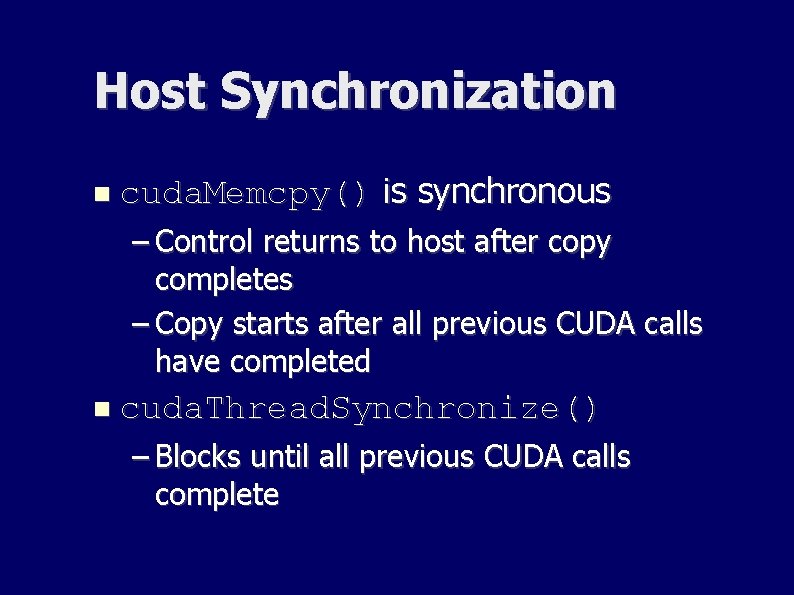
Host Synchronization cuda. Memcpy() is synchronous – Control returns to host after copy completes – Copy starts after all previous CUDA calls have completed cuda. Thread. Synchronize() – Blocks until all previous CUDA calls complete
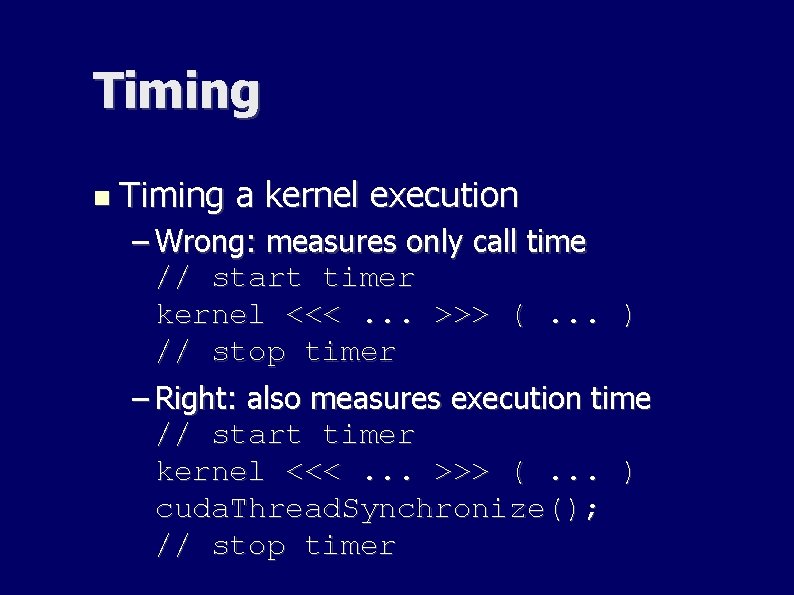
Timing a kernel execution – Wrong: measures only call time // start timer kernel <<<. . . >>> (. . . ) // stop timer – Right: also measures execution time // start timer kernel <<<. . . >>> (. . . ) cuda. Thread. Synchronize(); // stop timer
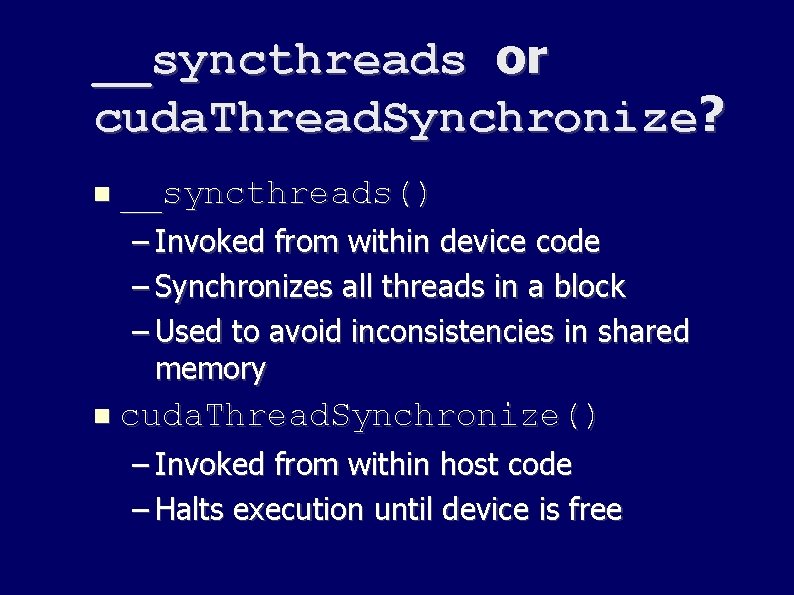
__syncthreads or cuda. Thread. Synchronize? __syncthreads() – Invoked from within device code – Synchronizes all threads in a block – Used to avoid inconsistencies in shared memory cuda. Thread. Synchronize() – Invoked from within host code – Halts execution until device is free
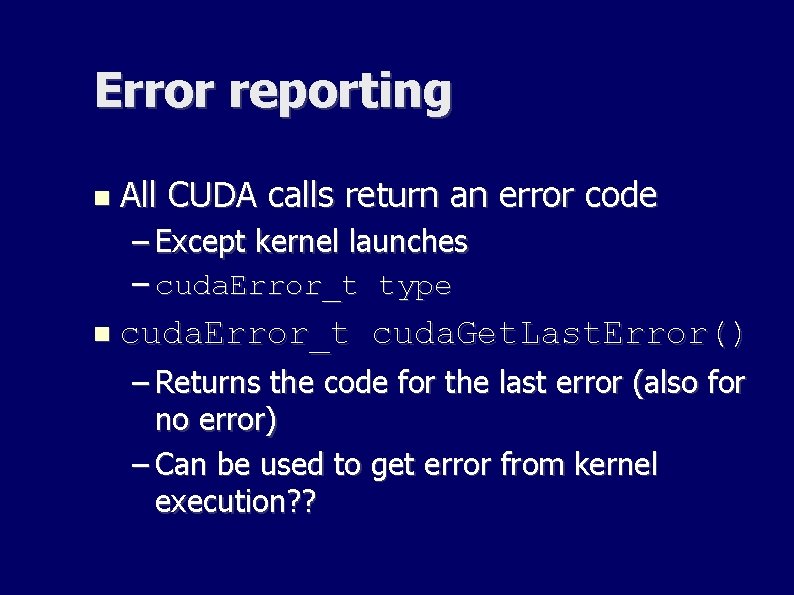
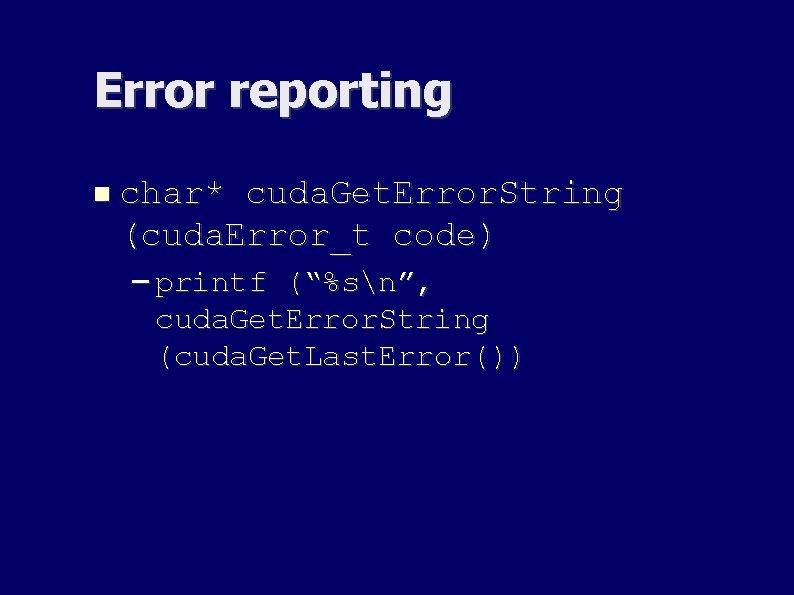
Error reporting All CUDA calls return an error code – Except kernel launches – cuda. Error_t type cuda. Error_t cuda. Get. Last. Error() – Returns the code for the last error (also for no error) – Can be used to get error from kernel execution? ?
Error reporting char* cuda. Get. Error. String (cuda. Error_t code) – printf (“%sn”, cuda. Get. Error. String (cuda. Get. Last. Error())
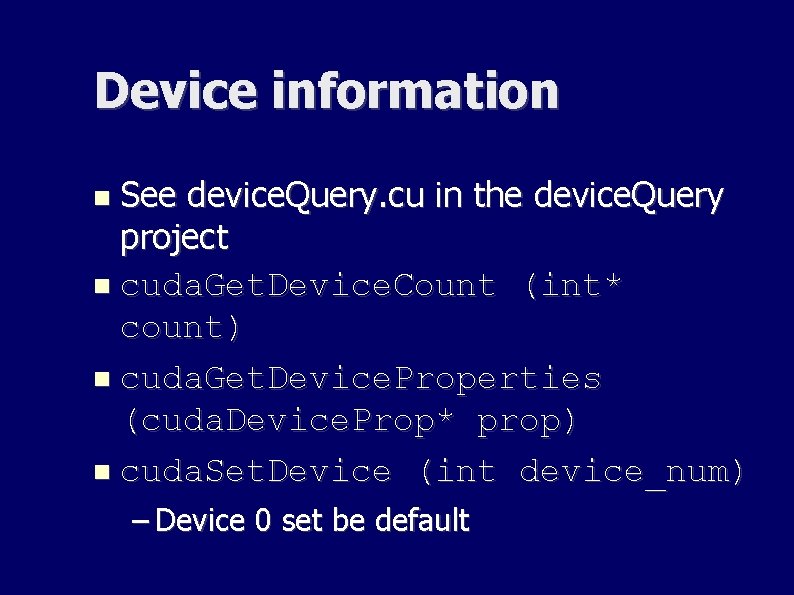
Device information See device. Query. cu in the device. Query project cuda. Get. Device. Count (int* count) cuda. Get. Device. Properties (cuda. Device. Prop* prop) cuda. Set. Device (int device_num) – Device 0 set be default
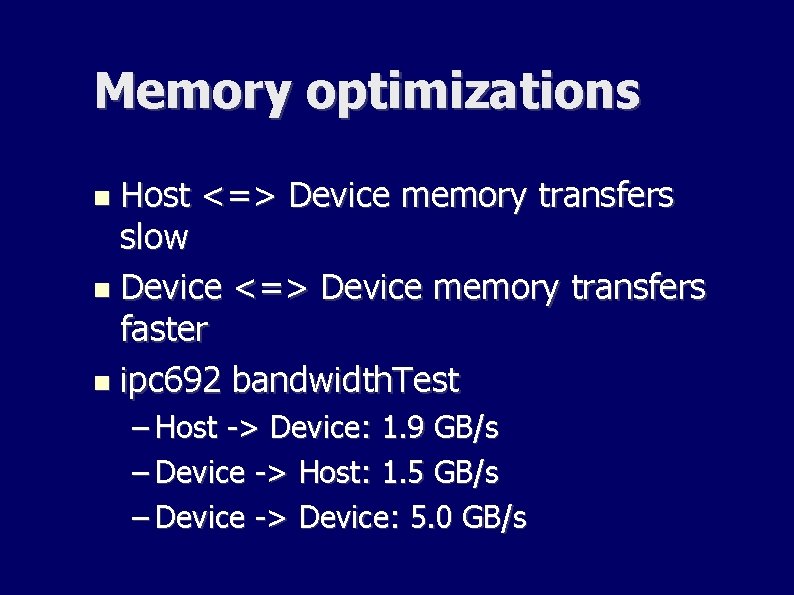
Memory optimizations Host <=> Device memory transfers slow Device <=> Device memory transfers faster ipc 692 bandwidth. Test – Host -> Device: 1. 9 GB/s – Device -> Host: 1. 5 GB/s – Device -> Device: 5. 0 GB/s
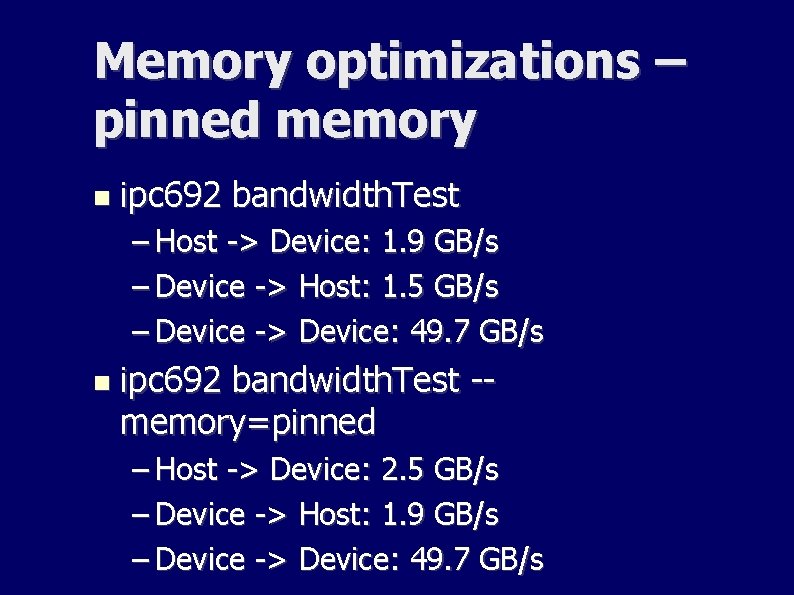
Memory optimizations – pinned memory Pinned memory = portion of main memory that cannot be swapped out Allows faster memory access, cuda. Memcpy()
Memory optimizations – pinned memory ipc 692 bandwidth. Test – Host -> Device: 1. 9 GB/s – Device -> Host: 1. 5 GB/s – Device -> Device: 49. 7 GB/s ipc 692 bandwidth. Test -memory=pinned – Host -> Device: 2. 5 GB/s – Device -> Host: 1. 9 GB/s – Device -> Device: 49. 7 GB/s
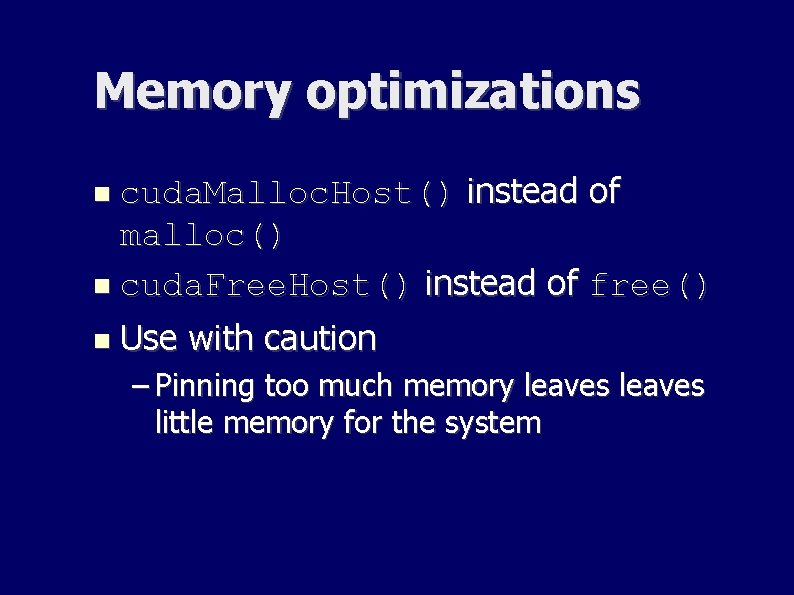
Memory optimizations cuda. Malloc. Host() instead of malloc() cuda. Free. Host() instead of free() Use with caution – Pinning too much memory leaves little memory for the system
All for today Next time – More on the CUDA API
See you next week!