
Programming Principles and Tools Group and Security Group
- Slides: 32
Programming Principles and Tools Group and Security Group Lightning Overview
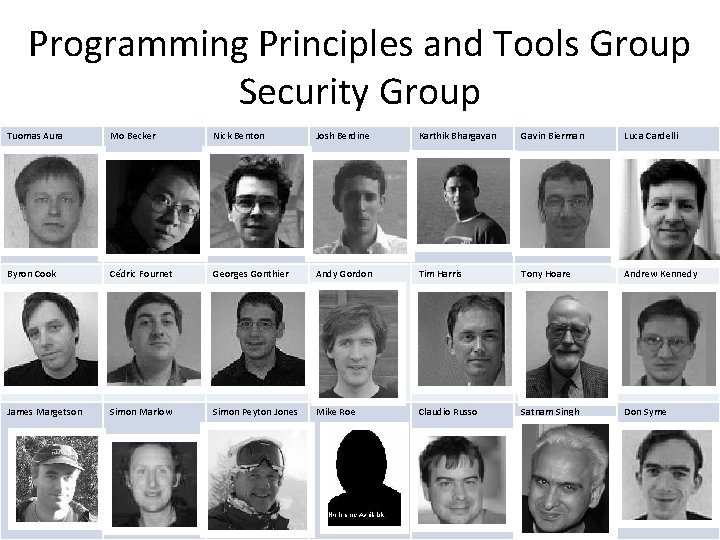
Programming Principles and Tools Group Security Group Tuomas Aura Mo Becker Nick Benton Josh Berdine Karthik Bhargavan Gavin Bierman Luca Cardelli Byron Cook Cédric Fournet Georges Gonthier Andy Gordon Tim Harris Tony Hoare Andrew Kennedy James Margetson Simon Marlow Simon Peyton Jones Mike Roe Claudio Russo Satnam Singh Don Syme
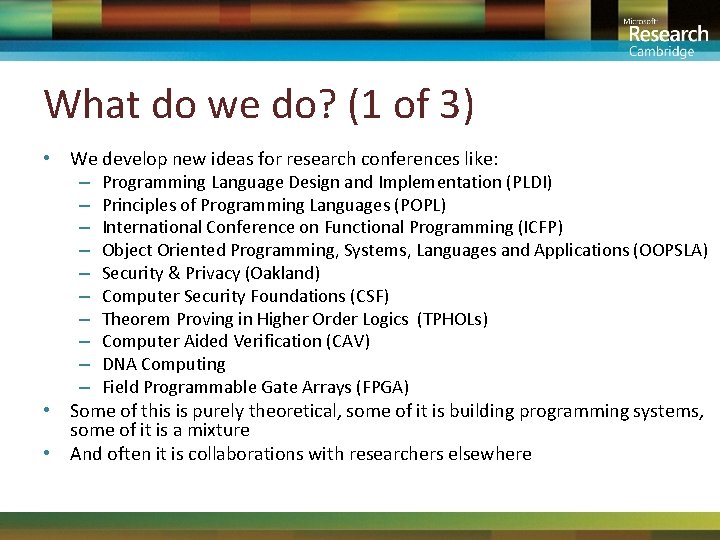
What do we do? (1 of 3) • We develop new ideas for research conferences like: – Programming Language Design and Implementation (PLDI) – Principles of Programming Languages (POPL) – International Conference on Functional Programming (ICFP) – Object Oriented Programming, Systems, Languages and Applications (OOPSLA) – Security & Privacy (Oakland) – Computer Security Foundations (CSF) – Theorem Proving in Higher Order Logics (TPHOLs) – Computer Aided Verification (CAV) – DNA Computing – Field Programmable Gate Arrays (FPGA) • Some of this is purely theoretical, some of it is building programming systems, some of it is a mixture • And often it is collaborations with researchers elsewhere
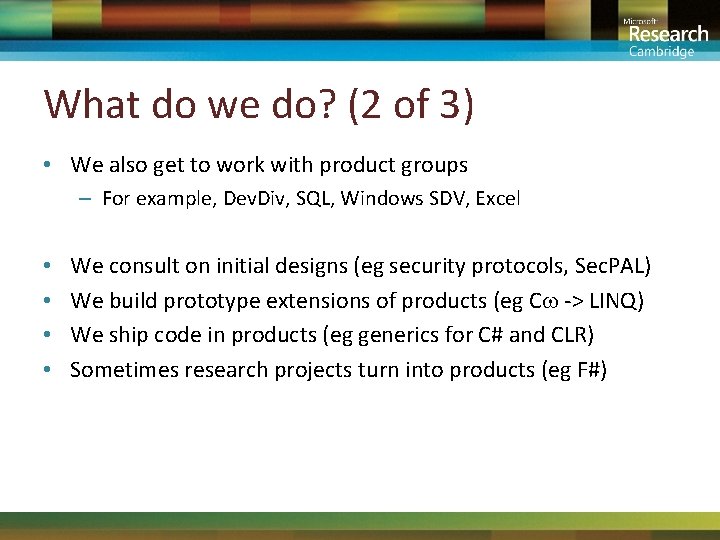
What do we do? (2 of 3) • We also get to work with product groups – For example, Dev. Div, SQL, Windows SDV, Excel • • We consult on initial designs (eg security protocols, Sec. PAL) We build prototype extensions of products (eg C -> LINQ) We ship code in products (eg generics for C# and CLR) Sometimes research projects turn into products (eg F#)
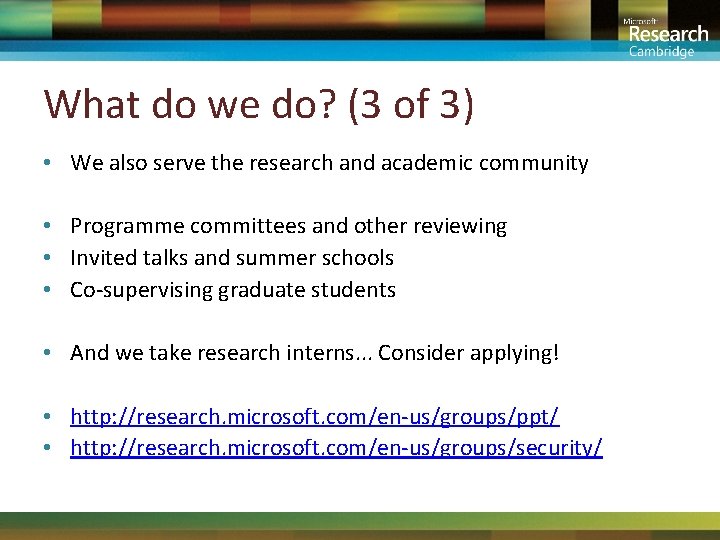
What do we do? (3 of 3) • We also serve the research and academic community • Programme committees and other reviewing • Invited talks and summer schools • Co-supervising graduate students • And we take research interns. . . Consider applying! • http: //research. microsoft. com/en-us/groups/ppt/ • http: //research. microsoft. com/en-us/groups/security/
Principles and Applications of Refinement Types Andrew D. Gordon (MSR) Joint work with Gavin Bierman (MSR) and David Langworthy (MS Corp) MSR Summer School, June 2009
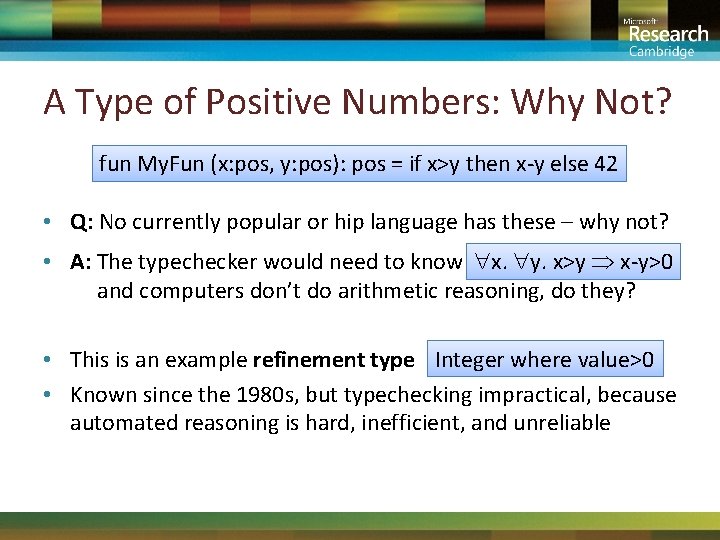
A Type of Positive Numbers: Why Not? fun My. Fun (x: pos, y: pos): pos = if x>y then x-y else 42 • Q: No currently popular or hip language has these – why not? • A: The typechecker would need to know x. y. x>y x-y>0 and computers don’t do arithmetic reasoning, do they? • This is an example refinement type Integer where value>0 • Known since the 1980 s, but typechecking impractical, because automated reasoning is hard, inefficient, and unreliable
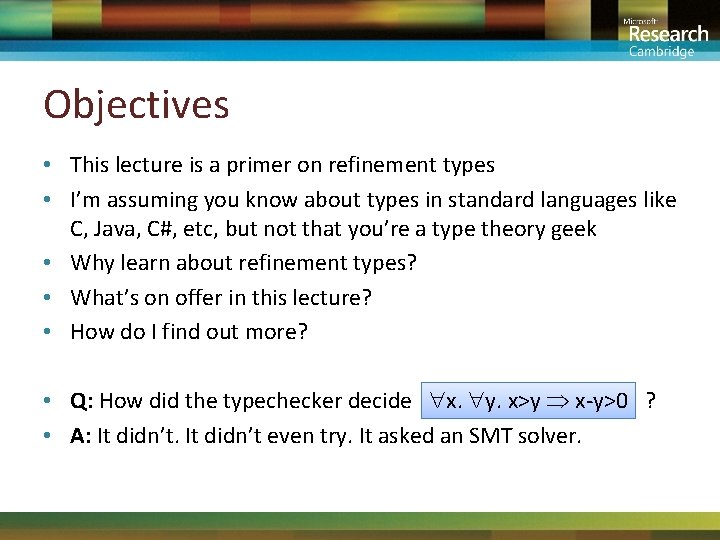
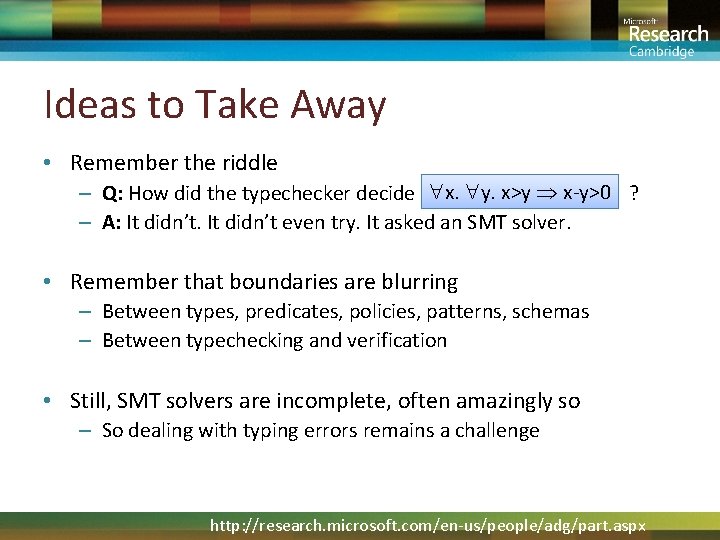
Objectives • This lecture is a primer on refinement types • I’m assuming you know about types in standard languages like C, Java, C#, etc, but not that you’re a type theory geek • Why learn about refinement types? • What’s on offer in this lecture? • How do I find out more? • Q: How did the typechecker decide x. y. x>y x-y>0 ? • A: It didn’t even try. It asked an SMT solver.
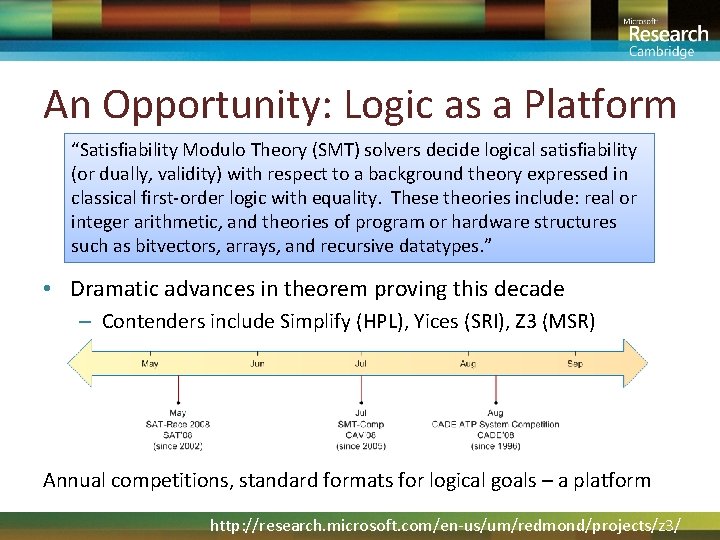
An Opportunity: Logic as a Platform “Satisfiability Modulo Theory (SMT) solvers decide logical satisfiability (or dually, validity) with respect to a background theory expressed in classical first-order logic with equality. These theories include: real or integer arithmetic, and theories of program or hardware structures such as bitvectors, arrays, and recursive datatypes. ” • Dramatic advances in theorem proving this decade – Contenders include Simplify (HPL), Yices (SRI), Z 3 (MSR) Annual competitions, standard formats for logical goals – a platform http: //research. microsoft. com/en-us/um/redmond/projects/z 3/
How typechecking based on an external solver makes type-safe systems modeling practical, and helps extend the Microsoft platform REFINEMENT TYPES AND M
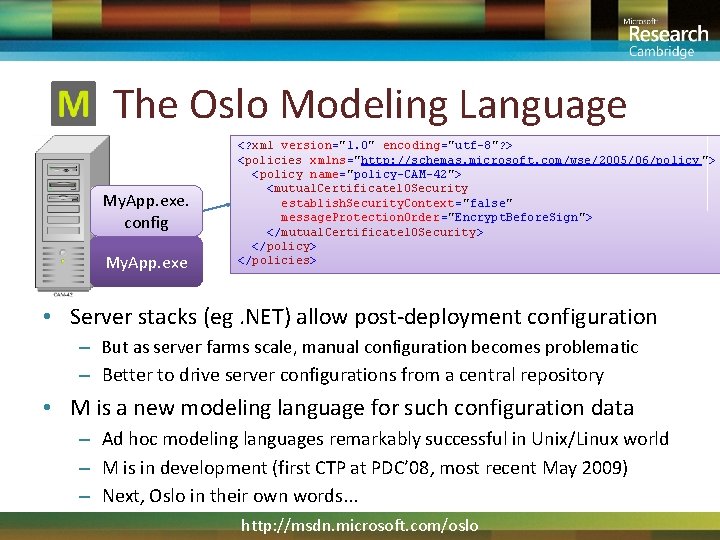
The Oslo Modeling Language My. App. exe. config My. App. exe <? xml version="1. 0" encoding="utf-8"? > <policies xmlns="http: //schemas. microsoft. com/wse/2005/06/policy "> <policy name="policy-CAM-42"> <mutual. Certificate 10 Security establish. Security. Context ="false" message. Protection. Order="Encrypt. Before. Sign"> </mutual. Certificate 10 Security > </policy> </policies> • Server stacks (eg. NET) allow post-deployment configuration – But as server farms scale, manual configuration becomes problematic – Better to drive server configurations from a central repository • M is a new modeling language for such configuration data – Ad hoc modeling languages remarkably successful in Unix/Linux world – M is in development (first CTP at PDC’ 08, most recent May 2009) – Next, Oslo in their own words. . . http: //msdn. microsoft. com/oslo
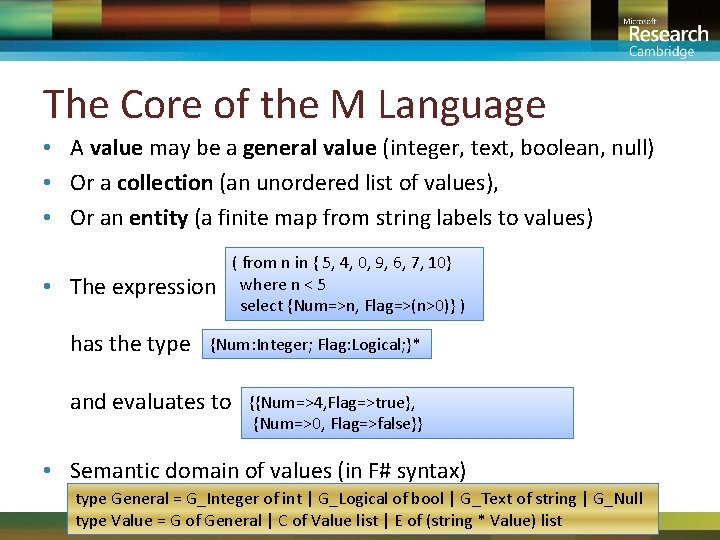
The Core of the M Language • A value may be a general value (integer, text, boolean, null) • Or a collection (an unordered list of values), • Or an entity (a finite map from string labels to values) • The expression has the type ( from n in { 5, 4, 0, 9, 6, 7, 10} where n < 5 select {Num=>n, Flag=>(n>0)} ) {Num: Integer; Flag: Logical; }* and evaluates to {{Num=>4, Flag=>true}, {Num=>0, Flag=>false}} • Semantic domain of values (in F# syntax) type General = G_Integer of int | G_Logical of bool | G_Text of string | G_Null type Value = G of General | C of Value list | E of (string * Value) list
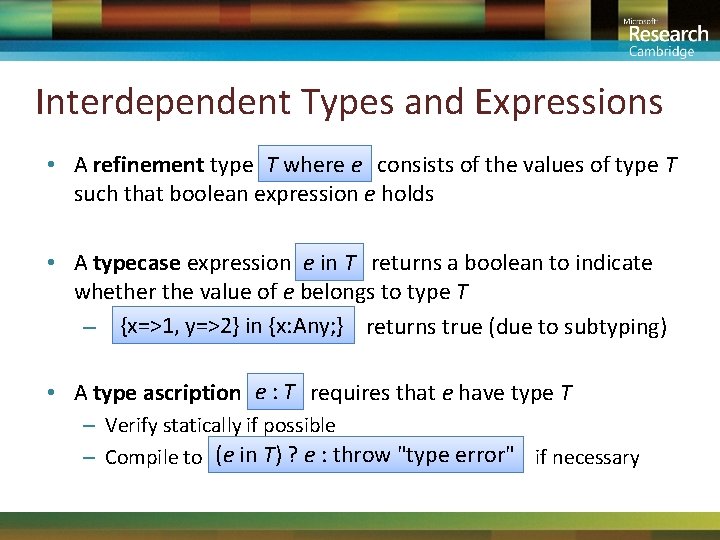
Interdependent Types and Expressions • A refinement type T where e consists of the values of type T such that boolean expression e holds • A typecase expression e in T returns a boolean to indicate whether the value of e belongs to type T – {x=>1, y=>2} in {x: Any; } returns true (due to subtyping) • A type ascription e : T requires that e have type T – Verify statically if possible – Compile to (e in T) ? e : throw "type error" if necessary
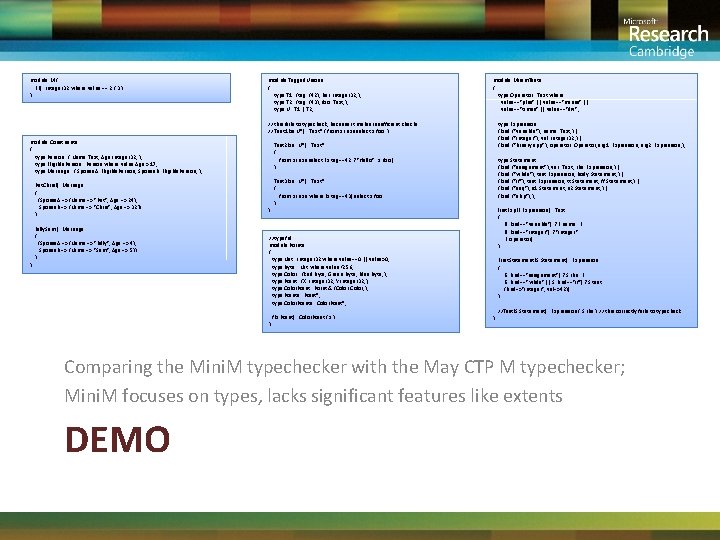
Some Examples in M • Example: type-safe unions • Demo: comparison of M/Mini. M • Case study: how static typing may help Dynamic IT
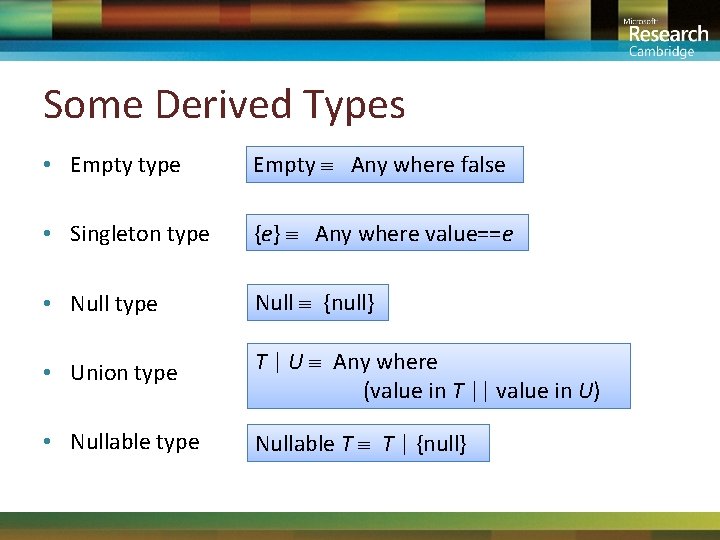
Some Derived Types • Empty type Empty Any where false • Singleton type {e} Any where value==e • Null type Null {null} • Union type T | U Any where (value in T || value in U) • Nullable type Nullable T T | {null}
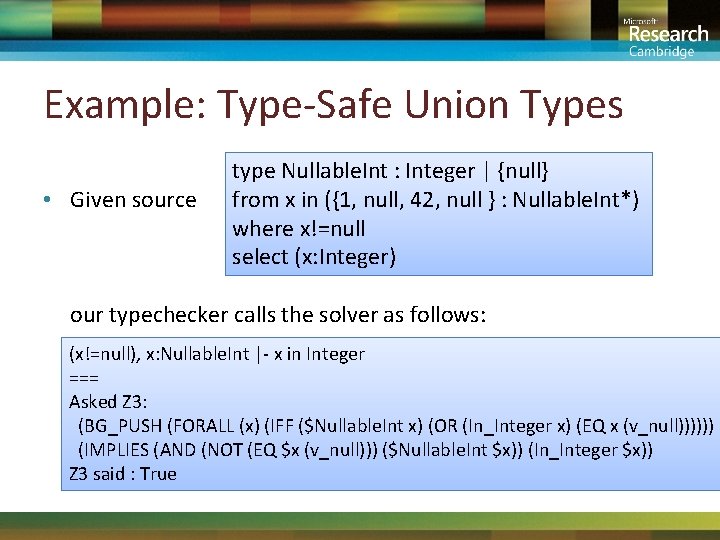
Example: Type-Safe Union Types • Given source type Nullable. Int : Integer | {null} from x in ({1, null, 42, null } : Nullable. Int*) where x!=null select (x: Integer) our typechecker calls the solver as follows: (x!=null), x: Nullable. Int |- x in Integer === Asked Z 3: (BG_PUSH (FORALL (x) (IFF ($Nullable. Int x) (OR (In_Integer x) (EQ x (v_null)))))) (IMPLIES (AND (NOT (EQ $x (v_null))) ($Nullable. Int $x)) (In_Integer $x)) Z 3 said : True
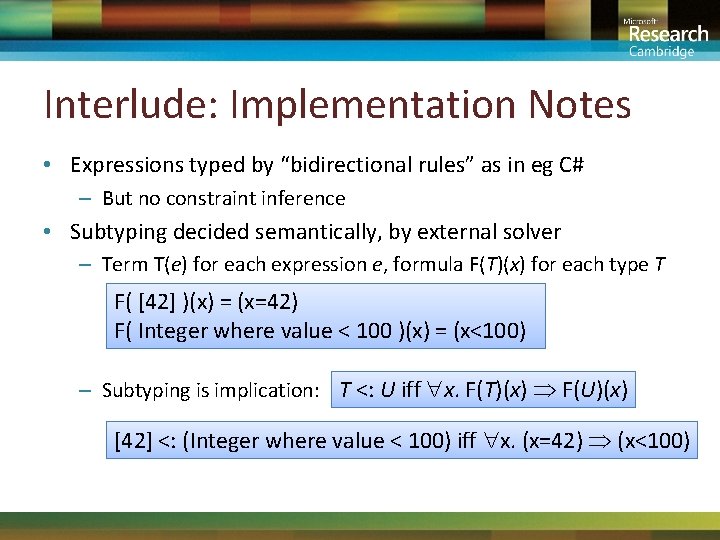
Interlude: Implementation Notes • Expressions typed by “bidirectional rules” as in eg C# – But no constraint inference • Subtyping decided semantically, by external solver – Term T(e) for each expression e, formula F(T)(x) for each type T F( [42] )(x) = (x=42) F( Integer where value < 100 )(x) = (x<100) – Subtyping is implication: T <: U iff x. F(T)(x) F(U)(x) [42] <: (Integer where value < 100) iff x. (x=42) (x<100)
module M { F() : Integer 32 where value == 2 { 3 } } module Tagged. Unions { type T 1 : {tag: {42}; bar: Integer 32; }; type T 2 : {tag: {43}; foo: Text; }; type U : T 1 | T 2; module Minim. Tests { type Operator : Text where value=="plus" || value=="minus" || value=="times" || value=="div"; // this fails to typecheck, because it makes insufficient checks // Test 1(xs: U*) : Text* { from x in xs select x. foo } module Constraints { type Person : { Name: Text; Age: Integer 32; }; type Eligible. Person : Person where value. Age > 17; type Marriage : { Spouse. A: Eligible. Person; Spouse. B: Eligible. Person; }; Pat. Chris(): Marriage { {Spouse. A => {Name => "Pat", Age => 24}, Spouse. B => {Name => "Chris", Age => 32}} } } Billy. Sam(): Marriage { {Spouse. A => {Name => "Billy", Age => 4}, Spouse. B => {Name => "Sam", Age => 5}} } type Expression : {kind: {"variable"}; name: Text; } | {kind: {"integer"}; val: Integer 32; } | {kind: {"binary app"}; operator: Operator; arg 1: Expression; arg 2: Expression; }; Test 2(xs : U*) : Text* { from x in xs select ( x. tag==42 ? "Hello" : x. foo ) } } type Statement : {kind: {"assignment"}; var: Text; rhs: Expression; } | {kind: {"while"}; test: Expression; body: Statement; } | {kind: {"if"}; test: Expression; tt: Statement; ff: Statement; } | {kind: {"seq"}; s 1: Statement; s 2: Statement; } | {kind: {"skip"}; }; Test 3(xs : U*) : Text* { from x in xs where (x. tag==43) select x. foo } First. Exp(E: Expression) : Text { (E. kind=="variable") ? E. name : ( (E. kind=="integer") ? "integer" : E. operator) } //typeful module Points { type Nat : Integer 32 where value==0 || value>0; type Byte : Nat where value<256; type Color : {Red: Byte; Green: Byte; Blue: Byte; }; type Point : {X: Integer 32; Y: Integer 32; }; type Color. Point : Point & {Color: Color; }; type Points : Point*; type Color. Points : Color. Point*; } f(x: Point) : Color. Point { x } First. Statement(S: Statement) : Expression { (S. kind=="assignment") ? S. rhs : ( (S. kind=="while" || S. kind=="if") ? S. test : {kind=>"integer", val=>42}) } } //Test(S: Statement) : Expression { S. rhs } // this correctly fails to typecheck Comparing the Mini. M typechecker with the May CTP M typechecker; Mini. M focuses on types, lacks significant features like extents DEMO
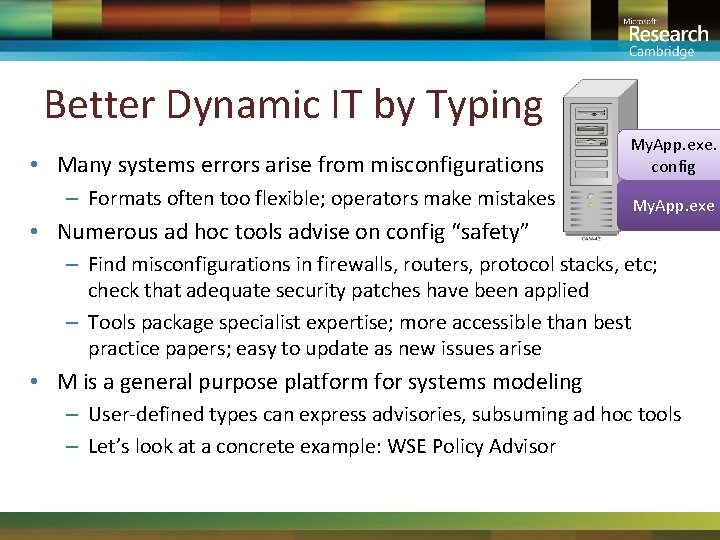
Better Dynamic IT by Typing • Many systems errors arise from misconfigurations – Formats often too flexible; operators make mistakes • Numerous ad hoc tools advise on config “safety” My. App. exe. config My. App. exe – Find misconfigurations in firewalls, routers, protocol stacks, etc; check that adequate security patches have been applied – Tools package specialist expertise; more accessible than best practice papers; easy to update as new issues arise • M is a general purpose platform for systems modeling – User-defined types can express advisories, subsuming ad hoc tools – Let’s look at a concrete example: WSE Policy Advisor
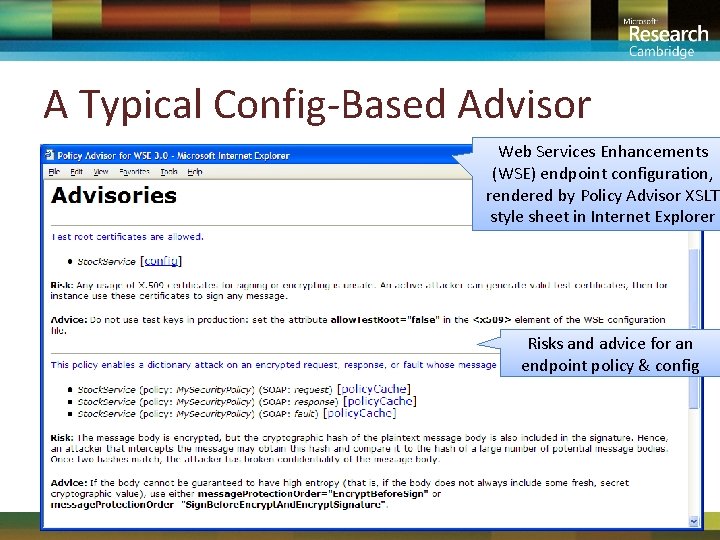
A Typical Config-Based Advisor Web Services Enhancements (WSE) endpoint configuration, rendered by Policy Advisor XSLT style sheet in Internet Explorer Risks and advice for an endpoint policy & config 20
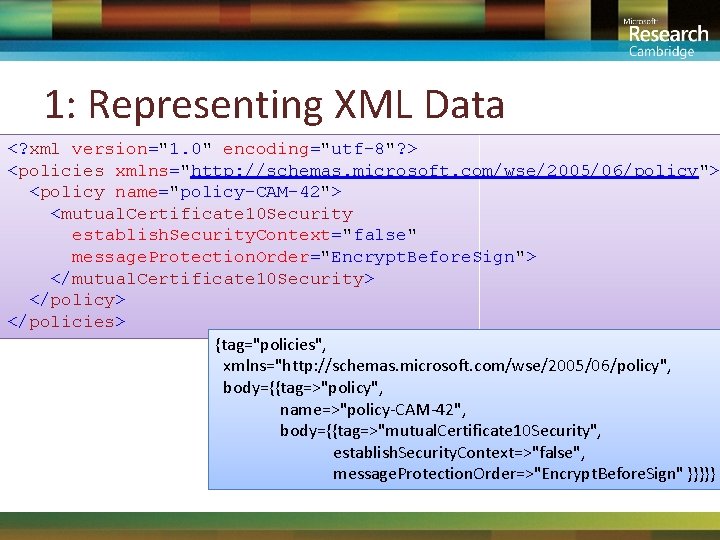
1: Representing XML Data <? xml version="1. 0" encoding="utf-8"? > <policies xmlns="http: //schemas. microsoft. com/wse/2005/06/policy"> <policy name="policy-CAM-42"> <mutual. Certificate 10 Security establish. Security. Context="false" message. Protection. Order="Encrypt. Before. Sign"> </mutual. Certificate 10 Security> </policies> {tag="policies", xmlns="http: //schemas. microsoft. com/wse/2005/06/policy", body={{tag=>"policy", name=>"policy-CAM-42", body={{tag=>"mutual. Certificate 10 Security", establish. Security. Context=>"false", message. Protection. Order=>"Encrypt. Before. Sign" }}}}}
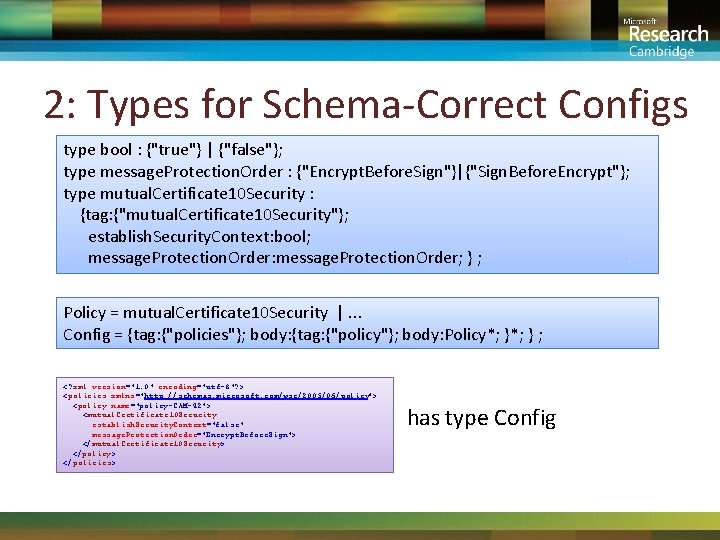
2: Types for Schema-Correct Configs type bool : {"true"} | {"false"}; type message. Protection. Order : {"Encrypt. Before. Sign"}|{"Sign. Before. Encrypt"}; type mutual. Certificate 10 Security : {tag: {"mutual. Certificate 10 Security"}; establish. Security. Context: bool; message. Protection. Order: message. Protection. Order; } ; Policy = mutual. Certificate 10 Security |. . . Config = {tag: {"policies"}; body: {tag: {"policy"}; body: Policy*; } ; <? xml version="1. 0" encoding="utf-8"? > <policies xmlns="http: //schemas. microsoft. com/wse/2005/06/policy"> <policy name="policy-CAM-42"> <mutual. Certificate 10 Security establish. Security. Context="false" message. Protection. Order="Encrypt. Before. Sign"> </mutual. Certificate 10 Security> </policies> has type Config
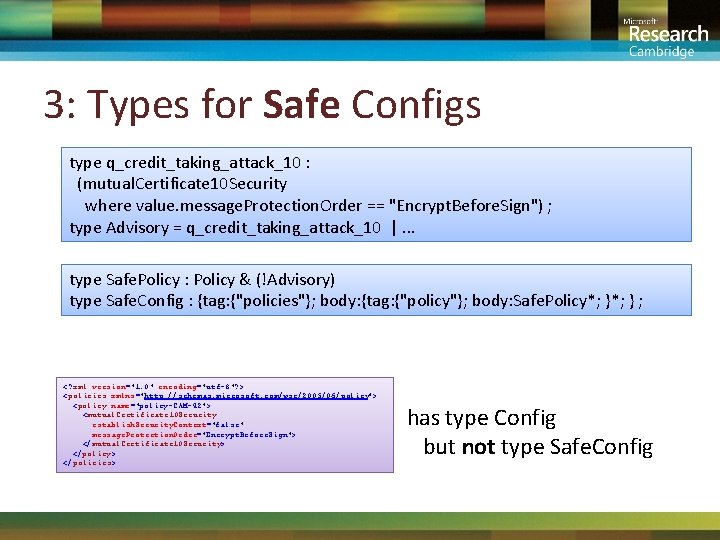
3: Types for Safe Configs type q_credit_taking_attack_10 : (mutual. Certificate 10 Security where value. message. Protection. Order == "Encrypt. Before. Sign") ; type Advisory = q_credit_taking_attack_10 |. . . type Safe. Policy : Policy & (!Advisory) type Safe. Config : {tag: {"policies"}; body: {tag: {"policy"}; body: Safe. Policy*; } ; <? xml version="1. 0" encoding="utf-8"? > <policies xmlns="http: //schemas. microsoft. com/wse/2005/06/policy"> <policy name="policy-CAM-42"> <mutual. Certificate 10 Security establish. Security. Context="false" message. Protection. Order="Encrypt. Before. Sign"> </mutual. Certificate 10 Security> </policies> has type Config but not type Safe. Config
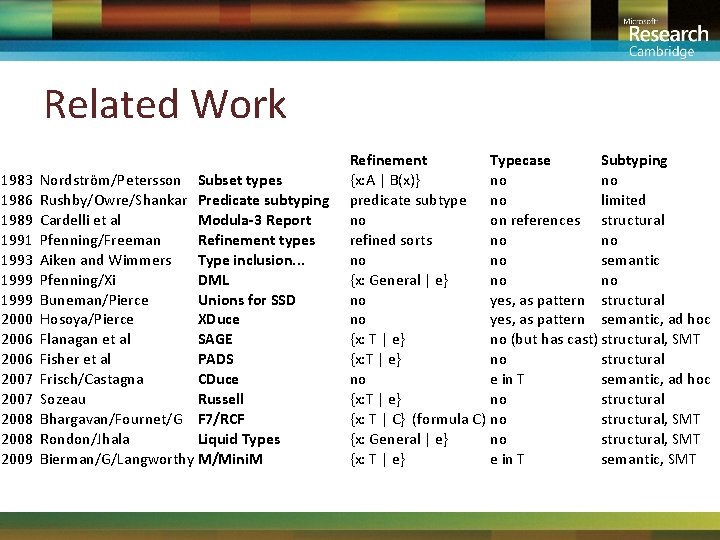
Related Work 1983 1986 1989 1991 1993 1999 2000 2006 2007 2008 2009 Nordström/Petersson Subset types Rushby/Owre/Shankar Predicate subtyping Cardelli et al Modula-3 Report Pfenning/Freeman Refinement types Aiken and Wimmers Type inclusion. . . Pfenning/Xi DML Buneman/Pierce Unions for SSD Hosoya/Pierce XDuce Flanagan et al SAGE Fisher et al PADS Frisch/Castagna CDuce Sozeau Russell Bhargavan/Fournet/G F 7/RCF Rondon/Jhala Liquid Types Bierman/G/Langworthy M/Mini. M Refinement Typecase Subtyping {x: A | B(x)} no no predicate subtype no limited no on references structural refined sorts no no semantic {x: General | e} no no no yes, as pattern structural no yes, as pattern semantic, ad hoc {x: T | e} no (but has cast) structural, SMT {x: T | e} no structural no e in T semantic, ad hoc {x: T | e} no structural {x: T | C} (formula C) no structural, SMT {x: General | e} no structural, SMT {x: T | e} e in T semantic, SMT
Refinement Types and M • The interdependence between typecase expressions and refinement types in M is a novel source of great expressivity • Relying on an external solver achieves type safety for union and dependent types without complex, arbitrary rules • Security and error checking expressible within M type system – Helps M extend the Microsoft platform • Our Z 3 -based typechecker Minim was jointly developed with the Oslo team in parallel with the mainline typechecker – We hope to merge the code-bases this year
Applying refinement types to the verification of cryptographic protocols and APIs REFINEMENT TYPES AND F 7
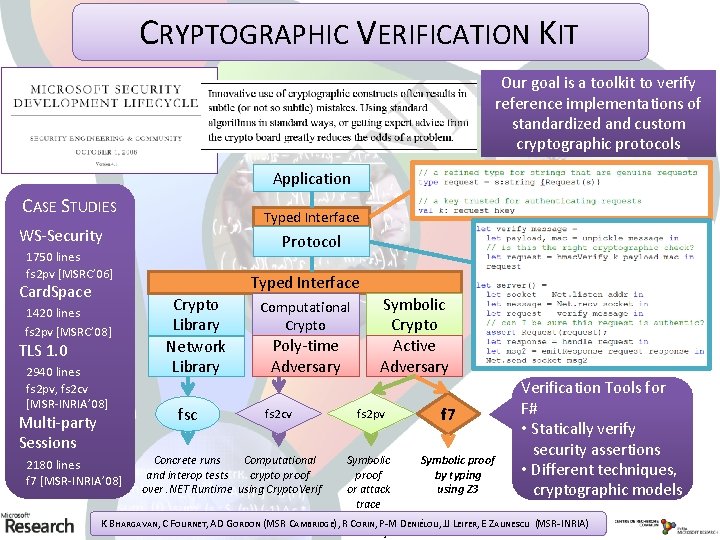
Crypto Verification CRYPTOGRAPHIC VERIFICATION KIT Kit Our goal is a toolkit to verify reference implementations of standardized and custom cryptographic protocols Application CASE STUDIES Typed Interface WS-Security Protocol 1750 lines fs 2 pv [MSRC’ 06] Card. Space 1420 lines fs 2 pv [MSRC’ 08] TLS 1. 0 2940 lines fs 2 pv, fs 2 cv [MSR-INRIA’ 08] Multi-party Sessions Typed Interface Crypto Library Network Library fsc Computational Crypto Poly-time Adversary fs 2 cv Symbolic Crypto Active Adversary fs 2 pv f 7 Verification Tools for F# • Statically verify security assertions • Different techniques, cryptographic models Symbolic proof by typing or attack using Z 3 trace K BHARGAVAN, C FOURNET, AD GORDON (MSR CAMBRIDGE), R Cusing ORIN, P-M DENIÉLOU, JJ LEIFER, E ZALINESCU (MSR-INRIA) Pro. Verif 2180 lines f 7 [MSR-INRIA’ 08] Concrete runs Computational and interop tests crypto proof over. NET Runtime using Crypto. Verif
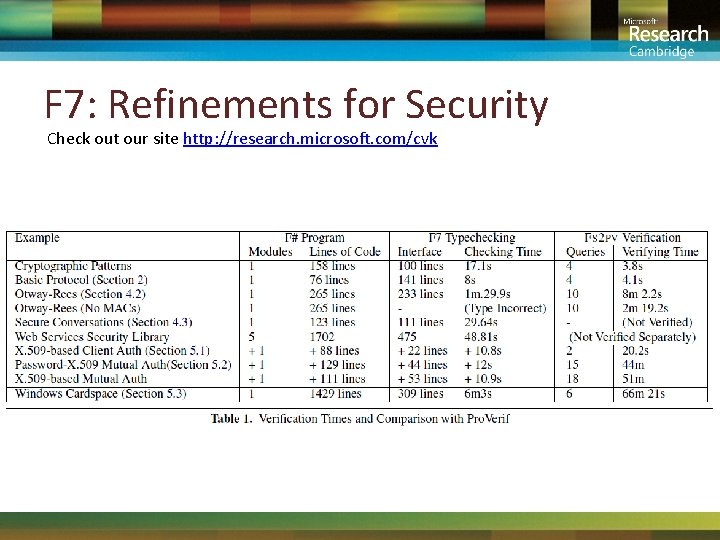
F 7: Refinements for Security Check out our site http: //research. microsoft. com/cvk
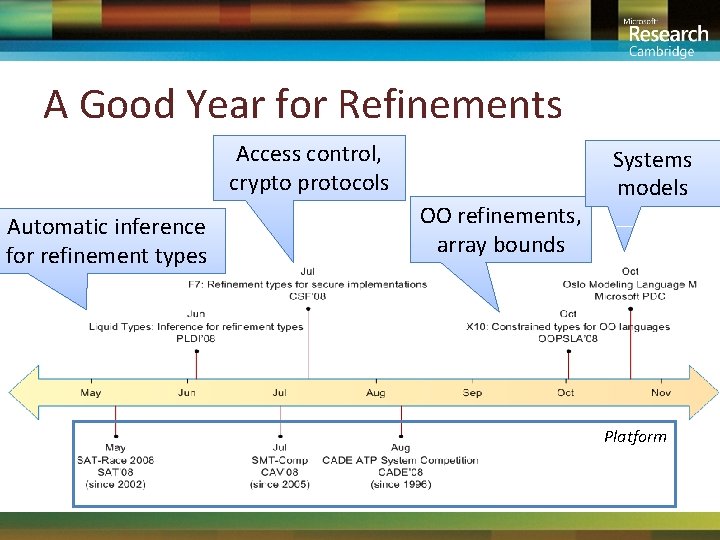
A Good Year for Refinements Access control, crypto protocols Automatic inference for refinement types OO refinements, array bounds Systems models Platform
Ideas to Take Away • Remember the riddle – Q: How did the typechecker decide x. y. x>y x-y>0 ? – A: It didn’t even try. It asked an SMT solver. • Remember that boundaries are blurring – Between types, predicates, policies, patterns, schemas – Between typechecking and verification • Still, SMT solvers are incomplete, often amazingly so – So dealing with typing errors remains a challenge http: //research. microsoft. com/en-us/people/adg/part. aspx
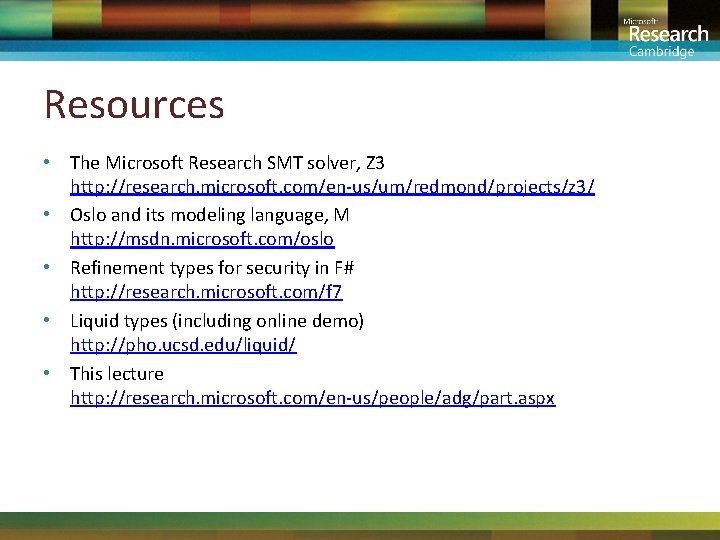
Resources • The Microsoft Research SMT solver, Z 3 http: //research. microsoft. com/en-us/um/redmond/projects/z 3/ • Oslo and its modeling language, M http: //msdn. microsoft. com/oslo • Refinement types for security in F# http: //research. microsoft. com/f 7 • Liquid types (including online demo) http: //pho. ucsd. edu/liquid/ • This lecture http: //research. microsoft. com/en-us/people/adg/part. aspx
THE END