
Programming Massively Parallel Processors Lecture Slides for Chapter

- Slides: 20
Programming Massively Parallel Processors Lecture Slides for Chapter 1: Introduction © David Kirk/NVIDIA and Wen-mei W. Hwu, 2007 -2010 ECE 408, University of Illinois, Urbana-Champaign 1
Course Goals • Learn how to program massively parallel processors and achieve – high performance – functionality and maintainability – scalability across future generations • Acquire technical knowledge required to achieve the above goals – principles and patterns of parallel programming – processor architecture features and constraints – programming API, tools and techniques © David Kirk/NVIDIA and Wen-mei W. Hwu, 2007 -2010 ECE 408, University of Illinois, Urbana-Champaign 2
People (replace with your own) • Professors: Wen-mei Hwu 215 CSL, w-hwu@uiuc. edu, 244 -8270 use ECE 498 AL to start your e-mail subject line Office hours: 2 -3: 30 pm Wednesdays; or after class David Kirk Chief Scientist, NVIDIA and Professor of ECE • Teaching Assistant: ece 498 al. TA@gmail. com John Stratton (stratton@uiuc. edu) Office hours: TBA © David Kirk/NVIDIA and Wen-mei W. Hwu, 2007 -2010 ECE 408, University of Illinois, Urbana-Champaign 3
Web Resources • Web site: http: //courses. ece. uiuc. edu/ece 498/al – Handouts and lecture slides/recordings – Textbook, documentation, software resources – Note: While we’ll make an effort to post announcements on the web, we can’t guarantee it, and won’t make any allowances for people who miss things in class. • Web board – Channel for electronic announcements – Forum for Q&A - the TAs and Professors read the board, and your classmates often have answers © David Kirk/NVIDIA and Wen-mei W. Hwu, 2007 -2010 ECE 408, University of Illinois, Urbana-Champaign 4
Bonus Days • Each of you get five bonus days – A bonus day is a no-questions-asked one-day extension that can be used on most assignments – You can’t turn in multiple versions of a team assignment on different days; all of you must combine individual bonus days into one team bonus day. – You can use multiple bonus days on the same thing – Weekends/holidays don’t count for the number of days of extension (Friday-Monday is one day extension) • Intended to cover illnesses, interview visits, just needing more time, etc. © David Kirk/NVIDIA and Wen-mei W. Hwu, 2007 -2010 ECE 408, University of Illinois, Urbana-Champaign 5
Using Bonus Days • Web page has a bonus day form. Print it out, sign, and attach to the thing you’re turning in. – Everyone who’s using a bonus day on an team assignment needs to sign the form • Penalty for being late beyond bonus days is 10% of the possible points/day, again counting only weekdays (Spring/Fall break counts as weekdays) • Things you can’t use bonus days on: – Final project design documents, final project presentations, final project demo, exam © David Kirk/NVIDIA and Wen-mei W. Hwu, 2007 -2010 ECE 408, University of Illinois, Urbana-Champaign 6
Academic Honesty • You are allowed and encouraged to discuss assignments with other students in the class. Getting verbal advice/help from people who’ve already taken the course is also fine. • Any reference to assignments from previous terms or web postings is unacceptable • Any copying of non-trivial code is unacceptable – Non-trivial = more than a line or so – Includes reading someone else’s code and then going off to write your own. © David Kirk/NVIDIA and Wen-mei W. Hwu, 2007 -2010 ECE 408, University of Illinois, Urbana-Champaign 7
Academic Honesty (cont. ) • Giving/receiving help on an exam is unacceptable • Penalties for academic dishonesty: – Zero on the assignment for the first occasion – Automatic failure of the course for repeat offenses © David Kirk/NVIDIA and Wen-mei W. Hwu, 2007 -2010 ECE 408, University of Illinois, Urbana-Champaign 8
Team Projects • Work can be divided up between team members in any way that works for you • However, each team member will demo the final checkpoint of each MP individually, and will get a separate demo grade – This will include questions on the entire design – Rationale: if you don’t know enough about the whole design to answer questions on it, you aren’t involved enough in the MP © David Kirk/NVIDIA and Wen-mei W. Hwu, 2007 -2010 ECE 408, University of Illinois, Urbana-Champaign 9
Lab Equipment • Your own PCs running G 80 emulators – Better debugging environment – Sufficient for first couple of weeks • NVIDIA G 80/G 280 boards – QP/AC x 86/GPU cluster accounts – Much much faster but less debugging support © David Kirk/NVIDIA and Wen-mei W. Hwu, 2007 -2010 ECE 408, University of Illinois, Urbana-Champaign 10
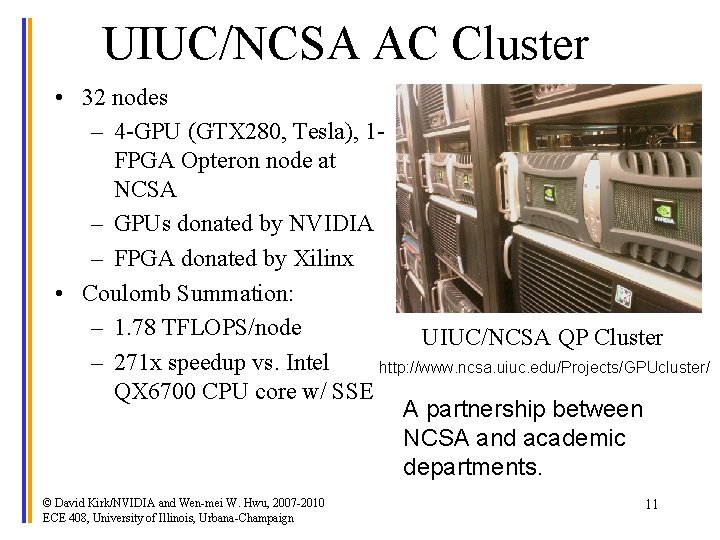
UIUC/NCSA AC Cluster • 32 nodes – 4 -GPU (GTX 280, Tesla), 1 FPGA Opteron node at NCSA – GPUs donated by NVIDIA – FPGA donated by Xilinx • Coulomb Summation: – 1. 78 TFLOPS/node UIUC/NCSA QP Cluster – 271 x speedup vs. Intel http: //www. ncsa. uiuc. edu/Projects/GPUcluster/ QX 6700 CPU core w/ SSE A partnership between NCSA and academic departments. © David Kirk/NVIDIA and Wen-mei W. Hwu, 2007 -2010 ECE 408, University of Illinois, Urbana-Champaign 11
Text/Notes 1. Textbook by Kirk and Hwu, Programming massively Parallel Processors, Elsevier, ISBN -13: 978 -0 -12 -381472 -2 2. NVIDIA, NVidia CUDA Programming Guide, NVidia (reference book) 3. T. Mattson, et al “Patterns for Parallel Programming, ” Addison Wesley, 2005 (recomm. ) 4. Lecture notes and recordings will be posted at the class web site © David Kirk/NVIDIA and Wen-mei W. Hwu, 2007 -2010 ECE 408, University of Illinois, Urbana-Champaign 12
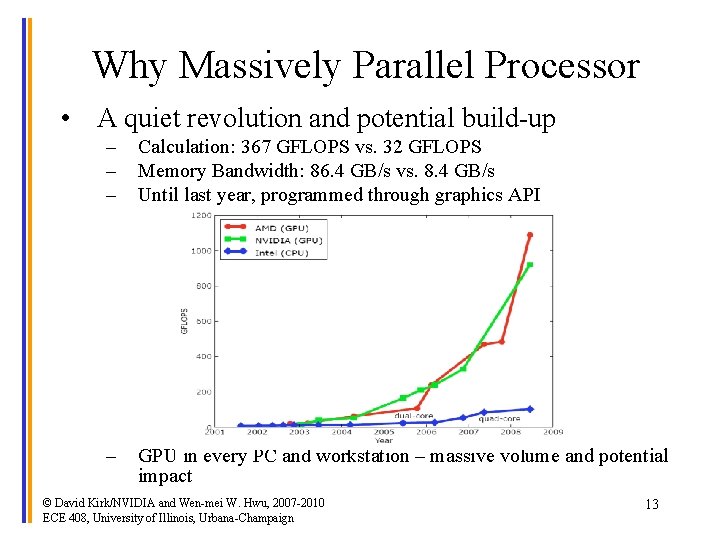
Why Massively Parallel Processor • A quiet revolution and potential build-up – – – Calculation: 367 GFLOPS vs. 32 GFLOPS Memory Bandwidth: 86. 4 GB/s vs. 8. 4 GB/s Until last year, programmed through graphics API – GPU in every PC and workstation – massive volume and potential impact © David Kirk/NVIDIA and Wen-mei W. Hwu, 2007 -2010 ECE 408, University of Illinois, Urbana-Champaign 13
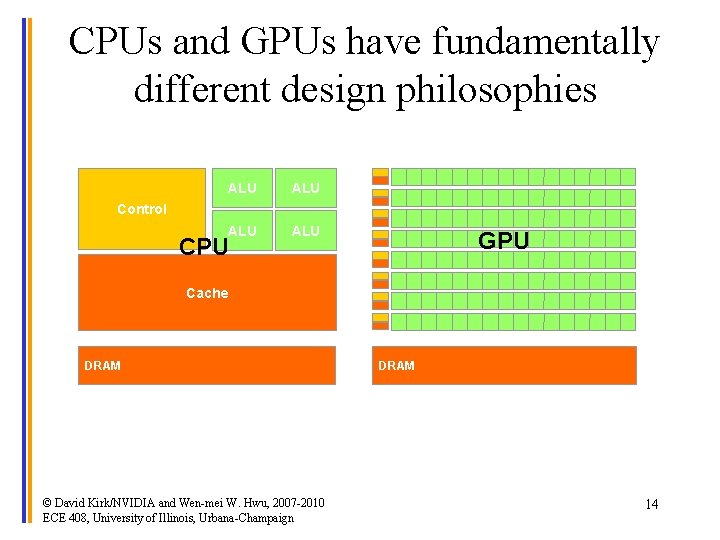
CPUs and GPUs have fundamentally different design philosophies ALU ALU Control CPU GPU Cache DRAM © David Kirk/NVIDIA and Wen-mei W. Hwu, 2007 -2010 ECE 408, University of Illinois, Urbana-Champaign DRAM 14
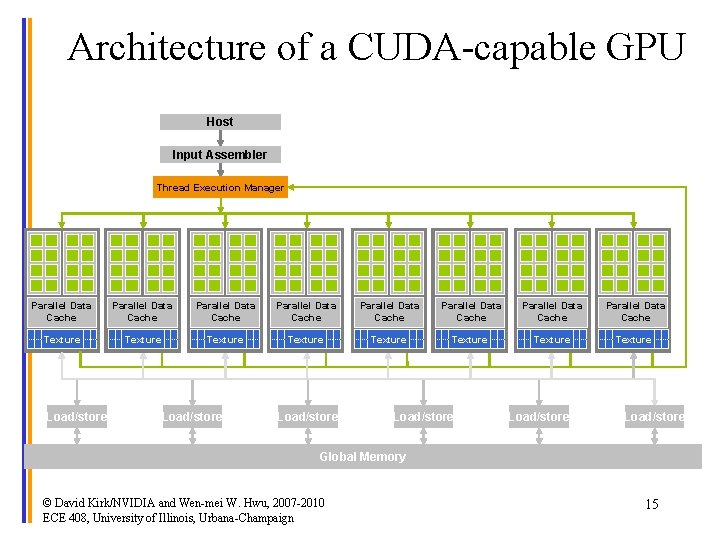
Architecture of a CUDA-capable GPU Host Input Assembler Thread Execution Manager Parallel Data Cache Parallel Data Cache Texture Texture Texture Load/store Load/store Global Memory © David Kirk/NVIDIA and Wen-mei W. Hwu, 2007 -2010 ECE 408, University of Illinois, Urbana-Champaign 15
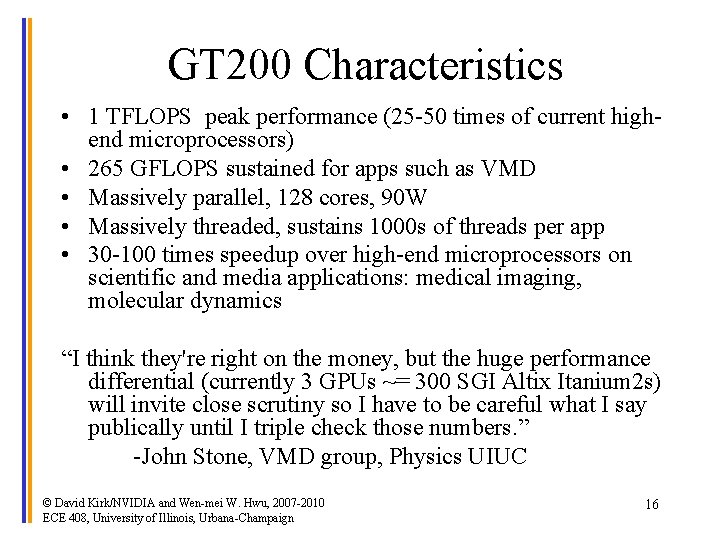
GT 200 Characteristics • 1 TFLOPS peak performance (25 -50 times of current highend microprocessors) • 265 GFLOPS sustained for apps such as VMD • Massively parallel, 128 cores, 90 W • Massively threaded, sustains 1000 s of threads per app • 30 -100 times speedup over high-end microprocessors on scientific and media applications: medical imaging, molecular dynamics “I think they're right on the money, but the huge performance differential (currently 3 GPUs ~= 300 SGI Altix Itanium 2 s) will invite close scrutiny so I have to be careful what I say publically until I triple check those numbers. ” -John Stone, VMD group, Physics UIUC © David Kirk/NVIDIA and Wen-mei W. Hwu, 2007 -2010 ECE 408, University of Illinois, Urbana-Champaign 16
Future Apps Reflect a Concurrent World • Exciting applications in future mass computing market have been traditionally considered “supercomputing applications” – Molecular dynamics simulation, Video and audio coding and manipulation, 3 D imaging and visualization, Consumer game physics, and virtual reality products – These “Super-apps” represent and model physical, concurrent world • Various granularities of parallelism exist, but… – programming model must not hinder parallel implementation – data delivery needs careful management © David Kirk/NVIDIA and Wen-mei W. Hwu, 2007 -2010 ECE 408, University of Illinois, Urbana-Champaign 17
Stretching Traditional Architectures • Traditional parallel architectures cover some super -applications – DSP, GPU, network apps, Scientific • The game is to grow mainstream architectures “out” or domain-specific architectures “in” – CUDA is latter © David Kirk/NVIDIA and Wen-mei W. Hwu, 2007 -2010 ECE 408, University of Illinois, Urbana-Champaign 18
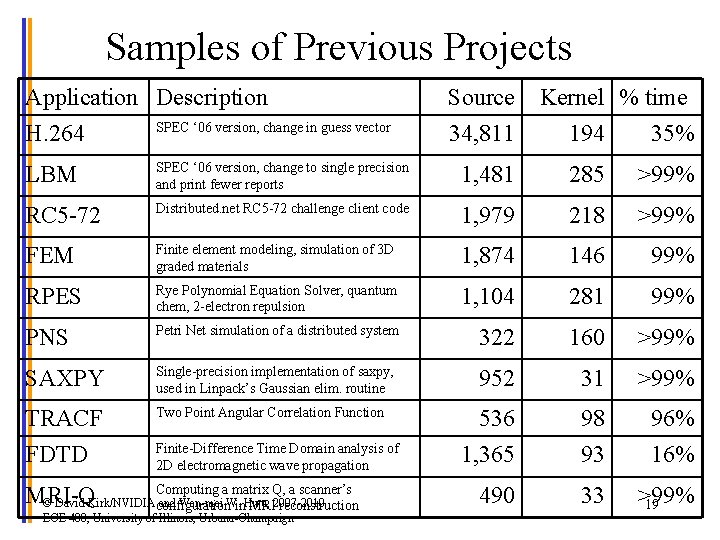
Samples of Previous Projects Application Description SPEC ‘ 06 version, change in guess vector H. 264 Source 34, 811 Kernel % time 194 35% LBM SPEC ‘ 06 version, change to single precision and print fewer reports 1, 481 285 >99% RC 5 -72 Distributed. net RC 5 -72 challenge client code 1, 979 218 >99% FEM Finite element modeling, simulation of 3 D graded materials 1, 874 146 99% RPES Rye Polynomial Equation Solver, quantum chem, 2 -electron repulsion 1, 104 281 99% PNS Petri Net simulation of a distributed system 322 160 >99% SAXPY Single-precision implementation of saxpy, used in Linpack’s Gaussian elim. routine 952 31 >99% TRACF FDTD Two Point Angular Correlation Function 536 1, 365 98 93 96% 16% 490 33 >99% 19 Finite-Difference Time Domain analysis of 2 D electromagnetic wave propagation Computing a matrix Q, a scanner’s MRI-Q © David Kirk/NVIDIA configuration and Wen-mei W. in. Hwu, MRI 2007 -2010 reconstruction ECE 408, University of Illinois, Urbana-Champaign
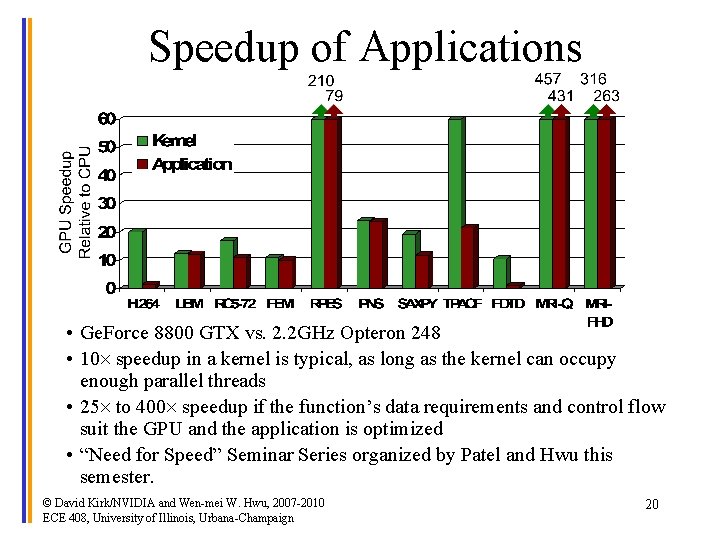
Speedup of Applications • Ge. Force 8800 GTX vs. 2. 2 GHz Opteron 248 • 10 speedup in a kernel is typical, as long as the kernel can occupy enough parallel threads • 25 to 400 speedup if the function’s data requirements and control flow suit the GPU and the application is optimized • “Need for Speed” Seminar Series organized by Patel and Hwu this semester. © David Kirk/NVIDIA and Wen-mei W. Hwu, 2007 -2010 ECE 408, University of Illinois, Urbana-Champaign 20