
Programming Massively Parallel Processors CUDA Memories David KirkNVIDIA


- Slides: 25
Programming Massively Parallel Processors CUDA Memories © David Kirk/NVIDIA and Wen-mei W. Hwu, 2007 -2010 ECE 408, University of Illinois, Urbana Champaign 1
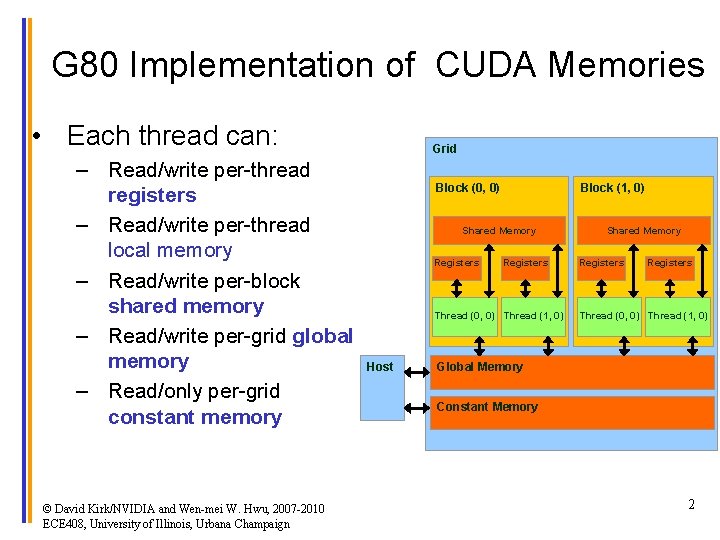
G 80 Implementation of CUDA Memories • Each thread can: – Read/write per-thread registers – Read/write per-thread local memory – Read/write per-block shared memory – Read/write per-grid global memory – Read/only per-grid constant memory © David Kirk/NVIDIA and Wen-mei W. Hwu, 2007 -2010 ECE 408, University of Illinois, Urbana Champaign Grid Block (0, 0) Block (1, 0) Shared Memory Registers Thread (0, 0) Thread (1, 0) Host Shared Memory Registers Thread (0, 0) Thread (1, 0) Global Memory Constant Memory 2
CUDA Variable Type Qualifiers Variable declaration Memory Scope Lifetime local thread __device__ __local__ int Local. Var; __device__ __shared__ int Shared. Var; shared block __device__ int Global. Var; global grid application constant grid application __device__ __constant__ int Constant. Var; • __device__ is optional when used with __local__, __shared__, or __constant__ • Automatic variables without any qualifier reside in a register – Except arrays that reside in local memory © David Kirk/NVIDIA and Wen-mei W. Hwu, 2007 -2010 ECE 408, University of Illinois, Urbana Champaign 3
Where to Declare Variables? Can host access it? global constant yes Outside of any Function © David Kirk/NVIDIA and Wen-mei W. Hwu, 2007 -2010 ECE 408, University of Illinois, Urbana Champaign no register (automatic) shared local In the kernel 4
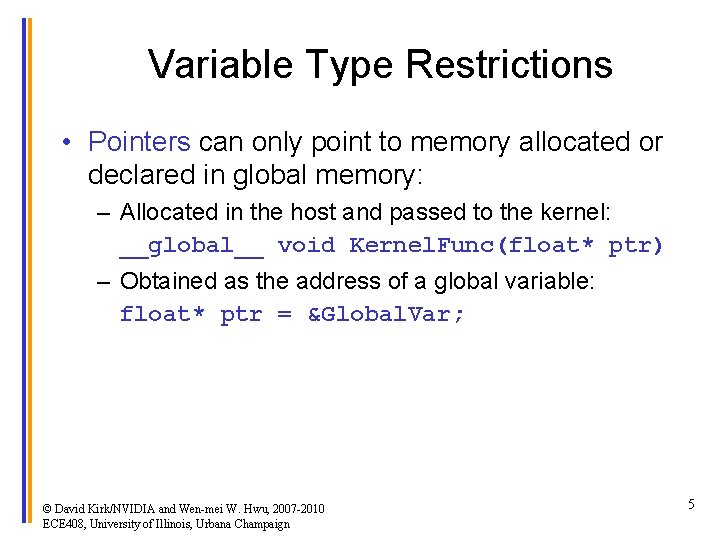
Variable Type Restrictions • Pointers can only point to memory allocated or declared in global memory: – Allocated in the host and passed to the kernel: __global__ void Kernel. Func(float* ptr) – Obtained as the address of a global variable: float* ptr = &Global. Var; © David Kirk/NVIDIA and Wen-mei W. Hwu, 2007 -2010 ECE 408, University of Illinois, Urbana Champaign 5
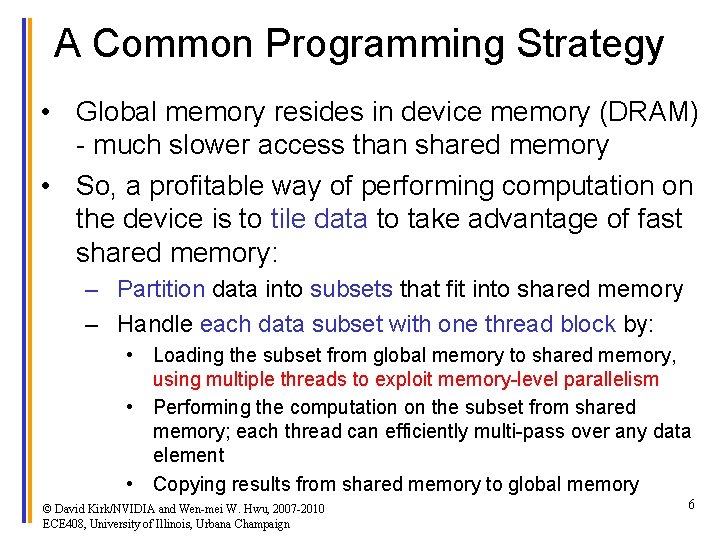
A Common Programming Strategy • Global memory resides in device memory (DRAM) - much slower access than shared memory • So, a profitable way of performing computation on the device is to tile data to take advantage of fast shared memory: – Partition data into subsets that fit into shared memory – Handle each data subset with one thread block by: • Loading the subset from global memory to shared memory, using multiple threads to exploit memory-level parallelism • Performing the computation on the subset from shared memory; each thread can efficiently multi-pass over any data element • Copying results from shared memory to global memory © David Kirk/NVIDIA and Wen-mei W. Hwu, 2007 -2010 ECE 408, University of Illinois, Urbana Champaign 6
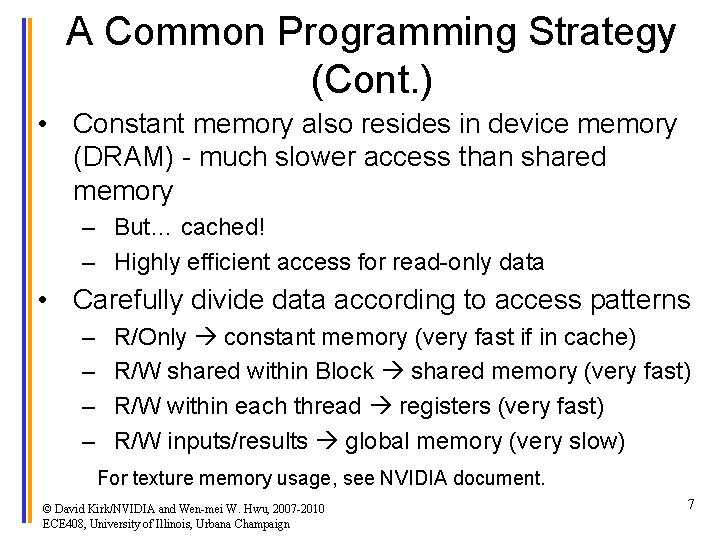
A Common Programming Strategy (Cont. ) • Constant memory also resides in device memory (DRAM) - much slower access than shared memory – But… cached! – Highly efficient access for read-only data • Carefully divide data according to access patterns – – R/Only constant memory (very fast if in cache) R/W shared within Block shared memory (very fast) R/W within each thread registers (very fast) R/W inputs/results global memory (very slow) For texture memory usage, see NVIDIA document. © David Kirk/NVIDIA and Wen-mei W. Hwu, 2007 -2010 ECE 408, University of Illinois, Urbana Champaign 7
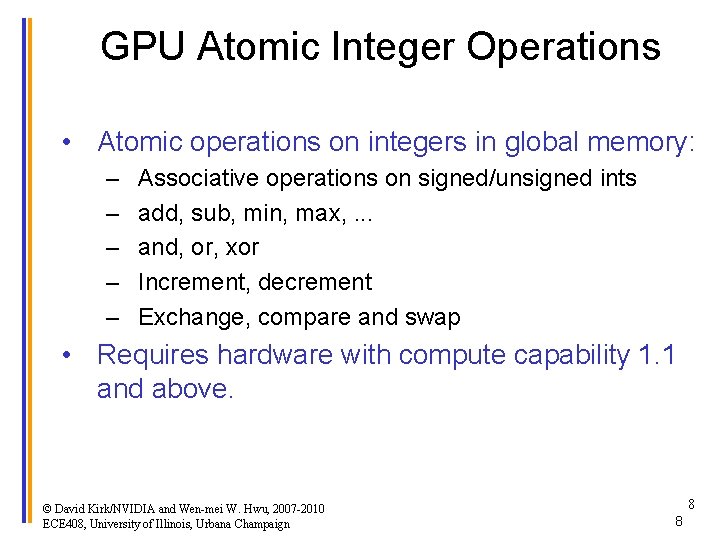
GPU Atomic Integer Operations • Atomic operations on integers in global memory: – – – Associative operations on signed/unsigned ints add, sub, min, max, . . . and, or, xor Increment, decrement Exchange, compare and swap • Requires hardware with compute capability 1. 1 and above. © David Kirk/NVIDIA and Wen-mei W. Hwu, 2007 -2010 ECE 408, University of Illinois, Urbana Champaign 8 8
Matrix Multiplication using Shared Memory © David Kirk/NVIDIA and Wen-mei W. Hwu, 2007 -2010 ECE 408, University of Illinois, Urbana Champaign 9
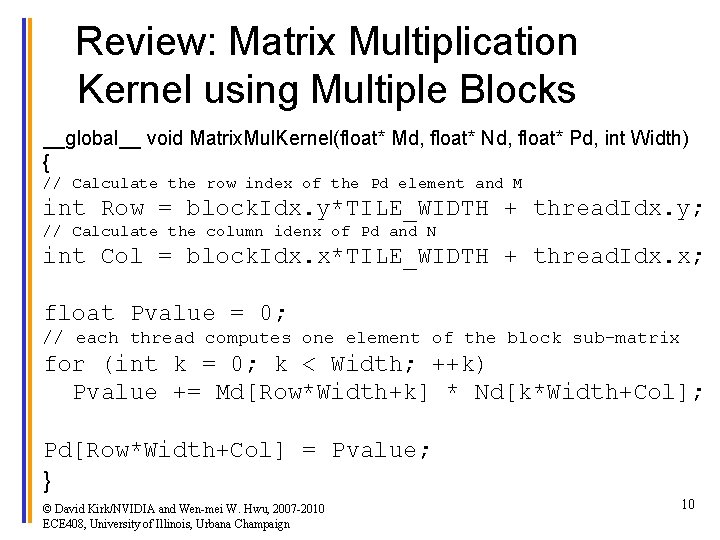
Review: Matrix Multiplication Kernel using Multiple Blocks __global__ void Matrix. Mul. Kernel(float* Md, float* Nd, float* Pd, int Width) { // Calculate the row index of the Pd element and M int Row = block. Idx. y*TILE_WIDTH + thread. Idx. y; // Calculate the column idenx of Pd and N int Col = block. Idx. x*TILE_WIDTH + thread. Idx. x; float Pvalue = 0; // each thread computes one element of the block sub-matrix for (int k = 0; k < Width; ++k) Pvalue += Md[Row*Width+k] * Nd[k*Width+Col]; Pd[Row*Width+Col] = Pvalue; } © David Kirk/NVIDIA and Wen-mei W. Hwu, 2007 -2010 ECE 408, University of Illinois, Urbana Champaign 10
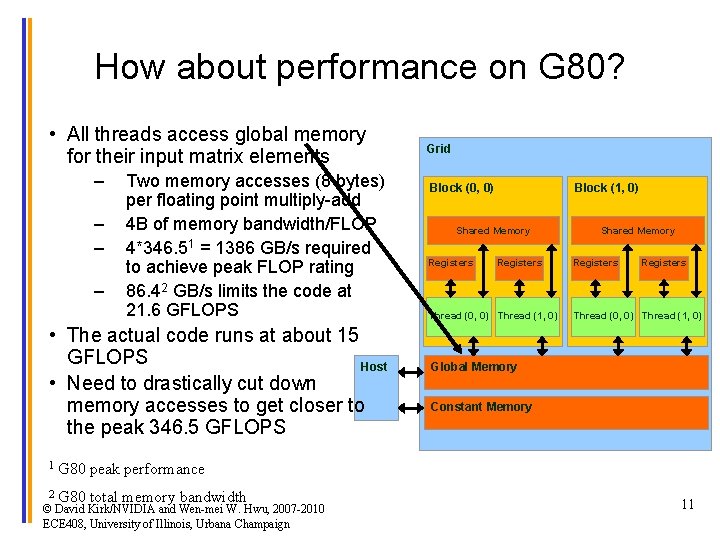
How about performance on G 80? • All threads access global memory for their input matrix elements – – Two memory accesses (8 bytes) per floating point multiply-add 4 B of memory bandwidth/FLOP 4*346. 51 = 1386 GB/s required to achieve peak FLOP rating 86. 42 GB/s limits the code at 21. 6 GFLOPS • The actual code runs at about 15 GFLOPS Host • Need to drastically cut down memory accesses to get closer to the peak 346. 5 GFLOPS 1 G 80 peak performance 2 G 80 total memory bandwidth © David Kirk/NVIDIA and Wen-mei W. Hwu, 2007 -2010 ECE 408, University of Illinois, Urbana Champaign Grid Block (0, 0) Block (1, 0) Shared Memory Registers Thread (0, 0) Thread (1, 0) Global Memory Constant Memory 11
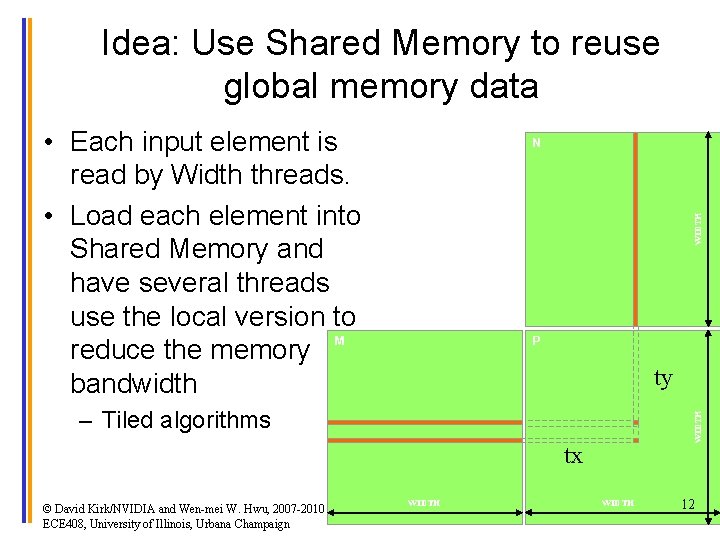
Idea: Use Shared Memory to reuse global memory data • Each input element is read by Width threads. • Load each element into Shared Memory and have several threads use the local version to reduce the memory M bandwidth WIDTH N P ty WIDTH – Tiled algorithms tx © David Kirk/NVIDIA and Wen-mei W. Hwu, 2007 -2010 ECE 408, University of Illinois, Urbana Champaign WIDTH 12
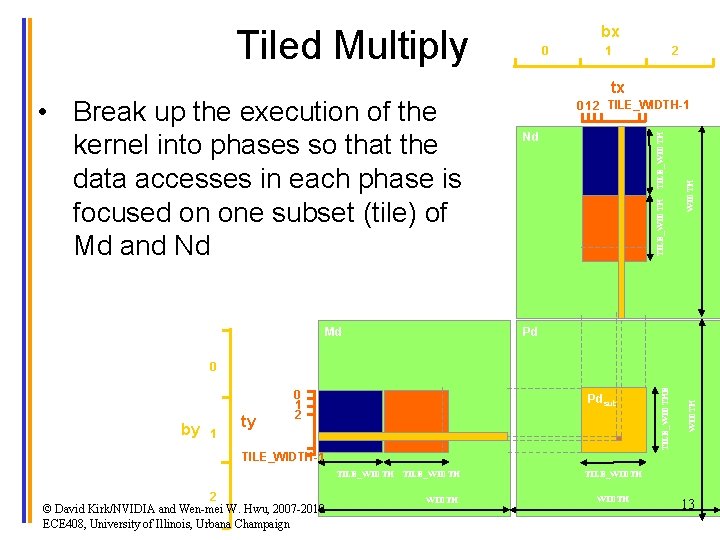
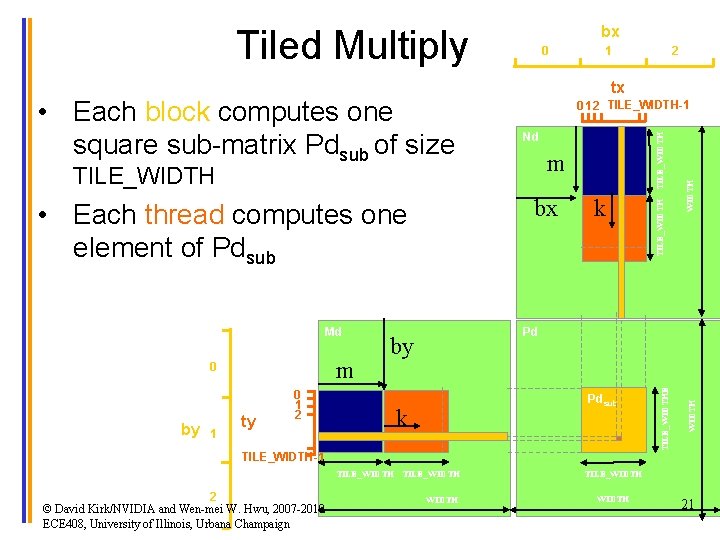
bx Tiled Multiply Md 1 2 tx TILE_WIDTH Nd WIDTH 0 1 2 TILE_WIDTH-1 TILE_WIDTH • Break up the execution of the kernel into phases so that the data accesses in each phase is focused on one subset (tile) of Md and Nd 0 Pd 1 ty Pdsub TILE_WIDTH-1 TILE_WIDTH 2 © David Kirk/NVIDIA and Wen-mei W. Hwu, 2007 -2010 ECE 408, University of Illinois, Urbana Champaign WIDTH by 0 1 2 TILE_WIDTHE 0 TILE_WIDTH 13
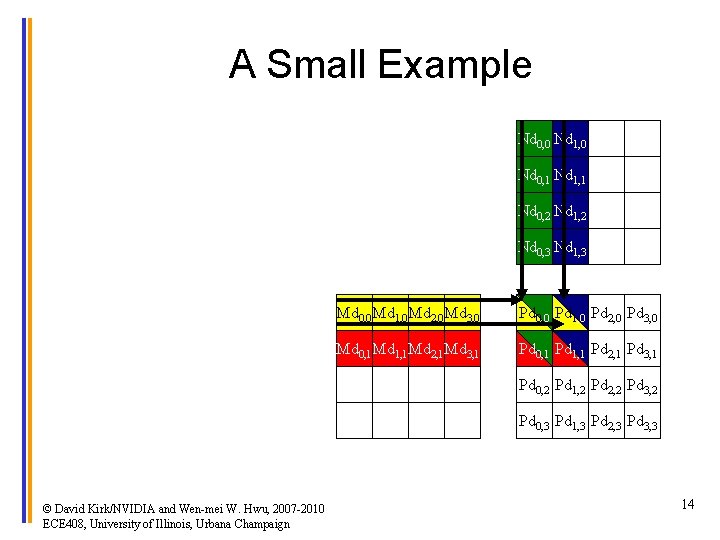
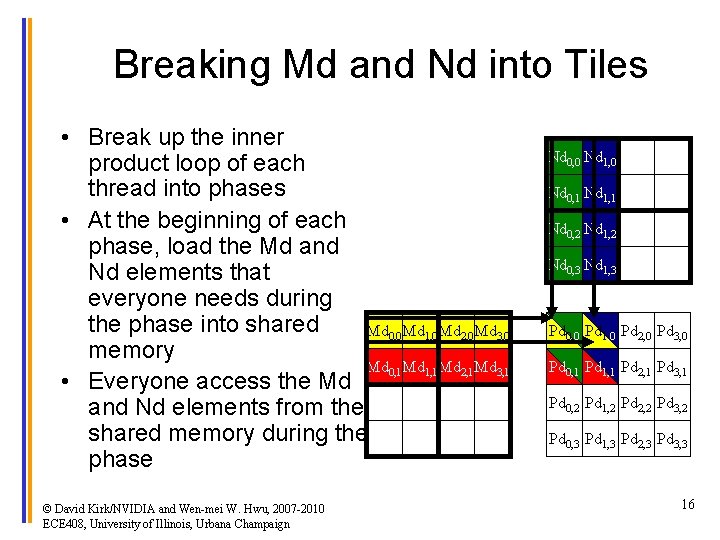
A Small Example Nd 0, 0 Nd 1, 0 Nd 0, 1 Nd 1, 1 Nd 0, 2 Nd 1, 2 Nd 0, 3 Nd 1, 3 Md 0, 0 Md 1, 0 Md 2, 0 Md 3, 0 Pd 0, 0 Pd 1, 0 Pd 2, 0 Pd 3, 0 Md 0, 1 Md 1, 1 Md 2, 1 Md 3, 1 Pd 0, 1 Pd 1, 1 Pd 2, 1 Pd 3, 1 Pd 0, 2 Pd 1, 2 Pd 2, 2 Pd 3, 2 Pd 0, 3 Pd 1, 3 Pd 2, 3 Pd 3, 3 © David Kirk/NVIDIA and Wen-mei W. Hwu, 2007 -2010 ECE 408, University of Illinois, Urbana Champaign 14
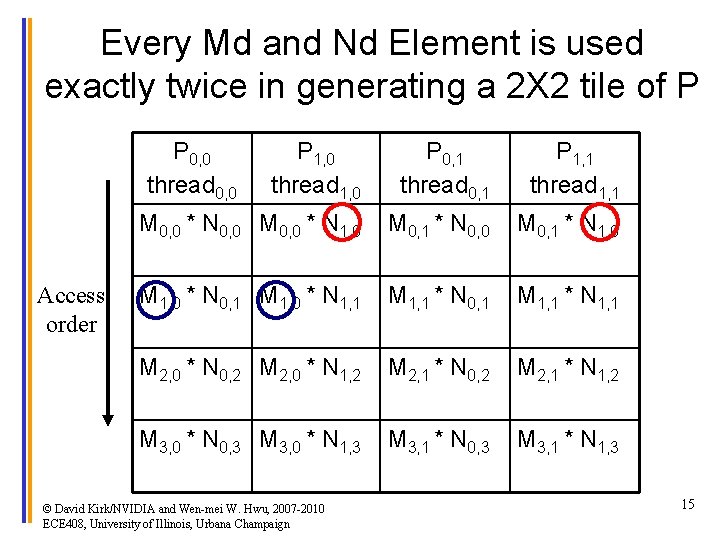
Every Md and Nd Element is used exactly twice in generating a 2 X 2 tile of P P 0, 0 thread 0, 0 Access order P 1, 0 thread 1, 0 P 0, 1 thread 0, 1 P 1, 1 thread 1, 1 M 0, 0 * N 0, 0 M 0, 0 * N 1, 0 M 0, 1 * N 0, 0 M 0, 1 * N 1, 0 M 1, 0 * N 0, 1 M 1, 0 * N 1, 1 M 1, 1 * N 0, 1 M 1, 1 * N 1, 1 M 2, 0 * N 0, 2 M 2, 0 * N 1, 2 M 2, 1 * N 0, 2 M 2, 1 * N 1, 2 M 3, 0 * N 0, 3 M 3, 0 * N 1, 3 M 3, 1 * N 0, 3 M 3, 1 * N 1, 3 © David Kirk/NVIDIA and Wen-mei W. Hwu, 2007 -2010 ECE 408, University of Illinois, Urbana Champaign 15
Breaking Md and Nd into Tiles • Break up the inner product loop of each thread into phases • At the beginning of each phase, load the Md and Nd elements that everyone needs during the phase into shared Md 0, 0 Md 1, 0 Md 2, 0 Md 3, 0 memory Md 0, 1 Md 1, 1 Md 2, 1 Md 3, 1 • Everyone access the Md and Nd elements from the shared memory during the phase © David Kirk/NVIDIA and Wen-mei W. Hwu, 2007 -2010 ECE 408, University of Illinois, Urbana Champaign Nd 0, 0 Nd 1, 0 Nd 0, 1 Nd 1, 1 Nd 0, 2 Nd 1, 2 Nd 0, 3 Nd 1, 3 Pd 0, 0 Pd 1, 0 Pd 2, 0 Pd 3, 0 Pd 0, 1 Pd 1, 1 Pd 2, 1 Pd 3, 1 Pd 0, 2 Pd 1, 2 Pd 2, 2 Pd 3, 2 Pd 0, 3 Pd 1, 3 Pd 2, 3 Pd 3, 3 16
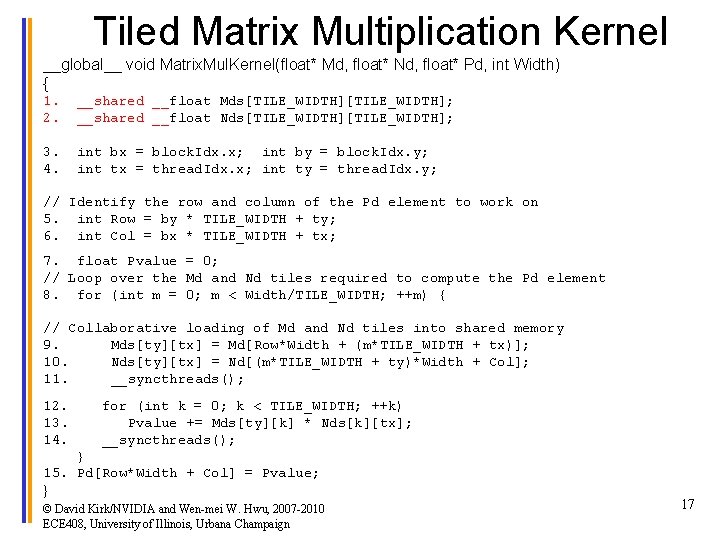
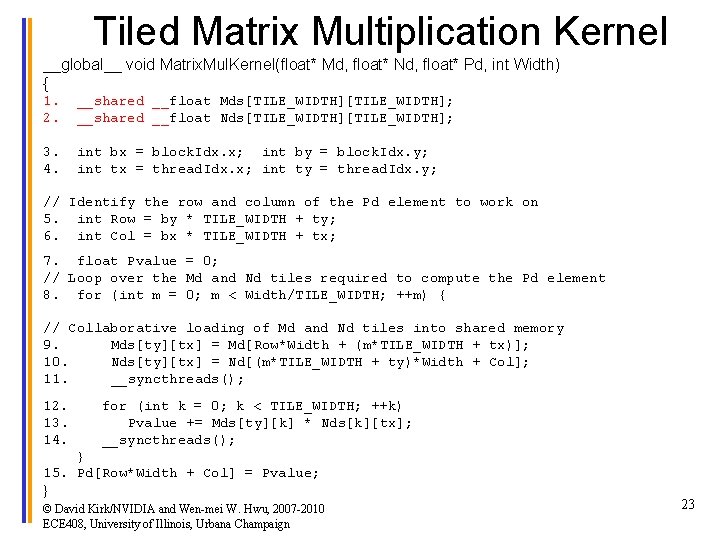
Tiled Matrix Multiplication Kernel __global__ void Matrix. Mul. Kernel(float* Md, float* Nd, float* Pd, int Width) { 1. 2. __shared __float Mds[TILE_WIDTH]; __shared __float Nds[TILE_WIDTH]; 3. 4. int bx = block. Idx. x; int by = block. Idx. y; int tx = thread. Idx. x; int ty = thread. Idx. y; // Identify the row and column of the Pd element to work on 5. int Row = by * TILE_WIDTH + ty; 6. int Col = bx * TILE_WIDTH + tx; 7. float Pvalue = 0; // Loop over the Md and Nd tiles required to compute the Pd element 8. for (int m = 0; m < Width/TILE_WIDTH; ++m) { // Collaborative loading of Md and Nd tiles into shared memory 9. Mds[ty][tx] = Md[Row*Width + (m*TILE_WIDTH + tx)]; 10. Nds[ty][tx] = Nd[(m*TILE_WIDTH + ty)*Width + Col]; 11. __syncthreads(); 12. 13. 14. for (int k = 0; k < TILE_WIDTH; ++k) Pvalue += Mds[ty][k] * Nds[k][tx]; __syncthreads(); } 15. Pd[Row*Width + Col] = Pvalue; } © David Kirk/NVIDIA and Wen-mei W. Hwu, 2007 -2010 ECE 408, University of Illinois, Urbana Champaign 17
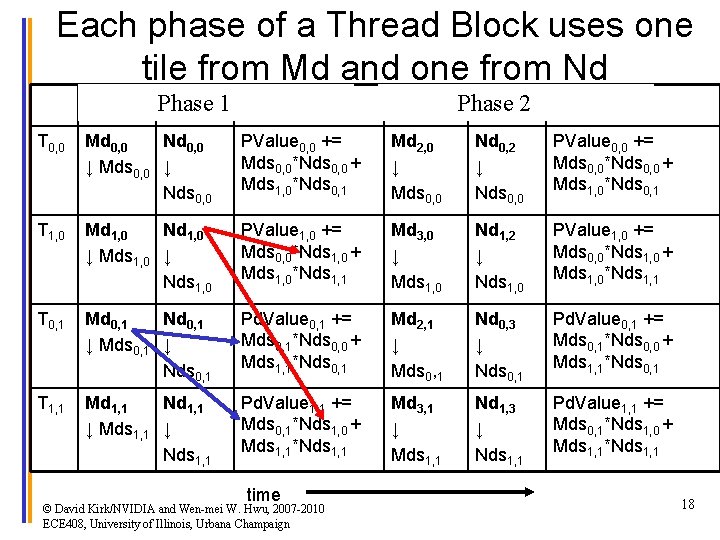
Each phase of a Thread Block uses one tile from Md and one from Nd Step 4 Phase 1 Step 52 Step 6 Phase T 0, 0 Md 0, 0 Nd 0, 0 ↓ Mds 0, 0 ↓ Nds 0, 0 PValue 0, 0 += Mds 0, 0*Nds 0, 0 + Mds 1, 0*Nds 0, 1 Md 2, 0 ↓ Mds 0, 0 Nd 0, 2 ↓ Nds 0, 0 PValue 0, 0 += Mds 0, 0*Nds 0, 0 + Mds 1, 0*Nds 0, 1 T 1, 0 Md 1, 0 Nd 1, 0 ↓ Mds 1, 0 ↓ Nds 1, 0 PValue 1, 0 += Mds 0, 0*Nds 1, 0 + Mds 1, 0*Nds 1, 1 Md 3, 0 ↓ Mds 1, 0 Nd 1, 2 ↓ Nds 1, 0 PValue 1, 0 += Mds 0, 0*Nds 1, 0 + Mds 1, 0*Nds 1, 1 T 0, 1 Md 0, 1 Nd 0, 1 ↓ Mds 0, 1 ↓ Nds 0, 1 Pd. Value 0, 1 += Mds 0, 1*Nds 0, 0 + Mds 1, 1*Nds 0, 1 Md 2, 1 ↓ Mds 0, 1 Nd 0, 3 ↓ Nds 0, 1 Pd. Value 0, 1 += Mds 0, 1*Nds 0, 0 + Mds 1, 1*Nds 0, 1 T 1, 1 Md 1, 1 Nd 1, 1 ↓ Mds 1, 1 ↓ Nds 1, 1 Pd. Value 1, 1 += Mds 0, 1*Nds 1, 0 + Mds 1, 1*Nds 1, 1 Md 3, 1 ↓ Mds 1, 1 Nd 1, 3 ↓ Nds 1, 1 Pd. Value 1, 1 += Mds 0, 1*Nds 1, 0 + Mds 1, 1*Nds 1, 1 time © David Kirk/NVIDIA and Wen-mei W. Hwu, 2007 -2010 ECE 408, University of Illinois, Urbana Champaign 18
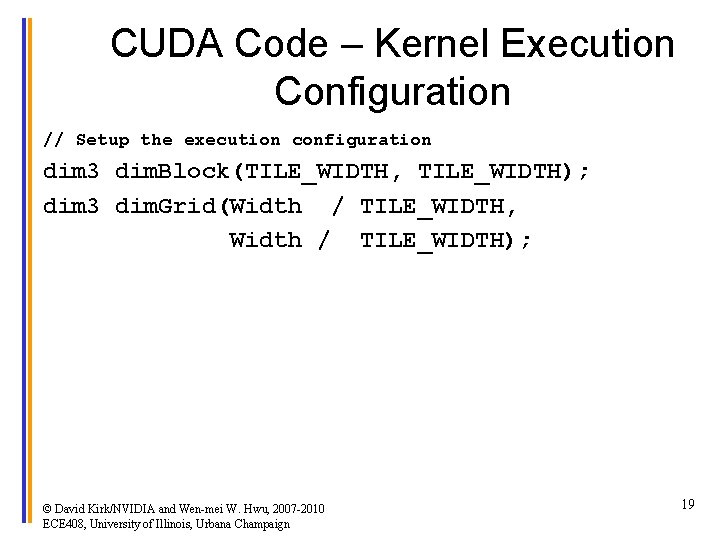
CUDA Code – Kernel Execution Configuration // Setup the execution configuration dim 3 dim. Block(TILE_WIDTH, TILE_WIDTH); dim 3 dim. Grid(Width / TILE_WIDTH, Width / TILE_WIDTH); © David Kirk/NVIDIA and Wen-mei W. Hwu, 2007 -2010 ECE 408, University of Illinois, Urbana Champaign 19
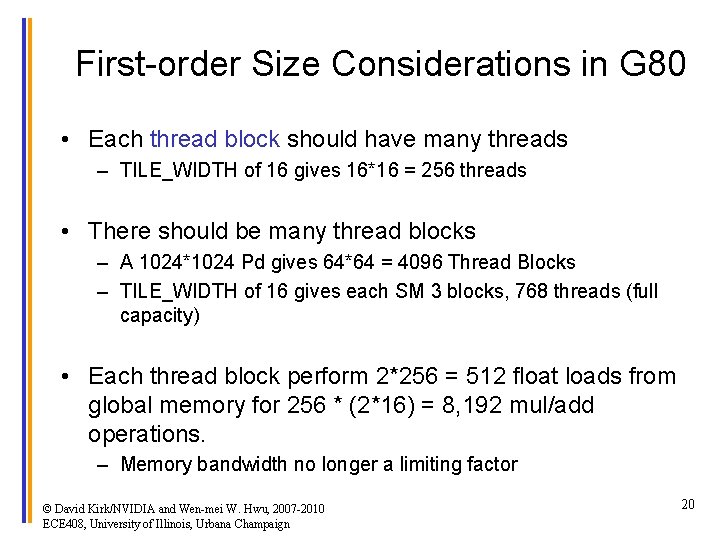
First-order Size Considerations in G 80 • Each thread block should have many threads – TILE_WIDTH of 16 gives 16*16 = 256 threads • There should be many thread blocks – A 1024*1024 Pd gives 64*64 = 4096 Thread Blocks – TILE_WIDTH of 16 gives each SM 3 blocks, 768 threads (full capacity) • Each thread block perform 2*256 = 512 float loads from global memory for 256 * (2*16) = 8, 192 mul/add operations. – Memory bandwidth no longer a limiting factor © David Kirk/NVIDIA and Wen-mei W. Hwu, 2007 -2010 ECE 408, University of Illinois, Urbana Champaign 20
bx Tiled Multiply m bx by 1 ty 0 1 2 k Pd by Pdsub k TILE_WIDTH-1 TILE_WIDTH 2 © David Kirk/NVIDIA and Wen-mei W. Hwu, 2007 -2010 ECE 408, University of Illinois, Urbana Champaign WIDTH m 0 TILE_WIDTH Nd WIDTH 0 1 2 TILE_WIDTH-1 TILE_WIDTHE Md 2 tx TILE_WIDTH • Each thread computes one element of Pdsub 1 TILE_WIDTH • Each block computes one square sub-matrix Pdsub of size 0 TILE_WIDTH 21
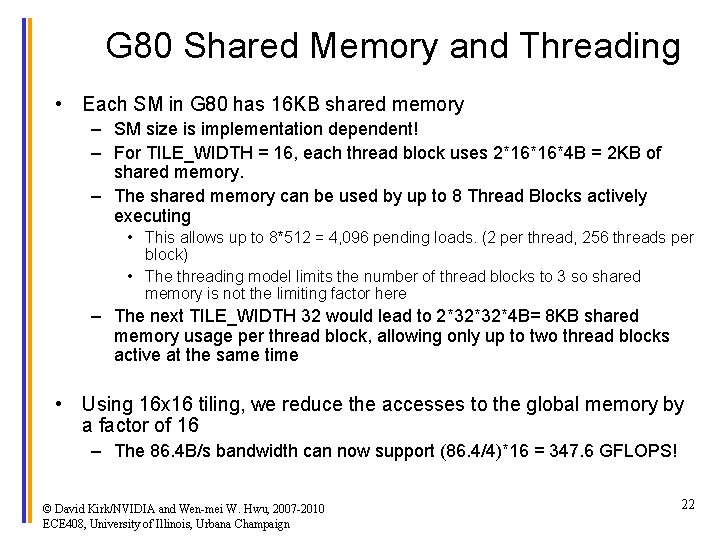
G 80 Shared Memory and Threading • Each SM in G 80 has 16 KB shared memory – SM size is implementation dependent! – For TILE_WIDTH = 16, each thread block uses 2*16*16*4 B = 2 KB of shared memory. – The shared memory can be used by up to 8 Thread Blocks actively executing • This allows up to 8*512 = 4, 096 pending loads. (2 per thread, 256 threads per block) • The threading model limits the number of thread blocks to 3 so shared memory is not the limiting factor here – The next TILE_WIDTH 32 would lead to 2*32*32*4 B= 8 KB shared memory usage per thread block, allowing only up to two thread blocks active at the same time • Using 16 x 16 tiling, we reduce the accesses to the global memory by a factor of 16 – The 86. 4 B/s bandwidth can now support (86. 4/4)*16 = 347. 6 GFLOPS! © David Kirk/NVIDIA and Wen-mei W. Hwu, 2007 -2010 ECE 408, University of Illinois, Urbana Champaign 22
Tiled Matrix Multiplication Kernel __global__ void Matrix. Mul. Kernel(float* Md, float* Nd, float* Pd, int Width) { 1. 2. __shared __float Mds[TILE_WIDTH]; __shared __float Nds[TILE_WIDTH]; 3. 4. int bx = block. Idx. x; int by = block. Idx. y; int tx = thread. Idx. x; int ty = thread. Idx. y; // Identify the row and column of the Pd element to work on 5. int Row = by * TILE_WIDTH + ty; 6. int Col = bx * TILE_WIDTH + tx; 7. float Pvalue = 0; // Loop over the Md and Nd tiles required to compute the Pd element 8. for (int m = 0; m < Width/TILE_WIDTH; ++m) { // Collaborative loading of Md and Nd tiles into shared memory 9. Mds[ty][tx] = Md[Row*Width + (m*TILE_WIDTH + tx)]; 10. Nds[ty][tx] = Nd[(m*TILE_WIDTH + ty)*Width + Col]; 11. __syncthreads(); 12. 13. 14. for (int k = 0; k < TILE_WIDTH; ++k) Pvalue += Mds[ty][k] * Nds[k][tx]; __syncthreads(); } 15. Pd[Row*Width + Col] = Pvalue; } © David Kirk/NVIDIA and Wen-mei W. Hwu, 2007 -2010 ECE 408, University of Illinois, Urbana Champaign 23
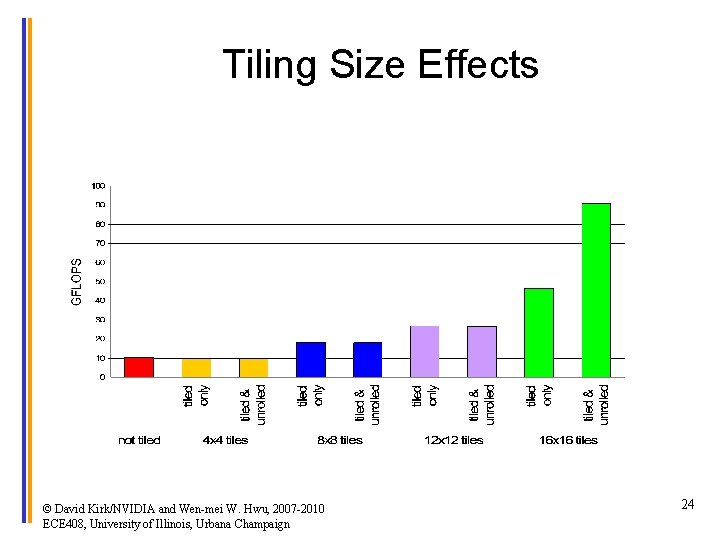
Tiling Size Effects © David Kirk/NVIDIA and Wen-mei W. Hwu, 2007 -2010 ECE 408, University of Illinois, Urbana Champaign 24
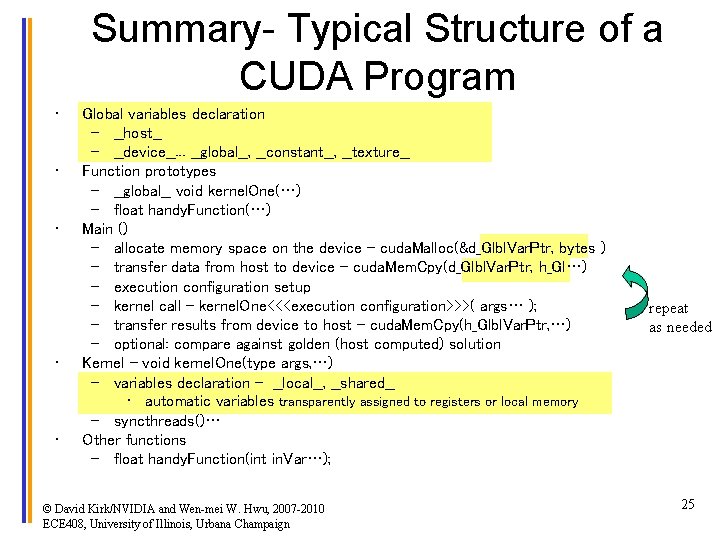
Summary- Typical Structure of a CUDA Program • • • Global variables declaration – __host__ – __device__. . . __global__, __constant__, __texture__ Function prototypes – __global__ void kernel. One(…) – float handy. Function(…) Main () – allocate memory space on the device – cuda. Malloc(&d_Glbl. Var. Ptr, bytes ) – transfer data from host to device – cuda. Mem. Cpy(d_Glbl. Var. Ptr, h_Gl…) – execution configuration setup – kernel call – kernel. One<<<execution configuration>>>( args… ); – transfer results from device to host – cuda. Mem. Cpy(h_Glbl. Var. Ptr, …) – optional: compare against golden (host computed) solution Kernel – void kernel. One(type args, …) – variables declaration - __local__, __shared__ • automatic variables transparently assigned to registers or local memory – syncthreads()… Other functions – float handy. Function(int in. Var…); © David Kirk/NVIDIA and Wen-mei W. Hwu, 2007 -2010 ECE 408, University of Illinois, Urbana Champaign repeat as needed 25