
Programming Languages and Compilers CS 421 Elsa L

- Slides: 72
Programming Languages and Compilers (CS 421) Elsa L Gunter 2112 SC, UIUC http: //courses. engr. illinois. edu/cs 421 Based in part on slides by Mattox Beckman, as updated by Vikram Adve and Gul Agha 10/2/2020 1
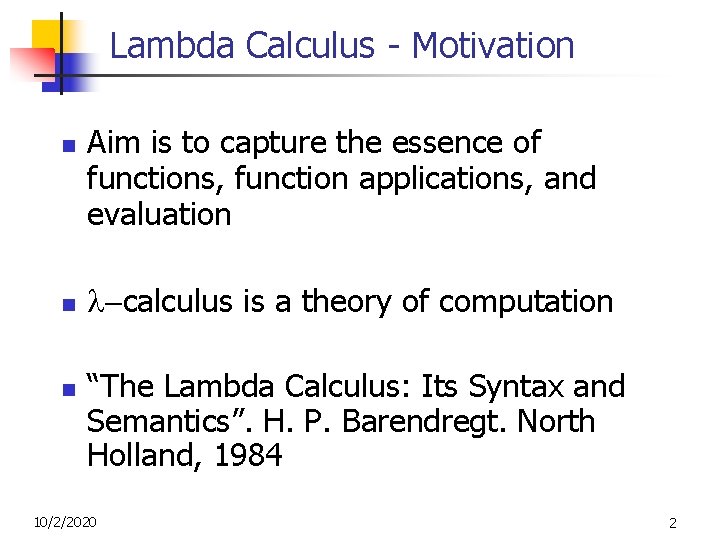
Lambda Calculus - Motivation n Aim is to capture the essence of functions, function applications, and evaluation calculus is a theory of computation “The Lambda Calculus: Its Syntax and Semantics”. H. P. Barendregt. North Holland, 1984 10/2/2020 2
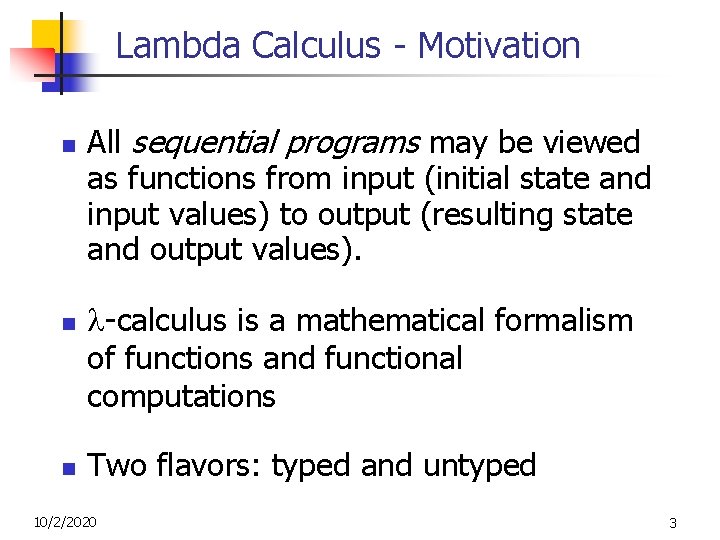
Lambda Calculus - Motivation n All sequential programs may be viewed as functions from input (initial state and input values) to output (resulting state and output values). -calculus is a mathematical formalism of functions and functional computations Two flavors: typed and untyped 10/2/2020 3
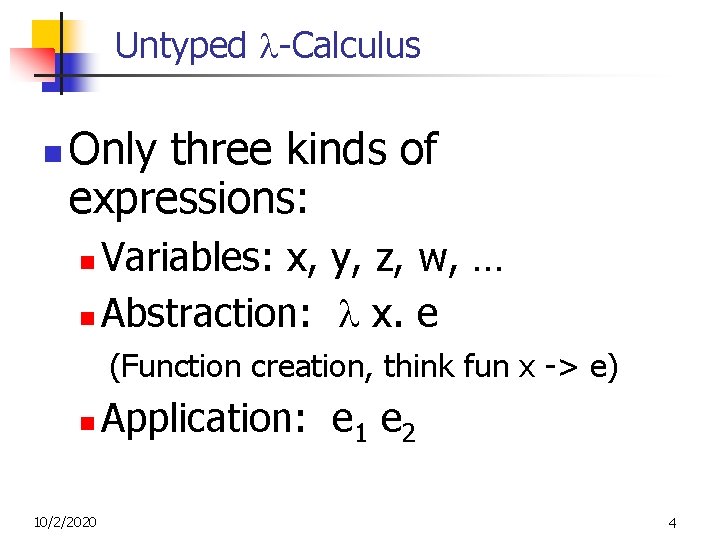
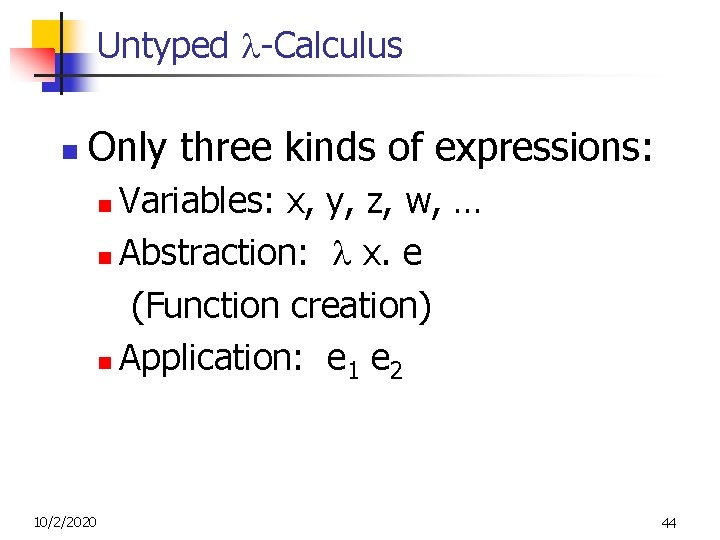
Untyped -Calculus n Only three kinds of expressions: Variables: x, y, z, w, … n Abstraction: x. e n (Function creation, think fun x -> e) n 10/2/2020 Application: e 1 e 2 4
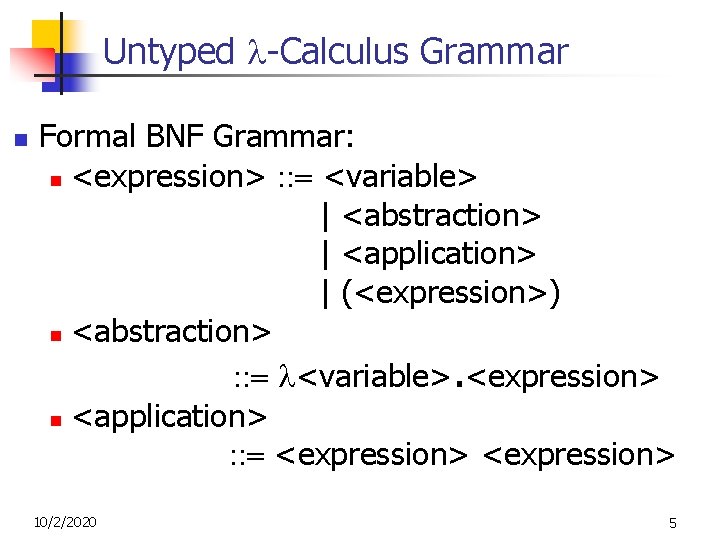
Untyped -Calculus Grammar n Formal BNF Grammar: n <expression> : : = <variable> | <abstraction> | <application> | (<expression>) n <abstraction> : : = <variable>. <expression> n <application> : : = <expression> 10/2/2020 5
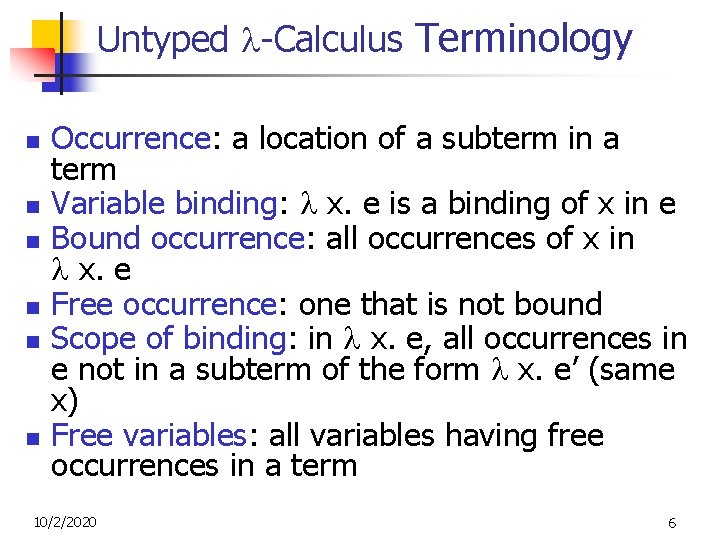
Untyped -Calculus Terminology n n n Occurrence: a location of a subterm in a term Variable binding: x. e is a binding of x in e Bound occurrence: all occurrences of x in x. e Free occurrence: one that is not bound Scope of binding: in x. e, all occurrences in e not in a subterm of the form x. e’ (same x) Free variables: all variables having free occurrences in a term 10/2/2020 6
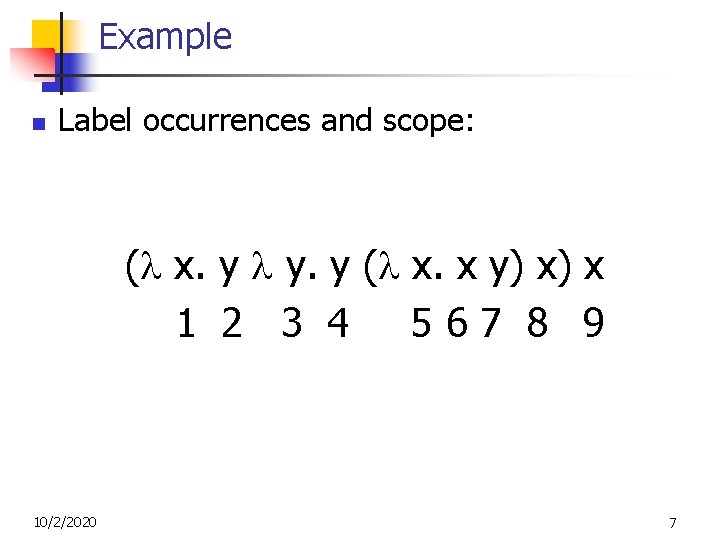
Example n Label occurrences and scope: ( x. y y. y ( x. x y) x) x 1 2 3 4 567 8 9 10/2/2020 7
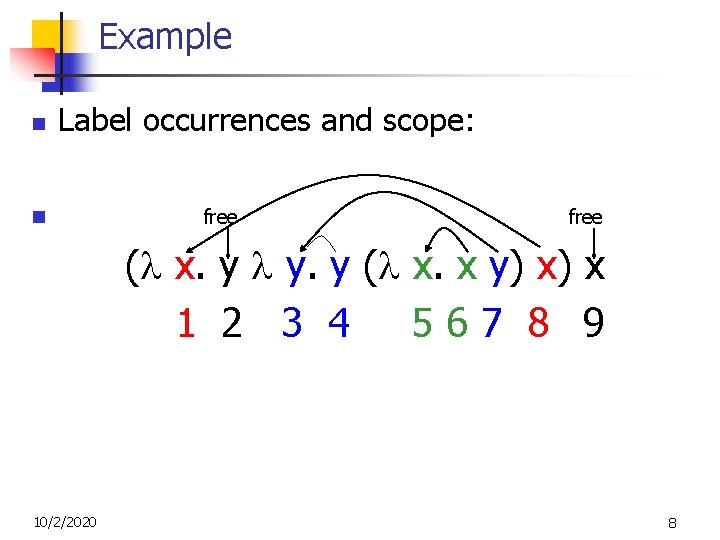
Example n Label occurrences and scope: n free ( x. y y. y ( x. x y) x) x 1 2 3 4 567 8 9 10/2/2020 8
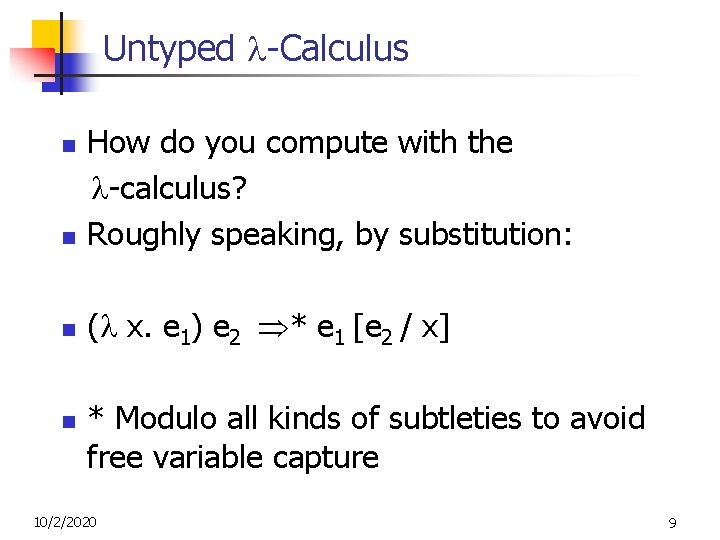
Untyped -Calculus n How do you compute with the -calculus? Roughly speaking, by substitution: n ( x. e 1) e 2 * e 1 [e 2 / x] n n * Modulo all kinds of subtleties to avoid free variable capture 10/2/2020 9
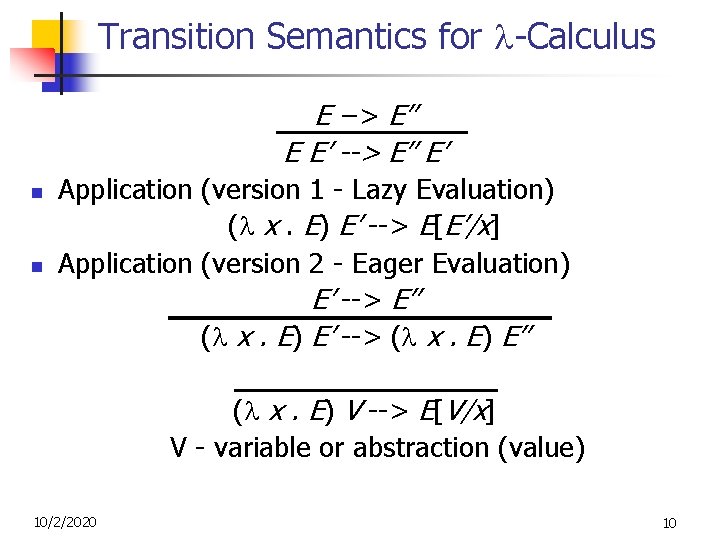
Transition Semantics for -Calculus E --> E’’ E E’ --> E’’ E’ n n Application (version 1 - Lazy Evaluation) ( x. E) E’ --> E[E’/x] Application (version 2 - Eager Evaluation) E’ --> E’’ ( x. E) E’ --> ( x. E) E’’ ( x. E) V --> E[V/x] V - variable or abstraction (value) 10/2/2020 10
How Powerful is the Untyped -Calculus? n The untyped -calculus is Turing Complete n n Can express any sequential computation Problems: n n n 10/2/2020 How to express basic data: booleans, integers, etc? How to express recursion? Constants, if_then_else, etc, are conveniences; can be added as syntactic sugar 11
Typed vs Untyped -Calculus n n The pure -calculus has no notion of type: (f f) is a legal expression Types restrict which applications are valid Types are not syntactic sugar! They disallow some terms Simply typed -calculus is less powerful than the untyped -Calculus: NOT Turing Complete (no recursion) 10/2/2020 12
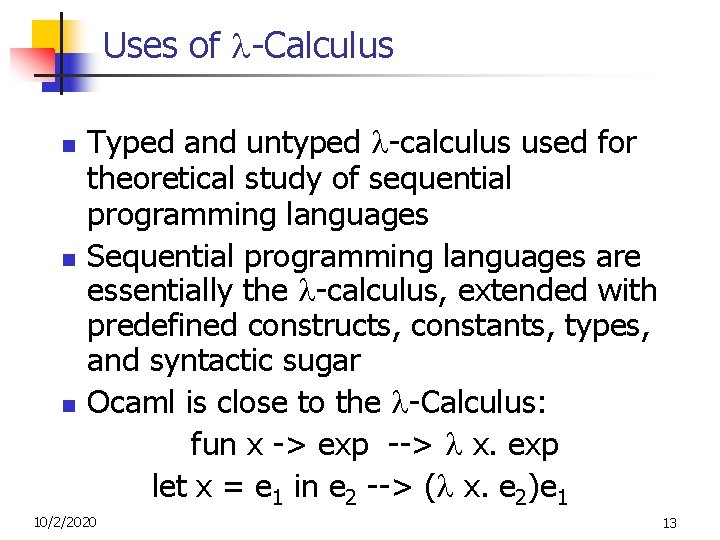
Uses of -Calculus n n n Typed and untyped -calculus used for theoretical study of sequential programming languages Sequential programming languages are essentially the -calculus, extended with predefined constructs, constants, types, and syntactic sugar Ocaml is close to the -Calculus: fun x -> exp --> x. exp let x = e 1 in e 2 --> ( x. e 2)e 1 10/2/2020 13
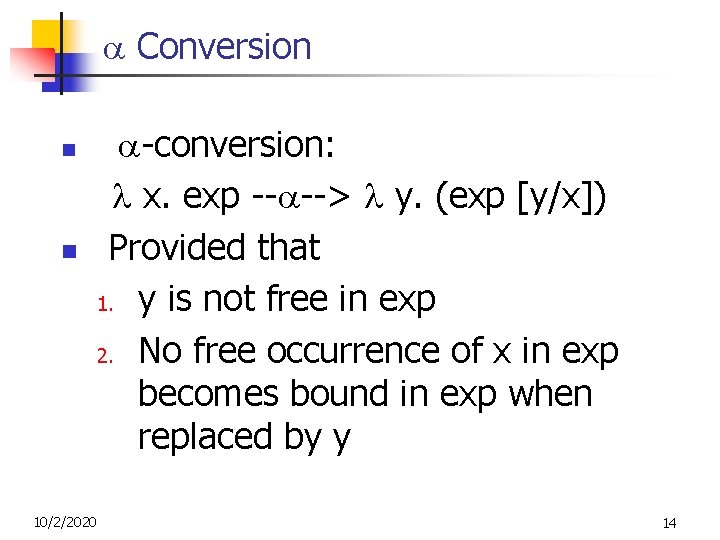
Conversion n n 10/2/2020 -conversion: x. exp -- --> y. (exp [y/x]) Provided that 1. y is not free in exp 2. No free occurrence of x in exp becomes bound in exp when replaced by y 14
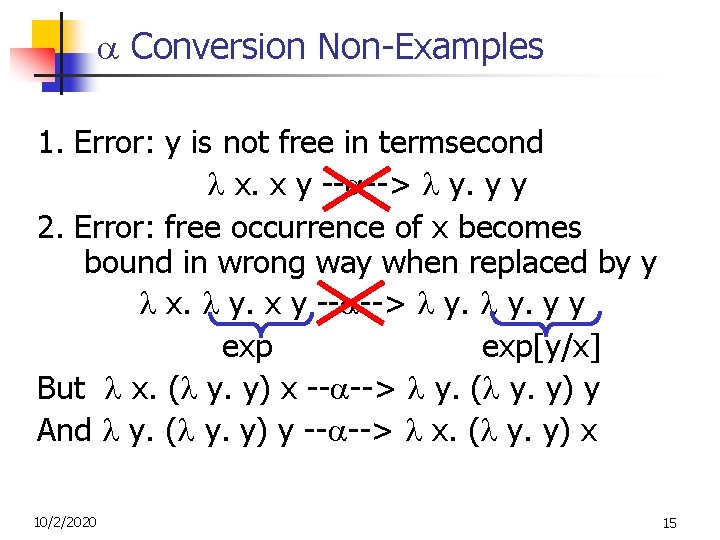
Conversion Non-Examples 1. Error: y is not free in termsecond x. x y -- --> y. y y 2. Error: free occurrence of x becomes bound in wrong way when replaced by y x. y. x y -- --> y. y y exp[y/x] But x. ( y. y) x -- --> y. ( y. y) y And y. ( y. y) y -- --> x. ( y. y) x 10/2/2020 15
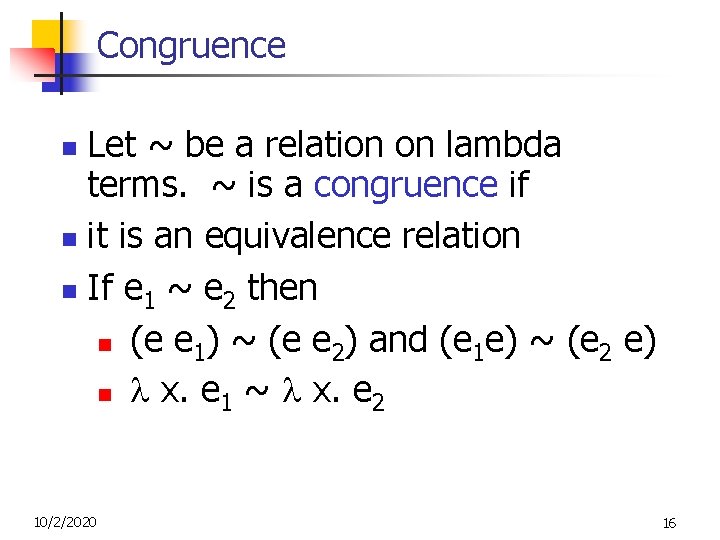
Congruence Let ~ be a relation on lambda terms. ~ is a congruence if n it is an equivalence relation n If e 1 ~ e 2 then n (e e 1) ~ (e e 2) and (e 1 e) ~ (e 2 e) n x. e 1 ~ x. e 2 n 10/2/2020 16
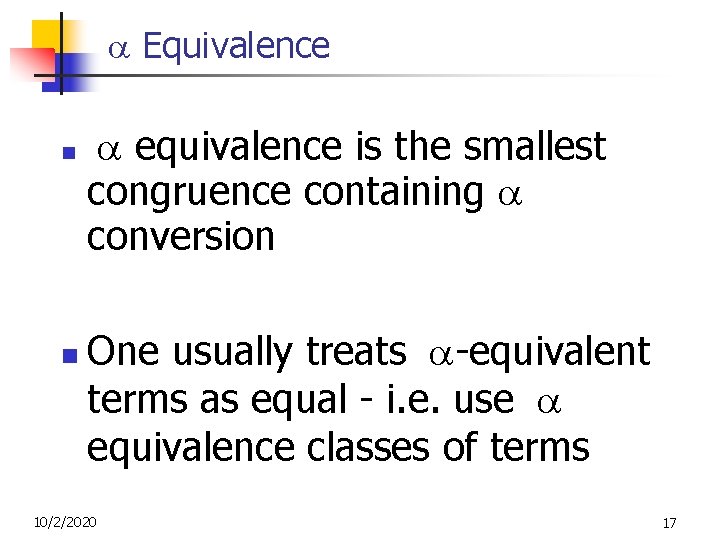
Equivalence n n equivalence is the smallest congruence containing conversion One usually treats -equivalent terms as equal - i. e. use equivalence classes of terms 10/2/2020 17
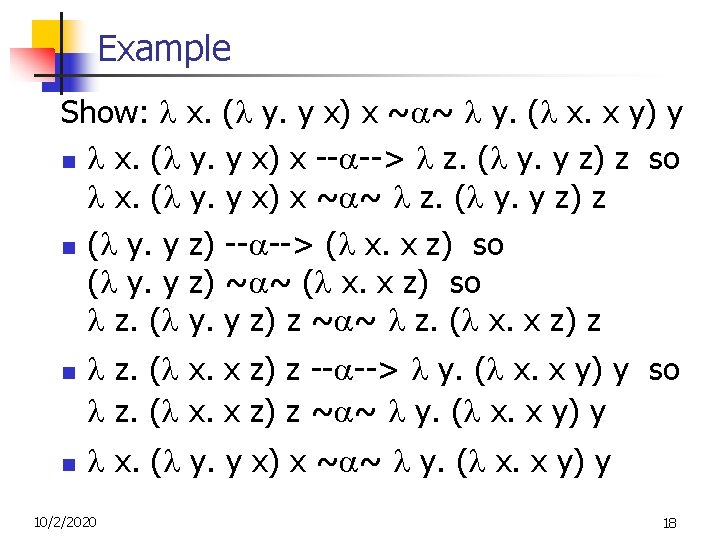
Example Show: x. ( y. y x) x ~ ~ y. ( x. x y) y n x. ( y. y x) x -- --> z. ( y. y z) z so x. ( y. y x) x ~ ~ z. ( y. y z) z n ( y. y z) -- --> ( x. x z) so ( y. y z) ~ ~ ( x. x z) so z. ( y. y z) z ~ ~ z. ( x. x z) z n n z. ( x. x z) z -- --> y. ( x. x y) y so z. ( x. x z) z ~ ~ y. ( x. x y) y x. ( y. y x) x ~ ~ y. ( x. x y) y 10/2/2020 18
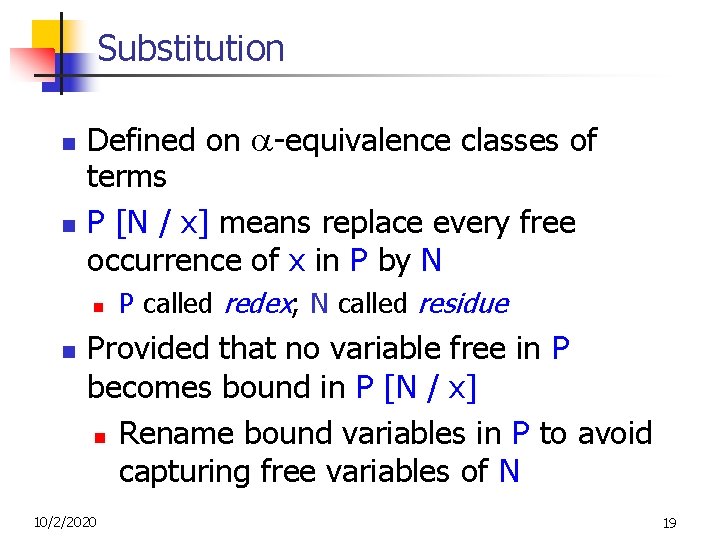
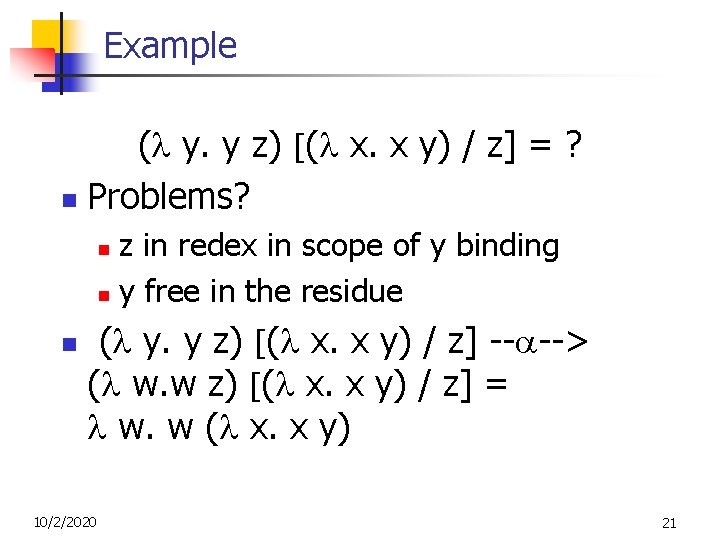
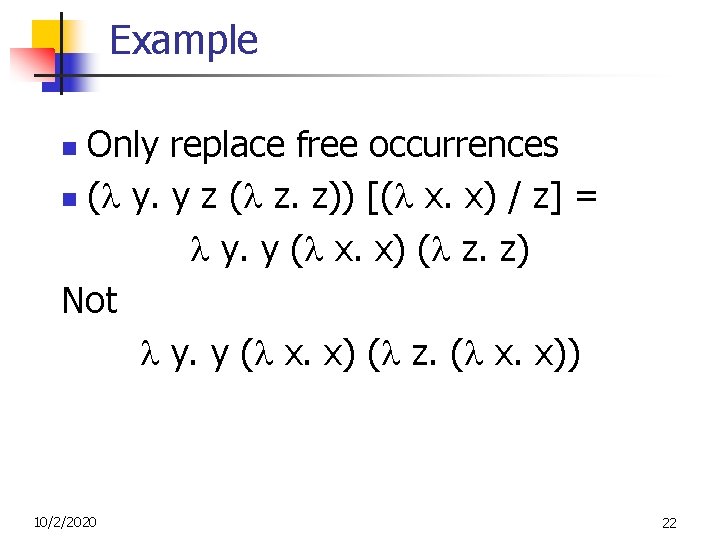
Substitution n n Defined on -equivalence classes of terms P [N / x] means replace every free occurrence of x in P by N n n P called redex; N called residue Provided that no variable free in P becomes bound in P [N / x] n Rename bound variables in P to avoid capturing free variables of N 10/2/2020 19
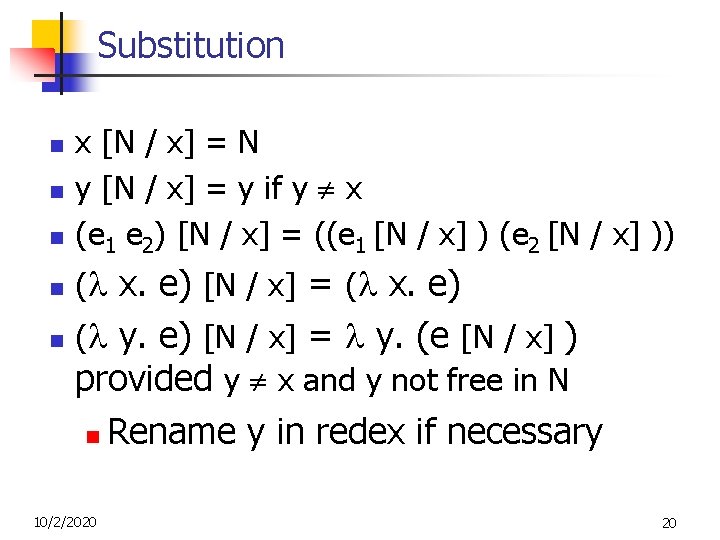
Substitution n x [N / x] = N y [N / x] = y if y x (e 1 e 2) [N / x] = ((e 1 [N / x] ) (e 2 [N / x] )) n ( x. e) [N / x] = ( x. e) n n n ( y. e) [N / x] = y. (e [N / x] ) provided y x and y not free in N n 10/2/2020 Rename y in redex if necessary 20
Example ( y. y z) [( x. x y) / z] = ? n Problems? z in redex in scope of y binding n y free in the residue n n ( y. y z) [( x. x y) / z] -- --> ( w. w z) [( x. x y) / z] = w. w ( x. x y) 10/2/2020 21
Example Only replace free occurrences n ( y. y z ( z. z)) [( x. x) / z] = y. y ( x. x) ( z. z) Not y. y ( x. x) ( z. ( x. x)) n 10/2/2020 22
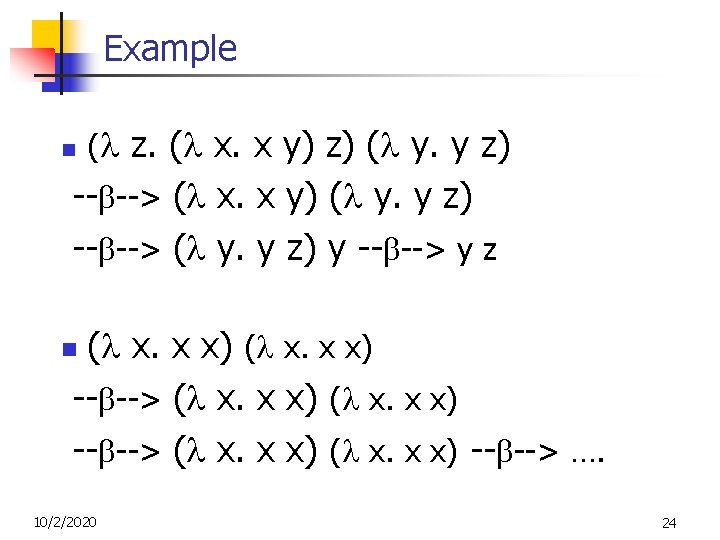
reduction Rule: ( x. P) N -- --> P [N /x] n n n Essence of computation in the lambda calculus Usually defined on -equivalence classes of terms 10/2/2020 23
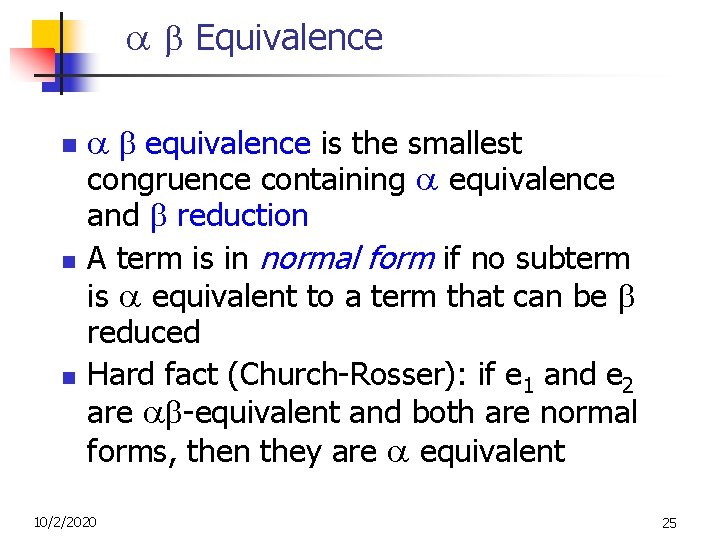
Equivalence n n n equivalence is the smallest congruence containing equivalence and reduction A term is in normal form if no subterm is equivalent to a term that can be reduced Hard fact (Church-Rosser): if e 1 and e 2 are -equivalent and both are normal forms, then they are equivalent 10/2/2020 25
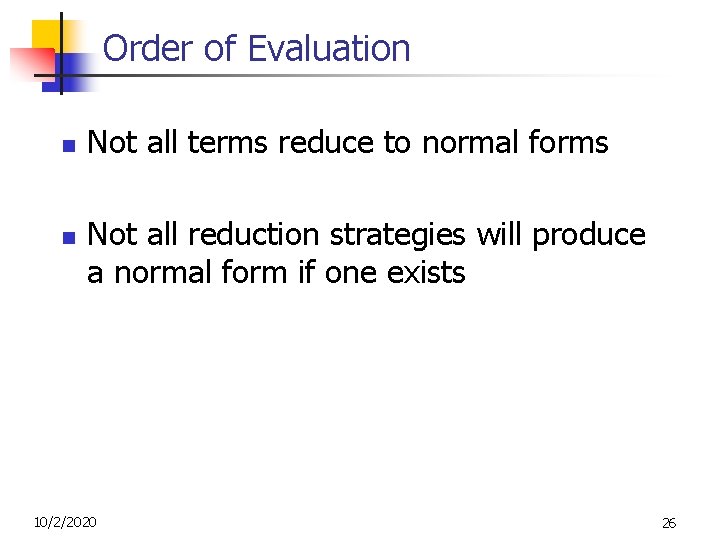
Order of Evaluation n n Not all terms reduce to normal forms Not all reduction strategies will produce a normal form if one exists 10/2/2020 26
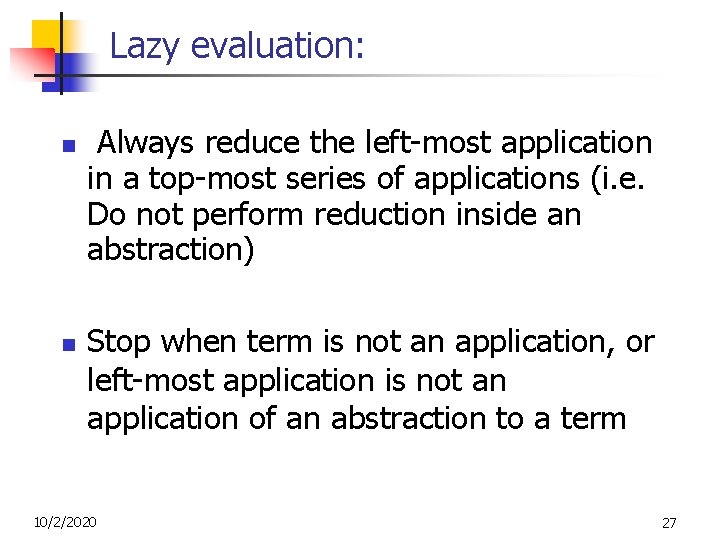
Lazy evaluation: n n Always reduce the left-most application in a top-most series of applications (i. e. Do not perform reduction inside an abstraction) Stop when term is not an application, or left-most application is not an application of an abstraction to a term 10/2/2020 27
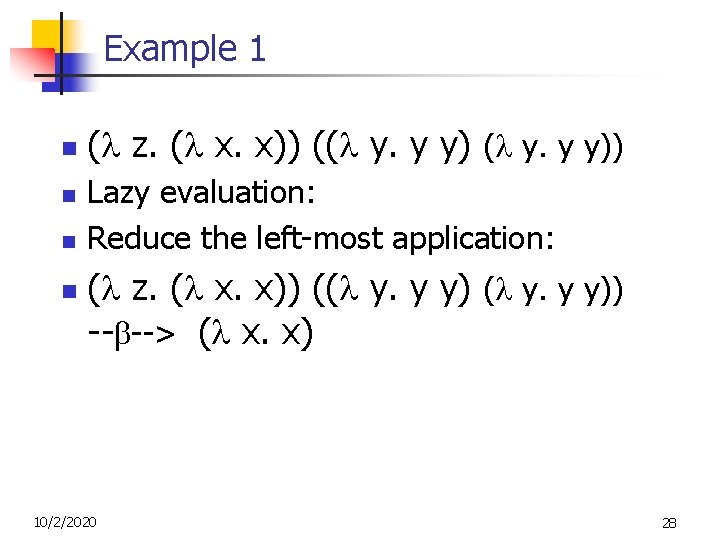
Example 1 n n ( z. ( x. x)) (( y. y y)) Lazy evaluation: Reduce the left-most application: ( z. ( x. x)) (( y. y y)) -- --> ( x. x) 10/2/2020 28
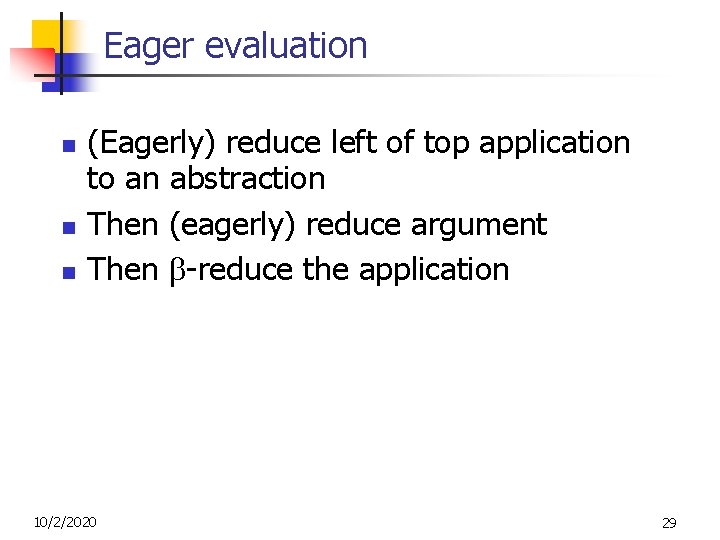
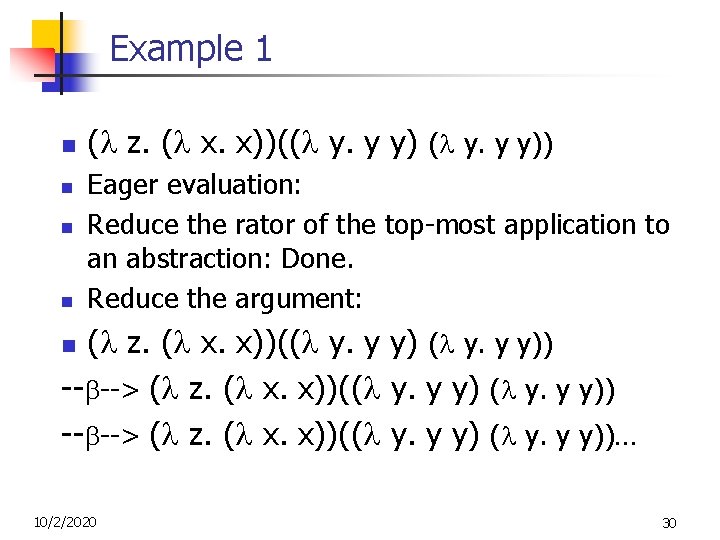
Eager evaluation n (Eagerly) reduce left of top application to an abstraction Then (eagerly) reduce argument Then -reduce the application 10/2/2020 29
Example 1 n n ( z. ( x. x))(( y. y y)) Eager evaluation: Reduce the rator of the top-most application to an abstraction: Done. Reduce the argument: ( z. ( x. x))(( y. y y)) -- --> ( z. ( x. x))(( y. y y))… n 10/2/2020 30
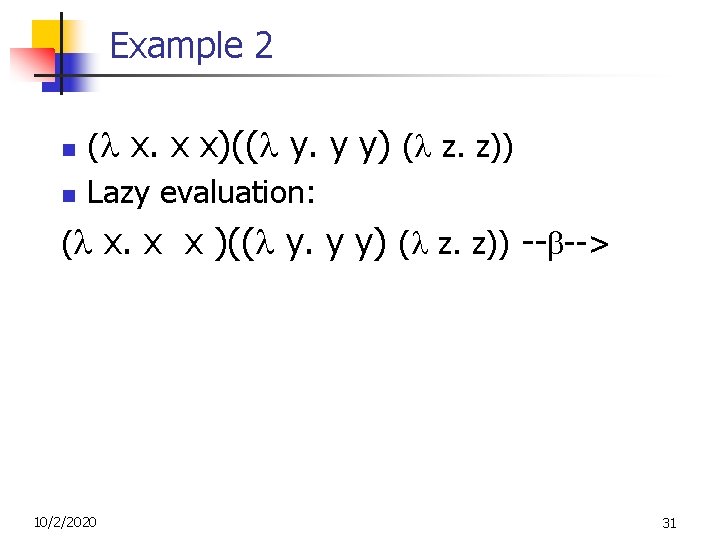
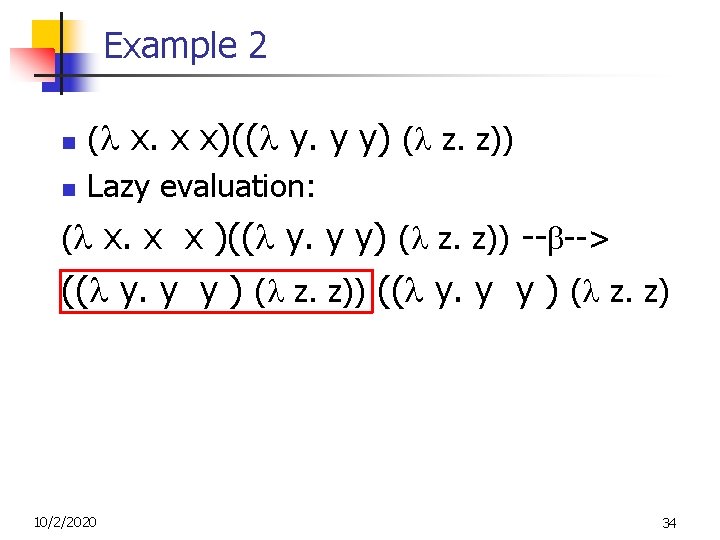
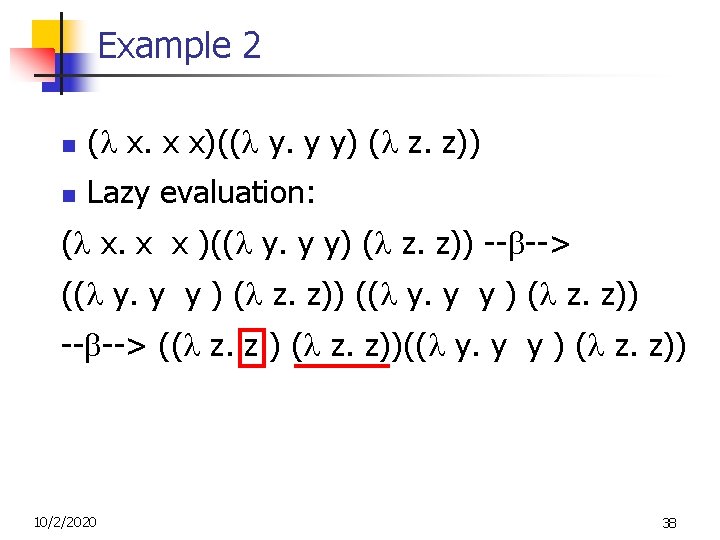
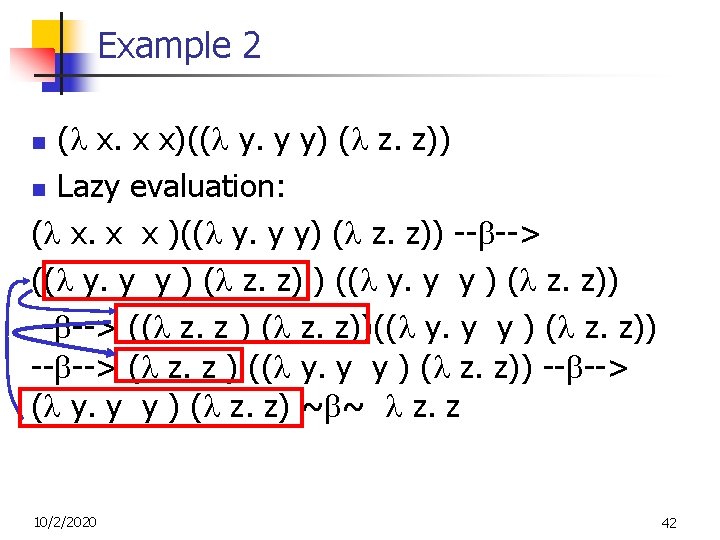
Example 2 n n ( x. x x)(( y. y y) ( z. z)) Lazy evaluation: ( x. x x )(( y. y y) ( z. z)) -- --> 10/2/2020 31
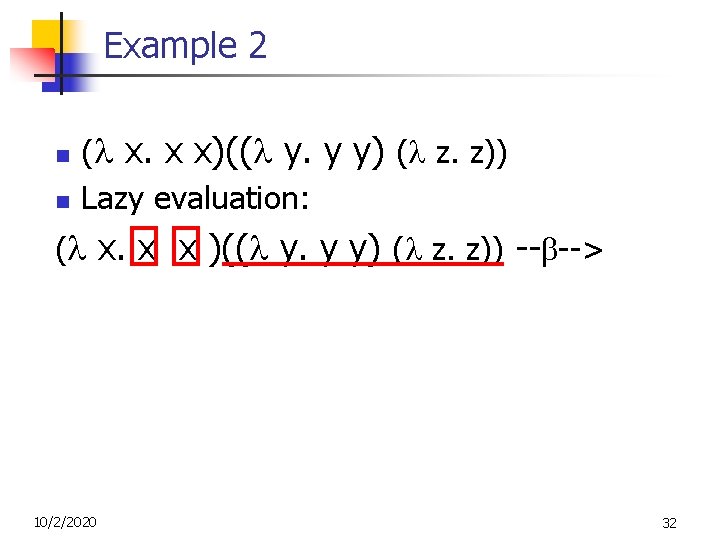
Example 2 n n ( x. x x)(( y. y y) ( z. z)) Lazy evaluation: ( x. x x )(( y. y y) ( z. z)) -- --> 10/2/2020 32
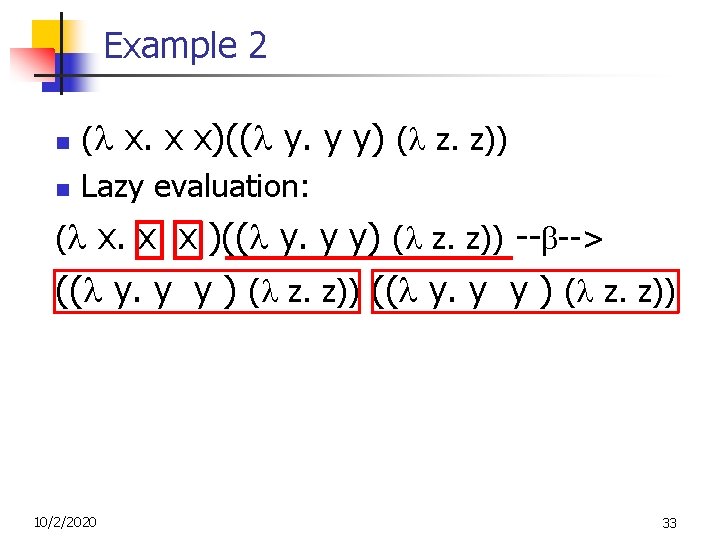
Example 2 n n ( x. x x)(( y. y y) ( z. z)) Lazy evaluation: ( x. x x )(( y. y y) ( z. z)) -- --> (( y. y y ) ( z. z)) 10/2/2020 33
Example 2 n n ( x. x x)(( y. y y) ( z. z)) Lazy evaluation: ( x. x x )(( y. y y) ( z. z)) -- --> (( y. y y ) ( z. z)) (( y. y y ) ( z. z) 10/2/2020 34
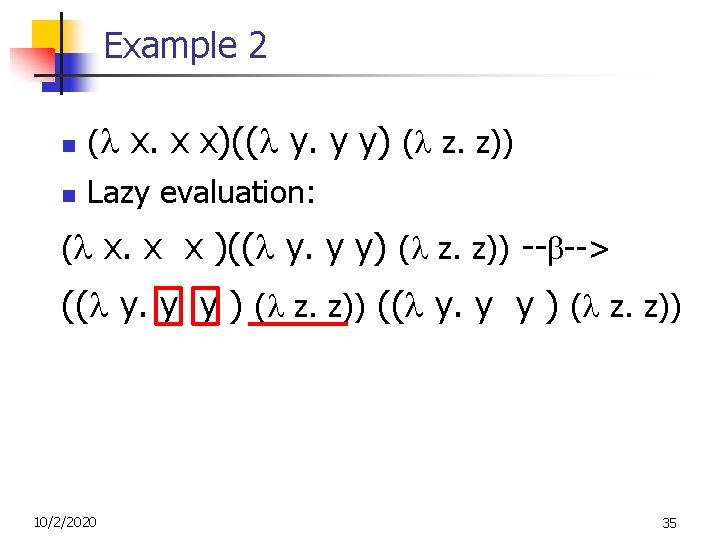
Example 2 n ( x. x x)(( y. y y) ( z. z)) n Lazy evaluation: ( x. x x )(( y. y y) ( z. z)) -- --> (( y. y y ) ( z. z)) 10/2/2020 35
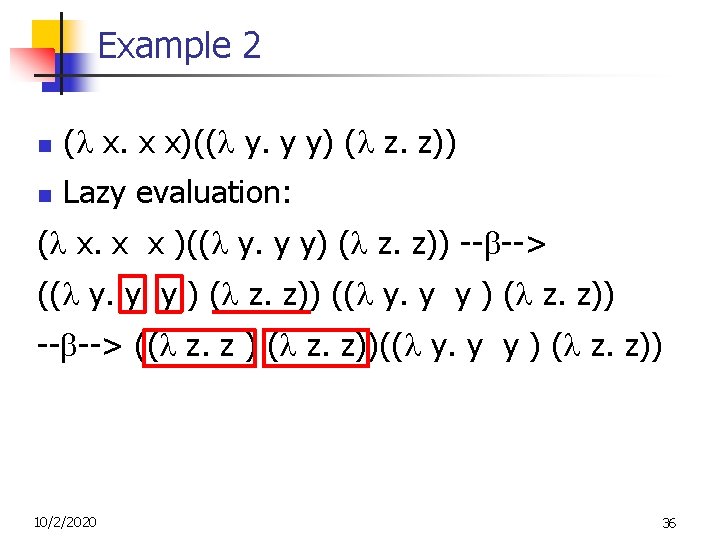
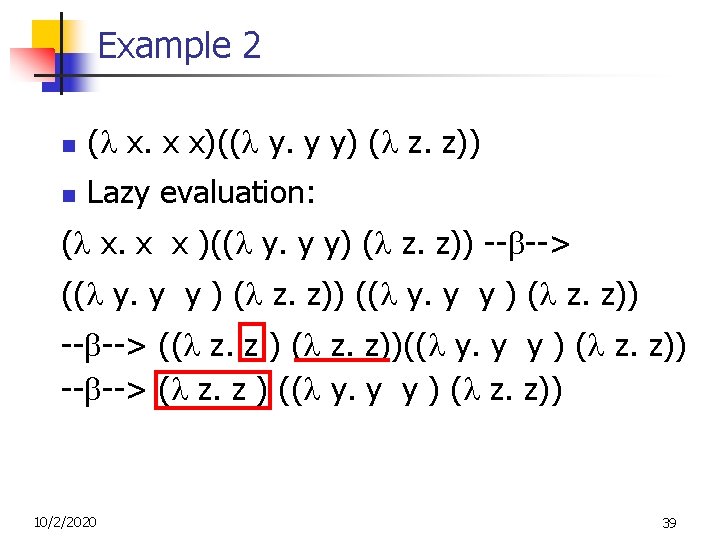
Example 2 n ( x. x x)(( y. y y) ( z. z)) n Lazy evaluation: ( x. x x )(( y. y y) ( z. z)) -- --> (( y. y y ) ( z. z)) -- --> (( z. z ) ( z. z))(( y. y y ) ( z. z)) 10/2/2020 36
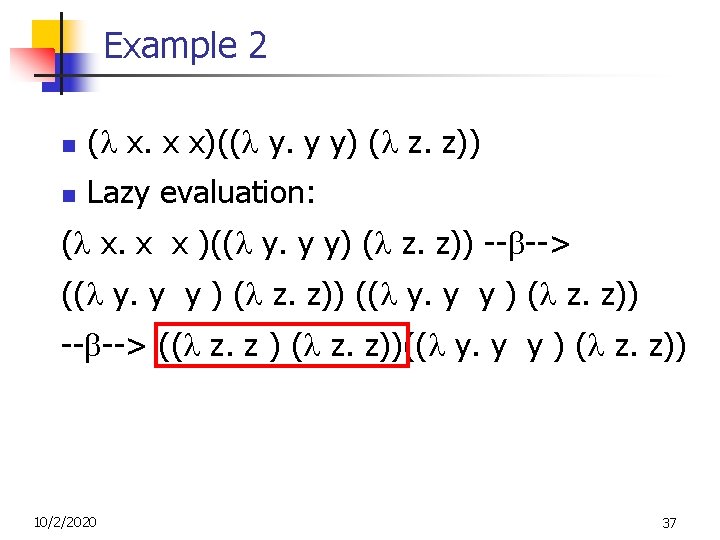
Example 2 n ( x. x x)(( y. y y) ( z. z)) n Lazy evaluation: ( x. x x )(( y. y y) ( z. z)) -- --> (( y. y y ) ( z. z)) -- --> (( z. z ) ( z. z))(( y. y y ) ( z. z)) 10/2/2020 37
Example 2 n ( x. x x)(( y. y y) ( z. z)) n Lazy evaluation: ( x. x x )(( y. y y) ( z. z)) -- --> (( y. y y ) ( z. z)) -- --> (( z. z ) ( z. z))(( y. y y ) ( z. z)) 10/2/2020 38
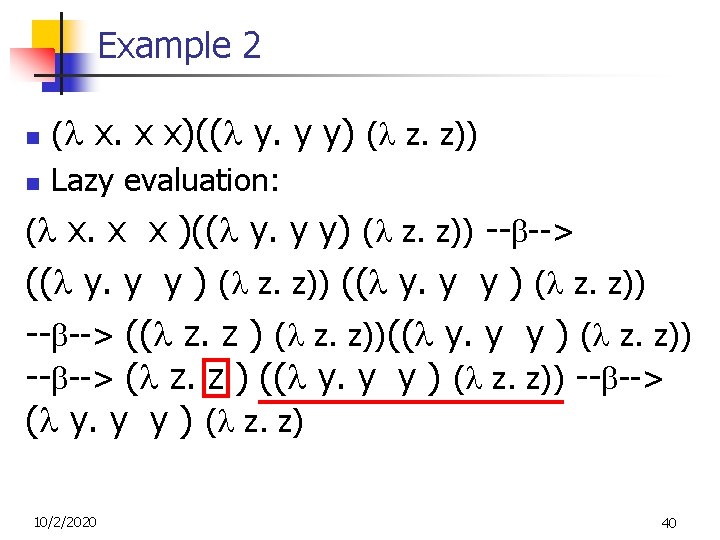
Example 2 n ( x. x x)(( y. y y) ( z. z)) n Lazy evaluation: ( x. x x )(( y. y y) ( z. z)) -- --> (( y. y y ) ( z. z)) -- --> (( z. z ) ( z. z))(( y. y y ) ( z. z)) -- --> ( z. z ) (( y. y y ) ( z. z)) 10/2/2020 39
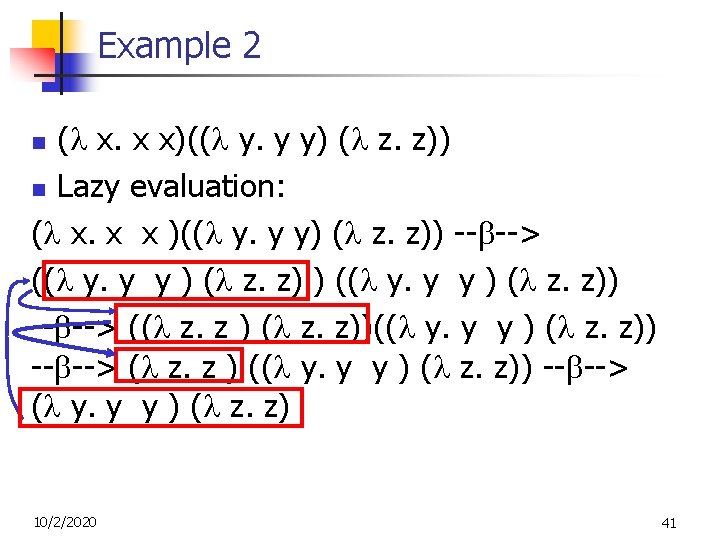
Example 2 n n ( x. x x)(( y. y y) ( z. z)) Lazy evaluation: ( x. x x )(( y. y y) ( z. z)) -- --> (( y. y y ) ( z. z)) -- --> (( z. z ) ( z. z))(( y. y y ) ( z. z)) -- --> ( z. z ) (( y. y y ) ( z. z)) -- --> ( y. y y ) ( z. z) 10/2/2020 40
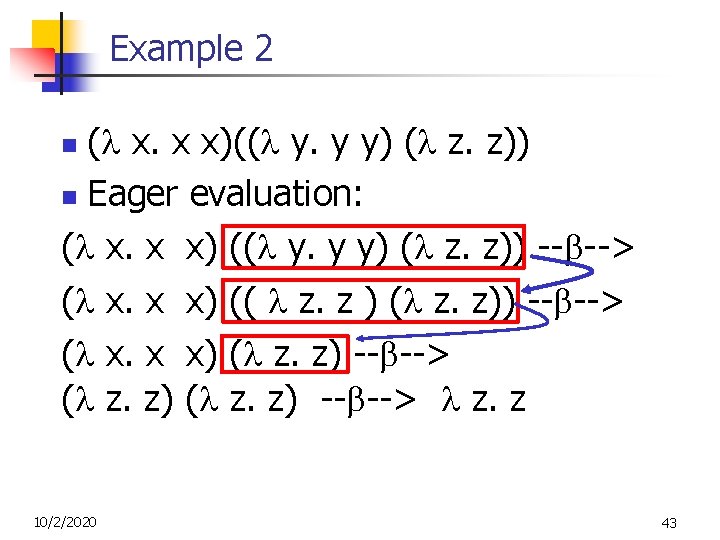
Example 2 ( x. x x)(( y. y y) ( z. z)) n Eager evaluation: ( x. x x) (( y. y y) ( z. z)) -- --> ( x. x x) (( z. z ) ( z. z)) -- --> ( x. x x) ( z. z) -- --> z. z n 10/2/2020 43
Untyped -Calculus n Only three kinds of expressions: Variables: x, y, z, w, … n Abstraction: x. e (Function creation) n Application: e 1 e 2 n 10/2/2020 44
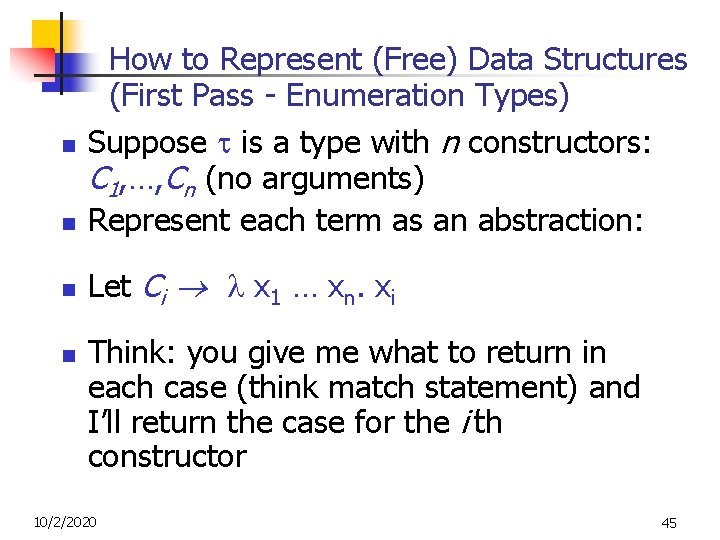
n How to Represent (Free) Data Structures (First Pass - Enumeration Types) Suppose is a type with n constructors: C 1, …, Cn (no arguments) Represent each term as an abstraction: n Let Ci x 1 … xn. xi n n Think: you give me what to return in each case (think match statement) and I’ll return the case for the i'th constructor 10/2/2020 45
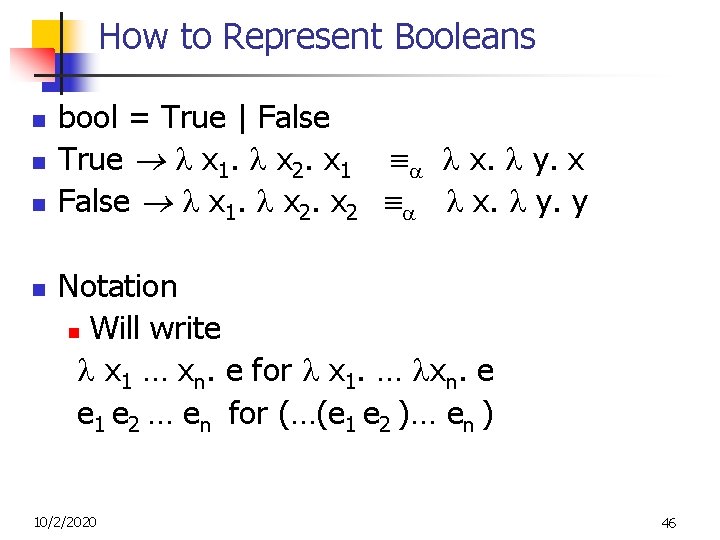
How to Represent Booleans n n bool = True | False True x 1. x 2. x 1 x. y. x False x 1. x 2 x. y. y Notation n Will write x 1 … xn. e for x 1. … xn. e e 1 e 2 … en for (…(e 1 e 2 )… en ) 10/2/2020 46
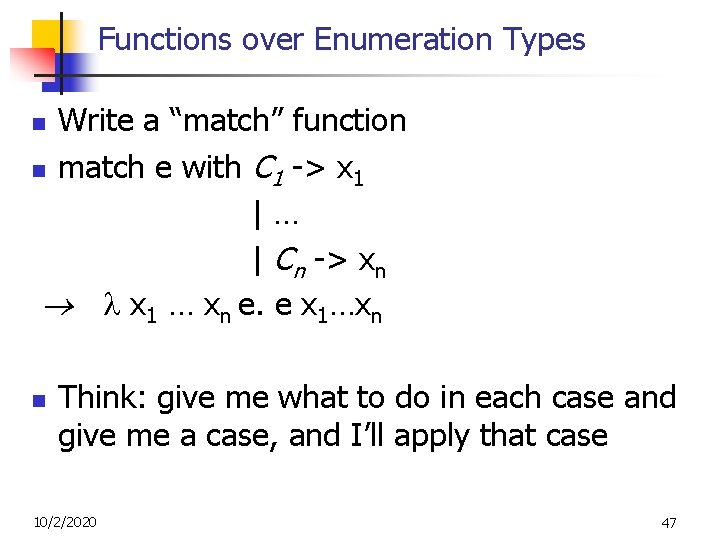
Functions over Enumeration Types Write a “match” function n match e with C 1 -> x 1 |… | Cn -> xn x 1 … xn e. e x 1…xn n n Think: give me what to do in each case and give me a case, and I’ll apply that case 10/2/2020 47
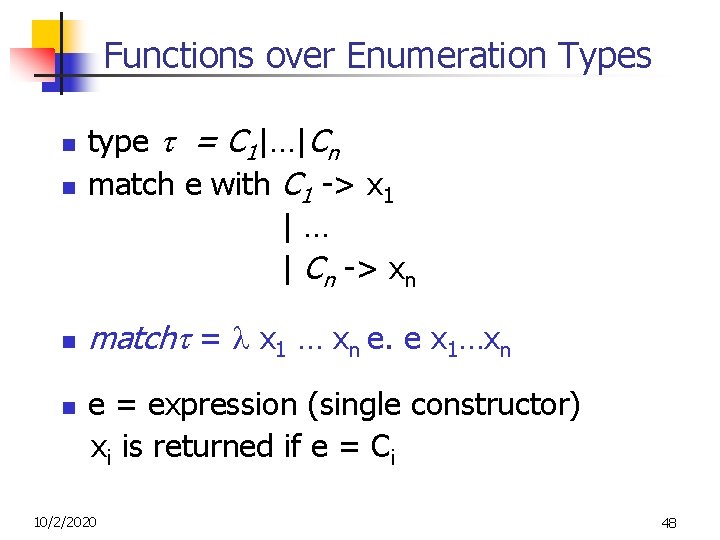
Functions over Enumeration Types n n type = C 1|…|Cn match e with C 1 -> x 1 |… | Cn -> xn match = x 1 … xn e. e x 1…xn e = expression (single constructor) xi is returned if e = Ci 10/2/2020 48
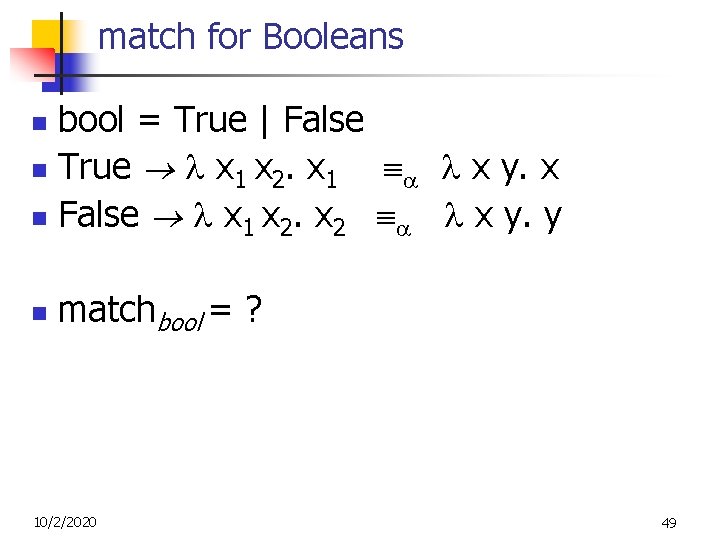
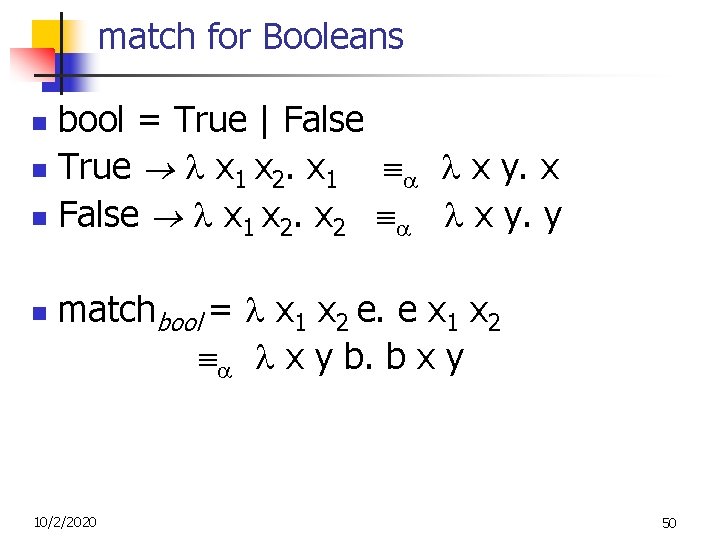
match for Booleans bool = True | False n True x 1 x 2. x 1 x y. x n False x 1 x 2 x y. y n n matchbool = ? 10/2/2020 49
match for Booleans bool = True | False n True x 1 x 2. x 1 x y. x n False x 1 x 2 x y. y n n matchbool = x 1 x 2 e. e x 1 x 2 x y b. b x y 10/2/2020 50
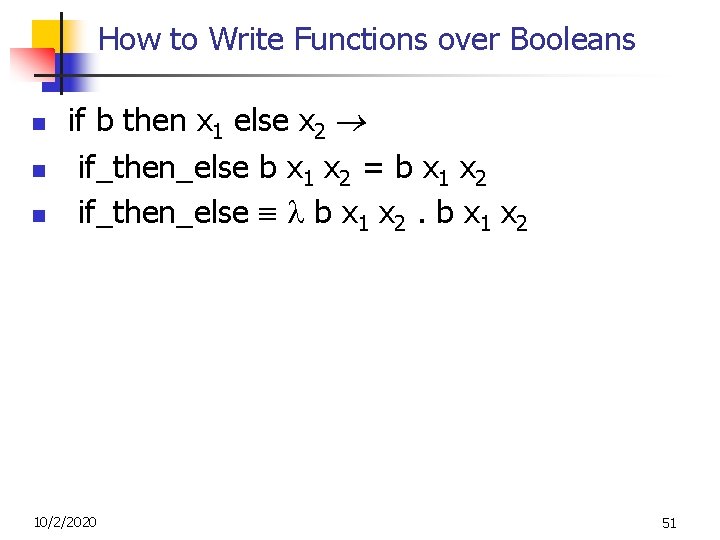
How to Write Functions over Booleans n n n if b then x 1 else x 2 if_then_else b x 1 x 2 = b x 1 x 2 if_then_else b x 1 x 2 10/2/2020 51
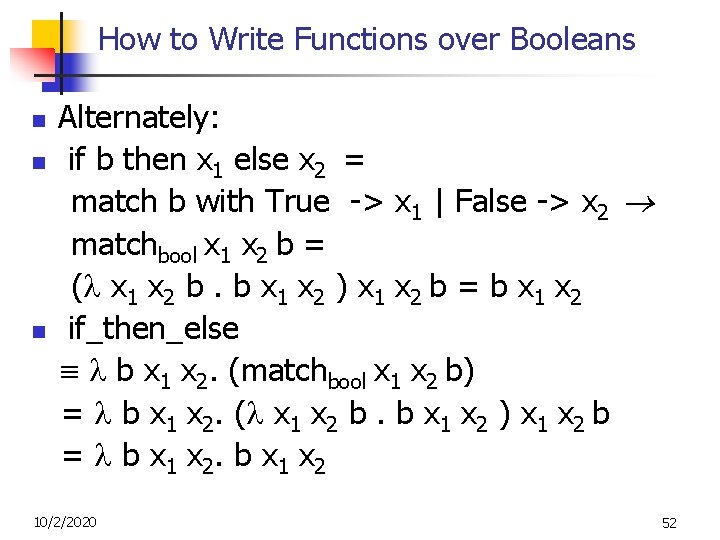
How to Write Functions over Booleans n n n Alternately: if b then x 1 else x 2 = match b with True -> x 1 | False -> x 2 matchbool x 1 x 2 b = ( x 1 x 2 b. b x 1 x 2 ) x 1 x 2 b = b x 1 x 2 if_then_else b x 1 x 2. (matchbool x 1 x 2 b) = b x 1 x 2. ( x 1 x 2 b. b x 1 x 2 ) x 1 x 2 b = b x 1 x 2 10/2/2020 52
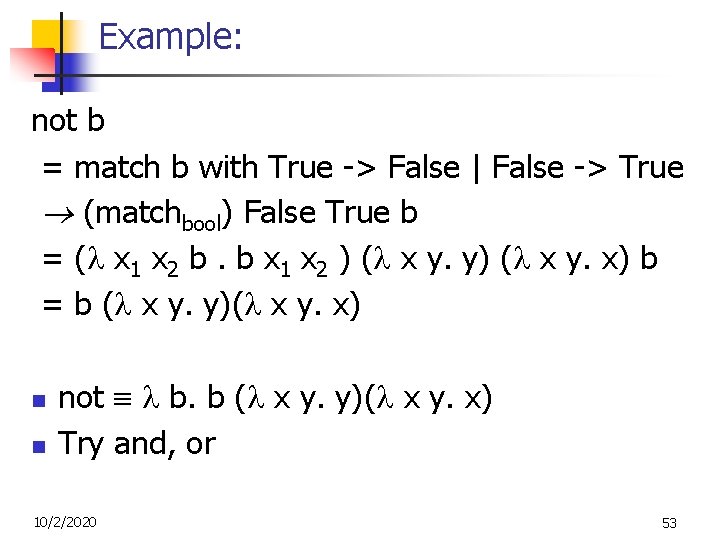
Example: not b = match b with True -> False | False -> True (matchbool) False True b = ( x 1 x 2 b. b x 1 x 2 ) ( x y. y) ( x y. x) b = b ( x y. y)( x y. x) n n not b. b ( x y. y)( x y. x) Try and, or 10/2/2020 53
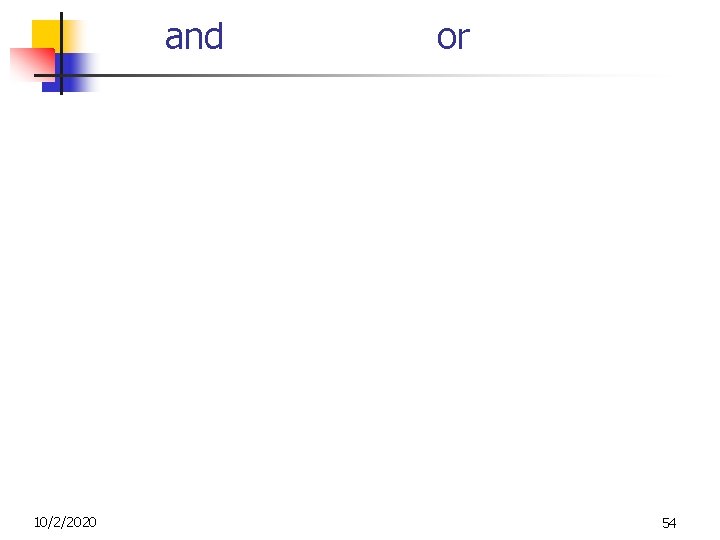
and 10/2/2020 or 54
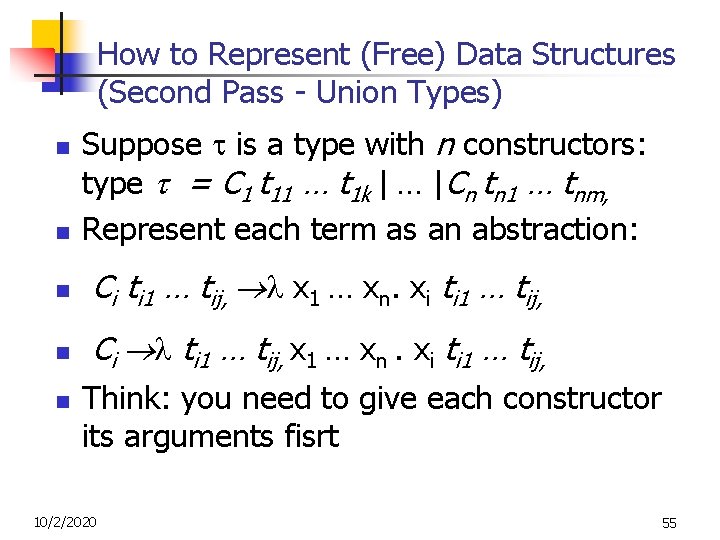
How to Represent (Free) Data Structures (Second Pass - Union Types) n n Suppose is a type with n constructors: type = C 1 t 11 … t 1 k | … |Cn tn 1 … tnm, Represent each term as an abstraction: n Ci ti 1 … tij, x 1 … xn. xi ti 1 … tij, n Ci ti 1 … tij, x 1 … xn. xi ti 1 … tij, n Think: you need to give each constructor its arguments fisrt 10/2/2020 55
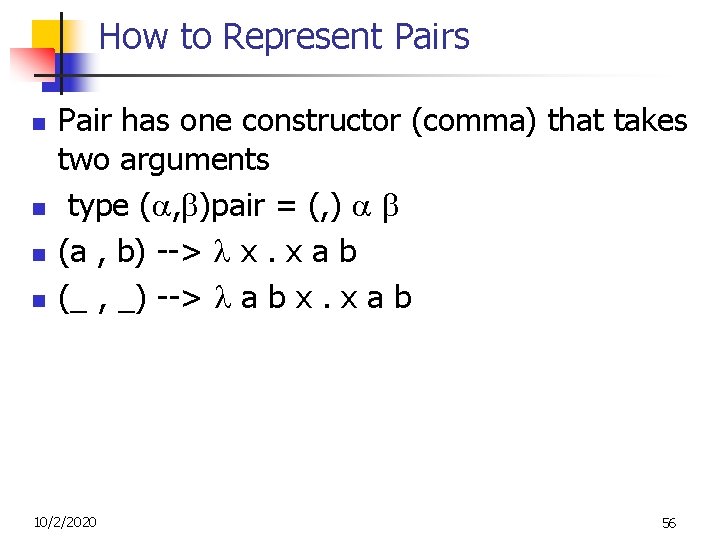
How to Represent Pairs n n Pair has one constructor (comma) that takes two arguments type ( , )pair = (, ) (a , b) --> x. x a b (_ , _) --> a b x. x a b 10/2/2020 56
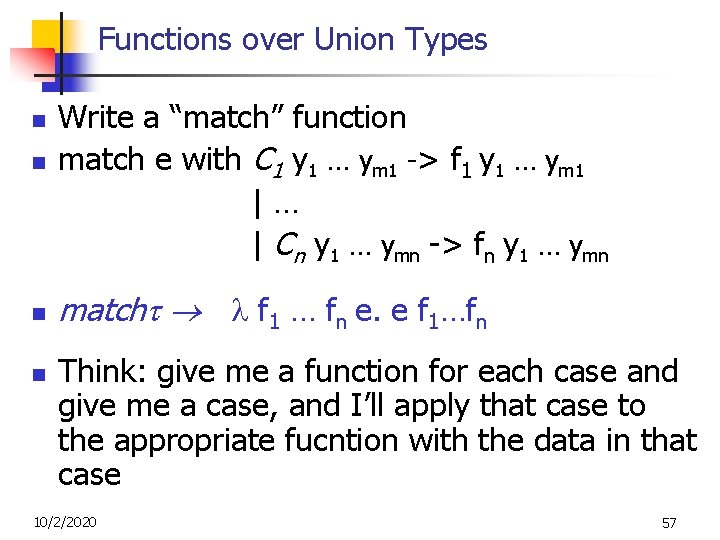
Functions over Union Types n n Write a “match” function match e with C 1 y 1 … ym 1 -> f 1 y 1 … ym 1 |… | Cn y 1 … ymn -> fn y 1 … ymn match f 1 … fn e. e f 1…fn Think: give me a function for each case and give me a case, and I’ll apply that case to the appropriate fucntion with the data in that case 10/2/2020 57
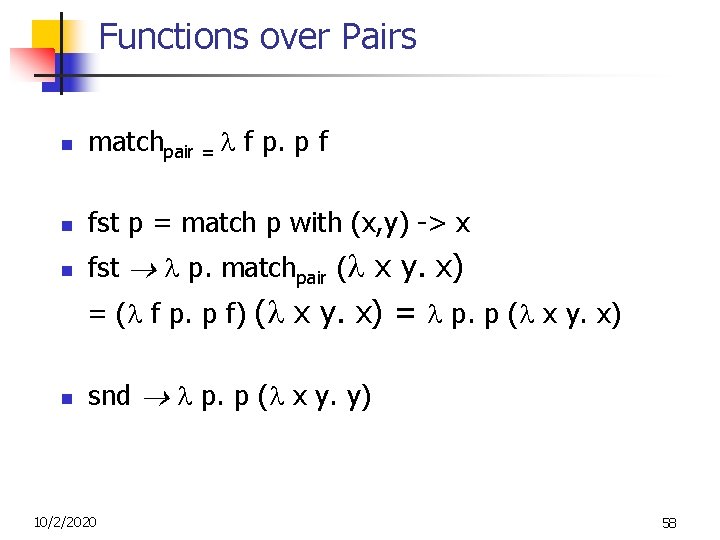
Functions over Pairs n matchpair = f p. p f n fst p = match p with (x, y) -> x n fst p. matchpair ( x y. x) = ( f p. p f) ( x y. x) = p. p ( x y. x) n snd p. p ( x y. y) 10/2/2020 58
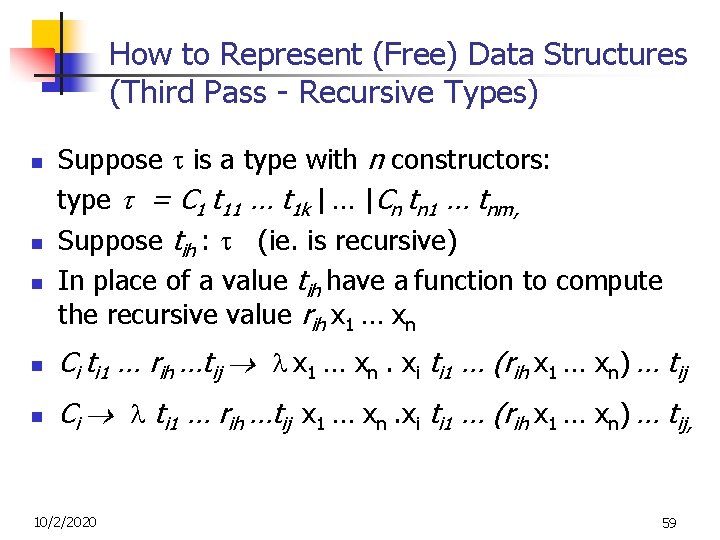
How to Represent (Free) Data Structures (Third Pass - Recursive Types) n n n Suppose is a type with n constructors: type = C 1 t 11 … t 1 k | … |Cn tn 1 … tnm, Suppose tih : (ie. is recursive) In place of a value tih have a function to compute the recursive value rih x 1 … xn n Ci ti 1 … rih …tij x 1 … xn. xi ti 1 … (rih x 1 … xn) … tij, 10/2/2020 59
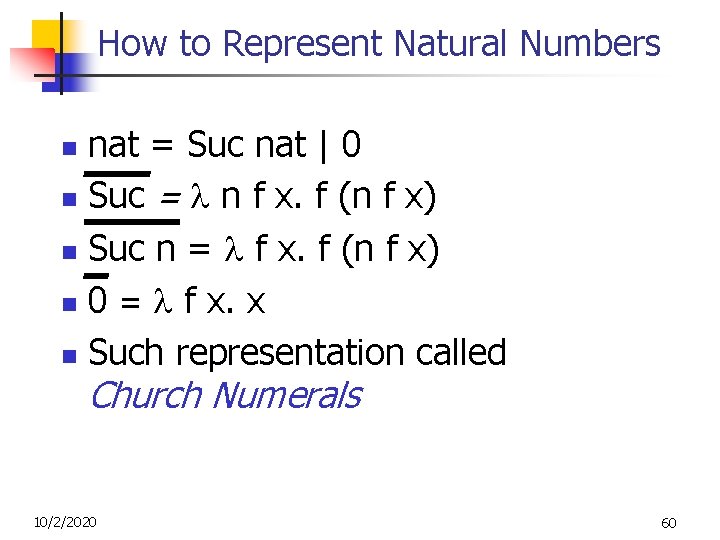
How to Represent Natural Numbers nat = Suc nat | 0 n Suc = n f x. f (n f x) n Suc n = f x. f (n f x) n 0 = f x. x n Such representation called n Church Numerals 10/2/2020 60
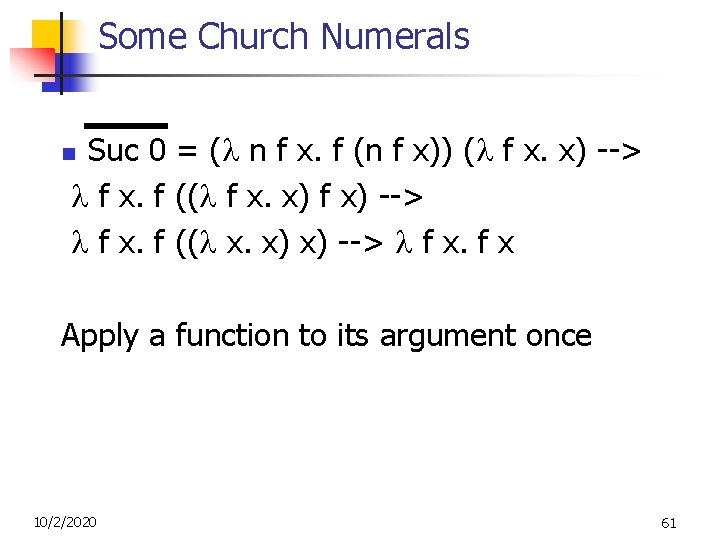
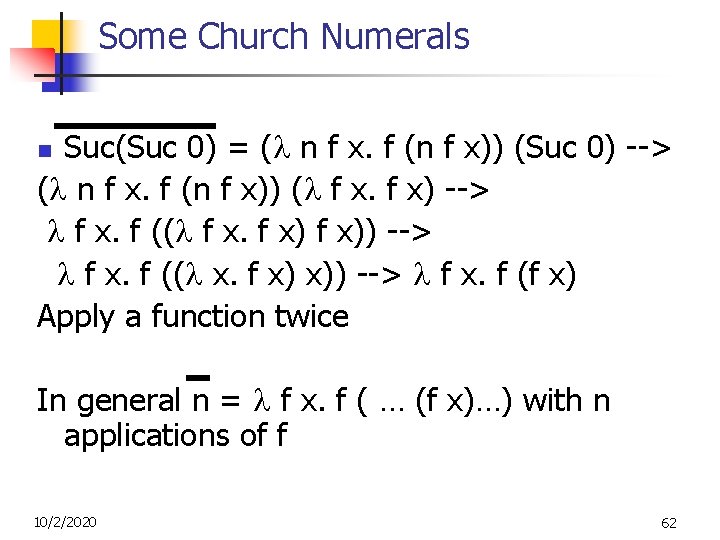
Some Church Numerals Suc 0 = ( n f x. f (n f x)) ( f x. x) --> f x. f (( f x. x) f x) --> f x. f (( x. x) x) --> f x n Apply a function to its argument once 10/2/2020 61
Some Church Numerals Suc(Suc 0) = ( n f x. f (n f x)) (Suc 0) --> ( n f x. f (n f x)) ( f x) --> f x. f (( f x)) --> f x. f (( x. f x) x)) --> f x. f (f x) Apply a function twice n In general n = f x. f ( … (f x)…) with n applications of f 10/2/2020 62
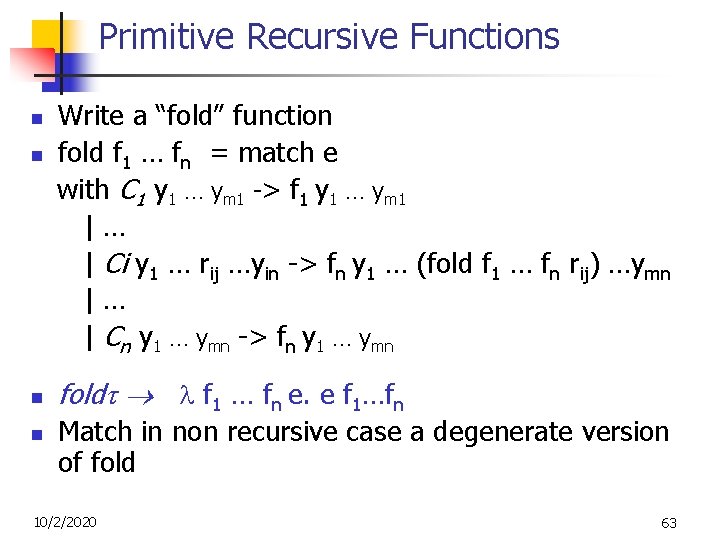
Primitive Recursive Functions n n Write a “fold” function fold f 1 … fn = match e with C 1 y 1 … ym 1 -> f 1 y 1 … ym 1 |… | Ci y 1 … rij …yin -> fn y 1 … (fold f 1 … fn rij) …ymn |… | Cn y 1 … ymn -> fn y 1 … ymn fold f 1 … fn e. e f 1…fn Match in non recursive case a degenerate version of fold 10/2/2020 63
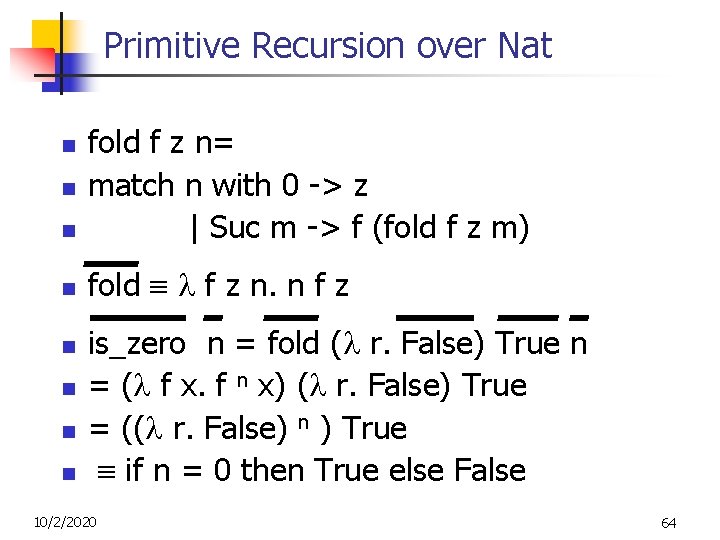
Primitive Recursion over Nat n fold f z n= match n with 0 -> z | Suc m -> f (fold f z m) n fold f z n. n f z n n n is_zero n = fold ( r. False) True n = ( f x. f n x) ( r. False) True = (( r. False) n ) True if n = 0 then True else False 10/2/2020 64
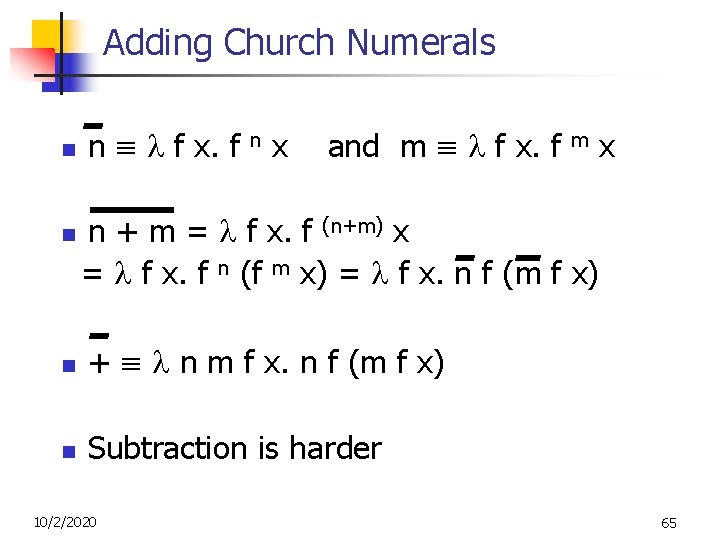
Adding Church Numerals n n n f x. f n x and m f x. f m x n + m = f x. f (n+m) x = f x. f n (f m x) = f x. n f (m f x) n + n m f x. n f (m f x) n Subtraction is harder 10/2/2020 65
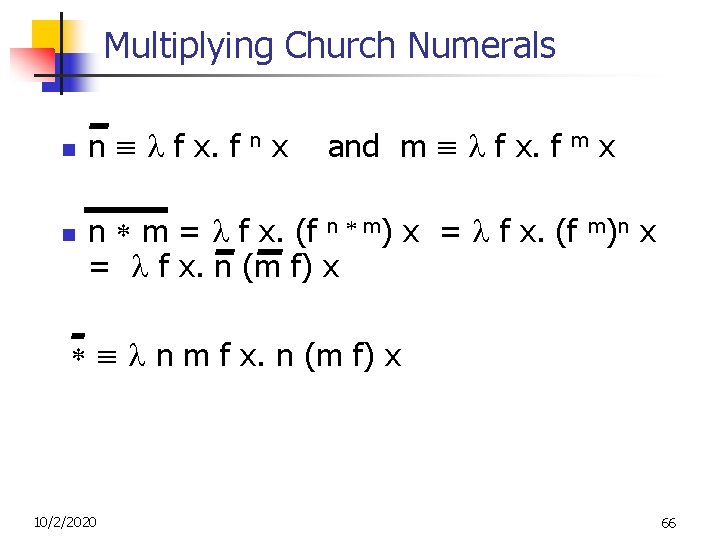
Multiplying Church Numerals n n n f x. f n x and m f x. f m x n m = f x. (f n m) x = f x. (f m)n x = f x. n (m f) x n m f x. n (m f) x 10/2/2020 66
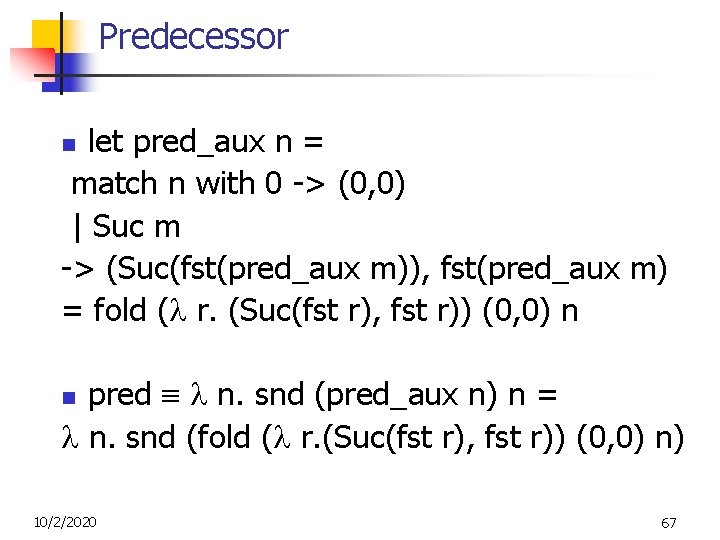
Predecessor let pred_aux n = match n with 0 -> (0, 0) | Suc m -> (Suc(fst(pred_aux m)), fst(pred_aux m) = fold ( r. (Suc(fst r), fst r)) (0, 0) n n pred n. snd (pred_aux n) n = n. snd (fold ( r. (Suc(fst r), fst r)) (0, 0) n) n 10/2/2020 67
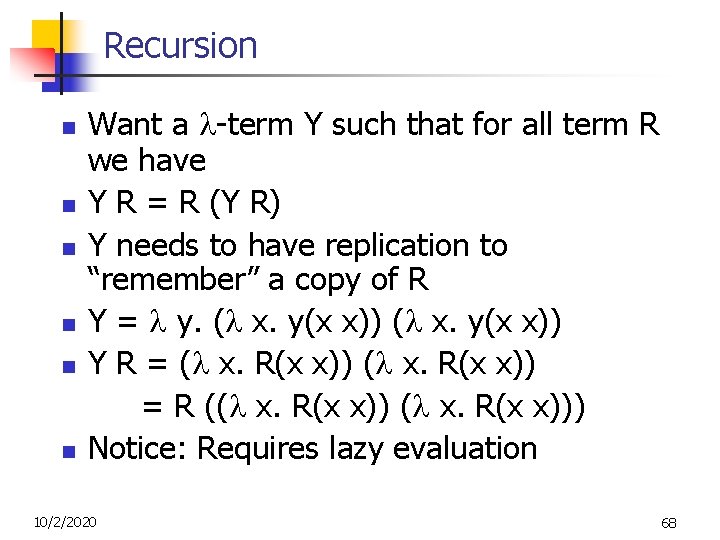
Recursion n n n Want a -term Y such that for all term R we have Y R = R (Y R) Y needs to have replication to “remember” a copy of R Y = y. ( x. y(x x)) Y R = ( x. R(x x)) = R (( x. R(x x))) Notice: Requires lazy evaluation 10/2/2020 68
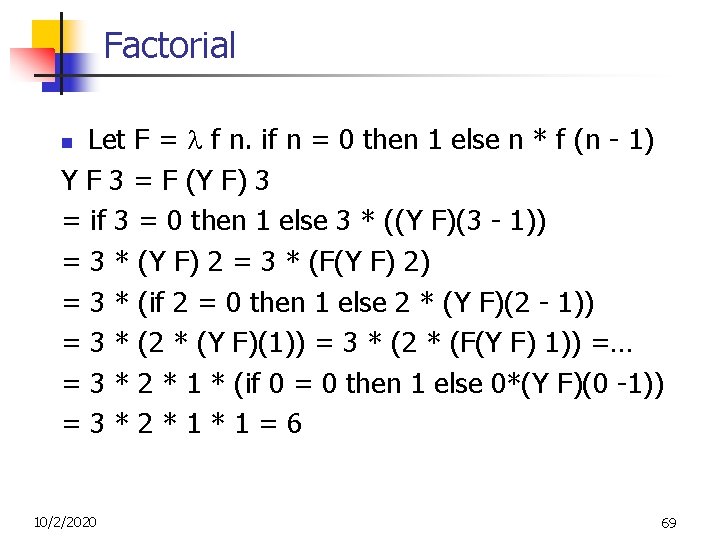
Factorial Let F = f n. if n = 0 then 1 else n * f (n - 1) Y F 3 = F (Y F) 3 = if 3 = 0 then 1 else 3 * ((Y F)(3 - 1)) = 3 * (Y F) 2 = 3 * (F(Y F) 2) = 3 * (if 2 = 0 then 1 else 2 * (Y F)(2 - 1)) = 3 * (2 * (Y F)(1)) = 3 * (2 * (F(Y F) 1)) =… = 3 * 2 * 1 * (if 0 = 0 then 1 else 0*(Y F)(0 -1)) =3*2*1*1=6 n 10/2/2020 69
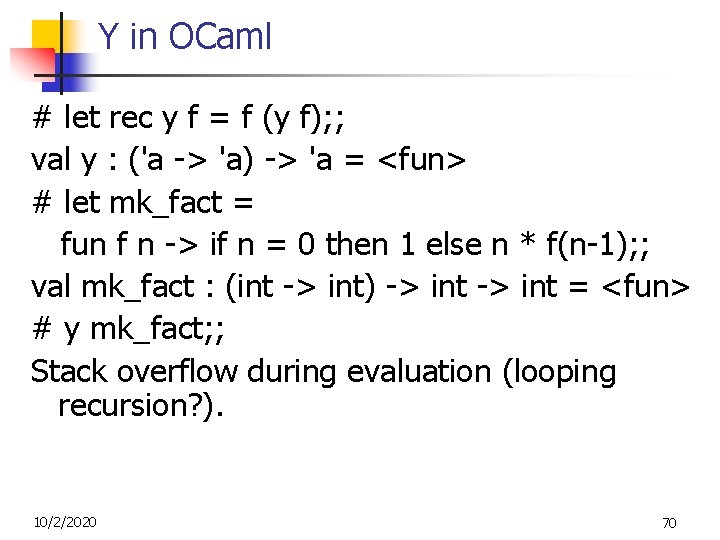
Y in OCaml # let rec y f = f (y f); ; val y : ('a -> 'a) -> 'a = <fun> # let mk_fact = fun f n -> if n = 0 then 1 else n * f(n-1); ; val mk_fact : (int -> int) -> int = <fun> # y mk_fact; ; Stack overflow during evaluation (looping recursion? ). 10/2/2020 70
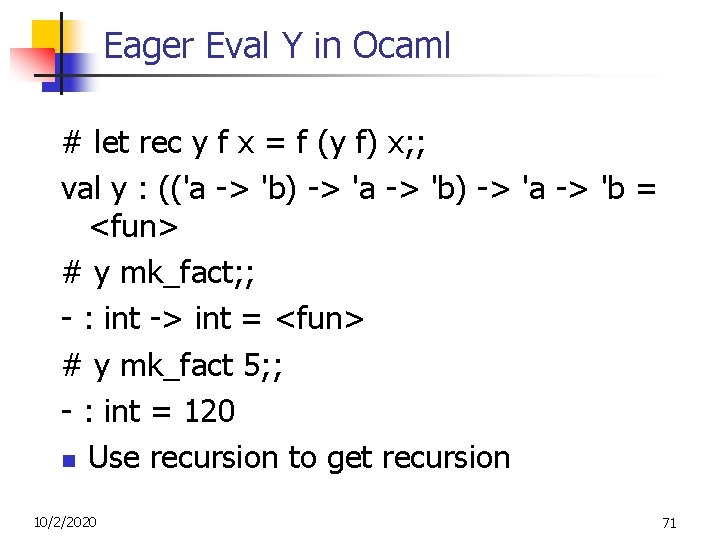
Eager Eval Y in Ocaml # let rec y f x = f (y f) x; ; val y : (('a -> 'b) -> 'a -> 'b = <fun> # y mk_fact; ; - : int -> int = <fun> # y mk_fact 5; ; - : int = 120 n Use recursion to get recursion 10/2/2020 71
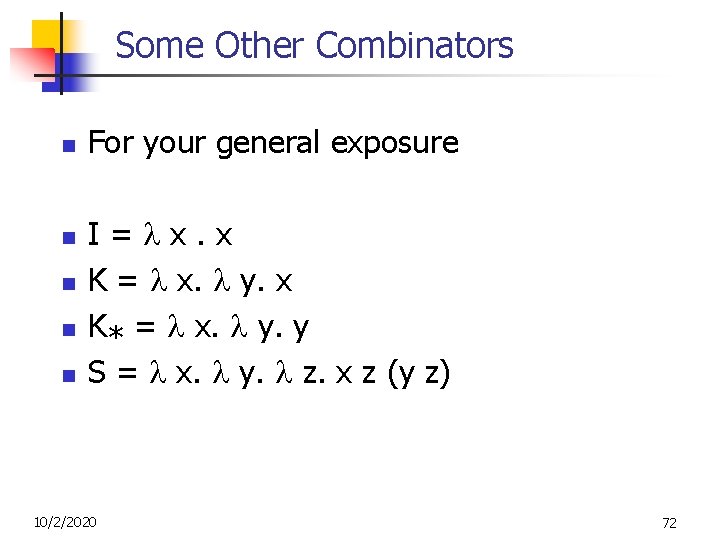
Some Other Combinators n n n For your general exposure I= x. x K = x. y. x K* = x. y. y S = x. y. z. x z (y z) 10/2/2020 72