
Programming Languages and Compilers CS 421 Elsa L

![Nested Recursive Type Values # let ltree = Tree. Node(5, [Tree. Node (3, []);](https://slidetodoc.com/presentation_image/8b729c651ebcf14fa97172f70204e569/image-42.jpg "Nested Recursive Type Values # let ltree = Tree. Node(5, [Tree. Node (3, []);")
- Slides: 59
Programming Languages and Compilers (CS 421) Elsa L Gunter 2112 SC, UIUC http: //www. cs. uiuc. edu/class/cs 421/ Based in part on slides by Mattox Beckman, as updated by Vikram Adve and Gul Agha 9/25/2020 1
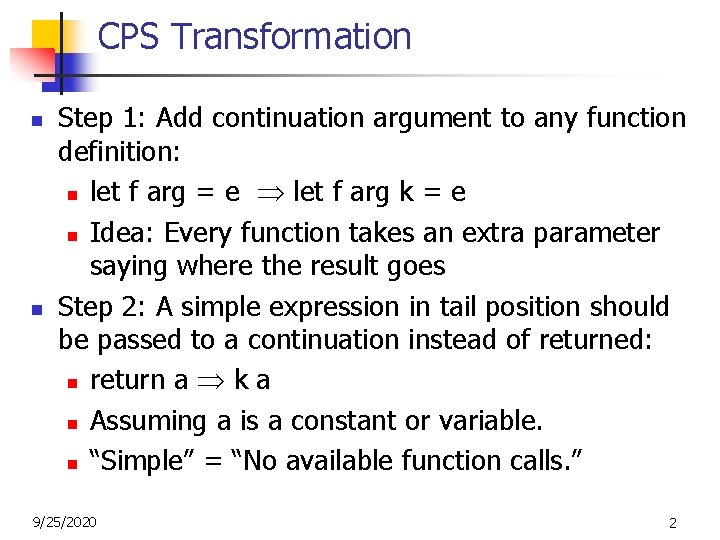
CPS Transformation n n Step 1: Add continuation argument to any function definition: n let f arg = e let f arg k = e n Idea: Every function takes an extra parameter saying where the result goes Step 2: A simple expression in tail position should be passed to a continuation instead of returned: n return a k a n Assuming a is a constant or variable. n “Simple” = “No available function calls. ” 9/25/2020 2
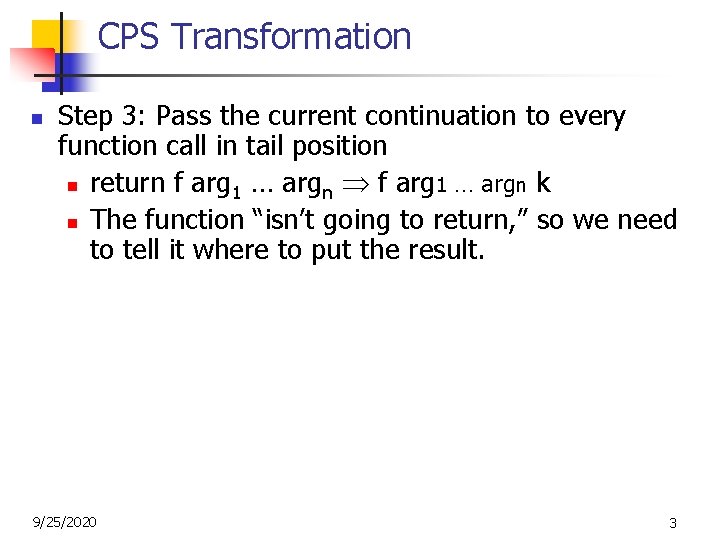
CPS Transformation n Step 3: Pass the current continuation to every function call in tail position n return f arg 1 … argn k n The function “isn’t going to return, ” so we need to tell it where to put the result. 9/25/2020 3
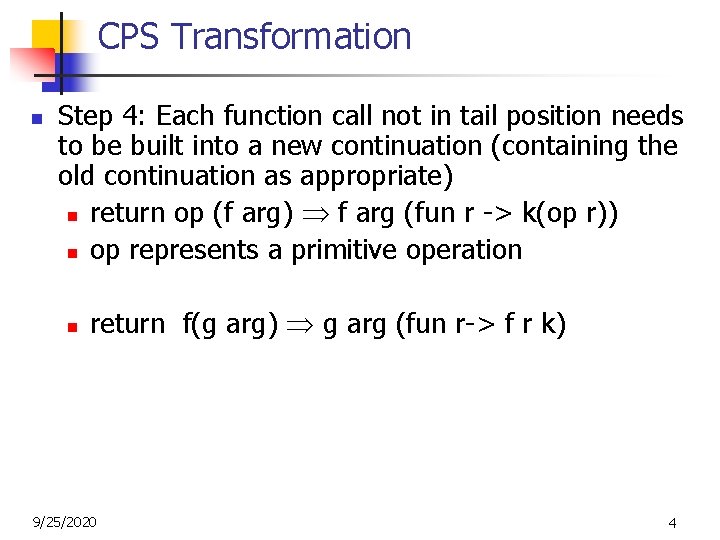
CPS Transformation n Step 4: Each function call not in tail position needs to be built into a new continuation (containing the old continuation as appropriate) n return op (f arg) f arg (fun r -> k(op r)) n op represents a primitive operation n return f(g arg) g arg (fun r-> f r k) 9/25/2020 4
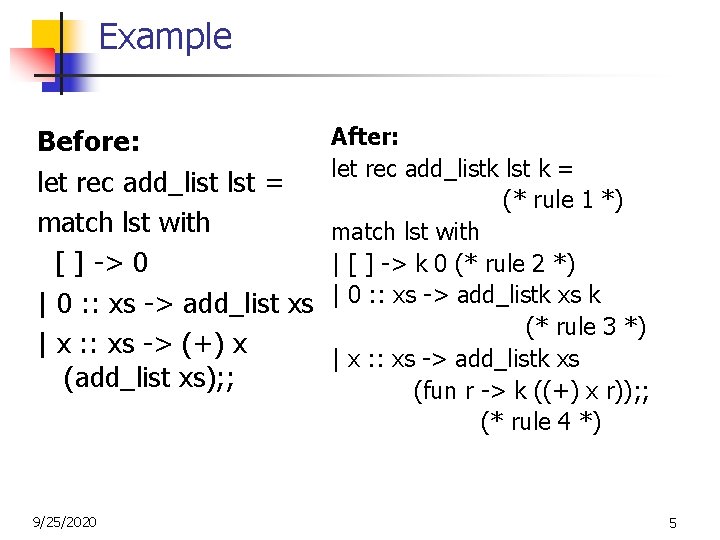
Example Before: let rec add_list lst = match lst with [ ] -> 0 | 0 : : xs -> add_list xs | x : : xs -> (+) x (add_list xs); ; 9/25/2020 After: let rec add_listk lst k = (* rule 1 *) match lst with | [ ] -> k 0 (* rule 2 *) | 0 : : xs -> add_listk xs k (* rule 3 *) | x : : xs -> add_listk xs (fun r -> k ((+) x r)); ; (* rule 4 *) 5
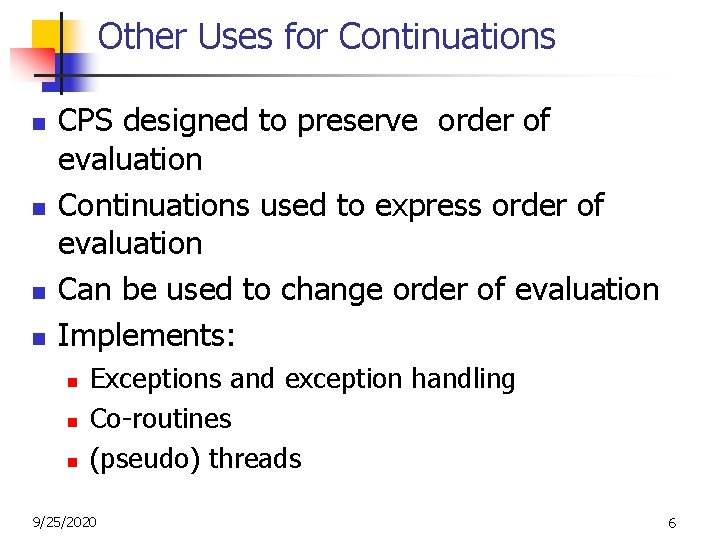
Other Uses for Continuations n n CPS designed to preserve order of evaluation Continuations used to express order of evaluation Can be used to change order of evaluation Implements: n n n Exceptions and exception handling Co-routines (pseudo) threads 9/25/2020 6
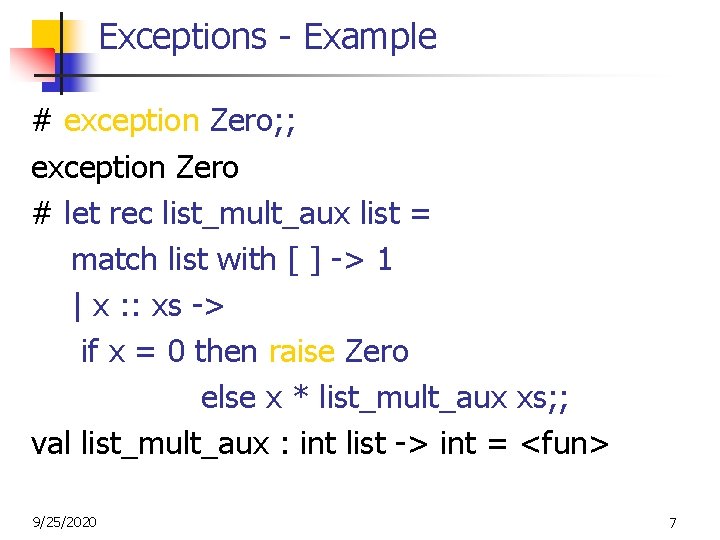
Exceptions - Example # exception Zero; ; exception Zero # let rec list_mult_aux list = match list with [ ] -> 1 | x : : xs -> if x = 0 then raise Zero else x * list_mult_aux xs; ; val list_mult_aux : int list -> int = <fun> 9/25/2020 7
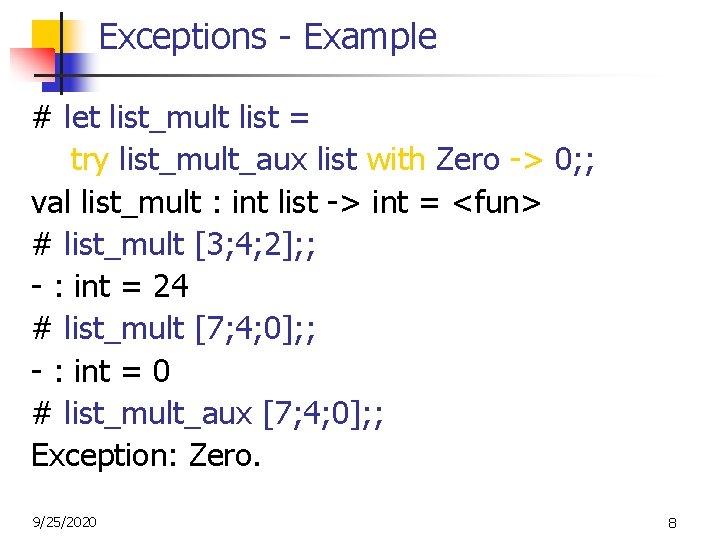
Exceptions - Example # let list_mult list = try list_mult_aux list with Zero -> 0; ; val list_mult : int list -> int = <fun> # list_mult [3; 4; 2]; ; - : int = 24 # list_mult [7; 4; 0]; ; - : int = 0 # list_mult_aux [7; 4; 0]; ; Exception: Zero. 9/25/2020 8
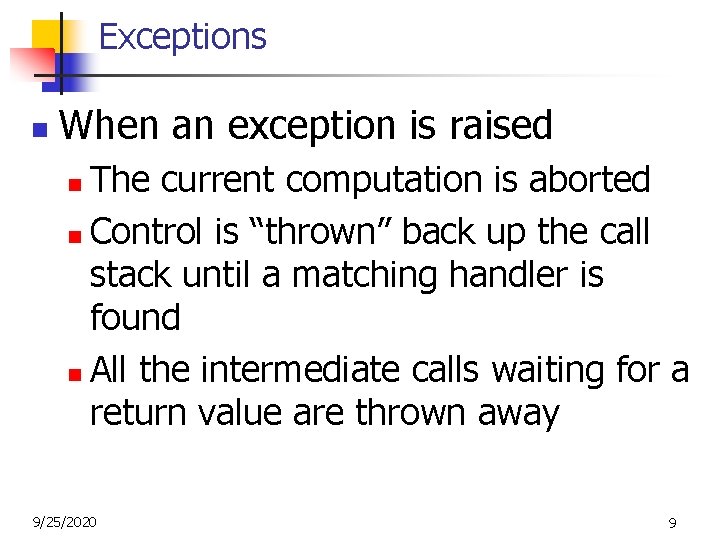
Exceptions n When an exception is raised The current computation is aborted n Control is “thrown” back up the call stack until a matching handler is found n All the intermediate calls waiting for a return value are thrown away n 9/25/2020 9
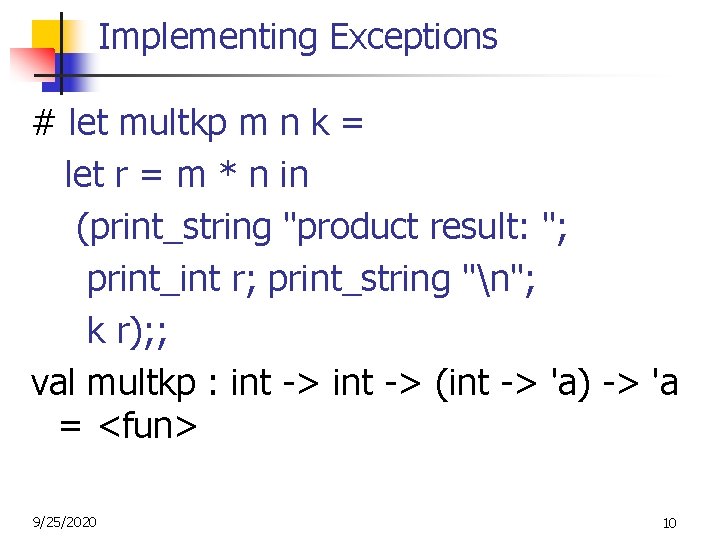
Implementing Exceptions # let multkp m n k = let r = m * n in (print_string "product result: "; print_int r; print_string "n"; k r); ; val multkp : int -> (int -> 'a) -> 'a = <fun> 9/25/2020 10
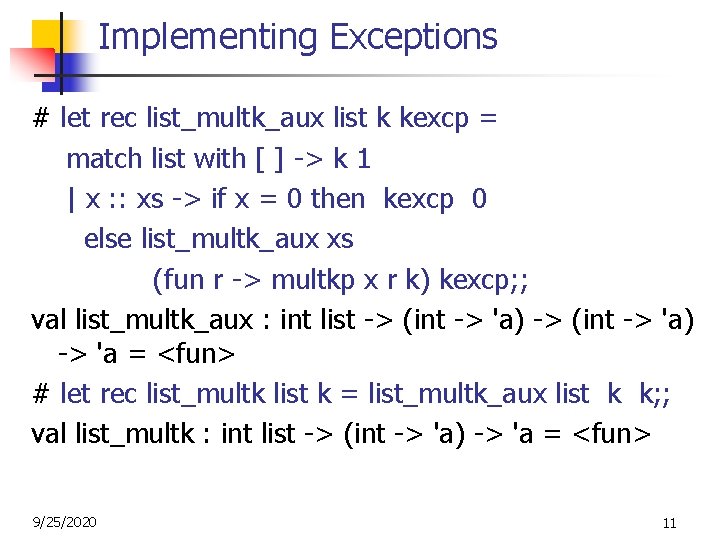
Implementing Exceptions # let rec list_multk_aux list k kexcp = match list with [ ] -> k 1 | x : : xs -> if x = 0 then kexcp 0 else list_multk_aux xs (fun r -> multkp x r k) kexcp; ; val list_multk_aux : int list -> (int -> 'a) -> 'a = <fun> # let rec list_multk list k = list_multk_aux list k k; ; val list_multk : int list -> (int -> 'a) -> 'a = <fun> 9/25/2020 11
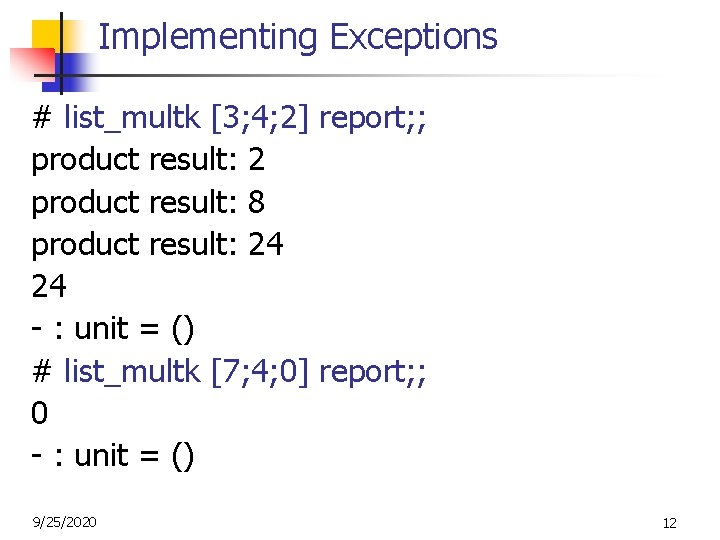
Implementing Exceptions # list_multk [3; 4; 2] report; ; product result: 2 product result: 8 product result: 24 24 - : unit = () # list_multk [7; 4; 0] report; ; 0 - : unit = () 9/25/2020 12
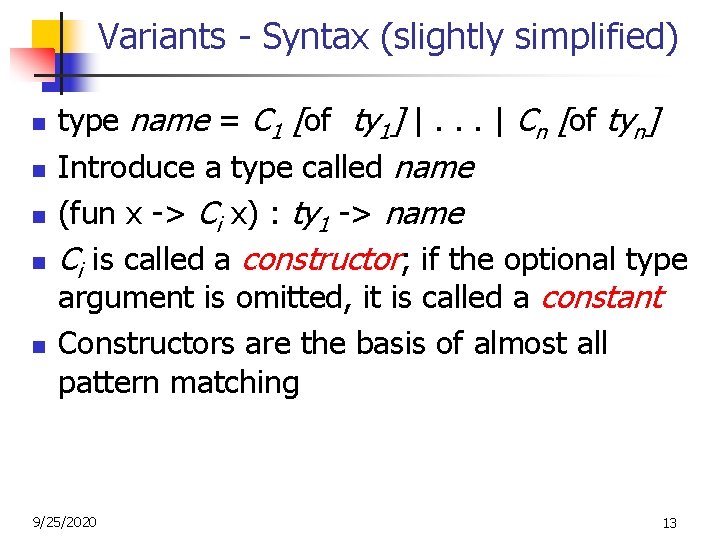
Variants - Syntax (slightly simplified) n n n type name = C 1 [of ty 1] |. . . | Cn [of tyn] Introduce a type called name (fun x -> Ci x) : ty 1 -> name Ci is called a constructor; if the optional type argument is omitted, it is called a constant Constructors are the basis of almost all pattern matching 9/25/2020 13
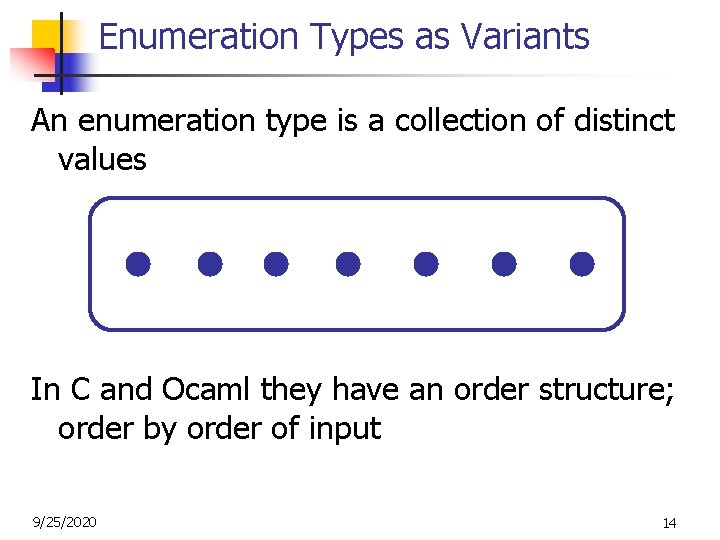
Enumeration Types as Variants An enumeration type is a collection of distinct values In C and Ocaml they have an order structure; order by order of input 9/25/2020 14
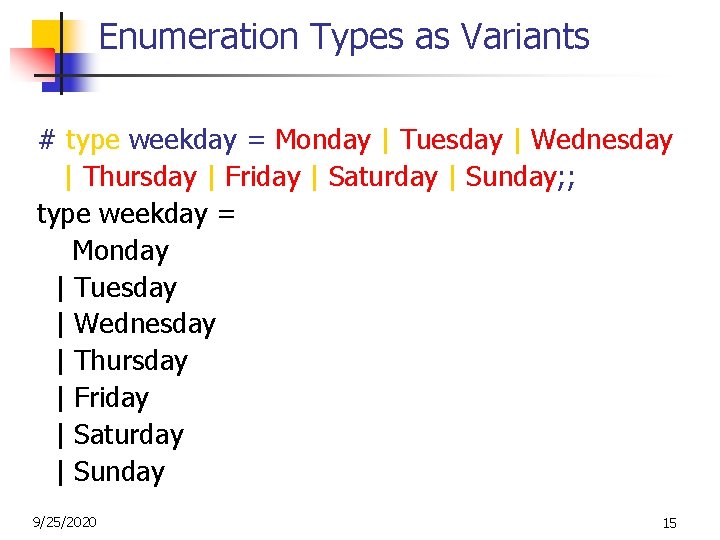
Enumeration Types as Variants # type weekday = Monday | Tuesday | Wednesday | Thursday | Friday | Saturday | Sunday; ; type weekday = Monday | Tuesday | Wednesday | Thursday | Friday | Saturday | Sunday 9/25/2020 15
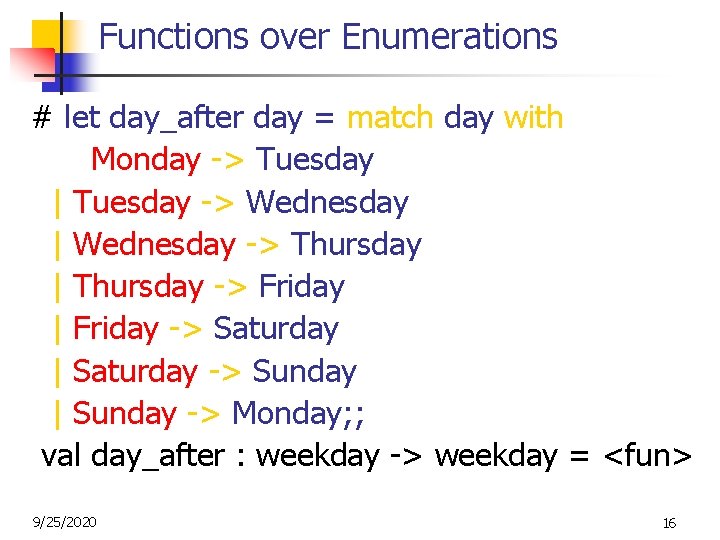
Functions over Enumerations # let day_after day = match day with Monday -> Tuesday | Tuesday -> Wednesday | Wednesday -> Thursday | Thursday -> Friday | Friday -> Saturday | Saturday -> Sunday | Sunday -> Monday; ; val day_after : weekday -> weekday = <fun> 9/25/2020 16
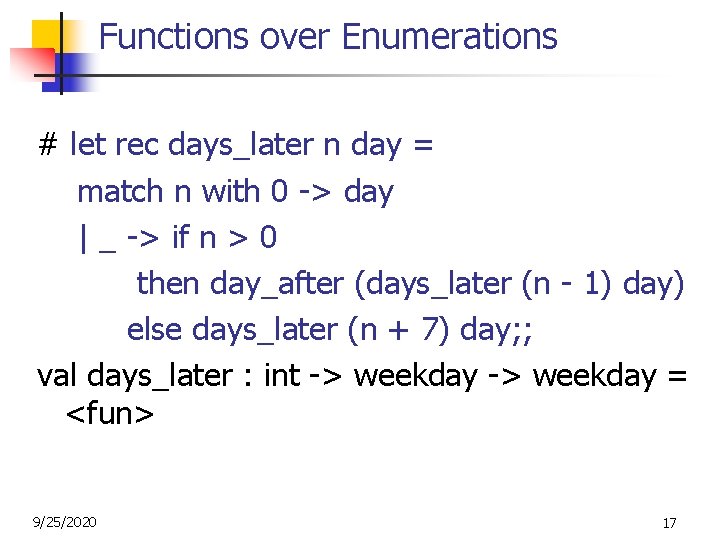
Functions over Enumerations # let rec days_later n day = match n with 0 -> day | _ -> if n > 0 then day_after (days_later (n - 1) day) else days_later (n + 7) day; ; val days_later : int -> weekday = <fun> 9/25/2020 17
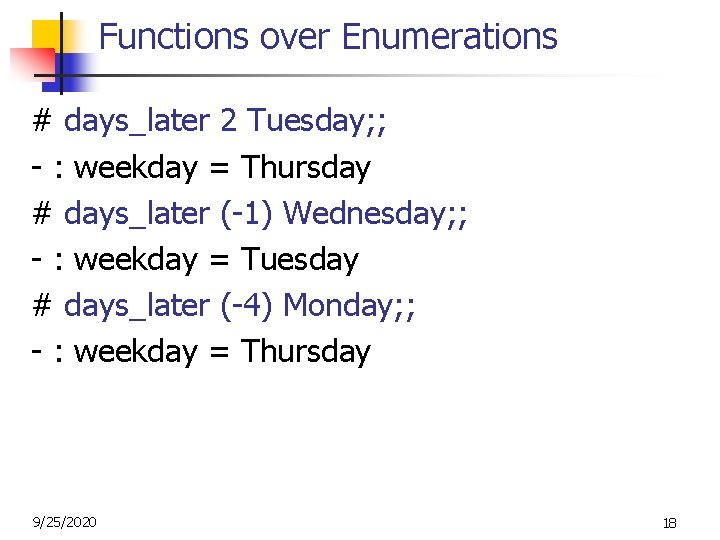
Functions over Enumerations # days_later 2 Tuesday; ; - : weekday = Thursday # days_later (-1) Wednesday; ; - : weekday = Tuesday # days_later (-4) Monday; ; - : weekday = Thursday 9/25/2020 18
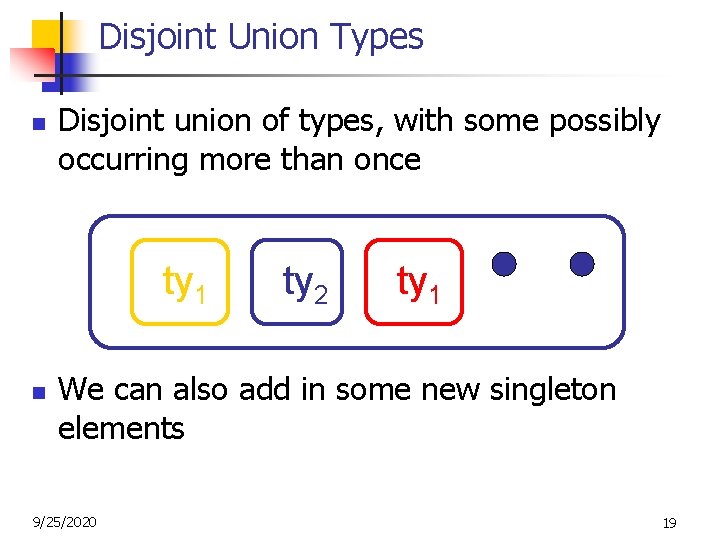
Disjoint Union Types n Disjoint union of types, with some possibly occurring more than once ty 1 n ty 2 ty 1 We can also add in some new singleton elements 9/25/2020 19
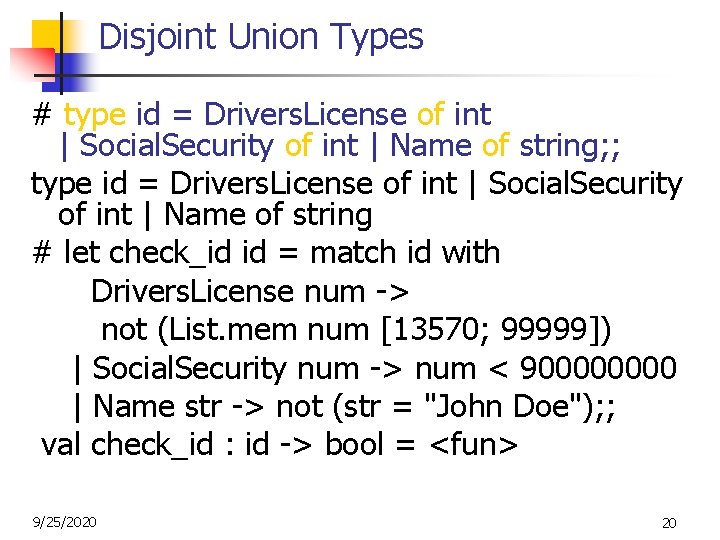
Disjoint Union Types # type id = Drivers. License of int | Social. Security of int | Name of string; ; type id = Drivers. License of int | Social. Security of int | Name of string # let check_id id = match id with Drivers. License num -> not (List. mem num [13570; 99999]) | Social. Security num -> num < 90000 | Name str -> not (str = "John Doe"); ; val check_id : id -> bool = <fun> 9/25/2020 20
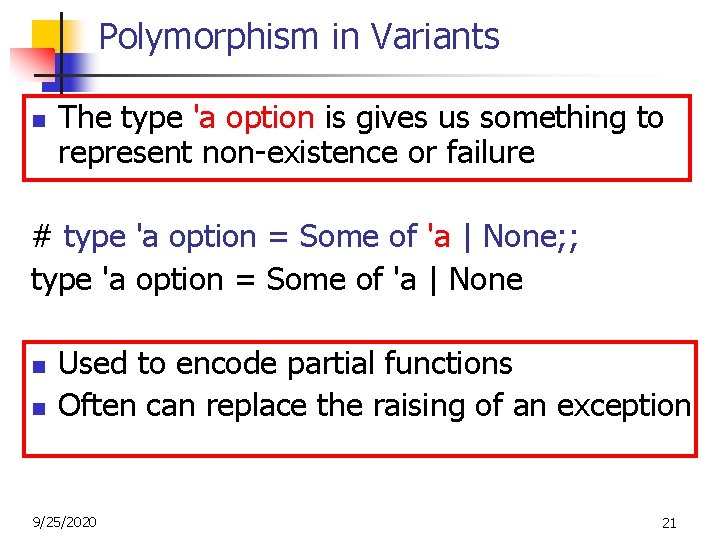
Polymorphism in Variants n The type 'a option is gives us something to represent non-existence or failure # type 'a option = Some of 'a | None; ; type 'a option = Some of 'a | None n n Used to encode partial functions Often can replace the raising of an exception 9/25/2020 21
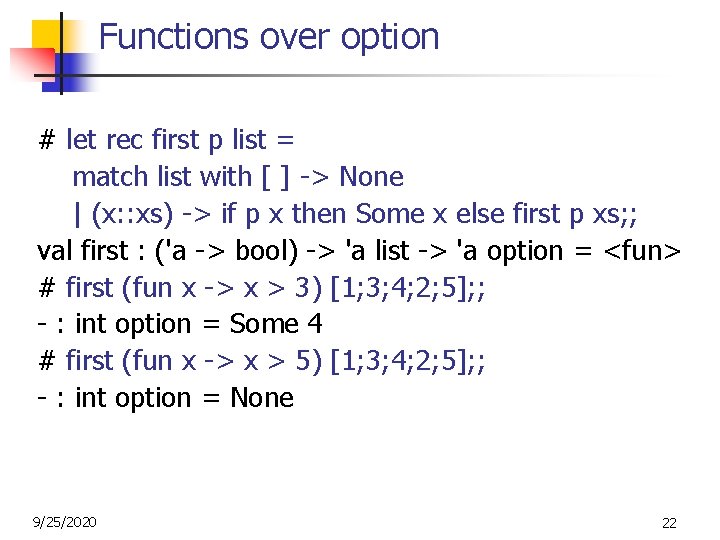
Functions over option # let rec first p list = match list with [ ] -> None | (x: : xs) -> if p x then Some x else first p xs; ; val first : ('a -> bool) -> 'a list -> 'a option = <fun> # first (fun x -> x > 3) [1; 3; 4; 2; 5]; ; - : int option = Some 4 # first (fun x -> x > 5) [1; 3; 4; 2; 5]; ; - : int option = None 9/25/2020 22
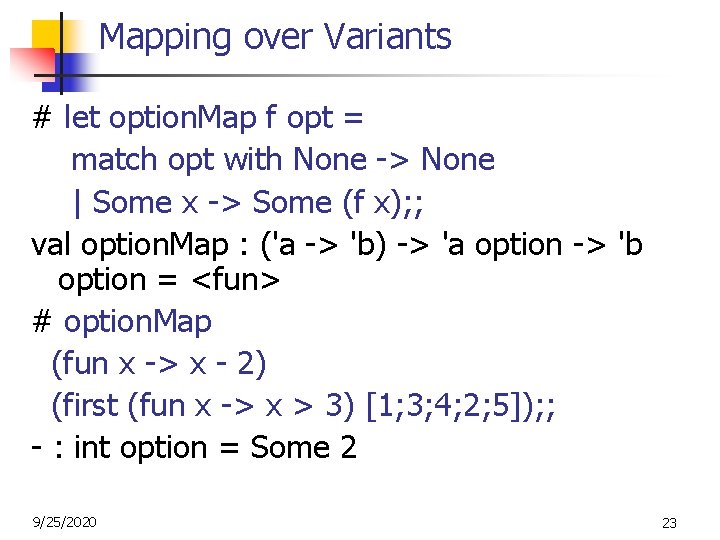
Mapping over Variants # let option. Map f opt = match opt with None -> None | Some x -> Some (f x); ; val option. Map : ('a -> 'b) -> 'a option -> 'b option = <fun> # option. Map (fun x -> x - 2) (first (fun x -> x > 3) [1; 3; 4; 2; 5]); ; - : int option = Some 2 9/25/2020 23
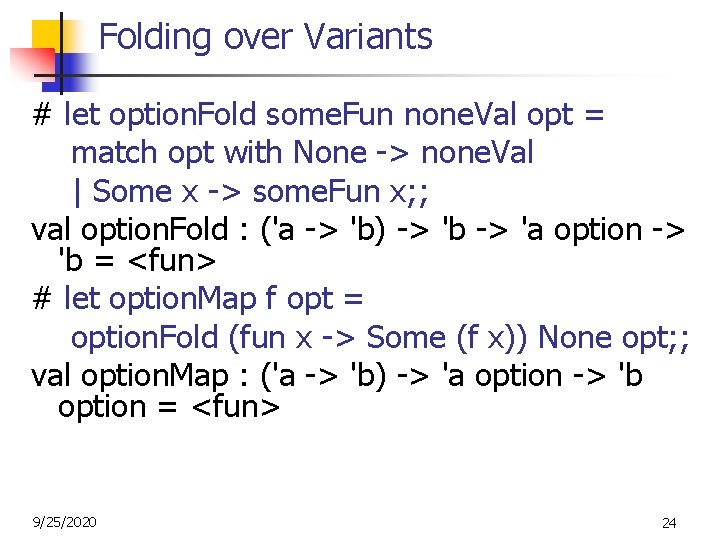
Folding over Variants # let option. Fold some. Fun none. Val opt = match opt with None -> none. Val | Some x -> some. Fun x; ; val option. Fold : ('a -> 'b) -> 'b -> 'a option -> 'b = <fun> # let option. Map f opt = option. Fold (fun x -> Some (f x)) None opt; ; val option. Map : ('a -> 'b) -> 'a option -> 'b option = <fun> 9/25/2020 24
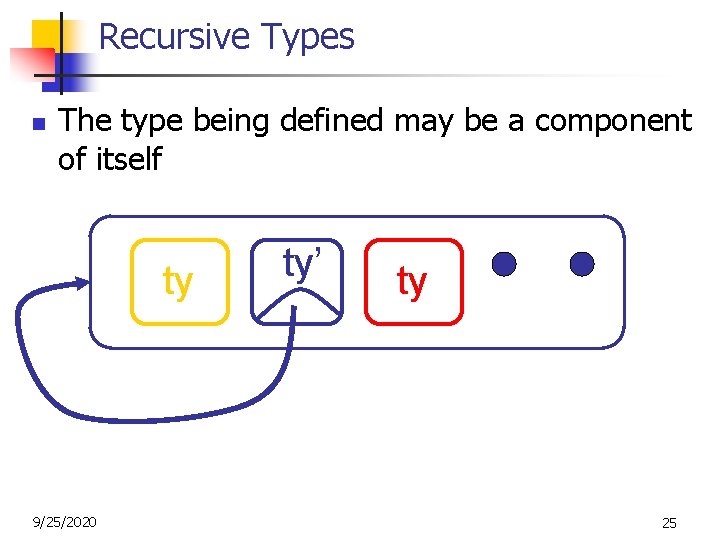
Recursive Types n The type being defined may be a component of itself ty 9/25/2020 ty’ ty 25
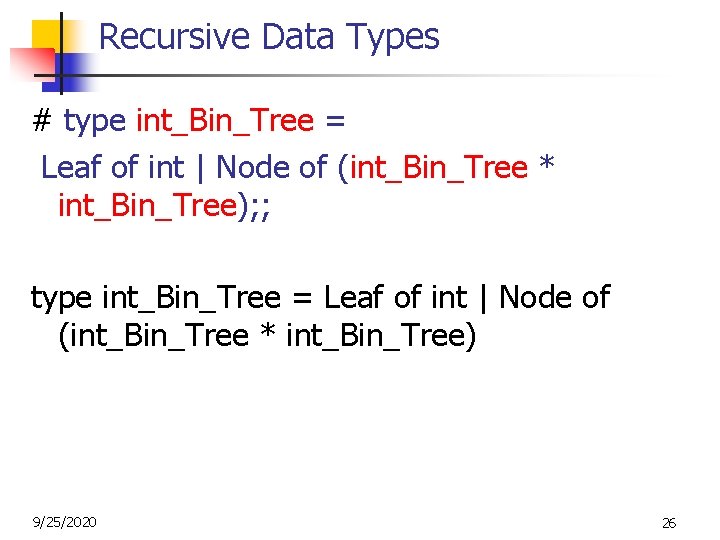
Recursive Data Types # type int_Bin_Tree = Leaf of int | Node of (int_Bin_Tree * int_Bin_Tree); ; type int_Bin_Tree = Leaf of int | Node of (int_Bin_Tree * int_Bin_Tree) 9/25/2020 26
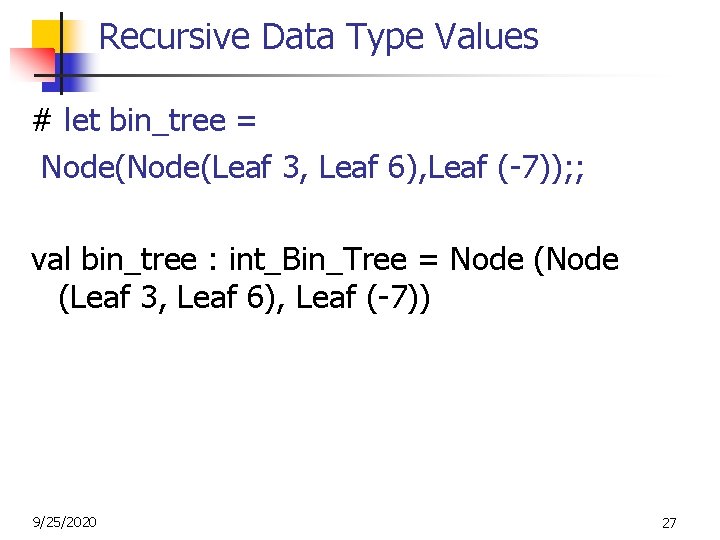
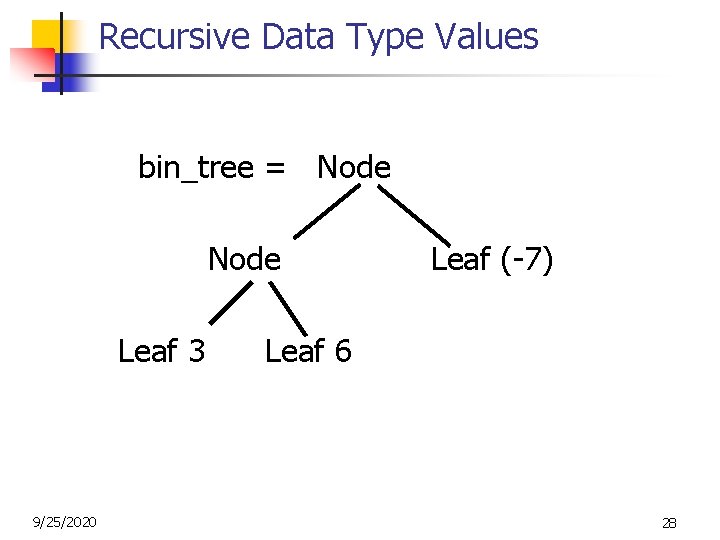
Recursive Data Type Values # let bin_tree = Node(Leaf 3, Leaf 6), Leaf (-7)); ; val bin_tree : int_Bin_Tree = Node (Leaf 3, Leaf 6), Leaf (-7)) 9/25/2020 27
Recursive Data Type Values bin_tree = Node Leaf 3 9/25/2020 Leaf (-7) Leaf 6 28
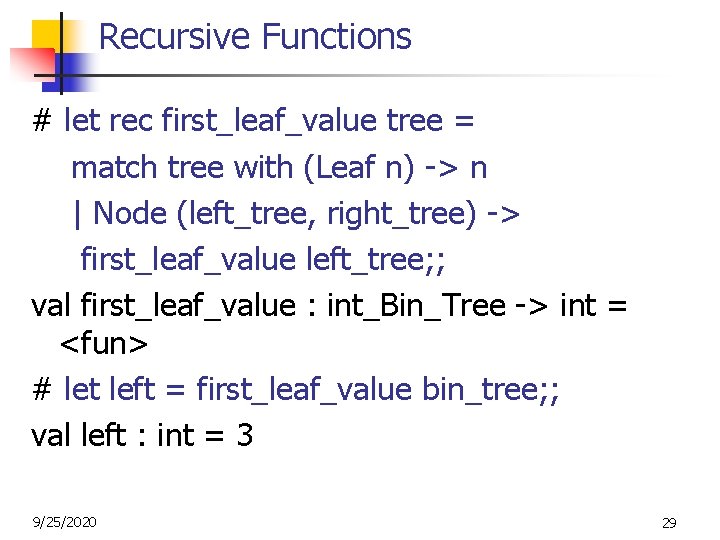
Recursive Functions # let rec first_leaf_value tree = match tree with (Leaf n) -> n | Node (left_tree, right_tree) -> first_leaf_value left_tree; ; val first_leaf_value : int_Bin_Tree -> int = <fun> # let left = first_leaf_value bin_tree; ; val left : int = 3 9/25/2020 29
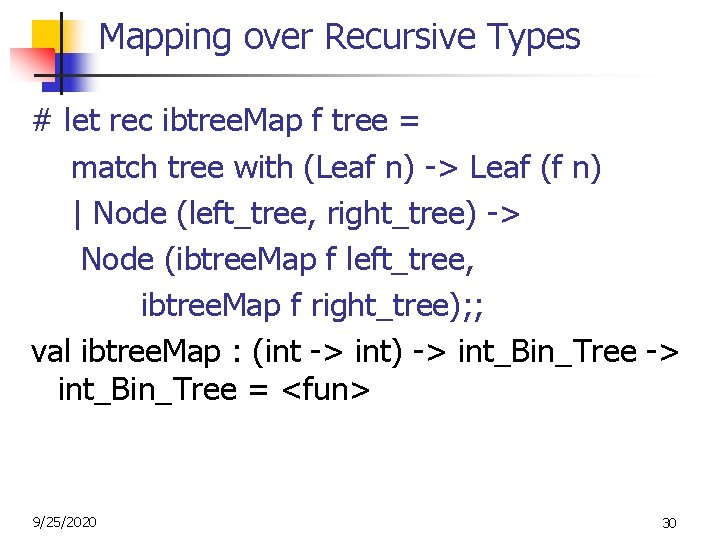
Mapping over Recursive Types # let rec ibtree. Map f tree = match tree with (Leaf n) -> Leaf (f n) | Node (left_tree, right_tree) -> Node (ibtree. Map f left_tree, ibtree. Map f right_tree); ; val ibtree. Map : (int -> int) -> int_Bin_Tree = <fun> 9/25/2020 30
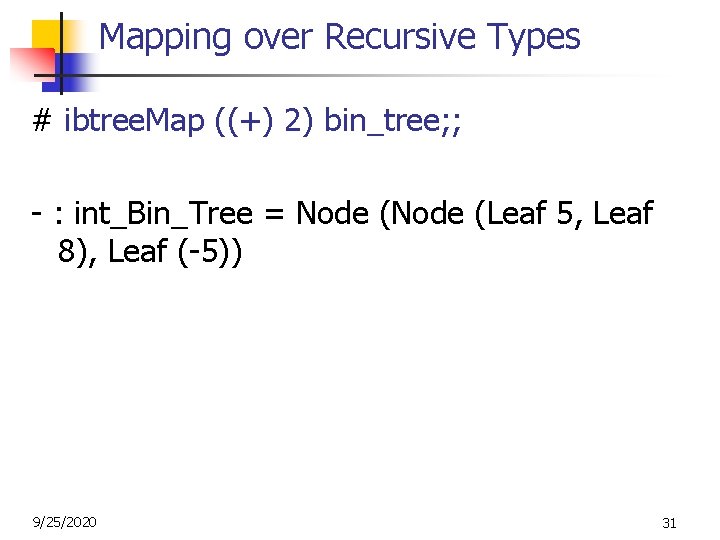
Mapping over Recursive Types # ibtree. Map ((+) 2) bin_tree; ; - : int_Bin_Tree = Node (Leaf 5, Leaf 8), Leaf (-5)) 9/25/2020 31
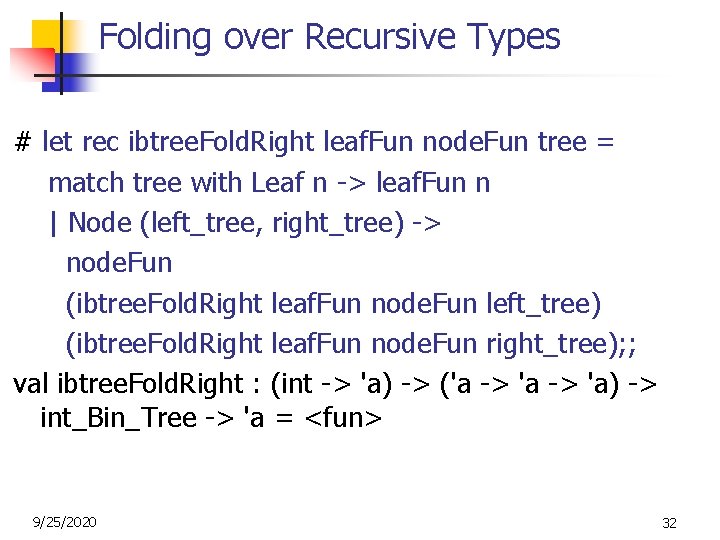
Folding over Recursive Types # let rec ibtree. Fold. Right leaf. Fun node. Fun tree = match tree with Leaf n -> leaf. Fun n | Node (left_tree, right_tree) -> node. Fun (ibtree. Fold. Right leaf. Fun node. Fun left_tree) (ibtree. Fold. Right leaf. Fun node. Fun right_tree); ; val ibtree. Fold. Right : (int -> 'a) -> ('a -> 'a) -> int_Bin_Tree -> 'a = <fun> 9/25/2020 32
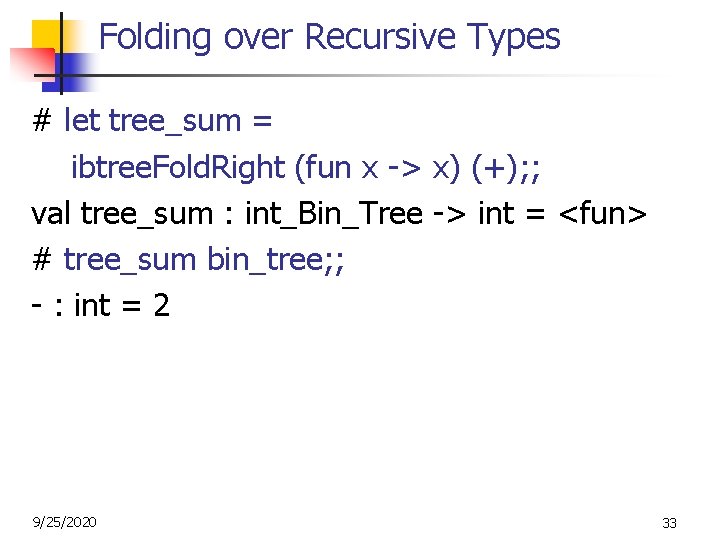
Folding over Recursive Types # let tree_sum = ibtree. Fold. Right (fun x -> x) (+); ; val tree_sum : int_Bin_Tree -> int = <fun> # tree_sum bin_tree; ; - : int = 2 9/25/2020 33
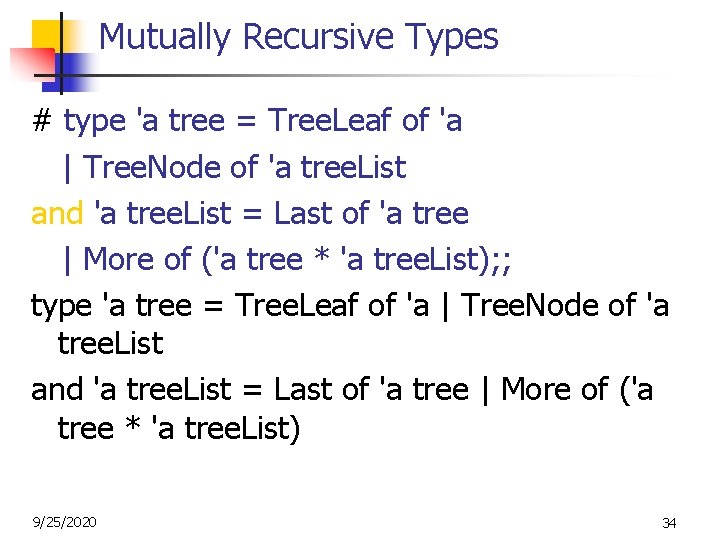
Mutually Recursive Types # type 'a tree = Tree. Leaf of 'a | Tree. Node of 'a tree. List and 'a tree. List = Last of 'a tree | More of ('a tree * 'a tree. List); ; type 'a tree = Tree. Leaf of 'a | Tree. Node of 'a tree. List and 'a tree. List = Last of 'a tree | More of ('a tree * 'a tree. List) 9/25/2020 34
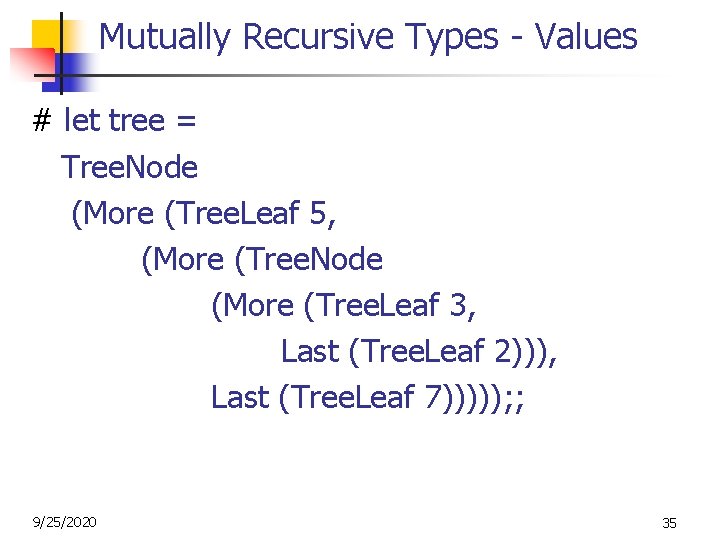
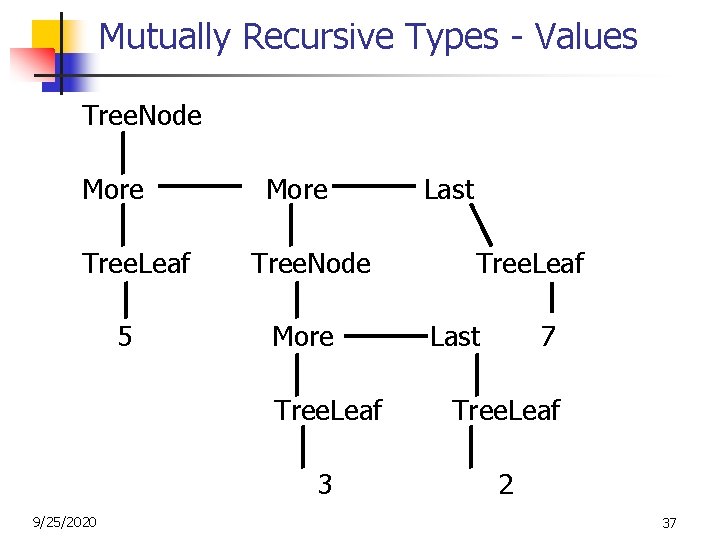
Mutually Recursive Types - Values # let tree = Tree. Node (More (Tree. Leaf 5, (More (Tree. Node (More (Tree. Leaf 3, Last (Tree. Leaf 2))), Last (Tree. Leaf 7))))); ; 9/25/2020 35
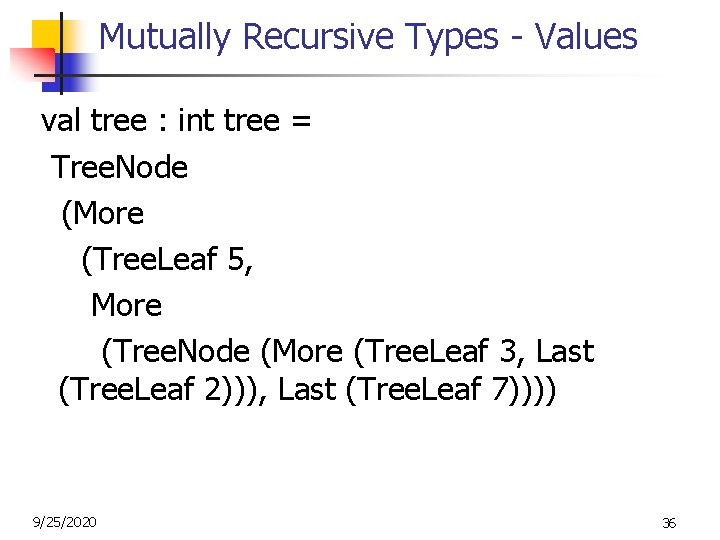
Mutually Recursive Types - Values val tree : int tree = Tree. Node (More (Tree. Leaf 5, More (Tree. Node (More (Tree. Leaf 3, Last (Tree. Leaf 2))), Last (Tree. Leaf 7)))) 9/25/2020 36
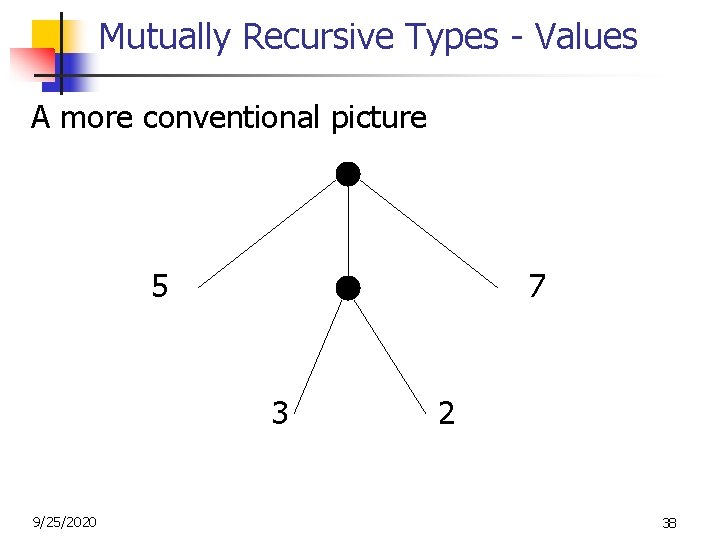
Mutually Recursive Types - Values Tree. Node More Tree. Leaf 5 9/25/2020 More Tree. Node More Last Tree. Leaf Last 7 Tree. Leaf 3 2 37
Mutually Recursive Types - Values A more conventional picture 5 7 3 9/25/2020 2 38
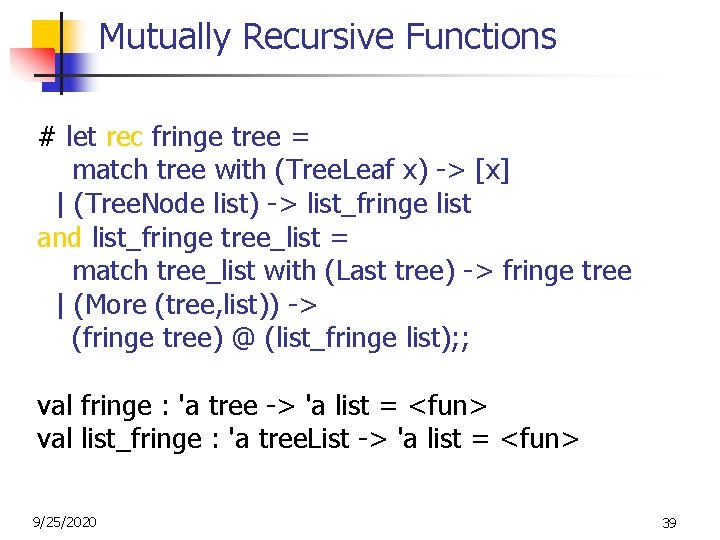
Mutually Recursive Functions # let rec fringe tree = match tree with (Tree. Leaf x) -> [x] | (Tree. Node list) -> list_fringe list and list_fringe tree_list = match tree_list with (Last tree) -> fringe tree | (More (tree, list)) -> (fringe tree) @ (list_fringe list); ; val fringe : 'a tree -> 'a list = <fun> val list_fringe : 'a tree. List -> 'a list = <fun> 9/25/2020 39
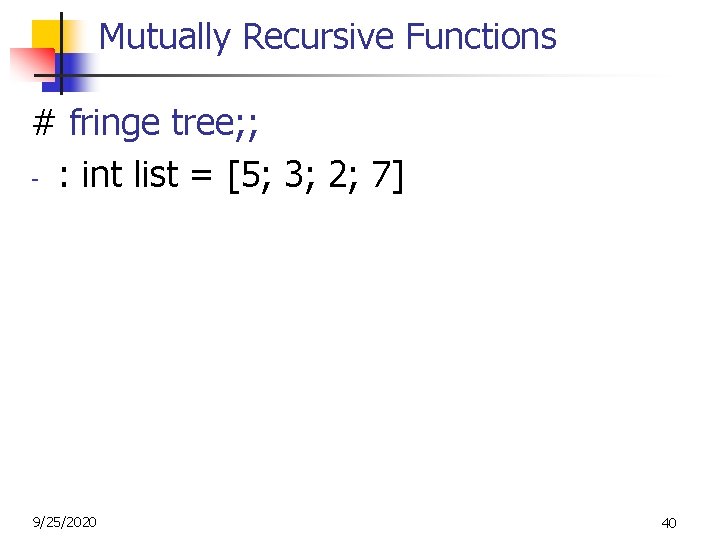
Mutually Recursive Functions # fringe tree; ; - : int list = [5; 3; 2; 7] 9/25/2020 40
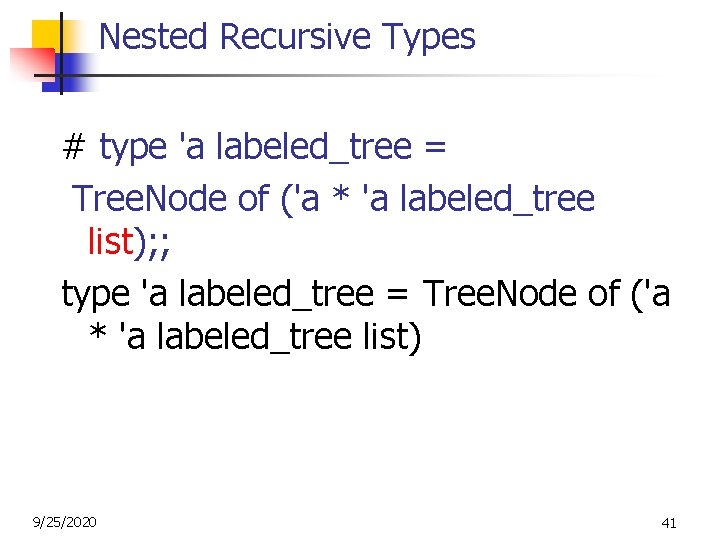
Nested Recursive Types # type 'a labeled_tree = Tree. Node of ('a * 'a labeled_tree list); ; type 'a labeled_tree = Tree. Node of ('a * 'a labeled_tree list) 9/25/2020 41
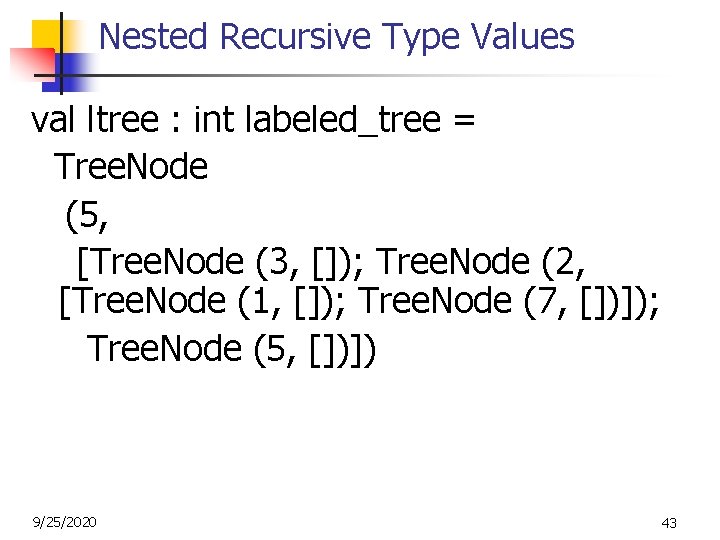
Nested Recursive Type Values # let ltree = Tree. Node(5, [Tree. Node (3, []); Tree. Node (2, [Tree. Node (1, []); Tree. Node (7, [])]); Tree. Node (5, [])]); ; 9/25/2020 42
Nested Recursive Type Values val ltree : int labeled_tree = Tree. Node (5, [Tree. Node (3, []); Tree. Node (2, [Tree. Node (1, []); Tree. Node (7, [])]); Tree. Node (5, [])]) 9/25/2020 43
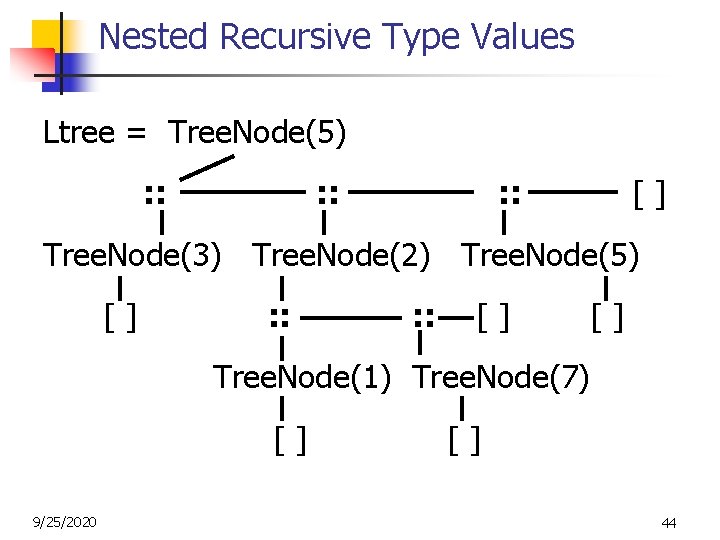
Nested Recursive Type Values Ltree = Tree. Node(5) : : [] Tree. Node(3) Tree. Node(2) Tree. Node(5) [] : : [] [] Tree. Node(1) Tree. Node(7) [] 9/25/2020 [] 44
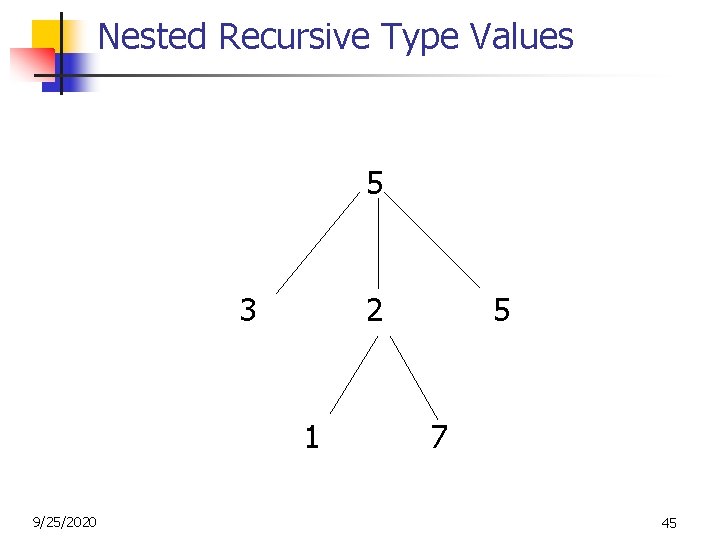
Nested Recursive Type Values 5 3 2 1 9/25/2020 5 7 45
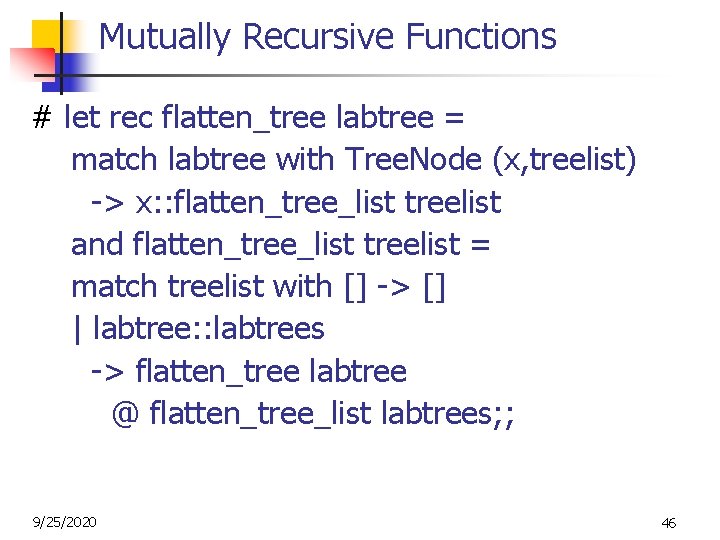
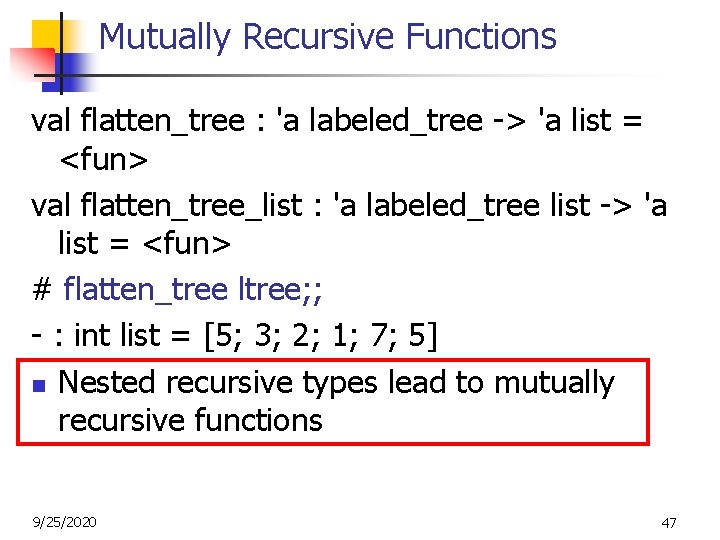
Mutually Recursive Functions # let rec flatten_tree labtree = match labtree with Tree. Node (x, treelist) -> x: : flatten_tree_list treelist and flatten_tree_list treelist = match treelist with [] -> [] | labtree: : labtrees -> flatten_tree labtree @ flatten_tree_list labtrees; ; 9/25/2020 46
Mutually Recursive Functions val flatten_tree : 'a labeled_tree -> 'a list = <fun> val flatten_tree_list : 'a labeled_tree list -> 'a list = <fun> # flatten_tree ltree; ; - : int list = [5; 3; 2; 1; 7; 5] n Nested recursive types lead to mutually recursive functions 9/25/2020 47
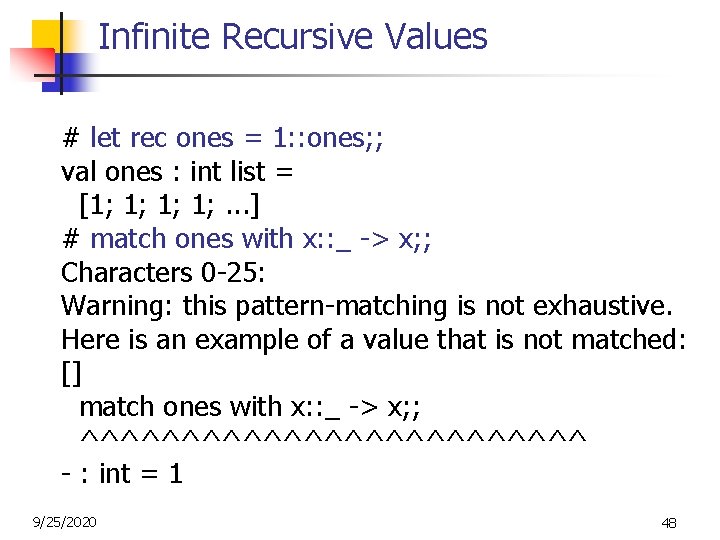
Infinite Recursive Values # let rec ones = 1: : ones; ; val ones : int list = [1; 1; . . . ] # match ones with x: : _ -> x; ; Characters 0 -25: Warning: this pattern-matching is not exhaustive. Here is an example of a value that is not matched: [] match ones with x: : _ -> x; ; ^^^^^^^^^^^^^ - : int = 1 9/25/2020 48
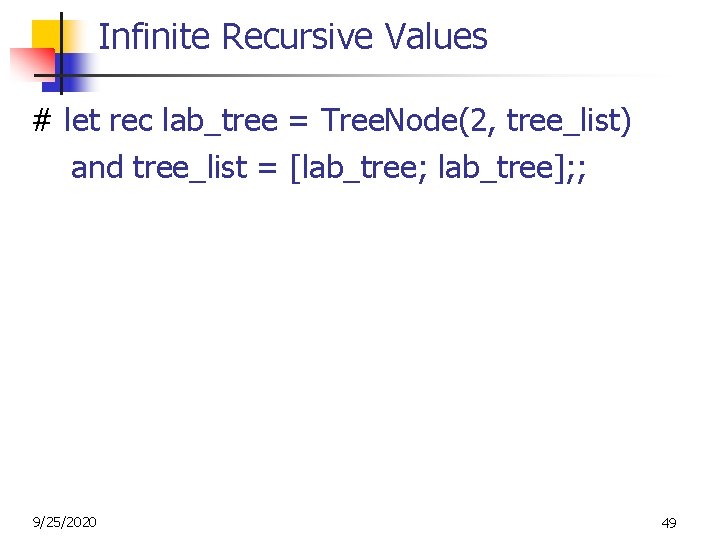
Infinite Recursive Values # let rec lab_tree = Tree. Node(2, tree_list) and tree_list = [lab_tree; lab_tree]; ; 9/25/2020 49
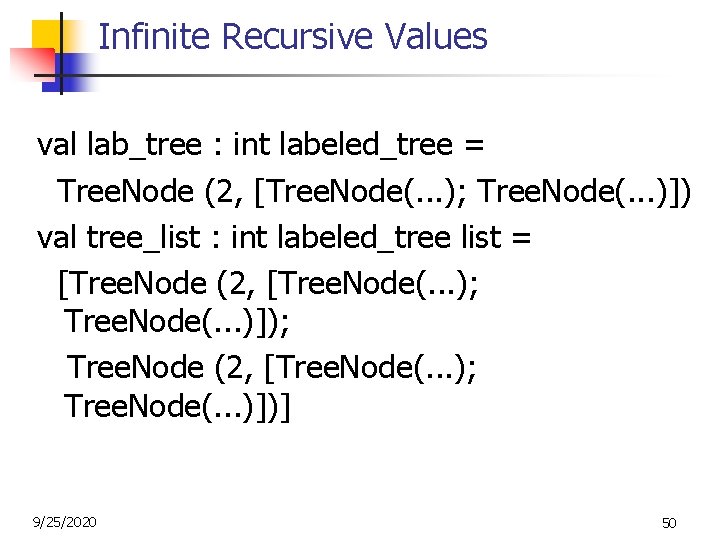
Infinite Recursive Values val lab_tree : int labeled_tree = Tree. Node (2, [Tree. Node(. . . ); Tree. Node(. . . )]) val tree_list : int labeled_tree list = [Tree. Node (2, [Tree. Node(. . . ); Tree. Node(. . . )]); Tree. Node (2, [Tree. Node(. . . ); Tree. Node(. . . )])] 9/25/2020 50
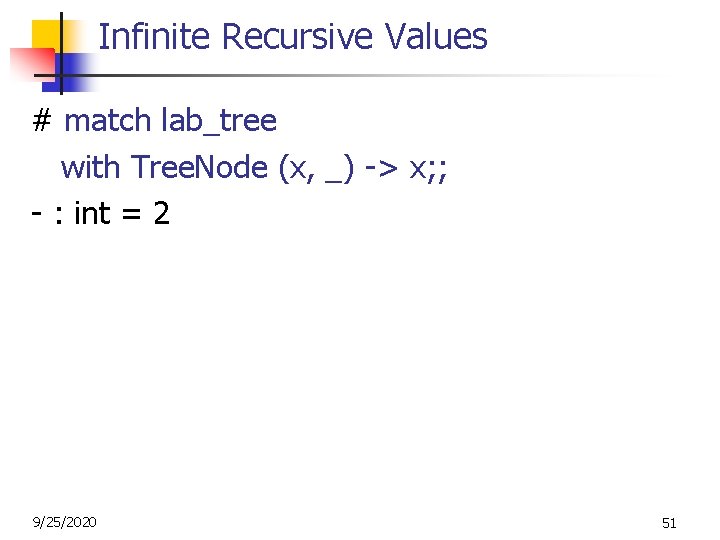
Infinite Recursive Values # match lab_tree with Tree. Node (x, _) -> x; ; - : int = 2 9/25/2020 51
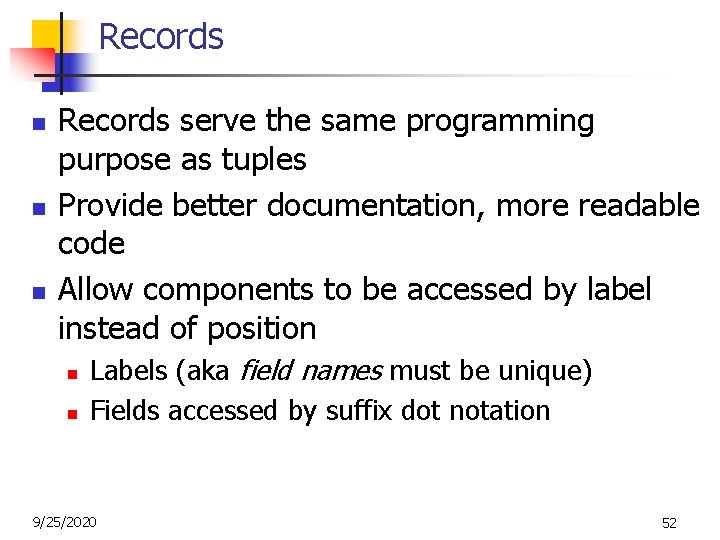
Records n n n Records serve the same programming purpose as tuples Provide better documentation, more readable code Allow components to be accessed by label instead of position n n Labels (aka field names must be unique) Fields accessed by suffix dot notation 9/25/2020 52
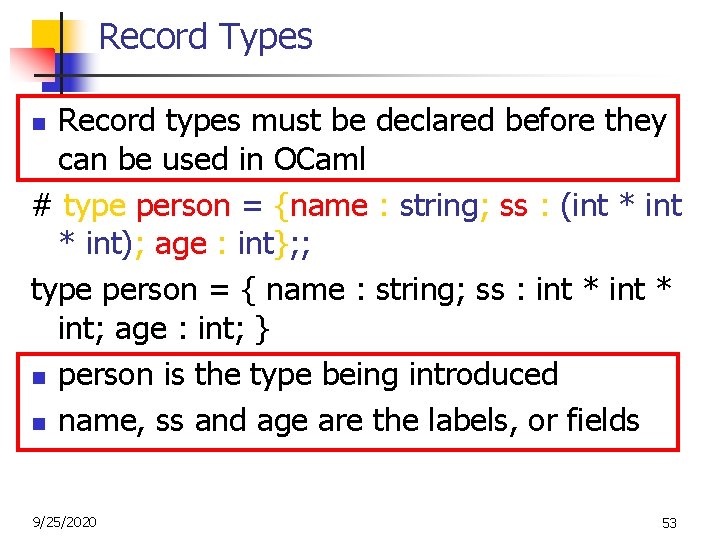
Record Types Record types must be declared before they can be used in OCaml # type person = {name : string; ss : (int * int); age : int}; ; type person = { name : string; ss : int * int; age : int; } n person is the type being introduced n name, ss and age are the labels, or fields n 9/25/2020 53
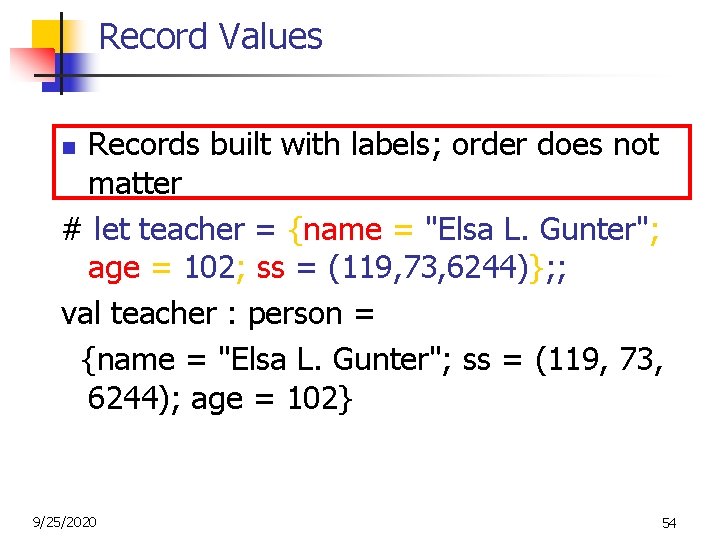
Record Values Records built with labels; order does not matter # let teacher = {name = "Elsa L. Gunter"; age = 102; ss = (119, 73, 6244)}; ; val teacher : person = {name = "Elsa L. Gunter"; ss = (119, 73, 6244); age = 102} n 9/25/2020 54
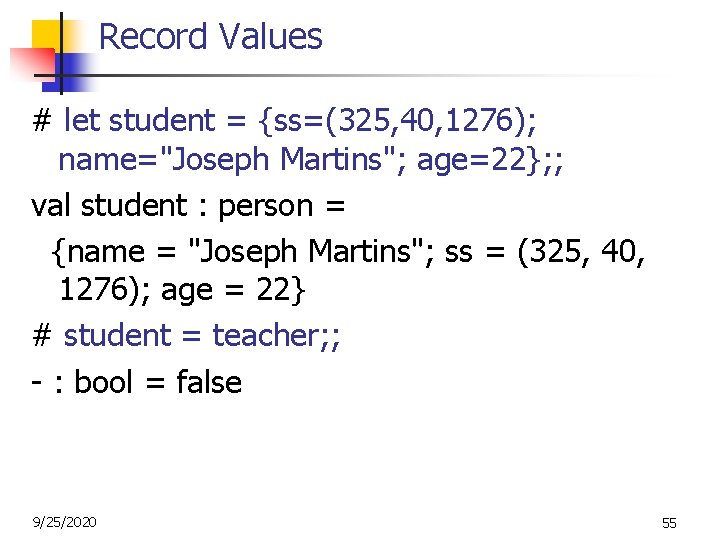
Record Values # let student = {ss=(325, 40, 1276); name="Joseph Martins"; age=22}; ; val student : person = {name = "Joseph Martins"; ss = (325, 40, 1276); age = 22} # student = teacher; ; - : bool = false 9/25/2020 55
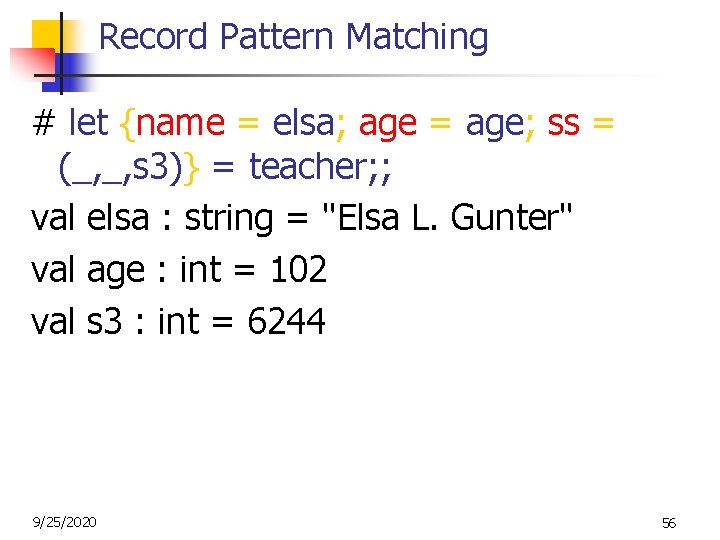
Record Pattern Matching # let {name = elsa; age = age; ss = (_, _, s 3)} = teacher; ; val elsa : string = "Elsa L. Gunter" val age : int = 102 val s 3 : int = 6244 9/25/2020 56
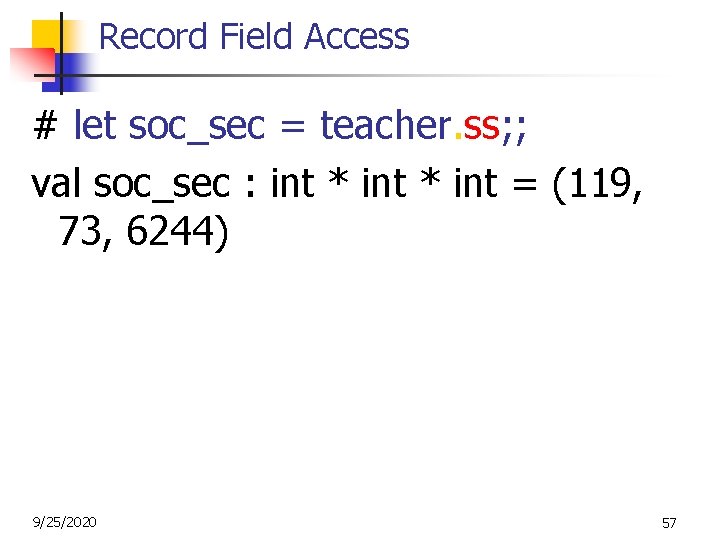
Record Field Access # let soc_sec = teacher. ss; ; val soc_sec : int * int = (119, 73, 6244) 9/25/2020 57
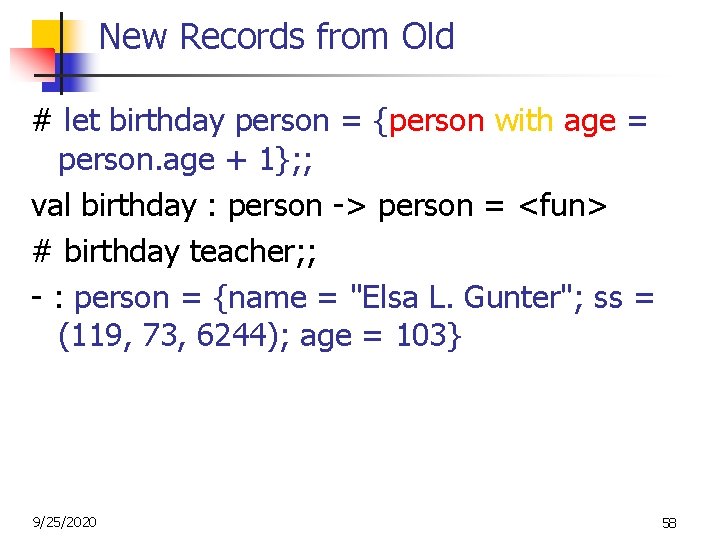
New Records from Old # let birthday person = {person with age = person. age + 1}; ; val birthday : person -> person = <fun> # birthday teacher; ; - : person = {name = "Elsa L. Gunter"; ss = (119, 73, 6244); age = 103} 9/25/2020 58
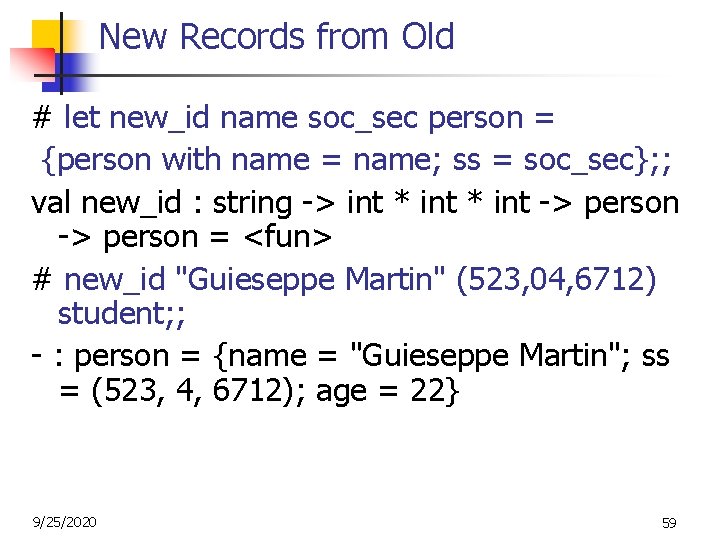
New Records from Old # let new_id name soc_sec person = {person with name = name; ss = soc_sec}; ; val new_id : string -> int * int -> person = <fun> # new_id "Guieseppe Martin" (523, 04, 6712) student; ; - : person = {name = "Guieseppe Martin"; ss = (523, 4, 6712); age = 22} 9/25/2020 59