
Programming Language Seminar http www cs tau ac
![import java. io. *; public class Hello. World { public static void main(String args[])](https://slidetodoc.com/presentation_image_h2/dec7e8ce9f85243ca65d161ebb9b518c/image-4.jpg "import java. io. *; public class Hello. World { public static void main(String args[])")
![[Technicalities] • Expert only part • Show something really interesting beyond the paper/tool](https://slidetodoc.com/presentation_image_h2/dec7e8ce9f85243ca65d161ebb9b518c/image-12.jpg "[Technicalities] • Expert only part • Show something really interesting beyond the paper/tool")

- Slides: 20
Programming Language Seminar http: //www. cs. tau. ac. il/~msagiv/courses/pls 01. html Tue. 14: 00 -16: 00 Shenkar 114 Mooly Sagiv 640 -7606 msagiv@post. tau. ac. il
Outline • Topics • Requirements • How to give a presentation
Programming Languages • Existing – C – Java • Java in a Nutshell (3 rd Edition) • Thinking in Java http: //www. planetpdf. com/ • New – C# – CAML – Vault
import java. io. *; public class Hello. World { public static void main(String args[]) { System. out. println("Hello world from Java"); System. out. println("Press 'Enter' to exit. "); try { int ch = System. in. read(); } catch(IOException e) {} } }
Programming Languages • Existing – C – Java • Java in a Nutshell (3 rd Edition) • Thinking in Java http: //www. planetpdf. com/ • New – C# – CAML – Vault
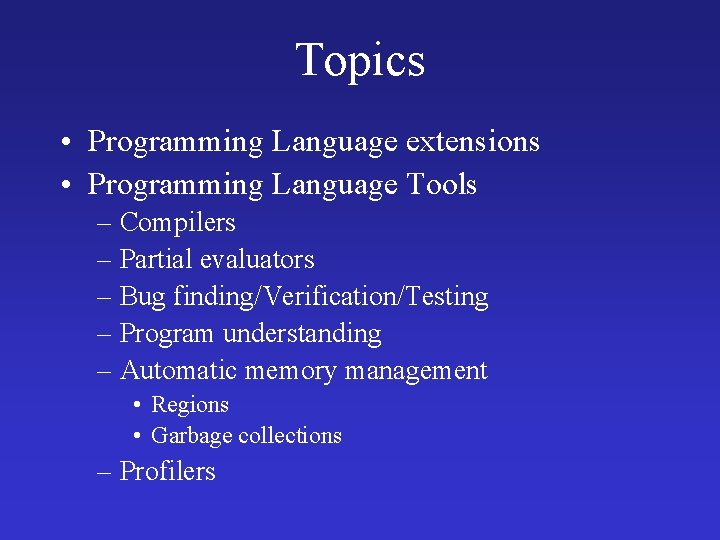
Topics • Programming Language extensions • Programming Language Tools – Compilers – Partial evaluators – Bug finding/Verification/Testing – Program understanding – Automatic memory management • Regions • Garbage collections – Profilers
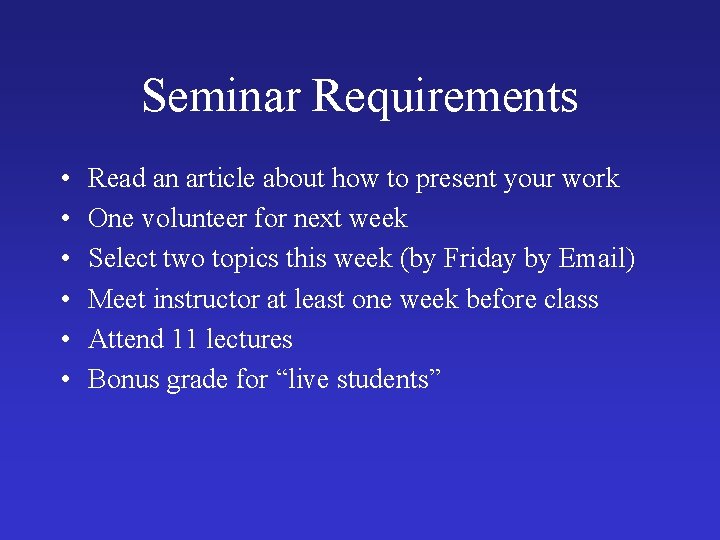
Seminar Requirements • • • Read an article about how to present your work One volunteer for next week Select two topics this week (by Friday by Email) Meet instructor at least one week before class Attend 11 lectures Bonus grade for “live students”
How to give a presentation • What to say and how to say it • Getting through the audience • Visual aids
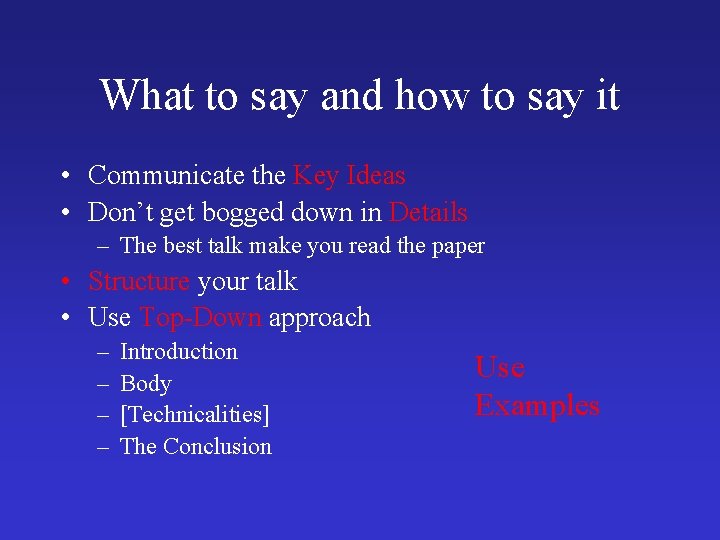
What to say and how to say it • Communicate the Key Ideas • Don’t get bogged down in Details – The best talk make you read the paper • Structure your talk • Use Top-Down approach – – Introduction Body [Technicalities] The Conclusion Use Examples
Introduction • • • Define the problem Motivate the audience Introduce terminology Discuss earlier work Emphasize the contributions [Provide a road map] Use Examples
The body • • • Abstract the major results Explain the significance of the results Explain the main techniques Use enlightening examples Demonstrations are welcome
[Technicalities] • Expert only part • Show something really interesting beyond the paper/tool
The Conclusion • Hindsight is clearer than Foresight • Give open problems/further work • Indicate that your talk is over
Know your audience • Background
Getting Through The Audience • • Use Repetitions Remind, don’t assume Don’t over-run Maintain Eye Contact Control your Voice Control your motion Take care of your appearance
Visual Aids • • Power. Point transparencies Don’t overload transparencies Don’t use too many transparencies Use Overlays Properly Use Color Effectively Use Pictures and Tables The blackboard can be used too
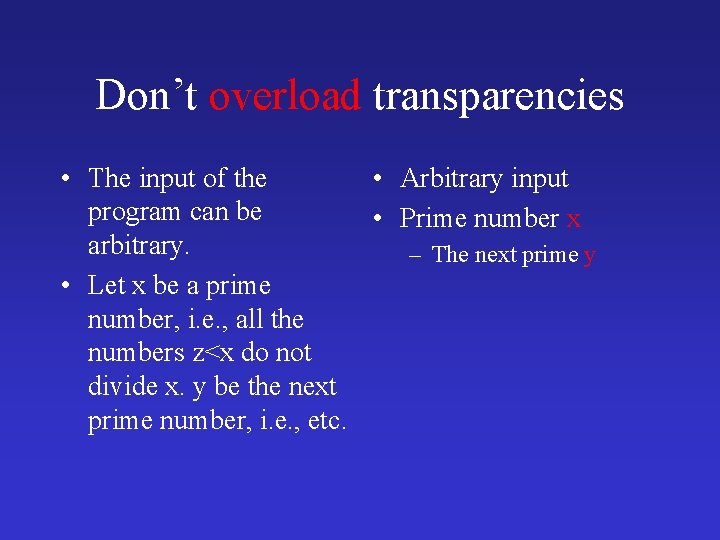
Don’t overload transparencies • The input of the • Arbitrary input program can be • Prime number x arbitrary. – The next prime y • Let x be a prime number, i. e. , all the numbers z<x do not divide x. y be the next prime number, i. e. , etc.
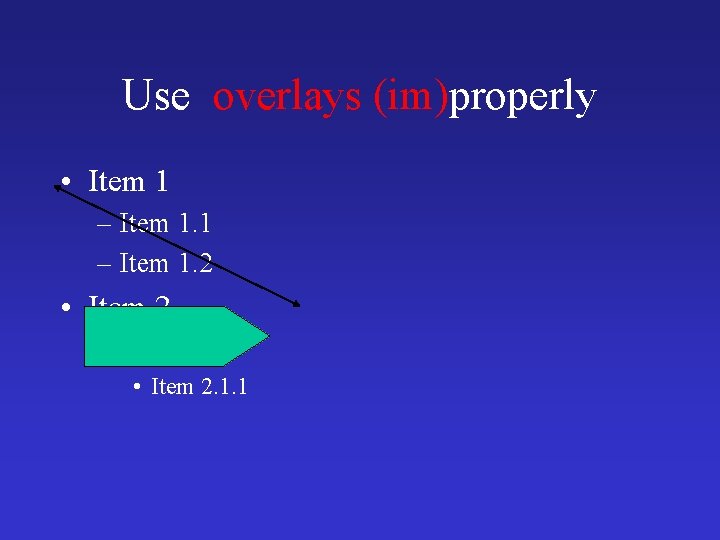
Use overlays (im)properly • Item 1 – Item 1. 2 • Item 2 – Item 2. 1 • Item 2. 1. 1
Use colors properly • Item 1 • Item 2 • Item 3
http: //www. cs. tau. ac. il/~msagiv/courses/pls 01. html