
Programming Language History and Evolution In Text Chapter
- Slides: 15
Programming Language History and Evolution In Text: Chapter 2 1
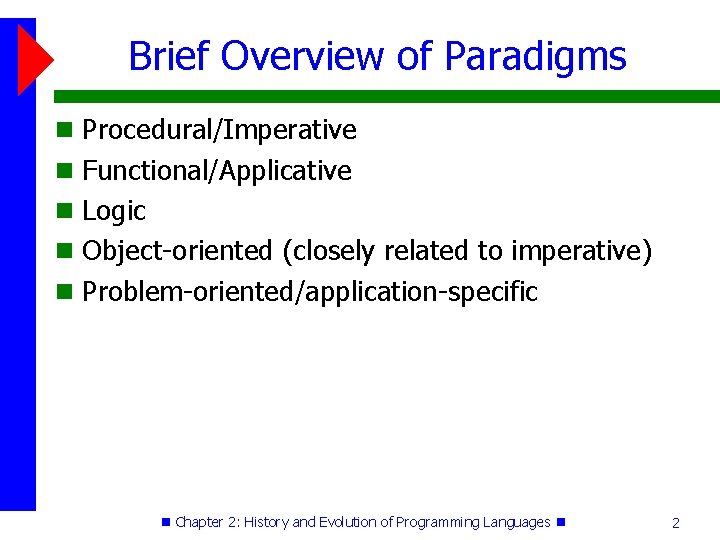
Brief Overview of Paradigms Procedural/Imperative Functional/Applicative Logic Object-oriented (closely related to imperative) Problem-oriented/application-specific Chapter 2: History and Evolution of Programming Languages 2
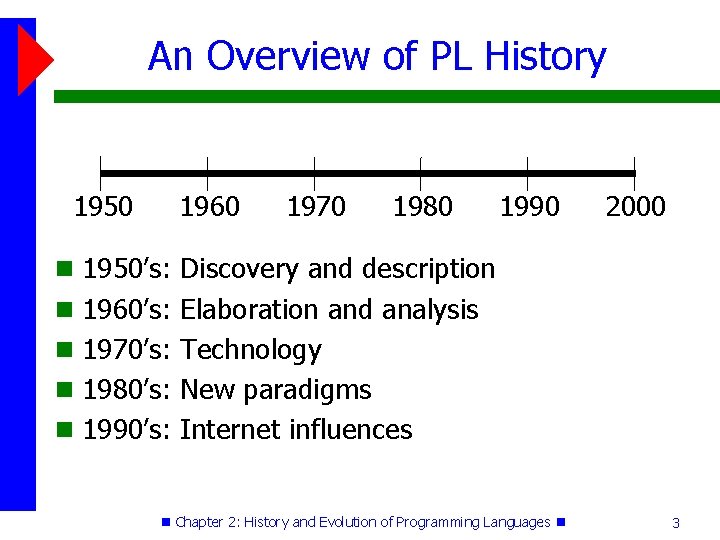
An Overview of PL History 1950 1960 1970 1980 1990 2000 1950’s: Discovery and description 1960’s: Elaboration and analysis 1970’s: Technology 1980’s: New paradigms 1990’s: Internet influences Chapter 2: History and Evolution of Programming Languages 3
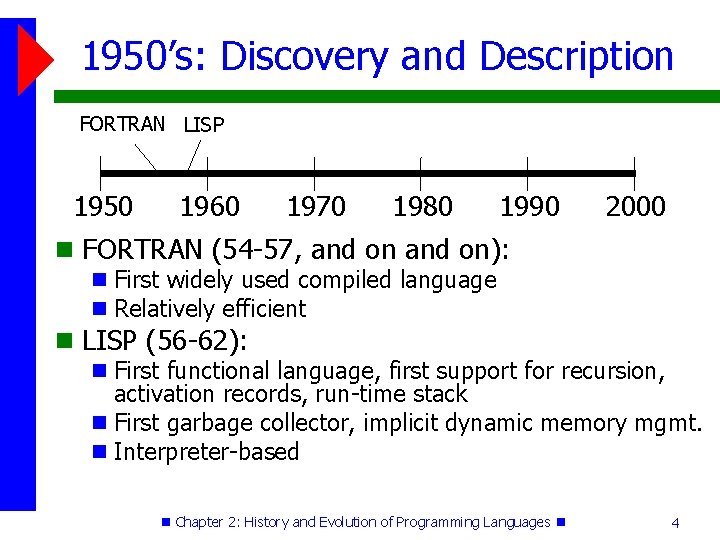
1950’s: Discovery and Description FORTRAN LISP 1950 1960 1970 1980 1990 2000 FORTRAN (54 -57, and on): First widely used compiled language Relatively efficient LISP (56 -62): First functional language, first support for recursion, activation records, run-time stack First garbage collector, implicit dynamic memory mgmt. Interpreter-based Chapter 2: History and Evolution of Programming Languages 4
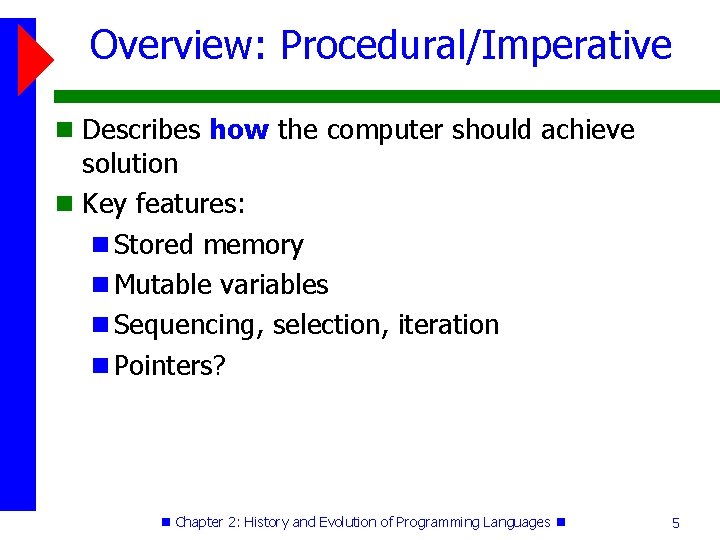
Overview: Procedural/Imperative Describes how the computer should achieve solution Key features: Stored memory Mutable variables Sequencing, selection, iteration Pointers? Chapter 2: History and Evolution of Programming Languages 5
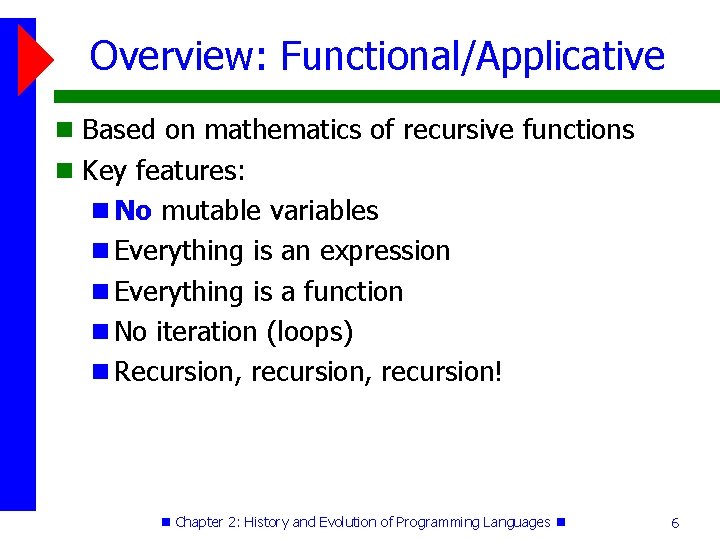
Overview: Functional/Applicative Based on mathematics of recursive functions Key features: No mutable variables Everything is an expression Everything is a function No iteration (loops) Recursion, recursion! Chapter 2: History and Evolution of Programming Languages 6
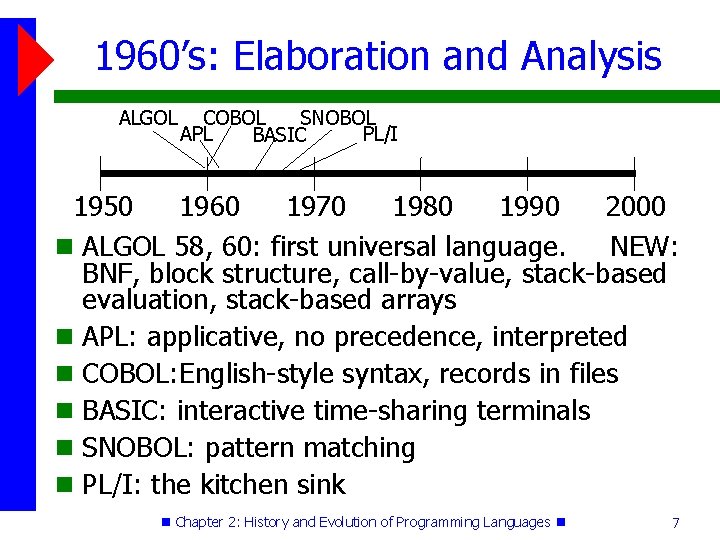
1960’s: Elaboration and Analysis ALGOL COBOL SNOBOL APL PL/I BASIC 1950 1960 1970 1980 1990 2000 ALGOL 58, 60: first universal language. NEW: BNF, block structure, call-by-value, stack-based evaluation, stack-based arrays APL: applicative, no precedence, interpreted COBOL: English-style syntax, records in files BASIC: interactive time-sharing terminals SNOBOL: pattern matching PL/I: the kitchen sink Chapter 2: History and Evolution of Programming Languages 7
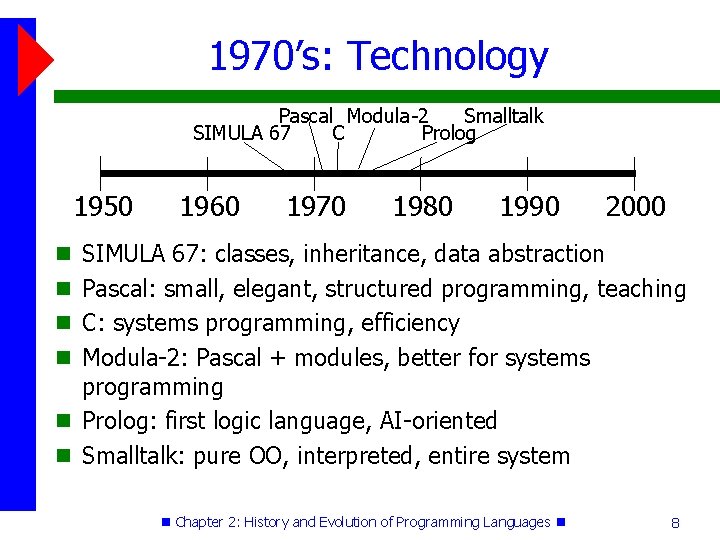
1970’s: Technology Pascal Modula-2 Smalltalk SIMULA 67 C Prolog 1950 1960 1970 1980 1990 2000 SIMULA 67: classes, inheritance, data abstraction Pascal: small, elegant, structured programming, teaching C: systems programming, efficiency Modula-2: Pascal + modules, better for systems programming Prolog: first logic language, AI-oriented Smalltalk: pure OO, interpreted, entire system Chapter 2: History and Evolution of Programming Languages 8
Overview: OOP Based on procedural/imperative style, with added data+code abstraction & encapsulation Key features: Encapsulation Inheritance Polymorphism/dynamic binding Chapter 2: History and Evolution of Programming Languages 9
Overview: Logic Based on predicate logic Declarative: describes what problem is to be solved, but not how Key features: No mutable variables Statements: implications or assertions Every statement succeeds or fails Few explicit control constructs Recursion, recursion! Must understand implementation model to use Chapter 2: History and Evolution of Programming Languages 10
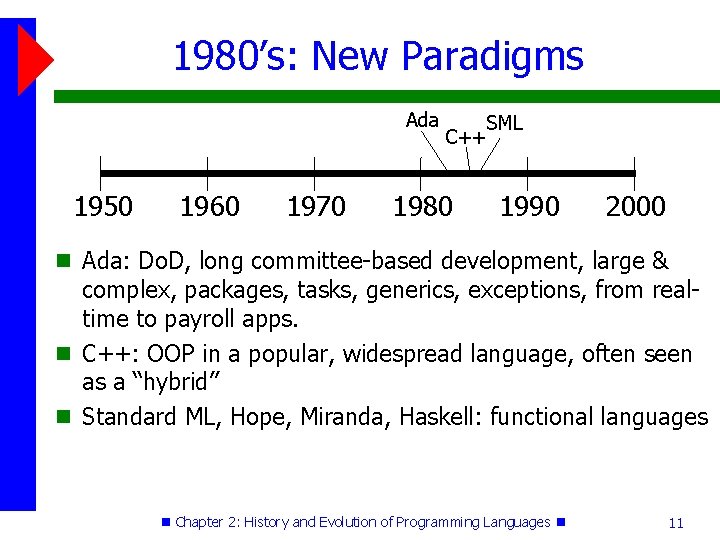
1980’s: New Paradigms Ada 1950 1960 1970 SML C++ 1980 1990 2000 Ada: Do. D, long committee-based development, large & complex, packages, tasks, generics, exceptions, from realtime to payroll apps. C++: OOP in a popular, widespread language, often seen as a “hybrid” Standard ML, Hope, Miranda, Haskell: functional languages Chapter 2: History and Evolution of Programming Languages 11
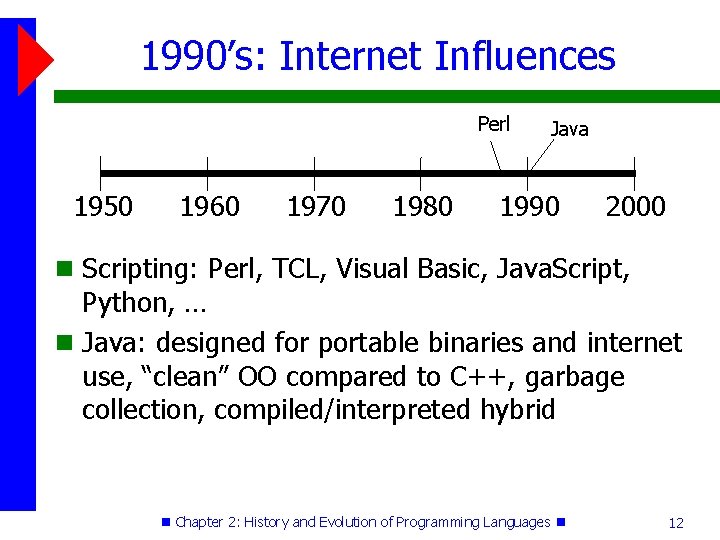
1990’s: Internet Influences Perl 1950 1960 1970 1980 Java 1990 2000 Scripting: Perl, TCL, Visual Basic, Java. Script, Python, … Java: designed for portable binaries and internet use, “clean” OO compared to C++, garbage collection, compiled/interpreted hybrid Chapter 2: History and Evolution of Programming Languages 12
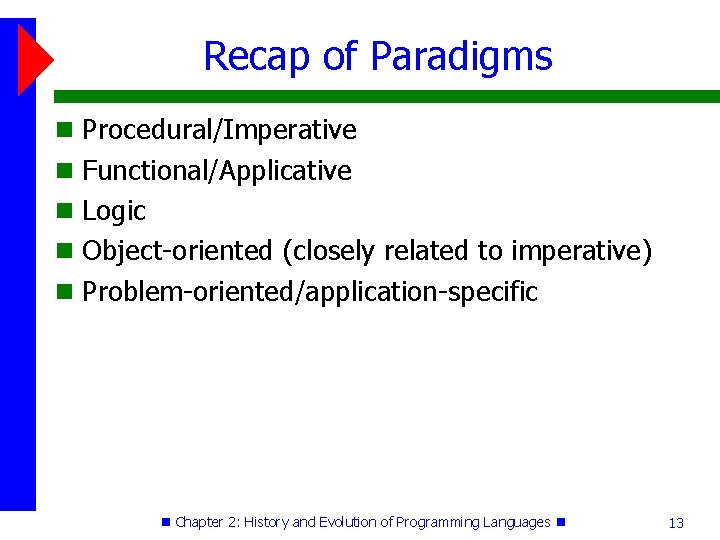
Recap of Paradigms Procedural/Imperative Functional/Applicative Logic Object-oriented (closely related to imperative) Problem-oriented/application-specific Chapter 2: History and Evolution of Programming Languages 13
Paradigms: Key Differentiating Factors What distinguishes one paradigm from another? Chapter 2: History and Evolution of Programming Languages 14
Languages: Key Differentiating Factors What distinguishes one language from another? Chapter 2: History and Evolution of Programming Languages 15