
Programming in C DaleWeemsHeadington Chapter 8 Scope Lifetime
- Slides: 32
Programming in C++ Dale/Weems/Headington Chapter 8 Scope, Lifetime, and More on Functions 1
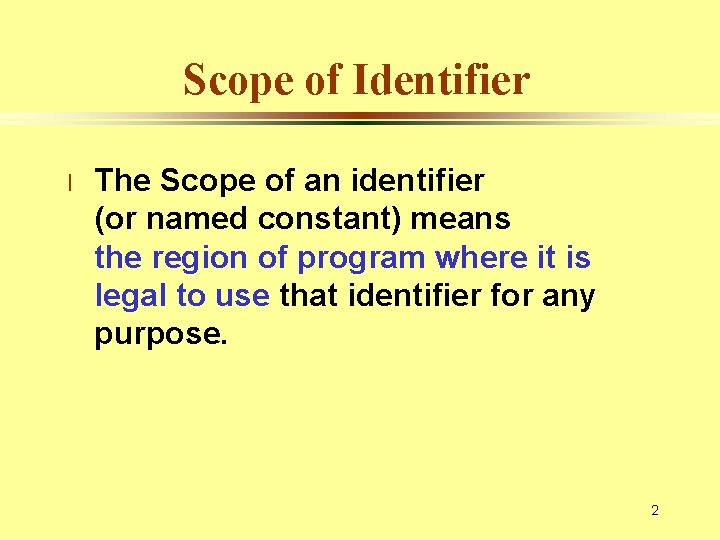
Scope of Identifier l The Scope of an identifier (or named constant) means the region of program where it is legal to use that identifier for any purpose. 2
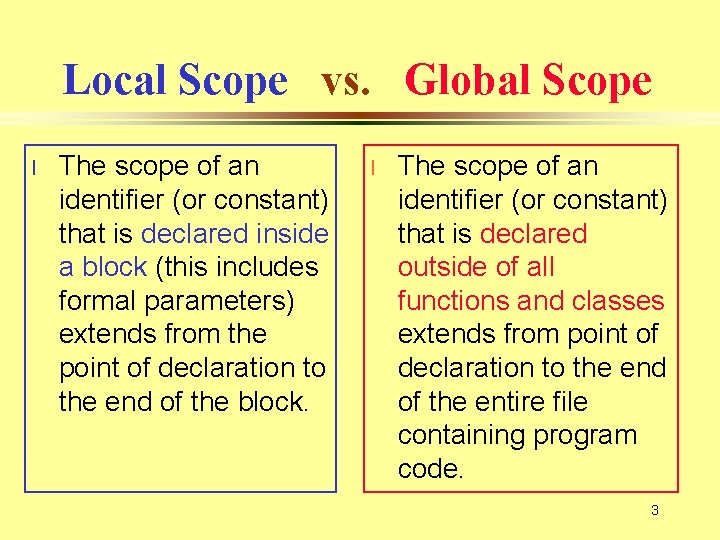
Local Scope vs. Global Scope l The scope of an identifier (or constant) that is declared inside a block (this includes formal parameters) extends from the point of declaration to the end of the block. l The scope of an identifier (or constant) that is declared outside of all functions and classes extends from point of declaration to the end of the entire file containing program code. 3
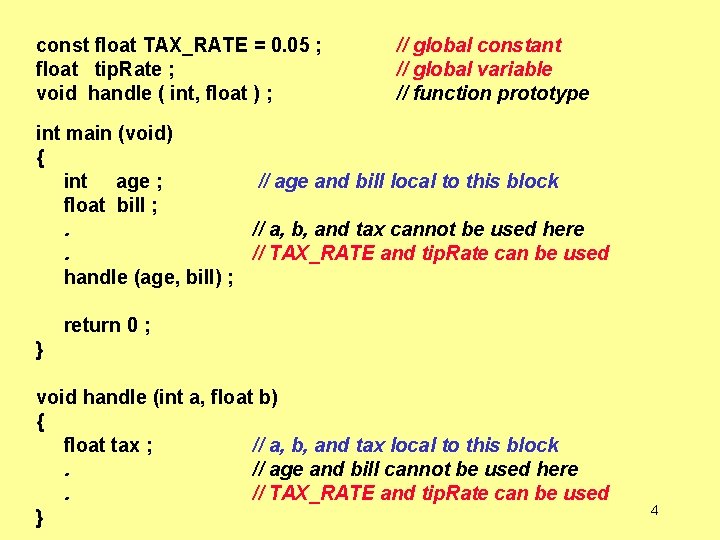
const float TAX_RATE = 0. 05 ; float tip. Rate ; void handle ( int, float ) ; // global constant // global variable // function prototype int main (void) { int age ; // age and bill local to this block float bill ; . // a, b, and tax cannot be used here. // TAX_RATE and tip. Rate can be used handle (age, bill) ; return 0 ; } void handle (int a, float b) { float tax ; // a, b, and tax local to this block. // age and bill cannot be used here. // TAX_RATE and tip. Rate can be used } 4
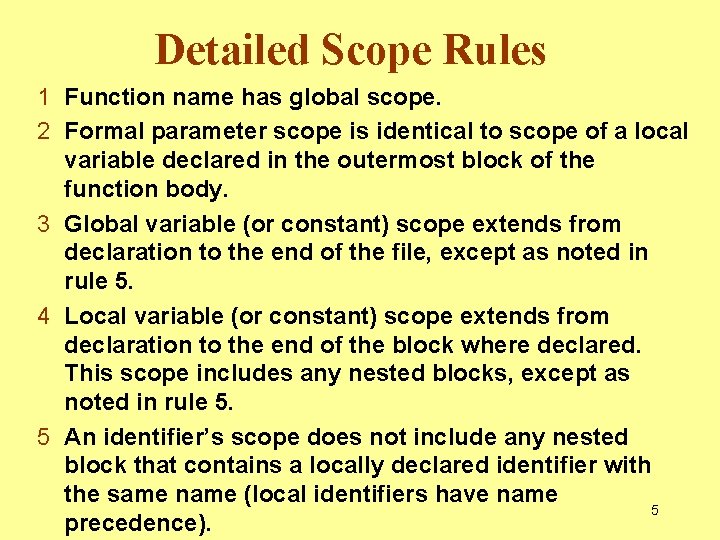
Detailed Scope Rules 1 Function name has global scope. 2 Formal parameter scope is identical to scope of a local variable declared in the outermost block of the function body. 3 Global variable (or constant) scope extends from declaration to the end of the file, except as noted in rule 5. 4 Local variable (or constant) scope extends from declaration to the end of the block where declared. This scope includes any nested blocks, except as noted in rule 5. 5 An identifier’s scope does not include any nested block that contains a locally declared identifier with the same name (local identifiers have name 5 precedence).
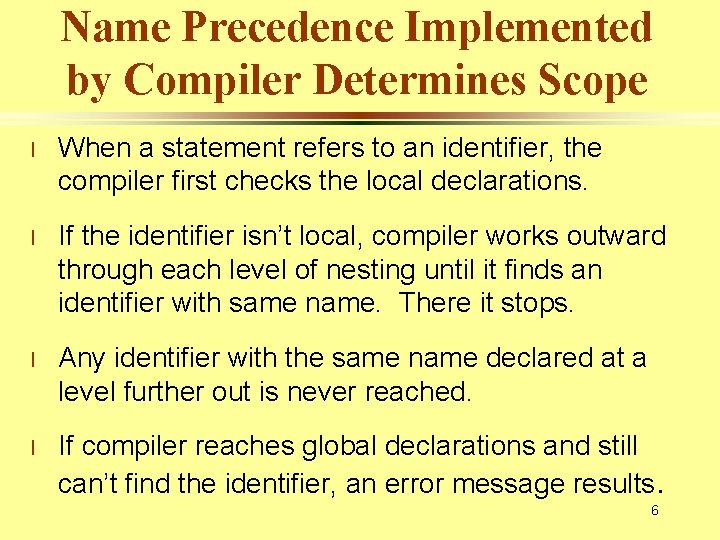
Name Precedence Implemented by Compiler Determines Scope l When a statement refers to an identifier, the compiler first checks the local declarations. l If the identifier isn’t local, compiler works outward through each level of nesting until it finds an identifier with same name. There it stops. l Any identifier with the same name declared at a level further out is never reached. l If compiler reaches global declarations and still can’t find the identifier, an error message results. 6
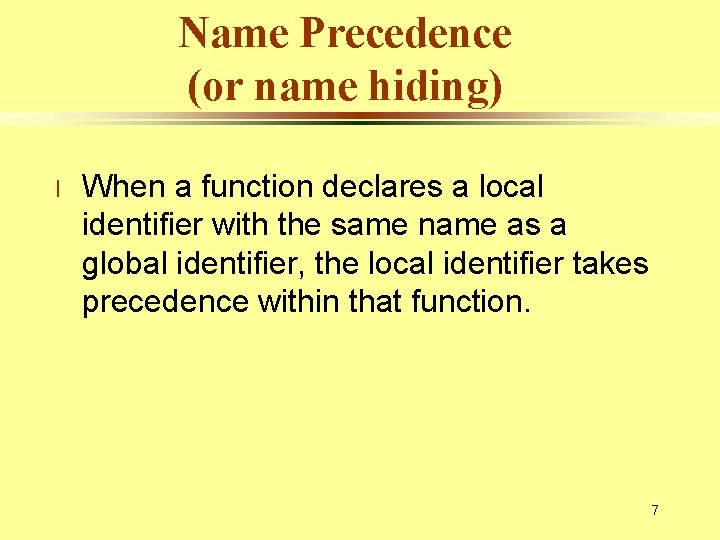
Name Precedence (or name hiding) l When a function declares a local identifier with the same name as a global identifier, the local identifier takes precedence within that function. 7
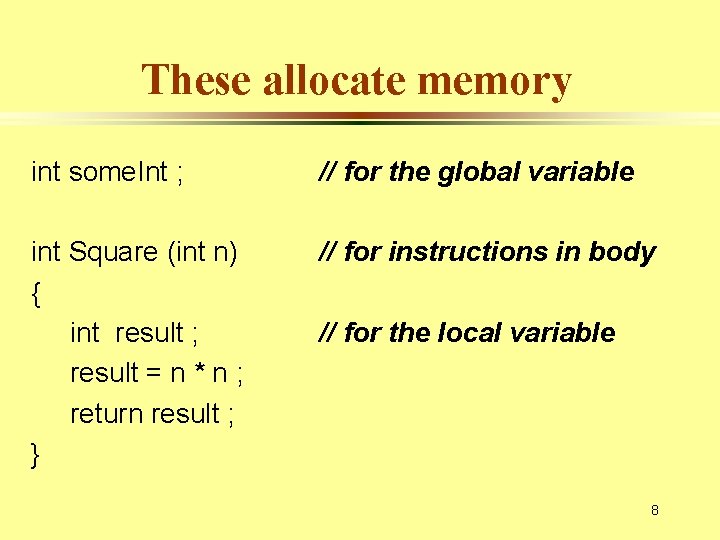
These allocate memory int some. Int ; // for the global variable int Square (int n) { int result ; result = n * n ; return result ; } // for instructions in body // for the local variable 8
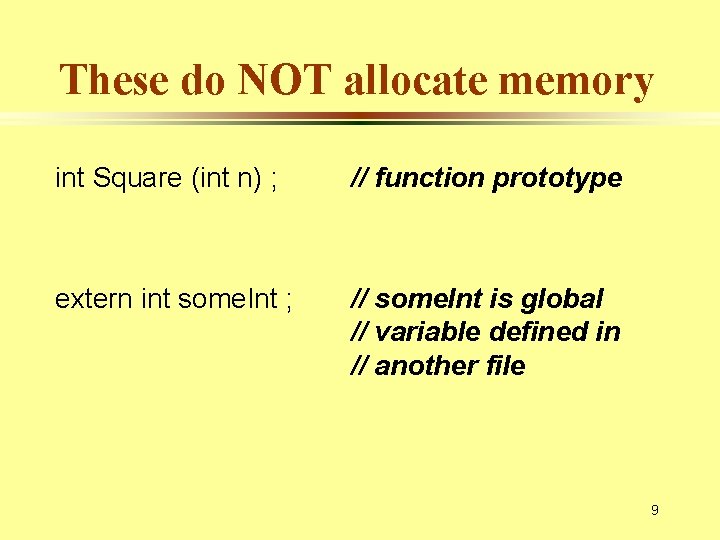
These do NOT allocate memory int Square (int n) ; // function prototype extern int some. Int ; // some. Int is global // variable defined in // another file 9
Lifetime of a Variable l The lifetime of a variable is the time during program execution when an identifier actually has memory allocated to it. 10
Lifetime of Local Automatic Variables l their storage is created (allocated) when control enters the function l local variables are “alive” while function is executing l their storage is destroyed (deallocated) when function exits 11
Lifetime of Global Variables l their lifetime is the lifetime of the entire program l their memory is allocated when program begins execution l their memory is deallocated when the entire program terminates 12
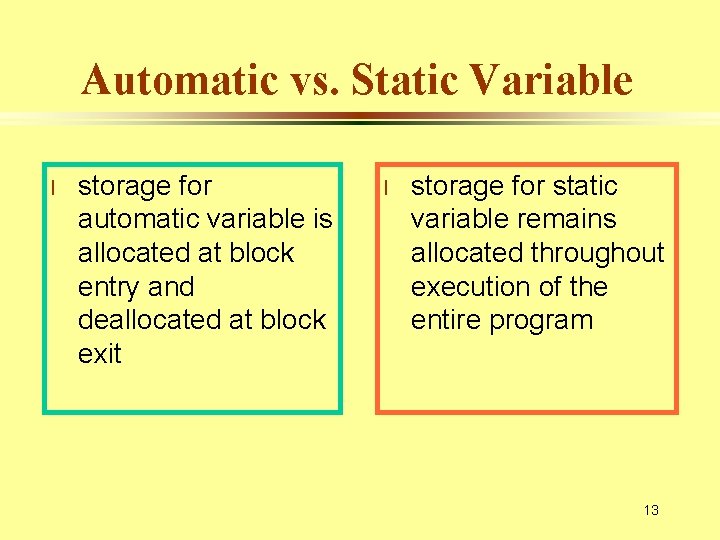
Automatic vs. Static Variable l storage for automatic variable is allocated at block entry and deallocated at block exit l storage for static variable remains allocated throughout execution of the entire program 13
By default, l local variables are automatic. l To obtain a static local variable, you must use the reserved work static in its declaration. 14
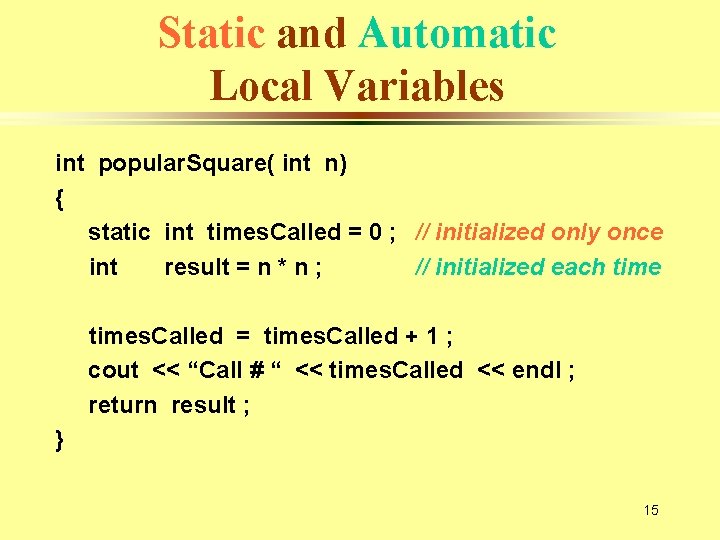
Static and Automatic Local Variables int popular. Square( int n) { static int times. Called = 0 ; // initialized only once int result = n * n ; // initialized each times. Called = times. Called + 1 ; cout << “Call # “ << times. Called << endl ; return result ; } 15
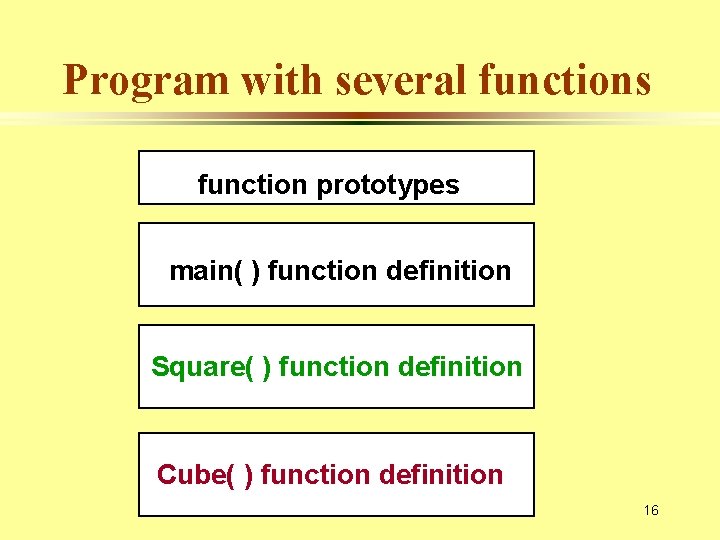
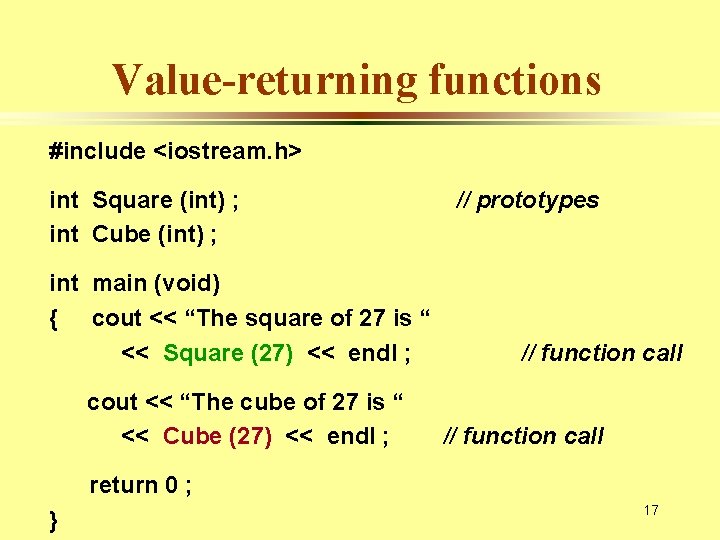
Program with several functions function prototypes main( ) function definition Square( ) function definition Cube( ) function definition 16
Value-returning functions #include <iostream. h> int Square (int) ; int Cube (int) ; int main (void) { cout << “The square of 27 is “ << Square (27) << endl ; cout << “The cube of 27 is “ << Cube (27) << endl ; // prototypes // function call return 0 ; } 17
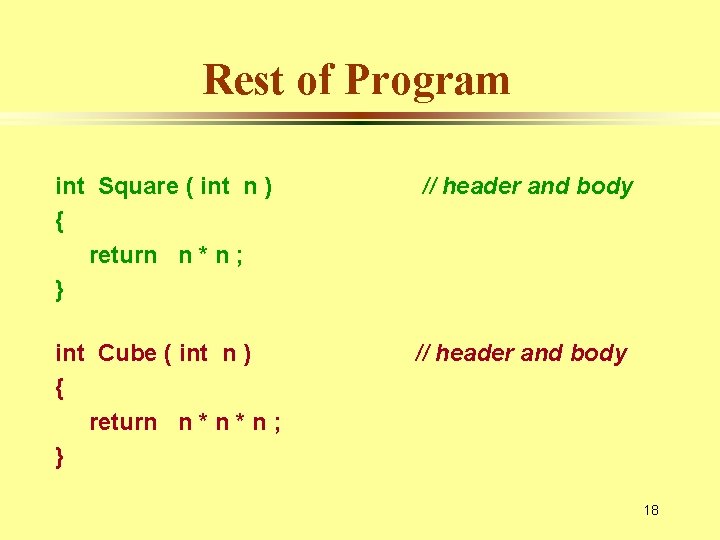
Rest of Program int Square ( int n ) { return n * n ; } // header and body int Cube ( int n ) { return n * n ; } // header and body 18
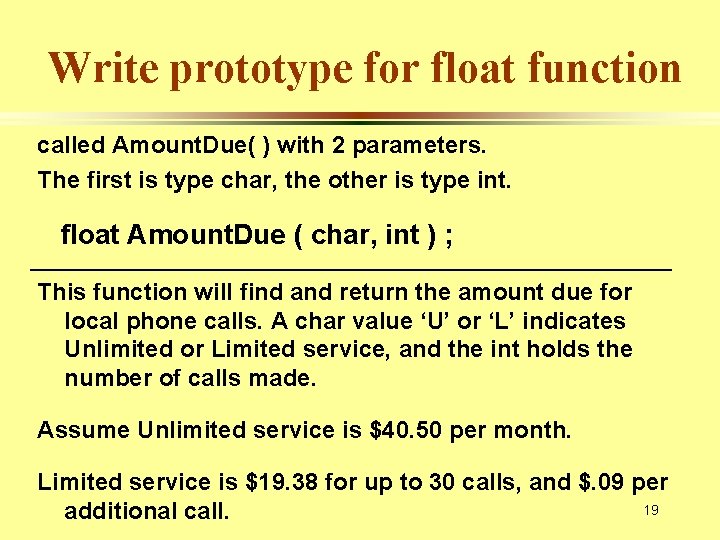
Write prototype for float function called Amount. Due( ) with 2 parameters. The first is type char, the other is type int. float Amount. Due ( char, int ) ; This function will find and return the amount due for local phone calls. A char value ‘U’ or ‘L’ indicates Unlimited or Limited service, and the int holds the number of calls made. Assume Unlimited service is $40. 50 per month. Limited service is $19. 38 for up to 30 calls, and $. 09 per 19 additional call.
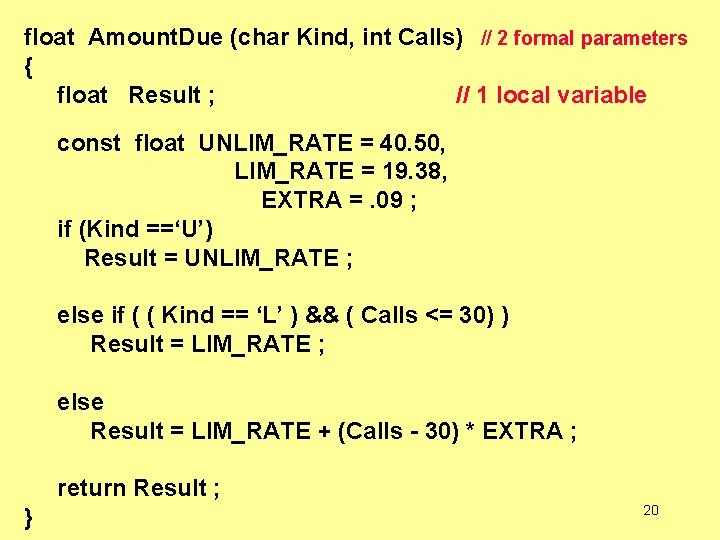
float Amount. Due (char Kind, int Calls) // 2 formal parameters { float Result ; // 1 local variable const float UNLIM_RATE = 40. 50, LIM_RATE = 19. 38, EXTRA =. 09 ; if (Kind ==‘U’) Result = UNLIM_RATE ; else if ( ( Kind == ‘L’ ) && ( Calls <= 30) ) Result = LIM_RATE ; else Result = LIM_RATE + (Calls - 30) * EXTRA ; return Result ; } 20
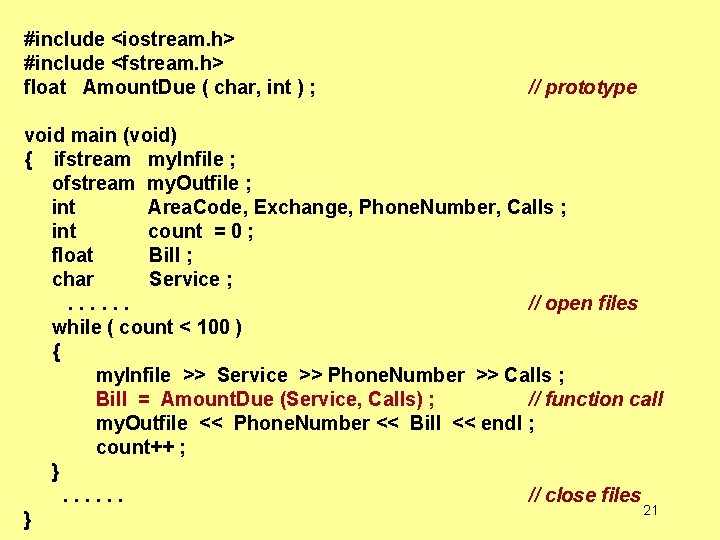
#include <iostream. h> #include <fstream. h> float Amount. Due ( char, int ) ; // prototype void main (void) { ifstream my. Infile ; ofstream my. Outfile ; int Area. Code, Exchange, Phone. Number, Calls ; int count = 0 ; float Bill ; char Service ; . . . // open files while ( count < 100 ) { my. Infile >> Service >> Phone. Number >> Calls ; Bill = Amount. Due (Service, Calls) ; // function call my. Outfile << Phone. Number << Bill << endl ; count++ ; }. . . // close files 21 }
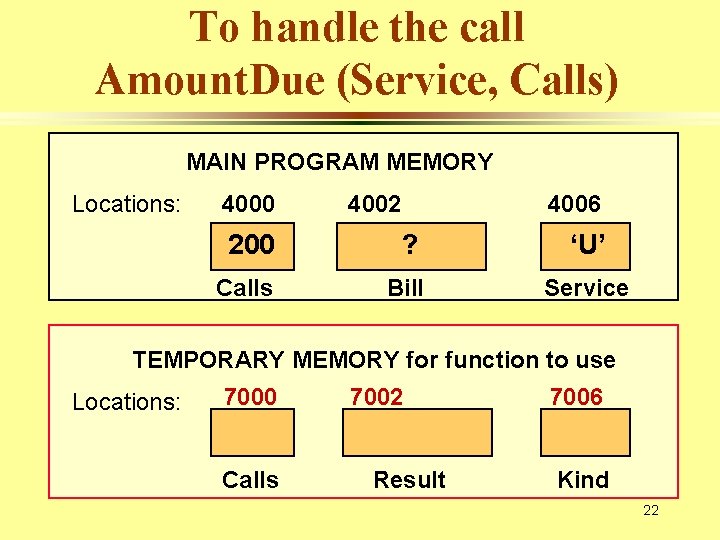
To handle the call Amount. Due (Service, Calls) MAIN PROGRAM MEMORY Locations: 4000 4002 4006 200 ? ‘U’ Calls Bill Service TEMPORARY MEMORY for function to use Locations: 7000 Calls 7002 Result 7006 Kind 22
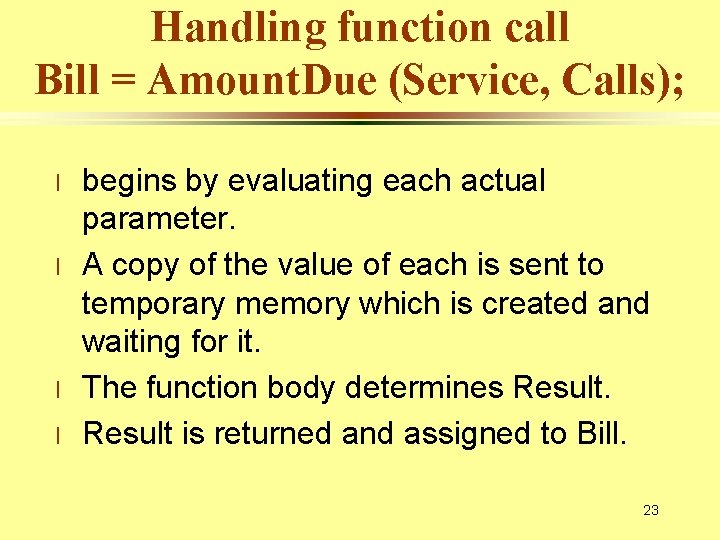
Handling function call Bill = Amount. Due (Service, Calls); l l begins by evaluating each actual parameter. A copy of the value of each is sent to temporary memory which is created and waiting for it. The function body determines Result is returned and assigned to Bill. 23
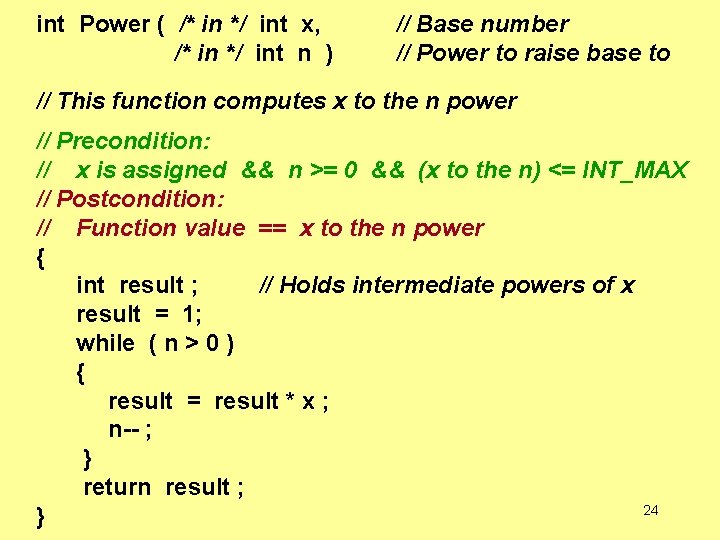
int Power ( /* in */ int x, /* in */ int n ) // Base number // Power to raise base to // This function computes x to the n power // Precondition: // x is assigned && n >= 0 && (x to the n) <= INT_MAX // Postcondition: // Function value == x to the n power { int result ; // Holds intermediate powers of x result = 1; while ( n > 0 ) { result = result * x ; n-- ; } return result ; 24 }
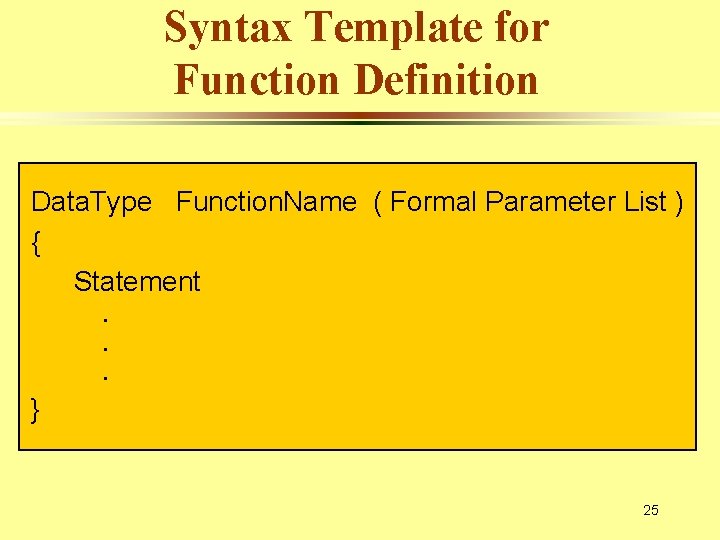
Syntax Template for Function Definition Data. Type Function. Name ( Formal Parameter List ) { Statement. . . } 25
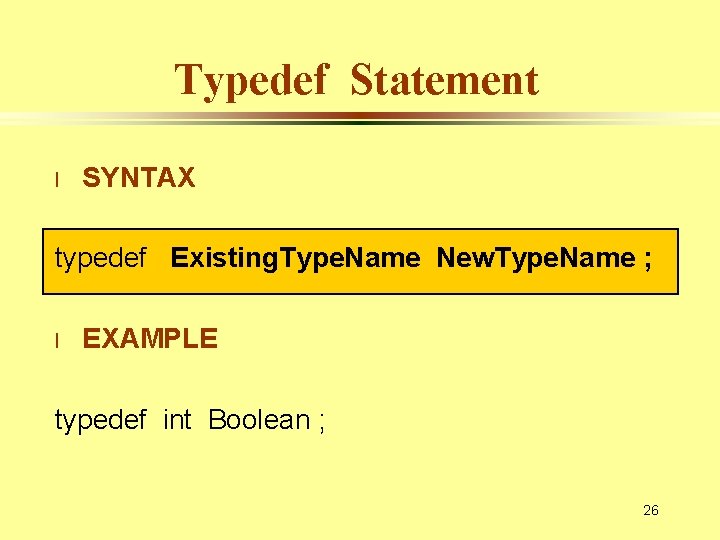
Typedef Statement l SYNTAX typedef Existing. Type. Name New. Type. Name ; l EXAMPLE typedef int Boolean ; 26
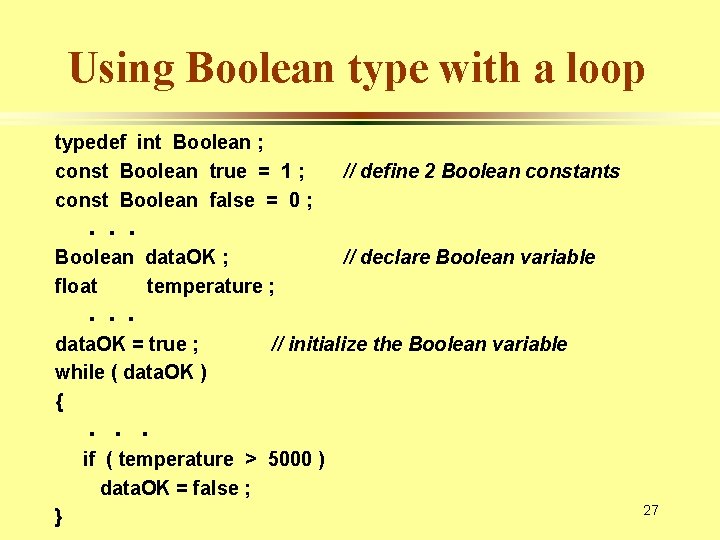
Using Boolean type with a loop typedef int Boolean ; const Boolean true = 1 ; // define 2 Boolean constants const Boolean false = 0 ; . . . Boolean data. OK ; // declare Boolean variable float temperature ; . . . data. OK = true ; // initialize the Boolean variable while ( data. OK ) {. . . if ( temperature > 5000 ) data. OK = false ; } 27
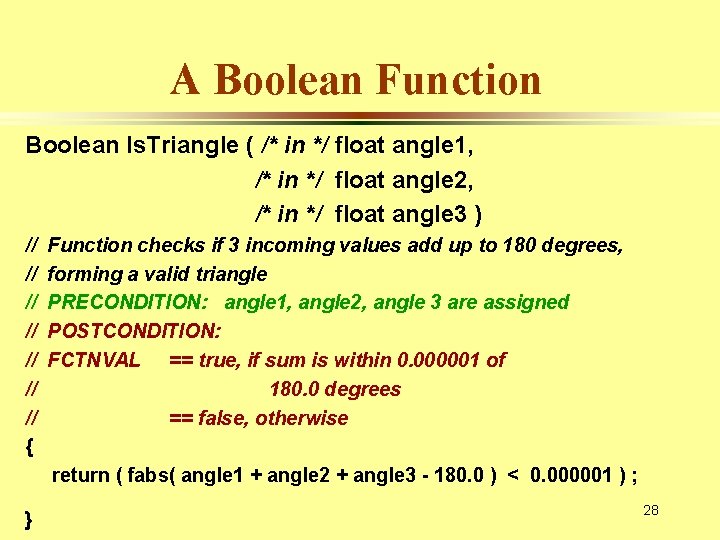
A Boolean Function Boolean Is. Triangle ( /* in */ float angle 1, /* in */ float angle 2, /* in */ float angle 3 ) // // { Function checks if 3 incoming values add up to 180 degrees, forming a valid triangle PRECONDITION: angle 1, angle 2, angle 3 are assigned POSTCONDITION: FCTNVAL == true, if sum is within 0. 000001 of 180. 0 degrees == false, otherwise return ( fabs( angle 1 + angle 2 + angle 3 - 180. 0 ) < 0. 000001 ) ; } 28
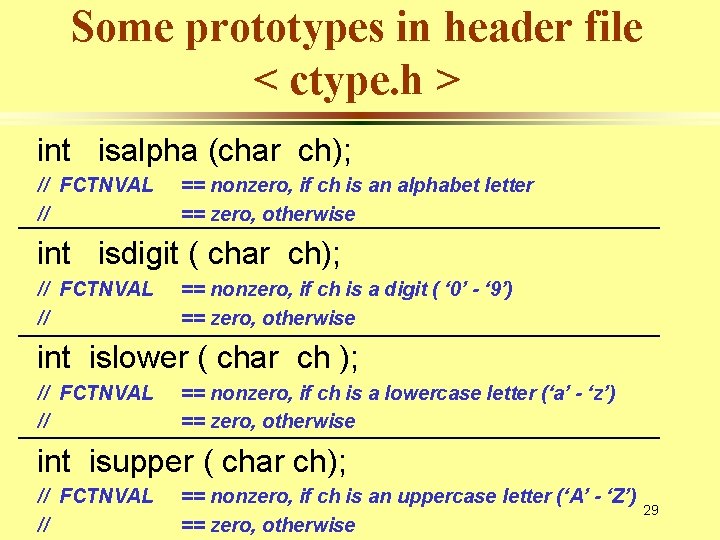
Some prototypes in header file < ctype. h > int isalpha (char ch); // FCTNVAL // == nonzero, if ch is an alphabet letter == zero, otherwise int isdigit ( char ch); // FCTNVAL // == nonzero, if ch is a digit ( ‘ 0’ - ‘ 9’) == zero, otherwise int islower ( char ch ); // FCTNVAL // == nonzero, if ch is a lowercase letter (‘a’ - ‘z’) == zero, otherwise int isupper ( char ch); // FCTNVAL // == nonzero, if ch is an uppercase letter (‘A’ - ‘Z’) == zero, otherwise 29
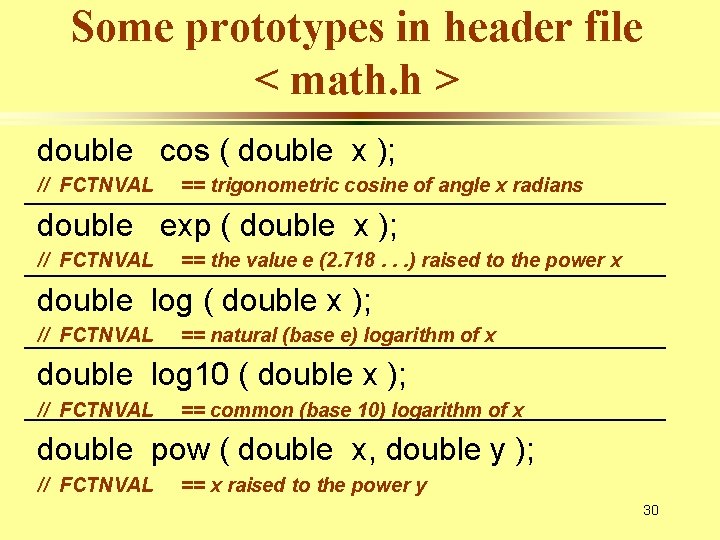
Some prototypes in header file < math. h > double cos ( double x ); // FCTNVAL == trigonometric cosine of angle x radians double exp ( double x ); // FCTNVAL == the value e (2. 718. . . ) raised to the power x double log ( double x ); // FCTNVAL == natural (base e) logarithm of x double log 10 ( double x ); // FCTNVAL == common (base 10) logarithm of x double pow ( double x, double y ); // FCTNVAL == x raised to the power y 30
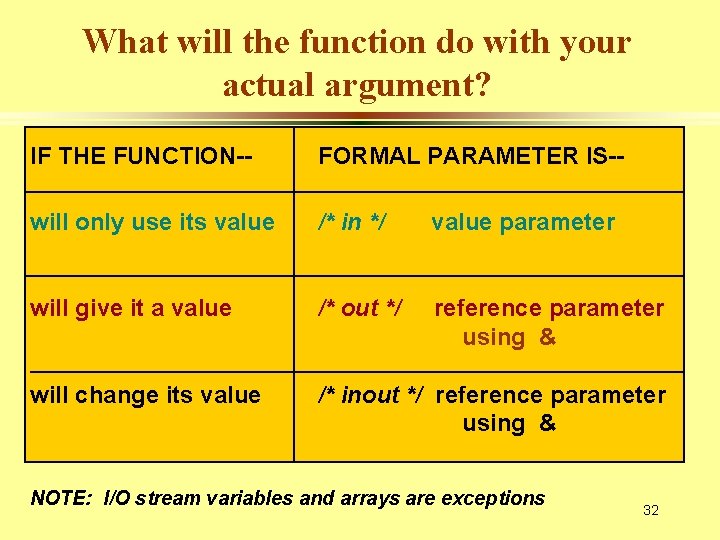
“What will the function do with your actual argument? ” The answer determines whether your formal parameter should be value or reference as follows. . . 31
What will the function do with your actual argument? IF THE FUNCTION-- FORMAL PARAMETER IS-- will only use its value /* in */ value parameter will give it a value /* out */ reference parameter using & will change its value /* inout */ reference parameter using & NOTE: I/O stream variables and arrays are exceptions 32