
Programming in C CSE 4253 Prof Roger Crawfis

- Slides: 35
Programming in C# CSE 4253 Prof. Roger Crawfis
Course Overview 1 -credit pass/no-pass brief introduction to C#. l Covers the. NET framework, (most of) the C# language and some of the most useful. NET API’s. l Should not be your first programming class. l l l Assume you know C++ and/or Java and basic object-oriented or component-based programming. Requires (lots of) practice / reading. l C# and. NET cannot be learned thoroughly in this brief course.
S/U Details l Requirements for the course l l l Learning l l l Do all assignments (including worksheets). If you know C# already, fine get the stuff done at your own pace for credit. If you want to know some subtle points, better programming, watch the lectures. If stuck make sure you do the worksheets and watch the lectures. Assignments are S/U l l You will not be given a detailed grade Show me that you understand the concepts, and can write C# code
Syllabus Background, history, CLI, CIL, CLR, CTS, … l C# Types l l l C# language features l l foreach, yield, events, is/as (type casting), lock. Common Interfaces l l Primitive types, Classes, Properties, Interfaces, Delegates, Events, Generic types. Iterators, equality and comparison Base Class Library
Programming in C# C# History CSE 4253 Prof. Roger Crawfis
History of C# Developed by Microsoft. l Based on Java and C++, but has many additional extensions. l Java and C# are both being updated to keep up with each other. l Cross-development with Visual Basic, Visual C++, F#, Iron. Python, and many other. NET languages. l l See: http: //en. wikipedia. org/wiki/List_of_CLI_languages
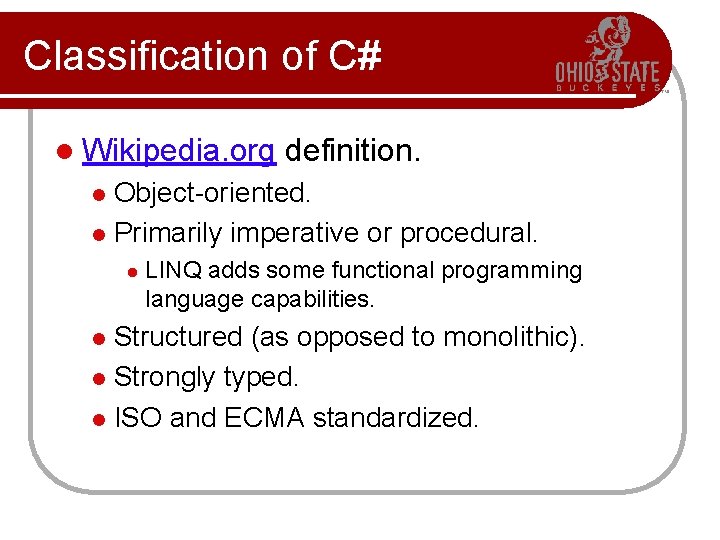
Classification of C# l Wikipedia. org definition. Object-oriented. l Primarily imperative or procedural. l l LINQ adds some functional programming language capabilities. Structured (as opposed to monolithic). l Strongly typed. l ISO and ECMA standardized. l
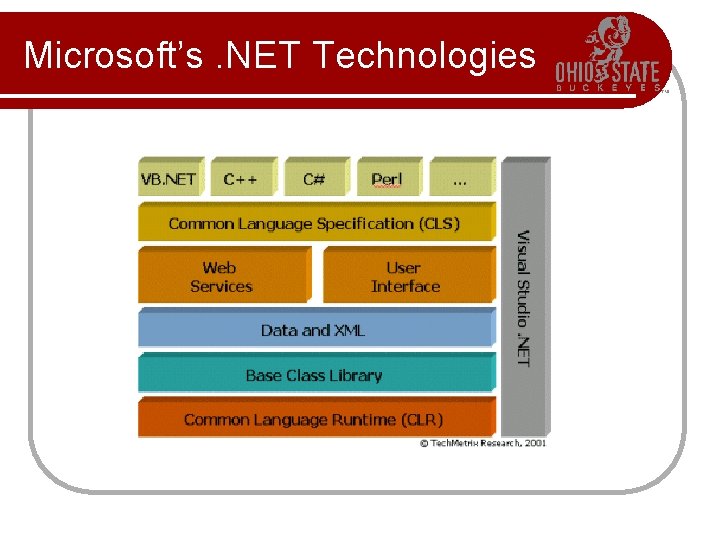
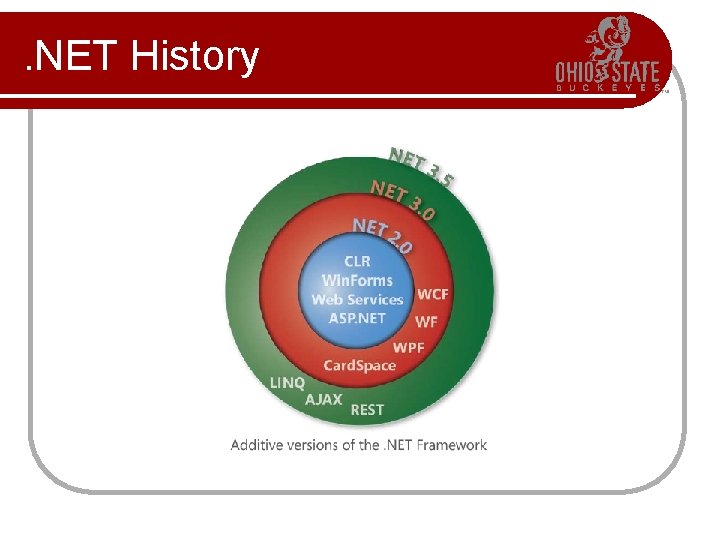
Microsoft’s. NET Technologies
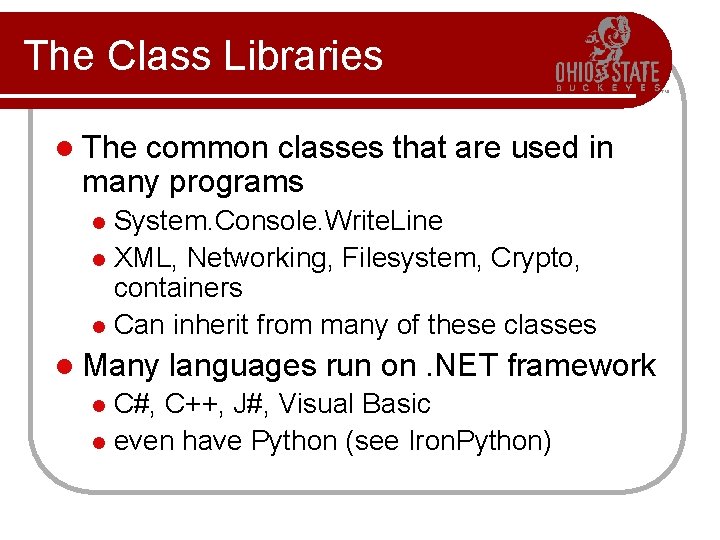
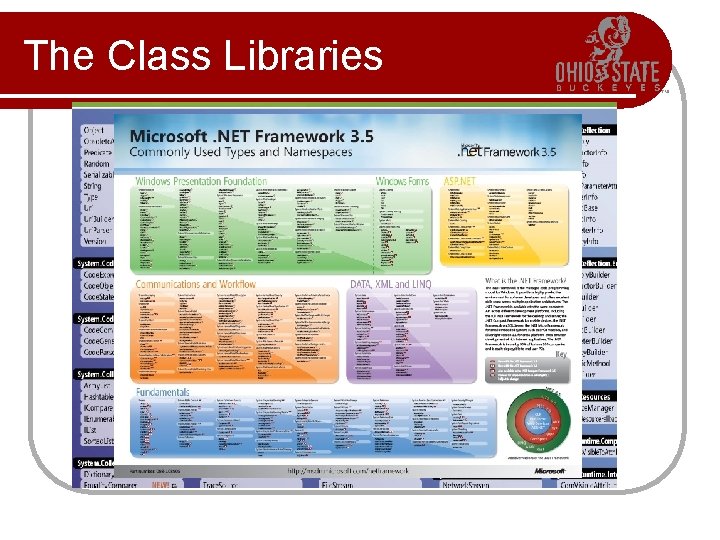
The Class Libraries l The common classes that are used in many programs System. Console. Write. Line l XML, Networking, Filesystem, Crypto, containers l Can inherit from many of these classes l l Many languages run on. NET framework C#, C++, J#, Visual Basic l even have Python (see Iron. Python) l
. NET History
The Class Libraries
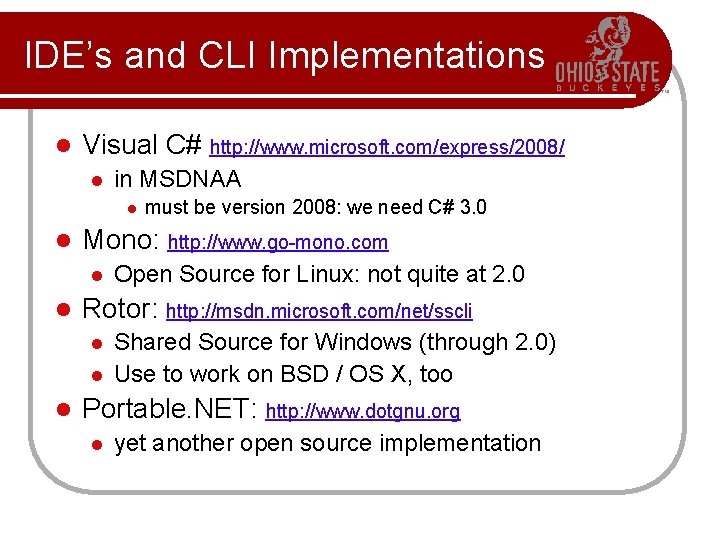
IDE’s and CLI Implementations l Visual C# http: //www. microsoft. com/express/2008/ l in MSDNAA l l Mono: http: //www. go-mono. com l l Open Source for Linux: not quite at 2. 0 Rotor: http: //msdn. microsoft. com/net/sscli l l l must be version 2008: we need C# 3. 0 Shared Source for Windows (through 2. 0) Use to work on BSD / OS X, too Portable. NET: http: //www. dotgnu. org l yet another open source implementation
Programming in C# CLR, CLI, oh my! CSE 459. 24 Prof. Roger Crawfis
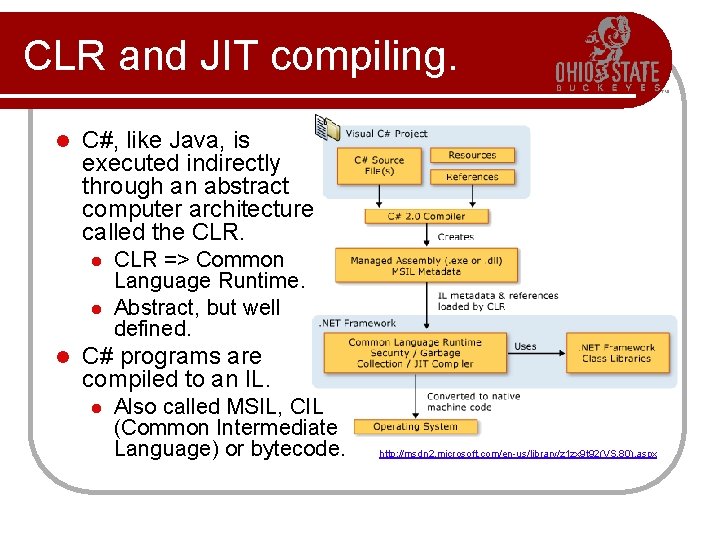
CLR and JIT compiling. l C#, like Java, is executed indirectly through an abstract computer architecture called the CLR. l l l CLR => Common Language Runtime. Abstract, but well defined. C# programs are compiled to an IL. l Also called MSIL, CIL (Common Intermediate Language) or bytecode. http: //msdn 2. microsoft. com/en-us/library/z 1 zx 9 t 92(VS. 80). aspx
CLR and JIT compiling. l The CLR transforms the CIL to assembly instructions for a particular hardware architecture. This is termed jit’ing or Just-in-time compiling. l Some initial performance cost, but the jitted code is cached for further execution. l The CLR can target the specific architecture in which the code is executing, so some performance gains are possible. l
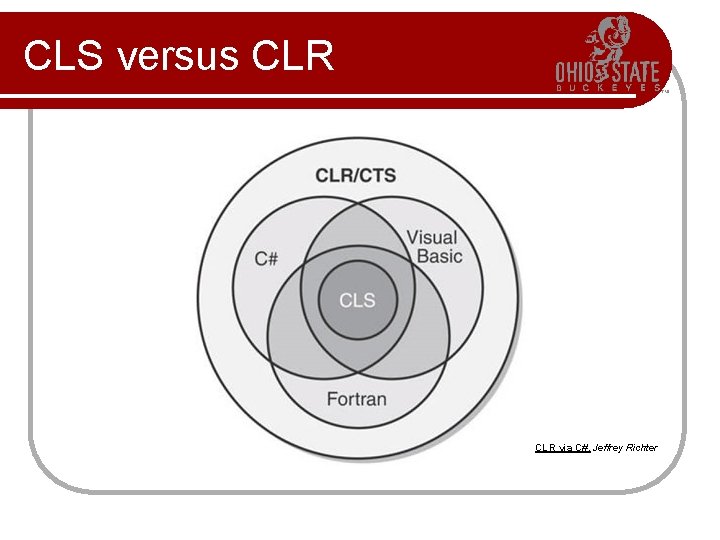
CLR and JIT compiling. l All . NET languages compile to the same CIL. l Each language actually uses only a subset of the CIL. l The least-common denominator is the Common Language Specification (CLS). l So, if you want to use your C# components in Visual Basic you need to program to the CLS.
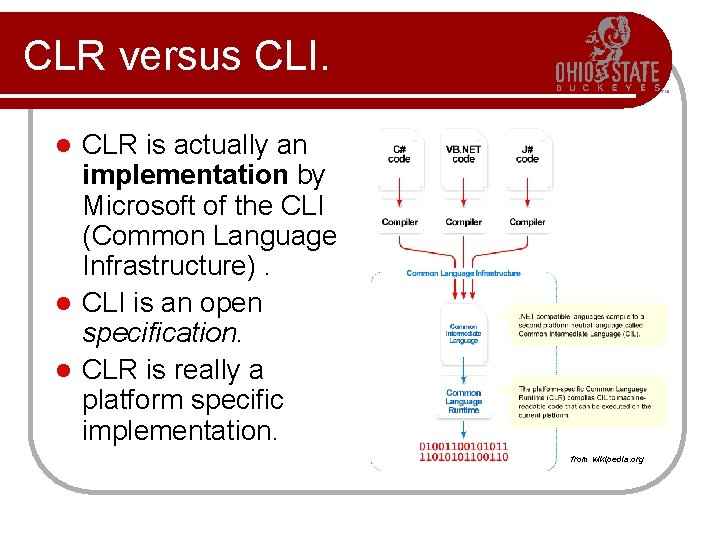
CLR versus CLI. CLR is actually an implementation by Microsoft of the CLI (Common Language Infrastructure). l CLI is an open specification. l CLR is really a platform specific implementation. l from wikipedia. org
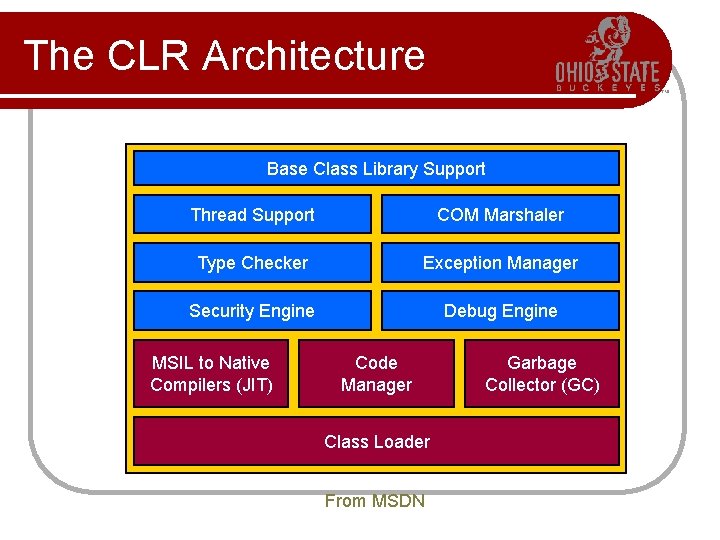
The CLR Architecture Base Class Library Support Thread Support COM Marshaler Type Checker Exception Manager Security Engine Debug Engine MSIL to Native Compilers (JIT) Code Manager Class Loader From MSDN Garbage Collector (GC)
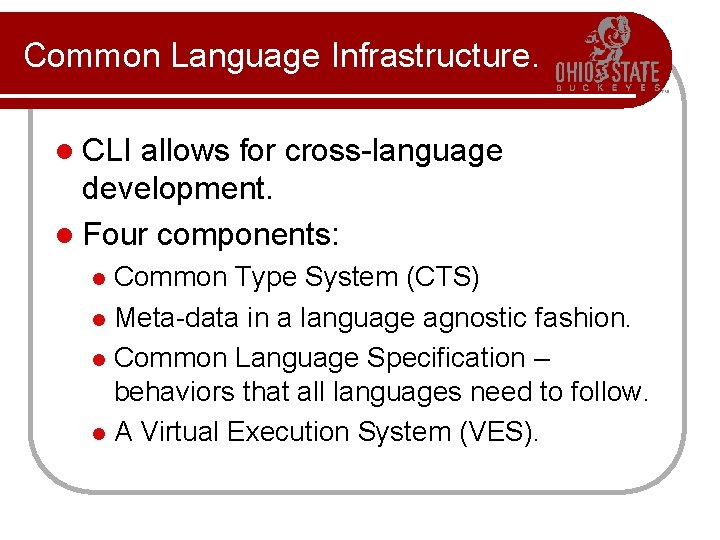
Common Language Infrastructure. l CLI allows for cross-language development. l Four components: Common Type System (CTS) l Meta-data in a language agnostic fashion. l Common Language Specification – behaviors that all languages need to follow. l A Virtual Execution System (VES). l
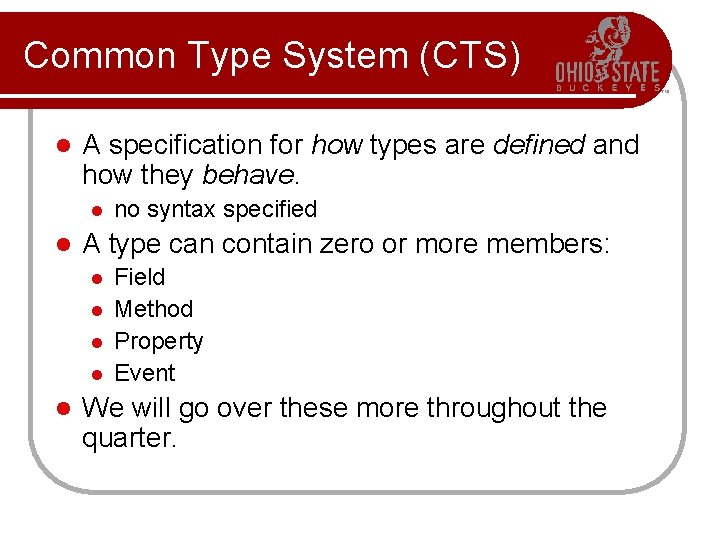
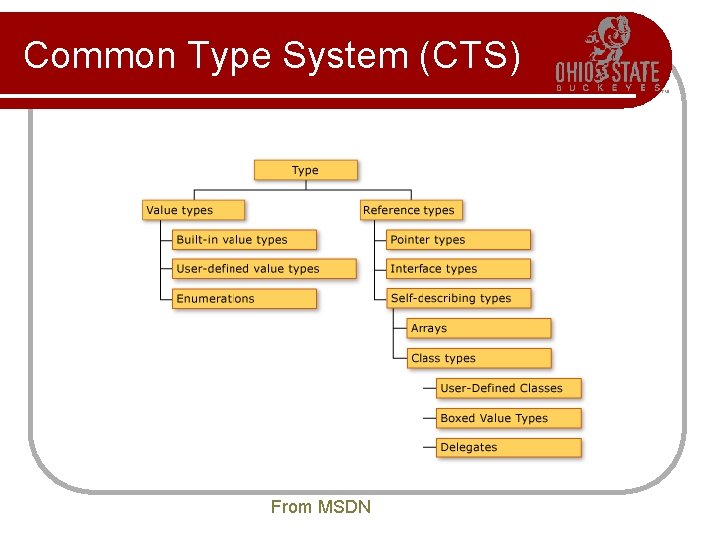
Common Type System (CTS) l A specification for how types are defined and how they behave. l l A type can contain zero or more members: l l l no syntax specified Field Method Property Event We will go over these more throughout the quarter.
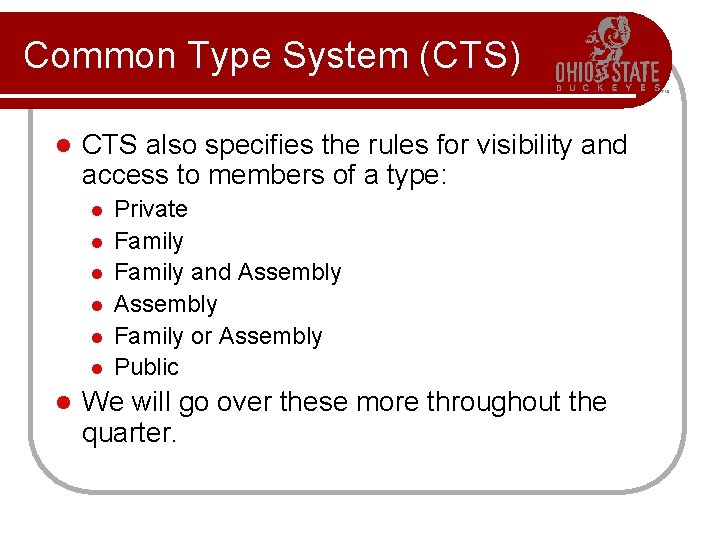
Common Type System (CTS) l CTS also specifies the rules for visibility and access to members of a type: l l l l Private Family and Assembly Family or Assembly Public We will go over these more throughout the quarter.
Common Type System (CTS) l Other rules Object life-time l Inheritance l Equality (through System. Object) l
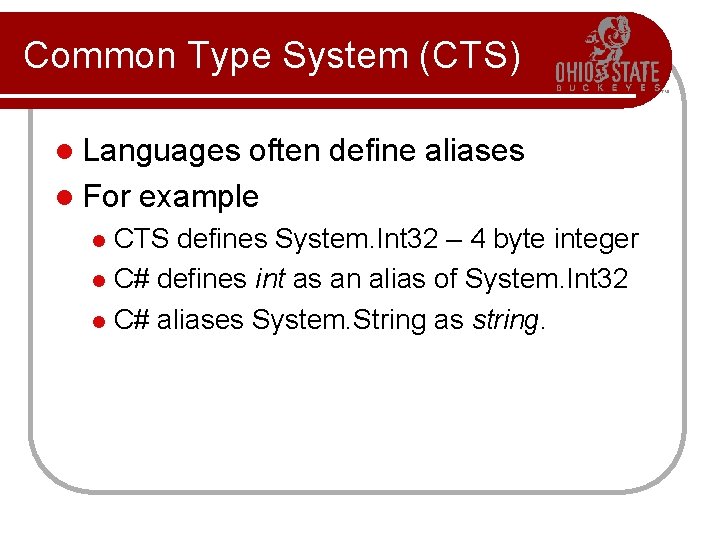
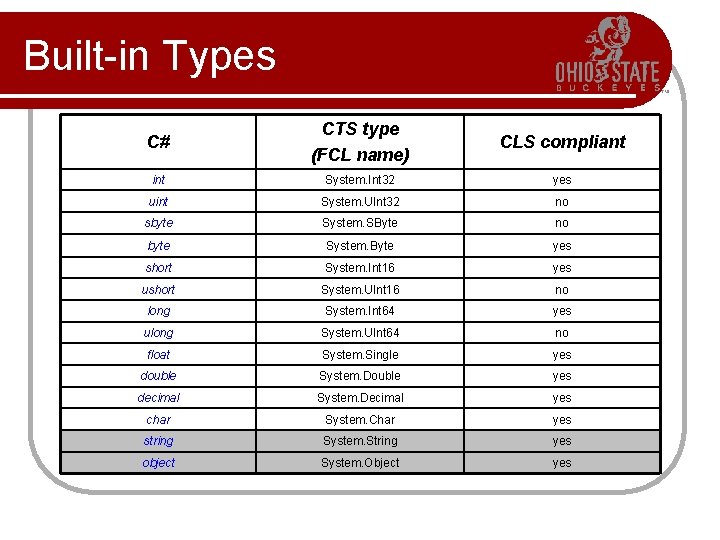
Common Type System (CTS) l Languages often define aliases l For example CTS defines System. Int 32 – 4 byte integer l C# defines int as an alias of System. Int 32 l C# aliases System. String as string. l
Common Type System (CTS) From MSDN
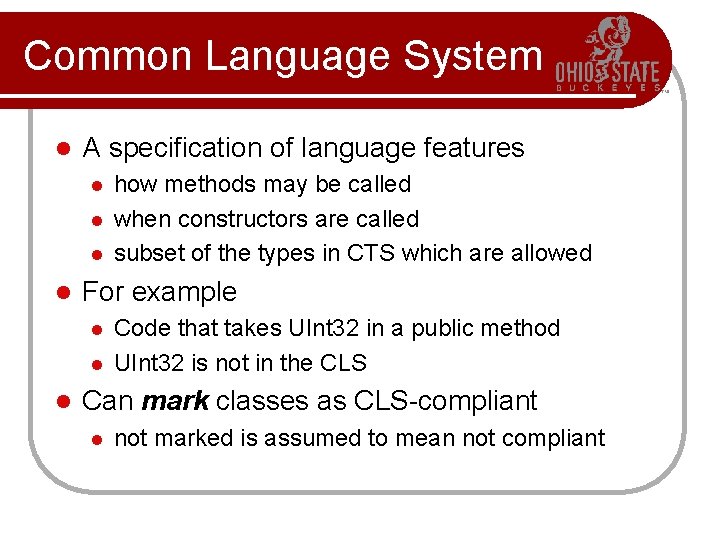
Common Language System l A specification of language features l l For example l l l how methods may be called when constructors are called subset of the types in CTS which are allowed Code that takes UInt 32 in a public method UInt 32 is not in the CLS Can mark classes as CLS-compliant l not marked is assumed to mean not compliant
CLS versus CLR via C#, Jeffrey Richter
Built-in Types C# CTS type (FCL name) CLS compliant int System. Int 32 yes uint System. UInt 32 no sbyte System. SByte no byte System. Byte yes short System. Int 16 yes ushort System. UInt 16 no long System. Int 64 yes ulong System. UInt 64 no float System. Single yes double System. Double yes decimal System. Decimal yes char System. Char yes string System. String yes object System. Object yes
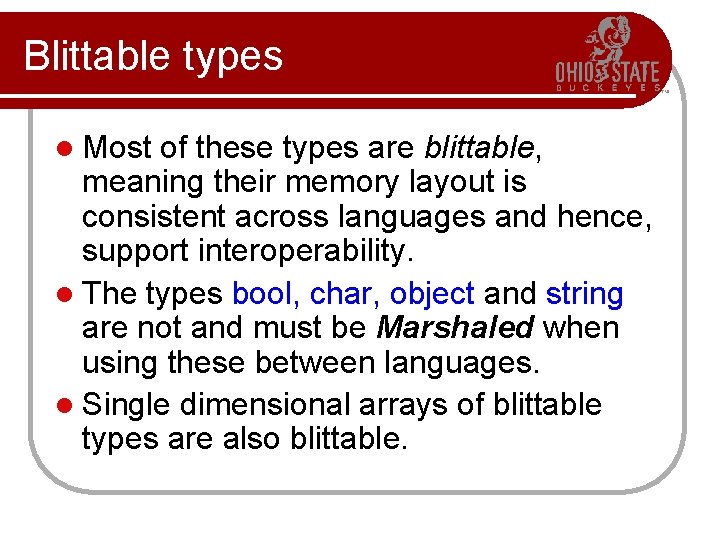
Blittable types l Most of these types are blittable, meaning their memory layout is consistent across languages and hence, support interoperability. l The types bool, char, object and string are not and must be Marshaled when using these between languages. l Single dimensional arrays of blittable types are also blittable.
Programming in C# Assemblies CSE 494 R (proposed course for 459 Programming in C#) Prof. Roger Crawfis
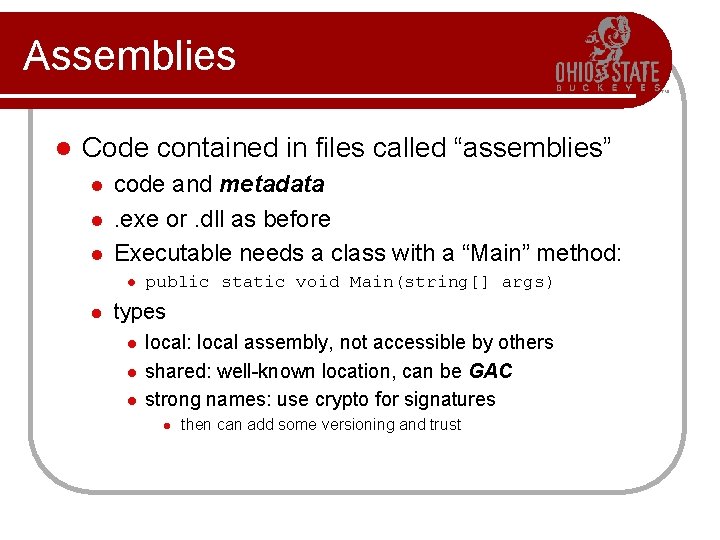
Assemblies l Code contained in files called “assemblies” l l l code and metadata. exe or. dll as before Executable needs a class with a “Main” method: l l public static void Main(string[] args) types l local: local assembly, not accessible by others shared: well-known location, can be GAC strong names: use crypto for signatures l then can add some versioning and trust
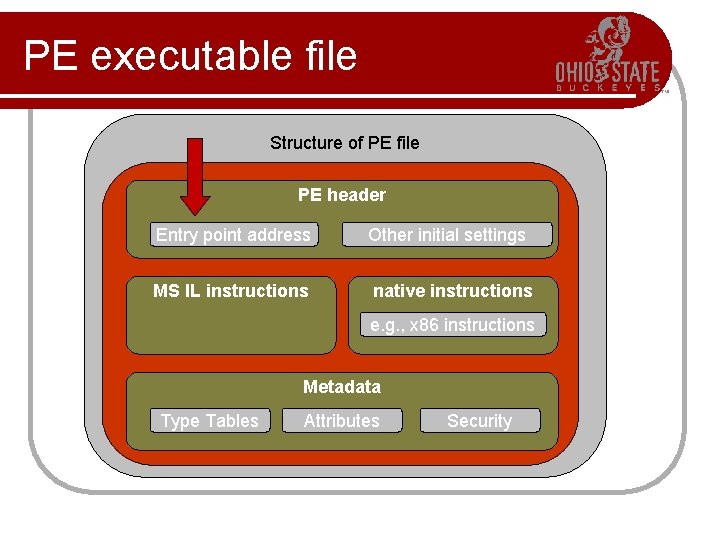
PE executable file Structure of PE file PE header Entry point address Other initial settings MS IL instructions native instructions e. g. , x 86 instructions Metadata Type Tables Attributes Security
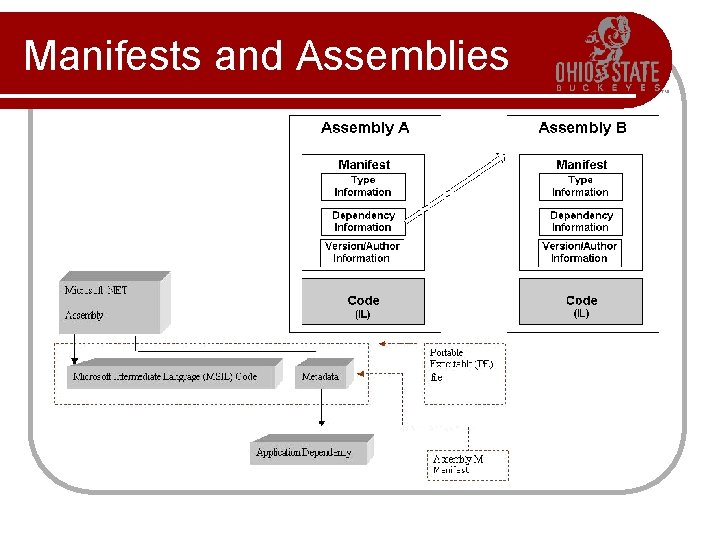
Manifests and Assemblies
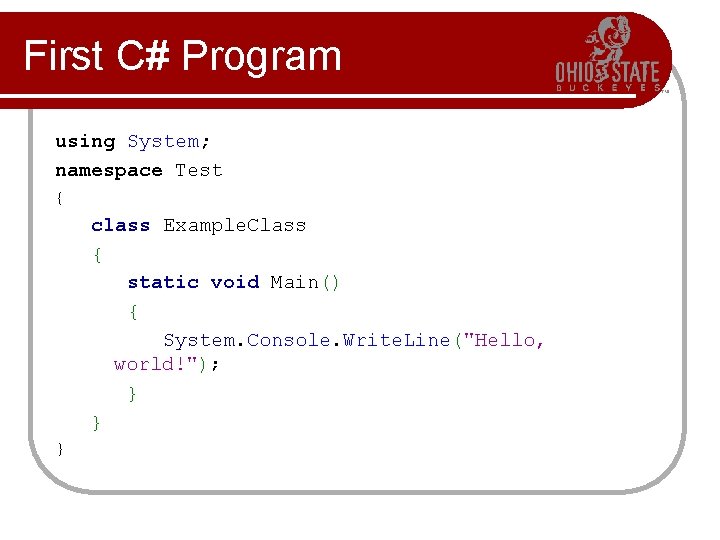
First C# Program using System; namespace Test { class Example. Class { static void Main() { System. Console. Write. Line("Hello, world!"); } } }
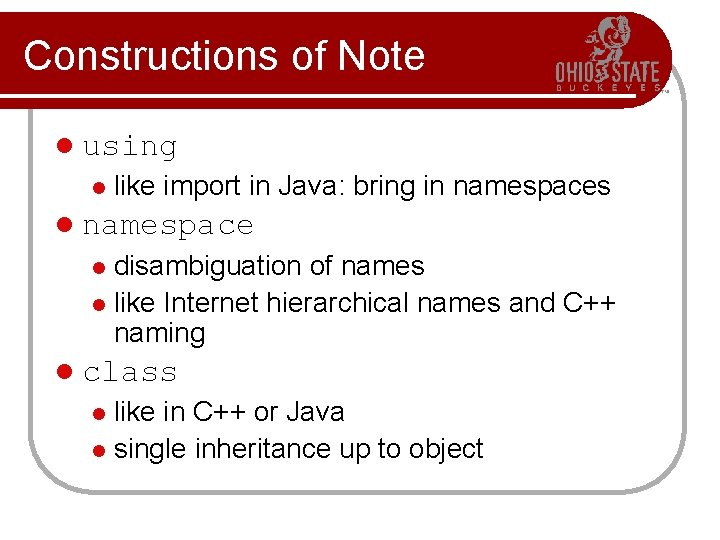
Constructions of Note l using l like import in Java: bring in namespaces l namespace disambiguation of names l like Internet hierarchical names and C++ naming l l class like in C++ or Java l single inheritance up to object l
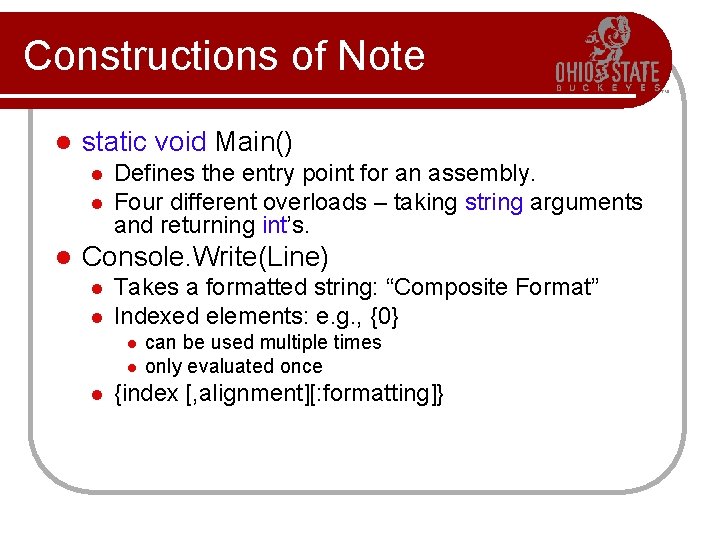
Constructions of Note l static void Main() l l l Defines the entry point for an assembly. Four different overloads – taking string arguments and returning int’s. Console. Write(Line) l l Takes a formatted string: “Composite Format” Indexed elements: e. g. , {0} l l l can be used multiple times only evaluated once {index [, alignment][: formatting]}