
Programming in C Advanced Pointers Reminder You cant
![teammates. c typedef struct player { char name[20]; struct player *teammate; /* can’t use](https://slidetodoc.com/presentation_image/35da5ba1351aa0c1b50dc1bdf1881b97/image-9.jpg "teammates. c typedef struct player { char name[20]; struct player *teammate; /* can’t use")
![Dynamic Teammates typedef struct player { char name[20]; struct player *teammate; } PLAYER; PLAYER](https://slidetodoc.com/presentation_image/35da5ba1351aa0c1b50dc1bdf1881b97/image-22.jpg "Dynamic Teammates typedef struct player { char name[20]; struct player *teammate; } PLAYER; PLAYER")
![Overwriting Memory • Not checking the max string size char s[8]; int i; gets(s);](https://slidetodoc.com/presentation_image/35da5ba1351aa0c1b50dc1bdf1881b97/image-34.jpg "Overwriting Memory • Not checking the max string size char s[8]; int i; gets(s);")
- Slides: 42
Programming in C Advanced Pointers
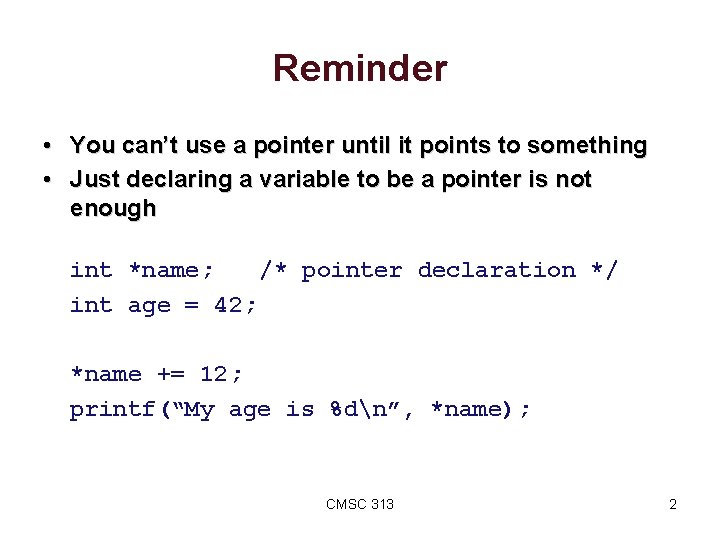
Reminder • You can’t use a pointer until it points to something • Just declaring a variable to be a pointer is not enough int *name; /* pointer declaration */ int age = 42; *name += 12; printf(“My age is %dn”, *name); CMSC 313 2
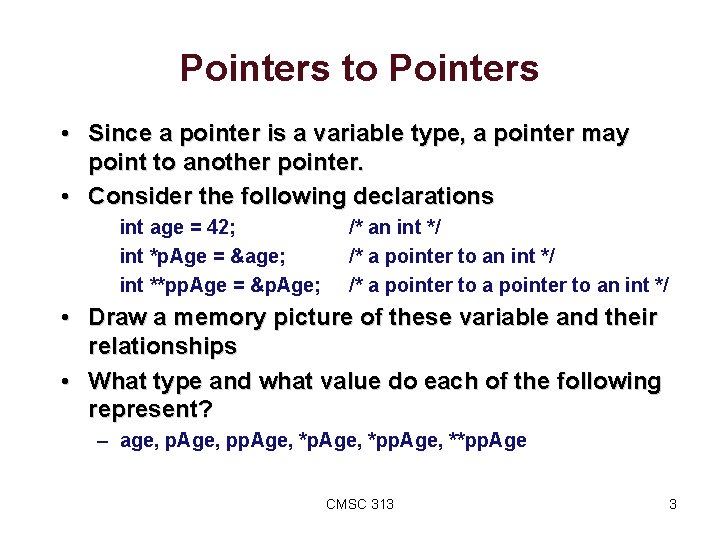
Pointers to Pointers • Since a pointer is a variable type, a pointer may point to another pointer. • Consider the following declarations int age = 42; int *p. Age = &age; int **pp. Age = &p. Age; /* an int */ /* a pointer to an int */ • Draw a memory picture of these variable and their relationships • What type and what value do each of the following represent? – age, p. Age, pp. Age, *pp. Age, **pp. Age CMSC 313 3
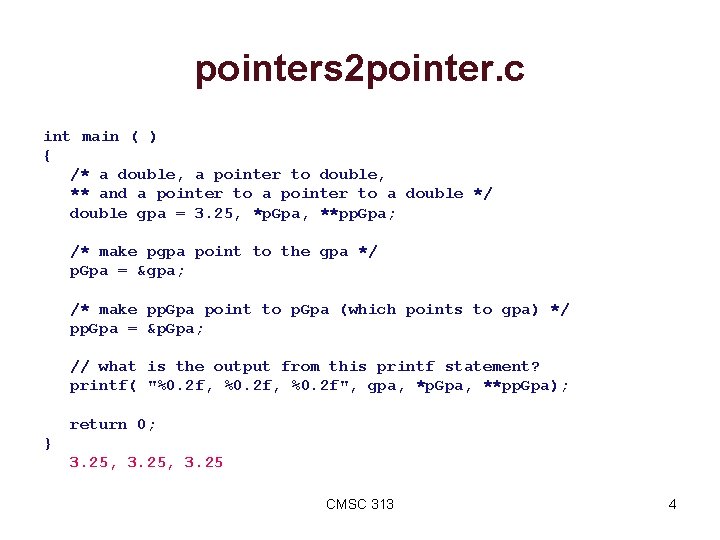
pointers 2 pointer. c int main ( ) { /* a double, a pointer to double, ** and a pointer to a double */ double gpa = 3. 25, *p. Gpa, **pp. Gpa; /* make pgpa point to the gpa */ p. Gpa = &gpa; /* make pp. Gpa point to p. Gpa (which points to gpa) */ pp. Gpa = &p. Gpa; // what is the output from this printf statement? printf( "%0. 2 f, %0. 2 f", gpa, *p. Gpa, **pp. Gpa); return 0; } 3. 25, 3. 25 CMSC 313 4
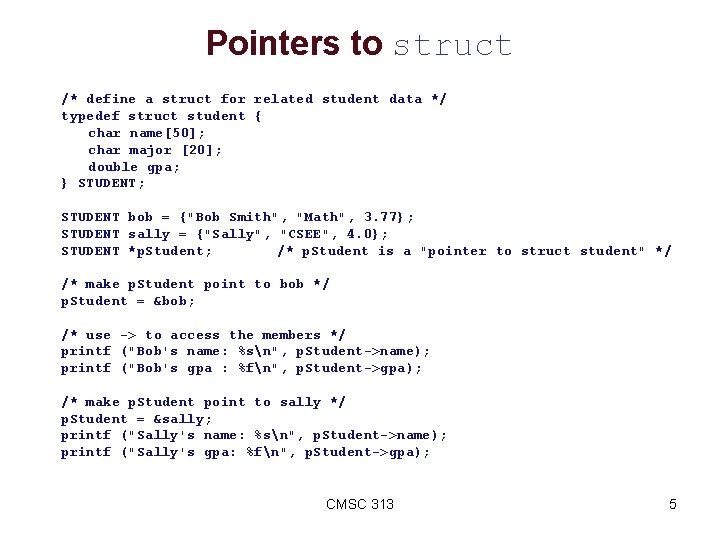
Pointers to struct /* define a struct for related student data */ typedef struct student { char name[50]; char major [20]; double gpa; } STUDENT; STUDENT bob = {"Bob Smith", "Math", 3. 77}; STUDENT sally = {"Sally", "CSEE", 4. 0}; STUDENT *p. Student; /* p. Student is a "pointer to struct student" */ /* make p. Student point to bob */ p. Student = &bob; /* use -> to access the members */ printf ("Bob's name: %sn", p. Student->name); printf ("Bob's gpa : %fn", p. Student->gpa); /* make p. Student point to sally */ p. Student = &sally; printf ("Sally's name: %sn", p. Student->name); printf ("Sally's gpa: %fn", p. Student->gpa); CMSC 313 5
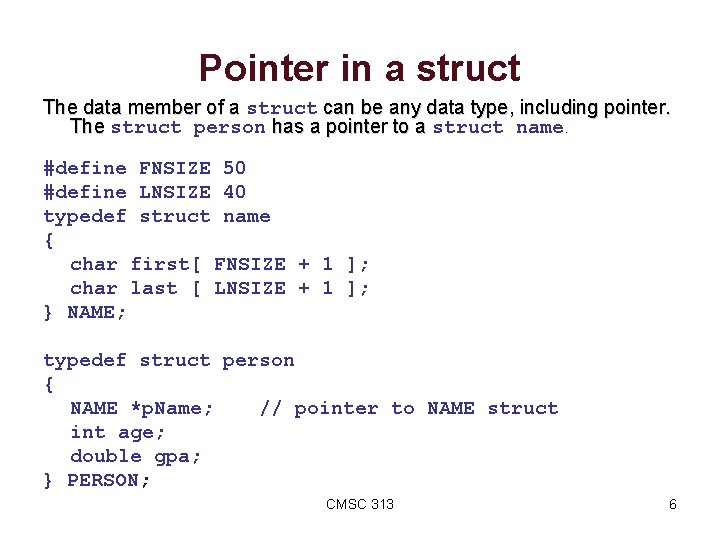
Pointer in a struct The data member of a struct can be any data type, including pointer. The struct person has a pointer to a struct name. #define FNSIZE 50 #define LNSIZE 40 typedef struct name { char first[ FNSIZE + 1 ]; char last [ LNSIZE + 1 ]; } NAME; typedef struct person { NAME *p. Name; // pointer to NAME struct int age; double gpa; } PERSON; CMSC 313 6
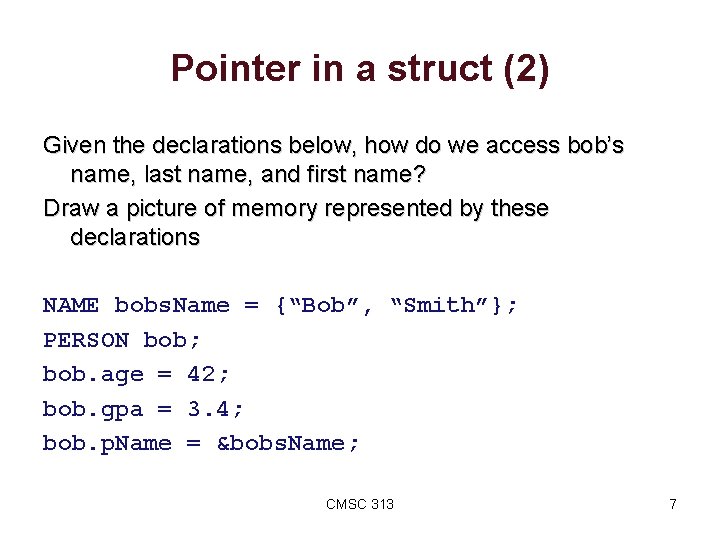
Pointer in a struct (2) Given the declarations below, how do we access bob’s name, last name, and first name? Draw a picture of memory represented by these declarations NAME bobs. Name = {“Bob”, “Smith”}; PERSON bob; bob. age = 42; bob. gpa = 3. 4; bob. p. Name = &bobs. Name; CMSC 313 7
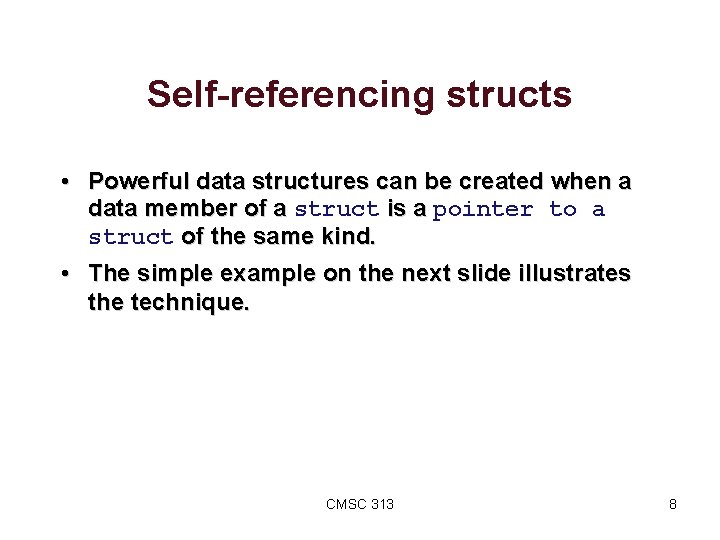
Self-referencing structs • Powerful data structures can be created when a data member of a struct is a pointer to a struct of the same kind. • The simple example on the next slide illustrates the technique. CMSC 313 8
teammates. c typedef struct player { char name[20]; struct player *teammate; /* can’t use TEAMMATE yet */ } TEAMMATE; TEAMMATE *team, bob, harry, john; team = &bob; /* first player */ strncpy(bob. name, “bob”, 20); bob. teammate = &harry; /* next teammate */ strncpy(harry. name, “harry”, 20); harry. teammate = &john; /* next teammate */ strncpy(john. name, “bill”, 20); john. teammate = NULL: CMSC 313 /* last teammate */ 9
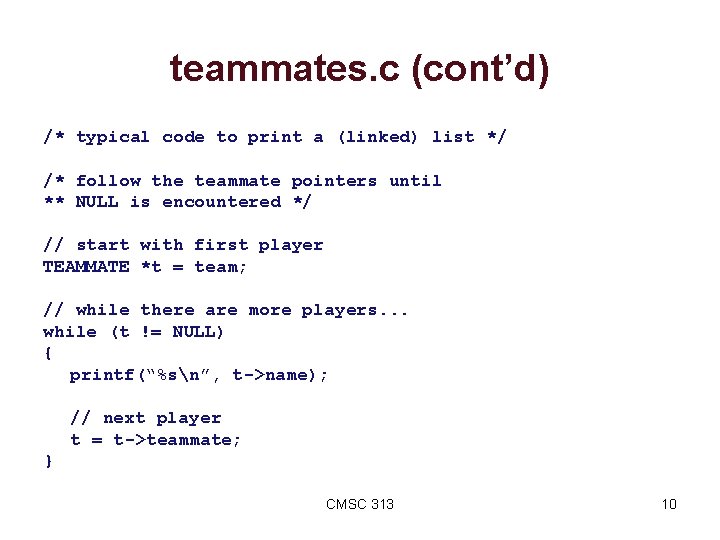
teammates. c (cont’d) /* typical code to print a (linked) list */ /* follow the teammate pointers until ** NULL is encountered */ // start with first player TEAMMATE *t = team; // while there are more players. . . while (t != NULL) { printf(“%sn”, t->name); // next player t = t->teammate; } CMSC 313 10
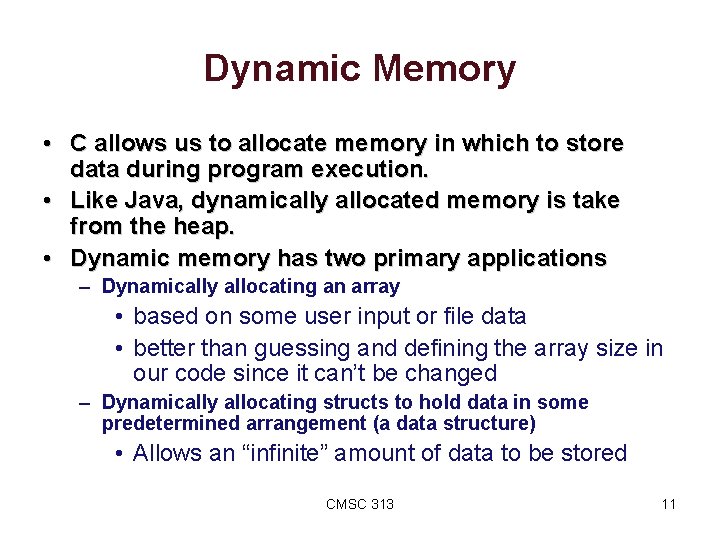
Dynamic Memory • C allows us to allocate memory in which to store data during program execution. • Like Java, dynamically allocated memory is take from the heap. • Dynamic memory has two primary applications – Dynamically allocating an array • based on some user input or file data • better than guessing and defining the array size in our code since it can’t be changed – Dynamically allocating structs to hold data in some predetermined arrangement (a data structure) • Allows an “infinite” amount of data to be stored CMSC 313 11
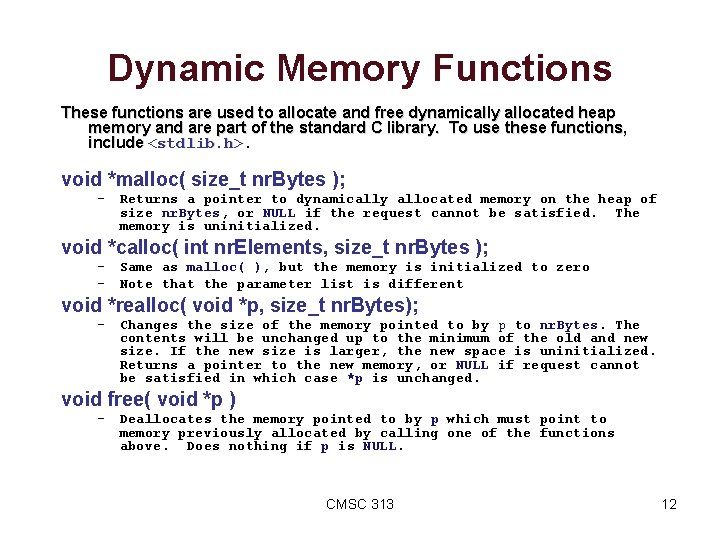
Dynamic Memory Functions These functions are used to allocate and free dynamically allocated heap memory and are part of the standard C library. To use these functions, include <stdlib. h>. void *malloc( size_t nr. Bytes ); – Returns a pointer to dynamically allocated memory on the heap of size nr. Bytes, or NULL if the request cannot be satisfied. The memory is uninitialized. void *calloc( int nr. Elements, size_t nr. Bytes ); – Same as malloc( ), but the memory is initialized to zero – Note that the parameter list is different void *realloc( void *p, size_t nr. Bytes); – Changes the size of the memory pointed to by p to nr. Bytes. The contents will be unchanged up to the minimum of the old and new size. If the new size is larger, the new space is uninitialized. Returns a pointer to the new memory, or NULL if request cannot be satisfied in which case *p is unchanged. void free( void *p ) – Deallocates the memory pointed to by p which must point to memory previously allocated by calling one of the functions above. Does nothing if p is NULL. CMSC 313 12
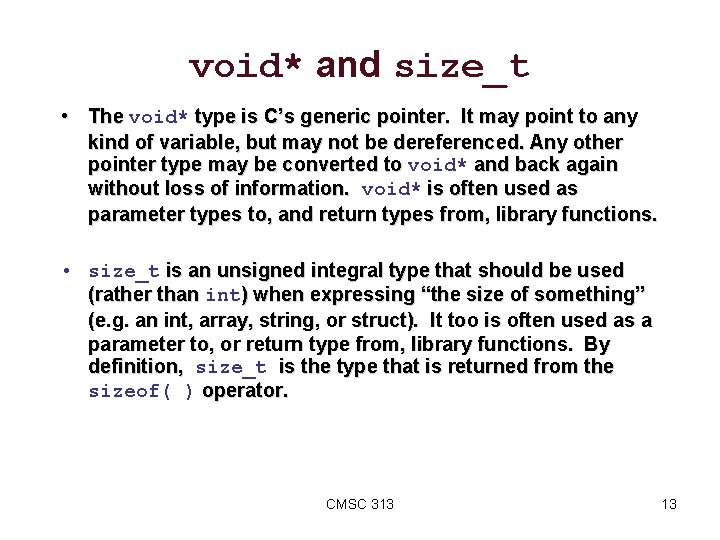
void* and size_t • The void* type is C’s generic pointer. It may point to any kind of variable, but may not be dereferenced. Any other pointer type may be converted to void* and back again without loss of information. void* is often used as parameter types to, and return types from, library functions. • size_t is an unsigned integral type that should be used (rather than int) when expressing “the size of something” (e. g. an int, array, string, or struct). It too is often used as a parameter to, or return type from, library functions. By definition, size_t is the type that is returned from the sizeof( ) operator. CMSC 313 13
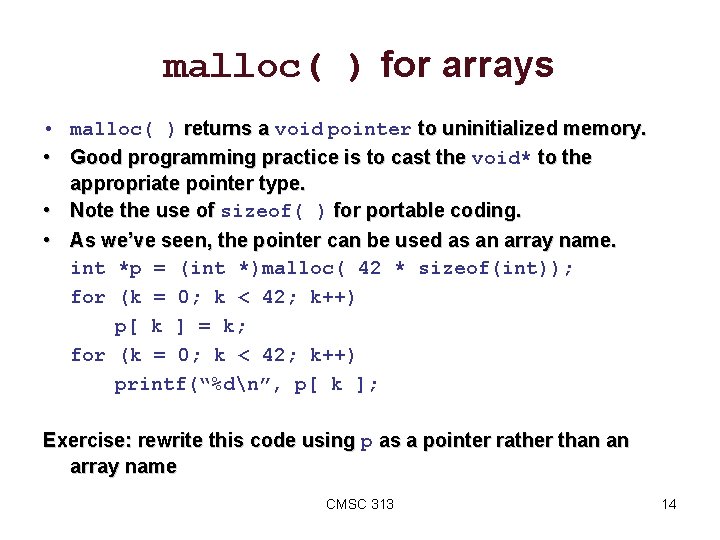
malloc( ) for arrays • malloc( ) returns a void pointer to uninitialized memory. • Good programming practice is to cast the void* to the appropriate pointer type. • Note the use of sizeof( ) for portable coding. • As we’ve seen, the pointer can be used as an array name. int *p = (int *)malloc( 42 * sizeof(int)); for (k = 0; k < 42; k++) p[ k ] = k; for (k = 0; k < 42; k++) printf(“%dn”, p[ k ]; Exercise: rewrite this code using p as a pointer rather than an array name CMSC 313 14
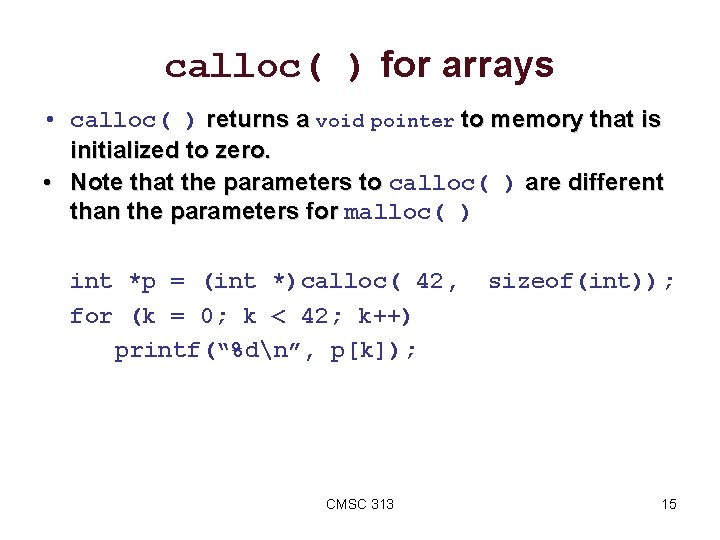
calloc( ) for arrays • calloc( ) returns a void pointer to memory that is initialized to zero. • Note that the parameters to calloc( ) are different than the parameters for malloc( ) int *p = (int *)calloc( 42, for (k = 0; k < 42; k++) printf(“%dn”, p[k]); CMSC 313 sizeof(int)); 15
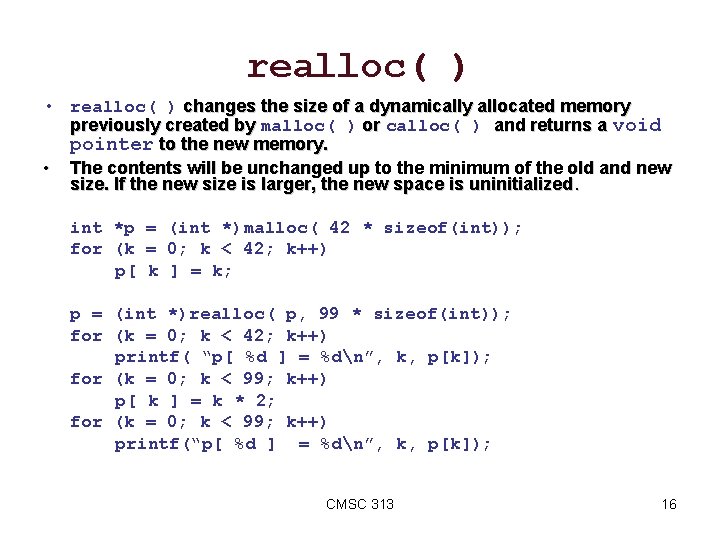
realloc( ) • realloc( ) changes the size of a dynamically allocated memory previously created by malloc( ) or calloc( ) and returns a void pointer to the new memory. • The contents will be unchanged up to the minimum of the old and new size. If the new size is larger, the new space is uninitialized. int *p = (int *)malloc( 42 * sizeof(int)); for (k = 0; k < 42; k++) p[ k ] = k; p = (int *)realloc( p, 99 * sizeof(int)); for (k = 0; k < 42; k++) printf( “p[ %d ] = %dn”, k, p[k]); for (k = 0; k < 99; k++) p[ k ] = k * 2; for (k = 0; k < 99; k++) printf(“p[ %d ] = %dn”, k, p[k]); CMSC 313 16
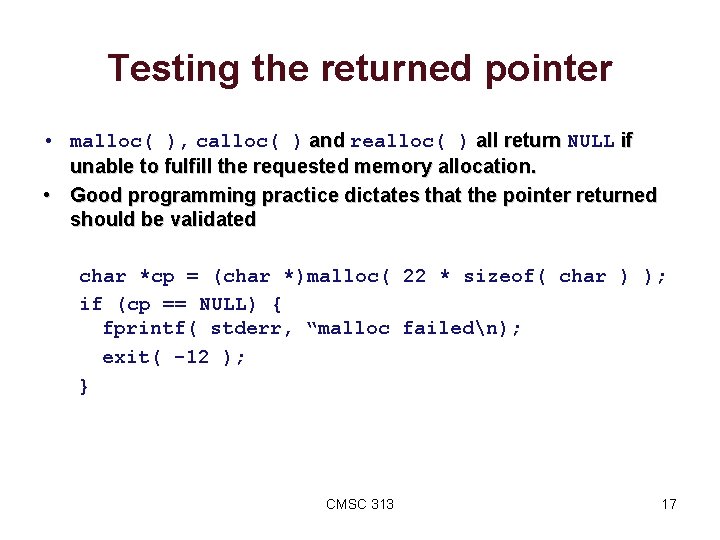
Testing the returned pointer • malloc( ), calloc( ) and realloc( ) all return NULL if unable to fulfill the requested memory allocation. • Good programming practice dictates that the pointer returned should be validated char *cp = (char *)malloc( 22 * sizeof( char ) ); if (cp == NULL) { fprintf( stderr, “malloc failedn); exit( -12 ); } CMSC 313 17
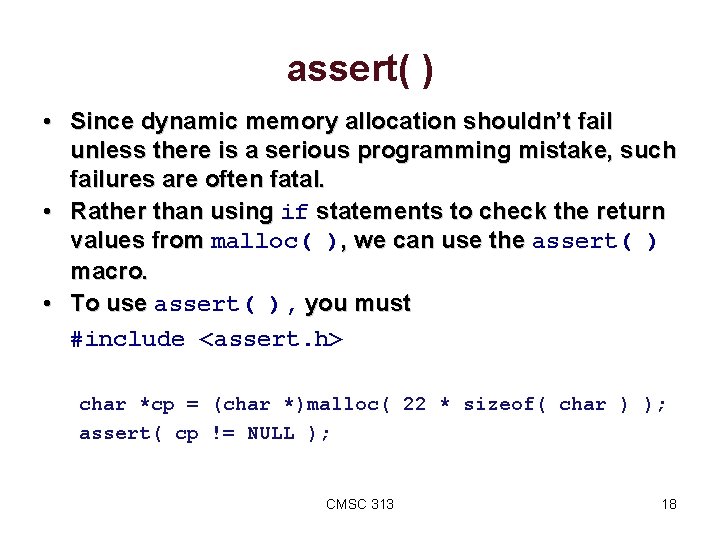
assert( ) • Since dynamic memory allocation shouldn’t fail unless there is a serious programming mistake, such failures are often fatal. • Rather than using if statements to check the return values from malloc( ), we can use the assert( ) macro. • To use assert( ), you must #include <assert. h> char *cp = (char *)malloc( 22 * sizeof( char ) ); assert( cp != NULL ); CMSC 313 18
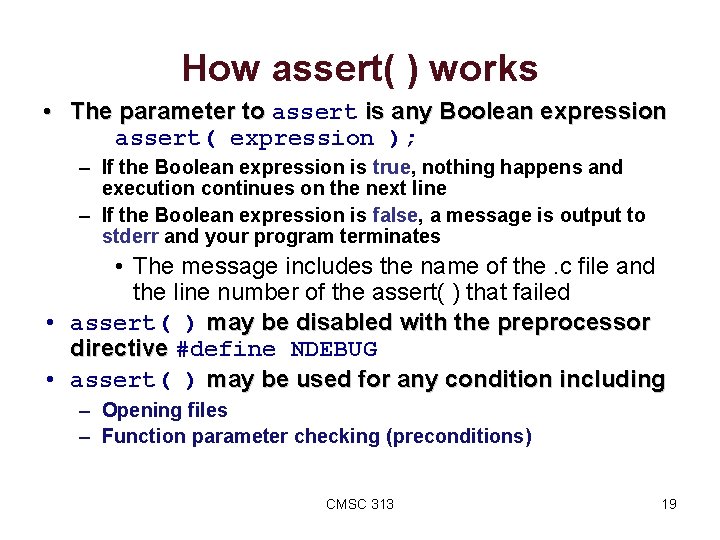
How assert( ) works • The parameter to assert is any Boolean expression assert( expression ); – If the Boolean expression is true, nothing happens and execution continues on the next line – If the Boolean expression is false, a message is output to stderr and your program terminates • The message includes the name of the. c file and the line number of the assert( ) that failed • assert( ) may be disabled with the preprocessor directive #define NDEBUG • assert( ) may be used for any condition including – Opening files – Function parameter checking (preconditions) CMSC 313 19
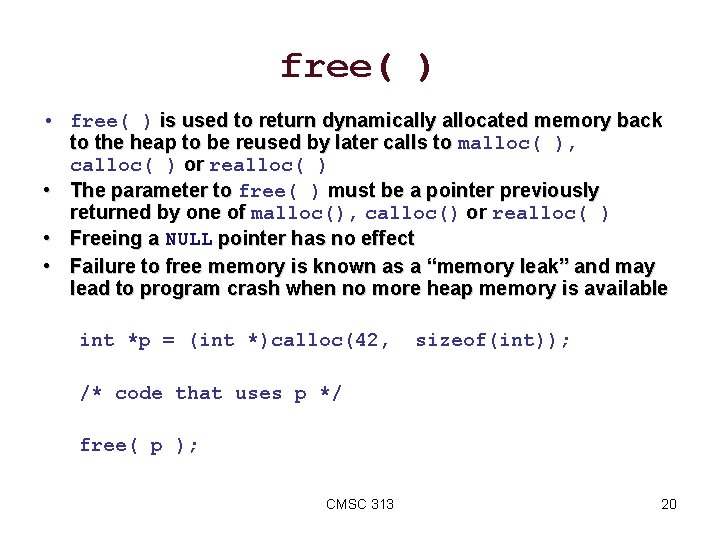
free( ) • free( ) is used to return dynamically allocated memory back to the heap to be reused by later calls to malloc( ), calloc( ) or realloc( ) • The parameter to free( ) must be a pointer previously returned by one of malloc(), calloc() or realloc( ) • Freeing a NULL pointer has no effect • Failure to free memory is known as a “memory leak” and may lead to program crash when no more heap memory is available int *p = (int *)calloc(42, sizeof(int)); /* code that uses p */ free( p ); CMSC 313 20
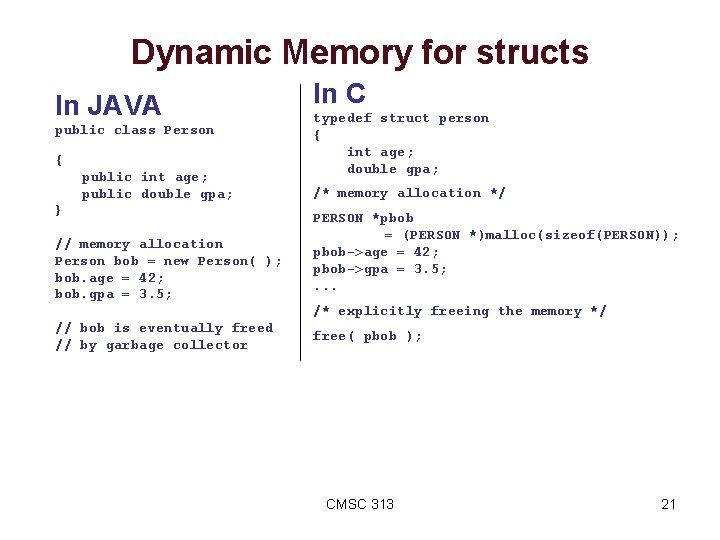
Dynamic Memory for structs In JAVA public class Person { public int age; public double gpa; } // memory allocation Person bob = new Person( ); bob. age = 42; bob. gpa = 3. 5; In C typedef struct person { int age; double gpa; /* memory allocation */ PERSON *pbob = (PERSON *)malloc(sizeof(PERSON)); pbob->age = 42; pbob->gpa = 3. 5; . . . /* explicitly freeing the memory */ // bob is eventually freed // by garbage collector free( pbob ); CMSC 313 21
Dynamic Teammates typedef struct player { char name[20]; struct player *teammate; } PLAYER; PLAYER *get. Player( ) { PLAYER *p = (PLAYER *)malloc(sizeof(PLAYER)); printf(“Please enter name: ”); scanf(“%19 s”, p->name); p->teammate = NULL; return p; } CMSC 313 22
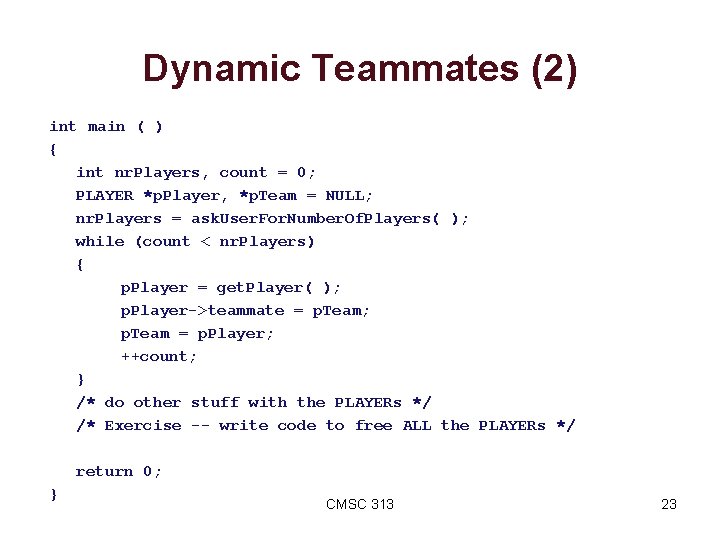
Dynamic Teammates (2) int main ( ) { int nr. Players, count = 0; PLAYER *p. Player, *p. Team = NULL; nr. Players = ask. User. For. Number. Of. Players( ); while (count < nr. Players) { p. Player = get. Player( ); p. Player->teammate = p. Team; p. Team = p. Player; ++count; } /* do other stuff with the PLAYERs */ /* Exercise -- write code to free ALL the PLAYERs */ return 0; } CMSC 313 23
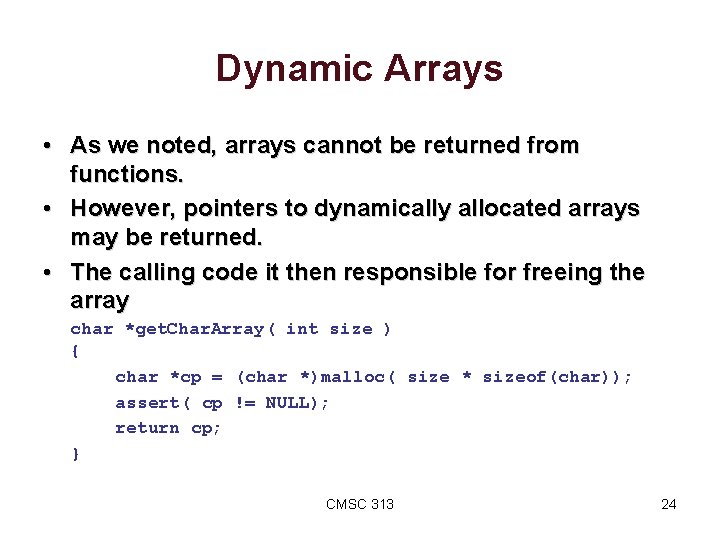
Dynamic Arrays • As we noted, arrays cannot be returned from functions. • However, pointers to dynamically allocated arrays may be returned. • The calling code it then responsible for freeing the array char *get. Char. Array( int size ) { char *cp = (char *)malloc( size * sizeof(char)); assert( cp != NULL); return cp; } CMSC 313 24
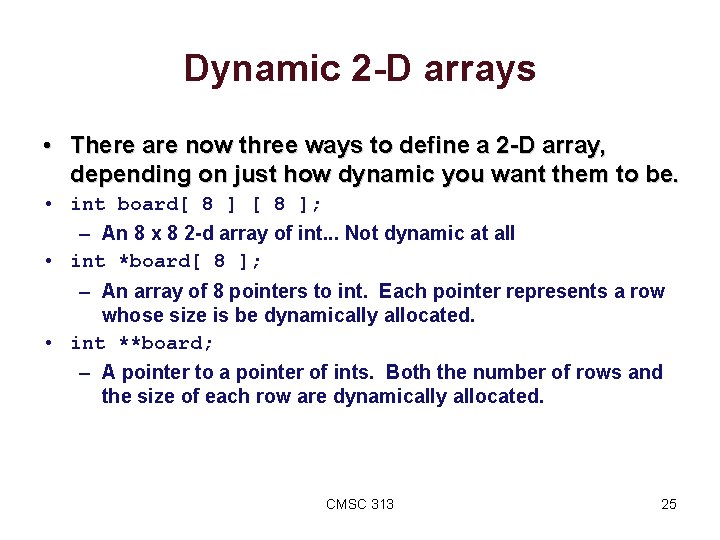
Dynamic 2 -D arrays • There are now three ways to define a 2 -D array, depending on just how dynamic you want them to be. • int board[ 8 ]; – An 8 x 8 2 -d array of int. . . Not dynamic at all • int *board[ 8 ]; – An array of 8 pointers to int. Each pointer represents a row whose size is be dynamically allocated. • int **board; – A pointer to a pointer of ints. Both the number of rows and the size of each row are dynamically allocated. CMSC 313 25
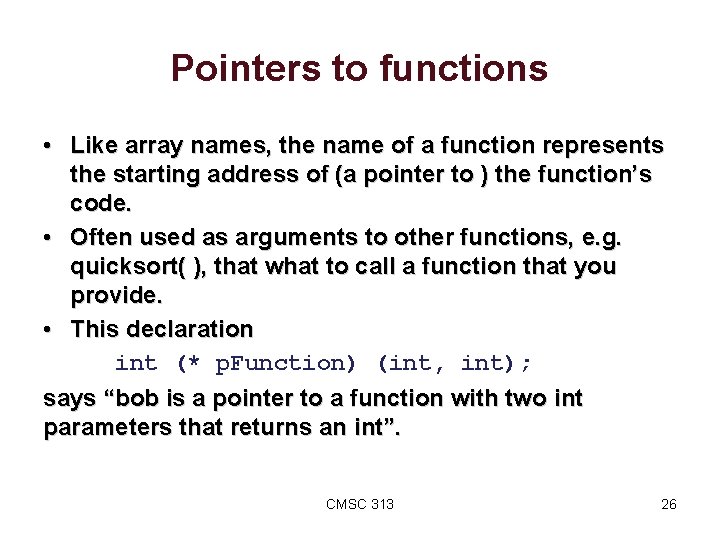
Pointers to functions • Like array names, the name of a function represents the starting address of (a pointer to ) the function’s code. • Often used as arguments to other functions, e. g. quicksort( ), that what to call a function that you provide. • This declaration int (* p. Function) (int, int); says “bob is a pointer to a function with two int parameters that returns an int”. CMSC 313 26
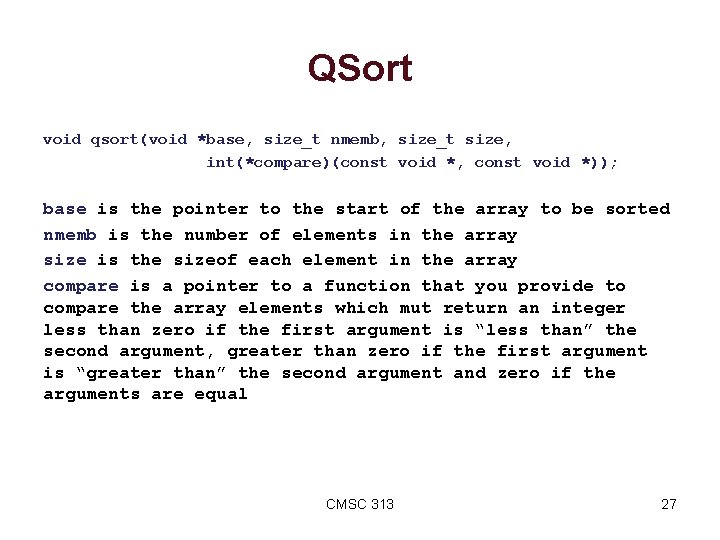
QSort void qsort(void *base, size_t nmemb, size_t size, int(*compare)(const void *, const void *)); base is the pointer to the start of the array to be sorted nmemb is the number of elements in the array size is the sizeof each element in the array compare is a pointer to a function that you provide to compare the array elements which mut return an integer less than zero if the first argument is “less than” the second argument, greater than zero if the first argument is “greater than” the second argument and zero if the arguments are equal CMSC 313 27
qsort. c See the following example code /afs/umbc. edu/users/c/m/cmsc 313/pub/code/qsort 1. c /afs/umbc. edu/users/c/m/cmsc 313/pub/code/qsort 2. c CMSC 313 28
Memory-Related Perils and Pitfalls • Using * with ++ • Dereferencing bad pointers • Reading uninitialized memory • Overwriting memory • Referencing nonexistent variables • Freeing blocks multiple times • Referencing freed blocks • Failing to free blocks
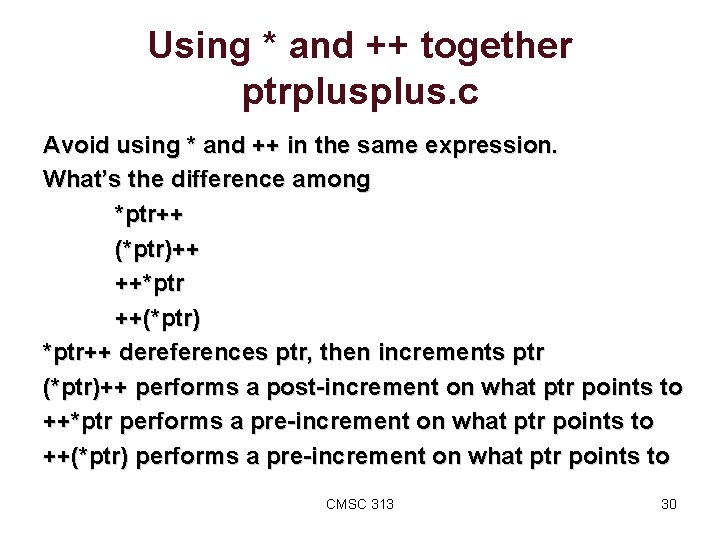
Using * and ++ together ptrplus. c Avoid using * and ++ in the same expression. What’s the difference among *ptr++ (*ptr)++ ++*ptr ++(*ptr) *ptr++ dereferences ptr, then increments ptr (*ptr)++ performs a post-increment on what ptr points to ++*ptr performs a pre-increment on what ptr points to ++(*ptr) performs a pre-increment on what ptr points to CMSC 313 30
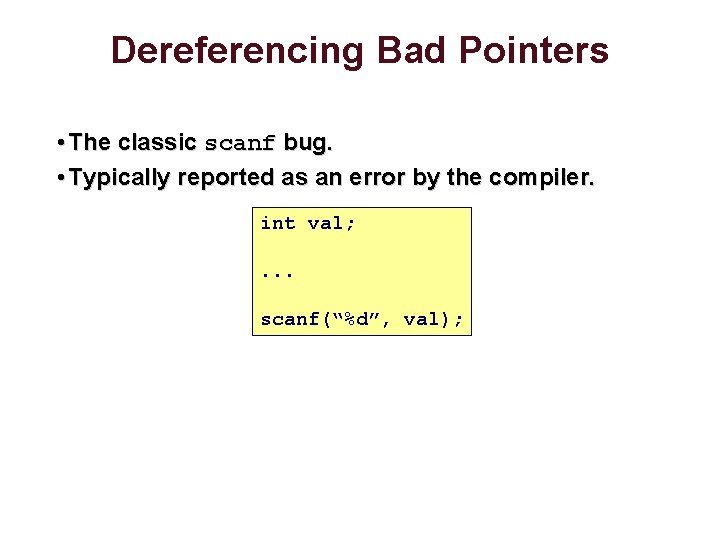
Dereferencing Bad Pointers • The classic scanf bug. • Typically reported as an error by the compiler. int val; . . . scanf(“%d”, val);
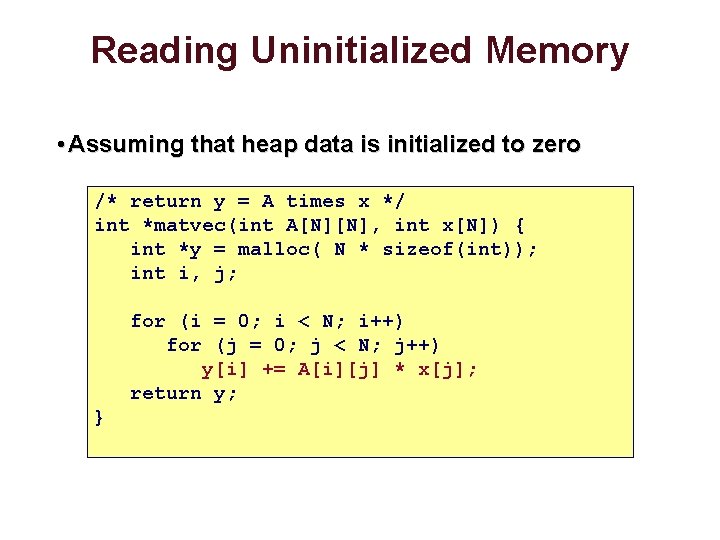
Reading Uninitialized Memory • Assuming that heap data is initialized to zero /* return y = A times x */ int *matvec(int A[N][N], int x[N]) { int *y = malloc( N * sizeof(int)); int i, j; for (i = 0; i < N; i++) for (j = 0; j < N; j++) y[i] += A[i][j] * x[j]; return y; }
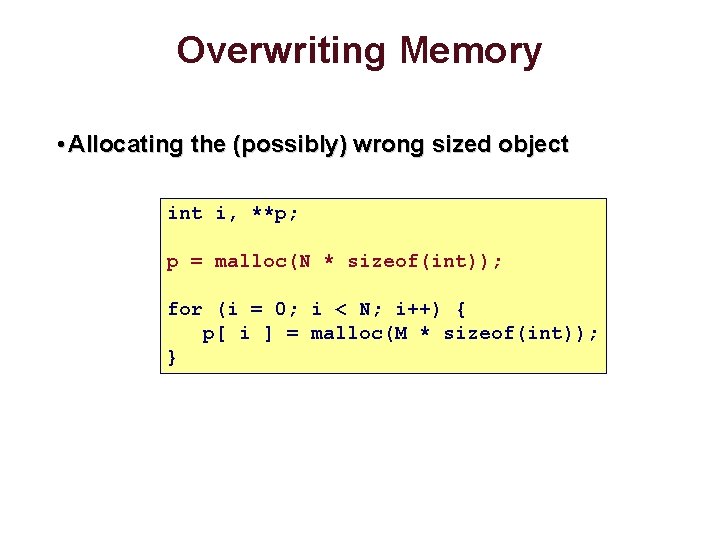
Overwriting Memory • Allocating the (possibly) wrong sized object int i, **p; p = malloc(N * sizeof(int)); for (i = 0; i < N; i++) { p[ i ] = malloc(M * sizeof(int)); }
Overwriting Memory • Not checking the max string size char s[8]; int i; gets(s); /* reads “ 123456789” from stdin */ • Basis for classic buffer overflow attacks – 1988 Internet worm –Modern attacks on Web servers –AOL/Microsoft IM war
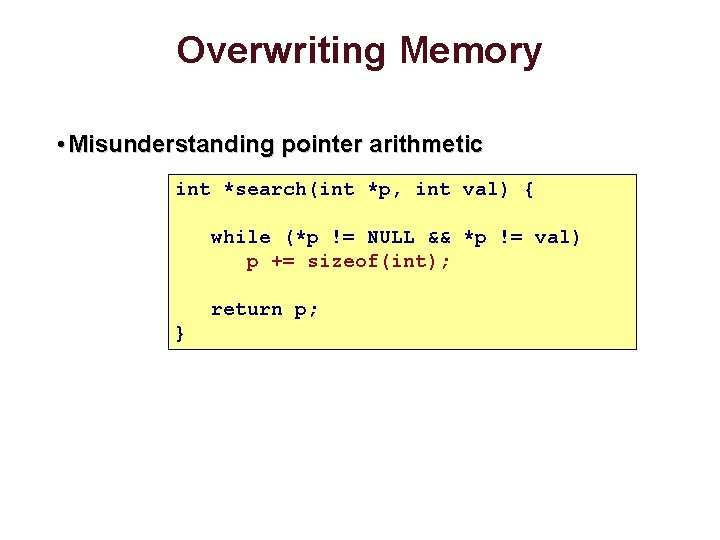
Overwriting Memory • Misunderstanding pointer arithmetic int *search(int *p, int val) { while (*p != NULL && *p != val) p += sizeof(int); return p; }
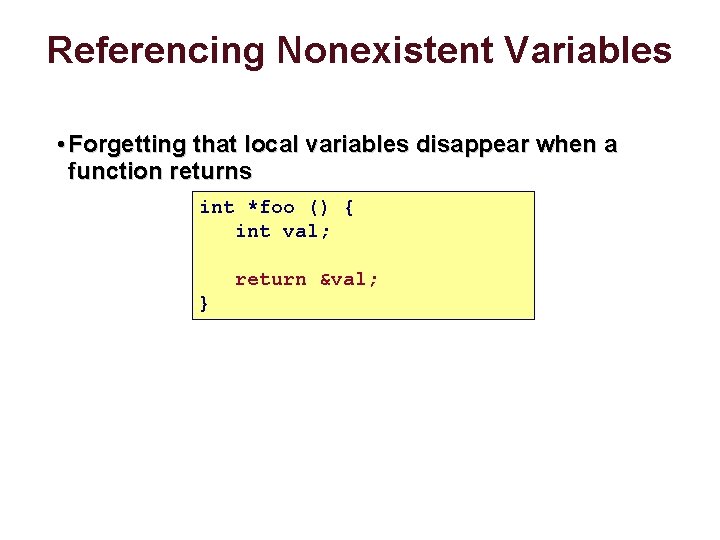
Referencing Nonexistent Variables • Forgetting that local variables disappear when a function returns int *foo () { int val; return &val; }
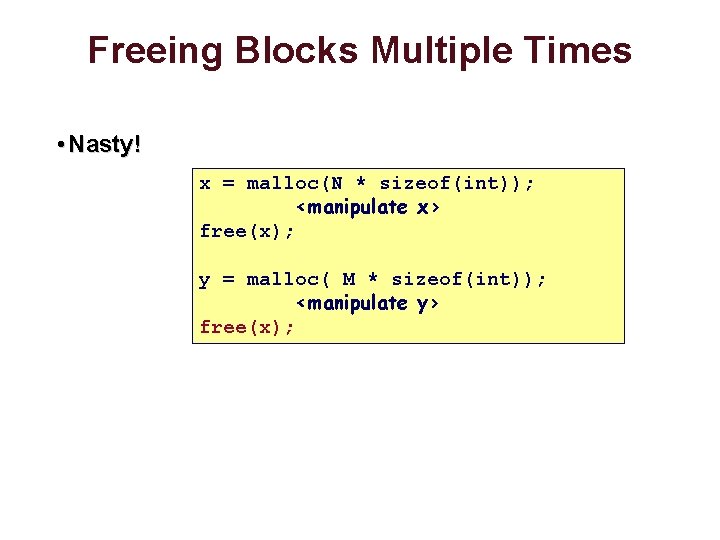
Freeing Blocks Multiple Times • Nasty! x = malloc(N * sizeof(int)); <manipulate x> free(x); y = malloc( M * sizeof(int)); <manipulate y> free(x);
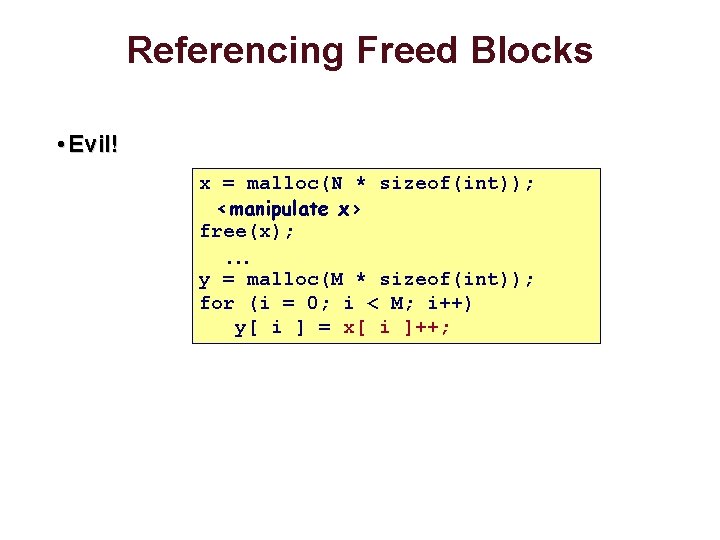
Referencing Freed Blocks • Evil! x = malloc(N * sizeof(int)); <manipulate x> free(x); . . . y = malloc(M * sizeof(int)); for (i = 0; i < M; i++) y[ i ] = x[ i ]++;
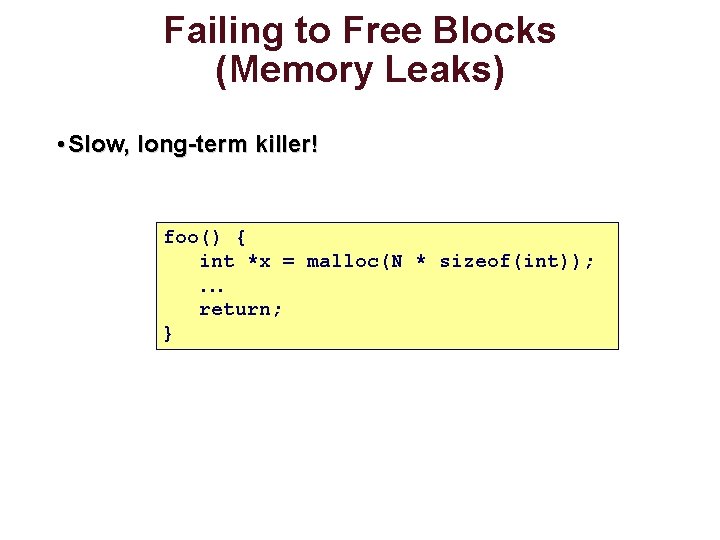
Failing to Free Blocks (Memory Leaks) • Slow, long-term killer! foo() { int *x = malloc(N * sizeof(int)); . . . return; }
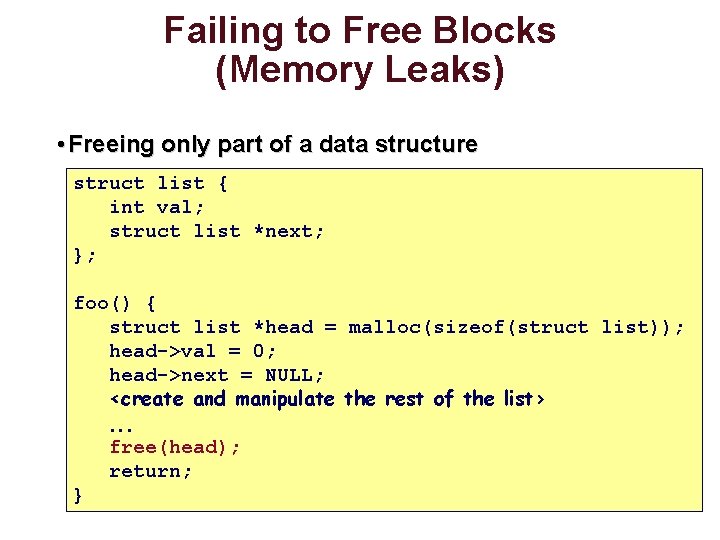
Failing to Free Blocks (Memory Leaks) • Freeing only part of a data structure struct list { int val; struct list *next; }; foo() { struct list *head = malloc(sizeof(struct list)); head->val = 0; head->next = NULL; <create and manipulate the rest of the list>. . . free(head); return; }
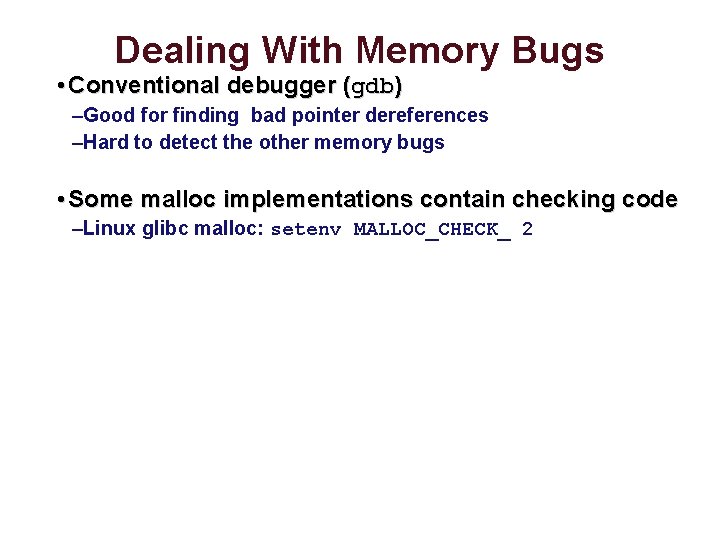
Dealing With Memory Bugs • Conventional debugger (gdb) –Good for finding bad pointer dereferences –Hard to detect the other memory bugs • Some malloc implementations contain checking code –Linux glibc malloc: setenv MALLOC_CHECK_ 2
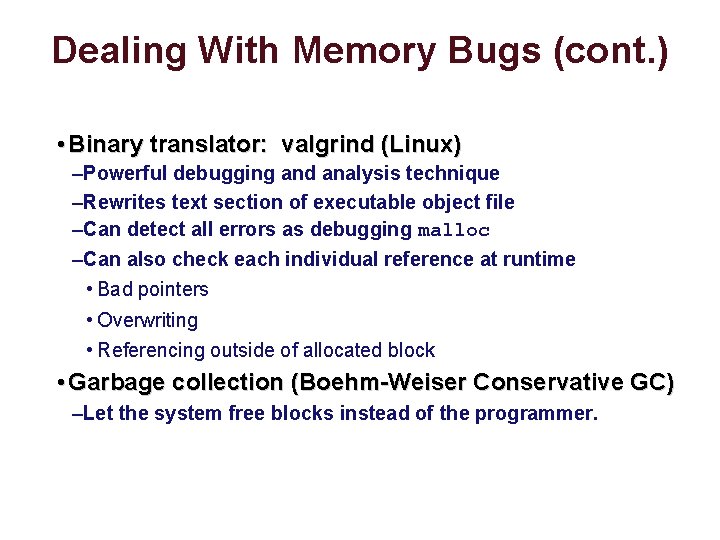
Dealing With Memory Bugs (cont. ) • Binary translator: valgrind (Linux) –Powerful debugging and analysis technique –Rewrites text section of executable object file –Can detect all errors as debugging malloc –Can also check each individual reference at runtime • Bad pointers • Overwriting • Referencing outside of allocated block • Garbage collection (Boehm-Weiser Conservative GC) –Let the system free blocks instead of the programmer.