
Programming in bioinformatics Bio Perl Dobrica Pavlinui http
Programming in bioinformatics: Bio. Perl Dobrica Pavlinušić http: //www. rot 13. org/~dpavlin/ PBF, 10. 05. 2007.
Programming and biology Basic algorithm structures
Programming for biology Cultural divide between biologists and computer science use programs, don't write them write programs when there's nothing to use programming takes time Focus on interesting, unsolved, problems Open Source tools comes as part of the rescue
Reasons for programming Scientific Quantity of existing data Dealing with new data Automating the automation Evaluating many targets Economic . . . programmers going into biology often have the harder time of it. . . biology is subtle, and it can take lots of work to begin to get a handle on the variety of living organisms. Programmers new to the field sometimes write a perfectly good program for what turns out to be the wrong problem! -- James Tisdall
Biology Science in different mediums in vitro – in glass in vivo – in life in silico – in computer algorithms Huge amount of experimental data collected, shared, analyzed biologists forced to relay on computers
Basic programming Simple basic building blocks which enable us to describe desired behavior (algorithm) to computer sequence condition loop
Why perl? well suited to text manipulation tasks easy to learn CPAN modules, including Bio. Perl rapid prototyping available on multiple platforms duct tape of Internet Unix, Linux, Windows, VMS. . . TIMTOWTDI There Is More Than One Way To Do It
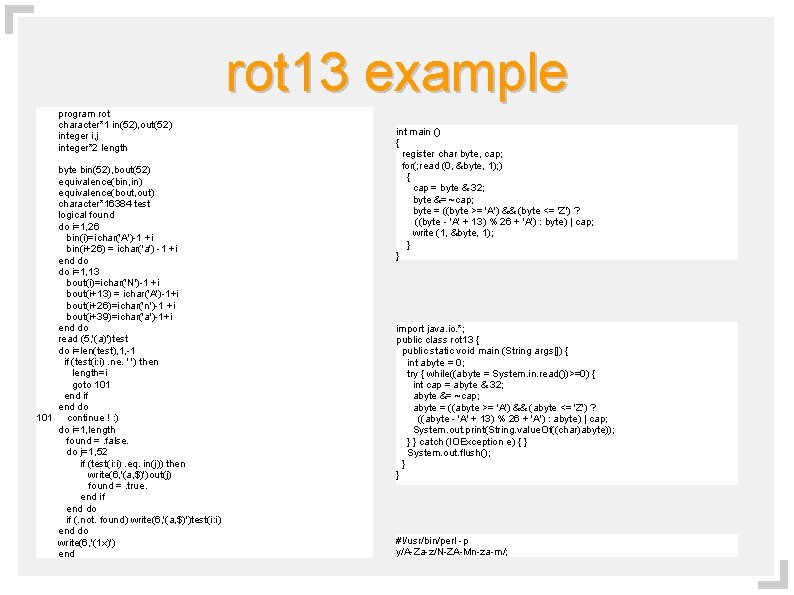
rot 13 example program rot character*1 in(52), out(52) integer i, j integer*2 length byte bin(52), bout(52) equivalence(bin, in) equivalence(bout, out) character*16384 test logical found do i=1, 26 bin(i)=ichar('A')-1 +i bin(i+26) = ichar('a') -1 +i end do do i=1, 13 bout(i)=ichar('N')-1 +i bout(i+13) = ichar('A')-1+i bout(i+26)=ichar('n')-1 +i bout(i+39)=ichar('a')-1+i end do read (5, '(a)')test do i=len(test), 1, -1 if (test(i: i). ne. ' ') then length=i goto 101 end if end do 101 continue ! : ) do i=1, length found =. false. do j=1, 52 if (test(i: i). eq. in(j)) then write(6, '(a, $)')out(j) found =. true. end if end do if (. not. found) write(6, '(a, $)')test(i: i) end do write(6, '(1 x)') end int main () { register char byte, cap; for(; read (0, &byte, 1); ) { cap = byte & 32; byte &= ~cap; byte = ((byte >= 'A') && (byte <= 'Z') ? ((byte - 'A' + 13) % 26 + 'A') : byte) | cap; write (1, &byte, 1); } } import java. io. *; public class rot 13 { public static void main (String args[]) { int abyte = 0; try { while((abyte = System. in. read())>=0) { int cap = abyte & 32; abyte &= ~cap; abyte = ((abyte >= 'A') && (abyte <= 'Z') ? ((abyte - 'A' + 13) % 26 + 'A') : abyte) | cap; System. out. print(String. value. Of((char)abyte)); } } catch (IOException e) { } System. out. flush(); } } #!/usr/bin/perl -p y/A-Za-z/N-ZA-Mn-za-m/;
Art of programming Different approaches take a class read a tutorial book get programming manual and plunge in be tutored by a programmer identify a program you need try all of above until you've managed to write the program
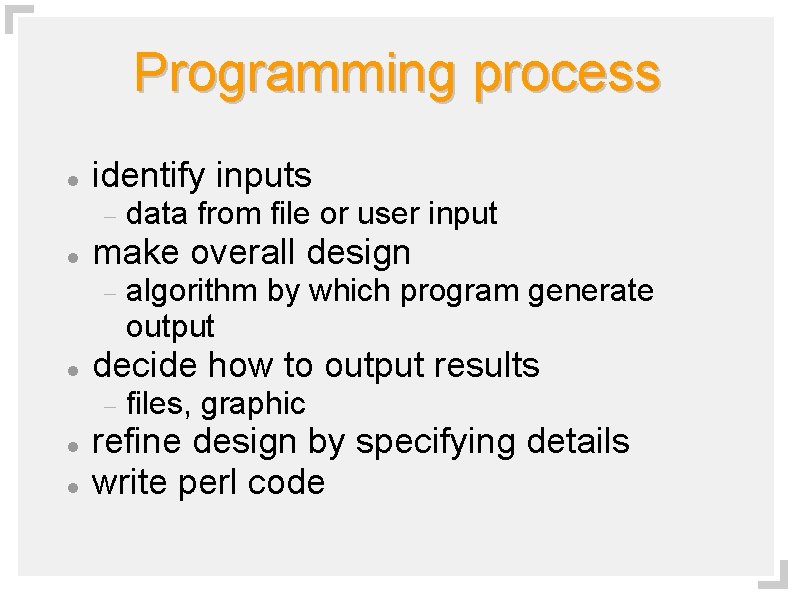
Programming process identify inputs make overall design algorithm by which program generate output decide how to output results data from file or user input files, graphic refine design by specifying details write perl code
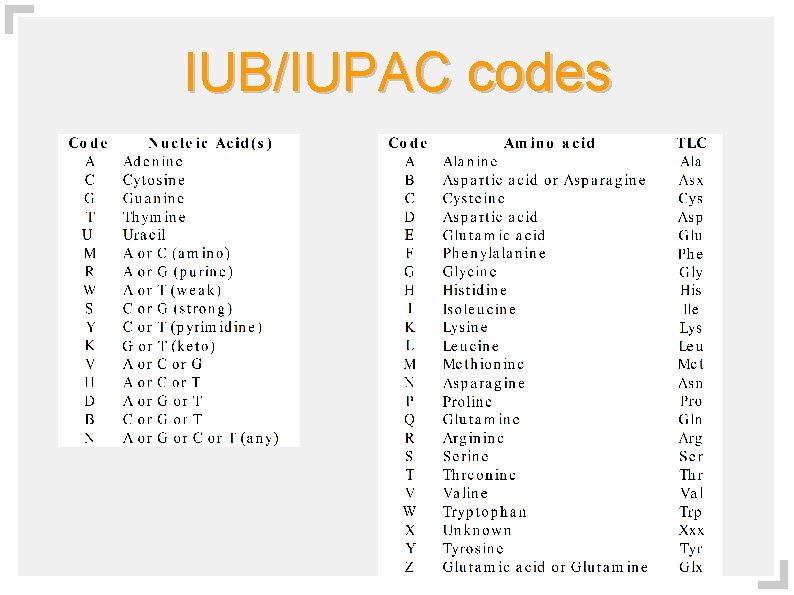
IUB/IUPAC codes
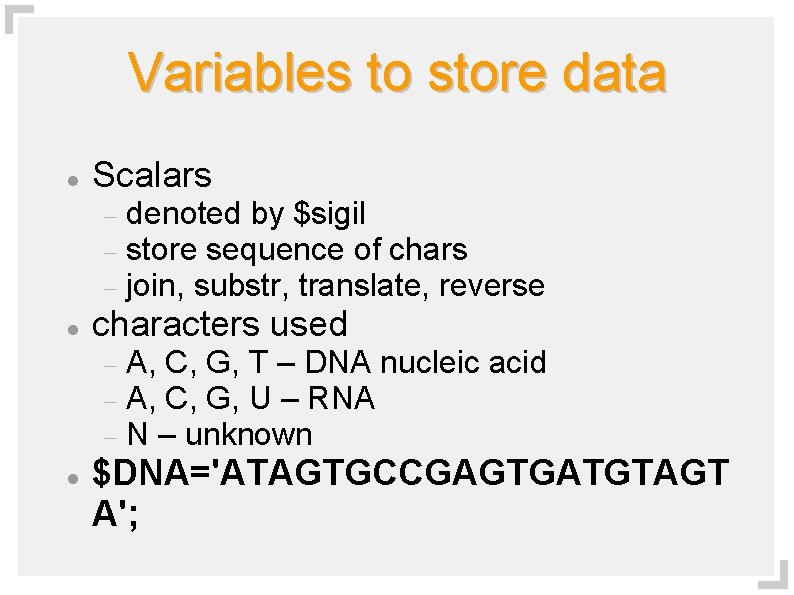
Variables to store data Scalars characters used denoted by $sigil store sequence of chars join, substr, translate, reverse A, C, G, T – DNA nucleic acid A, C, G, U – RNA N – unknown $DNA='ATAGTGCCGAGTGATGTAGT A';
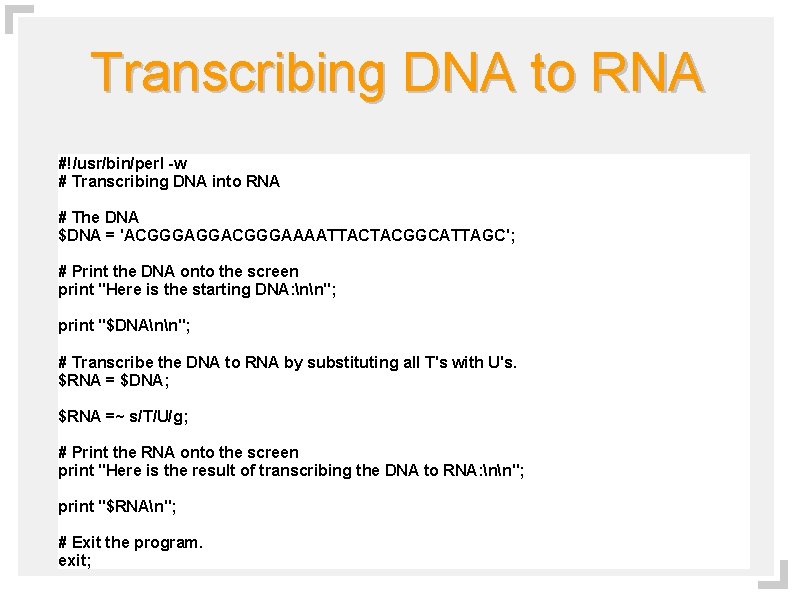
Transcribing DNA to RNA #!/usr/bin/perl -w # Transcribing DNA into RNA # The DNA $DNA = 'ACGGGAGGACGGGAAAATTACTACGGCATTAGC'; # Print the DNA onto the screen print "Here is the starting DNA: nn"; print "$DNAnn"; # Transcribe the DNA to RNA by substituting all T's with U's. $RNA = $DNA; $RNA =~ s/T/U/g; # Print the RNA onto the screen print "Here is the result of transcribing the DNA to RNA: nn"; print "$RNAn"; # Exit the program. exit;
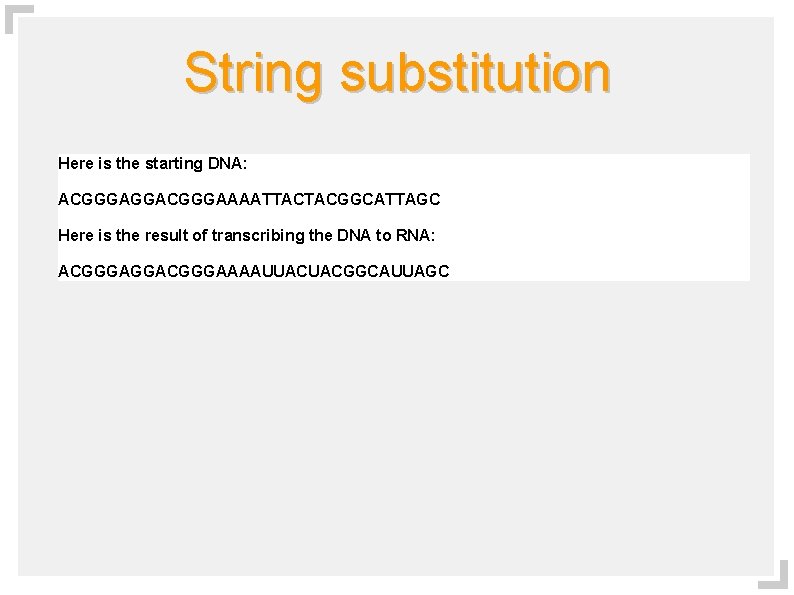
String substitution Here is the starting DNA: ACGGGAGGACGGGAAAATTACTACGGCATTAGC Here is the result of transcribing the DNA to RNA: ACGGGAGGACGGGAAAAUUACUACGGCAUUAGC
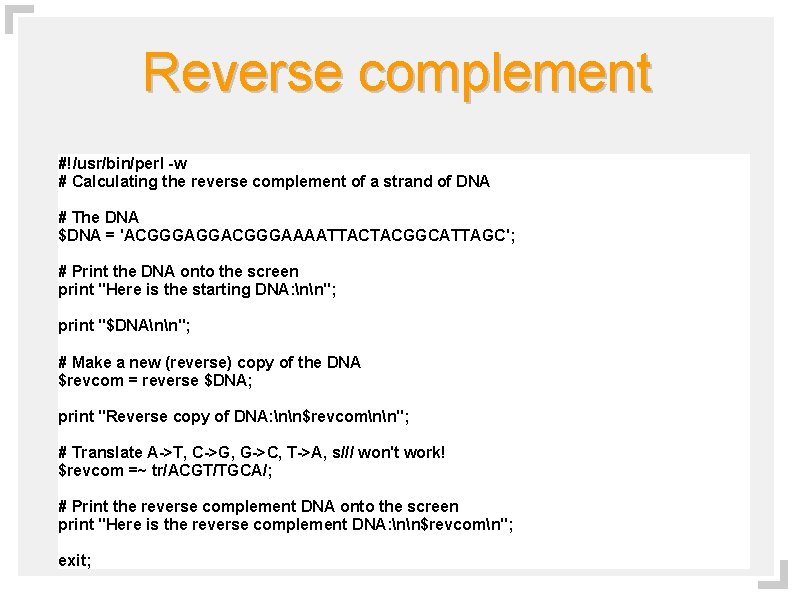
Reverse complement #!/usr/bin/perl -w # Calculating the reverse complement of a strand of DNA # The DNA $DNA = 'ACGGGAGGACGGGAAAATTACTACGGCATTAGC'; # Print the DNA onto the screen print "Here is the starting DNA: nn"; print "$DNAnn"; # Make a new (reverse) copy of the DNA $revcom = reverse $DNA; print "Reverse copy of DNA: nn$revcomnn"; # Translate A->T, C->G, G->C, T->A, s/// won't work! $revcom =~ tr/ACGT/TGCA/; # Print the reverse complement DNA onto the screen print "Here is the reverse complement DNA: nn$revcomn"; exit;
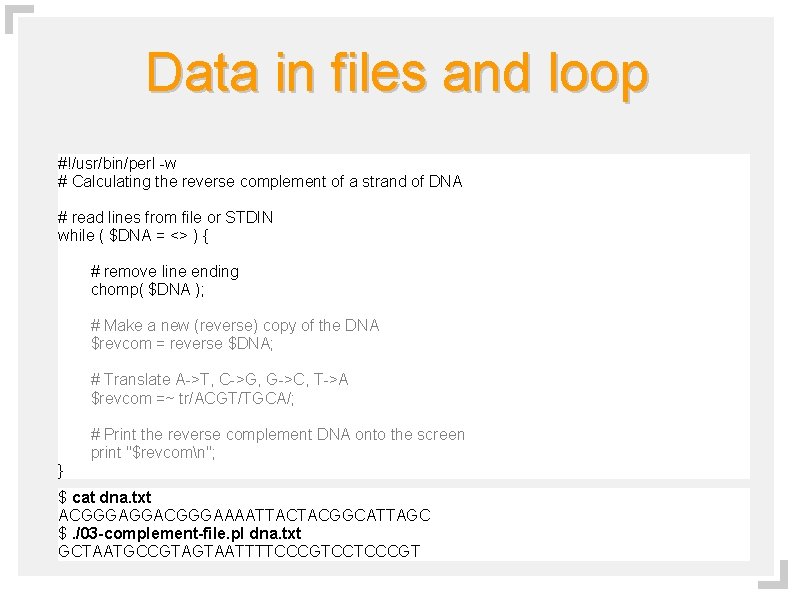
Data in files and loop #!/usr/bin/perl -w # Calculating the reverse complement of a strand of DNA # read lines from file or STDIN while ( $DNA = <> ) { # remove line ending chomp( $DNA ); # Make a new (reverse) copy of the DNA $revcom = reverse $DNA; # Translate A->T, C->G, G->C, T->A $revcom =~ tr/ACGT/TGCA/; # Print the reverse complement DNA onto the screen print "$revcomn"; } $ cat dna. txt ACGGGAGGACGGGAAAATTACTACGGCATTAGC $. /03 -complement-file. pl dna. txt GCTAATGCCGTAGTAATTTTCCCGTCCTCCCGT
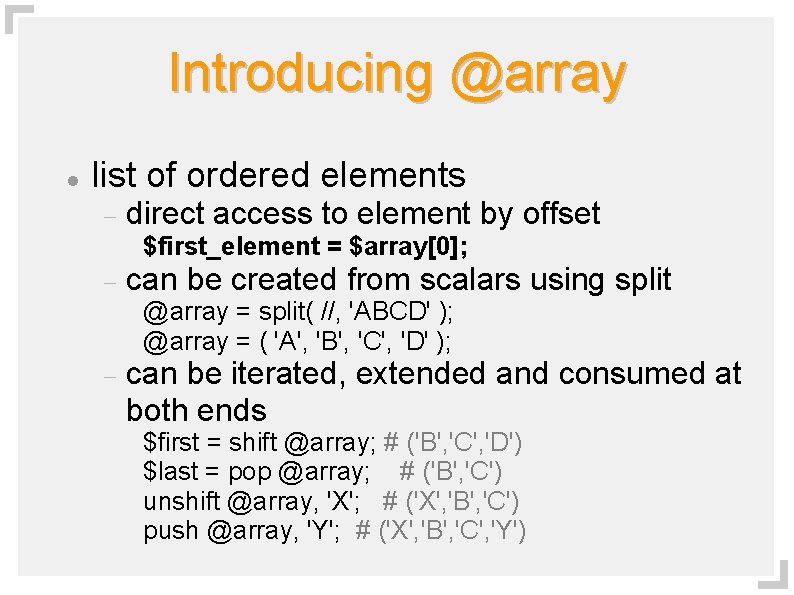
Introducing @array list of ordered elements direct access to element by offset $first_element = $array[0]; can be created from scalars using split @array = split( //, 'ABCD' ); @array = ( 'A', 'B', 'C', 'D' ); can be iterated, extended and consumed at both ends $first = shift @array; # ('B', 'C', 'D') $last = pop @array; # ('B', 'C') unshift @array, 'X'; # ('X', 'B', 'C') push @array, 'Y'; # ('X', 'B', 'C', 'Y')
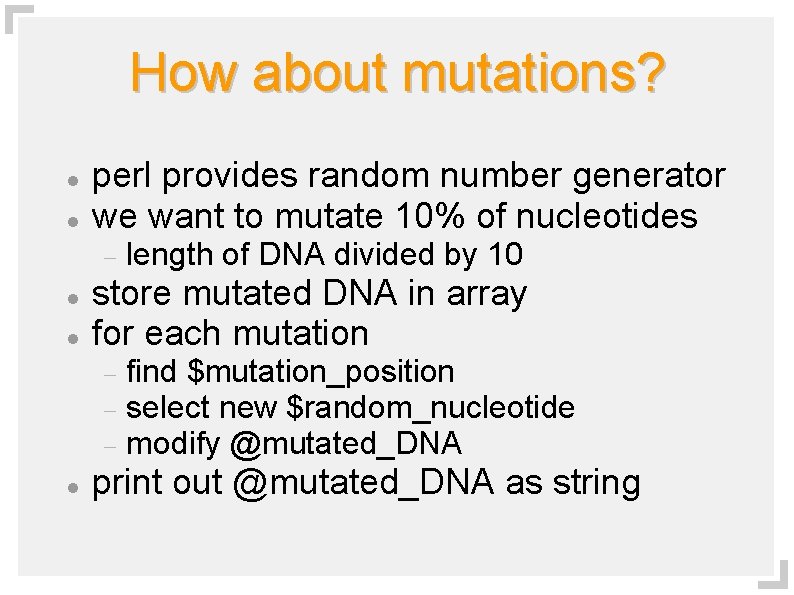
How about mutations? perl provides random number generator we want to mutate 10% of nucleotides store mutated DNA in array for each mutation length of DNA divided by 10 find $mutation_position select new $random_nucleotide modify @mutated_DNA print out @mutated_DNA as string
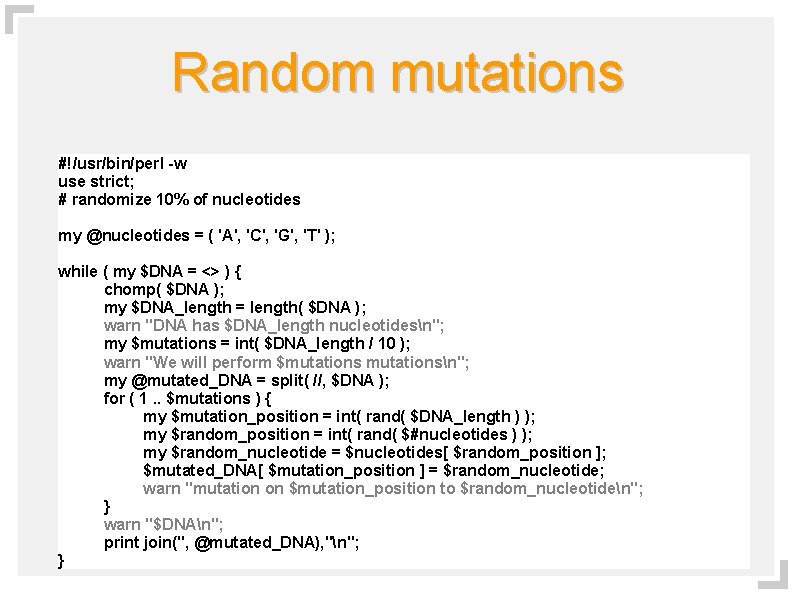
Random mutations #!/usr/bin/perl -w use strict; # randomize 10% of nucleotides my @nucleotides = ( 'A', 'C', 'G', 'T' ); while ( my $DNA = <> ) { chomp( $DNA ); my $DNA_length = length( $DNA ); warn "DNA has $DNA_length nucleotidesn"; my $mutations = int( $DNA_length / 10 ); warn "We will perform $mutationsn"; my @mutated_DNA = split( //, $DNA ); for ( 1. . $mutations ) { my $mutation_position = int( rand( $DNA_length ) ); my $random_position = int( rand( $#nucleotides ) ); my $random_nucleotide = $nucleotides[ $random_position ]; $mutated_DNA[ $mutation_position ] = $random_nucleotide; warn "mutation on $mutation_position to $random_nucleotiden"; } warn "$DNAn"; print join('', @mutated_DNA), "n"; }
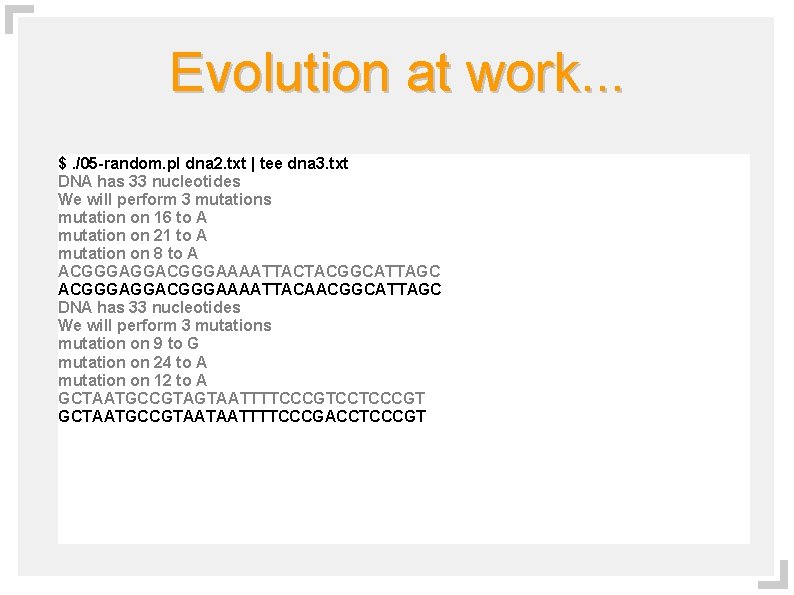
Evolution at work. . . $. /05 -random. pl dna 2. txt | tee dna 3. txt DNA has 33 nucleotides We will perform 3 mutations mutation on 16 to A mutation on 21 to A mutation on 8 to A ACGGGAGGACGGGAAAATTACTACGGCATTAGC ACGGGAGGACGGGAAAATTACAACGGCATTAGC DNA has 33 nucleotides We will perform 3 mutations mutation on 9 to G mutation on 24 to A mutation on 12 to A GCTAATGCCGTAGTAATTTTCCCGTCCTCCCGT GCTAATGCCGTAATAATTTTCCCGACCTCCCGT
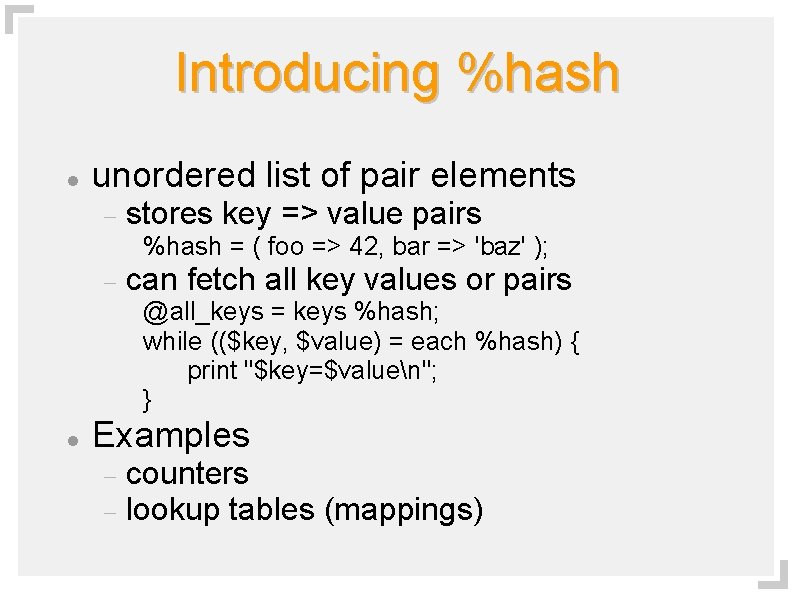
Introducing %hash unordered list of pair elements stores key => value pairs %hash = ( foo => 42, bar => 'baz' ); can fetch all key values or pairs @all_keys = keys %hash; while (($key, $value) = each %hash) { print "$key=$valuen"; } Examples counters lookup tables (mappings)
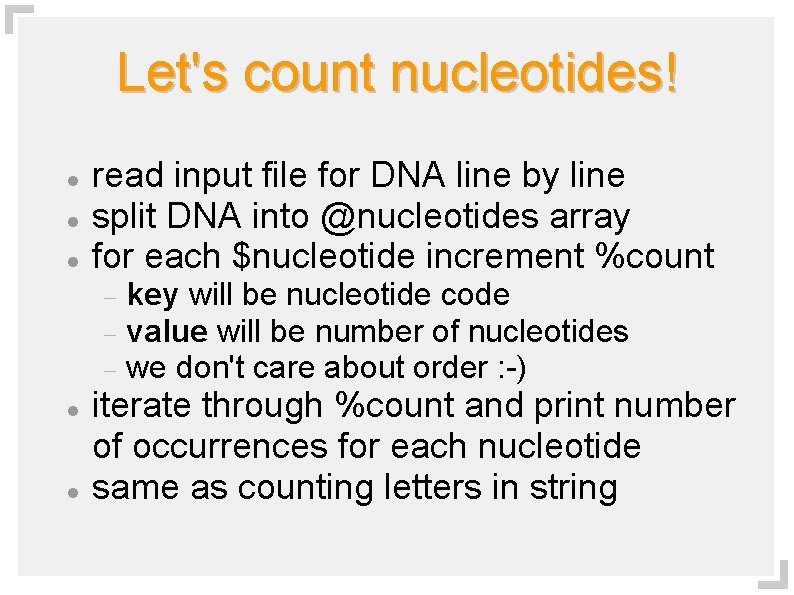
Let's count nucleotides! read input file for DNA line by line split DNA into @nucleotides array for each $nucleotide increment %count key will be nucleotide code value will be number of nucleotides we don't care about order : -) iterate through %count and print number of occurrences for each nucleotide same as counting letters in string
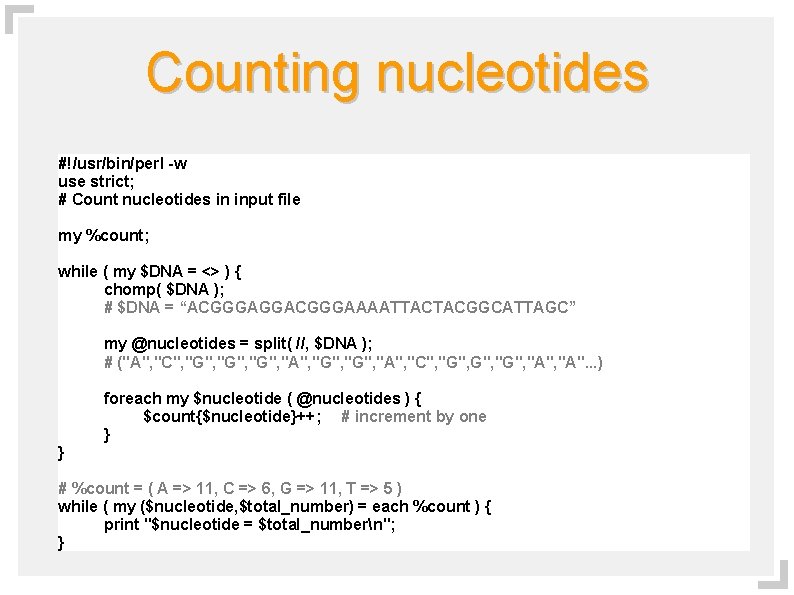
Counting nucleotides #!/usr/bin/perl -w use strict; # Count nucleotides in input file my %count; while ( my $DNA = <> ) { chomp( $DNA ); # $DNA = “ACGGGAGGACGGGAAAATTACTACGGCATTAGC” my @nucleotides = split( //, $DNA ); # ("A", "C", "G", "A", "G", "A", "C", "G", "A". . . ) foreach my $nucleotide ( @nucleotides ) { $count{$nucleotide}++; # increment by one } } # %count = ( A => 11, C => 6, G => 11, T => 5 ) while ( my ($nucleotide, $total_number) = each %count ) { print "$nucleotide = $total_numbern"; }
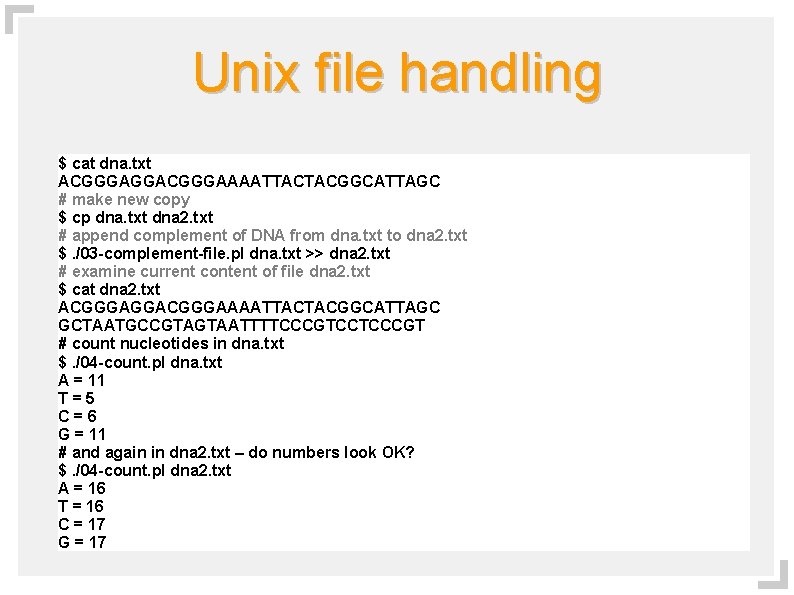
Unix file handling $ cat dna. txt ACGGGAGGACGGGAAAATTACTACGGCATTAGC # make new copy $ cp dna. txt dna 2. txt # append complement of DNA from dna. txt to dna 2. txt $. /03 -complement-file. pl dna. txt >> dna 2. txt # examine current content of file dna 2. txt $ cat dna 2. txt ACGGGAGGACGGGAAAATTACTACGGCATTAGC GCTAATGCCGTAGTAATTTTCCCGTCCTCCCGT # count nucleotides in dna. txt $. /04 -count. pl dna. txt A = 11 T=5 C=6 G = 11 # and again in dna 2. txt – do numbers look OK? $. /04 -count. pl dna 2. txt A = 16 T = 16 C = 17 G = 17
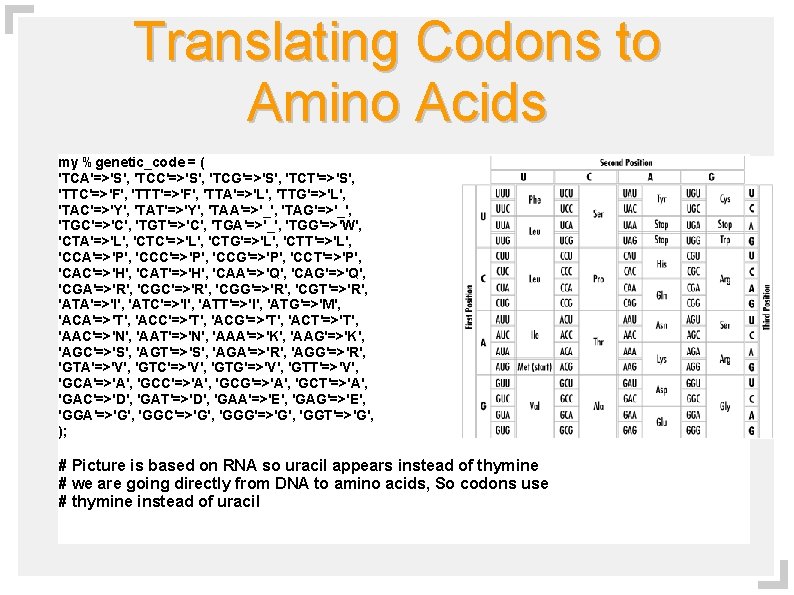
Translating Codons to Amino Acids my %genetic_code = ( 'TCA'=>'S', 'TCC'=>'S', 'TCG'=>'S', 'TCT'=>'S', 'TTC'=>'F', 'TTT'=>'F', 'TTA'=>'L', 'TTG'=>'L', 'TAC'=>'Y', 'TAT'=>'Y', 'TAA'=>'_', 'TAG'=>'_', 'TGC'=>'C', 'TGT'=>'C', 'TGA'=>'_', 'TGG'=>'W', 'CTA'=>'L', 'CTC'=>'L', 'CTG'=>'L', 'CTT'=>'L', 'CCA'=>'P', 'CCC'=>'P', 'CCG'=>'P', 'CCT'=>'P', 'CAC'=>'H', 'CAT'=>'H', 'CAA'=>'Q', 'CAG'=>'Q', 'CGA'=>'R', 'CGC'=>'R', 'CGG'=>'R', 'CGT'=>'R', 'ATA'=>'I', 'ATC'=>'I', 'ATT'=>'I', 'ATG'=>'M', 'ACA'=>'T', 'ACC'=>'T', 'ACG'=>'T', 'ACT'=>'T', 'AAC'=>'N', 'AAT'=>'N', 'AAA'=>'K', 'AAG'=>'K', 'AGC'=>'S', 'AGT'=>'S', 'AGA'=>'R', 'AGG'=>'R', 'GTA'=>'V', 'GTC'=>'V', 'GTG'=>'V', 'GTT'=>'V', 'GCA'=>'A', 'GCC'=>'A', 'GCG'=>'A', 'GCT'=>'A', 'GAC'=>'D', 'GAT'=>'D', 'GAA'=>'E', 'GAG'=>'E', 'GGA'=>'G', 'GGC'=>'G', 'GGG'=>'G', 'GGT'=>'G', ); # Picture is based on RNA so uracil appears instead of thymine # we are going directly from DNA to amino acids, So codons use # thymine instead of uracil
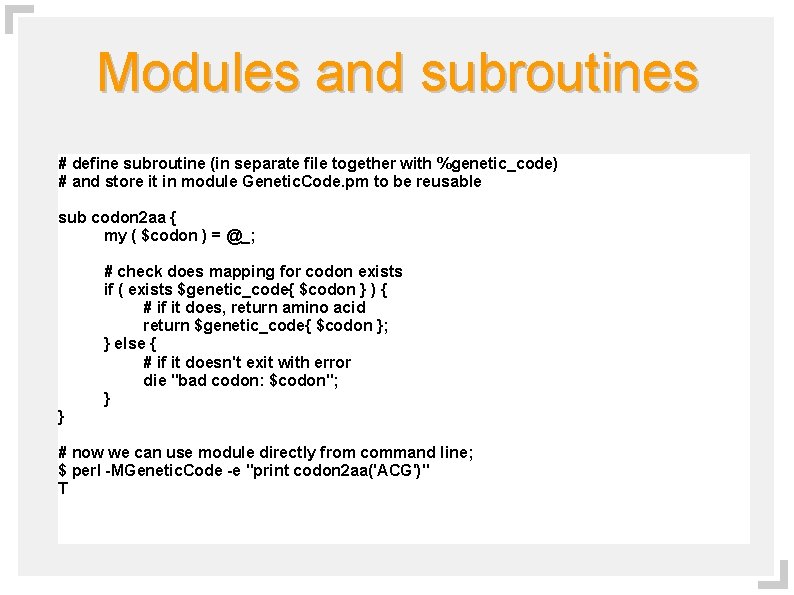
Modules and subroutines # define subroutine (in separate file together with %genetic_code) # and store it in module Genetic. Code. pm to be reusable sub codon 2 aa { my ( $codon ) = @_; # check does mapping for codon exists if ( exists $genetic_code{ $codon } ) { # if it does, return amino acid return $genetic_code{ $codon }; } else { # if it doesn't exit with error die "bad codon: $codon"; } } # now we can use module directly from command line; $ perl -MGenetic. Code -e "print codon 2 aa('ACG')" T
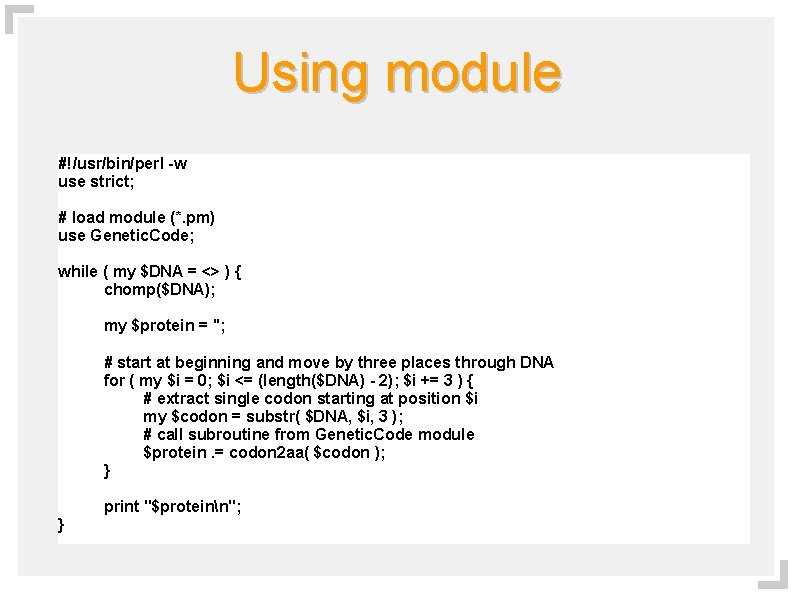
Using module #!/usr/bin/perl -w use strict; # load module (*. pm) use Genetic. Code; while ( my $DNA = <> ) { chomp($DNA); my $protein = ''; # start at beginning and move by three places through DNA for ( my $i = 0; $i <= (length($DNA) - 2); $i += 3 ) { # extract single codon starting at position $i my $codon = substr( $DNA, $i, 3 ); # call subroutine from Genetic. Code module $protein. = codon 2 aa( $codon ); } print "$proteinn"; }
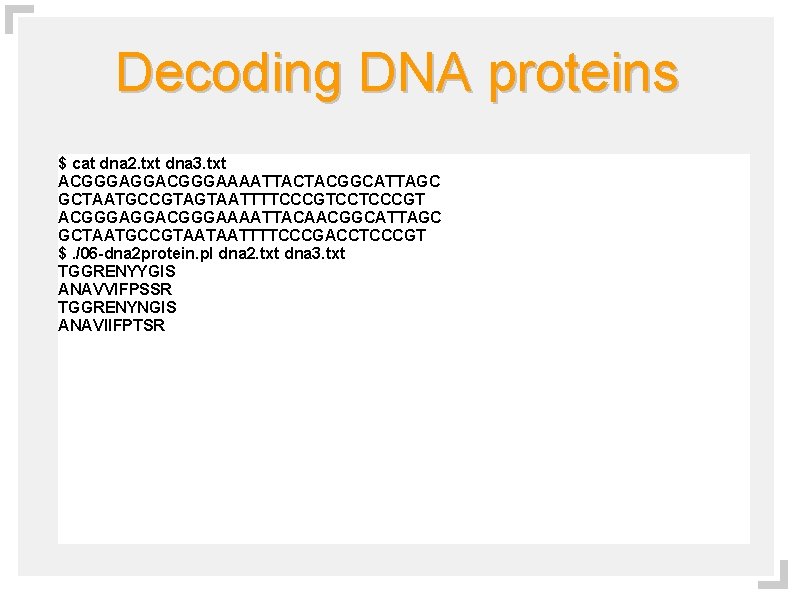
Decoding DNA proteins $ cat dna 2. txt dna 3. txt ACGGGAGGACGGGAAAATTACTACGGCATTAGC GCTAATGCCGTAGTAATTTTCCCGTCCTCCCGT ACGGGAGGACGGGAAAATTACAACGGCATTAGC GCTAATGCCGTAATAATTTTCCCGACCTCCCGT $. /06 -dna 2 protein. pl dna 2. txt dna 3. txt TGGRENYYGIS ANAVVIFPSSR TGGRENYNGIS ANAVIIFPTSR
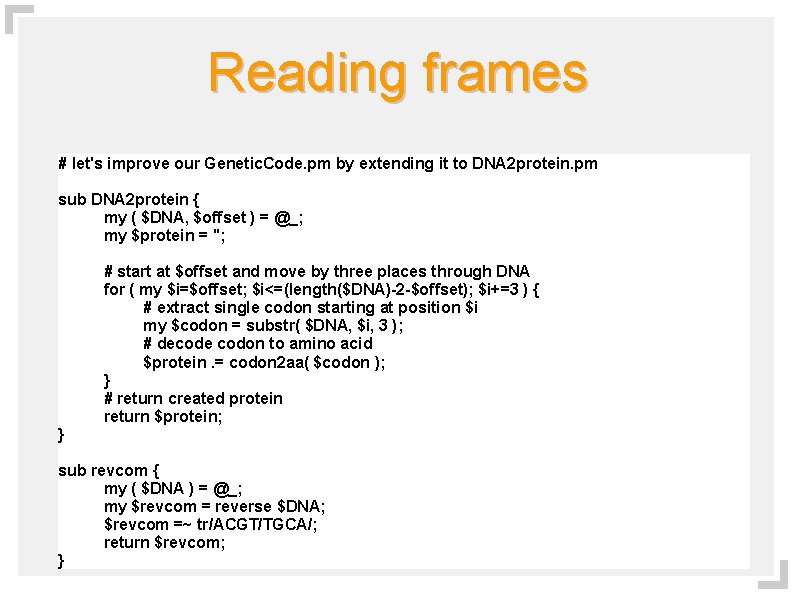
Reading frames # let's improve our Genetic. Code. pm by extending it to DNA 2 protein. pm sub DNA 2 protein { my ( $DNA, $offset ) = @_; my $protein = ''; # start at $offset and move by three places through DNA for ( my $i=$offset; $i<=(length($DNA)-2 -$offset); $i+=3 ) { # extract single codon starting at position $i my $codon = substr( $DNA, $i, 3 ); # decode codon to amino acid $protein. = codon 2 aa( $codon ); } # return created protein return $protein; } sub revcom { my ( $DNA ) = @_; my $revcom = reverse $DNA; $revcom =~ tr/ACGT/TGCA/; return $revcom; }
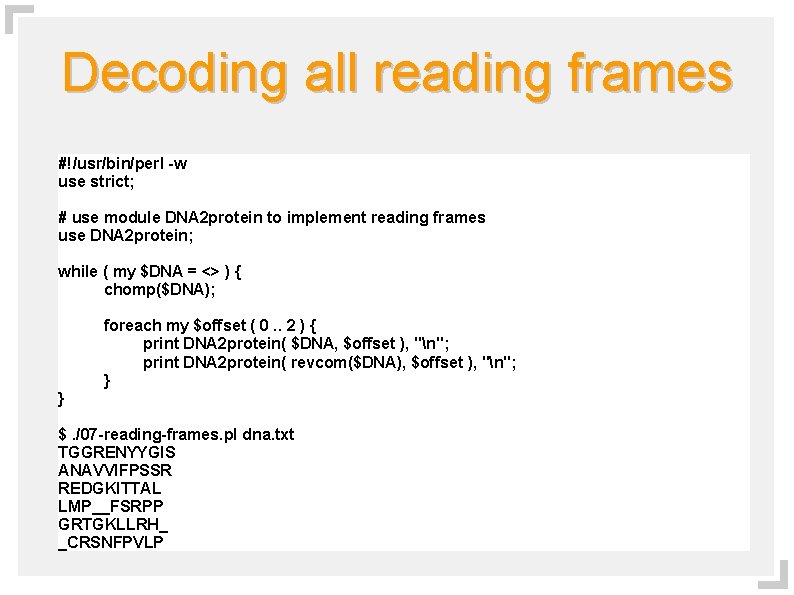
Decoding all reading frames #!/usr/bin/perl -w use strict; # use module DNA 2 protein to implement reading frames use DNA 2 protein; while ( my $DNA = <> ) { chomp($DNA); foreach my $offset ( 0. . 2 ) { print DNA 2 protein( $DNA, $offset ), "n"; print DNA 2 protein( revcom($DNA), $offset ), "n"; } } $. /07 -reading-frames. pl dna. txt TGGRENYYGIS ANAVVIFPSSR REDGKITTAL LMP__FSRPP GRTGKLLRH_ _CRSNFPVLP
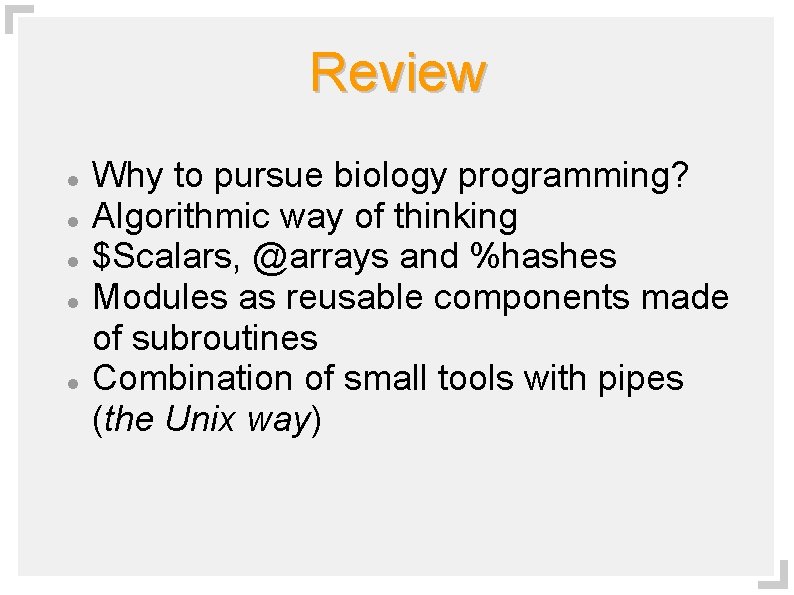
Review Why to pursue biology programming? Algorithmic way of thinking $Scalars, @arrays and %hashes Modules as reusable components made of subroutines Combination of small tools with pipes (the Unix way)
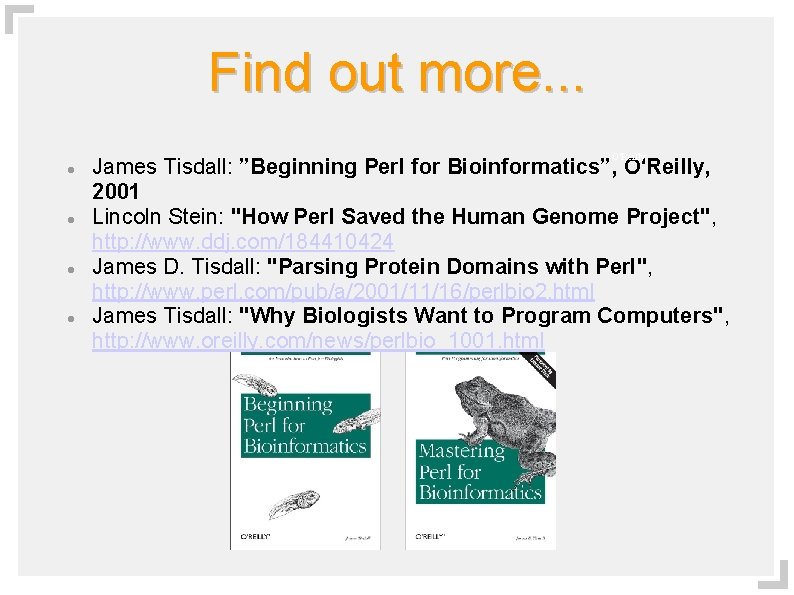
Find out more. . . O'Reilly James Tisdall: ”Beginning Perl for Bioinformatics”, O'Reilly, 2001 Lincoln Stein: "How Perl Saved the Human Genome Project", http: //www. ddj. com/184410424 James D. Tisdall: "Parsing Protein Domains with Perl", http: //www. perl. com/pub/a/2001/11/16/perlbio 2. html James Tisdall: "Why Biologists Want to Program Computers", http: //www. oreilly. com/news/perlbio_1001. html
Questions? 3*7*2
- Slides: 34