
Programming Fundamentals Lecture 4 Overview of Computer Programming
- Slides: 12
Programming Fundamentals Lecture #4 Overview of Computer Programming Junaid Hassan Lecturer CS & IT Department UOS MBDIN junaidte 14@gmail. com
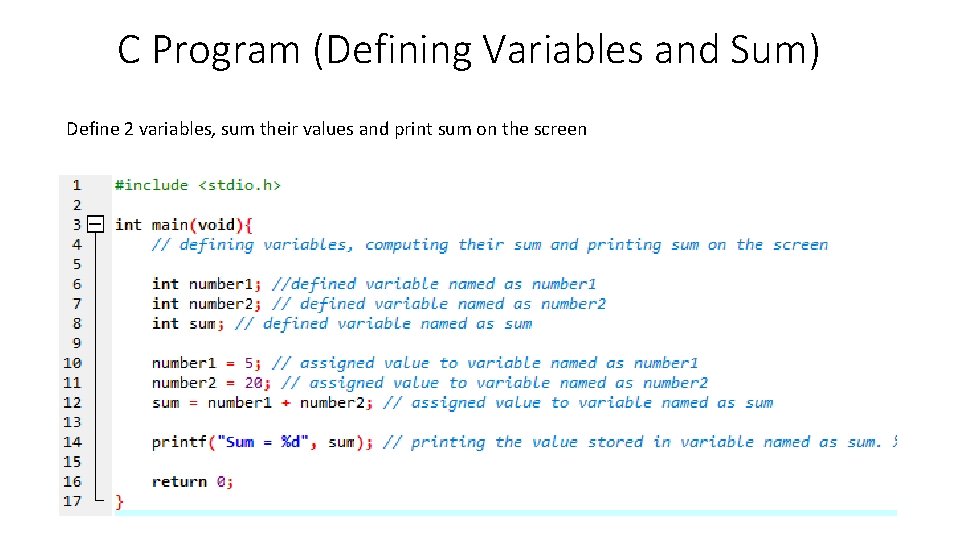
C Program (Defining Variables and Sum) Define 2 variables, sum their values and print sum on the screen
C Program (Defining Variables and Sum) In line printf(“Sum is %d”, sum); %d is called as conversion specifier. %d indicates that the data should be an integer. The letter d stands for decimal integer. This placeholder is ultimately filled by the value of variable named as ‘sum’.
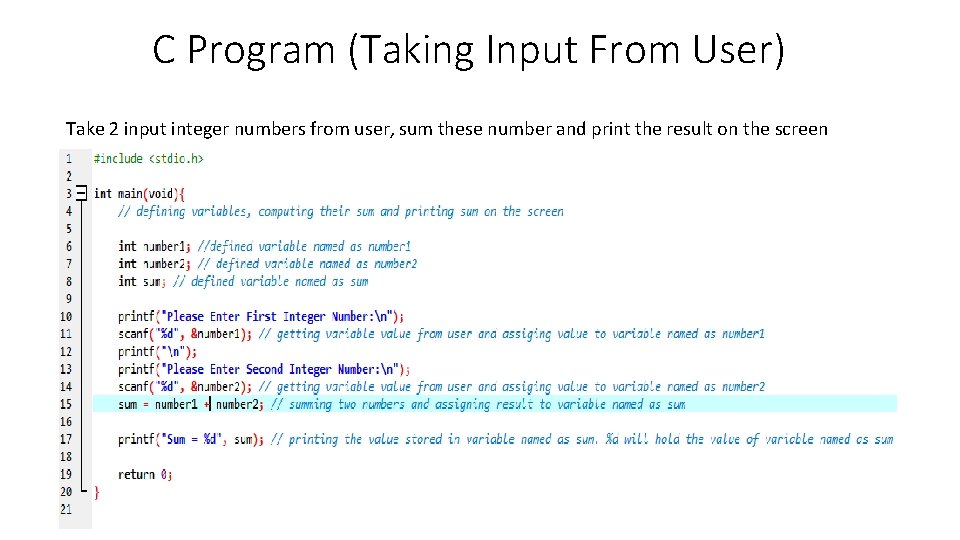
C Program (Taking Input From User) Take 2 input integer numbers from user, sum these number and print the result on the screen
C Program (Taking Input From User) • Everything in this program is explained in previous slides except following line: • scanf("%d", &number 1); • We already discussed that %d is a conversion specifier which says that it will hold data of the type decimal integer • Whereas ampersand (&) is called as address operator in C. • Ampersand (&) when combined with variable name (number 1), tells scanf the location (or address) in memory at which the variable number 1 is stored • Use of ampersand will become clear when we will study pointers in chapter 7
Memory Concepts • Variables we defined in our previous code examples actually correspond to locations in the computer memory • Every variable has a name, type and value • For example when scanf(“%d”, &number 1); is executed, the value entered by the user is stored into a memory location and we have assigned a name to that location i. e number 1. • Similarly value of each variable is stored into a different memory location and when we need to get the value stored at that memory location, we use the variable name • When we assign new value to a variable then previous value is replaced by that new value. • In other words previous value stored at that memory location is destroyed and is replaced by the new value
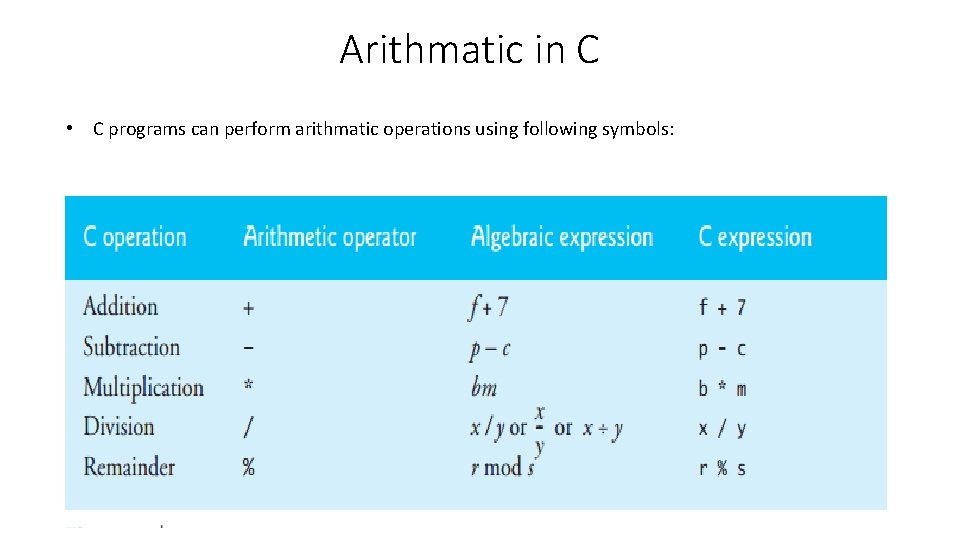
Arithmatic in C • C programs can perform arithmatic operations using following symbols:
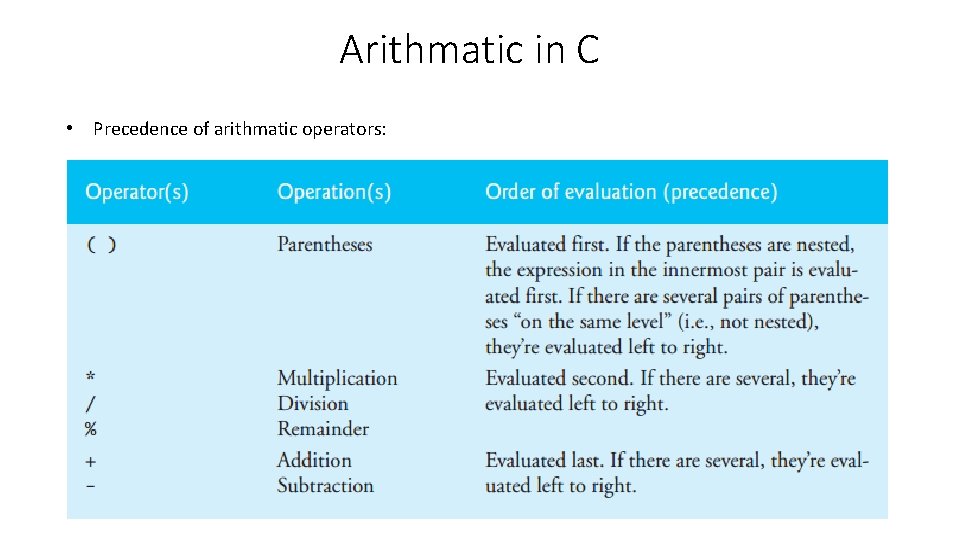
Arithmatic in C • Precedence of arithmatic operators:
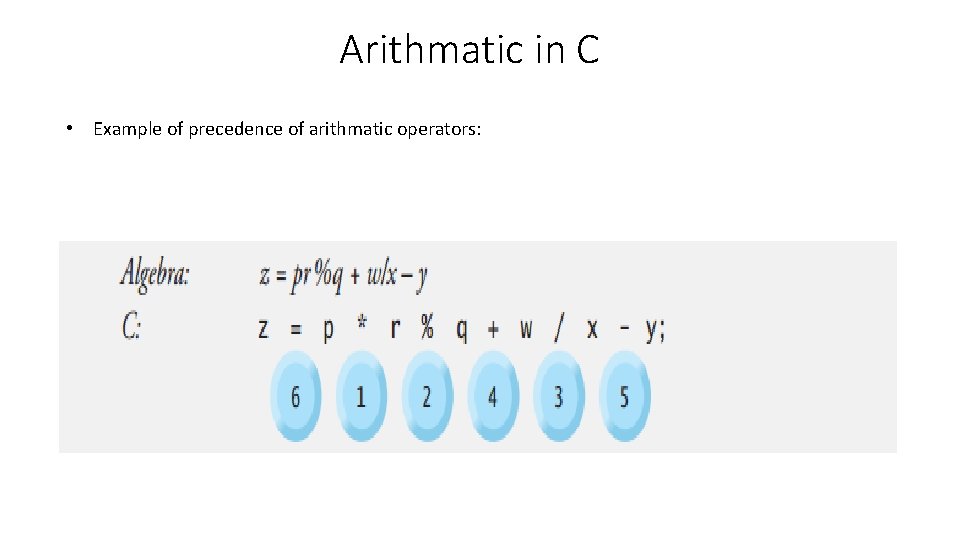
Arithmatic in C • Example of precedence of arithmatic operators:
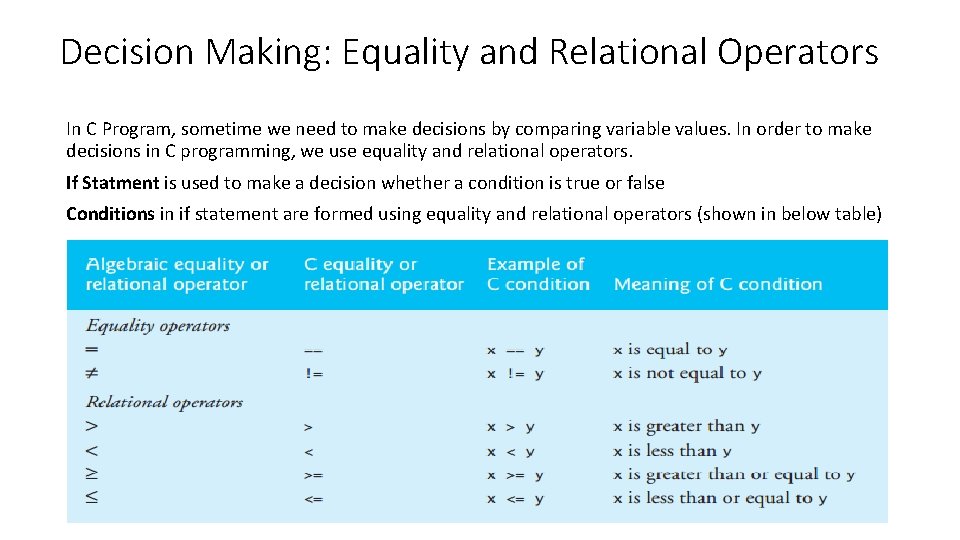
Decision Making: Equality and Relational Operators In C Program, sometime we need to make decisions by comparing variable values. In order to make decisions in C programming, we use equality and relational operators. If Statment is used to make a decision whether a condition is true or false Conditions in if statement are formed using equality and relational operators (shown in below table)
Decision Making: Equality and Relational Operators See Example Code
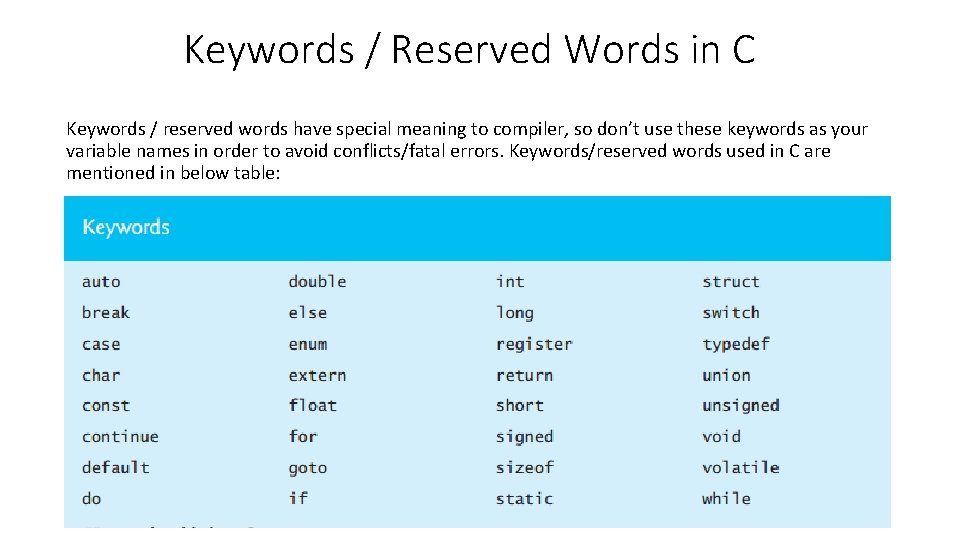
Keywords / Reserved Words in C Keywords / reserved words have special meaning to compiler, so don’t use these keywords as your variable names in order to avoid conflicts/fatal errors. Keywords/reserved words used in C are mentioned in below table: