
Programming Functions Passing Parameters by Reference COMP 102
Programming Functions: Passing Parameters by Reference
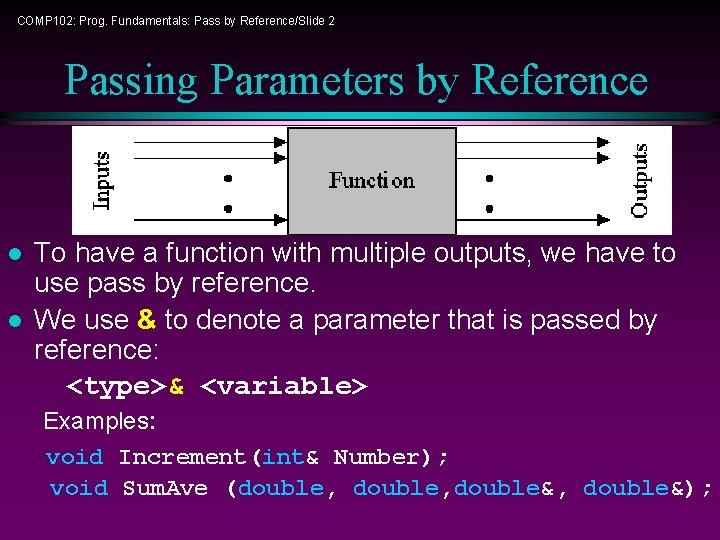
COMP 102: Prog. Fundamentals: Pass by Reference/Slide 2 Passing Parameters by Reference l l To have a function with multiple outputs, we have to use pass by reference. We use & to denote a parameter that is passed by reference: <type>& <variable> Examples: void Increment(int& Number); void Sum. Ave (double, double&, double&);
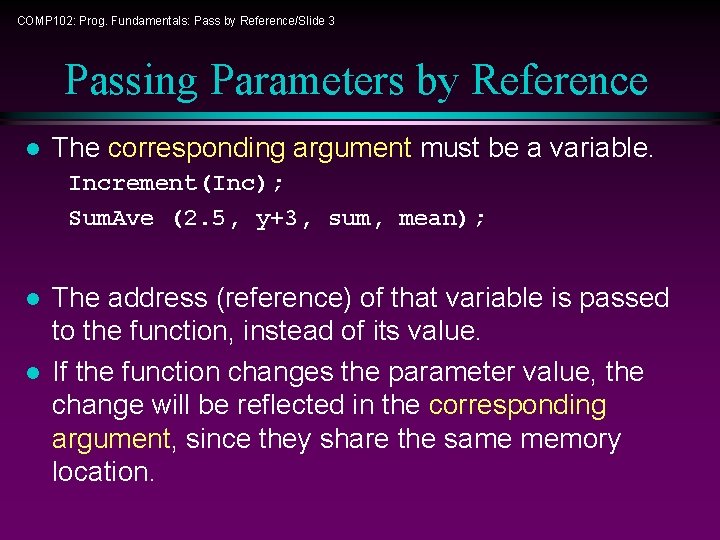
COMP 102: Prog. Fundamentals: Pass by Reference/Slide 3 Passing Parameters by Reference l The corresponding argument must be a variable. Increment(Inc); Sum. Ave (2. 5, y+3, sum, mean); l l The address (reference) of that variable is passed to the function, instead of its value. If the function changes the parameter value, the change will be reflected in the corresponding argument, since they share the same memory location.
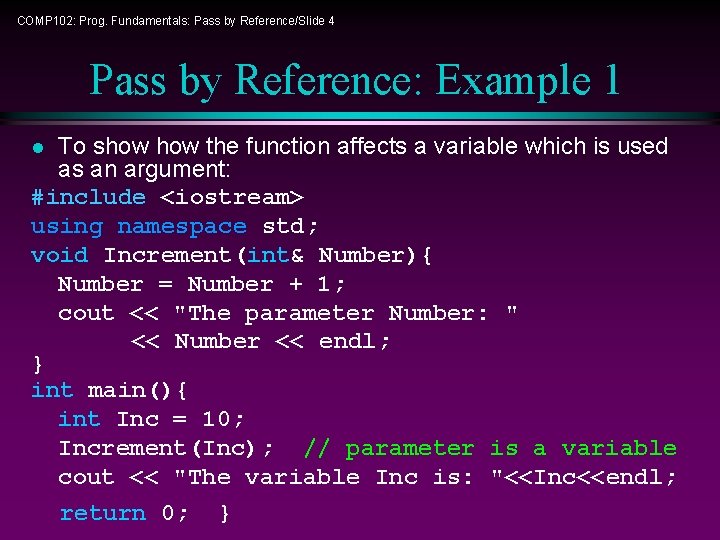
COMP 102: Prog. Fundamentals: Pass by Reference/Slide 4 Pass by Reference: Example 1 To show the function affects a variable which is used as an argument: #include <iostream> using namespace std; void Increment(int& Number){ Number = Number + 1; cout << "The parameter Number: " << Number << endl; } int main(){ int Inc = 10; Increment(Inc); // parameter is a variable cout << "The variable Inc is: "<<Inc<<endl; l return 0; }
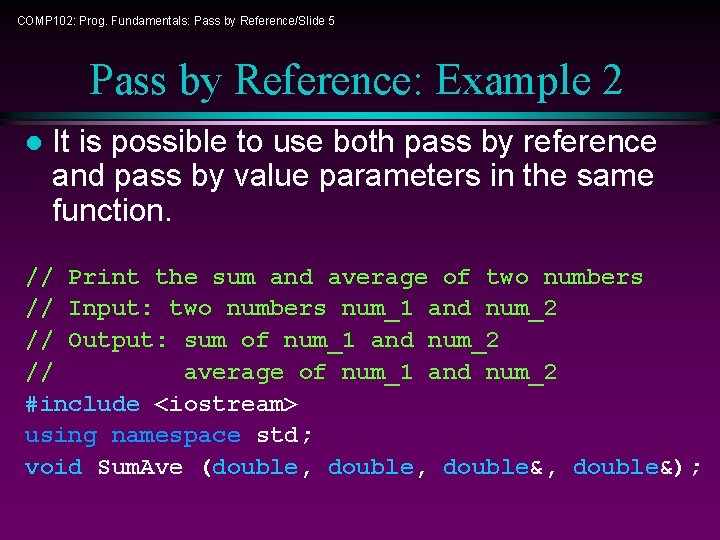
COMP 102: Prog. Fundamentals: Pass by Reference/Slide 5 Pass by Reference: Example 2 l It is possible to use both pass by reference and pass by value parameters in the same function. // Print the sum and average of two numbers // Input: two numbers num_1 and num_2 // Output: sum of num_1 and num_2 // average of num_1 and num_2 #include <iostream> using namespace std; void Sum. Ave (double, double&, double&);
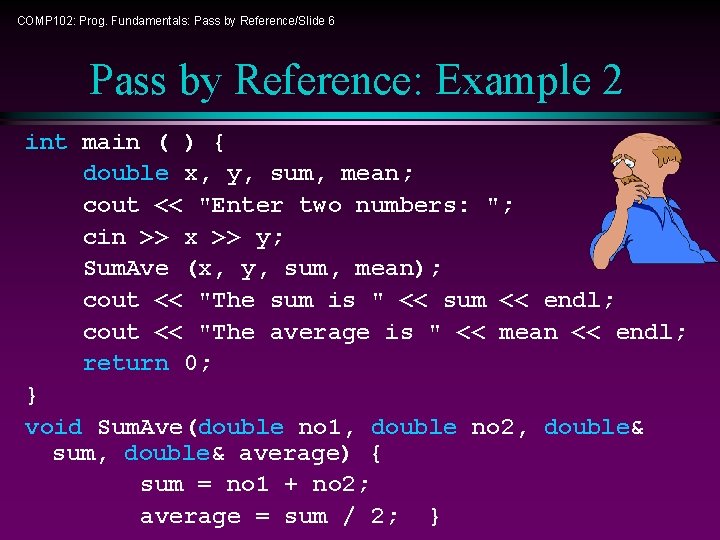
COMP 102: Prog. Fundamentals: Pass by Reference/Slide 6 Pass by Reference: Example 2 int main ( ) { double x, y, sum, mean; cout << "Enter two numbers: "; cin >> x >> y; Sum. Ave (x, y, sum, mean); cout << "The sum is " << sum << endl; cout << "The average is " << mean << endl; return 0; } void Sum. Ave(double no 1, double no 2, double& sum, double& average) { sum = no 1 + no 2; average = sum / 2; }
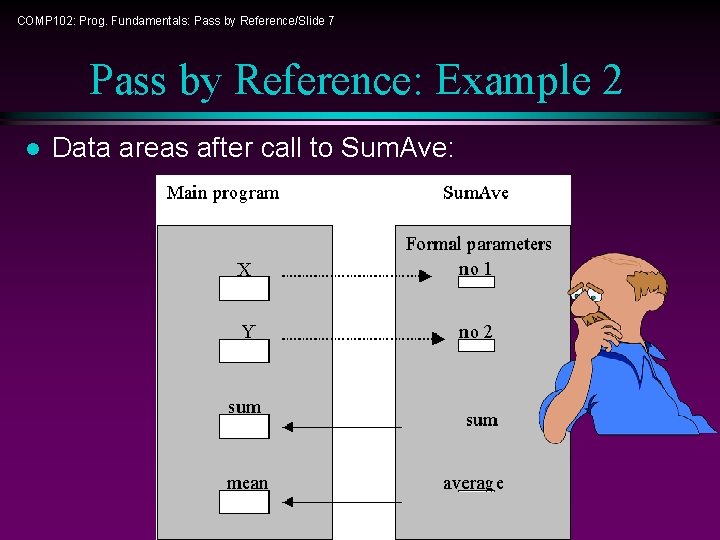
COMP 102: Prog. Fundamentals: Pass by Reference/Slide 7 Pass by Reference: Example 2 l Data areas after call to Sum. Ave:
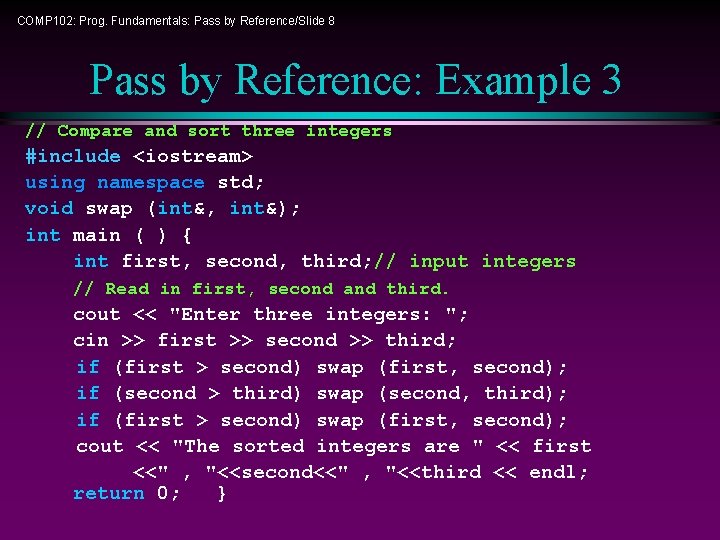
COMP 102: Prog. Fundamentals: Pass by Reference/Slide 8 Pass by Reference: Example 3 // Compare and sort three integers #include <iostream> using namespace std; void swap (int&, int&); int main ( ) { int first, second, third; // input integers // Read in first, second and third. cout << "Enter three integers: "; cin >> first >> second >> third; if (first > second) swap (first, second); if (second > third) swap (second, third); if (first > second) swap (first, second); cout << "The sorted integers are " << first <<" , "<<second<<" , "<<third << endl; return 0; }
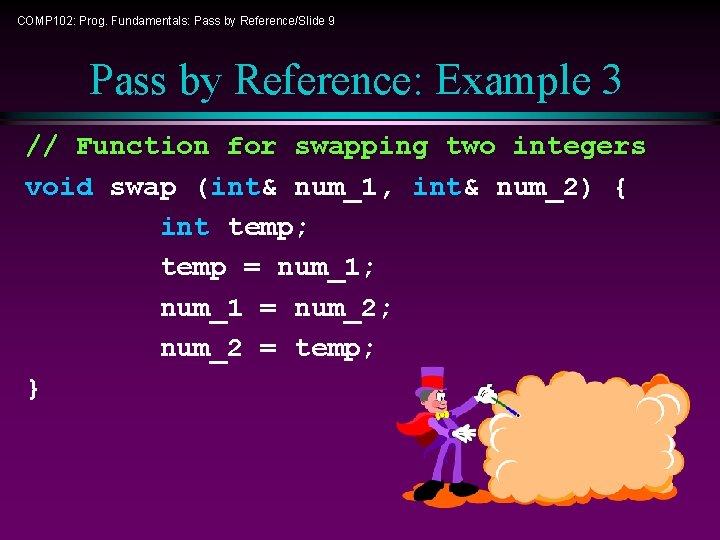
COMP 102: Prog. Fundamentals: Pass by Reference/Slide 9 Pass by Reference: Example 3 // Function for swapping two integers void swap (int& num_1, int& num_2) { int temp; temp = num_1; num_1 = num_2; num_2 = temp; }
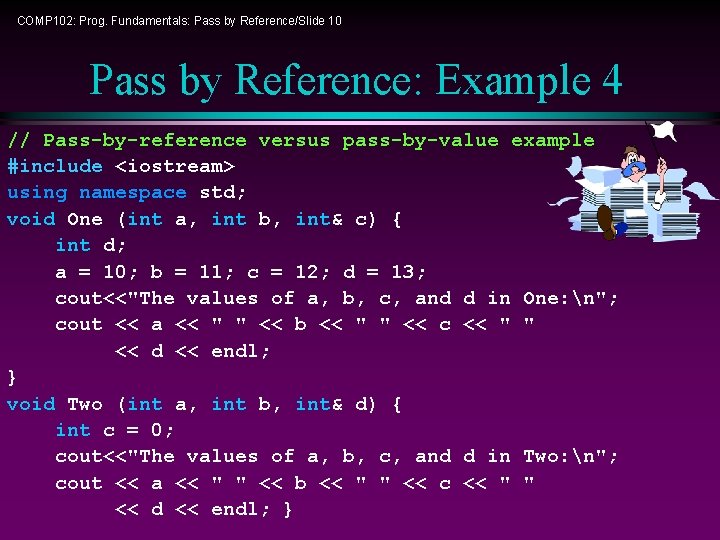
COMP 102: Prog. Fundamentals: Pass by Reference/Slide 10 Pass by Reference: Example 4 // Pass-by-reference versus pass-by-value example #include <iostream> using namespace std; void One (int a, int b, int& c) { int d; a = 10; b = 11; c = 12; d = 13; cout<<"The values of a, b, c, and d in One: n"; cout << a << " " << b << " " << c << " " << d << endl; } void Two (int a, int b, int& d) { int c = 0; cout<<"The values of a, b, c, and d in Two: n"; cout << a << " " << b << " " << c << " " << d << endl; }
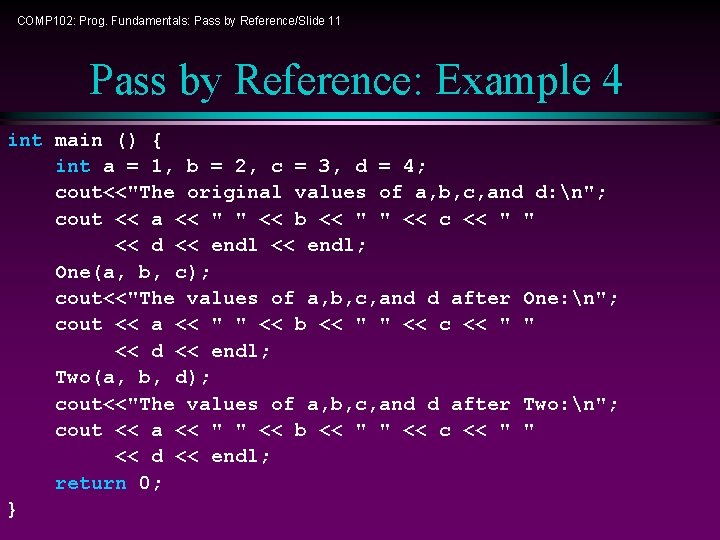
COMP 102: Prog. Fundamentals: Pass by Reference/Slide 11 Pass by Reference: Example 4 int main () { int a = 1, b = 2, c = 3, d = 4; cout<<"The original values of a, b, c, and d: n"; cout << a << " " << b << " " << c << " " << d << endl; One(a, b, c); cout<<"The values of a, b, c, and d after One: n"; cout << a << " " << b << " " << c << " " << d << endl; Two(a, b, d); cout<<"The values of a, b, c, and d after Two: n"; cout << a << " " << b << " " << c << " " << d << endl; return 0; }
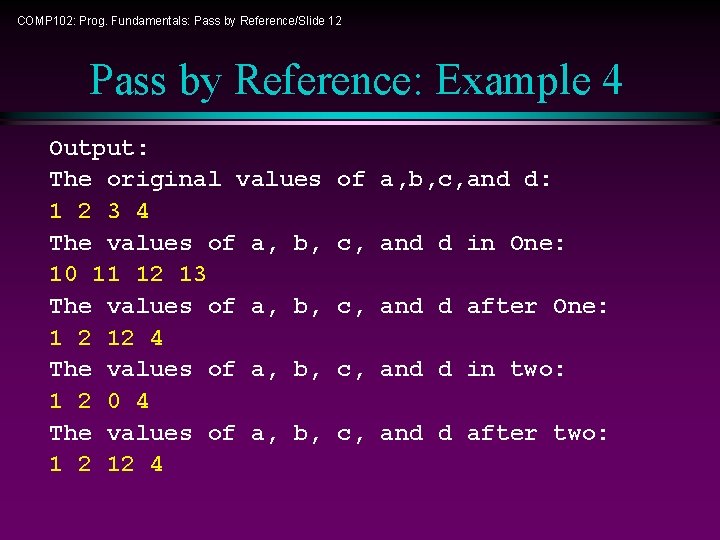
COMP 102: Prog. Fundamentals: Pass by Reference/Slide 12 Pass by Reference: Example 4 Output: The original values 1 2 3 4 The values of a, b, 10 11 12 13 The values of a, b, 1 2 12 4 The values of a, b, 1 2 0 4 The values of a, b, 1 2 12 4 of a, b, c, and d: c, and d in One: c, and d after One: c, and d in two: c, and d after two:
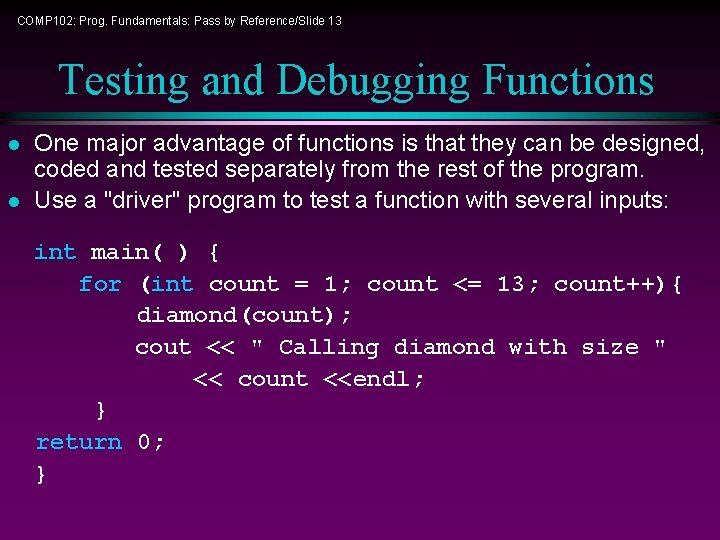
COMP 102: Prog. Fundamentals: Pass by Reference/Slide 13 Testing and Debugging Functions l l One major advantage of functions is that they can be designed, coded and tested separately from the rest of the program. Use a "driver" program to test a function with several inputs: int main( ) { for (int count = 1; count <= 13; count++){ diamond(count); cout << " Calling diamond with size " << count <<endl; } return 0; }
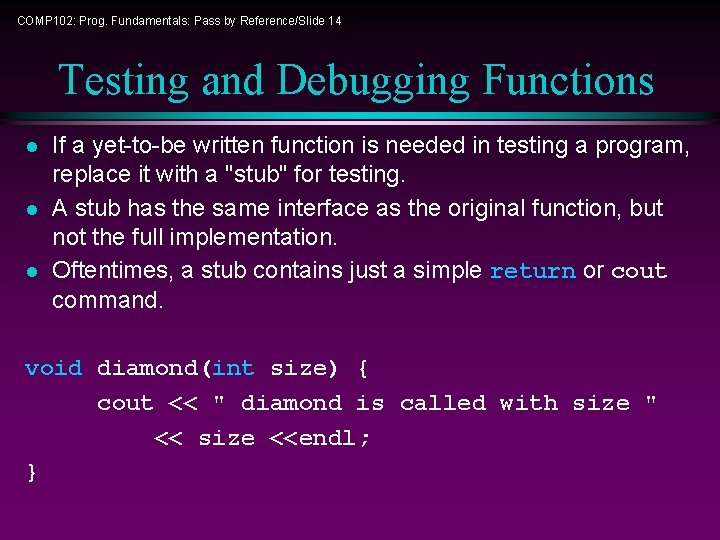
COMP 102: Prog. Fundamentals: Pass by Reference/Slide 14 Testing and Debugging Functions l l l If a yet-to-be written function is needed in testing a program, replace it with a "stub" for testing. A stub has the same interface as the original function, but not the full implementation. Oftentimes, a stub contains just a simple return or cout command. void diamond(int size) { cout << " diamond is called with size " << size <<endl; }
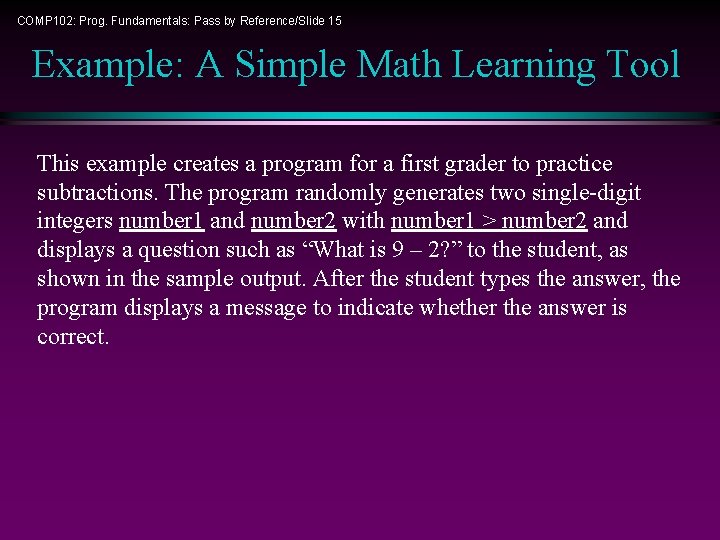
COMP 102: Prog. Fundamentals: Pass by Reference/Slide 15 Example: A Simple Math Learning Tool This example creates a program for a first grader to practice subtractions. The program randomly generates two single-digit integers number 1 and number 2 with number 1 > number 2 and displays a question such as “What is 9 – 2? ” to the student, as shown in the sample output. After the student types the answer, the program displays a message to indicate whether the answer is correct.
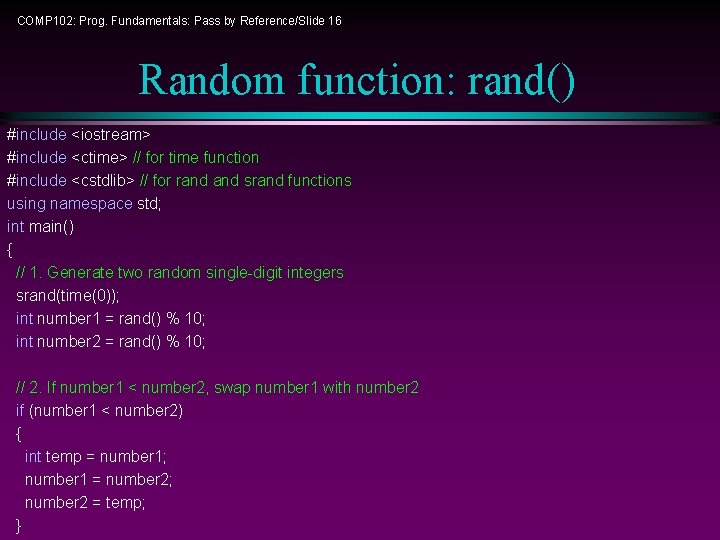
COMP 102: Prog. Fundamentals: Pass by Reference/Slide 16 Random function: rand() #include <iostream> #include <ctime> // for time function #include <cstdlib> // for rand srand functions using namespace std; int main() { // 1. Generate two random single-digit integers srand(time(0)); int number 1 = rand() % 10; int number 2 = rand() % 10; // 2. If number 1 < number 2, swap number 1 with number 2 if (number 1 < number 2) { int temp = number 1; number 1 = number 2; number 2 = temp; }
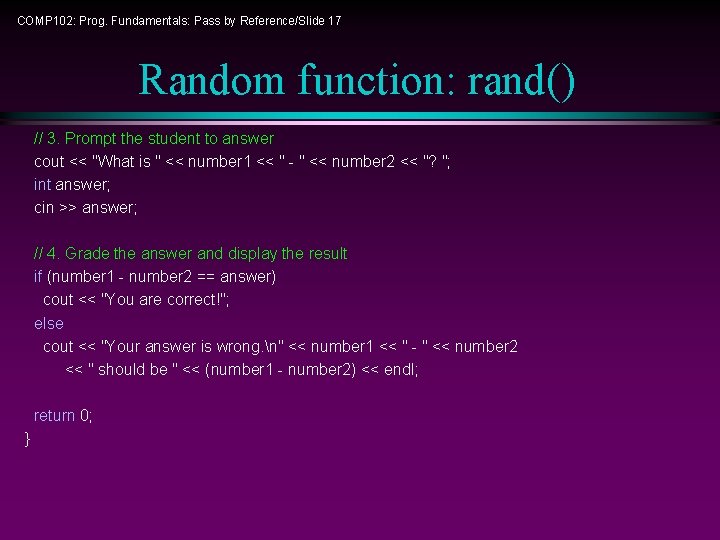
COMP 102: Prog. Fundamentals: Pass by Reference/Slide 17 Random function: rand() // 3. Prompt the student to answer cout << "What is " << number 1 << " - " << number 2 << "? "; int answer; cin >> answer; // 4. Grade the answer and display the result if (number 1 - number 2 == answer) cout << "You are correct!"; else cout << "Your answer is wrong. n" << number 1 << " - " << number 2 << " should be " << (number 1 - number 2) << endl; return 0; }
COMP 102: Prog. Fundamentals: Pass by Reference/Slide 18 Generating Random Characters Computer programs process numerical data and characters. You have seen many examples that involve numerical data. It is also important to understand characters and how to process them. Since every character has a unique ASCII code between 0 and 127. To generate a random character is to generate a random integer between 0 and 127. We already learn how to generate random number from last example. Basically it is to use the srand(seed) function to set a seed and use rand() to return a random integer. You can use it to write a simple expression to generate random numbers in any range. For example,
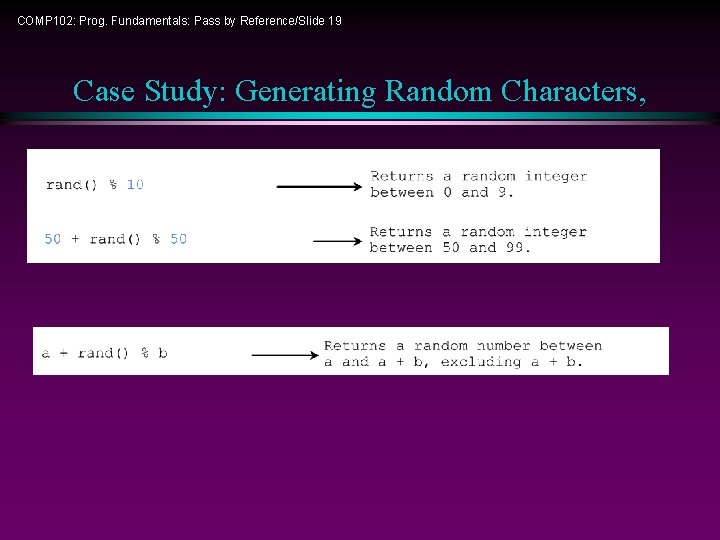
COMP 102: Prog. Fundamentals: Pass by Reference/Slide 19 Case Study: Generating Random Characters,
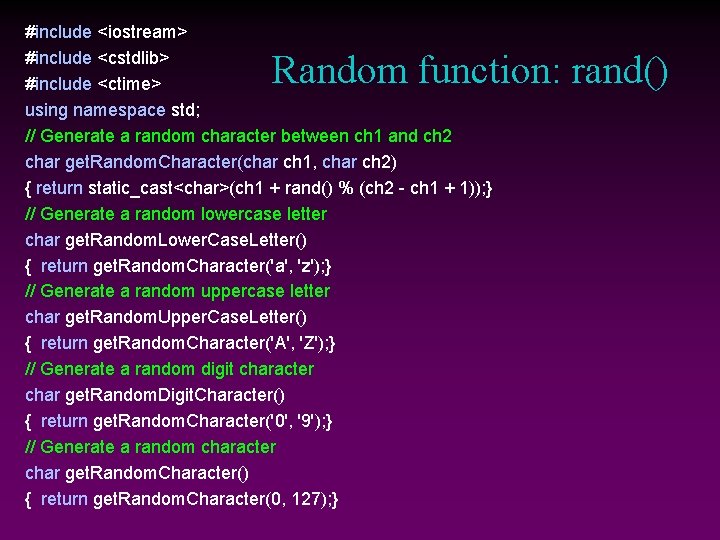
#include <iostream> #include <cstdlib> #include <ctime> using namespace std; // Generate a random character between ch 1 and ch 2 char get. Random. Character(char ch 1, char ch 2) { return static_cast<char>(ch 1 + rand() % (ch 2 - ch 1 + 1)); } // Generate a random lowercase letter char get. Random. Lower. Case. Letter() { return get. Random. Character('a', 'z'); } // Generate a random uppercase letter char get. Random. Upper. Case. Letter() { return get. Random. Character('A', 'Z'); } // Generate a random digit character char get. Random. Digit. Character() { return get. Random. Character('0', '9'); } // Generate a random character char get. Random. Character() { return get. Random. Character(0, 127); } Random function: rand()
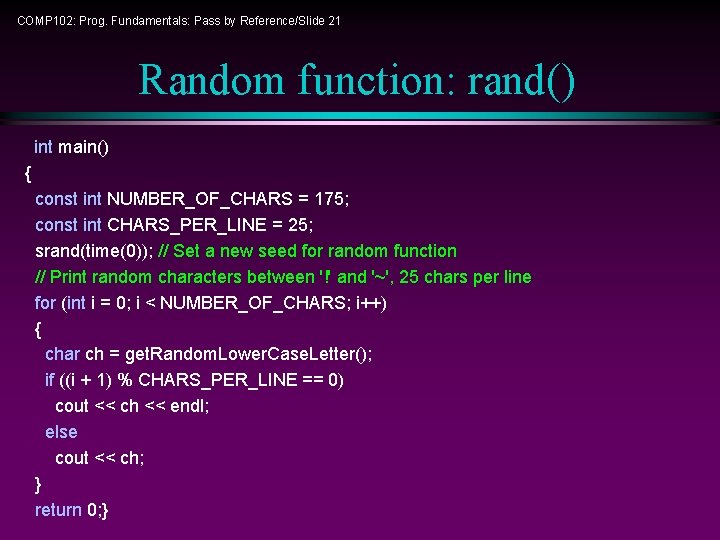
COMP 102: Prog. Fundamentals: Pass by Reference/Slide 21 Random function: rand() int main() { const int NUMBER_OF_CHARS = 175; const int CHARS_PER_LINE = 25; srand(time(0)); // Set a new seed for random function // Print random characters between '!' and '~', 25 chars per line for (int i = 0; i < NUMBER_OF_CHARS; i++) { char ch = get. Random. Lower. Case. Letter(); if ((i + 1) % CHARS_PER_LINE == 0) cout << ch << endl; else cout << ch; } return 0; }
- Slides: 21