
Programming for Problem Solving PPS GTU 3110003 Functions
Programming for Problem Solving (PPS) GTU # 3110003 Functions Prof. Nilesh Gambhava Computer Engineering Department, Darshan Institute of Engineering & Technology, Rajkot USING {C} Programming
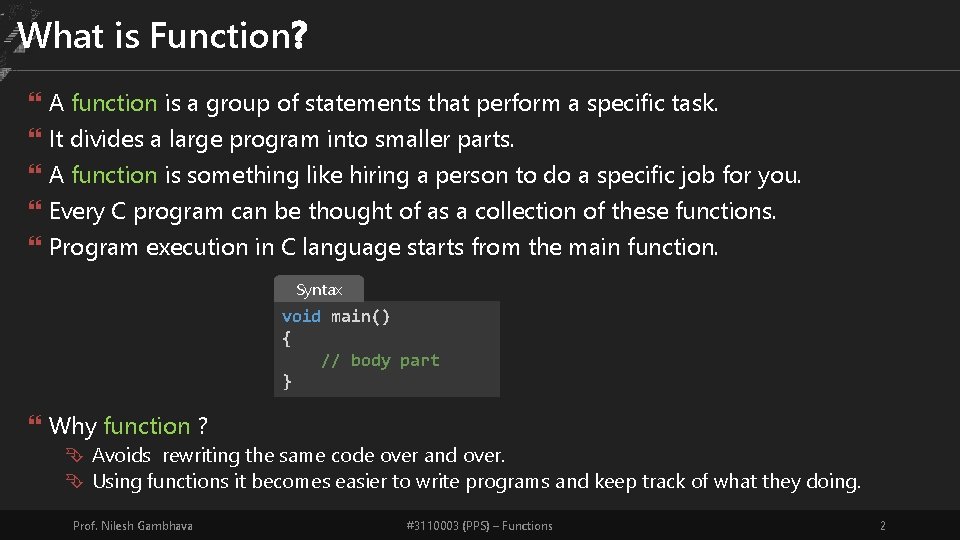
What is Function? A function is a group of statements that perform a specific task. It divides a large program into smaller parts. A function is something like hiring a person to do a specific job for you. Every C program can be thought of as a collection of these functions. Program execution in C language starts from the main function. Syntax void main() { // body part } Why function ? Avoids rewriting the same code over and over. Using functions it becomes easier to write programs and keep track of what they doing. Prof. Nilesh Gambhava #3110003 (PPS) – Functions 2
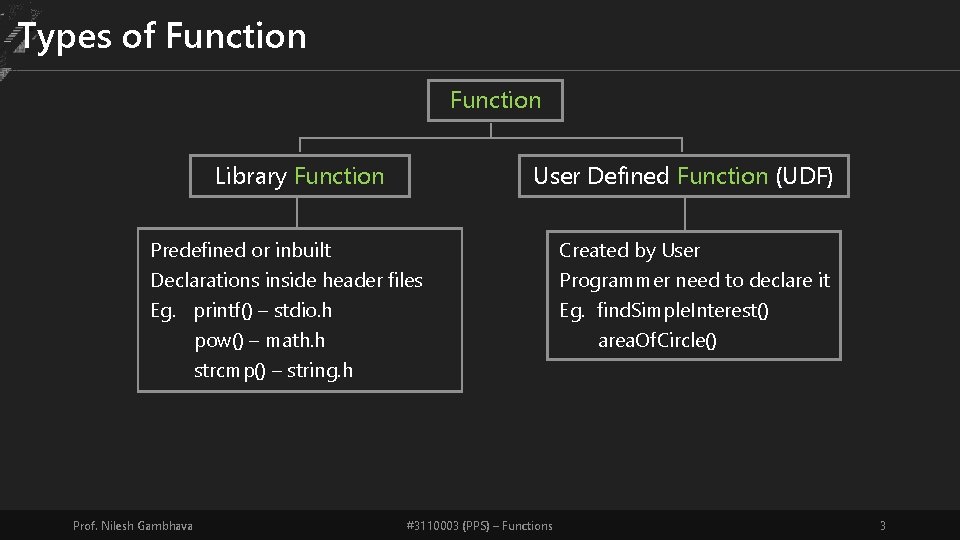
Types of Function Library Function User Defined Function (UDF) Predefined or inbuilt Declarations inside header files Eg. printf() – stdio. h pow() – math. h strcmp() – string. h Prof. Nilesh Gambhava #3110003 (PPS) – Functions Created by User Programmer need to declare it Eg. find. Simple. Interest() area. Of. Circle() 3
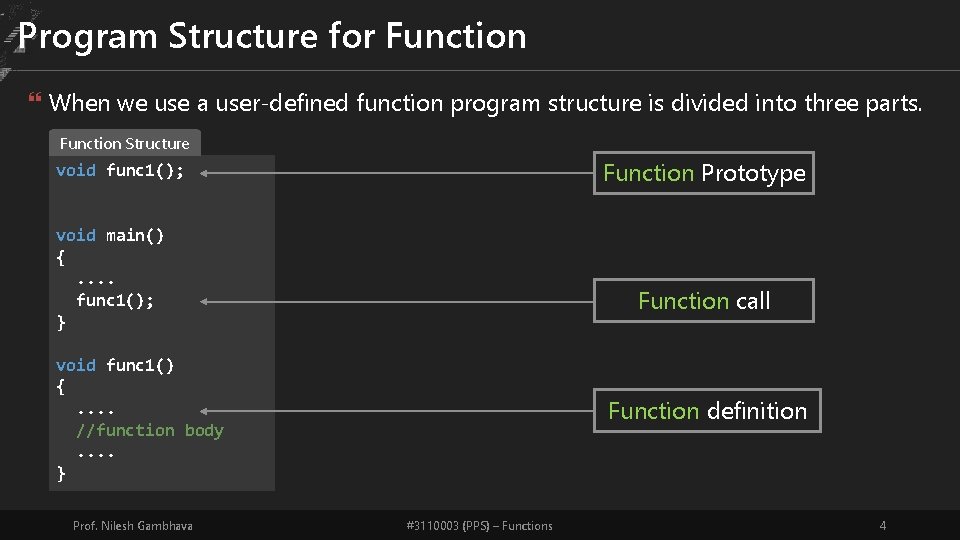
Program Structure for Function When we use a user-defined function program structure is divided into three parts. Function Structure Function Prototype void func 1(); void main() {. . func 1(); } Function call void func 1() {. . //function body. . } Prof. Nilesh Gambhava Function definition #3110003 (PPS) – Functions 4
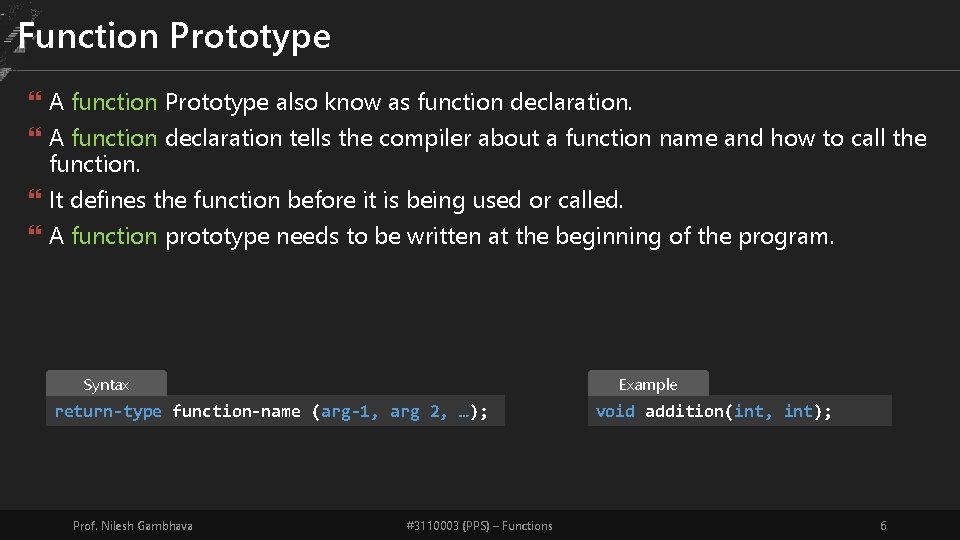
Function Prototype A function Prototype also know as function declaration. A function declaration tells the compiler about a function name and how to call the function. It defines the function before it is being used or called. A function prototype needs to be written at the beginning of the program. Syntax Example return-type function-name (arg-1, arg 2, …); Prof. Nilesh Gambhava #3110003 (PPS) – Functions void addition(int, int); 6
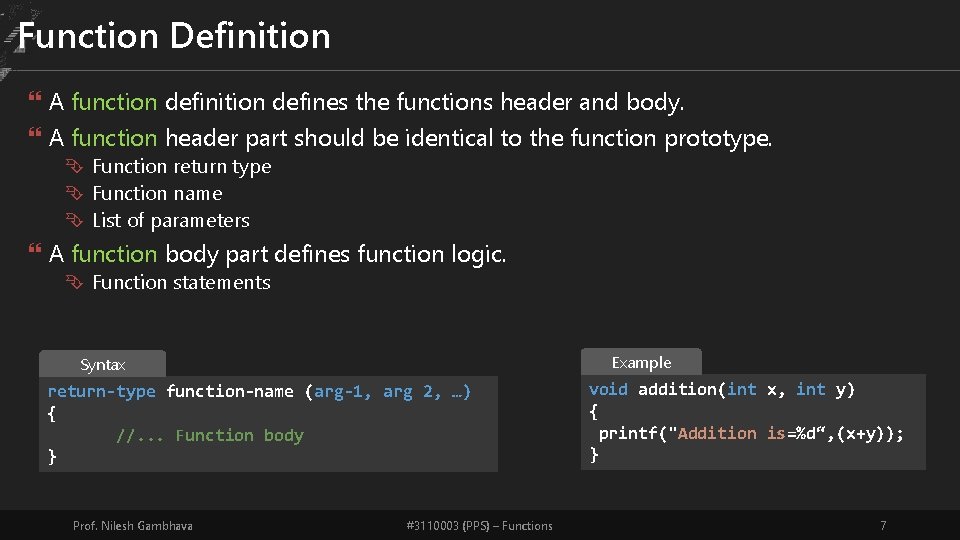
Function Definition A function definition defines the functions header and body. A function header part should be identical to the function prototype. Function return type Function name List of parameters A function body part defines function logic. Function statements Example Syntax return-type function-name (arg-1, arg 2, …) { //. . . Function body } Prof. Nilesh Gambhava #3110003 (PPS) – Functions void addition(int x, int y) { printf("Addition is=%d“, (x+y)); } 7
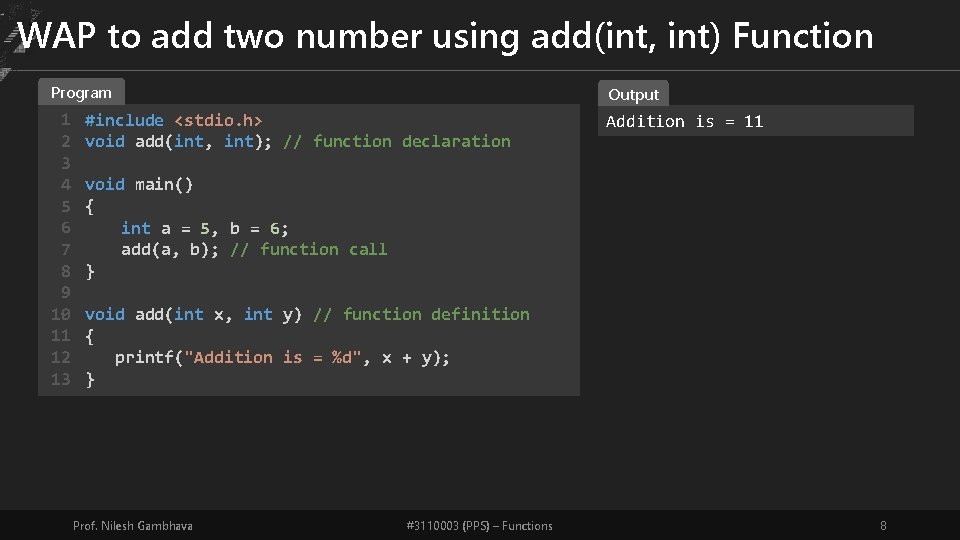
WAP to add two number using add(int, int) Function Program Output 1 2 3 4 5 6 7 8 9 10 11 12 13 Addition is = 11 #include <stdio. h> void add(int, int); // function declaration void main() { int a = 5, b = 6; add(a, b); // function call } void add(int x, int y) // function definition { printf("Addition is = %d", x + y); } Prof. Nilesh Gambhava #3110003 (PPS) – Functions 8
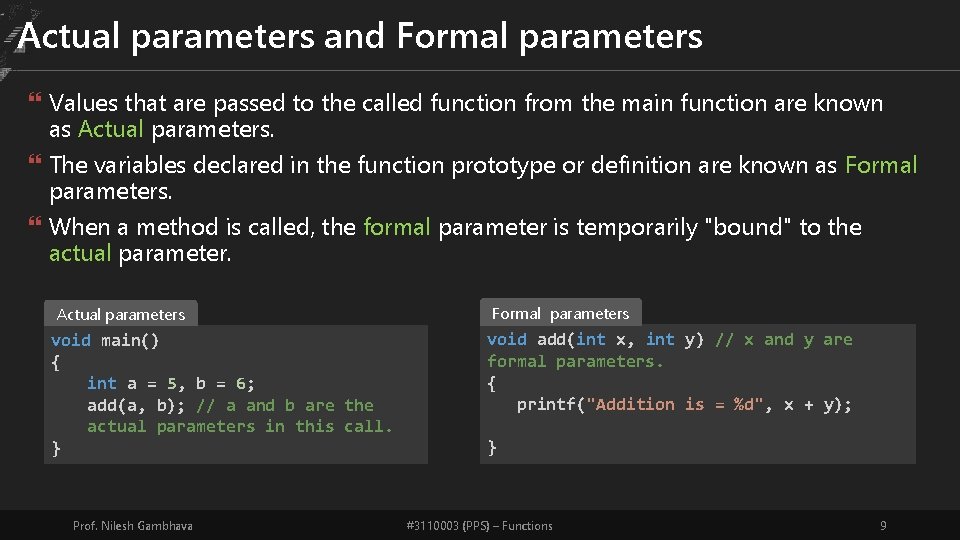
Actual parameters and Formal parameters Values that are passed to the called function from the main function are known as Actual parameters. The variables declared in the function prototype or definition are known as Formal parameters. When a method is called, the formal parameter is temporarily "bound" to the actual parameter. Actual parameters void main() { int a = 5, b = 6; add(a, b); // a and b are the actual parameters in this call. } Prof. Nilesh Gambhava Formal parameters void add(int x, int y) // x and y are formal parameters. { printf("Addition is = %d", x + y); } #3110003 (PPS) – Functions 9
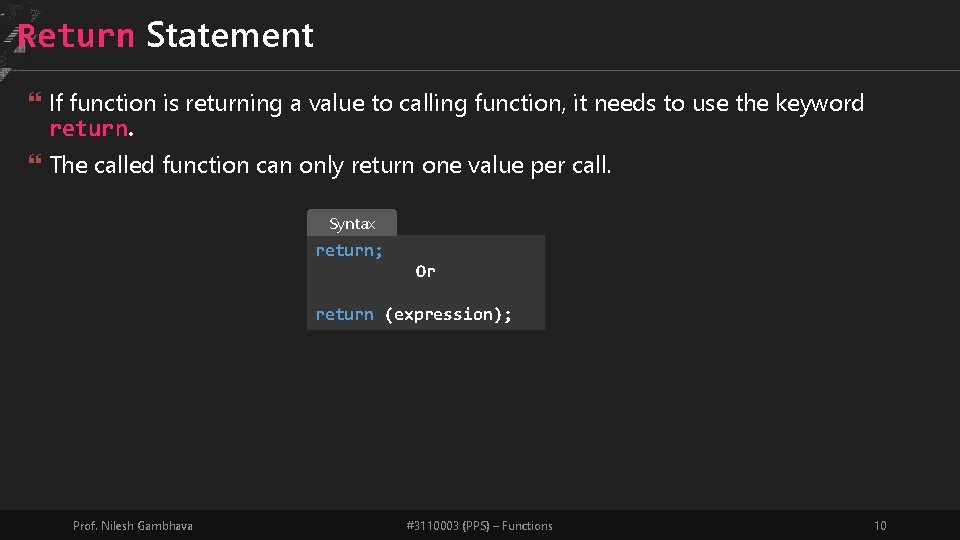
Return Statement If function is returning a value to calling function, it needs to use the keyword return. The called function can only return one value per call. Syntax return; Or return (expression); Prof. Nilesh Gambhava #3110003 (PPS) – Functions 10
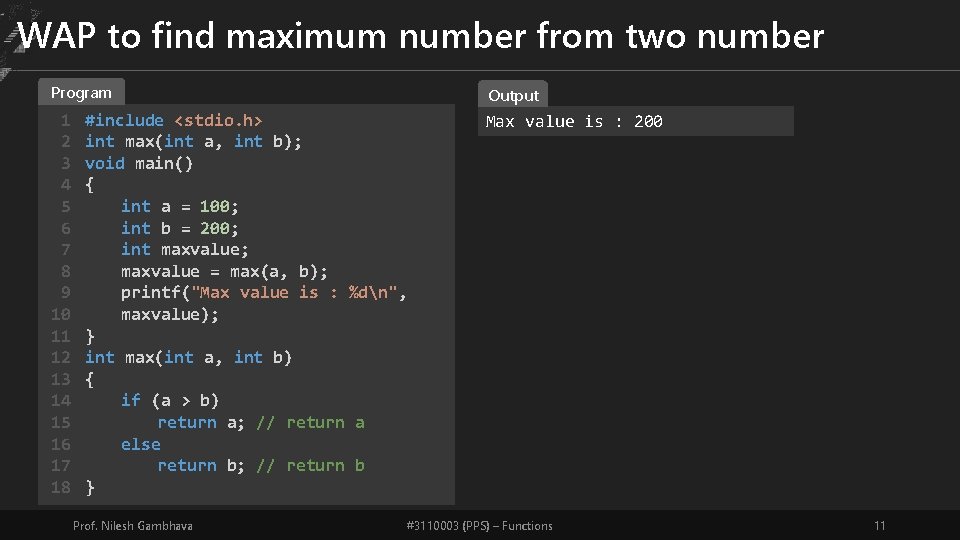
WAP to find maximum number from two number Program 1 2 3 4 5 6 7 8 9 10 11 12 13 14 15 16 17 18 Output #include <stdio. h> int max(int a, int b); void main() { int a = 100; int b = 200; int maxvalue; maxvalue = max(a, b); printf("Max value is : %dn", maxvalue); } int max(int a, int b) { if (a > b) return a; // return a else return b; // return b } Prof. Nilesh Gambhava Max value is : 200 #3110003 (PPS) – Functions 11
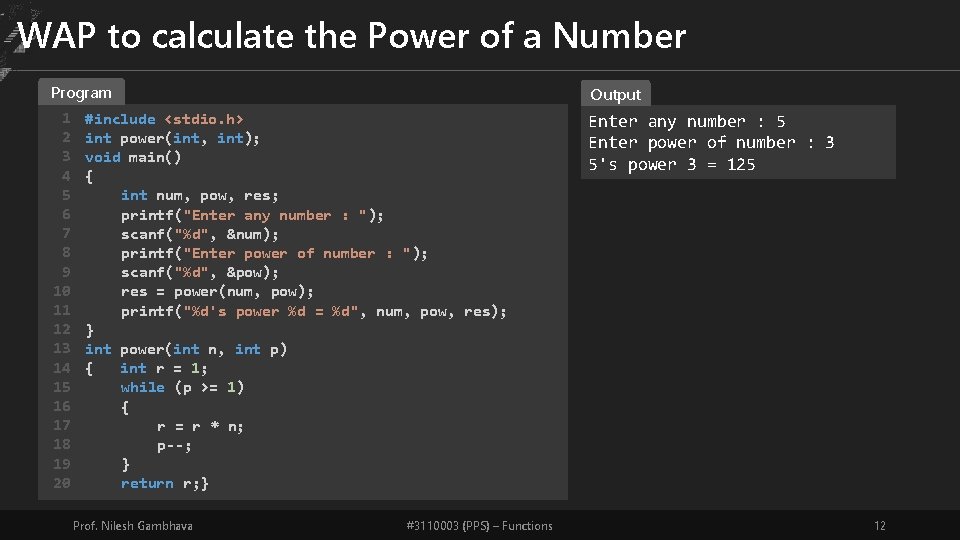
WAP to calculate the Power of a Number Program Output 1 2 3 4 5 6 7 8 9 10 11 12 13 14 15 16 17 18 19 20 Enter any number : 5 Enter power of number : 3 5's power 3 = 125 #include <stdio. h> int power(int, int); void main() { int num, pow, res; printf("Enter any number : "); scanf("%d", &num); printf("Enter power of number : "); scanf("%d", &pow); res = power(num, pow); printf("%d's power %d = %d", num, pow, res); } int power(int n, int p) { int r = 1; while (p >= 1) { r = r * n; p--; } return r; } Prof. Nilesh Gambhava #3110003 (PPS) – Functions 12
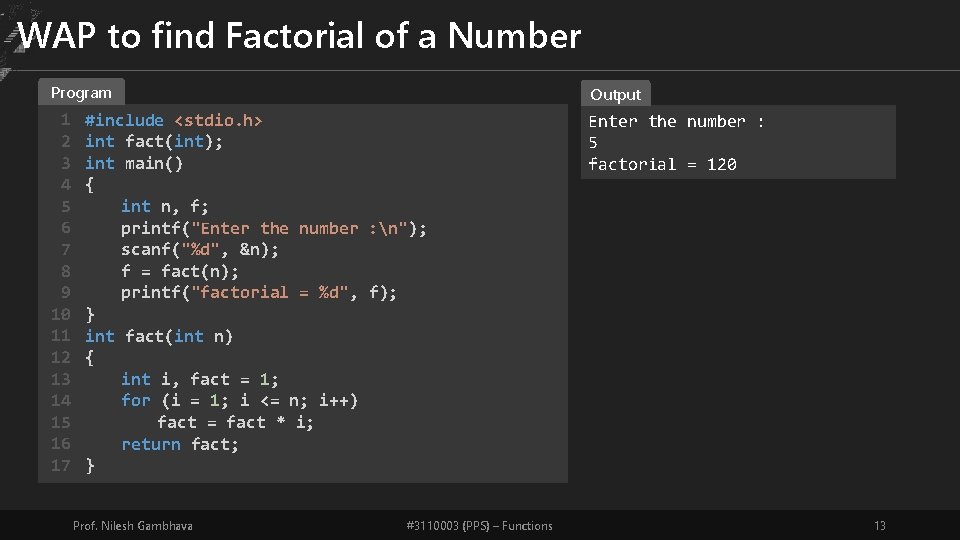
WAP to find Factorial of a Number Program Output 1 2 3 4 5 6 7 8 9 10 11 12 13 14 15 16 17 Enter the number : 5 factorial = 120 #include <stdio. h> int fact(int); int main() { int n, f; printf("Enter the number : n"); scanf("%d", &n); f = fact(n); printf("factorial = %d", f); } int fact(int n) { int i, fact = 1; for (i = 1; i <= n; i++) fact = fact * i; return fact; } Prof. Nilesh Gambhava #3110003 (PPS) – Functions 13
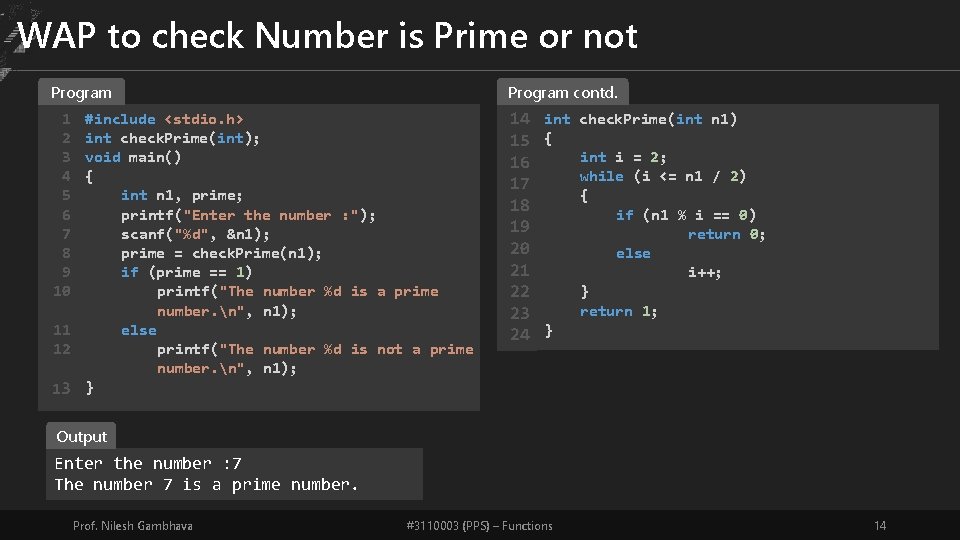
WAP to check Number is Prime or not Program contd. 1 2 3 4 5 6 7 8 9 10 14 int check. Prime(int n 1) 15 { int i = 2; 16 while (i <= n 1 / 2) 17 { 18 if (n 1 % i == 0) 19 return 0; 20 else 21 i++; } 22 return 1; 23 24 } #include <stdio. h> int check. Prime(int); void main() { int n 1, prime; printf("Enter the number : "); scanf("%d", &n 1); prime = check. Prime(n 1); if (prime == 1) printf("The number %d is a prime number. n", n 1); 11 else 12 printf("The number %d is not a prime number. n", n 1); 13 } Output Enter the number : 7 The number 7 is a prime number. Prof. Nilesh Gambhava #3110003 (PPS) – Functions 14

Category of Function (1) Function with no argument and but no return value No Input void main() {. . . fun 1(); . . . } No return value void fun 1() {. . . . } (2) Function with no argument and returns value void main() {. . . a = fun 1(). . . } Prof. Nilesh Gambhava No Input Function result int fun 1(void) {. . return b; } #3110003 (PPS) – Functions 15
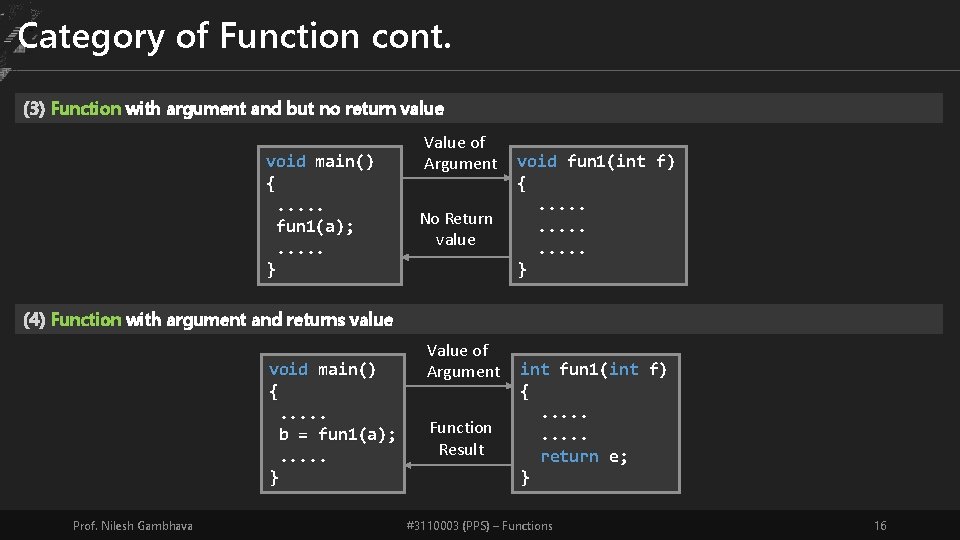
Category of Function cont. (3) Function with argument and but no return value void main() {. . . fun 1(a); . . . } Value of Argument No Return value void fun 1(int f) {. . . . } (4) Function with argument and returns value void main() {. . . b = fun 1(a); . . . } Prof. Nilesh Gambhava Value of Argument Function Result int fun 1(int f) {. . return e; } #3110003 (PPS) – Functions 16
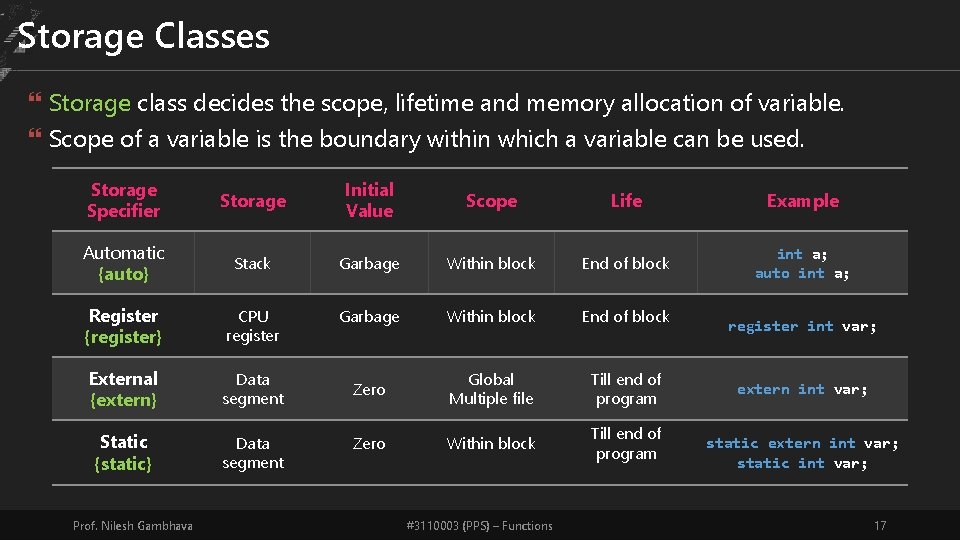
Storage Classes Storage class decides the scope, lifetime and memory allocation of variable. Scope of a variable is the boundary within which a variable can be used. Storage Specifier Storage Initial Value Scope Life Example Automatic {auto} Stack Garbage Within block End of block int a; auto int a; Register {register} CPU register Garbage Within block End of block External {extern} Data segment Zero Global Multiple file Till end of program Static {static} Data segment Zero Within block Till end of program Prof. Nilesh Gambhava #3110003 (PPS) – Functions register int var; extern int var; static int var; 17
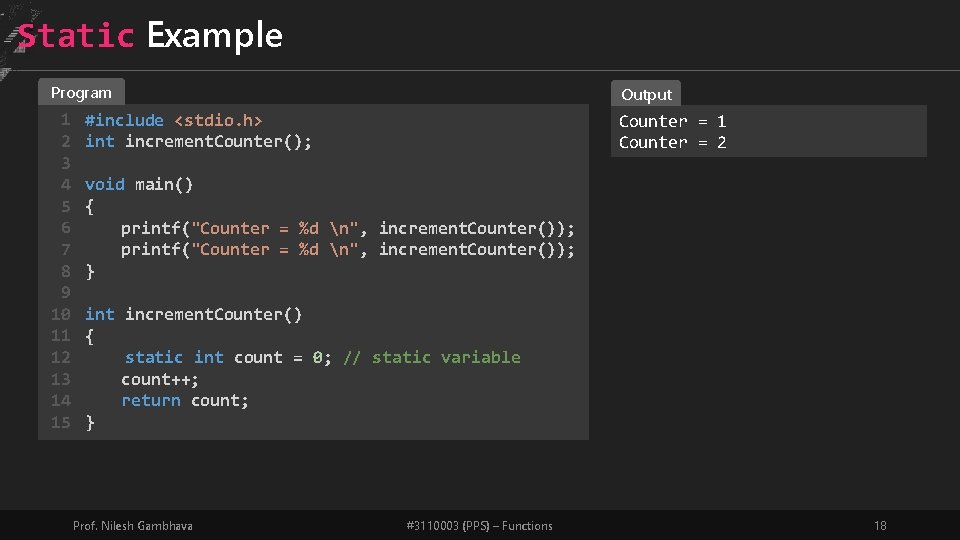
Static Example Program Output 1 2 3 4 5 6 7 8 9 10 11 12 13 14 15 Counter = 1 Counter = 2 #include <stdio. h> int increment. Counter(); void main() { printf("Counter = %d n", increment. Counter()); } int increment. Counter() { static int count = 0; // static variable count++; return count; } Prof. Nilesh Gambhava #3110003 (PPS) – Functions 18
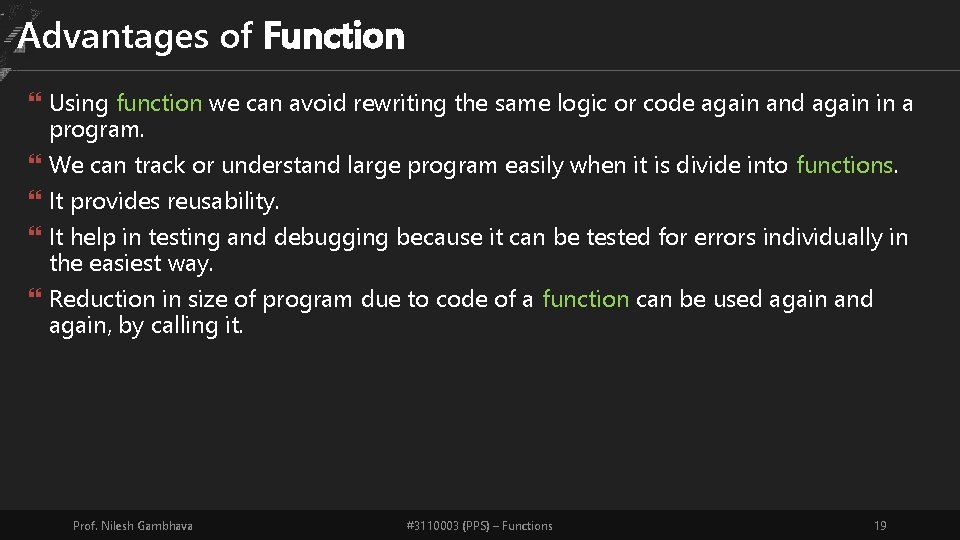
Advantages of Function Using function we can avoid rewriting the same logic or code again and again in a program. We can track or understand large program easily when it is divide into functions. It provides reusability. It help in testing and debugging because it can be tested for errors individually in the easiest way. Reduction in size of program due to code of a function can be used again and again, by calling it. Prof. Nilesh Gambhava #3110003 (PPS) – Functions 19
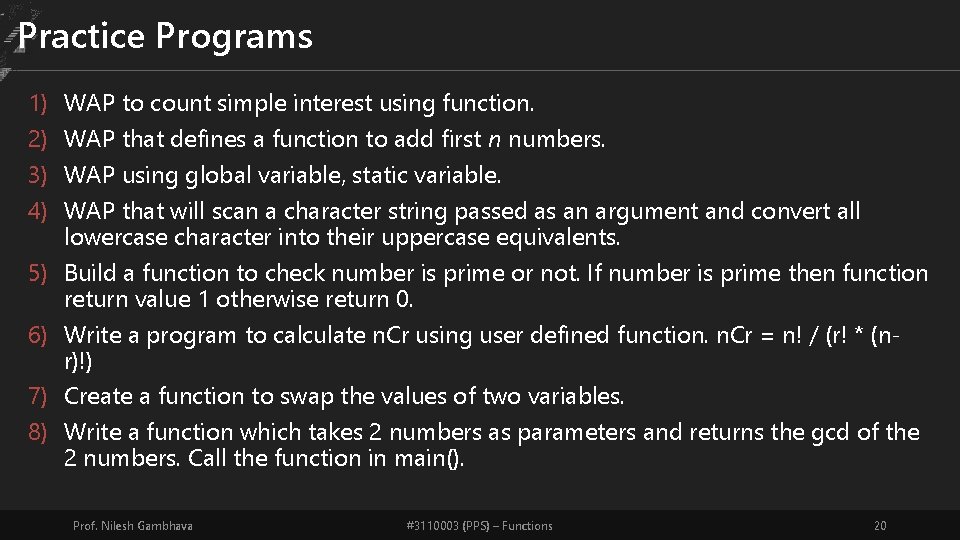
Practice Programs 1) 2) 3) 4) 5) 6) 7) 8) WAP to count simple interest using function. WAP that defines a function to add first n numbers. WAP using global variable, static variable. WAP that will scan a character string passed as an argument and convert all lowercase character into their uppercase equivalents. Build a function to check number is prime or not. If number is prime then function return value 1 otherwise return 0. Write a program to calculate n. Cr using user defined function. n. Cr = n! / (r! * (nr)!) Create a function to swap the values of two variables. Write a function which takes 2 numbers as parameters and returns the gcd of the 2 numbers. Call the function in main(). Prof. Nilesh Gambhava #3110003 (PPS) – Functions 20
Thank you
- Slides: 20