
Programming Basics Course Introduction Soft Uni Team Technical
Programming Basics Course Introduction Soft. Uni Team Technical Trainers Software University http: //softuni. bg Program ming Basics
Table of Contents 1. Course Objectives 2. Course Program 3. Trainers Team 4. Examination 5. Learning Resources 2
Programming Basics Course Objectives & Program
Course Objectives § The “Programming Basics" course: § First steps in computer programming with C#: § Compiler, IDE, variables, control-flow logic, console I/O, loops § Establish algorithmic thinking § Development of problems solving skills § Prepare for learning other languages and software technologies § Java, HTML, CSS, Java. Script, PHP § Databases & SQL, high-quality code § Web development technologies 4
Programming Basics – Course Topics 1. Course Intro. Basic Mathematical Concepts for Programmers 2. Introduction to Programming. Using the IDE 3. Primitive Data Types, Variables, Literals 4. Console-Based Input and Output 5. Operators, Expressions and Statements 6. Conditional Statements (if-else, switch-case) 5
Programming Basics – Course Topics (2) 7. Loops (while, do-while, foreach) 8. Advanced Topics: Methods & Collections 9. Practical Lab on All Course Material 10. Exam Preparation: Solving Sample Exams 11. Practical Exam 12. Exam Review (Lab) 6
The Trainers Team
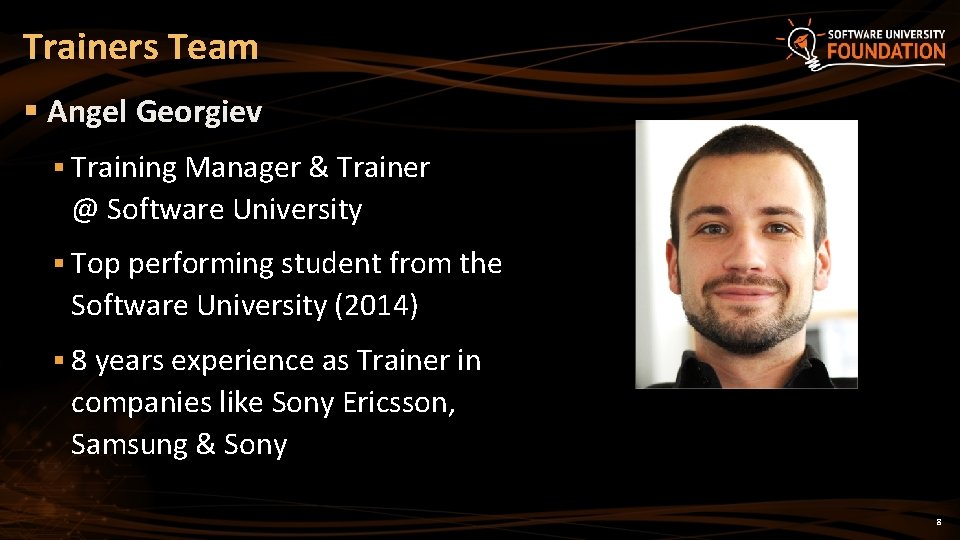
Trainers Team § Angel Georgiev § Training Manager & Trainer @ Software University § Top performing student from the Software University (2014) § 8 years experience as Trainer in companies like Sony Ericsson, Samsung & Sony 8
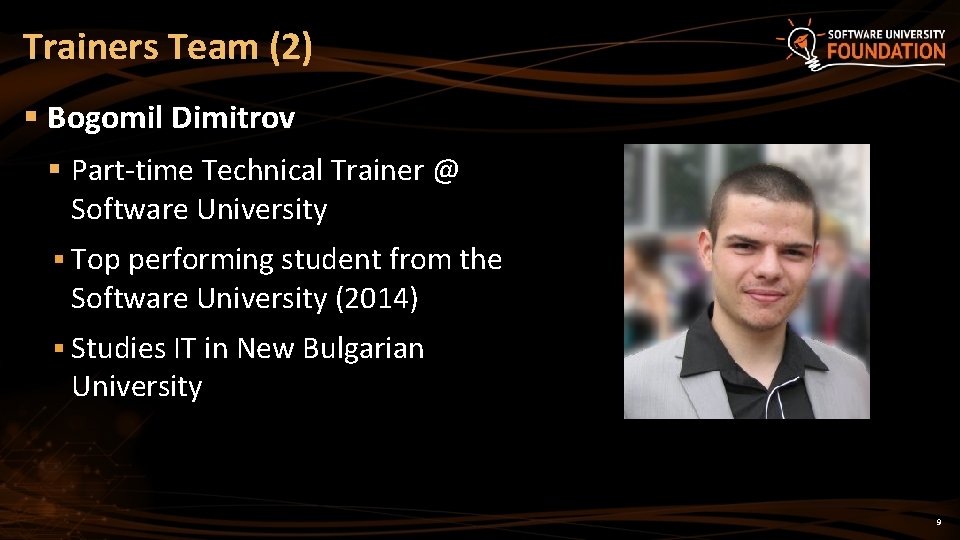
Trainers Team (2) § Bogomil Dimitrov § Part-time Technical Trainer @ Software University § Top performing student from the Software University (2014) § Studies IT in New Bulgarian University 9
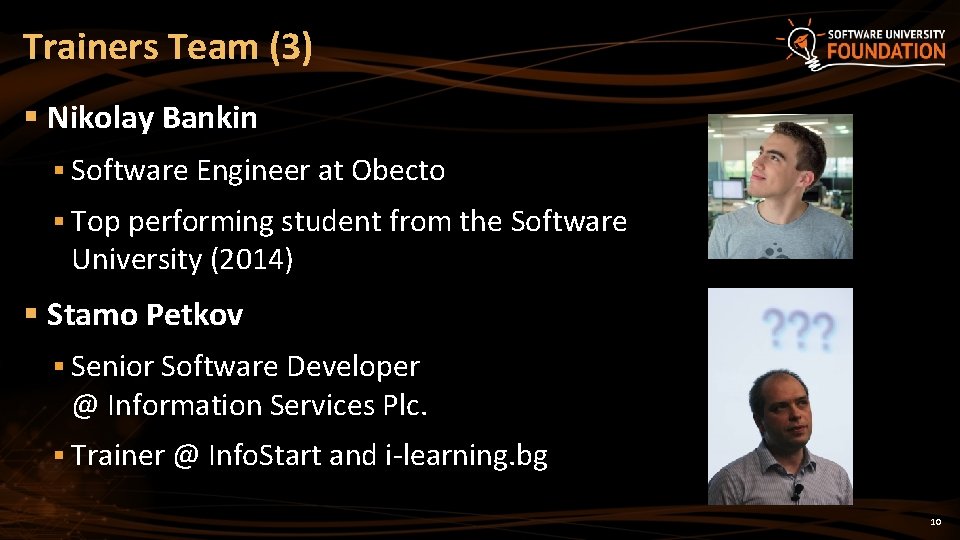
Trainers Team (3) § Nikolay Bankin § Software Engineer at Obecto § Top performing student from the Software University (2014) § Stamo Petkov § Senior Software Developer @ Information Services Plc. § Trainer @ Info. Start and i-learning. bg 10
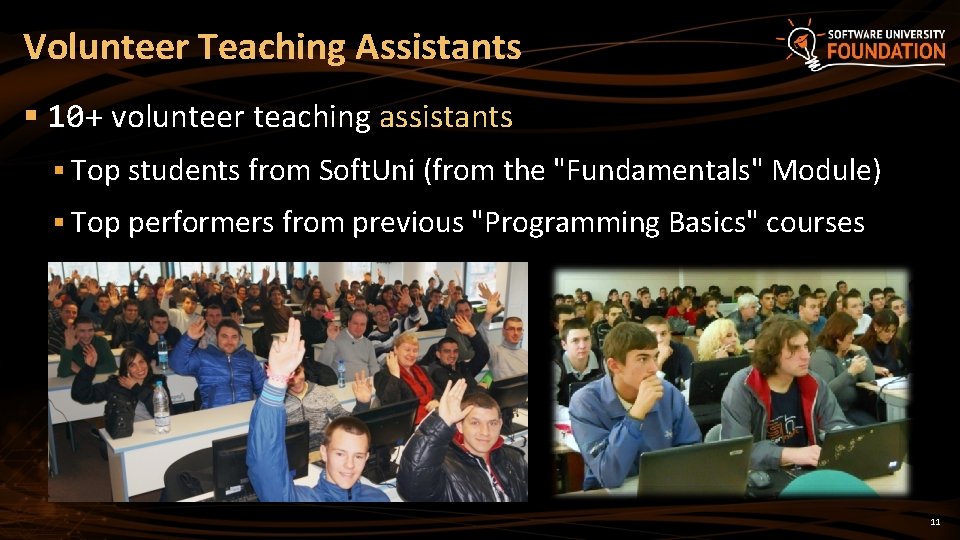
Volunteer Teaching Assistants § 10+ volunteer teaching assistants § Top students from Soft. Uni (from the "Fundamentals" Module) § Top performers from previous "Programming Basics" courses 11
Programming Basics Course Details Duration, Languages, Technologies
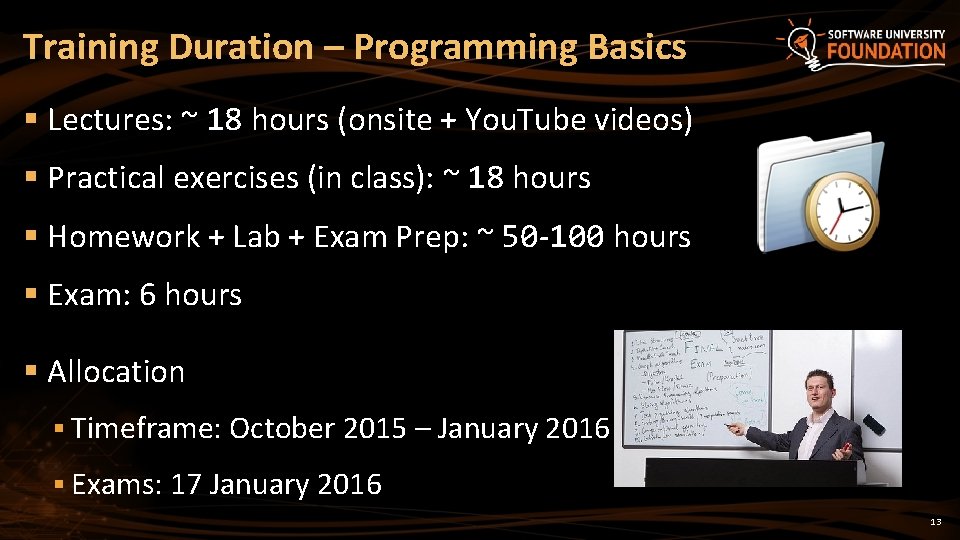
Training Duration – Programming Basics § Lectures: ~ 18 hours (onsite + You. Tube videos) § Practical exercises (in class): ~ 18 hours § Homework + Lab + Exam Prep: ~ 50 -100 hours § Exam: 6 hours § Allocation § Timeframe: October 2015 – January 2016 § Exams: 17 January 2016 13
Why C# and. NET Framework? § C#, . NET and Visual Studio in Windows environment § Excellent start for beginners, very easy to learn § The C# language § Modern object-oriented language § Very popular, used by millions developers § Easy to learn, yet very powerful § C# is just the start! § We will learn Java, PHP, Linux, HTML, JS, SQL, and many more 14
Why English? § Why the slides are in English? § English is the native language of the software engineers § Specific terminology should be in English § Translations are inaccurate and funny § Just learn English! § No excuses 15
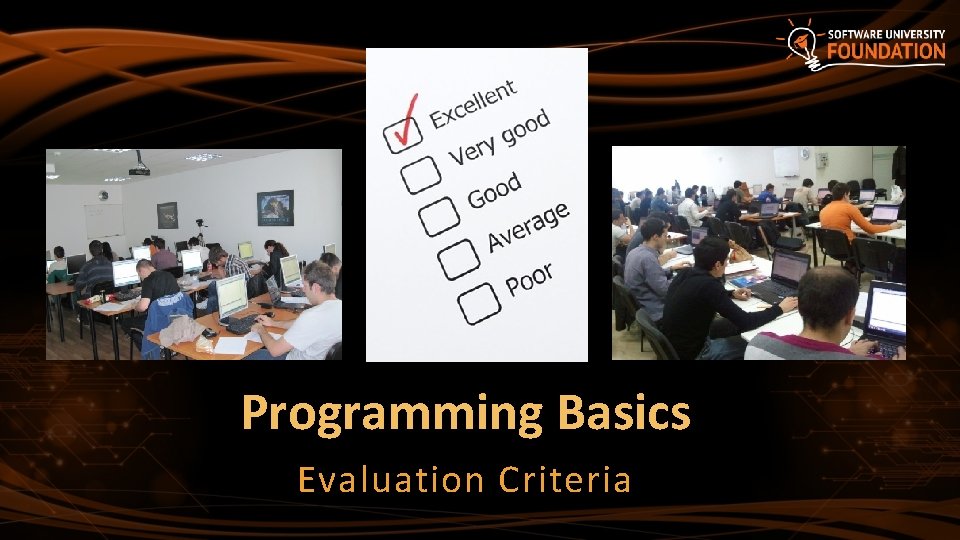
Programming Basics Evaluation Criteria
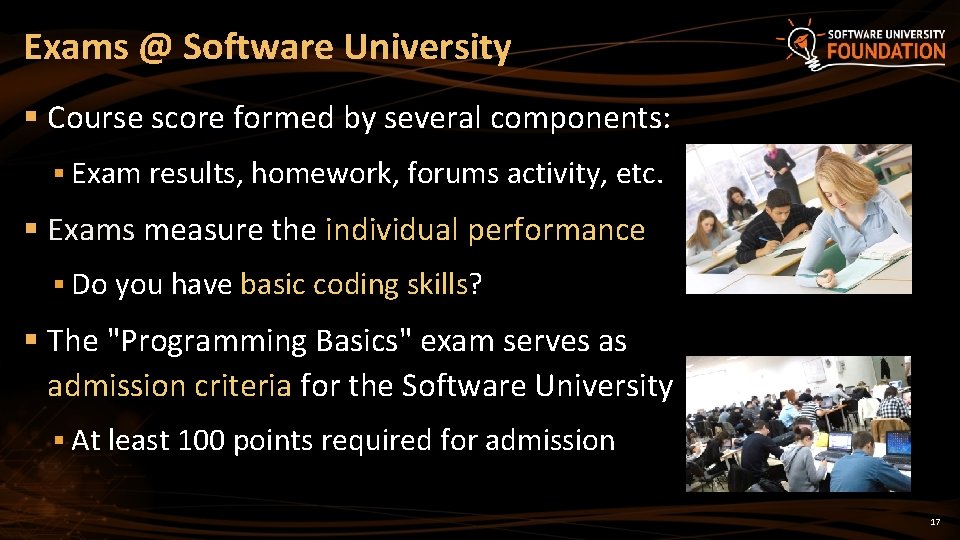
Exams @ Software University § Course score formed by several components: § Exam results, homework, forums activity, etc. § Exams measure the individual performance § Do you have basic coding skills? § The "Programming Basics" exam serves as admission criteria for the Software University § At least 100 points required for admission 17
Programming Basics Exam § The practical programming exam explained § 5 practical problems for 6 hours § 1 very easy, 3 with loops, 1 with bit operations § Covers all learned topics up to the moment § Automated judge system & real-time feedback § Solutions are evaluated for correctness only § Code quality is still not measured 18
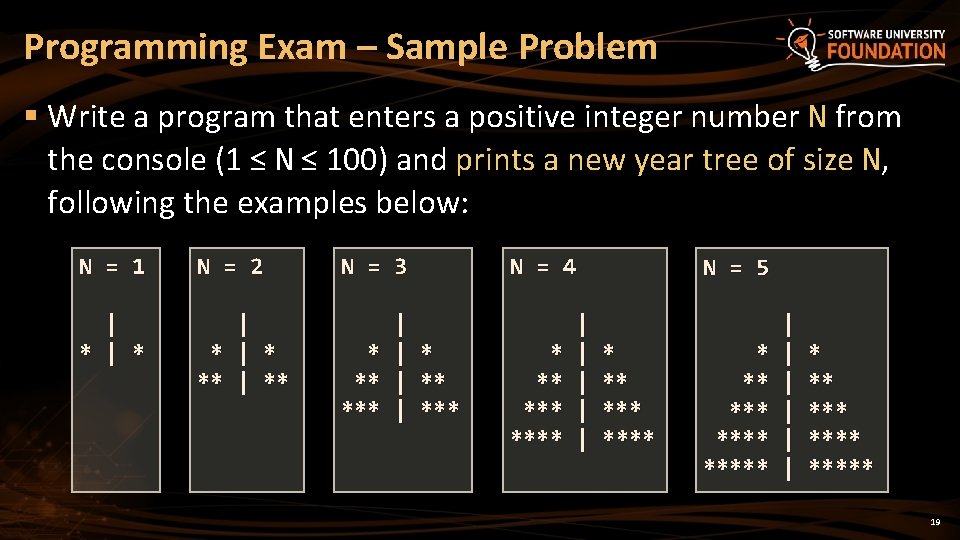
Programming Exam – Sample Problem § Write a program that enters a positive integer number N from the console (1 ≤ N ≤ 100) and prints a new year tree of size N, following the examples below: N = 1 N = 2 N = 3 | * | * ** | ** *** | *** N = 4 * ** **** | | | N = 5 * ** *** ***** | | | * ** ***** 19
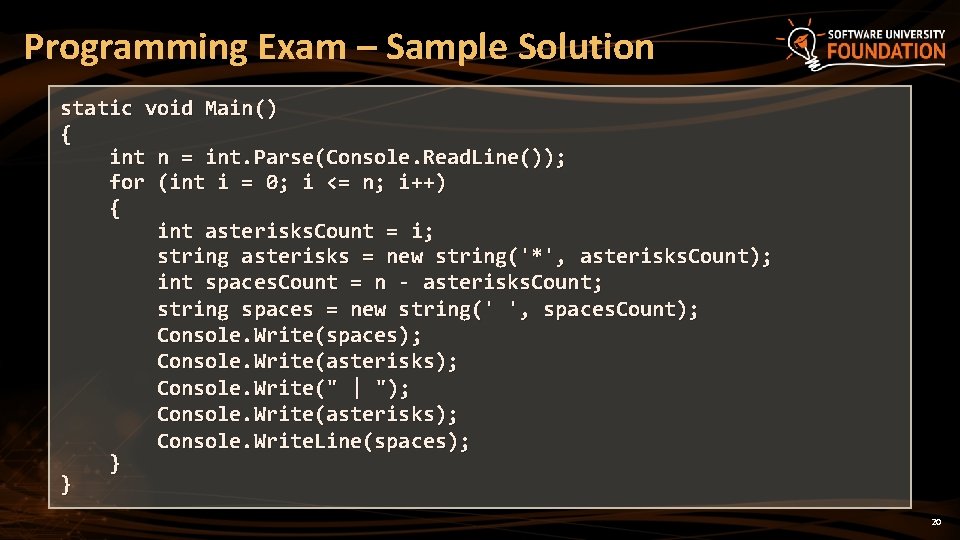
Programming Exam – Sample Solution static void Main() { int n = int. Parse(Console. Read. Line()); for (int i = 0; i <= n; i++) { int asterisks. Count = i; string asterisks = new string('*', asterisks. Count); int spaces. Count = n - asterisks. Count; string spaces = new string(' ', spaces. Count); Console. Write(spaces); Console. Write(asterisks); Console. Write(" | "); Console. Write(asterisks); Console. Write. Line(spaces); } } 20
Scoring System for the Course § Onsite students § Exam – 80% § Serves as pass / fail criteria § Homework + evaluation – 10% + 10% § Forums activity – bonus up to 10% § Online students § Exam – 100% § Forums activity – bonus up to 10% 21
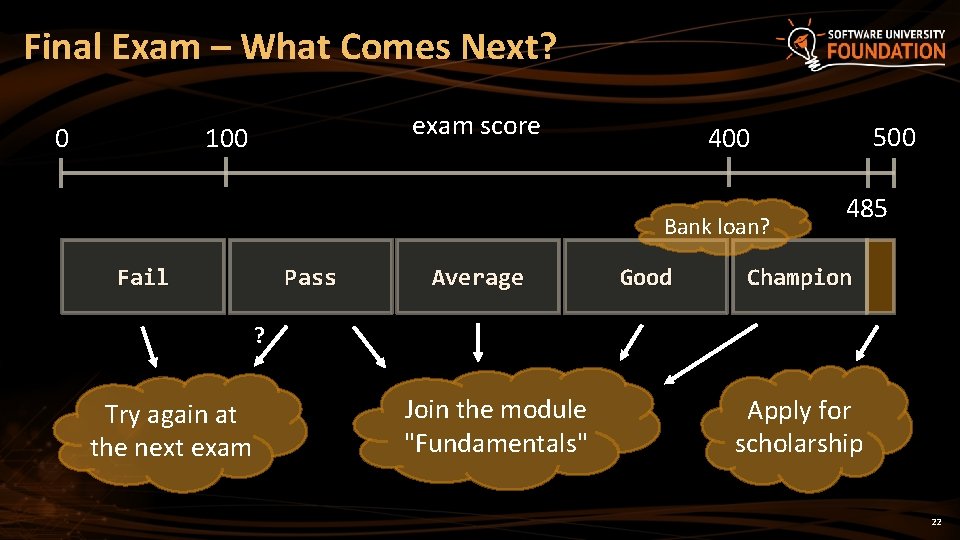
Final Exam – What Comes Next? 0 exam score 100 Bank loan? Fail Pass Average 500 400 Good 485 Champion ? Try again at the next exam Join the module "Fundamentals" Apply for scholarship 22
Homework Assignments § Doing your homework is very important! § Programming can only be learned through a lot of practice! § You should write code every day! § Each lecture is followed by a few exercises § Try to solve them in class § The rest are your homework § Homework assignments are due in 1 week after each lecture § Submission will be accepted through our web site: softuni. bg 23
Homework Peer Reviews § Everyone will give feedback to a few random homework submissions § Students submit homework anonymously § Please exclude your name from the submissions! § For each homework submitted § Students evaluate 3 random pieces of homework § From the same topic, in 3 days after the deadline § Give written feedback, at least 200 characters § Low-quality feedback report for punishment § Everyone can get feedback for their homework 24
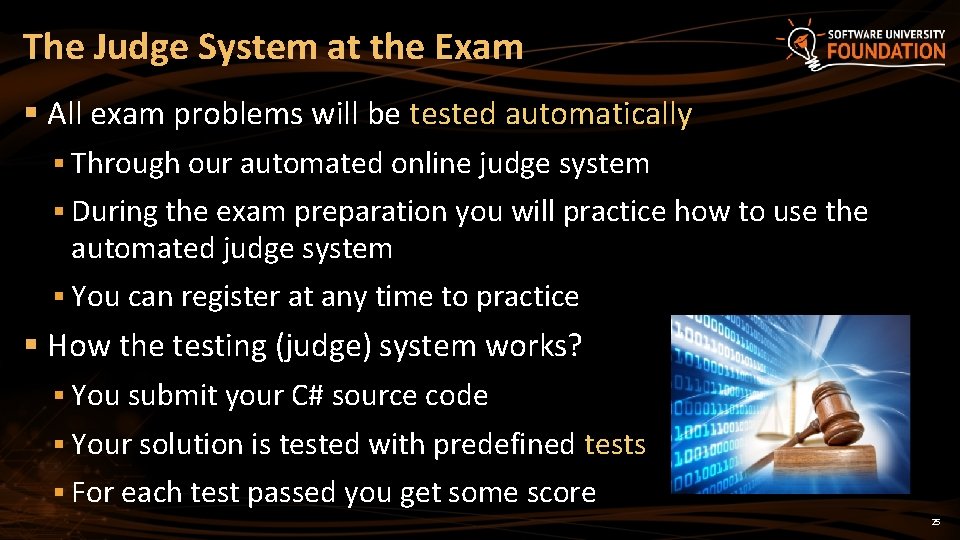
The Judge System at the Exam § All exam problems will be tested automatically § Through our automated online judge system § During the exam preparation you will practice how to use the automated judge system § You can register at any time to practice § How the testing (judge) system works? § You submit your C# source code § Your solution is tested with predefined tests § For each test passed you get some score 25
Resources What We Need Additionally?
Course Web Site & Forums § The Programming Basics official web site: https: //softuni. bg/courses/programming-basics/ § Register for the "Software University Forum": § Discuss the course exercises with your colleagues § Find solutions for all course exercises § Share source code / discuss ideas / help each other http: //softuni. bg/forum 27
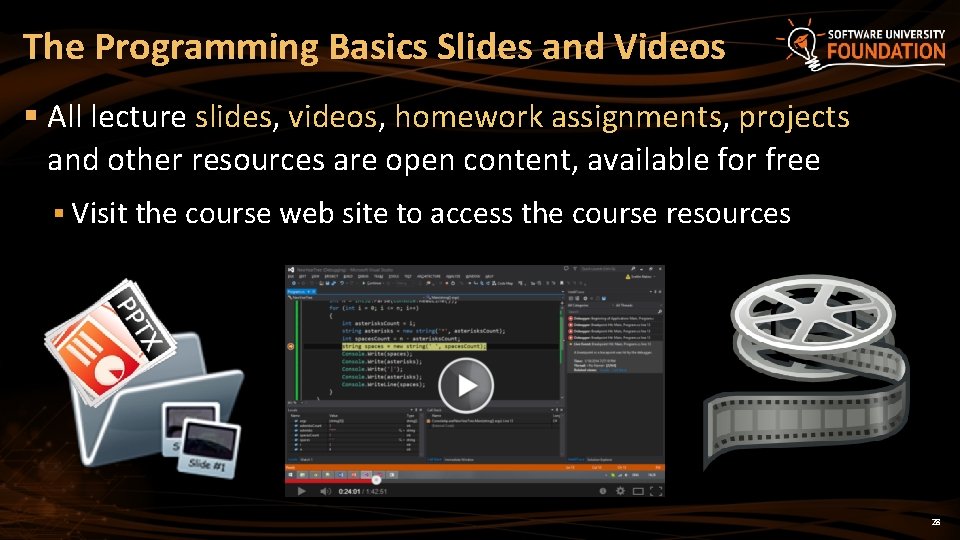
The Programming Basics Slides and Videos § All lecture slides, videos, homework assignments, projects and other resources are open content, available for free § Visit the course web site to access the course resources 28
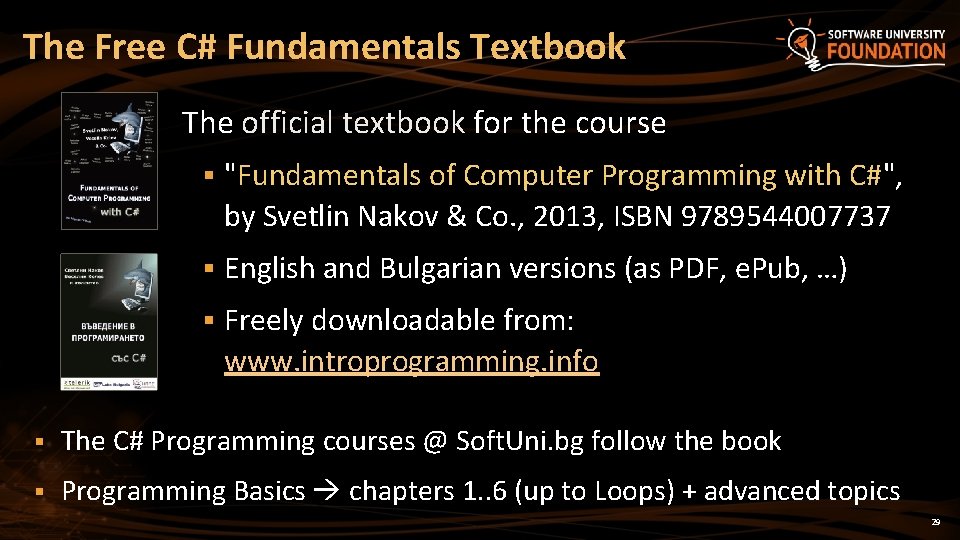
The Free C# Fundamentals Textbook The official textbook for the course § "Fundamentals of Computer Programming with C#", by Svetlin Nakov & Co. , 2013, ISBN 9789544007737 § English and Bulgarian versions (as PDF, e. Pub, …) § Freely downloadable from: www. introprogramming. info § The C# Programming courses @ Soft. Uni. bg follow the book § Programming Basics chapters 1. . 6 (up to Loops) + advanced topics 29
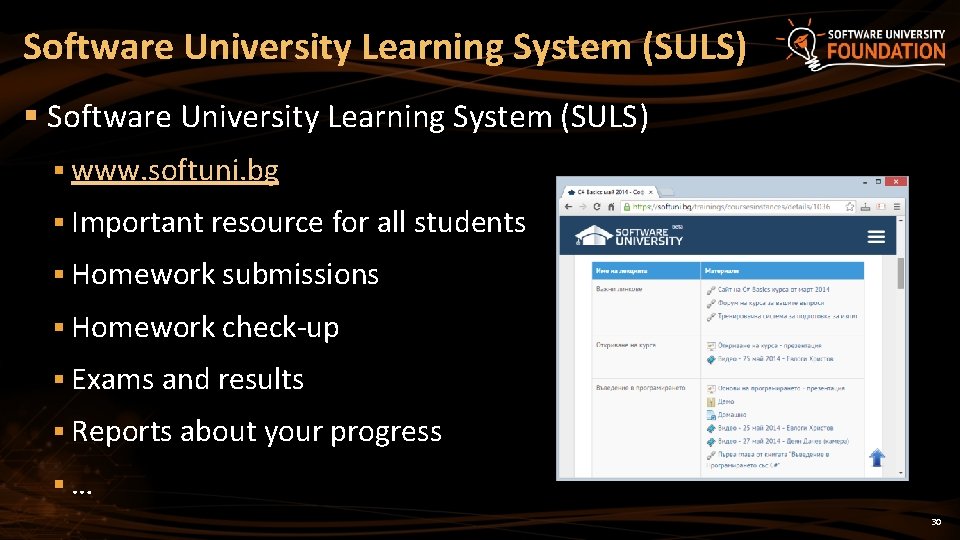
Software University Learning System (SULS) § www. softuni. bg § Important resource for all students § Homework submissions § Homework check-up § Exams and results § Reports about your progress §… 30
Required Software § Software needed for this course: § Microsoft Windows (Win 8. 1 / Win 8 / Win 7 / Win XP) § Visual Studio Community 2013 (a free version of VS 2013) § Visual Studio 2012, 2010, 2008 acceptable, but not recommended §. NET Framework 4. 5 (included in Visual Studio) 31
Summary § The “Programming Basics" course provides § The very first steps in programming § Training program § Programming, using Visual Studio, variables, control-flow logic, loops, advanced topics § Practical exams § Automated judge system + score system § Learning resources § Lectures, videos, software, books, forum 32
Programming Basics – Course Introduction ? s n stio e u Q ? ? ? https: //softuni. bg/courses/programming-basics/
License § This course (slides, examples, demos, videos, homework, etc. ) is licensed under the "Creative Commons Attribution. Non. Commercial-Share. Alike 4. 0 International" license § Attribution: this work may contain portions from § "Fundamentals of Computer Programming with C#" book by Svetlin Nakov & Co. under CC-BY-SA license § "C# Part I" course by Telerik Academy under CC-BY-NC-SA license 34
Free Trainings @ Software University § Software University Foundation – softuni. org § Software University – High-Quality Education, Profession and Job for Software Developers § softuni. bg § Software University @ Facebook § facebook. com/Software. University § Software University @ You. Tube § youtube. com/Software. University § Software University Forums – forum. softuni. bg
- Slides: 35