
Programming and Data Structures Debasis Samanta Computer Science
Programming and Data Structures Debasis Samanta Computer Science & Engineering Indian Institute of Technology Kharagpur Spring-2017
Lecture #7 Sorting algorithms CS 10001 : Programming and Data Structures 2 Lecture #07: © DSamanta
Today’s Discussion… *Introduction *Different sorting algorithms *Sorting by distribution * CS 10001 : Programming and Data Structures 3 Lecture #07: © DSamanta
Introduction CS 11001 : Programming and Data Structures 4 Lecture #11: © DSamanta
![Sorting – The Task • Given an array x[0], x[1], … , x[size-1] reorder](http://slidetodoc.com/presentation_image_h/a08500c0ba3127e5d22784b515e86761/image-5.jpg "Sorting – The Task • Given an array x[0], x[1], … , x[size-1] reorder")
Sorting – The Task • Given an array x[0], x[1], … , x[size-1] reorder entries so that x[0] <= x[1] <= . . . <= x[size-1] Here, List is in non-decreasing order. • We can also sort a list of elements in non-increasing order. CS 10001 : Programming and Data Structures 5 Lecture #07: © DSamanta
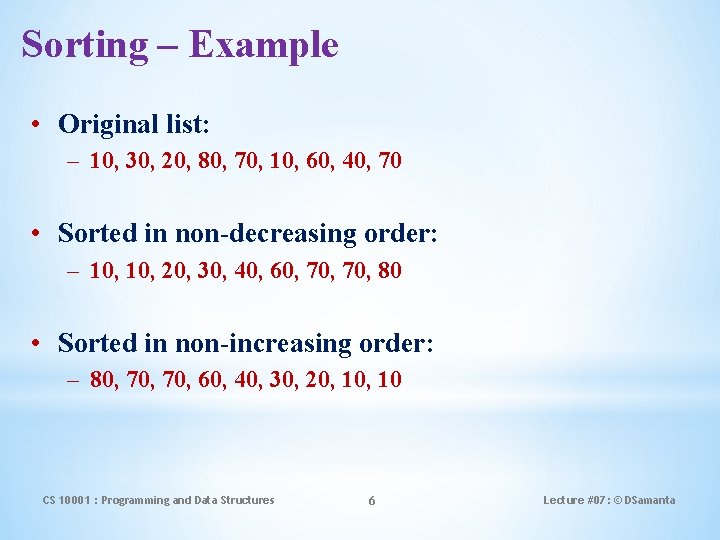
Sorting – Example • Original list: – 10, 30, 20, 80, 70, 10, 60, 40, 70 • Sorted in non-decreasing order: – 10, 20, 30, 40, 60, 70, 80 • Sorted in non-increasing order: – 80, 70, 60, 40, 30, 20, 10 CS 10001 : Programming and Data Structures 6 Lecture #07: © DSamanta
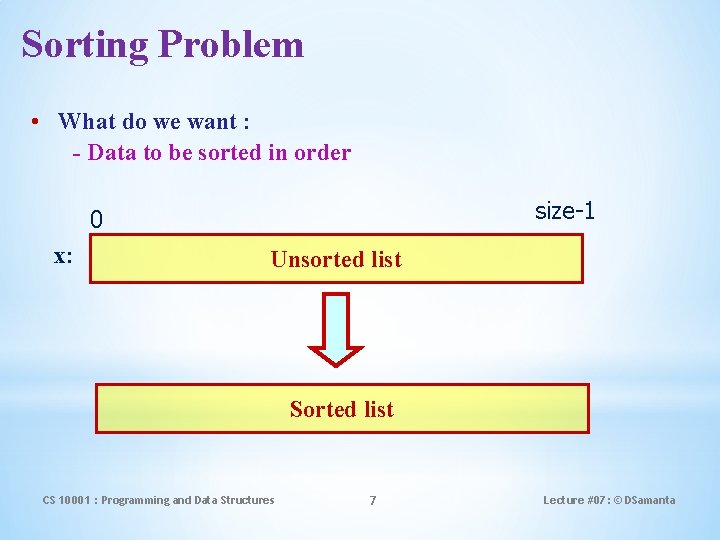
Sorting Problem • What do we want : - Data to be sorted in order size-1 0 x: Unsorted list Sorted list CS 10001 : Programming and Data Structures 7 Lecture #07: © DSamanta
Issues in Sorting Many issues are there in sorting techniques • How to rearrange a given set of data? • Which data structures are more suitable to store data prior to their sorting? • How fast the sorting can be achieved? • How sorting can be done in a memory constraint situation? • How to sort various types of data? CS 10001 : Programming and Data Structures 8 Lecture #07: © DSamanta
Sorting Algorithms CS 11001 : Programming and Data Structures 9 Lecture #11: © DSamanta
Sorting by Comparison • Basic operation involved in this type of sorting technique is comparison. A data item is compared with other items in the list of items in order to find its place in the sorted list. • Insertion • Selection • Exchange • Enumeration CS 10001 : Programming and Data Structures 10 Lecture #07: © DSamanta
Sorting by Comparison Sorting by comparison – Insertion: • From a given list of items, one item is considered at a time. The item chosen is then inserted into an appropriate position relative to the previously sorted items. The item can be inserted into the same list or to a different list. e. g. : Insertion sort Sorting by comparison – Selection: • First the smallest (or largest) item is located and it is separated from the rest; then the next smallest (or next largest) is selected and so on until all item are separated. e. g. : Selection sort, Heap sort CS 10001 : Programming and Data Structures 11 Lecture #07: © DSamanta
Sorting by Comparison Sorting by comparison – Exchange: • If two items are found to be out of order, they are interchanged. The process is repeated until no more exchange is required. e. g. : Bubble sort, Shell Sort, Quick Sorting by comparison – Enumeration: • Two or more input lists are merged into an output list and while merging the items, an input list is chosen following the required sorting order. e. g. : Merge sort CS 10001 : Programming and Data Structures 12 Lecture #07: © DSamanta
Sorting by Distribution • No key comparison takes place • All items under sorting are distributed over an auxiliary storage space based on the constituent element in each and then grouped them together to get the sorted list. • Distributions of items based on the following choices ü Radix - An item is placed in a space decided by the bases (or radix) of its components with which it is composed of. ü Counting - Items are sorted based on their relative counts. ü Hashing - Items are hashed, that is, dispersed into a list based on a hash function. Note: This lecture concentrates only on sorting by comparison. CS 10001 : Programming and Data Structures 13 Lecture #07: © DSamanta
Insertion Sort CS 10001 : Programming and Data Structures 14 Lecture #07: © DSamanta
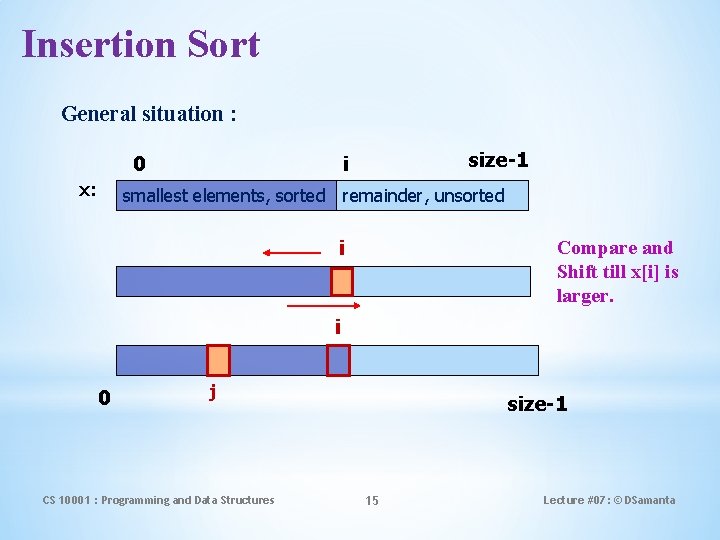
Insertion Sort General situation : 0 x: size-1 i smallest elements, sorted remainder, unsorted i Compare and Shift till x[i] is larger. i 0 j CS 10001 : Programming and Data Structures size-1 15 Lecture #07: © DSamanta
![Insertion Sort void insertion. Sort (int list[], int size) { int i, j, item;](http://slidetodoc.com/presentation_image_h/a08500c0ba3127e5d22784b515e86761/image-16.jpg "Insertion Sort void insertion. Sort (int list[], int size) { int i, j, item;")
Insertion Sort void insertion. Sort (int list[], int size) { int i, j, item; for (i=1; i<size; i++) { item = list[i] ; /* Move elements of list[0. . i-1], that are greater than item, to one position ahead of their current position */ for (j=i-1; (j>=0)&& (list[j] > item); j--) list[j+1] = list[j]; list[j+1] = item ; } } CS 10001 : Programming and Data Structures 16 Lecture #07: © DSamanta
![Insertion Sort int main() { int x[ ]={-45, 89, -65, 87, 0, 3, -23,](http://slidetodoc.com/presentation_image_h/a08500c0ba3127e5d22784b515e86761/image-17.jpg "Insertion Sort int main() { int x[ ]={-45, 89, -65, 87, 0, 3, -23,")
Insertion Sort int main() { int x[ ]={-45, 89, -65, 87, 0, 3, -23, 19, 56, 21, 76, -50}; int i; for(i=0; i<12; i++) printf("%d ", x[i]); printf("n"); insertion. Sort(x, 12); OUTPUT -45 89 -65 87 0 3 -23 19 56 21 76 -50 -65 -50 -45 -23 0 3 19 21 56 76 87 89 for(i=0; i<12; i++) printf("%d ", x[i]); printf("n"); } CS 10001 : Programming and Data Structures 17 Lecture #07: © DSamanta
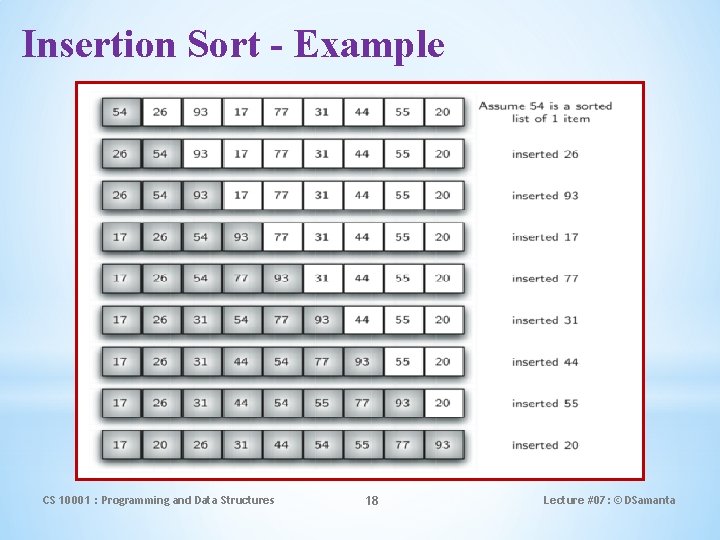
Insertion Sort - Example CS 10001 : Programming and Data Structures 18 Lecture #07: © DSamanta
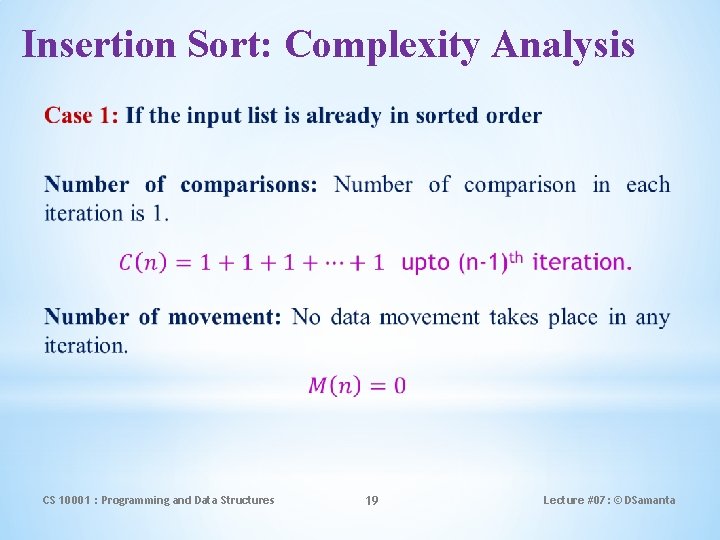
Insertion Sort: Complexity Analysis CS 10001 : Programming and Data Structures 19 Lecture #07: © DSamanta
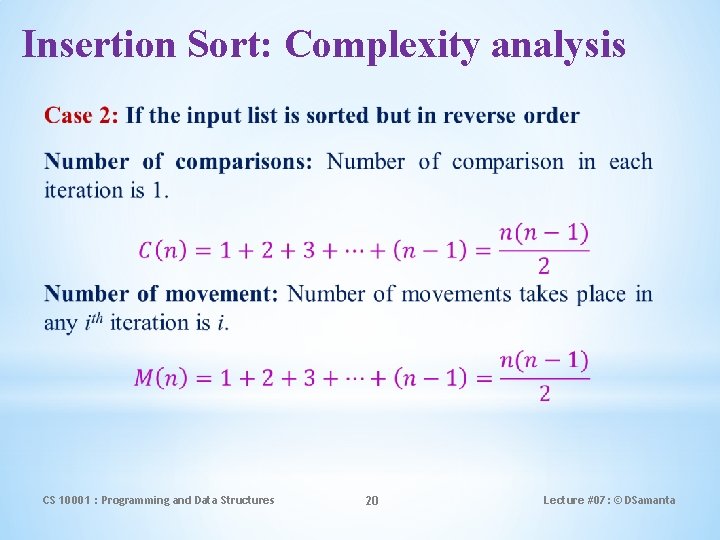
Insertion Sort: Complexity analysis CS 10001 : Programming and Data Structures 20 Lecture #07: © DSamanta
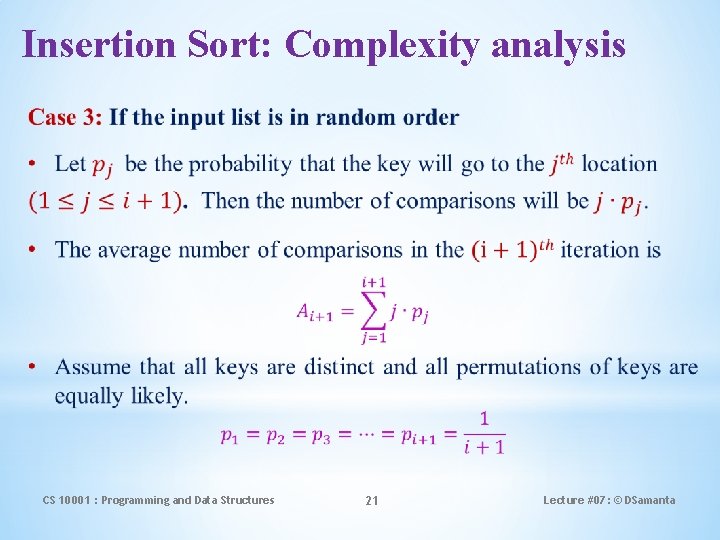
Insertion Sort: Complexity analysis CS 10001 : Programming and Data Structures 21 Lecture #07: © DSamanta
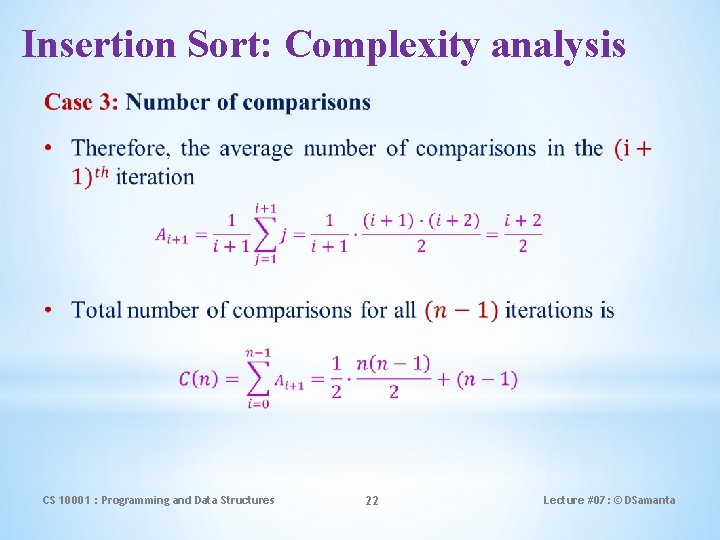
Insertion Sort: Complexity analysis CS 10001 : Programming and Data Structures 22 Lecture #07: © DSamanta
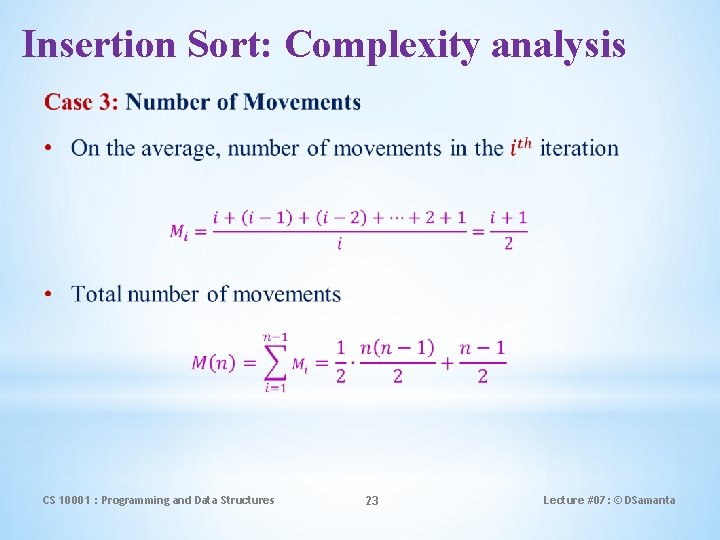
Insertion Sort: Complexity analysis CS 10001 : Programming and Data Structures 23 Lecture #07: © DSamanta
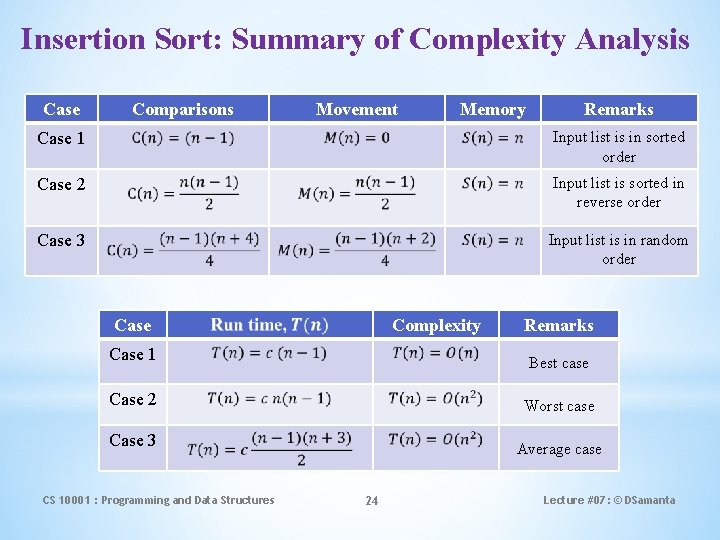
Insertion Sort: Summary of Complexity Analysis Case Comparisons Movement Memory Remarks Case 1 Input list is in sorted order Case 2 Input list is sorted in reverse order Case 3 Input list is in random order Case Complexity Remarks Case 1 Best case Case 2 Worst case Case 3 Average case CS 10001 : Programming and Data Structures 24 Lecture #07: © DSamanta
Selection Sort CS 10001 : Programming and Data Structures 25 Lecture #07: © DSamanta
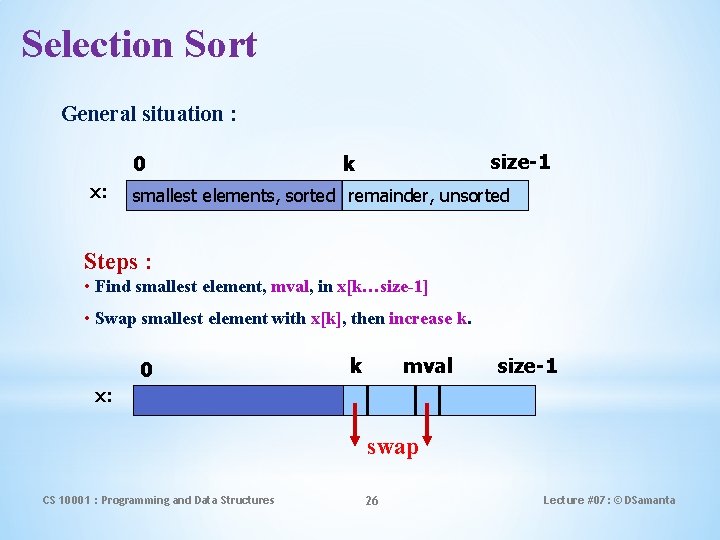
Selection Sort General situation : 0 x: size-1 k smallest elements, sorted remainder, unsorted Steps : • Find smallest element, mval, in x[k…size-1] • Swap smallest element with x[k], then increase k. 0 k mval size-1 x: swap CS 10001 : Programming and Data Structures 26 Lecture #07: © DSamanta
![Selection Sort /* Yield location of smallest element in x[k. . size-1]; */ int](http://slidetodoc.com/presentation_image_h/a08500c0ba3127e5d22784b515e86761/image-27.jpg "Selection Sort /* Yield location of smallest element in x[k. . size-1]; */ int")
Selection Sort /* Yield location of smallest element in x[k. . size-1]; */ int find. Min. Lloc (int x[ ], int k, int size) { int j, pos; /* x[pos] is the smallest element found so far */ pos = k; for (j=k+1; j<size; j++) if (x[j] < x[pos]) pos = j; return pos; } CS 10001 : Programming and Data Structures 27 Lecture #07: © DSamanta
![Selection Sort /* The main sorting function */ /* Sort x[0. . size-1] in](http://slidetodoc.com/presentation_image_h/a08500c0ba3127e5d22784b515e86761/image-28.jpg "Selection Sort /* The main sorting function */ /* Sort x[0. . size-1] in")
Selection Sort /* The main sorting function */ /* Sort x[0. . size-1] in non-decreasing order */ int selection. Sort (int x[], int size) { int k, m; for (k=0; k<size-1; k++) { m = find. Min. Loc(x, k, size); temp = a[k]; a[k] = a[m]; a[m] = temp; } } CS 10001 : Programming and Data Structures 28 Lecture #07: © DSamanta
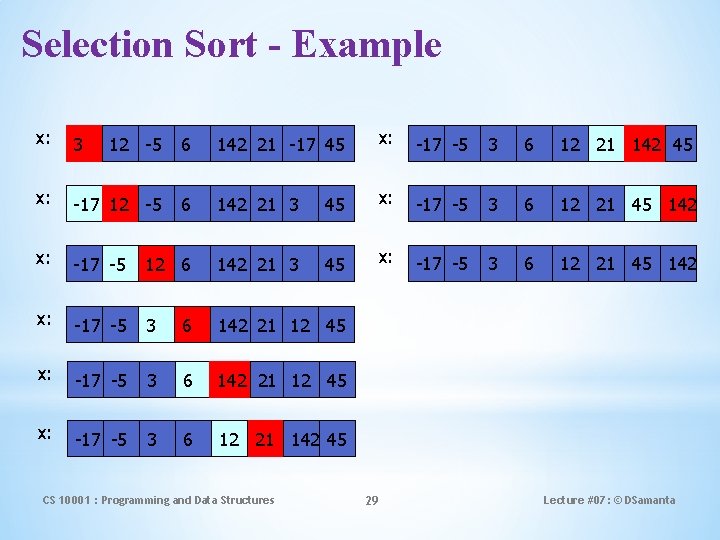
Selection Sort - Example x: 3 12 -5 6 142 21 -17 45 x: -17 -5 3 6 12 21 142 45 x: -17 12 -5 6 142 21 3 45 x: -17 -5 3 6 12 21 45 142 x: -17 -5 12 6 142 21 3 45 x: -17 -5 3 6 12 21 45 142 x: -17 -5 3 6 142 21 12 45 x: -17 -5 3 6 12 21 142 45 CS 10001 : Programming and Data Structures 29 Lecture #07: © DSamanta
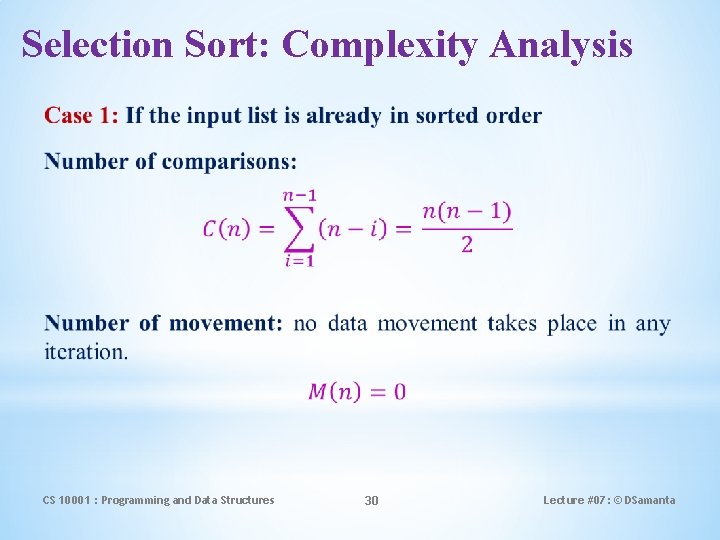
Selection Sort: Complexity Analysis CS 10001 : Programming and Data Structures 30 Lecture #07: © DSamanta
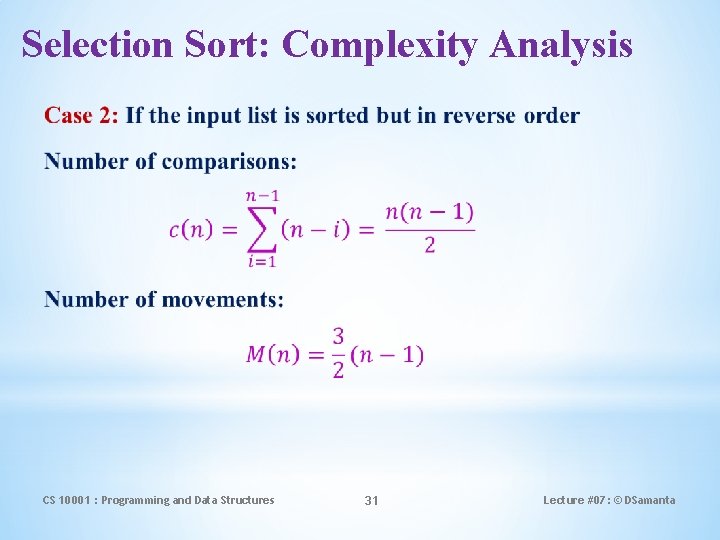
Selection Sort: Complexity Analysis CS 10001 : Programming and Data Structures 31 Lecture #07: © DSamanta
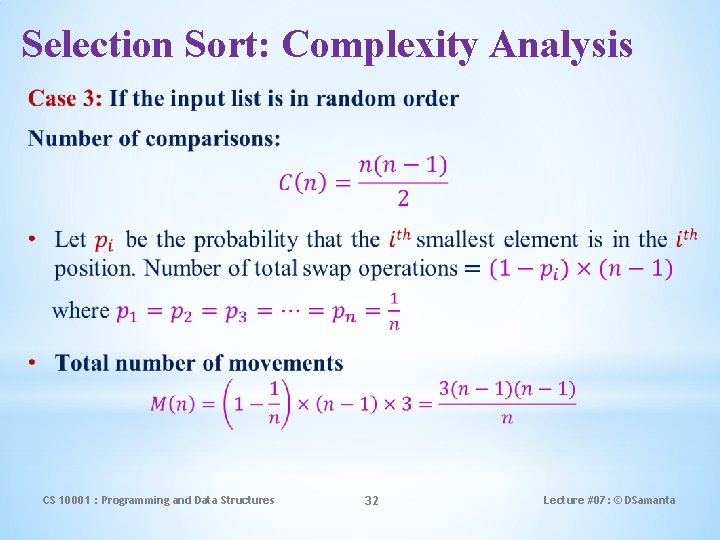
Selection Sort: Complexity Analysis CS 10001 : Programming and Data Structures 32 Lecture #07: © DSamanta
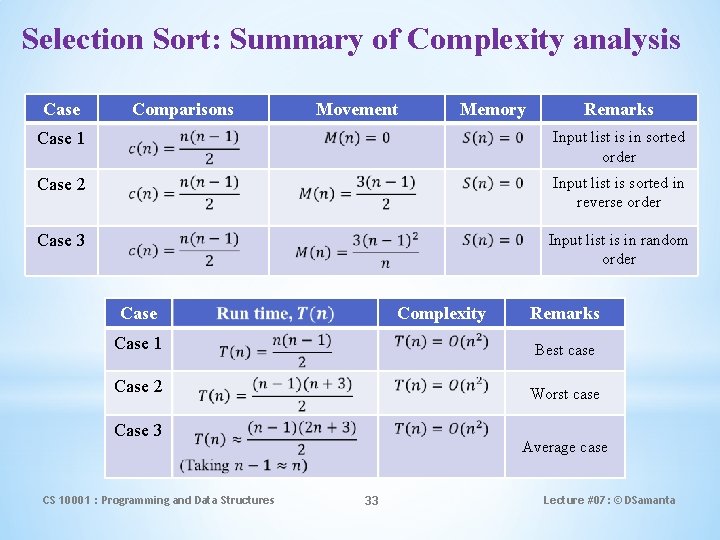
Selection Sort: Summary of Complexity analysis Case Comparisons Movement Memory Remarks Case 1 Input list is in sorted order Case 2 Input list is sorted in reverse order Case 3 Input list is in random order Case Complexity Remarks Case 1 Best case Case 2 Worst case Case 3 CS 10001 : Programming and Data Structures Average case 33 Lecture #07: © DSamanta
Bubble Sort CS 10001 : Programming and Data Structures 34 Lecture #07: © DSamanta
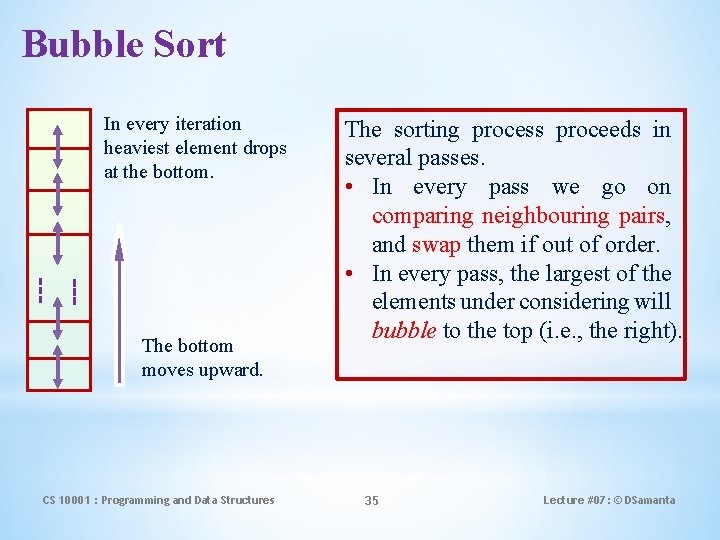
Bubble Sort In every iteration heaviest element drops at the bottom. The bottom moves upward. CS 10001 : Programming and Data Structures The sorting process proceeds in several passes. • In every pass we go on comparing neighbouring pairs, and swap them if out of order. • In every pass, the largest of the elements under considering will bubble to the top (i. e. , the right). 35 Lecture #07: © DSamanta
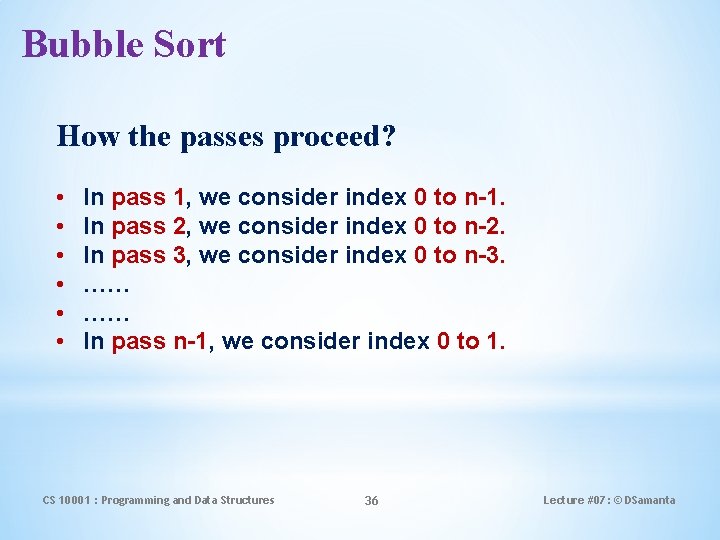
Bubble Sort How the passes proceed? • • • In pass 1, we consider index 0 to n-1. In pass 2, we consider index 0 to n-2. In pass 3, we consider index 0 to n-3. …… …… In pass n-1, we consider index 0 to 1. CS 10001 : Programming and Data Structures 36 Lecture #07: © DSamanta
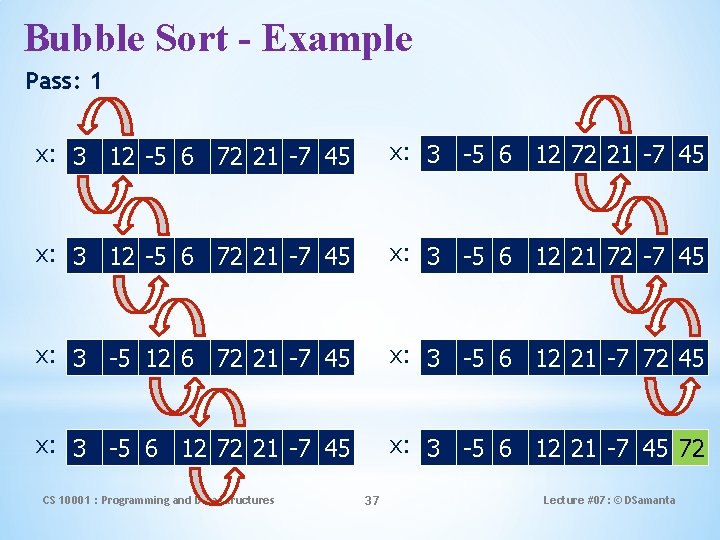
Bubble Sort - Example Pass: 1 x: 3 12 -5 6 72 21 -7 45 x: 3 -5 6 12 72 21 -7 45 x: 3 12 -5 6 72 21 -7 45 x: 3 -5 6 12 21 72 -7 45 x: 3 -5 12 6 72 21 -7 45 x: 3 -5 6 12 21 -7 72 45 x: 3 -5 6 12 72 21 -7 45 x: 3 -5 6 12 21 -7 45 72 CS 10001 : Programming and Data Structures 37 Lecture #07: © DSamanta
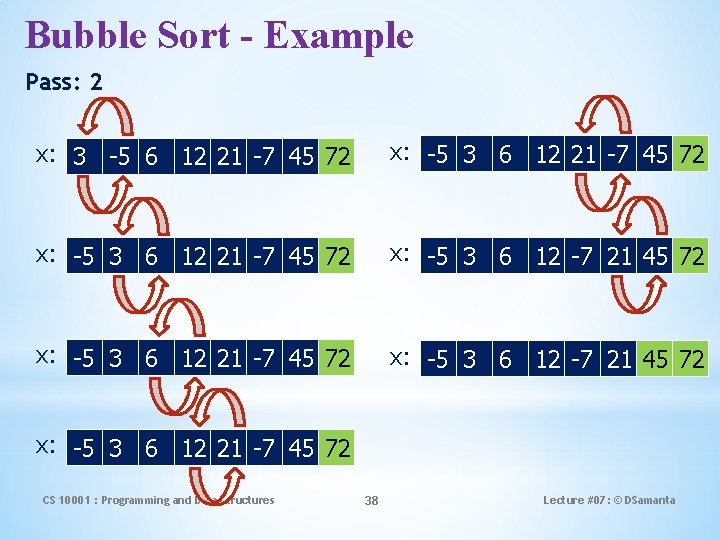
Bubble Sort - Example Pass: 2 x: 3 -5 6 12 21 -7 45 72 x: -5 3 6 12 -7 21 45 72 x: -5 3 6 12 21 -7 45 72 CS 10001 : Programming and Data Structures 38 Lecture #07: © DSamanta
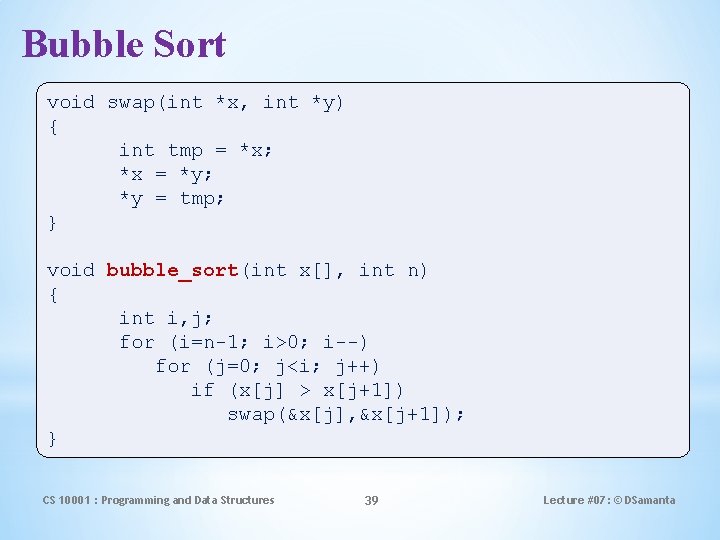
Bubble Sort void swap(int *x, int *y) { int tmp = *x; *x = *y; *y = tmp; } void bubble_sort(int x[], int n) { int i, j; for (i=n-1; i>0; i--) for (j=0; j<i; j++) if (x[j] > x[j+1]) swap(&x[j], &x[j+1]); } CS 10001 : Programming and Data Structures 39 Lecture #07: © DSamanta
![Bubble Sort int main() { int x[ ]={-45, 89, -65, 87, 0, 3, -23,](http://slidetodoc.com/presentation_image_h/a08500c0ba3127e5d22784b515e86761/image-40.jpg "Bubble Sort int main() { int x[ ]={-45, 89, -65, 87, 0, 3, -23,")
Bubble Sort int main() { int x[ ]={-45, 89, -65, 87, 0, 3, -23, 19, 56, 21, 76, -50}; int i; for(i=0; i<12; i++) printf("%d ", x[i]); OUTPUT printf("n"); -45 89 -65 87 0 3 -23 19 56 21 76 -50 bubble_sort(x, 12); -65 -50 -45 -23 0 3 19 21 56 76 87 89 for(i=0; i<12; i++) printf("%d ", x[i]); printf("n"); } CS 10001 : Programming and Data Structures 40 Lecture #07: © DSamanta
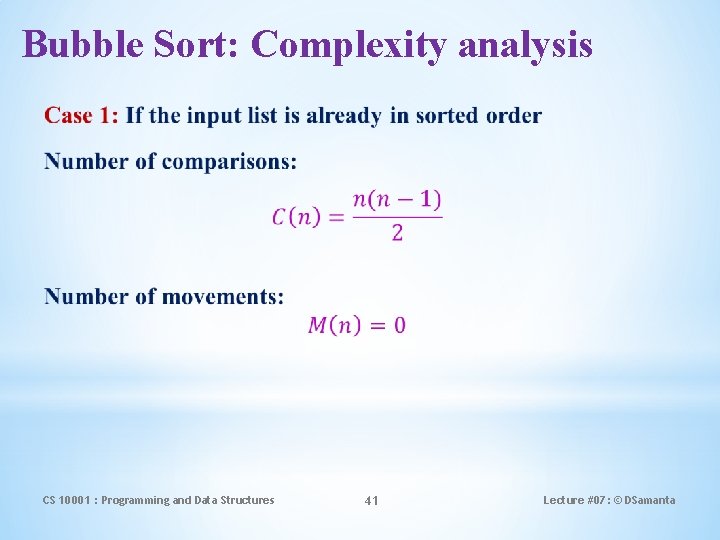
Bubble Sort: Complexity analysis CS 10001 : Programming and Data Structures 41 Lecture #07: © DSamanta
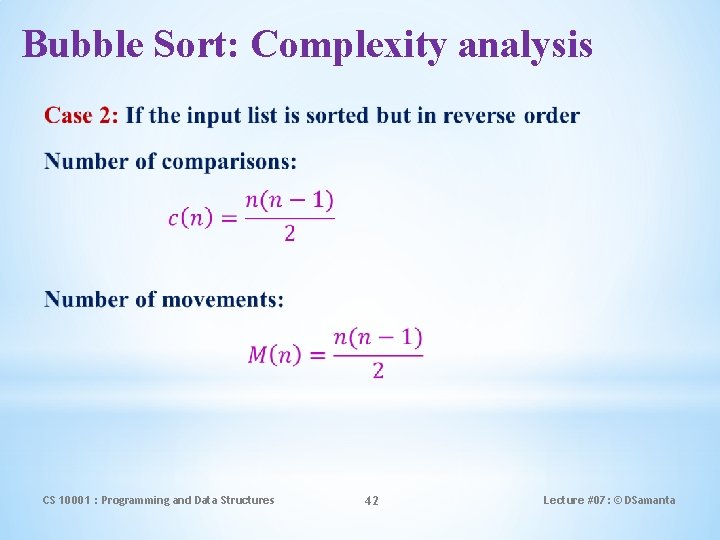
Bubble Sort: Complexity analysis CS 10001 : Programming and Data Structures 42 Lecture #07: © DSamanta
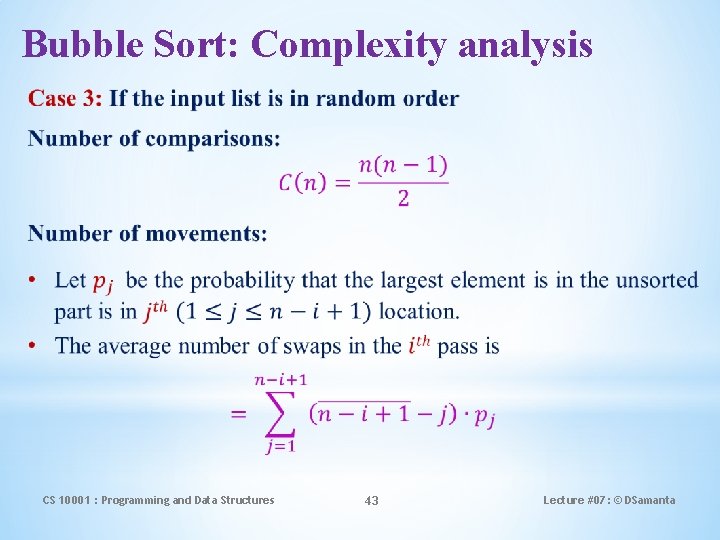
Bubble Sort: Complexity analysis CS 10001 : Programming and Data Structures 43 Lecture #07: © DSamanta
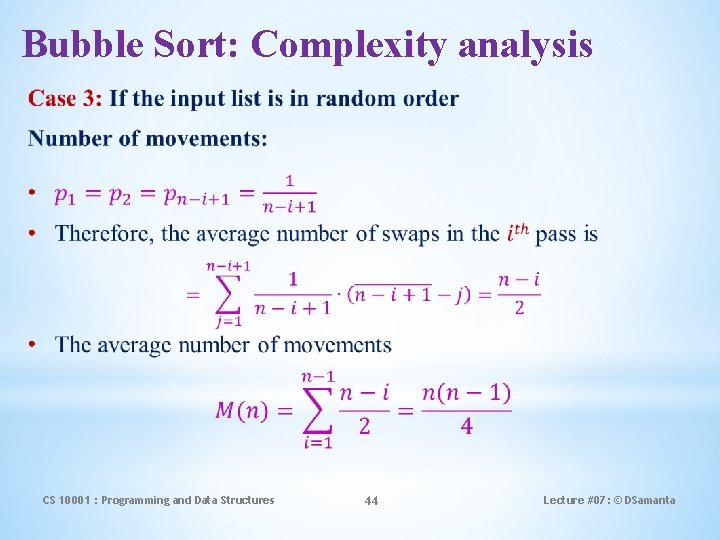
Bubble Sort: Complexity analysis CS 10001 : Programming and Data Structures 44 Lecture #07: © DSamanta
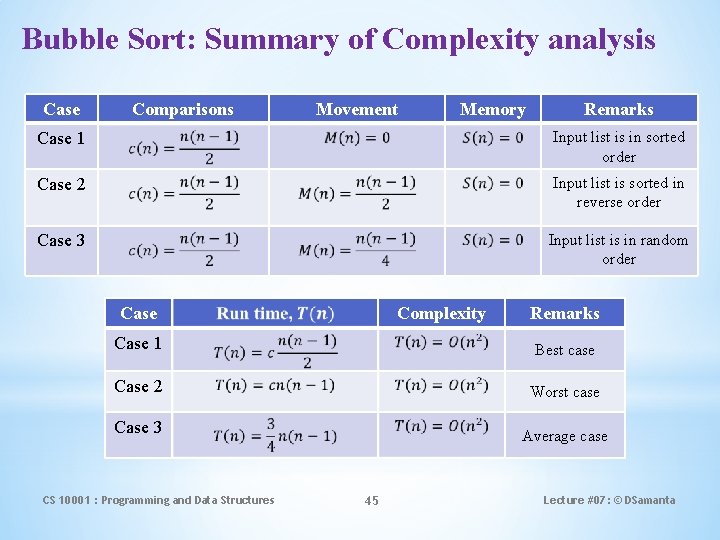
Bubble Sort: Summary of Complexity analysis Case Comparisons Movement Memory Remarks Case 1 Input list is in sorted order Case 2 Input list is sorted in reverse order Case 3 Input list is in random order Case Complexity Remarks Case 1 Best case Case 2 Worst case Case 3 Average case CS 10001 : Programming and Data Structures 45 Lecture #07: © DSamanta
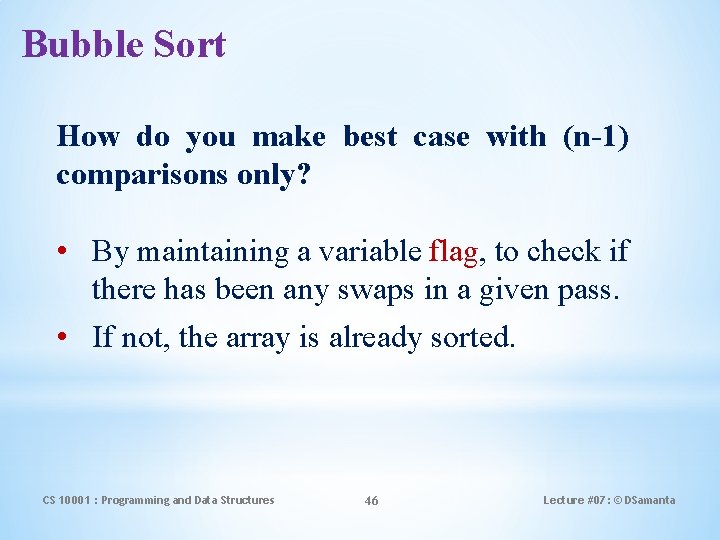
Bubble Sort How do you make best case with (n-1) comparisons only? • By maintaining a variable flag, to check if there has been any swaps in a given pass. • If not, the array is already sorted. CS 10001 : Programming and Data Structures 46 Lecture #07: © DSamanta
![Bubble Sort void bubble_sort(int x[], int n) { int i, j; int flag =](http://slidetodoc.com/presentation_image_h/a08500c0ba3127e5d22784b515e86761/image-47.jpg "Bubble Sort void bubble_sort(int x[], int n) { int i, j; int flag =")
Bubble Sort void bubble_sort(int x[], int n) { int i, j; int flag = 0; for (i=n-1; i>0; i--) { for (j=0; j<i; j++) if (x[j] > x[j+1]) { swap(&x[j], &x[j+1]); flag = 1; } if (flag == 0) return; } } CS 10001 : Programming and Data Structures 47 Lecture #07: © DSamanta
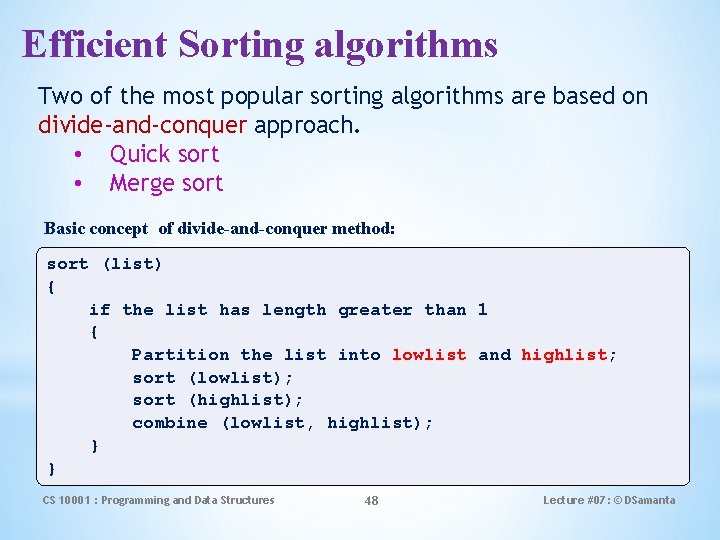
Efficient Sorting algorithms Two of the most popular sorting algorithms are based on divide-and-conquer approach. • Quick sort • Merge sort Basic concept of divide-and-conquer method: sort (list) { if the list has length greater than 1 { Partition the list into lowlist and highlist; sort (lowlist); sort (highlist); combine (lowlist, highlist); } } CS 10001 : Programming and Data Structures 48 Lecture #07: © DSamanta
Quick Sort CS 10001 : Programming and Data Structures 49 Lecture #07: © DSamanta
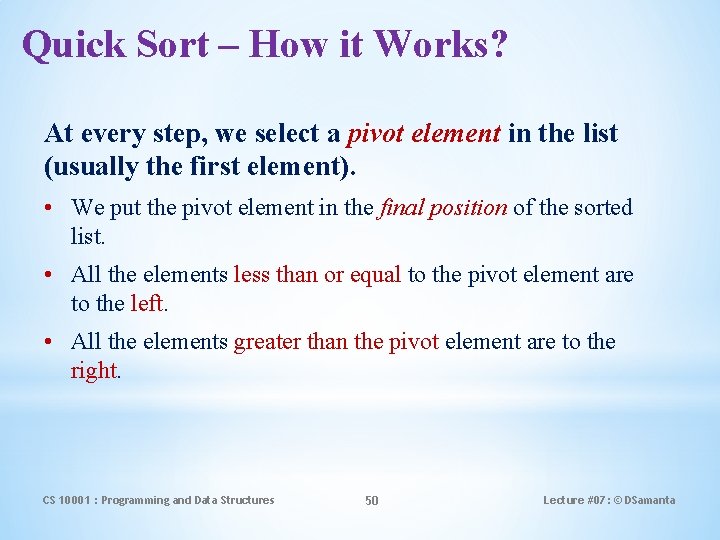
Quick Sort – How it Works? At every step, we select a pivot element in the list (usually the first element). • We put the pivot element in the final position of the sorted list. • All the elements less than or equal to the pivot element are to the left. • All the elements greater than the pivot element are to the right. CS 10001 : Programming and Data Structures 50 Lecture #07: © DSamanta
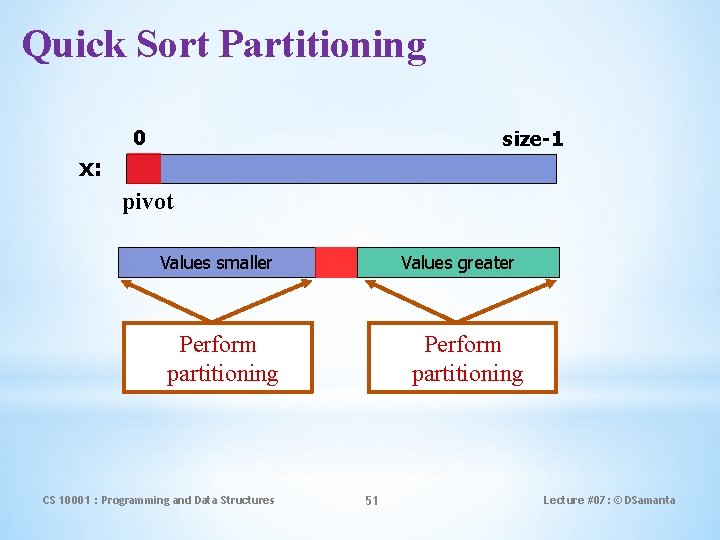
Quick Sort Partitioning 0 size-1 x: pivot Values smaller Values greater Perform partitioning CS 10001 : Programming and Data Structures Perform partitioning 51 Lecture #07: © DSamanta
![Quick Sort #include <stdio. h> void quick. Sort( int[], int); int partition( int[], int);](http://slidetodoc.com/presentation_image_h/a08500c0ba3127e5d22784b515e86761/image-52.jpg "Quick Sort #include <stdio. h> void quick. Sort( int[], int); int partition( int[], int);")
Quick Sort #include <stdio. h> void quick. Sort( int[], int); int partition( int[], int); void main() { int i, a[] = { 7, 12, 1, -2, 0, 15, 4, 11, 9}; printf("nn. Unsorted array is: "); for(i = 0; i < 9; ++i) printf(" %d ", a[i]); quick. Sort( a, 0, 8); printf("nn. Sorted array is: "); for(i = 0; i < 9; ++i) printf(" %d ", a[i]); } void quick. Sort( int a[], int l, int r) { int j; if( l < r ) { // divide and conquer j = partition( a, l, r); quick. Sort( a, l, j-1); quick. Sort( a, j+1, r); } } CS 10001 : Programming and Data Structures 52 Lecture #07: © DSamanta
![Quick Sort int partition( int a[], int l, int r) { int pivot, i,](http://slidetodoc.com/presentation_image_h/a08500c0ba3127e5d22784b515e86761/image-53.jpg "Quick Sort int partition( int a[], int l, int r) { int pivot, i,")
Quick Sort int partition( int a[], int l, int r) { int pivot, i, j, t; pivot = a[l]; i = l; j = r+1; while( 1) { do { ++i; } while(a[i]<=pivot && i<=r); do { --j; } while( a[j] > pivot ); if( i >= j ) break; t = a[i]; a[i] = a[j]; a[j] = t; } t = a[l]; a[l] = a[j]; a[j] = t; return j; } CS 10001 : Programming and Data Structures 53 Lecture #07: © DSamanta
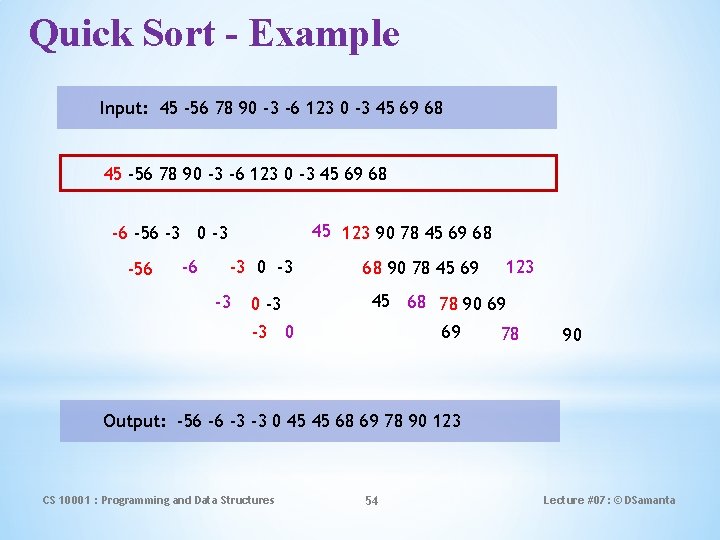
Quick Sort - Example Input: 45 -56 78 90 -3 -6 123 0 -3 45 69 68 45 123 90 78 45 69 68 -6 -56 -3 0 -3 -56 -6 -3 0 -3 68 90 78 45 69 123 45 68 78 90 69 -3 0 69 78 90 Output: -56 -6 -3 -3 0 45 45 68 69 78 90 123 CS 10001 : Programming and Data Structures 54 Lecture #07: © DSamanta
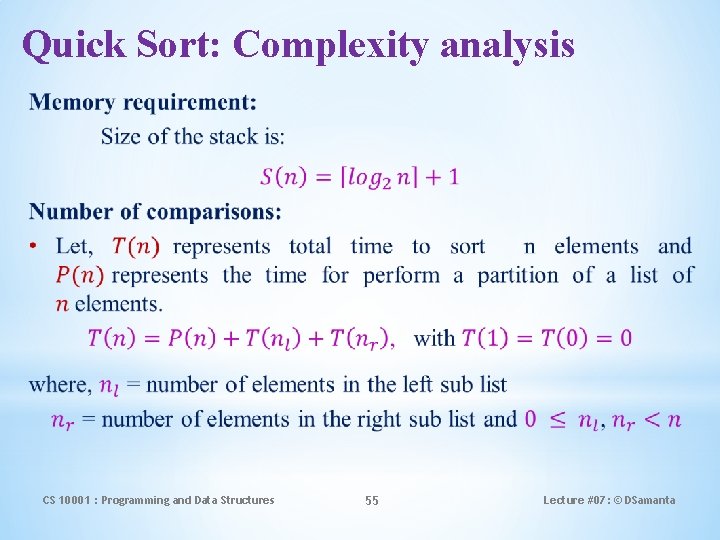
Quick Sort: Complexity analysis CS 10001 : Programming and Data Structures 55 Lecture #07: © DSamanta
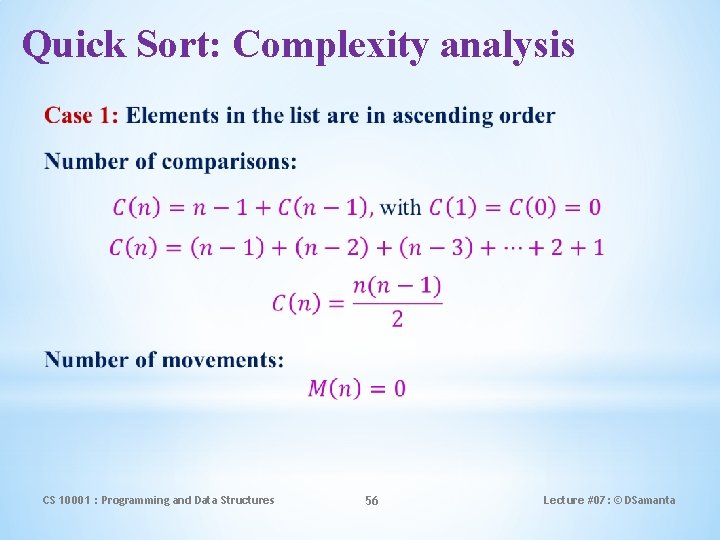
Quick Sort: Complexity analysis CS 10001 : Programming and Data Structures 56 Lecture #07: © DSamanta
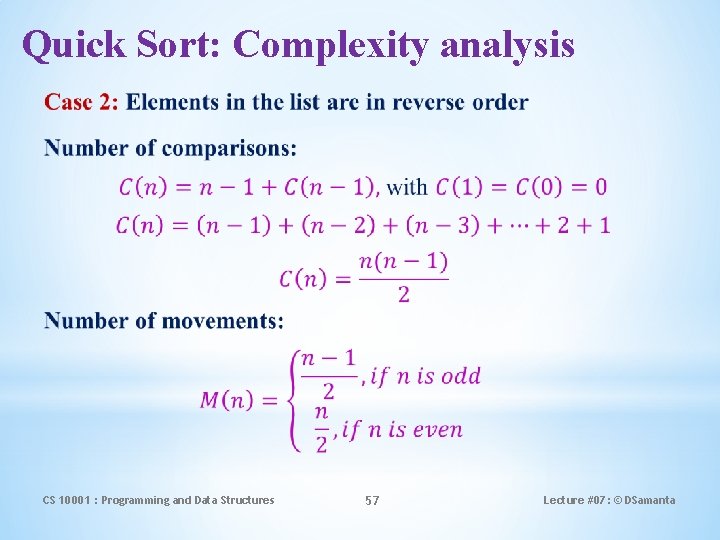
Quick Sort: Complexity analysis CS 10001 : Programming and Data Structures 57 Lecture #07: © DSamanta
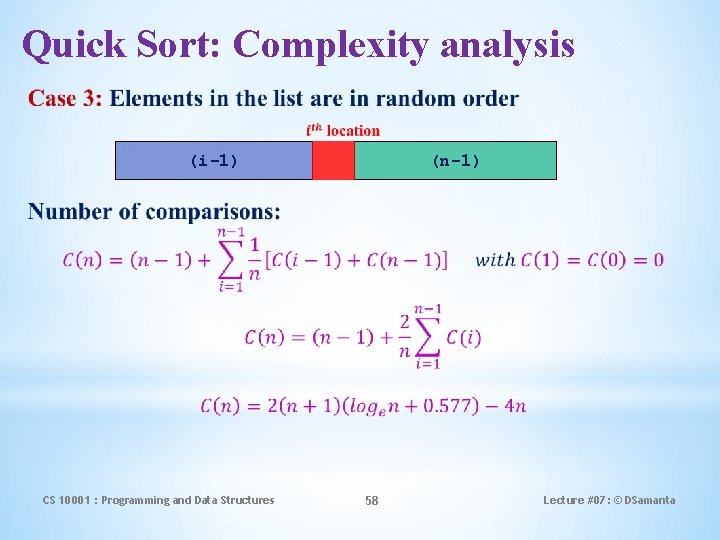
Quick Sort: Complexity analysis (i-1) CS 10001 : Programming and Data Structures (n-1) 58 Lecture #07: © DSamanta
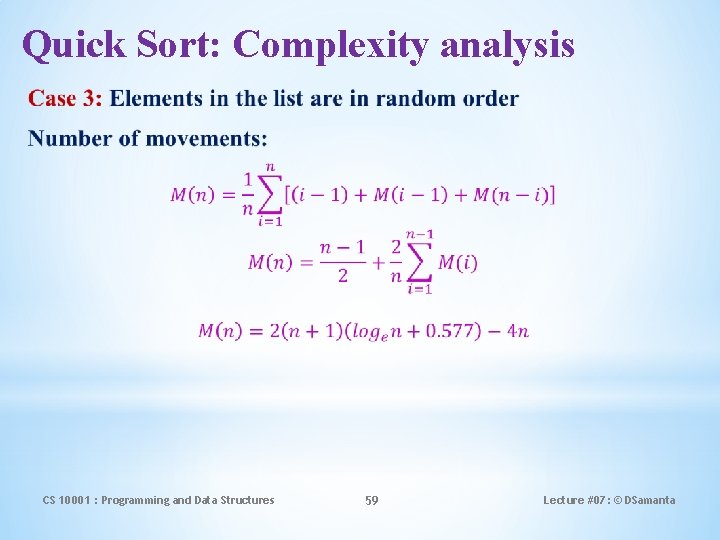
Quick Sort: Complexity analysis CS 10001 : Programming and Data Structures 59 Lecture #07: © DSamanta
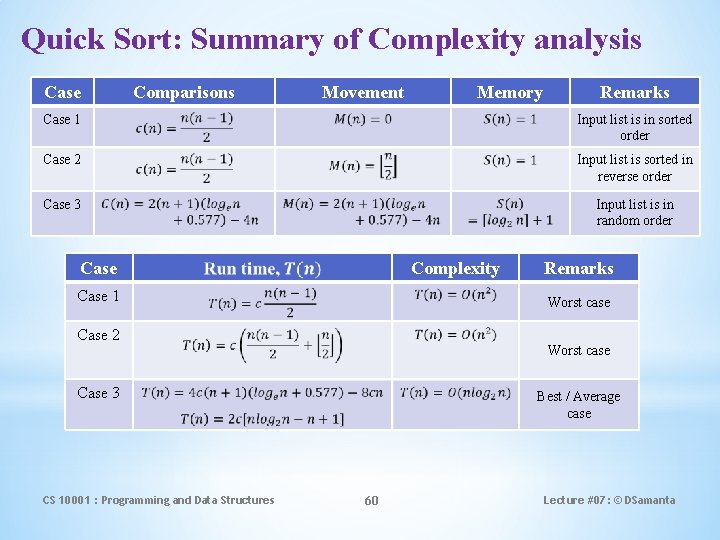
Quick Sort: Summary of Complexity analysis Case Comparisons Movement Memory Remarks Case 1 Input list is in sorted order Case 2 Input list is sorted in reverse order Case 3 Input list is in random order Case Complexity Case 1 Worst case Case 2 Worst case Case 3 CS 10001 : Programming and Data Structures Remarks Best / Average case 60 Lecture #07: © DSamanta
Merge Sort CS 10001 : Programming and Data Structures 61 Lecture #07: © DSamanta
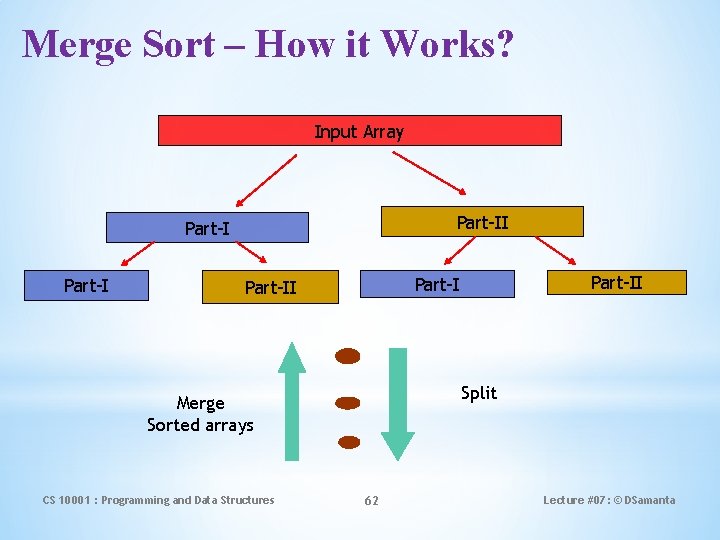
Merge Sort – How it Works? Input Array Part-II Part-I Split Merge Sorted arrays CS 10001 : Programming and Data Structures Part-II 62 Lecture #07: © DSamanta
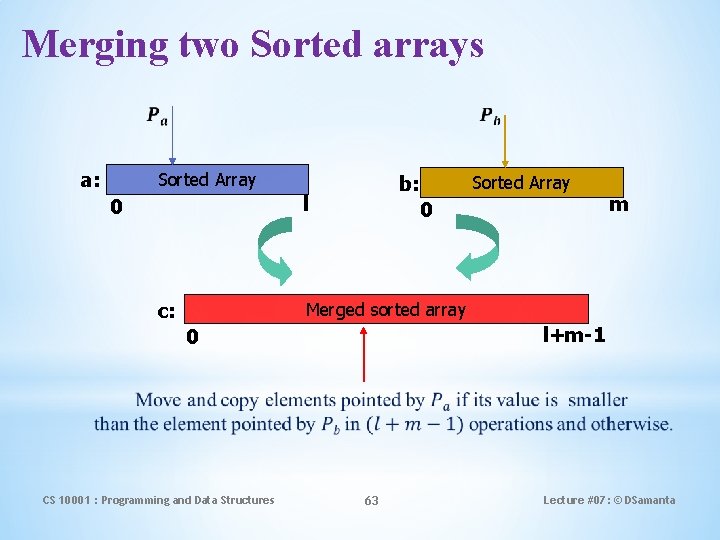
Merging two Sorted arrays a: Sorted Array b: l 0 c: Sorted Array 0 m Merged sorted array l+m-1 0 CS 10001 : Programming and Data Structures 63 Lecture #07: © DSamanta
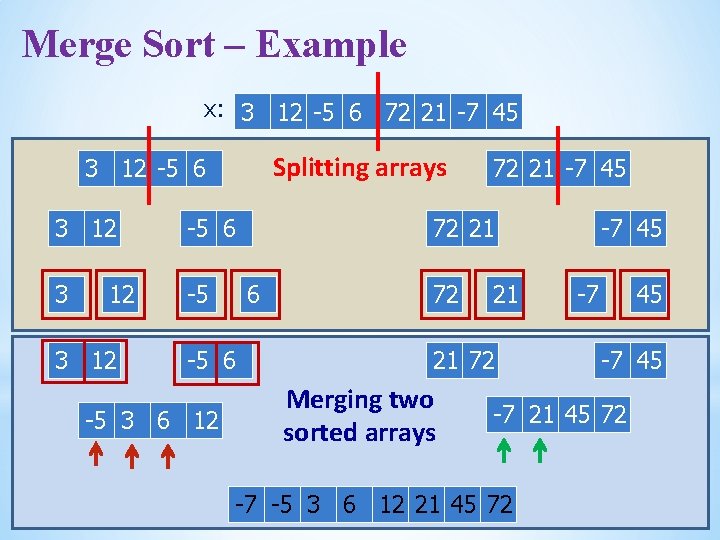
Merge Sort – Example x: 3 12 -5 6 72 21 -7 45 Splitting arrays 3 12 -5 6 3 -5 12 3 12 72 21 -7 45 72 21 6 -5 6 72 21 72 Merging two sorted arrays -5 3 6 12 21 -7 45 -7 21 45 72 -7 -7 -5 3 6 6412 21 45 72 CS 10001 : Programming and Data Structures -7 45 Lecture #07: © DSamanta
![Merge Sort Program #include<stdio. h> void mergesort(int a[], int i, int j); void merge(int](http://slidetodoc.com/presentation_image_h/a08500c0ba3127e5d22784b515e86761/image-65.jpg "Merge Sort Program #include<stdio. h> void mergesort(int a[], int i, int j); void merge(int")
Merge Sort Program #include<stdio. h> void mergesort(int a[], int i, int j); void merge(int a[], int i 1, int j 1, int i 2, int j 2); int main() { int a[30], n, i; printf("Enter no of elements: "); scanf("%d", &n); printf("Enter array elements: "); for(i=0; i<n; i++) scanf("%d", &a[i]); mergesort(a, 0, n-1); printf("n. Sorted array is : "); for(i=0; i<n; i++) printf("%d ", a[i]); return 0; } CS 10001 : Programming and Data Structures 65 Lecture #07: © DSamanta
![Merge Sort Program void mergesort(int a[], int i, int j) { int mid; if(i<j)](http://slidetodoc.com/presentation_image_h/a08500c0ba3127e5d22784b515e86761/image-66.jpg "Merge Sort Program void mergesort(int a[], int i, int j) { int mid; if(i<j)")
Merge Sort Program void mergesort(int a[], int i, int j) { int mid; if(i<j) { mid=(i+j)/2; /* left recursion */ mergesort(a, i, mid); /* right recursion */ mergesort(a, mid+1, j); /* merging of two sorted sub-arrays */ merge(a, i, mid+1, j); } } CS 10001 : Programming and Data Structures 66 Lecture #07: © DSamanta
![Merge Sort Program void merge(int a[], int i 1, int i 2, int j](http://slidetodoc.com/presentation_image_h/a08500c0ba3127e5d22784b515e86761/image-67.jpg "Merge Sort Program void merge(int a[], int i 1, int i 2, int j")
Merge Sort Program void merge(int a[], int i 1, int i 2, int j 1, int j 2) { int temp[50]; //array used for merging int i=i 1, j=j 1, k=0; while(i<=i 2 && j<=j 2) //while elements in both lists { if(a[i]<a[j]) temp[k++]=a[i++]; else temp[k++]=a[j++]; } while(i<=i 2) //copy remaining elements of the first list temp[k++]=a[i++]; while(j<=j 2) //copy remaining elements of the second list temp[k++]=a[j++]; for(i=i 1, j=0; i<=j 2; i++, j++) a[i]=temp[j]; //Transfer elements from temp[] back to a[] } CS 10001 : Programming and Data Structures 67 Lecture #07: © DSamanta
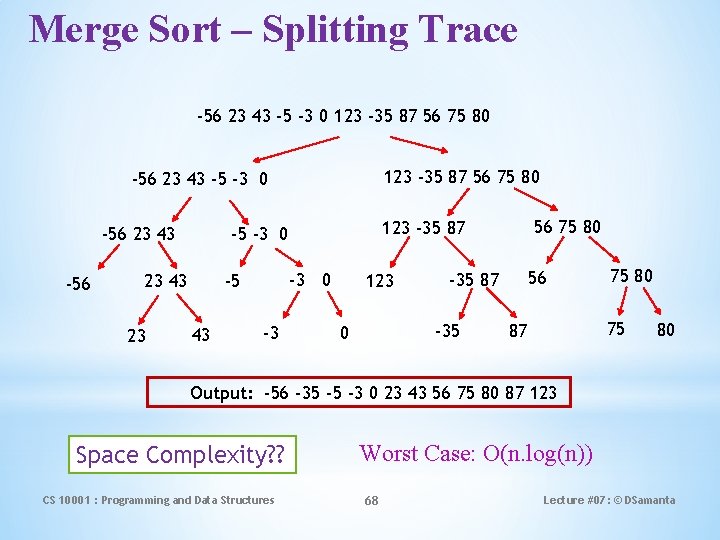
Merge Sort – Splitting Trace -56 23 43 -5 -3 0 123 -35 87 56 75 80 -56 23 43 -5 -3 0 -56 23 43 23 -3 0 -5 43 -3 56 75 80 123 -35 87 -5 -3 0 -56 23 43 123 -35 0 56 -35 87 75 80 75 87 80 Output: -56 -35 -5 -3 0 23 43 56 75 80 87 123 Space Complexity? ? CS 10001 : Programming and Data Structures Worst Case: O(n. log(n)) 68 Lecture #07: © DSamanta
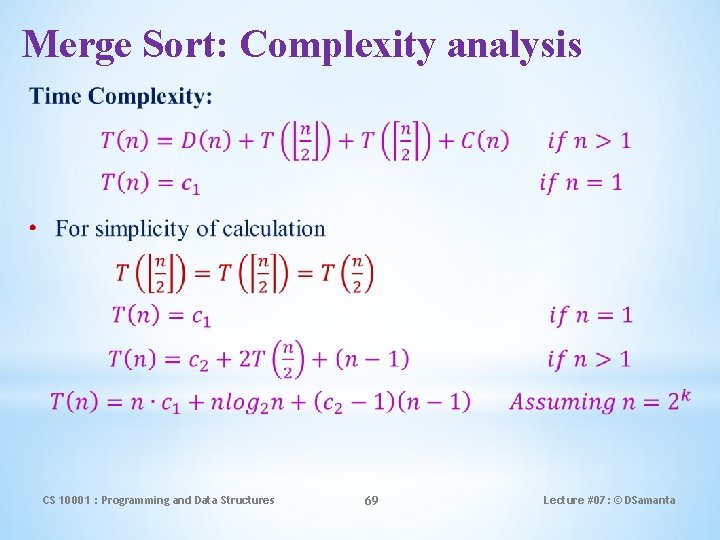
Merge Sort: Complexity analysis CS 10001 : Programming and Data Structures 69 Lecture #07: © DSamanta
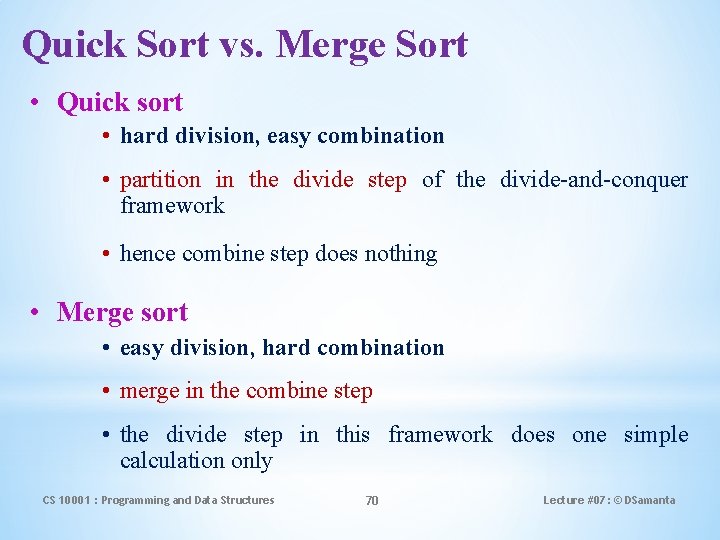
Quick Sort vs. Merge Sort • Quick sort • hard division, easy combination • partition in the divide step of the divide-and-conquer framework • hence combine step does nothing • Merge sort • easy division, hard combination • merge in the combine step • the divide step in this framework does one simple calculation only CS 10001 : Programming and Data Structures 70 Lecture #07: © DSamanta
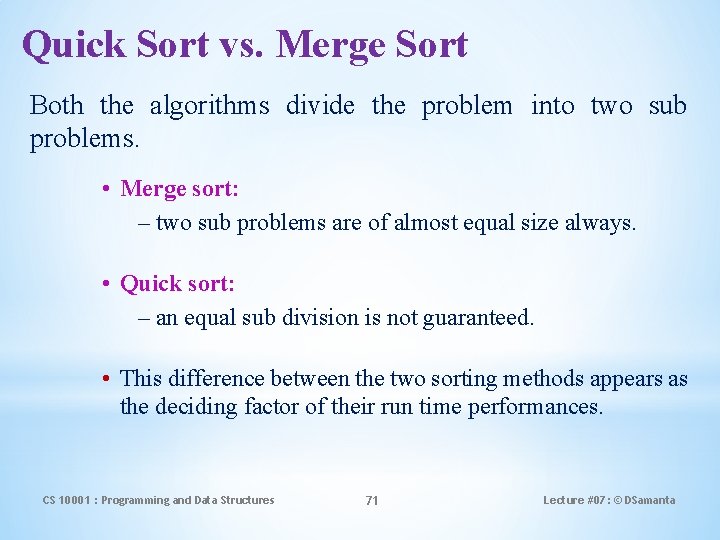
Quick Sort vs. Merge Sort Both the algorithms divide the problem into two sub problems. • Merge sort: – two sub problems are of almost equal size always. • Quick sort: – an equal sub division is not guaranteed. • This difference between the two sorting methods appears as the deciding factor of their run time performances. CS 10001 : Programming and Data Structures 71 Lecture #07: © DSamanta

Any question? You may post your question(s) at the “Discussion Forum” maintained in the course Web page. CS 10001 : Programming and Data Structures 72 Lecture #07: © DSamanta
Problems to Ponder… CS 10001 : Programming and Data Structures 73 Lecture #07: © DSamanta
Problems for Practice… *You can check the Moodle course management system for a set of problems for your own practice. • Login to the Moodle system at http: //cse. iitkgp. ac. in/ • Select “PDS Spring-2017 (Theory) in the link “My Courses” • Go to Topic 7: Practice Sheet #07 : Pointer in C *Solutions to the problems in Practice Sheet #07 will be uploaded in due time. CS 10001 : Programming and Data Structures 74 Lecture #07: © DSamanta
If you try to solve problems yourself, then you will learn many things automatically. Spend few minutes and then enjoy the study. CS 10001 : Programming and Data Structures 75 Lecture #07: © DSamanta
- Slides: 75