
Programming and Data Structures Debasis Samanta Computer Science
Programming and Data Structures Debasis Samanta Computer Science & Engineering Indian Institute of Technology Kharagpur Spring-2017
Lecture #7 Pointers in C CS 10001 : Programming and Data Structures 2 Lecture #07: © DSamanta

Concept of Pointer CS 10001 : Programming and Data Structures 3 Lecture #07: © DSamanta
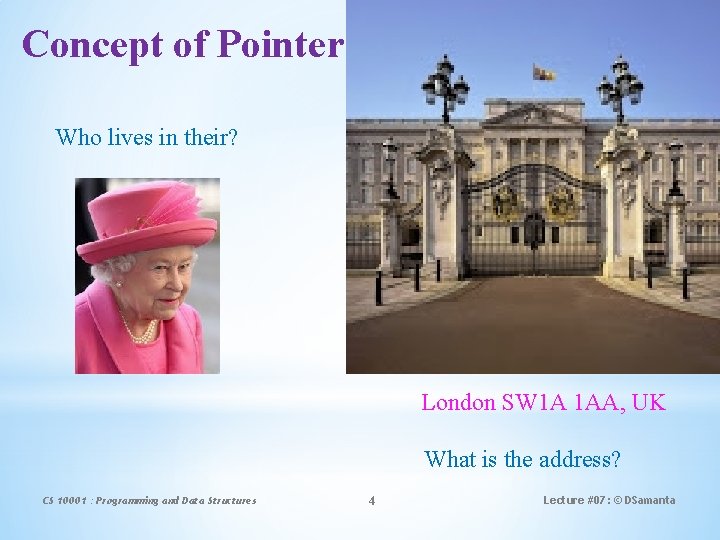
Concept of Pointer Who lives in their? London SW 1 A 1 AA, UK What is the address? CS 10001 : Programming and Data Structures 4 Lecture #07: © DSamanta
Today’s Discussion… *Concept of Pointer *Pointers and its Applications *Pointer Manipulation in C *Pointers and Array * Pointer Arrays *Command Line Arguments *Pointers to Functions CS 10001 : Programming and Data Structures 5 Lecture #07: © DSamanta
Concept of Pointer • In memory, every stored data item occupies one or more contiguous memory cells. • The number of memory cells required to store a data item depends on its type (char, int, float, double, etc. ). • Whenever we declare a variable, the system allocates memory location(s) to hold the value of the variable. • Since every byte in memory has a unique address, this location will also have its own (unique) address. CS 10001 : Programming and Data Structures 6 Lecture #07: © DSamanta
![Concept of Pointer int y = 5; char name[5]=“IIT”; float x; Memory locations &y](http://slidetodoc.com/presentation_image_h2/f39df7b571382eba8cc7e13a96197709/image-7.jpg "Concept of Pointer int y = 5; char name[5]=“IIT”; float x; Memory locations &y")
Concept of Pointer int y = 5; char name[5]=“IIT”; float x; Memory locations &y = 4576 &x = 1014 name[5] = 2345 CS 10001 : Programming and Data Structures 7 Lecture #07: © DSamanta
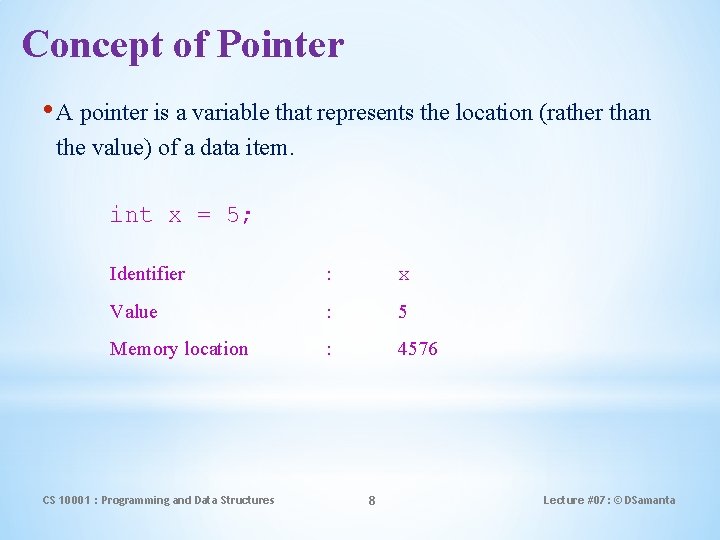
Concept of Pointer • A pointer is a variable that represents the location (rather than the value) of a data item. int x = 5; Identifier : x Value : 5 Memory location : 4576 CS 10001 : Programming and Data Structures 8 Lecture #07: © DSamanta
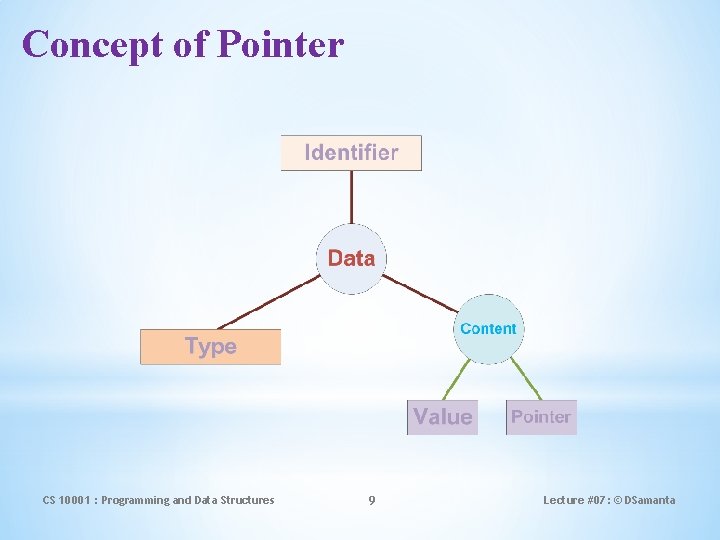
Concept of Pointer CS 10001 : Programming and Data Structures 9 Lecture #07: © DSamanta
Concept of Pointer • In many programs, it is required to know the memory locations of some identifiers. • That is, we need to store memory addresses. • Since memory addresses are simply numbers, they can be assigned to some variables which can be stored in memory. • Such variables that hold memory addresses are called pointers. • Since a pointer is a variable, its value is also stored in some memory location. • Such a variable is called pointer variable. CS 10001 : Programming and Data Structures 10 Lecture #07: © DSamanta
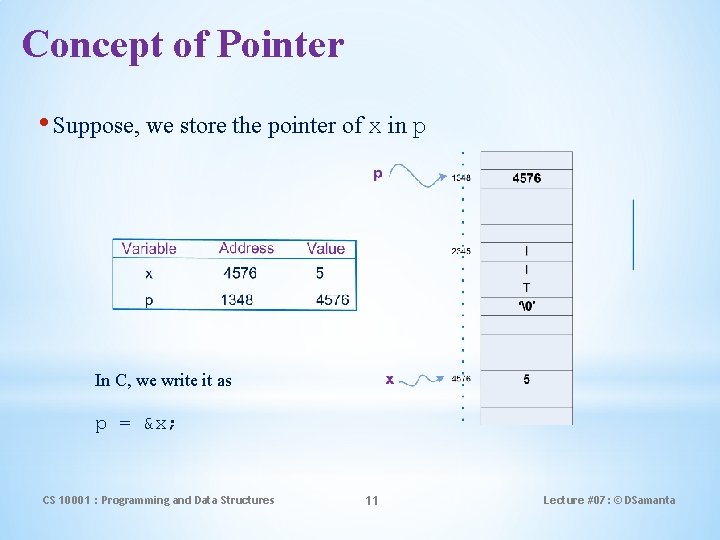
Concept of Pointer • Suppose, we store the pointer of x in p In C, we write it as p = &x; CS 10001 : Programming and Data Structures 11 Lecture #07: © DSamanta
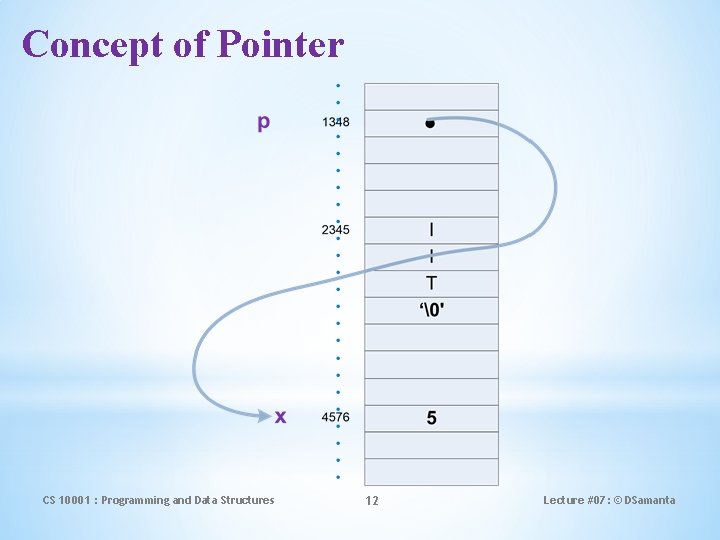
Concept of Pointer CS 10001 : Programming and Data Structures 12 Lecture #07: © DSamanta
Applications of Pointer • They have a number of useful applications. • Enables us to access a variable that is defined outside the function. • Can be used to pass information back and forth between a function and its reference point. • More efficient in handling data tables. • Reduces the length and complexity of a program. • Sometimes also increases the execution speed. CS 10001 : Programming and Data Structures 13 Lecture #07: © DSamanta
Pointer Manipulation in C CS 10001 : Programming and Data Structures 14 Lecture #07: © DSamanta
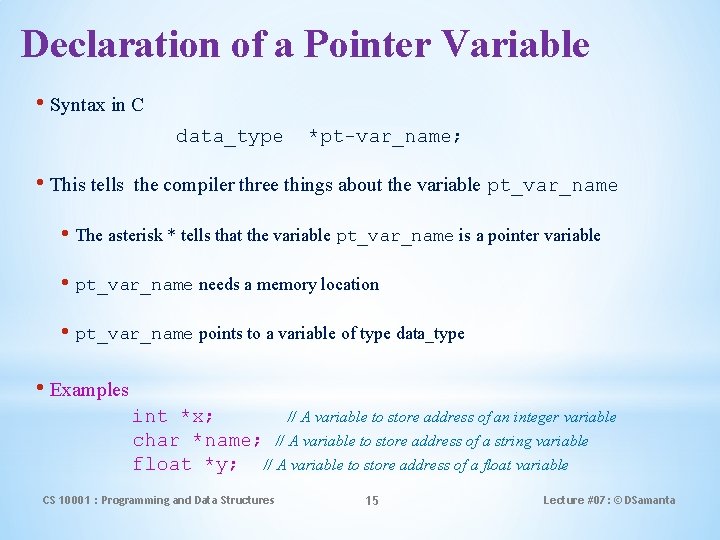
Declaration of a Pointer Variable • Syntax in C data_type • This tells *pt-var_name; the compiler three things about the variable pt_var_name • The asterisk * tells that the variable pt_var_name is a pointer variable • pt_var_name needs a memory location • pt_var_name points to a variable of type data_type • Examples int *x; // A variable to store address of an integer variable char *name; // A variable to store address of a string variable float *y; // A variable to store address of a float variable CS 10001 : Programming and Data Structures 15 Lecture #07: © DSamanta
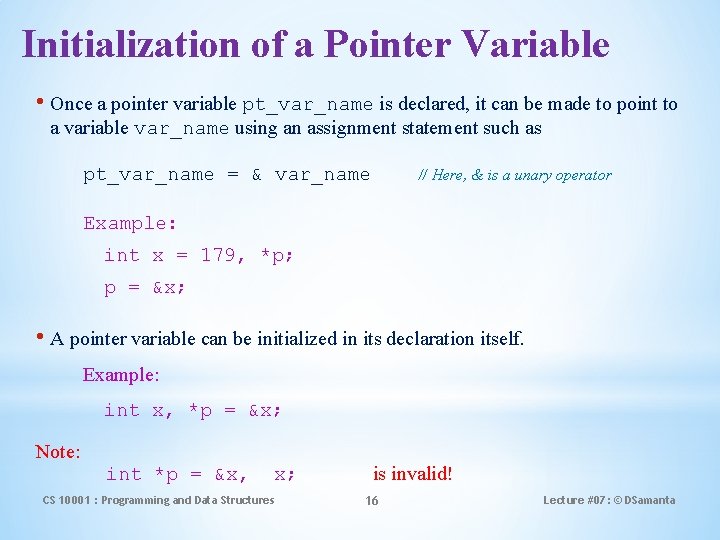
Initialization of a Pointer Variable • Once a pointer variable pt_var_name is declared, it can be made to point to a variable var_name using an assignment statement such as pt_var_name = & var_name // Here, & is a unary operator Example: int x = 179, *p; p = &x; • A pointer variable can be initialized in its declaration itself. Example: int x, *p = &x; Note: int *p = &x, x; CS 10001 : Programming and Data Structures is invalid! 16 Lecture #07: © DSamanta
Pointer Variables CS 10001 : Programming and Data Structures 17 Lecture #07: © DSamanta
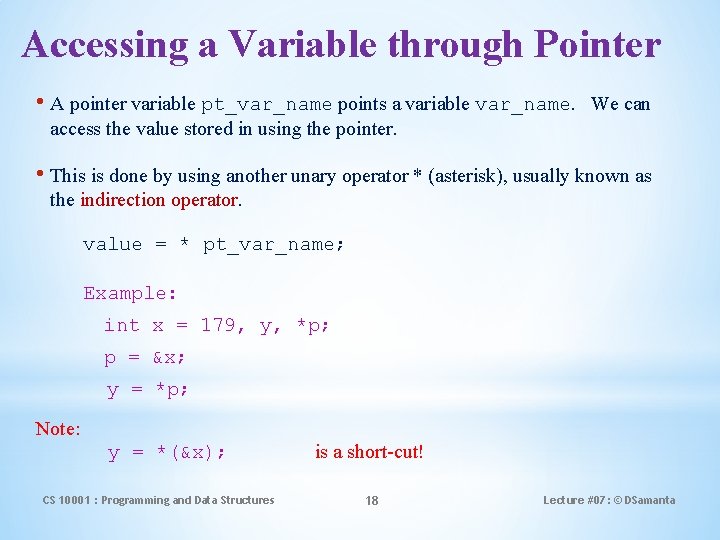
Accessing a Variable through Pointer • A pointer variable pt_var_name points a variable var_name. We can access the value stored in using the pointer. • This is done by using another unary operator * (asterisk), usually known as the indirection operator. value = * pt_var_name; Example: int x = 179, y, *p; p = &x; y = *p; Note: y = *(&x); CS 10001 : Programming and Data Structures is a short-cut! 18 Lecture #07: © DSamanta
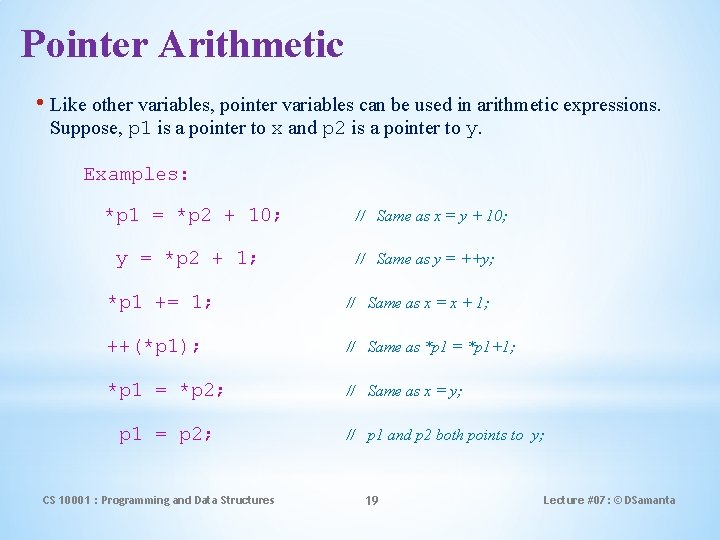
Pointer Arithmetic • Like other variables, pointer variables can be used in arithmetic expressions. Suppose, p 1 is a pointer to x and p 2 is a pointer to y. Examples: *p 1 = *p 2 + 10; y = *p 2 + 1; // Same as x = y + 10; // Same as y = ++y; *p 1 += 1; // Same as x = x + 1; ++(*p 1); // Same as *p 1 = *p 1+1; *p 1 = *p 2; // Same as x = y; p 1 = p 2; CS 10001 : Programming and Data Structures // p 1 and p 2 both points to y; 19 Lecture #07: © DSamanta
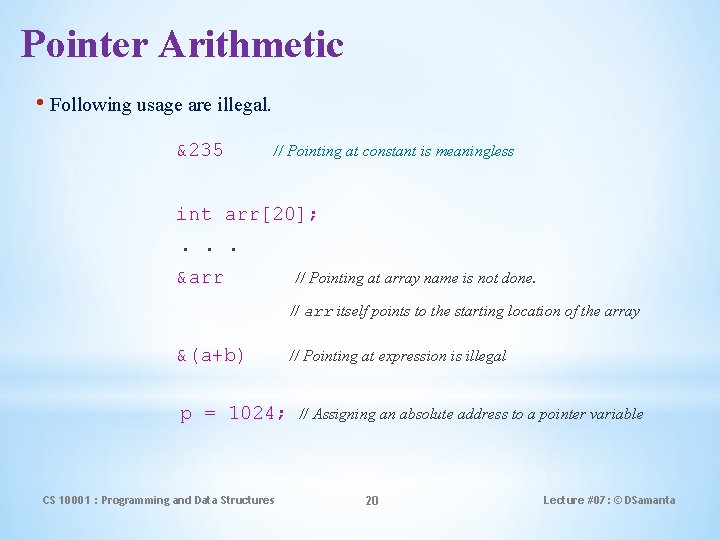
Pointer Arithmetic • Following usage are illegal. &235 // Pointing at constant is meaningless int arr[20]; . . . &arr // Pointing at array name is not done. // arr itself points to the starting location of the array &(a+b) p = 1024; CS 10001 : Programming and Data Structures // Pointing at expression is illegal // Assigning an absolute address to a pointer variable 20 Lecture #07: © DSamanta
Pointers and Arrays CS 10001 : Programming and Data Structures 21 Lecture #07: © DSamanta
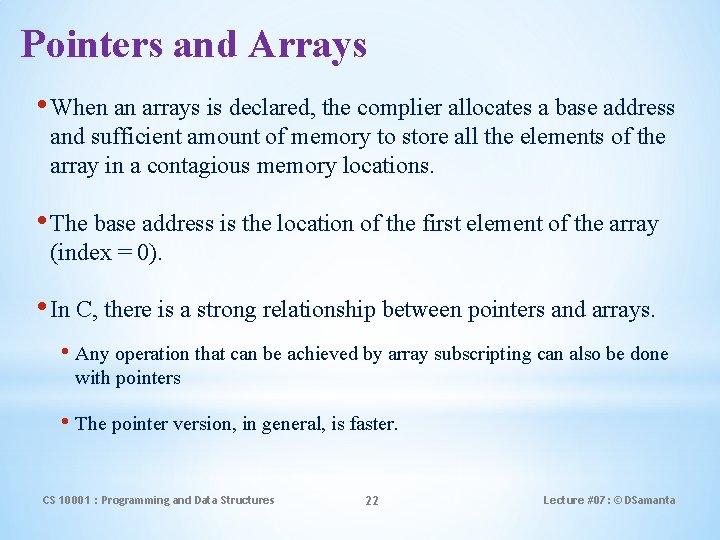
Pointers and Arrays • When an arrays is declared, the complier allocates a base address and sufficient amount of memory to store all the elements of the array in a contagious memory locations. • The base address is the location of the first element of the array (index = 0). • In C, there is a strong relationship between pointers and arrays. • Any operation that can be achieved by array subscripting can also be done with pointers • The pointer version, in general, is faster. CS 10001 : Programming and Data Structures 22 Lecture #07: © DSamanta
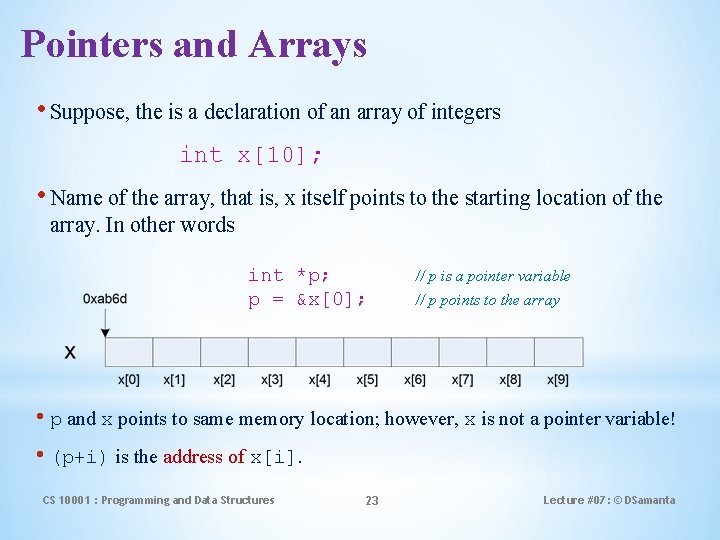
Pointers and Arrays • Suppose, the is a declaration of an array of integers int x[10]; • Name of the array, that is, x itself points to the starting location of the array. In other words int *p; p = &x[0]; // p is a pointer variable // p points to the array • p and x points to same memory location; however, x is not a pointer variable! • (p+i) is the address of x[i]. CS 10001 : Programming and Data Structures 23 Lecture #07: © DSamanta
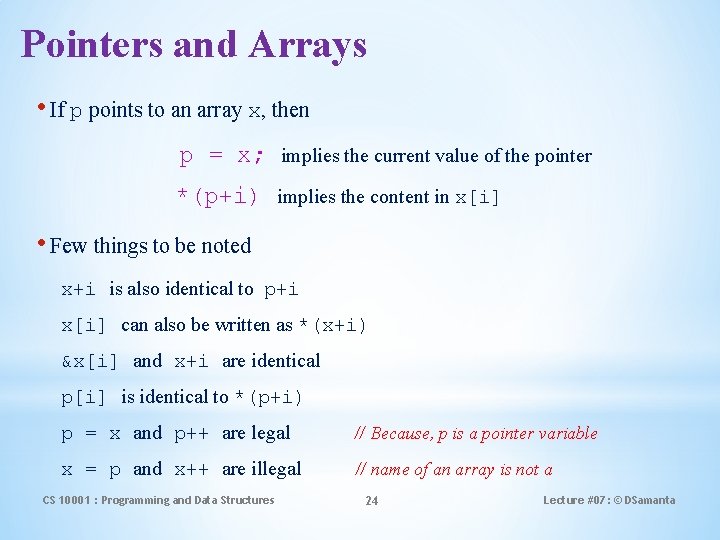
Pointers and Arrays • If p points to an array x, then p = x; implies the current value of the pointer *(p+i) implies the content in x[i] • Few things to be noted x+i is also identical to p+i x[i] can also be written as *(x+i) &x[i] and x+i are identical p[i] is identical to *(p+i) p = x and p++ are legal // Because, p is a pointer variable x = p and x++ are illegal // name of an array is not a CS 10001 : Programming and Data Structures 24 Lecture #07: © DSamanta
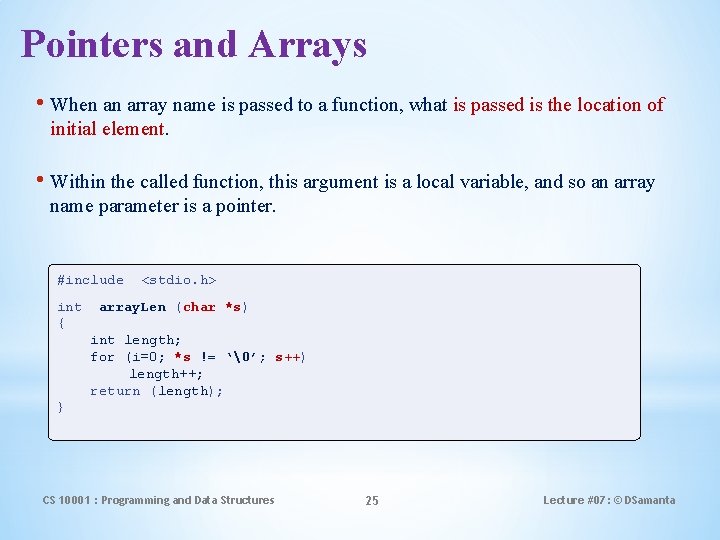
Pointers and Arrays • When an array name is passed to a function, what is passed is the location of initial element. • Within the called function, this argument is a local variable, and so an array name parameter is a pointer. #include int { <stdio. h> array. Len (char *s) int length; for (i=0; *s != ‘’; s++) length++; return (length); } CS 10001 : Programming and Data Structures 25 Lecture #07: © DSamanta
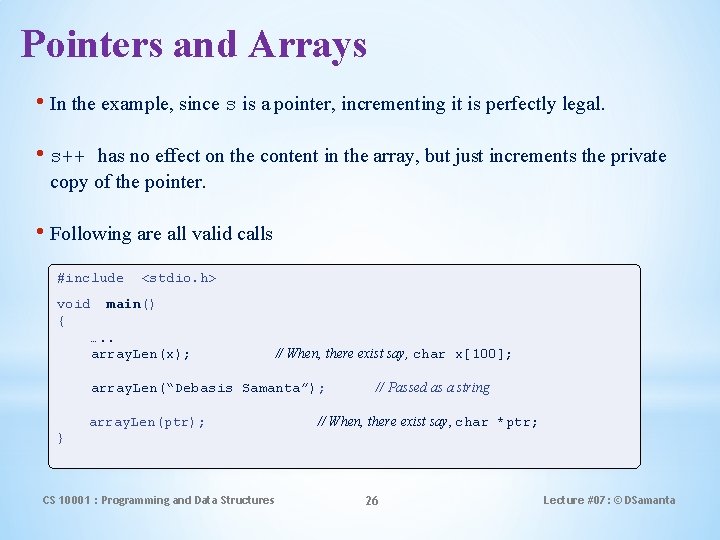
Pointers and Arrays • In the example, since s is a pointer, incrementing it is perfectly legal. • s++ has no effect on the content in the array, but just increments the private copy of the pointer. • Following are all valid calls #include void { <stdio. h> main() …. . array. Len(x); // When, there exist say, char x[100]; array. Len(“Debasis Samanta”); array. Len(ptr); // Passed as a string // When, there exist say, char *ptr; } CS 10001 : Programming and Data Structures 26 Lecture #07: © DSamanta
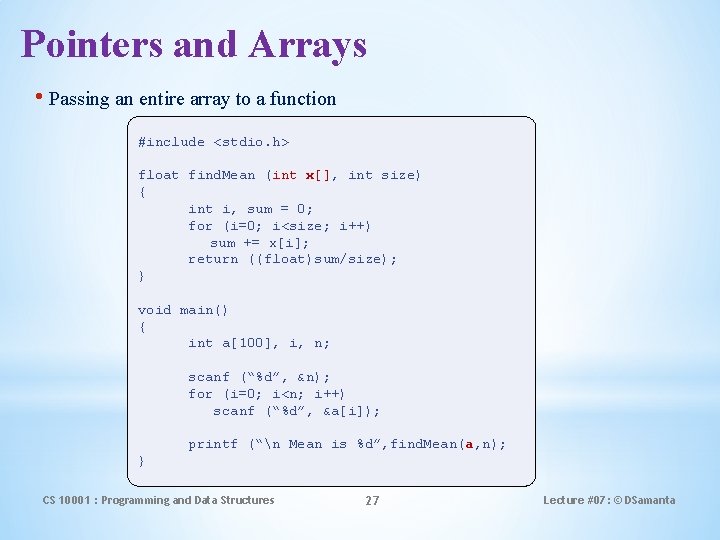
Pointers and Arrays • Passing an entire array to a function #include <stdio. h> float find. Mean (int x[], int size) { int i, sum = 0; for (i=0; i<size; i++) sum += x[i]; return ((float)sum/size); } void main() { int a[100], i, n; scanf (“%d”, &n); for (i=0; i<n; i++) scanf (“%d”, &a[i]); printf (“n Mean is %d”, find. Mean(a, n); } CS 10001 : Programming and Data Structures 27 Lecture #07: © DSamanta
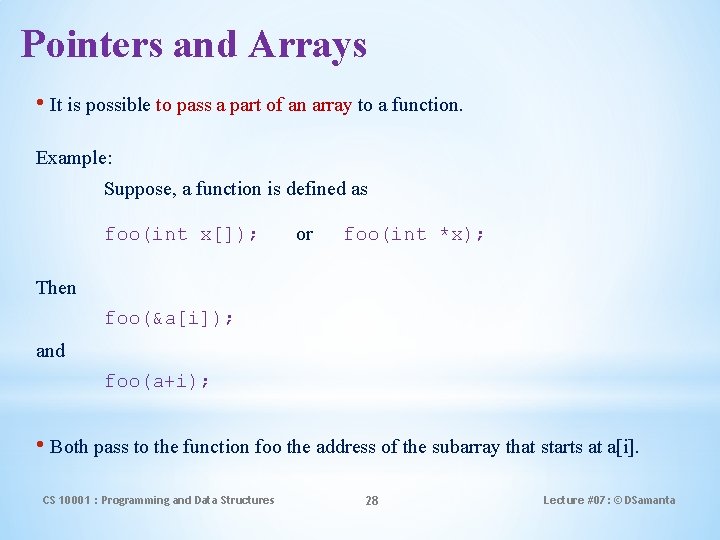
Pointers and Arrays • It is possible to pass a part of an array to a function. Example: Suppose, a function is defined as foo(int x[]); or foo(int *x); Then foo(&a[i]); and foo(a+i); • Both pass to the function foo the address of the subarray that starts at a[i]. CS 10001 : Programming and Data Structures 28 Lecture #07: © DSamanta
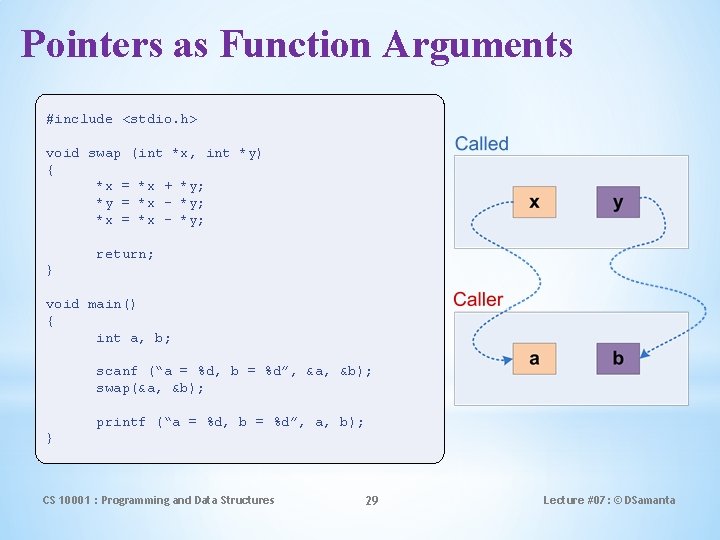
Pointers as Function Arguments #include <stdio. h> void swap (int *x, int *y) { *x = *x + *y; *y = *x – *y; *x = *x – *y; return; } void main() { int a, b; scanf (“a = %d, b = %d”, &a, &b); swap(&a, &b); printf (“a = %d, b = %d”, a, b); } CS 10001 : Programming and Data Structures 29 Lecture #07: © DSamanta
Pointer Array CS 10001 : Programming and Data Structures 30 Lecture #07: © DSamanta
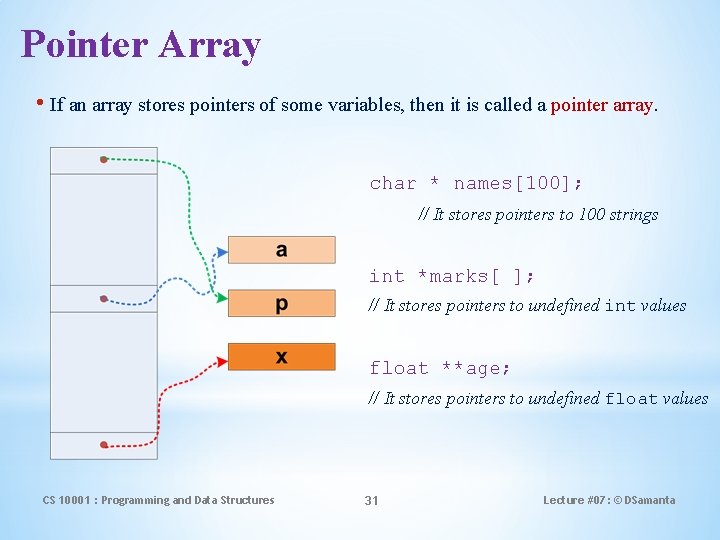
Pointer Array • If an array stores pointers of some variables, then it is called a pointer array. char * names[100]; // It stores pointers to 100 strings int *marks[ ]; // It stores pointers to undefined int values float **age; // It stores pointers to undefined float values CS 10001 : Programming and Data Structures 31 Lecture #07: © DSamanta
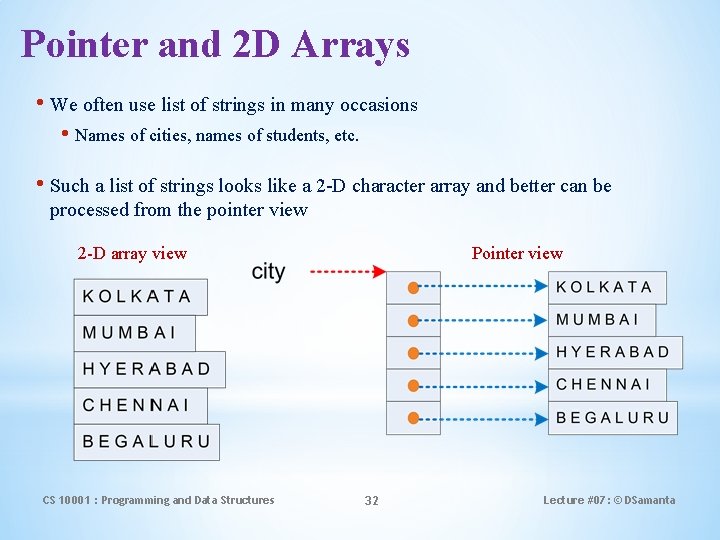
Pointer and 2 D Arrays • We often use list of strings in many occasions • Names of cities, names of students, etc. • Such a list of strings looks like a 2 -D character array and better can be processed from the pointer view 2 -D array view CS 10001 : Programming and Data Structures Pointer view 32 Lecture #07: © DSamanta
![Pointer and 2 D Arrays char city[20][15]; // 2 -D array view: to store](http://slidetodoc.com/presentation_image_h2/f39df7b571382eba8cc7e13a96197709/image-33.jpg "Pointer and 2 D Arrays char city[20][15]; // 2 -D array view: to store")
Pointer and 2 D Arrays char city[20][15]; // 2 -D array view: to store names of 20 cities // of maximum 15 characters char *city[20]; // Pointer view: to store names of 20 cities // of maximum 15 characters char *city[20] = {“Kolkata”, “Mumbai”, “Hyderabad”, “Chennai, Bengaluru”}; // Initialization of pointer array printf(“%s”, city[i]); // Using 2 -D array view printf(“%s”, city+i); // Using pointer view CS 10001 : Programming and Data Structures 33 Lecture #07: © DSamanta
Command Line Arguments CS 10001 : Programming and Data Structures 34 Lecture #07: © DSamanta

Command Line Arguments • It is a technique to supply input when the program is invoked a. out Hello C! find. Min 55 33 66 88 44 22 11 99 77 • This can be done by mentioning two arguments in main( ) void main(int argc, char *argv[]){ ……… state the body ……… return; } CS 10001 : Programming and Data Structures 35 Lecture #07: © DSamanta
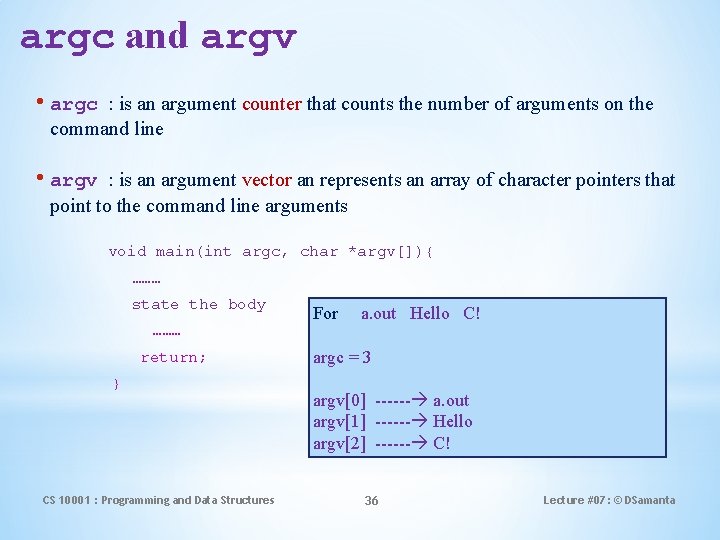
argc and argv • argc : is an argument counter that counts the number of arguments on the command line • argv : is an argument vector an represents an array of character pointers that point to the command line arguments void main(int argc, char *argv[]){ ……… state the body ……… return; } CS 10001 : Programming and Data Structures For a. out Hello C! argc = 3 argv[0] ------ a. out argv[1] ------ Hello argv[2] ------ C! 36 Lecture #07: © DSamanta
![Command Line Arguments: Example #include <stdio. h> void main(int argc, char *argv[]) { int](http://slidetodoc.com/presentation_image_h2/f39df7b571382eba8cc7e13a96197709/image-37.jpg "Command Line Arguments: Example #include <stdio. h> void main(int argc, char *argv[]) { int")
Command Line Arguments: Example #include <stdio. h> void main(int argc, char *argv[]) { int i; /* Print the values given as command line arguments */ for(i=1; i< argc; i++) printf(“%s%s”, argv[i], (i<argc-1) ? “ “ : “”); printf(“n”); return; } CS 10001 : Programming and Data Structures 37 Lecture #07: © DSamanta
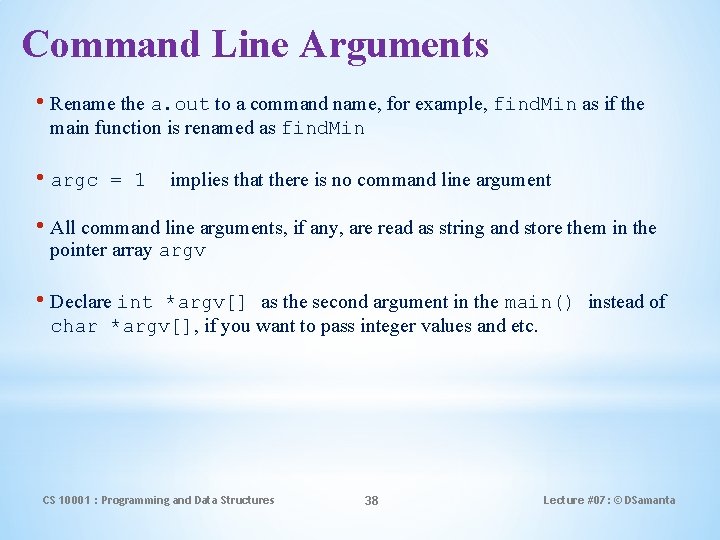
Command Line Arguments • Rename the a. out to a command name, for example, find. Min as if the main function is renamed as find. Min • argc = 1 implies that there is no command line argument • All command line arguments, if any, are read as string and store them in the pointer array argv • Declare int *argv[] as the second argument in the main() instead of char *argv[], if you want to pass integer values and etc. CS 10001 : Programming and Data Structures 38 Lecture #07: © DSamanta
Pointers to Functions CS 10001 : Programming and Data Structures 39 Lecture #07: © DSamanta
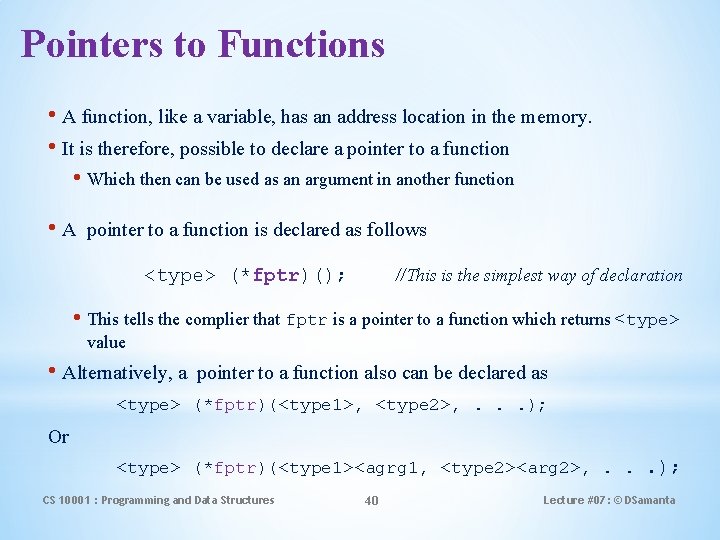
Pointers to Functions • A function, like a variable, has an address location in the memory. • It is therefore, possible to declare a pointer to a function • Which then can be used as an argument in another function • A pointer to a function is declared as follows <type> (*fptr)(); //This is the simplest way of declaration • This tells the complier that fptr is a pointer to a function which returns <type> value • Alternatively, a pointer to a function also can be declared as <type> (*fptr)(<type 1>, <type 2>, . . . ); Or <type> (*fptr)(<type 1><agrg 1, <type 2><arg 2>, . . . ); CS 10001 : Programming and Data Structures 40 Lecture #07: © DSamanta
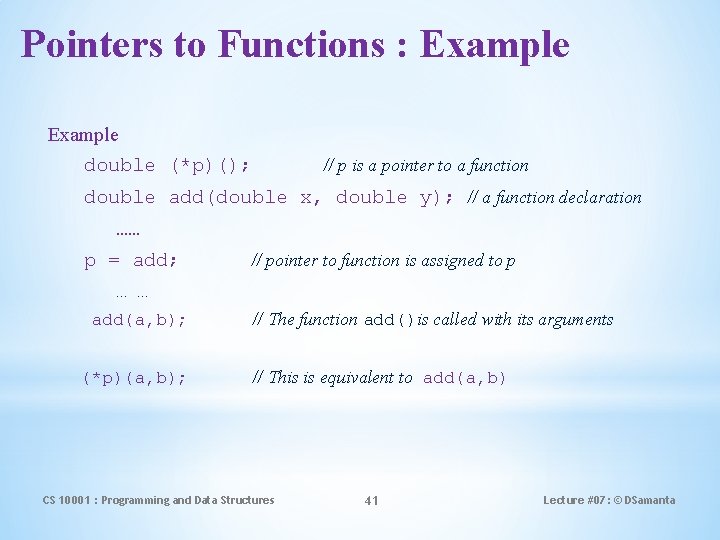
Pointers to Functions : Example double (*p)(); // p is a pointer to a function double add(double x, double y); // a function declaration …… p = add; // pointer to function is assigned to p …… add(a, b); (*p)(a, b); // The function add()is called with its arguments // This is equivalent to add(a, b) CS 10001 : Programming and Data Structures 41 Lecture #07: © DSamanta
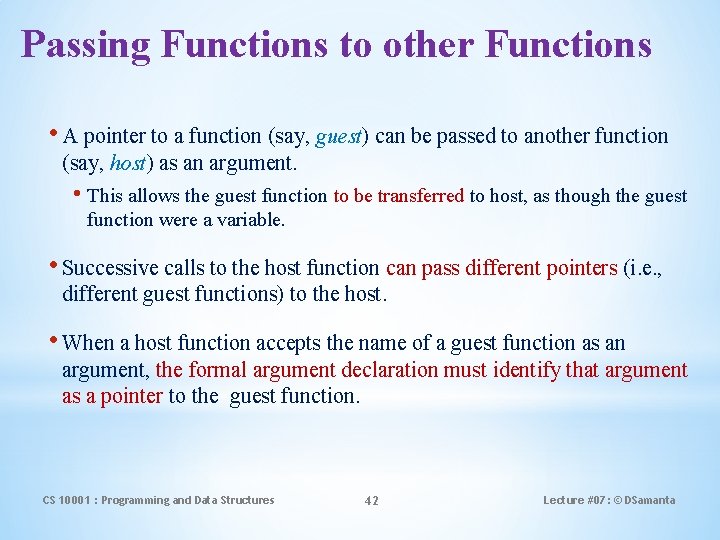
Passing Functions to other Functions • A pointer to a function (say, guest) can be passed to another function (say, host) as an argument. • This allows the guest function to be transferred to host, as though the guest function were a variable. • Successive calls to the host function can pass different pointers (i. e. , different guest functions) to the host. • When a host function accepts the name of a guest function as an argument, the formal argument declaration must identify that argument as a pointer to the guest function. CS 10001 : Programming and Data Structures 42 Lecture #07: © DSamanta
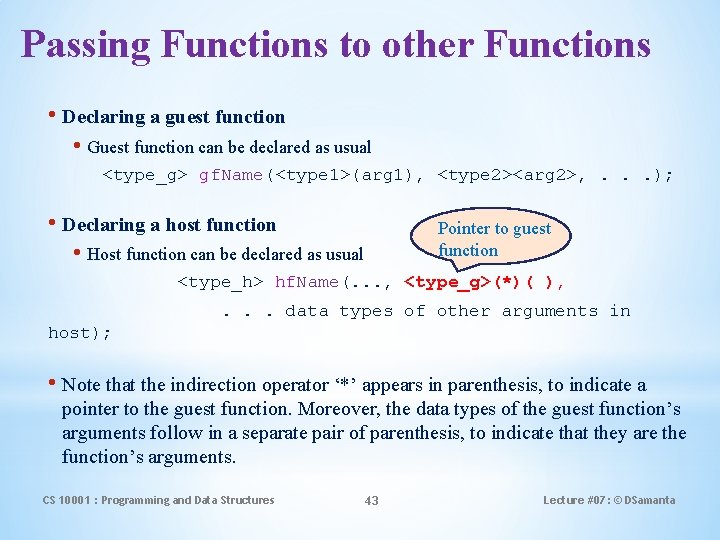
Passing Functions to other Functions • Declaring a guest function • Guest function can be declared as usual <type_g> gf. Name(<type 1>(arg 1), <type 2><arg 2>, . . . ); • Declaring a host function Pointer to guest function • Host function can be declared as usual <type_h> hf. Name(. . . , <type_g>(*)( ), . . . data types of other arguments in host); • Note that the indirection operator ‘*’ appears in parenthesis, to indicate a pointer to the guest function. Moreover, the data types of the guest function’s arguments follow in a separate pair of parenthesis, to indicate that they are the function’s arguments. CS 10001 : Programming and Data Structures 43 Lecture #07: © DSamanta
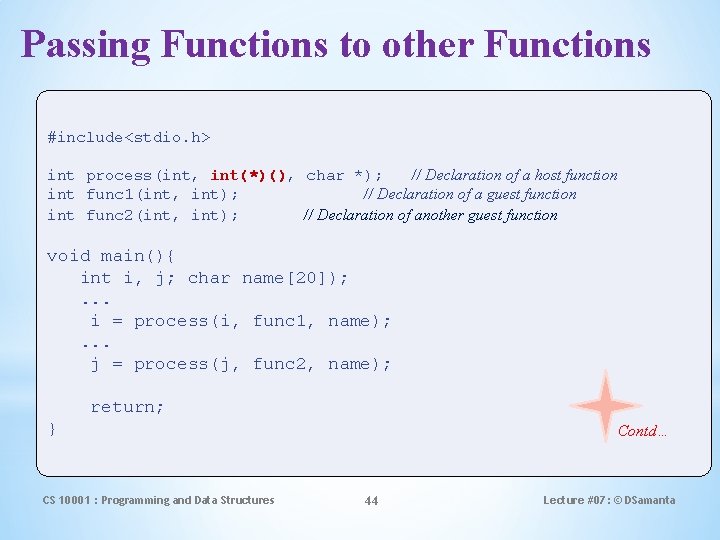
Passing Functions to other Functions #include<stdio. h> int process(int, int(*)(), char *); // Declaration of a host function int func 1(int, int); // Declaration of a guest function int func 2(int, int); // Declaration of another guest function void main(){ int i, j; char name[20]); . . . i = process(i, func 1, name); . . . j = process(j, func 2, name); return; } CS 10001 : Programming and Data Structures Contd… 44 Lecture #07: © DSamanta
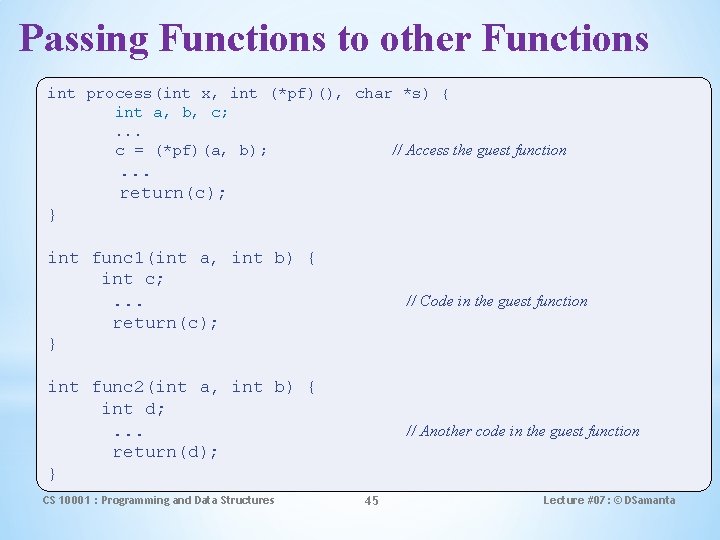
Passing Functions to other Functions int process(int x, int (*pf)(), char *s) { int a, b, c; . . . c = (*pf)(a, b); // Access the guest function . . . return(c); } int func 1(int a, int b) { int c; . . . return(c); } // Code in the guest function int func 2(int a, int b) { int d; . . . return(d); } // Another code in the guest function CS 10001 : Programming and Data Structures 45 Lecture #07: © DSamanta
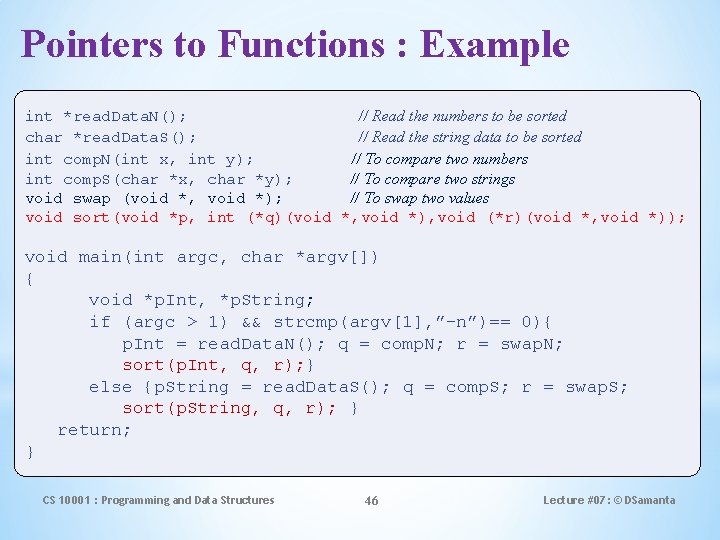
Pointers to Functions : Example int *read. Data. N(); // Read the numbers to be sorted char *read. Data. S(); // Read the string data to be sorted int comp. N(int x, int y); // To compare two numbers int comp. S(char *x, char *y); // To compare two strings void swap (void *, void *); // To swap two values void sort(void *p, int (*q)(void *, void *), void (*r)(void *, void *)); void main(int argc, char *argv[]) { void *p. Int, *p. String; if (argc > 1) && strcmp(argv[1], ”-n”)== 0){ p. Int = read. Data. N(); q = comp. N; r = swap. N; sort(p. Int, q, r); } else {p. String = read. Data. S(); q = comp. S; r = swap. S; sort(p. String, q, r); } return; } CS 10001 : Programming and Data Structures 46 Lecture #07: © DSamanta

Any question? You may post your question(s) at the “Discussion Forum” maintained in the course Web page. CS 10001 : Programming and Data Structures 47 Lecture #07: © DSamanta
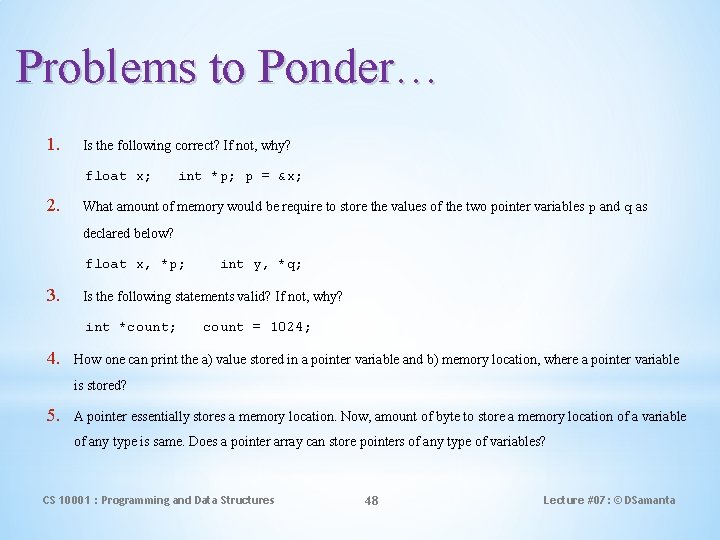
Problems to Ponder… 1. Is the following correct? If not, why? float x; 2. int *p; p = &x; What amount of memory would be require to store the values of the two pointer variables p and q as declared below? float x, *p; 3. Is the following statements valid? If not, why? int *count; 4. int y, *q; count = 1024; How one can print the a) value stored in a pointer variable and b) memory location, where a pointer variable is stored? 5. A pointer essentially stores a memory location. Now, amount of byte to store a memory location of a variable of any type is same. Does a pointer array can store pointers of any type of variables? CS 10001 : Programming and Data Structures 48 Lecture #07: © DSamanta
![Problems to Ponder… 6. Consider the following declarations. int *x, *p; char a[20]; p](http://slidetodoc.com/presentation_image_h2/f39df7b571382eba8cc7e13a96197709/image-49.jpg "Problems to Ponder… 6. Consider the following declarations. int *x, *p; char a[20]; p")
Problems to Ponder… 6. Consider the following declarations. int *x, *p; char a[20]; p = &x; x = 100; Give the answer to the following. a) How to print the address of x: b) What *p indicates? c) How to print the address where p is stored? d) How to print the content (i. e. , address) which is stored in p? e) How to access the variable through p? f) can we write p = 0 xabc 6, where the right-hand side is a hexa-decimal number? CS 10001 : Programming and Data Structures 49 Lecture #07: © DSamanta
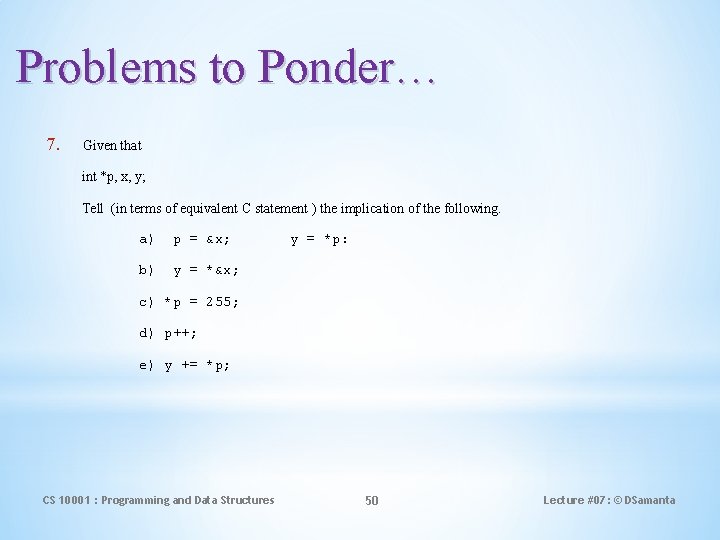
Problems to Ponder… 7. Given that int *p, x, y; Tell (in terms of equivalent C statement ) the implication of the following. a) p = &x; b) y = *&x; y = *p: c) *p = 255; d) p++; e) y += *p; CS 10001 : Programming and Data Structures 50 Lecture #07: © DSamanta
![Problems to Ponder… 8. Consider the following statement int a[10]; int *p; With respect](http://slidetodoc.com/presentation_image_h2/f39df7b571382eba8cc7e13a96197709/image-51.jpg "Problems to Ponder… 8. Consider the following statement int a[10]; int *p; With respect")
Problems to Ponder… 8. Consider the following statement int a[10]; int *p; With respect to the above declaration, which of the following statements is/are illegal? a) p = a; b) a = p; c) a+i; d) a++ e) P + i; CS 10001 : Programming and Data Structures 51 Lecture #07: © DSamanta
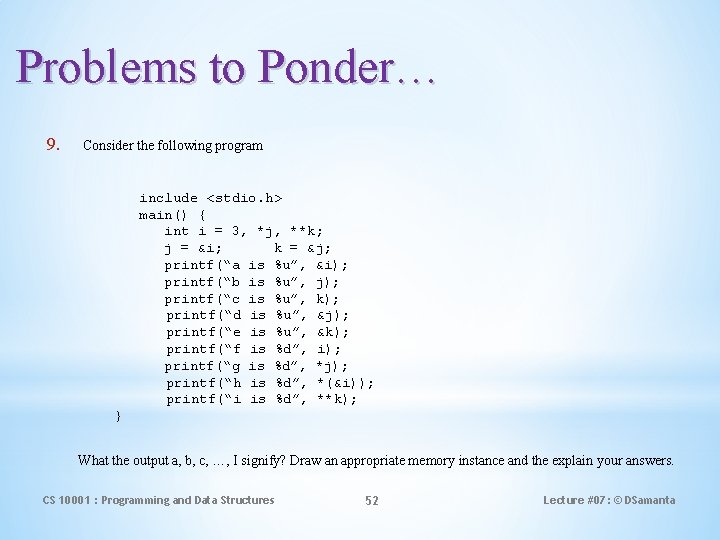
Problems to Ponder… 9. Consider the following program include <stdio. h> main() { int i = 3, *j, **k; j = &i; k = &j; printf(“a is %u”, &i); printf(“b is %u”, j); printf(“c is %u”, k); printf(“d is %u”, &j); printf(“e is %u”, &k); printf(“f is %d”, i); printf(“g is %d”, *j); printf(“h is %d”, *(&i)); printf(“i is %d”, **k); } What the output a, b, c, …, I signify? Draw an appropriate memory instance and the explain your answers. CS 10001 : Programming and Data Structures 52 Lecture #07: © DSamanta
![Problems to Ponder… 10. Using command line arguments say void main(in atrgc, char *argv[])](http://slidetodoc.com/presentation_image_h2/f39df7b571382eba8cc7e13a96197709/image-53.jpg "Problems to Ponder… 10. Using command line arguments say void main(in atrgc, char *argv[])")
Problems to Ponder… 10. Using command line arguments say void main(in atrgc, char *argv[]) we pass string values as input to the program. What modification should be in the argument list, if any, if we have to pass the input other than string values? 11. What is the difference between the two declarations? <type> (*f()); <type> *f(); CS 10001 : Programming and Data Structures 53 Lecture #07: © DSamanta
Problems for Practice… *You can check the Moodle course management system for a set of problems for your own practice. • Login to the Moodle system at http: //cse. iitkgp. ac. in/ • Select “PDS Spring-2017 (Theory) in the link “My Courses” • Go to Topic 7: Practice Sheet #07 : Pointer in C *Solutions to the problems in Practice Sheet #07 will be uploaded in due time. CS 10001 : Programming and Data Structures 54 Lecture #07: © DSamanta
If you try to solve problems yourself, then you will learn many things automatically. Spend few minutes and then enjoy the study. CS 10001 : Programming and Data Structures 55 Lecture #07: © DSamanta
- Slides: 55