
Programming Abstractions for SoftwareDefined Networks Jennifer Rexford Princeton
Programming Abstractions for Software-Defined Networks Jennifer Rexford Princeton University
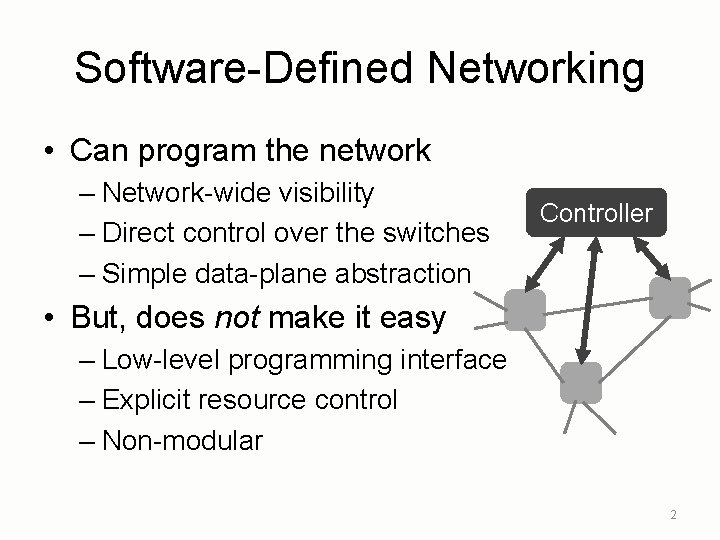
Software-Defined Networking • Can program the network – Network-wide visibility – Direct control over the switches – Simple data-plane abstraction Controller • But, does not make it easy – Low-level programming interface – Explicit resource control – Non-modular 2
SDN Research at Princeton • Programming languages – Raise the level of abstraction – Queries, composition, and updates • Grappling with reality – One controller platform Coexisting platforms – Central controller Replicated controllers – Simple data plane Flexible packet processing • Real applications – Server load balancing – Cellular core networks – Internet e. Xchange Points 3
Programming Languages Frenetic Project frenetic-lang. org Joint work with the research groups of David Walker (Princeton), Nate Foster (Cornell), and Arjun Guha (Umass-Amherst), and Josh Reich (now at AT&T Research)
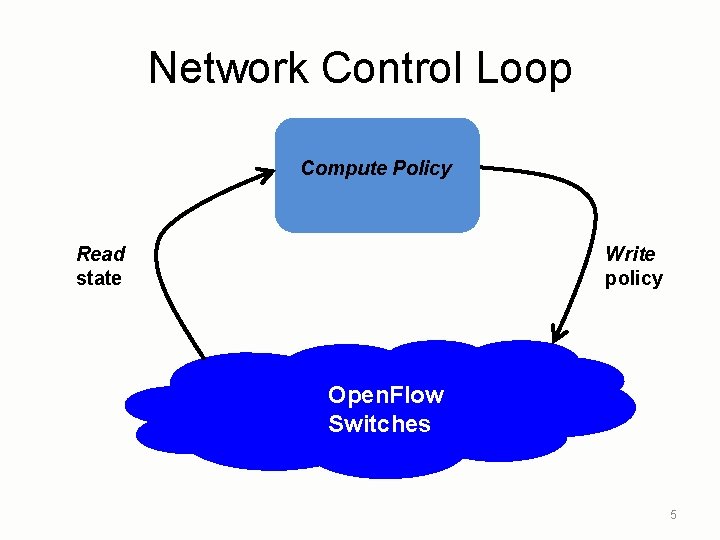
Network Control Loop Compute Policy Write policy Read state Open. Flow Switches 5
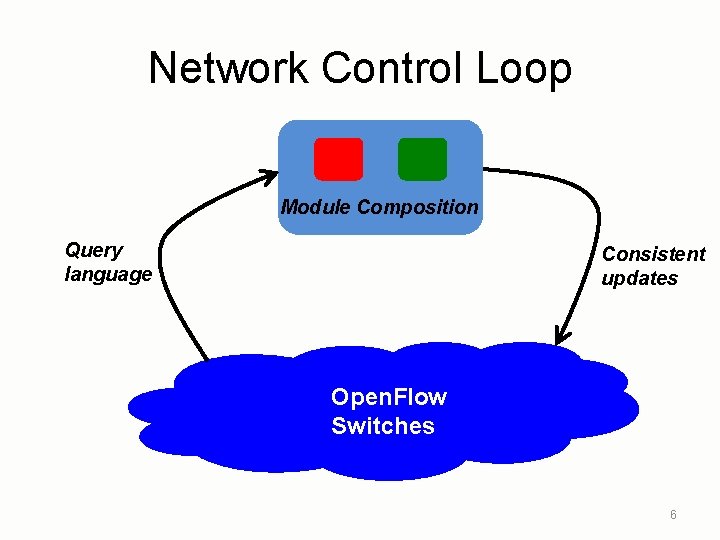
Network Control Loop Module Composition Query language Consistent updates Open. Flow Switches 6
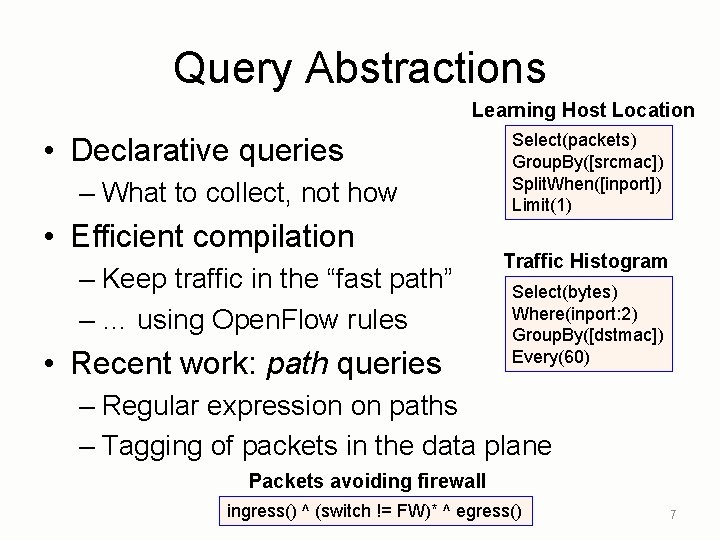
Query Abstractions Learning Host Location • Declarative queries – What to collect, not how • Efficient compilation – Keep traffic in the “fast path” – … using Open. Flow rules • Recent work: path queries Select(packets) Group. By([srcmac]) Split. When([inport]) Limit(1) Traffic Histogram Select(bytes) Where(inport: 2) Group. By([dstmac]) Every(60) – Regular expression on paths – Tagging of packets in the data plane Packets avoiding firewall ingress() ^ (switch != FW)* ^ egress() 7
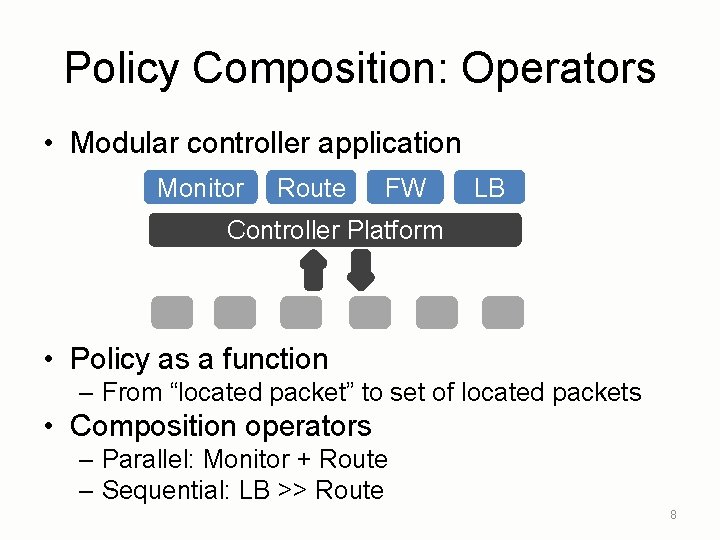
Policy Composition: Operators • Modular controller application Monitor Route FW LB Controller Platform • Policy as a function – From “located packet” to set of located packets • Composition operators – Parallel: Monitor + Route – Sequential: LB >> Route 8
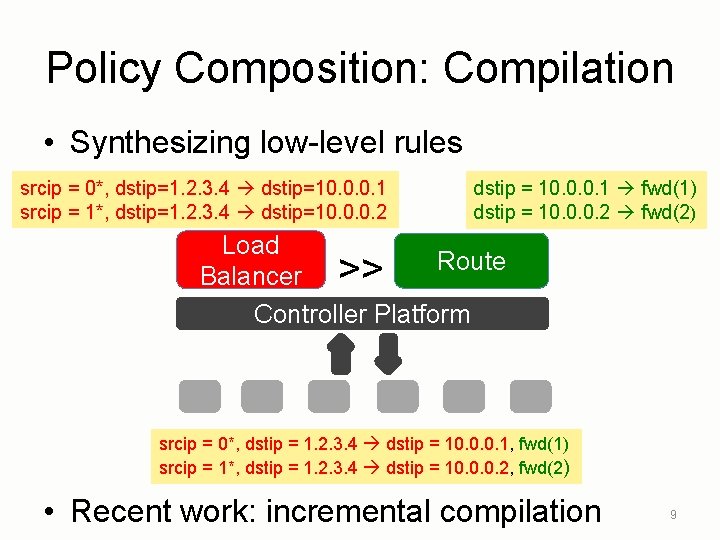
Policy Composition: Compilation • Synthesizing low-level rules srcip = 0*, dstip=1. 2. 3. 4 dstip=10. 0. 0. 1 srcip = 1*, dstip=1. 2. 3. 4 dstip=10. 0. 0. 2 dstip = 10. 0. 0. 1 fwd(1) dstip = 10. 0. 0. 2 fwd(2) Load Route >> Balancer Controller Platform srcip = 0*, dstip = 1. 2. 3. 4 dstip = 10. 0. 0. 1, fwd(1) srcip = 1*, dstip = 1. 2. 3. 4 dstip = 10. 0. 0. 2, fwd(2) • Recent work: incremental compilation 9
Consistent Updates • Transition from policy P 1 to P 2 – New access control, new paths, … • Preserve invariants – No loops, blackholes, congestion, … • Using Open. Flow mechanisms – Tag packets with policy version number – Two-phase update (internal, then ingress) • Recent work – Dynamic schedules for faster updates (with MSR) 10
Grappling With Reality Joint with David Walker (Princeton), Mike Freedman (Princeton), and P 4 team (p 4. org)
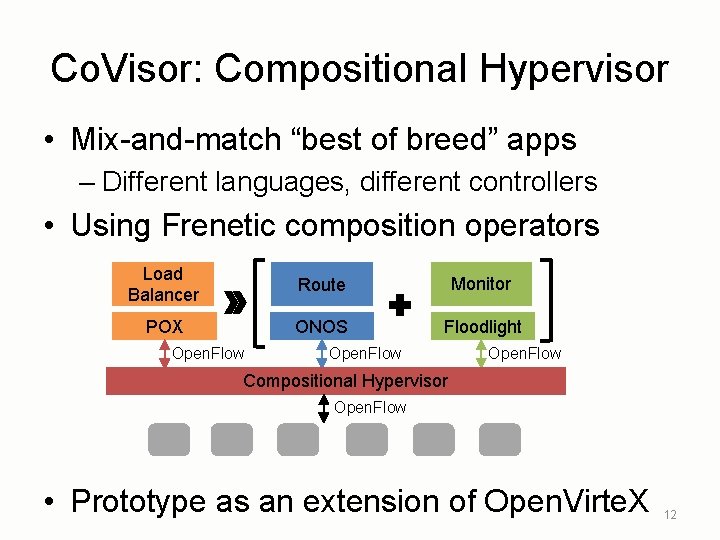
Co. Visor: Compositional Hypervisor • Mix-and-match “best of breed” apps – Different languages, different controllers • Using Frenetic composition operators Load Balancer Route Monitor POX ONOS Floodlight Open. Flow Compositional Hypervisor Open. Flow • Prototype as an extension of Open. Virte. X 12
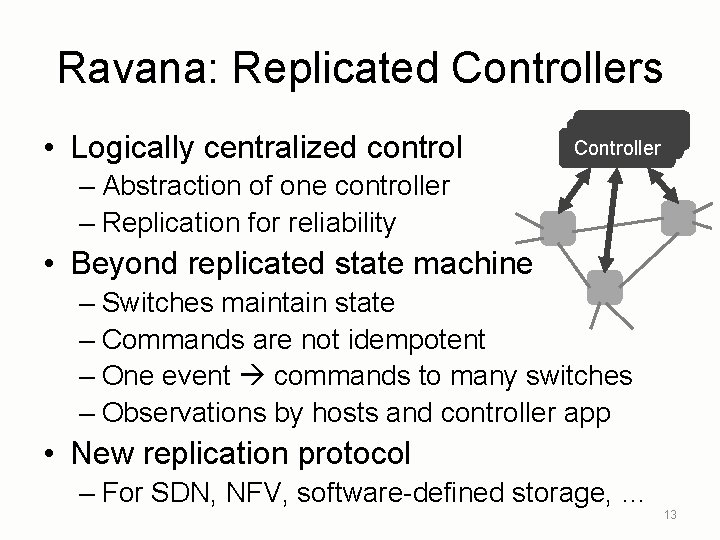
Ravana: Replicated Controllers • Logically centralized control Controller – Abstraction of one controller – Replication for reliability • Beyond replicated state machine – Switches maintain state – Commands are not idempotent – One event commands to many switches – Observations by hosts and controller app • New replication protocol – For SDN, NFV, software-defined storage, … 13
P 4: Flexible Packet Processing • Open. Flow 1. 0 is too simple – 12 header fields, one match-action table • Open. Flow 1. x is too complicated – 42 header fields, various match-action tables • Protocol-independent packet processing – Protocol independence – Target independence – Reconfigurability in the field • Ongoing work: efficient compilation 14
SDN Applications
Controller Applications • Niagara: server load balancing – Split traffic over multiple backend servers – … using commodity Open. Flow switches – Demo at the REANNZ exchange point • Soft. Cell: cellular core networks – Support user mobility and middlebox steering – … using commodity Open. Flow switches – Evaluation on traces from a large LTE network • SDX: Internet e. Xchange Points – Laurent Vanbever’s talk! 16
Conclusion • For SDN to succeed, we need – Programming abstractions – Practical underlying systems – Compelling applications • SPAN collaboration – Frenetic: Josh Reich (AT&T) – P 4: Nick Mc. Keown (Stanford), Dan Daly (Intel) – SDX: Scott Shenker (UCB) • Exploring tech transfer with On. Lab – Open. Virte. X: compositional hypervisor – ONOS: Frenetic support on top of ONOS 17
- Slides: 17