
Programmes and Modules Judith Webster Head of Academic
Programmes and Modules Judith Webster, Head of Academic Services
Why undertake Curriculum Review? College drivers: • Provide assurance that the College is effectively managing academic standards • More consistency in the ways students experience the delivery of an academic programme of study • Greater understanding of programme structures and pathways through the development of a common programme structure • Implementation of the Learning and Teaching Strategy • Respond to student feedback on assessment
External Drivers… include • • HESA Data Futures – More frequent reporting on module outcomes (including provisional results) on a regular basis. Office for Students (Of. S) – Conditions for registration include requirements around quality, reliable standards and positive outcomes for students: • • • B 1 - The provider must deliver well designed courses that provide a high quality academic experience for all students and enable a student’s achievements to be reliably assessed. B 3 – The provider must deliver successful outcomes for all of its students, which are recognised and valued by employers, and/or enable further study B 5 – the provider must deliver courses that meet the academic standards as they are described in the Framework for Higher Education Qualifications (FHEQ) at Level 4 or above.
External Drivers… And • • Teaching Excellence Framework – Subject pilots taking place – Postgraduate TEF Competition and Markets Authority – Students are protected by Consumer Law. We have to be clear what we are offering
Going modular • • The College has agreed that there should be standardised modules delivered across programmes of study based on either 5 or 7. 5 ECTS Modules can be delivered by multiplying 5 or 7. 5 e. g. 10, 15, 20 Notional study hours are 25 per one credit – so 5 credits are 125 notional study hours which includes contact time and independent study. Each module has a defined set of learning outcomes, an indicative curriculum and defined assessment methods.
Framework for Higher Education Qualifications (FHEQ) • • Developed by the sector and managed by the QAA. A framework for setting and maintaining academic standards Sets out the expectations for the framework levels in terms of generic requirements for qualifications to be awarded at each of those levels. Now a condition for Office for Students registration to be working within the FHEQ
Academic Standards • Threshold academic standards – the minimum acceptable level of achievement that a student has to demonstrate to be eligible for the award of academic credit or a qualification. For equivalent qualifications, the threshold level of achievement is agreed across the UK. • Academic Standards – the standards that the College set and maintain for the award of our academic credit or qualifications. These may exceed the threshold academic standards. They include the standards of performance that a student needs to demonstrate to achieve a particular classification of a qualification, such as a first-class honours degree classification in a certain subject or the award of merit or distinction in a master’s degree.
Academic Levels • • • The FHEQ describes five academic levels which define the outcomes of progressively more challenging learning in ascending order. Programme learning outcomes should align with the relevant qualification descriptors in the framework. Subject Benchmark Statements set out expectations about standards of degrees in a range of subject areas. They describe what gives a discipline its coherence and identity, and define what can be expected of a graduate in terms of the abilities and skills needed to develop understanding or competence in the subject.
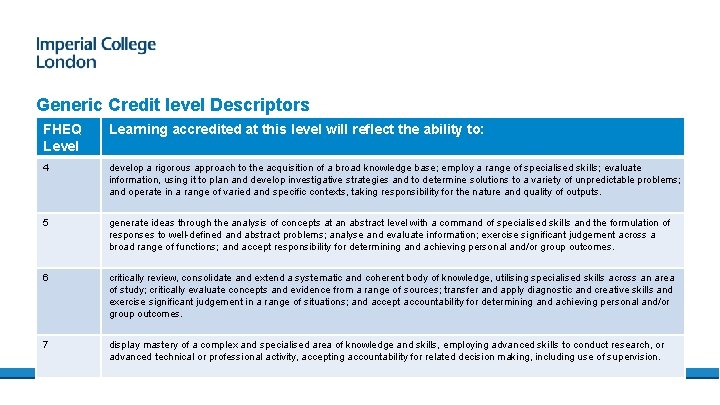
Generic Credit level Descriptors FHEQ Level Learning accredited at this level will reflect the ability to: 4 develop a rigorous approach to the acquisition of a broad knowledge base; employ a range of specialised skills; evaluate information, using it to plan and develop investigative strategies and to determine solutions to a variety of unpredictable problems; and operate in a range of varied and specific contexts, taking responsibility for the nature and quality of outputs. 5 generate ideas through the analysis of concepts at an abstract level with a command of specialised skills and the formulation of responses to well-defined and abstract problems; analyse and evaluate information; exercise significant judgement across a broad range of functions; and accept responsibility for determining and achieving personal and/or group outcomes. 6 critically review, consolidate and extend a systematic and coherent body of knowledge, utilising specialised skills across an area of study; critically evaluate concepts and evidence from a range of sources; transfer and apply diagnostic and creative skills and exercise significant judgement in a range of situations; and accept accountability for determining and achieving personal and/or group outcomes. 7 display mastery of a complex and specialised area of knowledge and skills, employing advanced skills to conduct research, or advanced technical or professional activity, accepting accountability for related decision making, including use of supervision.
Awards • • • Target Award - The main qualification a student is aiming for and registers for at the outset Intermediate Award – a separate qualification which can be awarded at a specific stage or level part of the way through a longer programme of study and for which the student can register at the outset of study. Exit Award – an award which may be offered on completion of an intermediate point of studies in a longer programme (when a student leaves the programme) but for which the student has not registered at the outset.
Programme Design • • An iterative process which depends on reflection and critical assessment of the evidence available to inform the process Considers how a programme is organised to enable students to achieve the intended learning outcomes, in terms of student workload, volume and nature of assessment, progression through the programme and increasing intellectual demand. Should be promote inclusivity Takes account of external reference points.
What is a module? • • • A self-contained, formally structured learning experience with a coherent and explicit set of learning outcomes and assessment criteria. Modules are assigned a credit level which is an indicator of the relative complexity and/or depth of learning. Credit is awarded to a learner in recognition of the achievement of designated learning outcomes at a specified level.
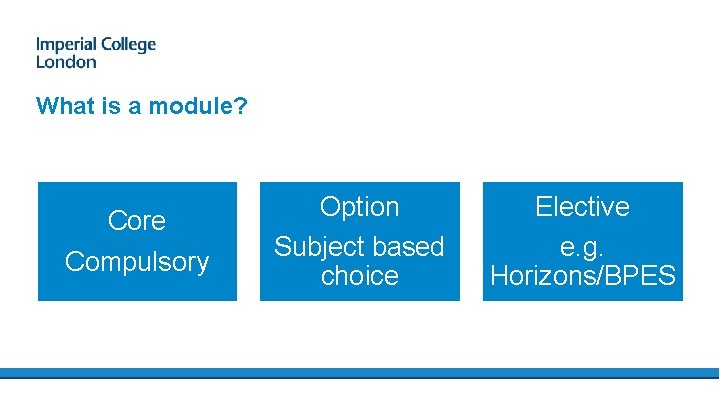
What is a module? Core Compulsory Option Subject based choice Elective e. g. Horizons/BPES
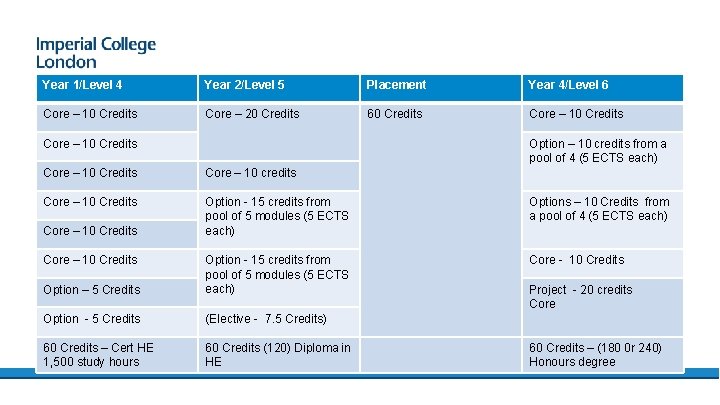
Year 1/Level 4 Year 2/Level 5 Placement Year 4/Level 6 Core – 10 Credits Core – 20 Credits 60 Credits Core – 10 Credits Option – 10 credits from a pool of 4 (5 ECTS each) Core – 10 Credits Core – 10 credits Core – 10 Credits Option - 15 credits from pool of 5 modules (5 ECTS each) Options – 10 Credits from a pool of 4 (5 ECTS each) Core - 10 Credits Option – 5 Credits Option - 15 credits from pool of 5 modules (5 ECTS each) Option - 5 Credits (Elective - 7. 5 Credits) 60 Credits – Cert HE 1, 500 study hours 60 Credits (120) Diploma in HE Core – 10 Credits Project - 20 credits Core 60 Credits – (180 0 r 240) Honours degree

• Any Questions?
Curriculum Review • • • The Learning and Teaching strategy prioritised review and redesign of curricula as a priority using a consistent approach. It also highlighted the need for students to take an integrated approach to the study of their discipline rather than focussing on passing exams. The need to establish a baseline understanding of the assessment load on each programme and across all modules being studied concurrently.
Process • • Departments will undertake the review of their taught course provision Curriculum Reference Panels will be established to undertake peer-review scrutiny of programmes in terms of: – Alignment to the Learning and Teaching Strategy – Alignment to the single set of academic regulations – Make recommendations for enhancement – Review and endorse programme and module specifications
Timescale • Curriculum Review to be completed by March 2019 • Additional meetings of Faculty Education Committees, the Programmes Committee and QAEC have been scheduled to accommodate the extra business.
Documentation • Document with a brief narrative on the approach taken • Programme Specification • Module Specification
- Slides: 19