
Programme Bachelor of Education B Sc B Ed

Programme : Bachelor of Education/ B. Sc. B. Ed. /BA. B. Ed. Subject Paper Code Year/Semester Paper Title Unit No & Name Module No. Module Name : Education B. Ed. B. Sc. B. Ed. /BA. B. Ed. EDU 12 BSBAEDU 12 F. Y. Semester III Action Research 02 – Methods of Action research 12 Observation as a Data Gathering Instrument: Developing Observation Schedule (Part I)

Russell De Souza, Ph. D.
OUTLINE § Concept of Observation § Types of Observation
LEARNING OUTCOMES § Explain the term Observation § Differentiate between participant and non-participant observation
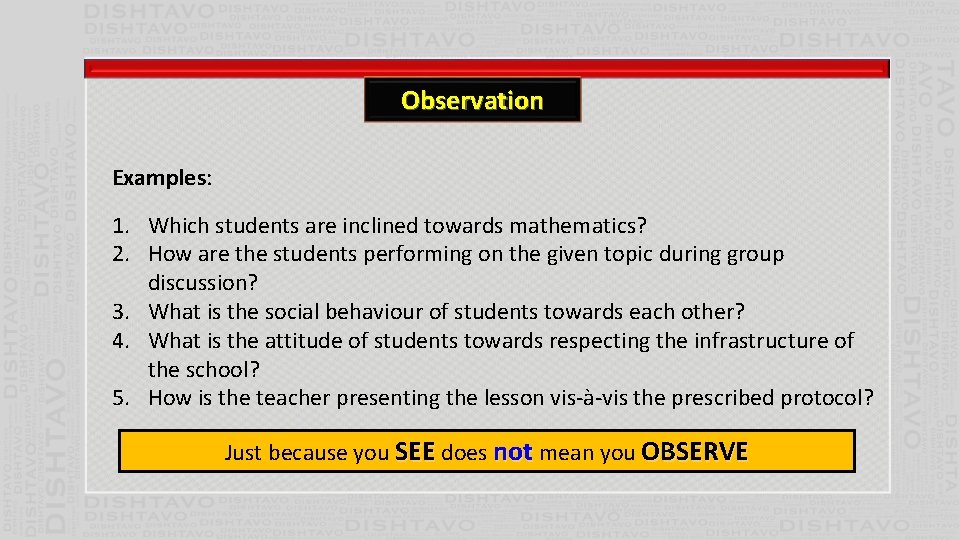
Observation Examples: 1. Which students are inclined towards mathematics? 2. How are the students performing on the given topic during group discussion? 3. What is the social behaviour of students towards each other? 4. What is the attitude of students towards respecting the infrastructure of the school? 5. How is the teacher presenting the lesson vis-à-vis the prescribed protocol? Just because you SEE does not mean you OBSERVE
Observation is a process in which one or more persons observe some real-life situation and record occurrences. No asking but observing TEACHER It is used to observe and evaluate the overt (seen or visible) behavior of individuals in controlled or uncontrolled situations. Instead of asking ‘how do you handle discipline in the classroom’ would be more worthy, reliable and valid to observe how the teacher manages and maintains discipline inclass. Alpha. Zeta, CC 0, via Wikimedia Commons
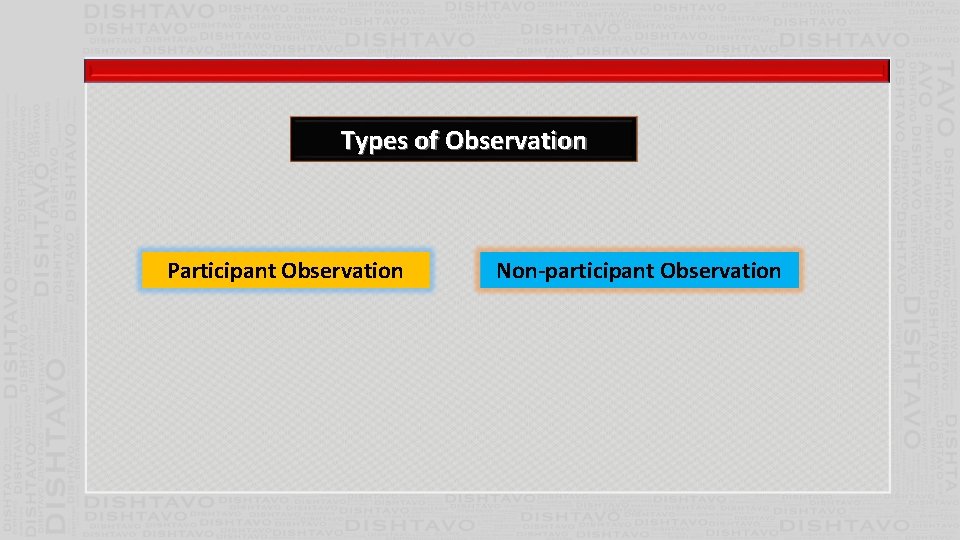
Types of Observation Participant Observation Non-participant Observation
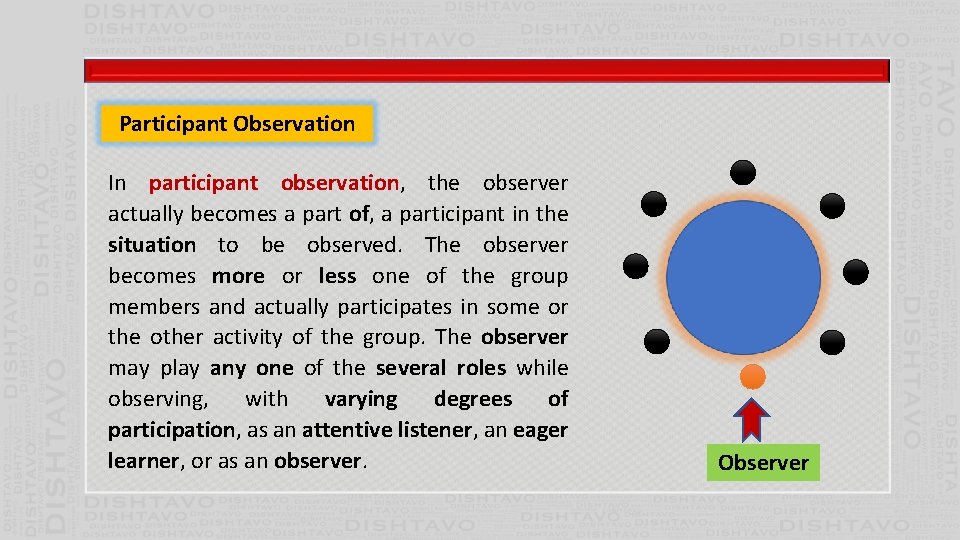
Participant Observation In participant observation, the observer actually becomes a part of, a participant in the situation to be observed. The observer becomes more or less one of the group members and actually participates in some or the other activity of the group. The observer may play any one of the several roles while observing, with varying degrees of participation, as an attentive listener, an eager learner, or as an observer. Observer
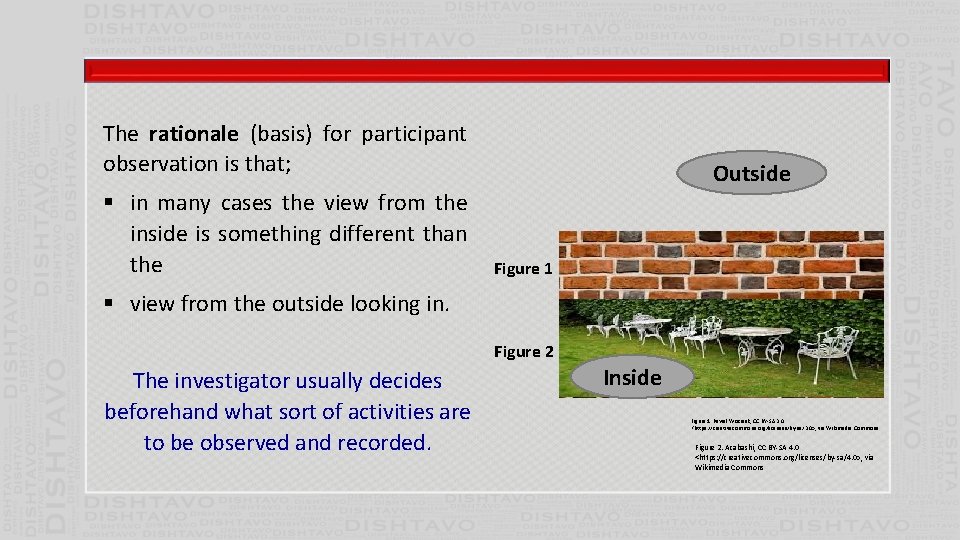
The rationale (basis) for participant observation is that; § in many cases the view from the inside is something different than the Outside Figure 1 § view from the outside looking in. Figure 2 The investigator usually decides beforehand what sort of activities are to be observed and recorded. Inside Figure 1. Pawel Wozniak, CC BY-SA 3. 0 <https: //creativecommons. org/licenses/by-sa/3. 0>, via Wikimedia Commons Figure 2. Acabashi, CC BY-SA 4. 0 <https: //creativecommons. org/licenses/by-sa/4. 0>, via Wikimedia Commons
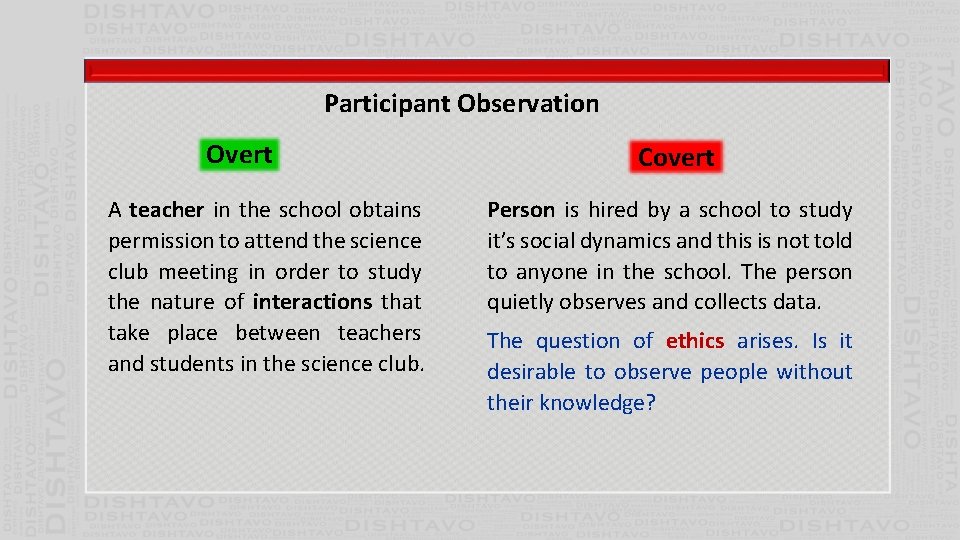
Participant Observation Overt A teacher in the school obtains permission to attend the science club meeting in order to study the nature of interactions that take place between teachers and students in the science club. Covert Person is hired by a school to study it’s social dynamics and this is not told to anyone in the school. The person quietly observes and collects data. The question of ethics arises. Is it desirable to observe people without their knowledge?
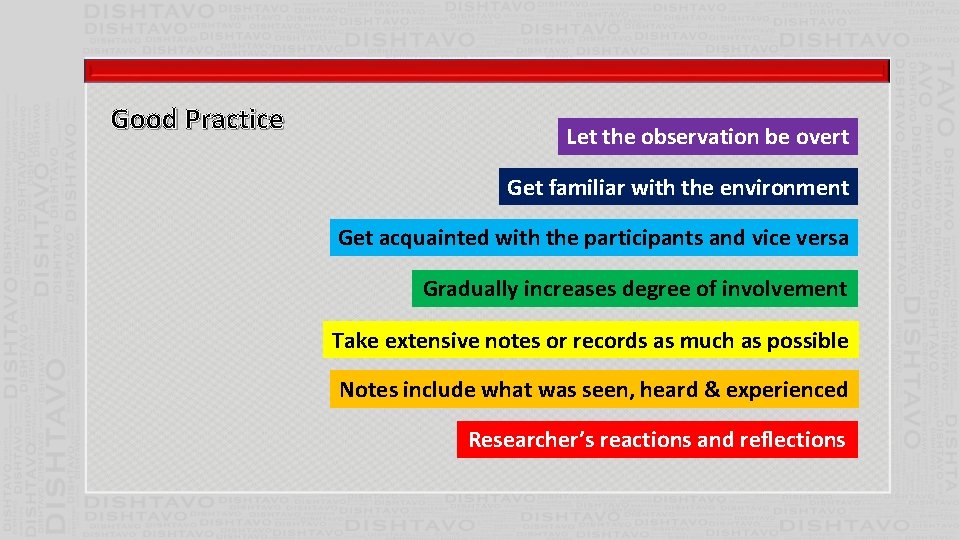
Good Practice Let the observation be overt Get familiar with the environment Get acquainted with the participants and vice versa Gradually increases degree of involvement Take extensive notes or records as much as possible Notes include what was seen, heard & experienced Researcher’s reactions and reflections
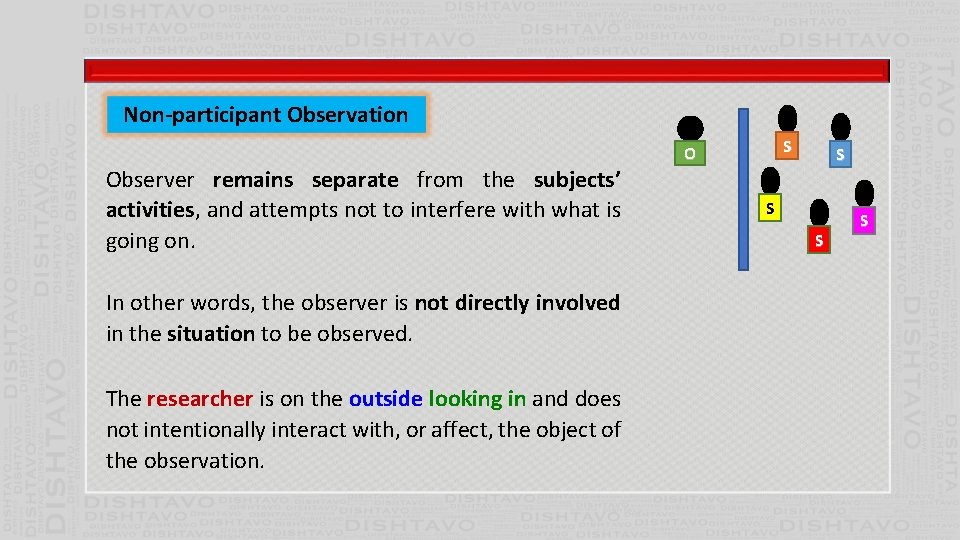
Non-participant Observation Observer remains separate from the subjects’ activities, and attempts not to interfere with what is going on. In other words, the observer is not directly involved in the situation to be observed. The researcher is on the outside looking in and does not intentionally interact with, or affect, the object of the observation. S O S S
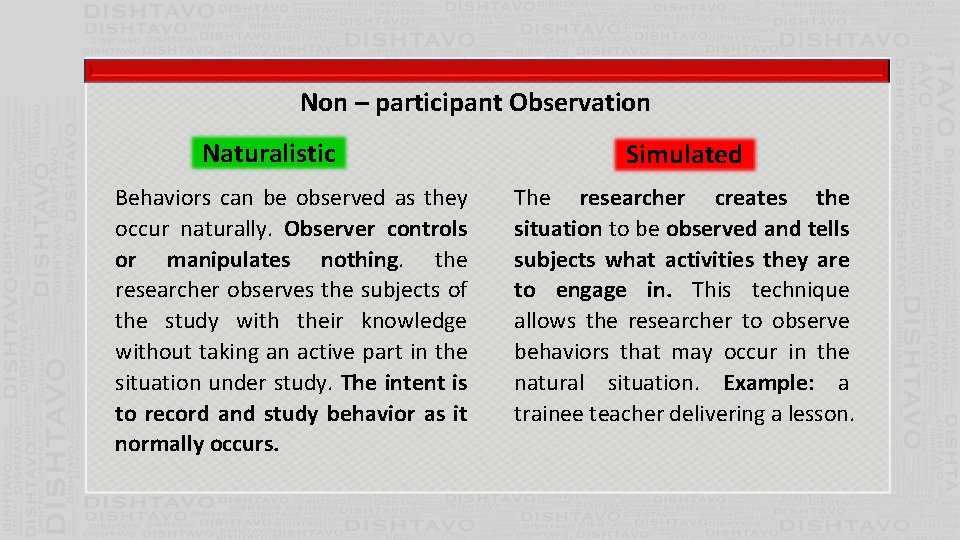
Non – participant Observation Naturalistic Behaviors can be observed as they occur naturally. Observer controls or manipulates nothing. the researcher observes the subjects of the study with their knowledge without taking an active part in the situation under study. The intent is to record and study behavior as it normally occurs. Simulated The researcher creates the situation to be observed and tells subjects what activities they are to engage in. This technique allows the researcher to observe behaviors that may occur in the natural situation. Example: a trainee teacher delivering a lesson.

References Gillham, B. (2008). Observation Techniques: Structured to Unstructured. Bloombury Academic. Jorgensen, D. L. (1989). Participant Observation - A Methodology for Human Studies (Vol. 15). Sage. Williams, J. P. (2008). Nonparticipant Observation. In L. M. Given (Ed. ), Sage Encyclopedia of Qualitative Research Methods (pp. 561 - 562). Sage.
- Slides: 16