
Programmatic Accreditation Practices Laura Rasar King ASPA Chair




- Slides: 17
Programmatic Accreditation Practices Laura Rasar King, ASPA Chair February 22, 2017; NACIQI Meeting
Who is ASPA? • Collaborative forum and collective voice for accreditors of specialized and professional higher education programs/schools in USA • 60 members • Nursing, architecture, English language, religious study • >12, 000 programs accredited • 58% CHEA recognized (35/60) • 50% ED recognized = 59% of total (30/51) • 16/30 have Title IV link; <2% of total federal aid $ • ~75% in fields with some form of licensure or certification Association of Specialized and Professional Accreditors Page 2
What do programmatic accreditors do? • Conduct an in-depth assessment of specialized or professional programs at a college, university or independent institution. • Connect the professions to the academic programs by ensuring competency of graduates. • Have missions that allow for targeted evaluations of quality that relate directly to the student’s learning and competence. Association of Specialized and Professional Accreditors Page 3
2016 Outcomes Survey • Why do a survey? • External concerns about accreditation performance • Outcomes as an accepted indicator of quality • Communicating actual practices • How are accreditors doing? Association of Specialized and Professional Accreditors Page 4
Methodology • Excerpts from standards/policies that describe • requirements for student learning assessment, and • program outcome assessment • Examples of indicators used to assess compliance with standards/policies • Use of benchmarks • Original response/report January 2016: 45 agencies • Updated report June 2016: all 60 ASPA members Association of Specialized and Professional Accreditors Page 5
The findings/results • All respondents look at outcomes • Competency assessment • Bright line indicators • Program-determined indicators • Context must be considered – one size does not fit all • Survey limitation – excerpts interpreted by Task Force Association of Specialized and Professional Accreditors Page 6
Outcomes categories • Outcomes requirements meet the needs of the profession • Nature of the field • Labor market • Licensure/certification • Full report: http: //www. aspa-usa. org/wpcontent/uploads/2016/08/Outcomes-Report-June 2016. pdf Association of Specialized and Professional Accreditors Page 7
Overall Findings Outcomes Requirements Association of Specialized and Professional Accreditors - 2016 100% 93% 90% 82% 80% 70% 60% 52% 50% 40% 30% 20% 10% 0% Any Bright Line from Agency Any Program-Determined Competency Assessment n=60 agencies Association of Specialized and Professional Accreditors Page 8
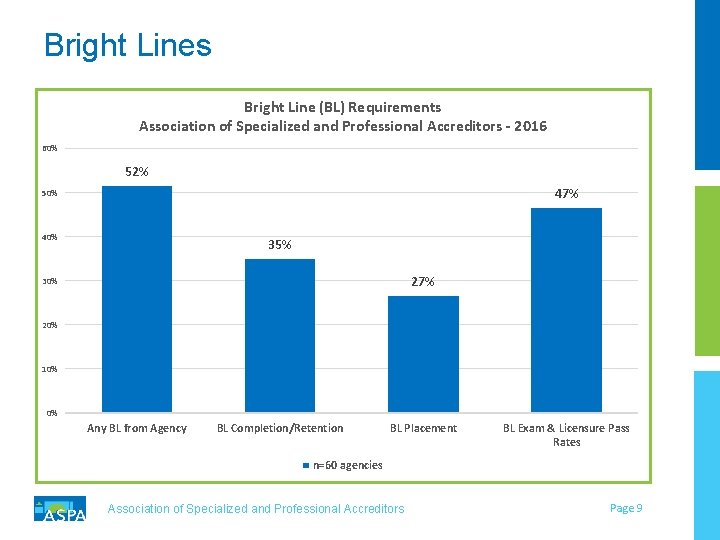
Bright Lines Bright Line (BL) Requirements Association of Specialized and Professional Accreditors - 2016 60% 52% 47% 50% 40% 35% 27% 30% 20% 10% 0% Any BL from Agency BL Completion/Retention BL Placement BL Exam & Licensure Pass Rates n=60 agencies Association of Specialized and Professional Accreditors Page 9
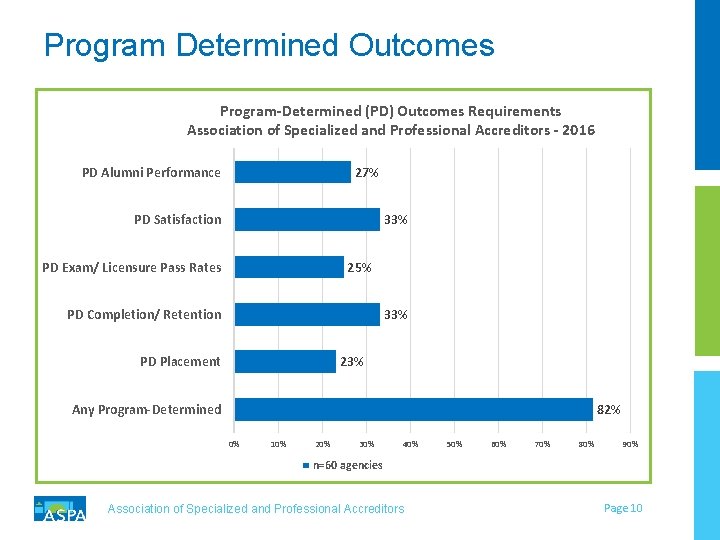
Program Determined Outcomes Program-Determined (PD) Outcomes Requirements Association of Specialized and Professional Accreditors - 2016 PD Alumni Performance 27% PD Satisfaction 33% PD Exam/ Licensure Pass Rates 25% PD Completion/ Retention 33% PD Placement 23% Any Program-Determined 82% 0% 10% 20% 30% 40% 50% 60% 70% 80% 90% n=60 agencies Association of Specialized and Professional Accreditors Page 10
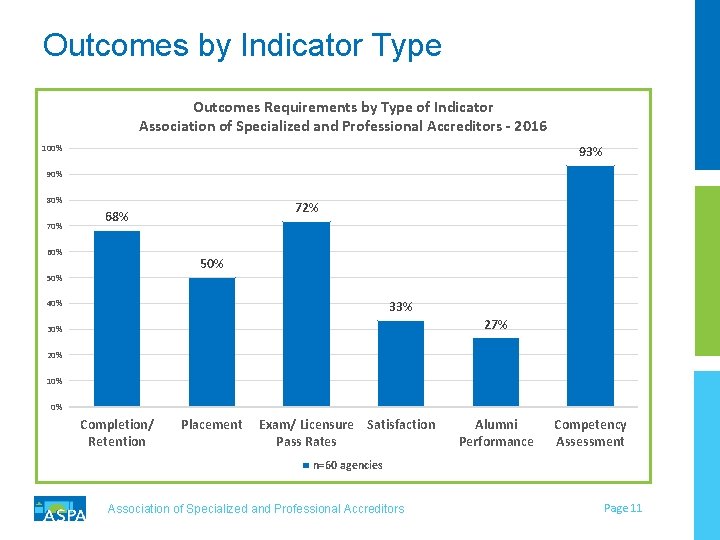
Outcomes by Indicator Type Outcomes Requirements by Type of Indicator Association of Specialized and Professional Accreditors - 2016 100% 93% 90% 80% 72% 68% 60% 50% 40% 33% 27% 30% 20% 10% 0% Completion/ Retention Placement Exam/ Licensure Satisfaction Pass Rates Alumni Performance Competency Assessment n=60 agencies Association of Specialized and Professional Accreditors Page 11
Competency assessment • Nearly all ASPA members require their programs to have some form of assessment for the attainment of competencies: • based on the mission of the program and/or defined by the accreditor/profession • detailed plan for the assessment of competencies • assessment results used for program improvement • Bottom line – competencies for the profession protect the public interest Association of Specialized and Professional Accreditors Page 12
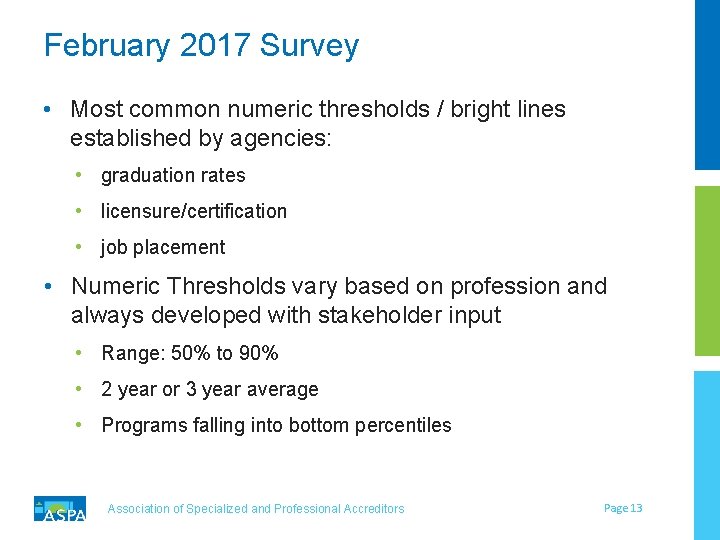
February 2017 Survey • Most common numeric thresholds / bright lines established by agencies: • graduation rates • licensure/certification • job placement • Numeric Thresholds vary based on profession and always developed with stakeholder input • Range: 50% to 90% • 2 year or 3 year average • Programs falling into bottom percentiles Association of Specialized and Professional Accreditors Page 13
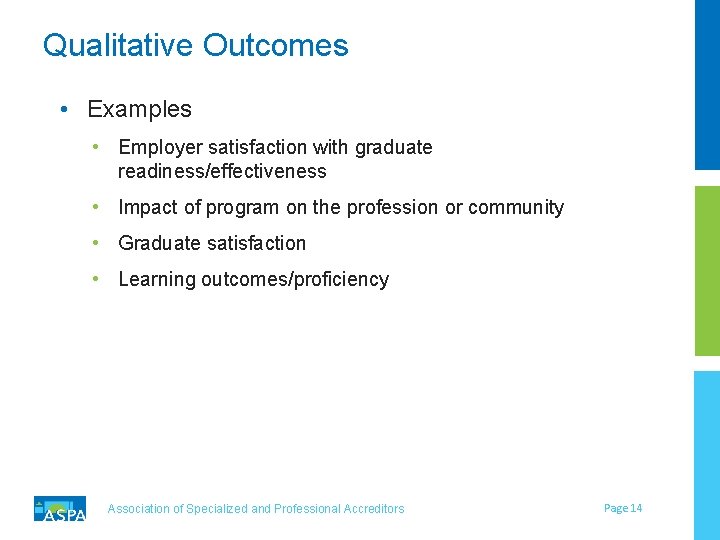
Qualitative Outcomes • Examples • Employer satisfaction with graduate readiness/effectiveness • Impact of program on the profession or community • Graduate satisfaction • Learning outcomes/proficiency Association of Specialized and Professional Accreditors Page 14
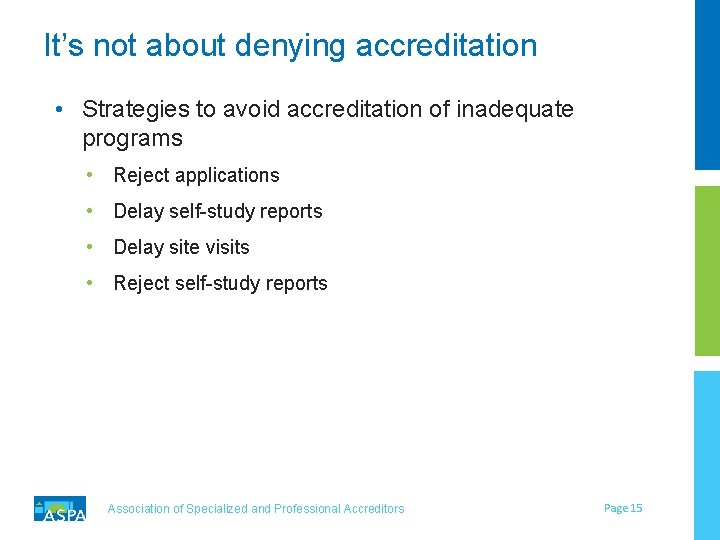
It’s not about denying accreditation • Strategies to avoid accreditation of inadequate programs • Reject applications • Delay self-study reports • Delay site visits • Reject self-study reports Association of Specialized and Professional Accreditors Page 15
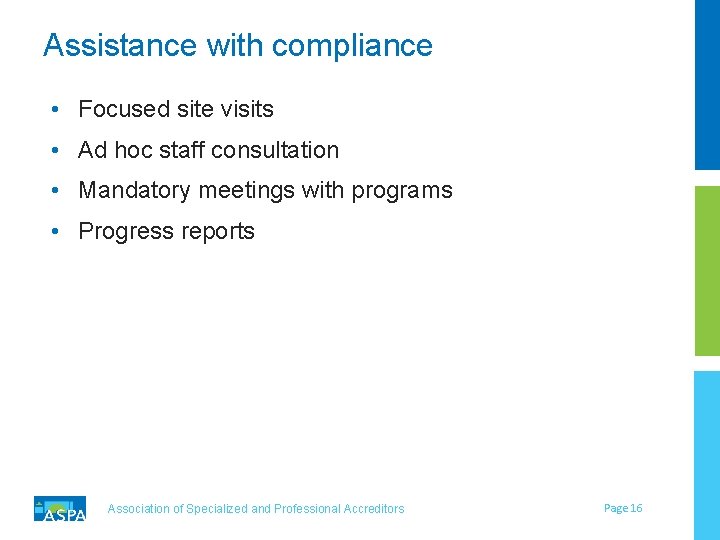
Assistance with compliance • Focused site visits • Ad hoc staff consultation • Mandatory meetings with programs • Progress reports Association of Specialized and Professional Accreditors Page 16
Questions Association of Specialized and Professional Accreditors Page 17