
Programmable InNetwork Obfuscation of DNS Traffic Liang Wang

Programmable In-Network Obfuscation of DNS Traffic Liang Wang, Hyojoon Kim, Prateek Mittal, Jennifer Rexford Princeton University
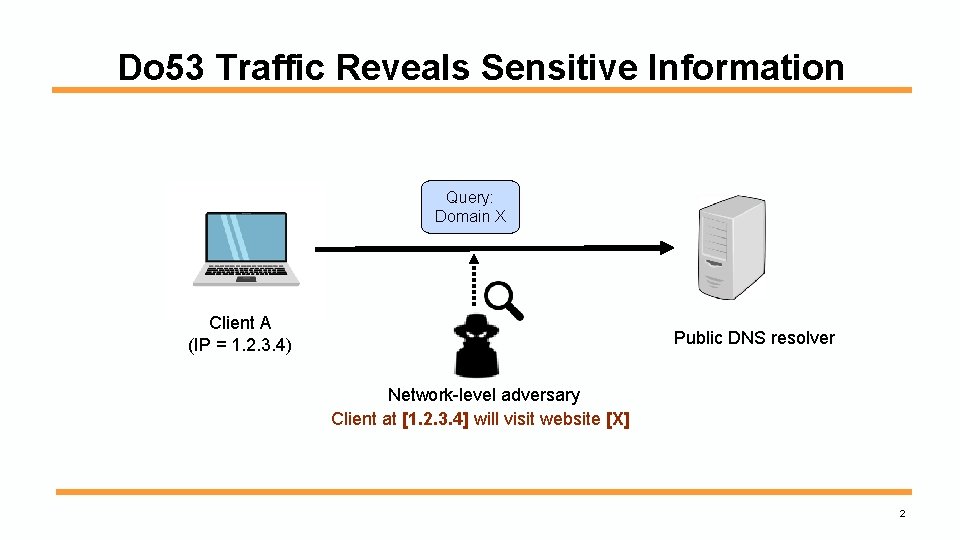
Do 53 Traffic Reveals Sensitive Information Query: Domain X Client A (IP = 1. 2. 3. 4) Public DNS resolver Network-level adversary Client at [1. 2. 3. 4] will visit website [X] 2
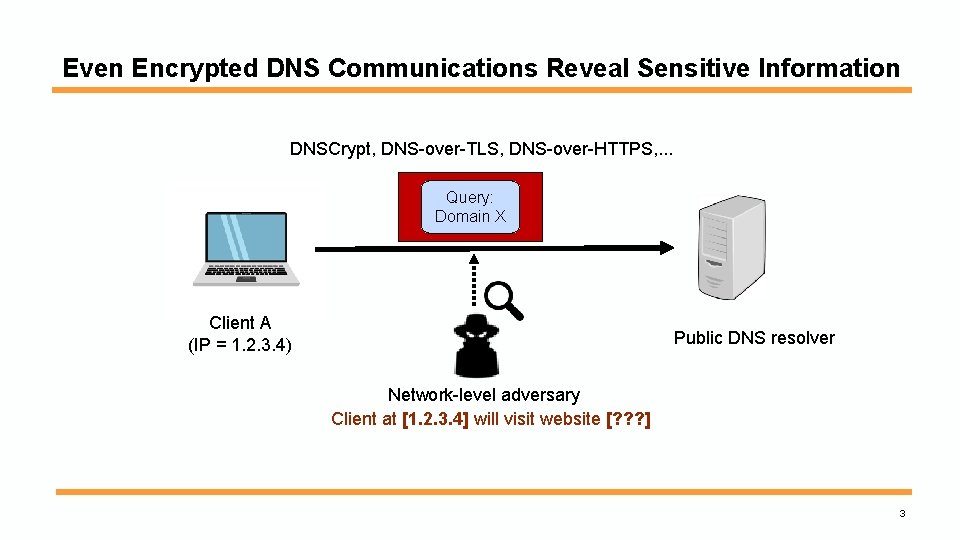
Even Encrypted DNS Communications Reveal Sensitive Information DNSCrypt, DNS-over-TLS, DNS-over-HTTPS, . . . Query: Domain X Client A (IP = 1. 2. 3. 4) Public DNS resolver Network-level adversary Client at [1. 2. 3. 4] will visit website [? ? ? ] 3
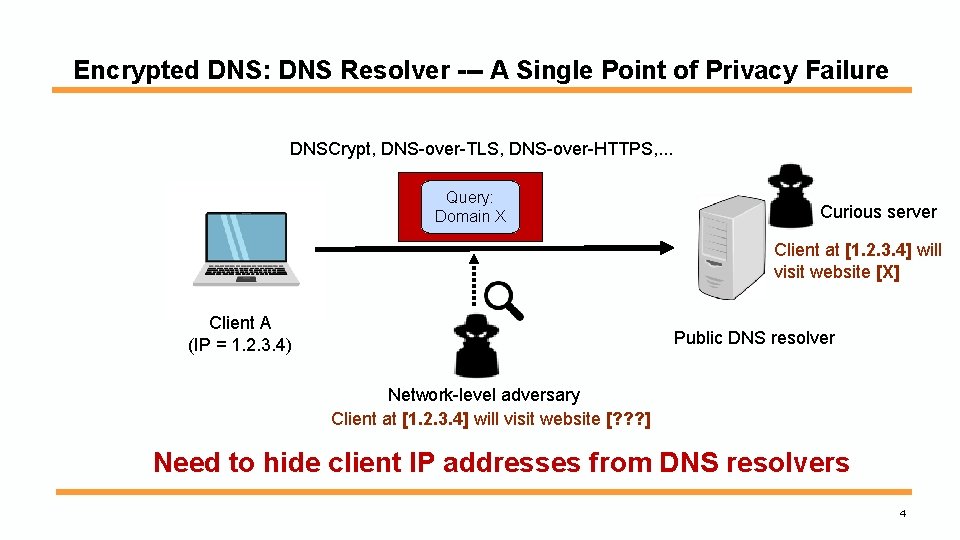
Encrypted DNS: DNS Resolver --- A Single Point of Privacy Failure DNSCrypt, DNS-over-TLS, DNS-over-HTTPS, . . . Query: Domain X Curious server Client at [1. 2. 3. 4] will visit website [X] Client A (IP = 1. 2. 3. 4) Public DNS resolver Network-level adversary Client at [1. 2. 3. 4] will visit website [? ? ? ] Need to hide client IP addresses from DNS resolvers 4
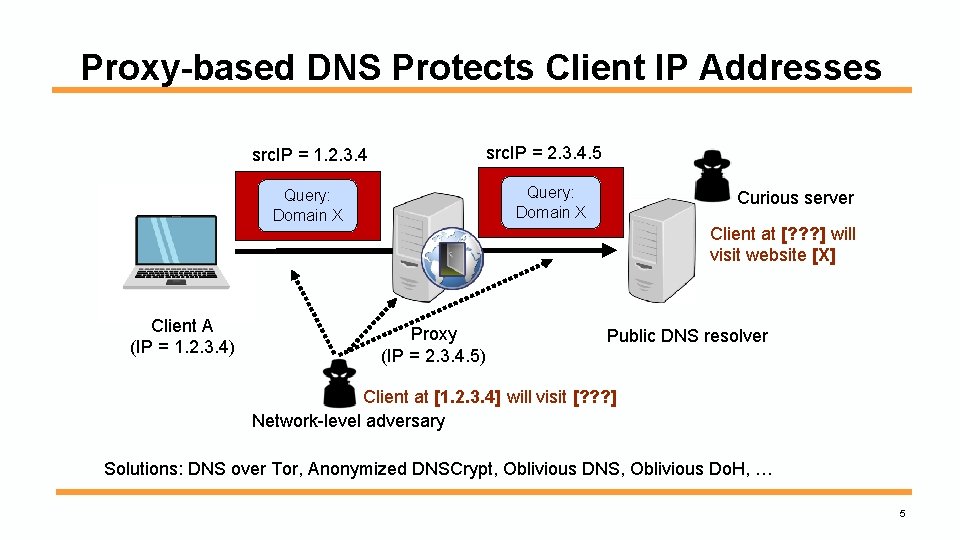
Proxy-based DNS Protects Client IP Addresses src. IP = 2. 3. 4. 5 src. IP = 1. 2. 3. 4 Query: Domain X Client A (IP = 1. 2. 3. 4) Curious server Client at [? ? ? ] will visit website [X] Proxy (IP = 2. 3. 4. 5) Public DNS resolver Client at [1. 2. 3. 4] will visit [? ? ? ] Network-level adversary Solutions: DNS over Tor, Anonymized DNSCrypt, Oblivious DNS, Oblivious Do. H, … 5
Proxy-based DNS: Practical Challenges Solutions: DNS over Tor, Anonymized DNSCrypt, Oblivious DNS, Oblivious Do. H, … • Higher latency • Modifications to DNS client / infrastructure Ø High deployment barriers for proxy-based solutions Need a lightweight IP anonymization method that requires no modifications to DNS client and server 6
Can We Embed Proxy in Network Elements? Opportunities: • Programmable data-plane hardware § Offload privacy functionality to the network o High speed o Avoid end user involvement • Growing ubiquity of IPv 6 in the Internet core • Use IPv 6 address to embed information 7
Our Solution: PINOT: A lightweight in-network IP address obfuscation system • Goal: Prevent public DNS services from associating client IP addresses to queries • Use programmable switch to encrypt IP addresses at a high speed (12. 8 Tbps) • No modification to DNS protocols; No additional client software installation • Complementary to encrypted DNS 8
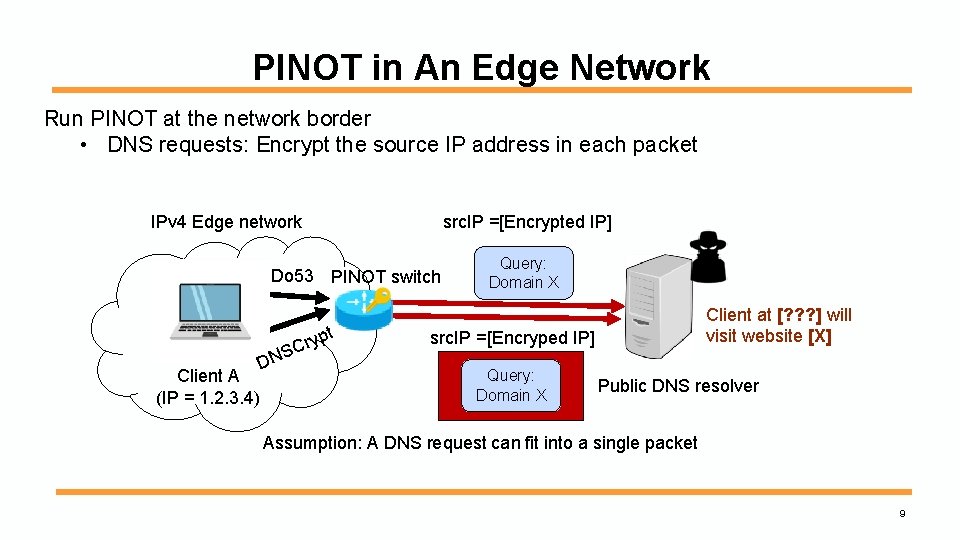
PINOT in An Edge Network Run PINOT at the network border • DNS requests: Encrypt the source IP address in each packet IPv 4 Edge network src. IP =[Encrypted IP] Do 53 PINOT switch t p Cry S DN Client A (IP = 1. 2. 3. 4) Query: Domain X Client at [? ? ? ] will visit website [X] src. IP =[Encryped IP] Query: Domain X Public DNS resolver Assumption: A DNS request can fit into a single packet 9
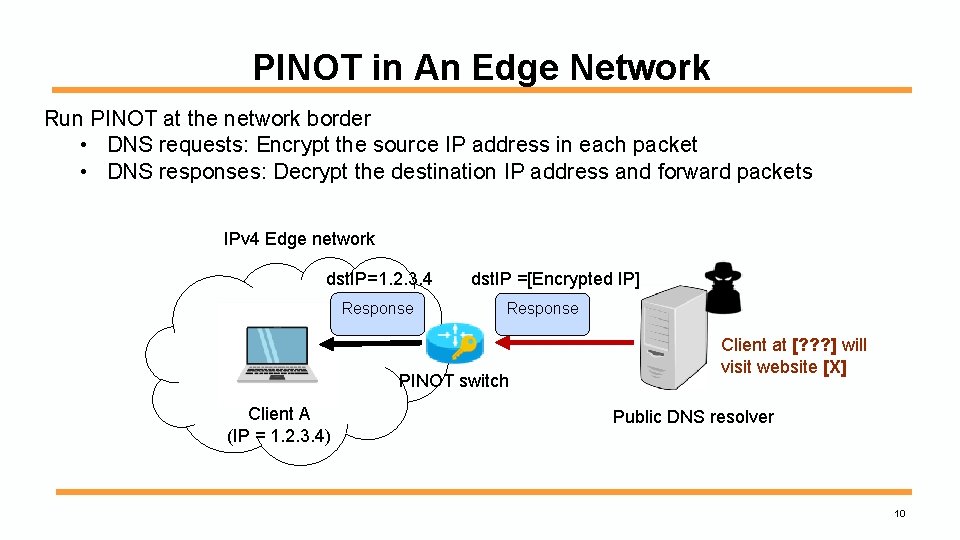
PINOT in An Edge Network Run PINOT at the network border • DNS requests: Encrypt the source IP address in each packet • DNS responses: Decrypt the destination IP address and forward packets IPv 4 Edge network dst. IP=1. 2. 3. 4 Response dst. IP =[Encrypted IP] Response PINOT switch Client A (IP = 1. 2. 3. 4) Client at [? ? ? ] will visit website [X] Public DNS resolver 10
Challenges • Perform encryption on resource-constrained programmable switch • Receive return traffic without cooperation • Work with asymmetric routing 11
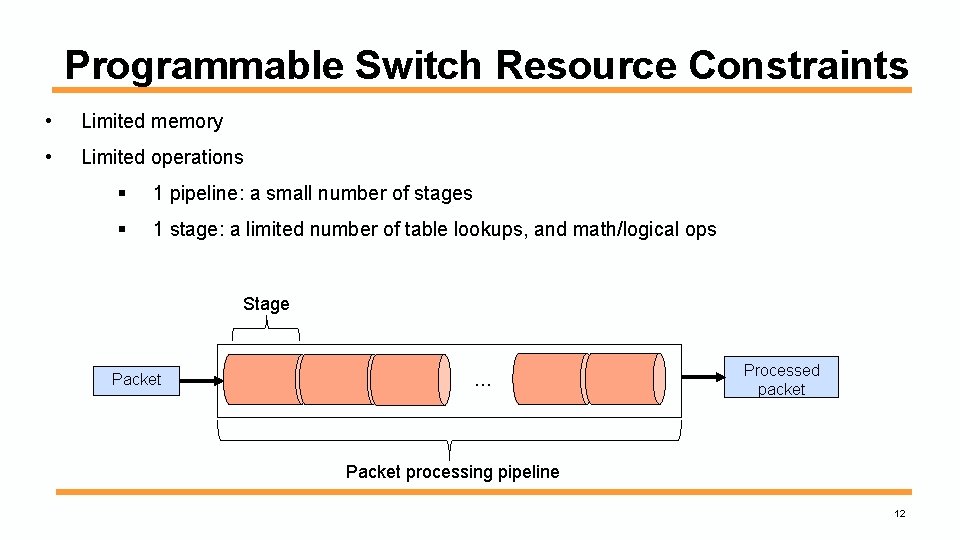
Programmable Switch Resource Constraints • Limited memory • Limited operations § 1 pipeline: a small number of stages § 1 stage: a limited number of table lookups, and math/logical ops Stage Packet … Processed packet Packet processing pipeline 12
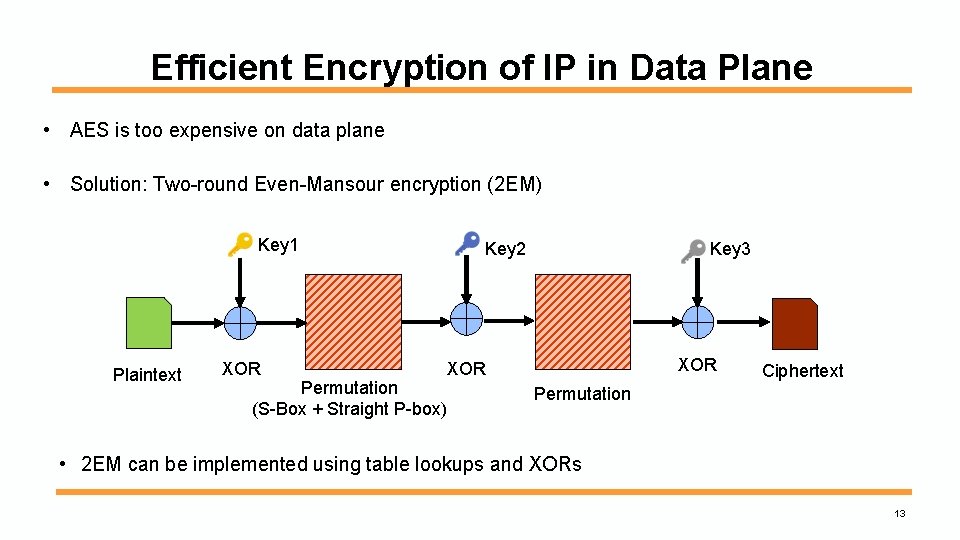
Efficient Encryption of IP in Data Plane • AES is too expensive on data plane • Solution: Two-round Even-Mansour encryption (2 EM) Key 1 Plaintext XOR Key 3 Key 2 XOR Permutation (S-Box + Straight P-box) Ciphertext Permutation • 2 EM can be implemented using table lookups and XORs 13
Efficient Encryption of IP in Data Plane • AES is too expensive on data plane • Solution: Two-round Even-Mansour encryption (2 EM) § Encrypt IP using a single pass through packet processing pipeline Ø Encrypt packets at 3. 2 Tbps on our Intel Tofino switch! § Pad IPv 4 address with random bits for stronger security and privacy Ø Consecutive requests from the same client have distinct client source IP addresses • See paper for more details 14
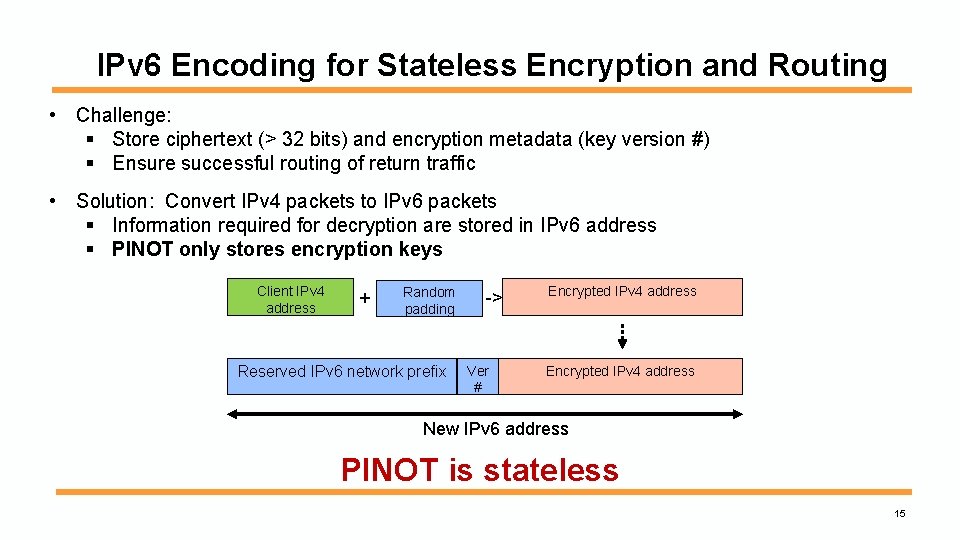
IPv 6 Encoding for Stateless Encryption and Routing • Challenge: § Store ciphertext (> 32 bits) and encryption metadata (key version #) § Ensure successful routing of return traffic • Solution: Convert IPv 4 packets to IPv 6 packets § Information required for decryption are stored in IPv 6 address § PINOT only stores encryption keys Client IPv 4 address + Random padding Reserved IPv 6 network prefix -> Ver # Encrypted IPv 4 address New IPv 6 address PINOT is stateless 15
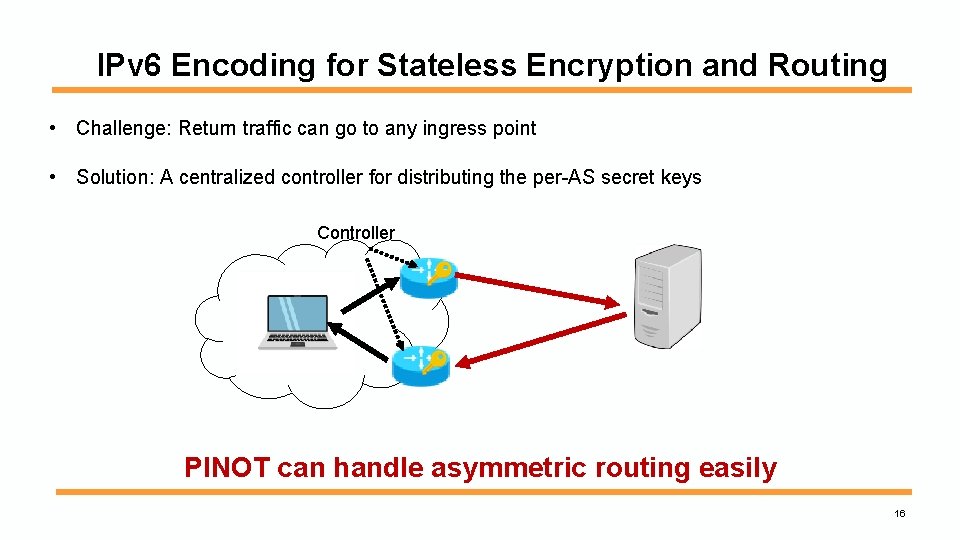
IPv 6 Encoding for Stateless Encryption and Routing • Challenge: Return traffic can go to any ingress point • Solution: A centralized controller for distributing the per-AS secret keys Controller PINOT can handle asymmetric routing easily 16
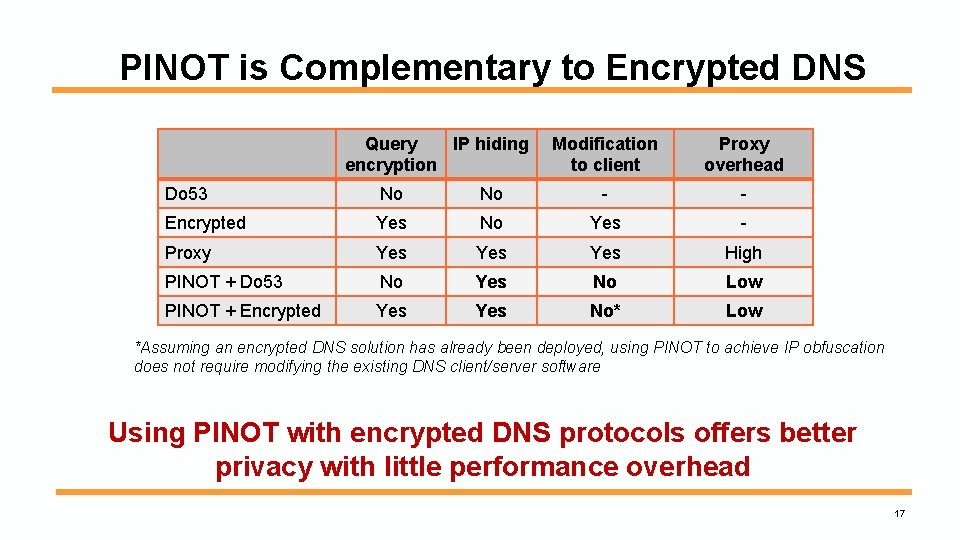
PINOT is Complementary to Encrypted DNS Query IP hiding encryption Modification to client Proxy overhead Do 53 No No - - Encrypted Yes No Yes - Proxy Yes Yes High PINOT + Do 53 No Yes No Low PINOT + Encrypted Yes No* Low *Assuming an encrypted DNS solution has already been deployed, using PINOT to achieve IP obfuscation does not require modifying the existing DNS client/server software Using PINOT with encrypted DNS protocols offers better privacy with little performance overhead 17
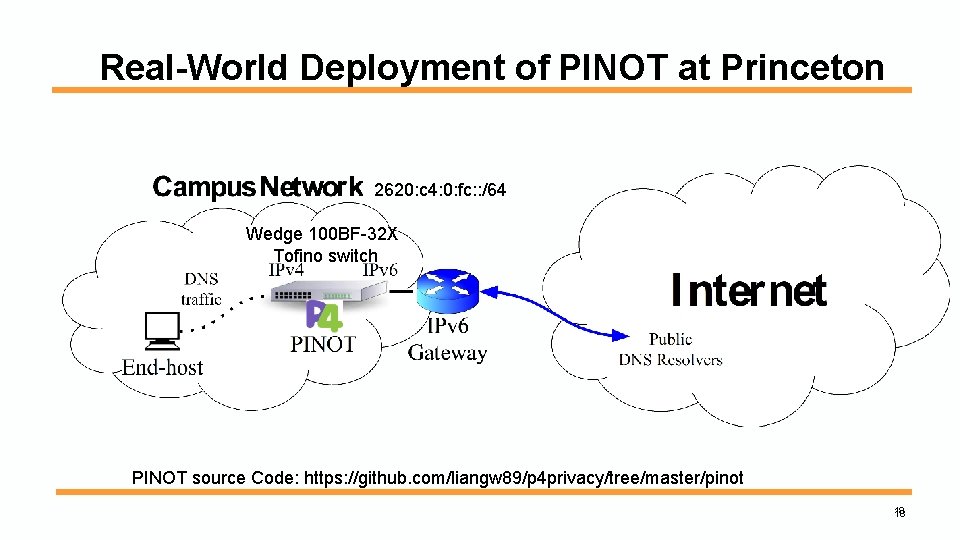
Real-World Deployment of PINOT at Princeton 2620: c 4: 0: fc: : /64 Wedge 100 BF-32 X Tofino switch PINOT source Code: https: //github. com/liangw 89/p 4 privacy/tree/master/pinot 18 18
Evaluation of PINOT for Do 53 • Target resolver: 350+ public resolvers with both IPv 4 and IPV 6 support • Query: 10 queries for random domains from Top 1 M to each resolver • Setting: IPv 6 network, IPv 4 network, and IPv 4 + PINOT Ø PINOT is feasible • DNS responses are consistent across settings Ø PINOT introduces low latency • Potential overhead: IPv 6 and IPv 4 packets take different routing paths • PINOT does not add extra latency in 97% of the cases 19 19
PINOT for Other Connectionless Protocols § NTP: IPv 6 host discovery and scanning § Single-packet protocol like DNS § Wire. Guard VPN: Client IP address collection § Crypto-key routing allows per-packet encryption without disrupting connectivity PINOT prevents the public NTP/Wire. Guard VPN servers from learning the real client IP addresses 20
Conclusion Ø PINOT, an in-network proxy service • Low performance overhead • Low deployment barriers § Single network § No modification to DNS § No cooperation from end-users Ø A network deploy can PINOT to provide extra privacy for users as a value-added service Ø A useful building block for bootstrapping more privacy applications! 21

22
PINOT Variants • PINOT for IPv 6 network • Use the lowest 64 bits of IPv 6 address for encryption • PINOT for connection-oriented protocols • Need to maintain per-connection state • Work with Do. H and Do. T 23
- Slides: 23