
Programmability from silicon to bits the Big Ideas
Programmability from silicon to bits the Big Ideas of Computer Science 6. 004 – Fall 2002 10/10/02 1
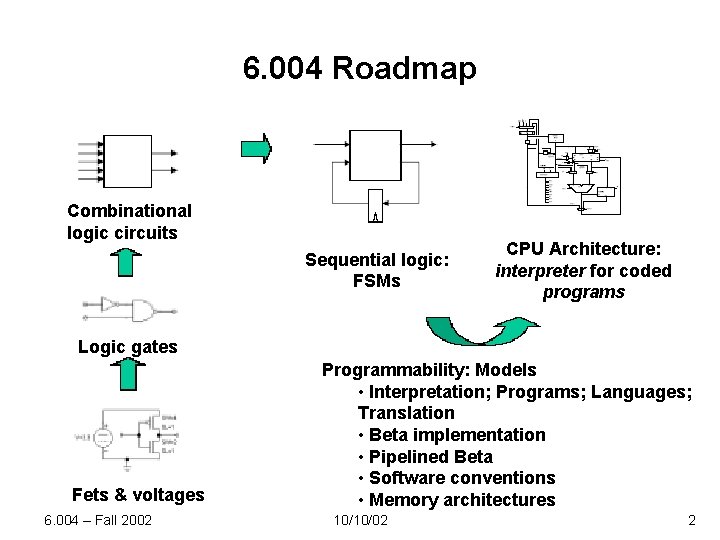
6. 004 Roadmap Combinational logic circuits Sequential logic: FSMs CPU Architecture: interpreter for coded programs Logic gates Fets & voltages 6. 004 – Fall 2002 Programmability: Models • Interpretation; Programs; Languages; Translation • Beta implementation • Pipelined Beta • Software conventions • Memory architectures 10/10/02 2

FSMs as Programmable Machines ROM-based FSM sketch: An FSM’s behavior is completely determined by its ROM contents. Given i, s, and o, we need a ROM organized as: inputs outputs 2 i+s words x (o+s) bits So how many possible i-input, o-output, FSMs with s-state bits exist? 2 (o+s)2 i+s (some may be equivalent) 6. 004 – Fall 2002 10/10/02 3
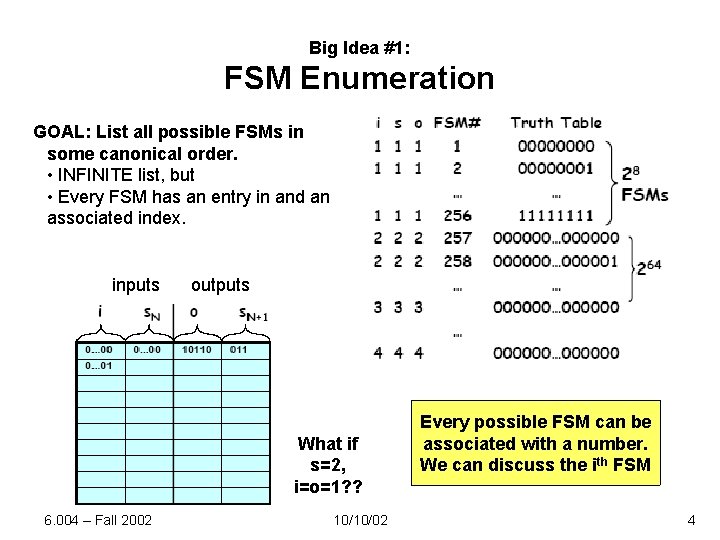
Big Idea #1: FSM Enumeration GOAL: List all possible FSMs in some canonical order. • INFINITE list, but • Every FSM has an entry in and an associated index. inputs outputs What if s=2, i=o=1? ? 6. 004 – Fall 2002 10/10/02 Every possible FSM can be associated with a number. We can discuss the ith FSM 4
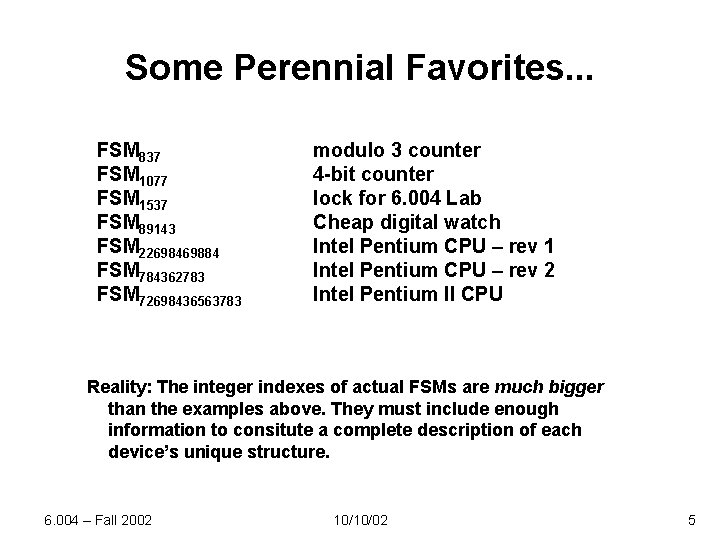
Some Perennial Favorites. . . FSM 837 FSM 1077 FSM 1537 FSM 89143 FSM 22698469884 FSM 784362783 FSM 72698436563783 modulo 3 counter 4 -bit counter lock for 6. 004 Lab Cheap digital watch Intel Pentium CPU – rev 1 Intel Pentium CPU – rev 2 Intel Pentium II CPU Reality: The integer indexes of actual FSMs are much bigger than the examples above. They must include enough information to consitute a complete description of each device’s unique structure. 6. 004 – Fall 2002 10/10/02 5
Models of Computation The roots of computer science stem from the study of many alternative mathematical “models” of computation, and study of the classes of computations they could represent. • switches An elusive goal was to find an “ultimate” model, capable of representing all practical compuations. . . • memories • gates • combinational logic • FSMs Are FSMs the ultimate digital computing device? 6. 004 – Fall 2002 10/10/02 6
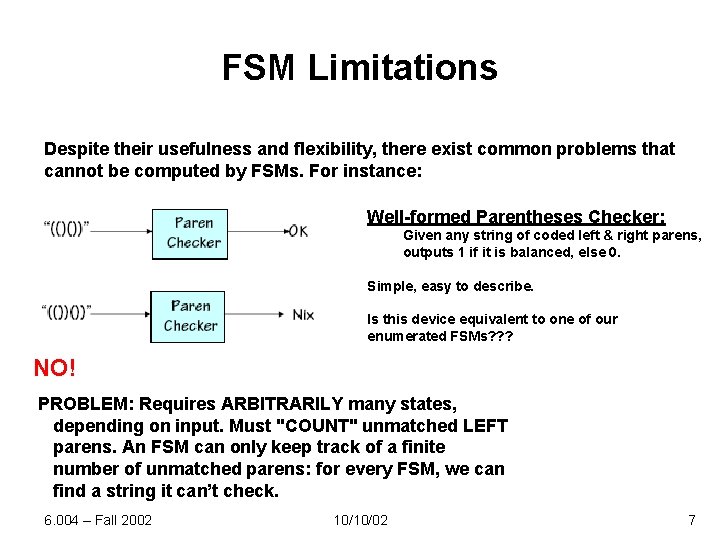
FSM Limitations Despite their usefulness and flexibility, there exist common problems that cannot be computed by FSMs. For instance: Well-formed Parentheses Checker: Given any string of coded left & right parens, outputs 1 if it is balanced, else 0. Simple, easy to describe. Is this device equivalent to one of our enumerated FSMs? ? ? NO! PROBLEM: Requires ARBITRARILY many states, depending on input. Must "COUNT" unmatched LEFT parens. An FSM can only keep track of a finite number of unmatched parens: for every FSM, we can find a string it can’t check. 6. 004 – Fall 2002 10/10/02 7
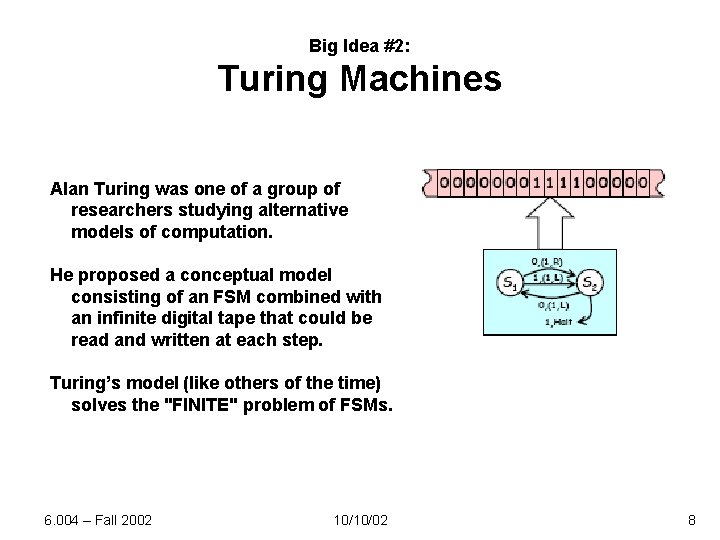
Big Idea #2: Turing Machines Alan Turing was one of a group of researchers studying alternative models of computation. He proposed a conceptual model consisting of an FSM combined with an infinite digital tape that could be read and written at each step. Turing’s model (like others of the time) solves the "FINITE" problem of FSMs. 6. 004 – Fall 2002 10/10/02 8
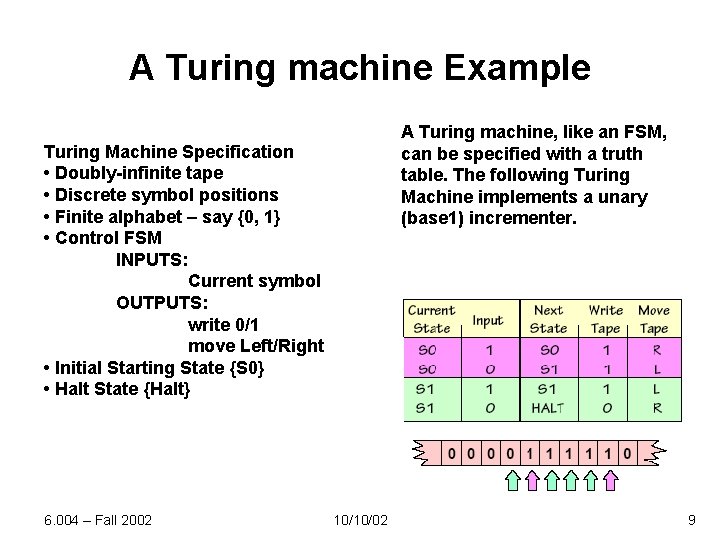
A Turing machine Example A Turing machine, like an FSM, can be specified with a truth table. The following Turing Machine implements a unary (base 1) incrementer. Turing Machine Specification • Doubly-infinite tape • Discrete symbol positions • Finite alphabet – say {0, 1} • Control FSM INPUTS: Current symbol OUTPUTS: write 0/1 move Left/Right • Initial Starting State {S 0} • Halt State {Halt} 6. 004 – Fall 2002 10/10/02 9
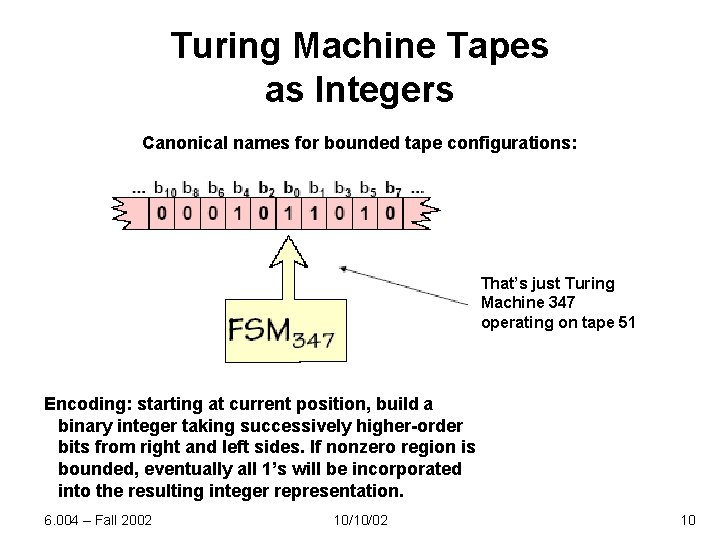
Turing Machine Tapes as Integers Canonical names for bounded tape configurations: That’s just Turing Machine 347 operating on tape 51 Encoding: starting at current position, build a binary integer taking successively higher-order bits from right and left sides. If nonzero region is bounded, eventually all 1’s will be incorporated into the resulting integer representation. 6. 004 – Fall 2002 10/10/02 10
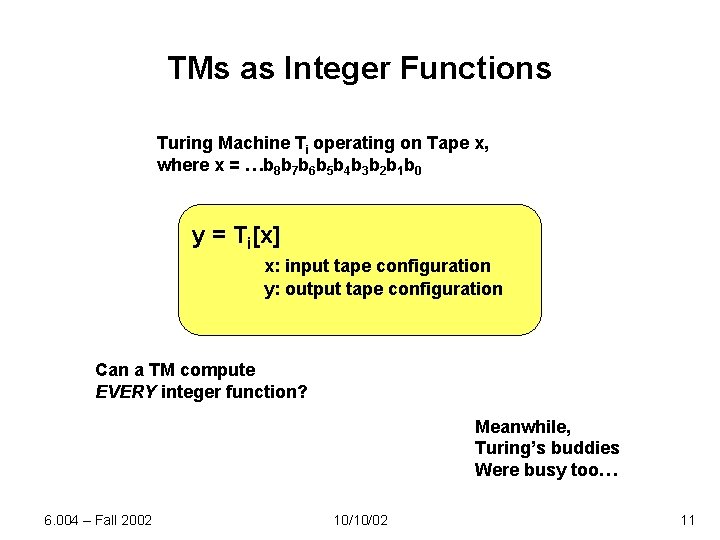
TMs as Integer Functions Turing Machine Ti operating on Tape x, where x = …b 8 b 7 b 6 b 5 b 4 b 3 b 2 b 1 b 0 y = Ti[x] x: input tape configuration y: output tape configuration Can a TM compute EVERY integer function? Meanwhile, Turing’s buddies Were busy too… 6. 004 – Fall 2002 10/10/02 11
![Alternative models of computation Turing Machines [Turing] Recursive Functions [Kleene] F(0, x) ≡ x](http://slidetodoc.com/presentation_image_h2/479c906f465798f02bd21a83a1508acd/image-12.jpg "Alternative models of computation Turing Machines [Turing] Recursive Functions [Kleene] F(0, x) ≡ x")
Alternative models of computation Turing Machines [Turing] Recursive Functions [Kleene] F(0, x) ≡ x F(1+y, x) ≡ 1+F(x, y) (define (fact n) (. . . (fact (- n 1)). . . ) Lambda calculus [Church, Curry, Rosser. . . ] λx. λy. xxy Production Systems [Post, Markov] (lambda(x)(lambda(y)(x (x y)))) 6. 004 – Fall 2002 10/10/02 α→β IF pulse=0 THEN patient=dead 12
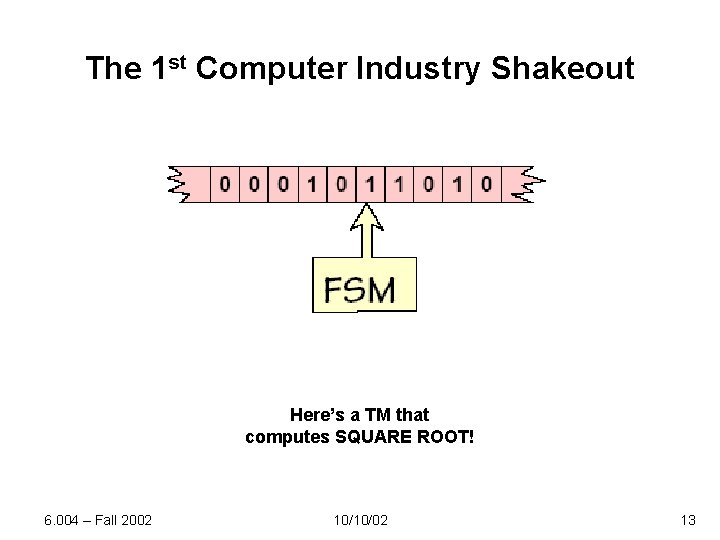
The 1 st Computer Industry Shakeout Here’s a TM that computes SQUARE ROOT! 6. 004 – Fall 2002 10/10/02 13
And the battles raged Here’s a Lambda Expression that does the same thing. . . (λ(x). . . and here’s one that computes the nth root for ANY n! (λ(x n). . . ) CONTEST: Which model computes more functions? RESULT: an N-way TIE! 6. 004 – Fall 2002 10/10/02 14
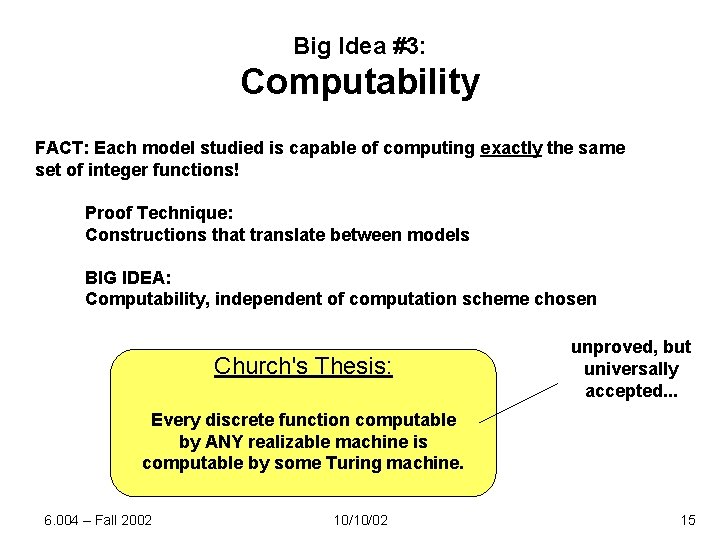
Big Idea #3: Computability FACT: Each model studied is capable of computing exactly the same set of integer functions! Proof Technique: Constructions that translate between models BIG IDEA: Computability, independent of computation scheme chosen Church's Thesis: unproved, but universally accepted. . . Every discrete function computable by ANY realizable machine is computable by some Turing machine. 6. 004 – Fall 2002 10/10/02 15
![Computable Function f(x) computable <=> for some k, all x: f(x) = TK[x] f.](http://slidetodoc.com/presentation_image_h2/479c906f465798f02bd21a83a1508acd/image-16.jpg "Computable Function f(x) computable <=> for some k, all x: f(x) = TK[x] f.")
Computable Function f(x) computable <=> for some k, all x: f(x) = TK[x] f. K(x) Equivalently: f(x) computable on Cray, Pentium, in C, Scheme, Java, . . . Representation Tricks: • Multi-argument functions? to compute fk(x, y), use <x, y> = ιnteger whose even bits come from x, and whose odd bits come from y; whence f. K(x, y) = TK[<x, y>] • Data types: Can encode characters, strings, floats, . . . as integers. • Alphabet size: use groups of N bits for 2 N symbols 6. 004 – Fall 2002 10/10/02 16
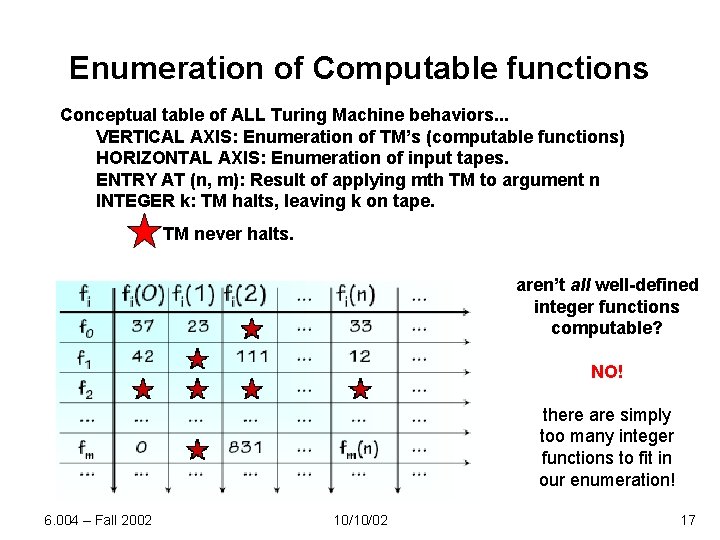
Enumeration of Computable functions Conceptual table of ALL Turing Machine behaviors. . . VERTICAL AXIS: Enumeration of TM’s (computable functions) HORIZONTAL AXIS: Enumeration of input tapes. ENTRY AT (n, m): Result of applying mth TM to argument n INTEGER k: TM halts, leaving k on tape. TM never halts. aren’t all well-defined integer functions computable? NO! there are simply too many integer functions to fit in our enumeration! 6. 004 – Fall 2002 10/10/02 17
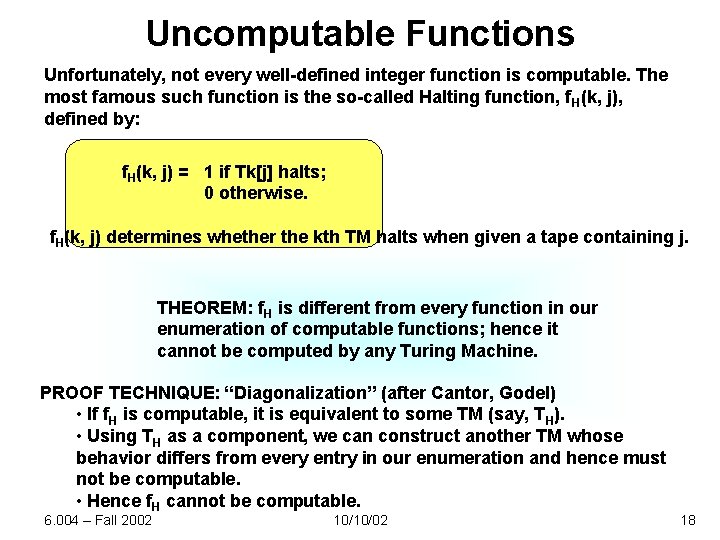
Uncomputable Functions Unfortunately, not every well-defined integer function is computable. The most famous such function is the so-called Halting function, f H(k, j), defined by: f. H(k, j) = 1 if Tk[j] halts; 0 otherwise. f. H(k, j) determines whether the kth TM halts when given a tape containing j. THEOREM: f. H is different from every function in our enumeration of computable functions; hence it cannot be computed by any Turing Machine. PROOF TECHNIQUE: “Diagonalization” (after Cantor, Godel) • If f. H is computable, it is equivalent to some TM (say, TH). • Using TH as a component, we can construct another TM whose behavior differs from every entry in our enumeration and hence must not be computable. • Hence f. H cannot be computable. 6. 004 – Fall 2002 10/10/02 18
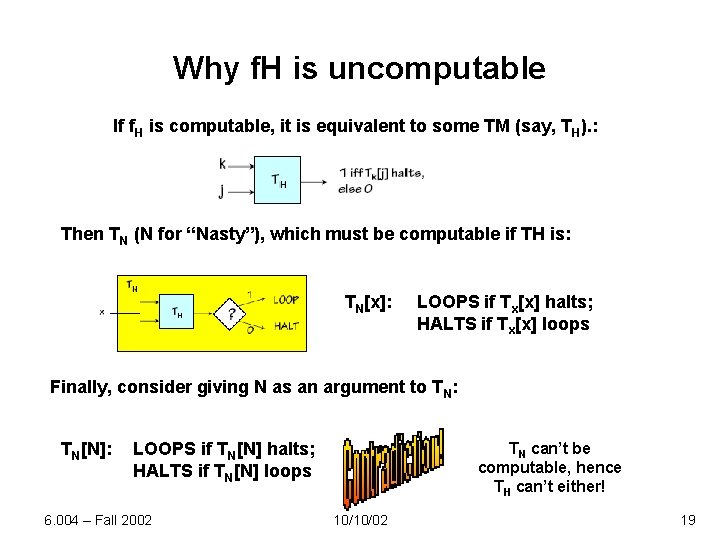
Why f. H is uncomputable If f. H is computable, it is equivalent to some TM (say, TH). : Then TN (N for “Nasty”), which must be computable if TH is: TN[x]: LOOPS if Tx[x] halts; HALTS if Tx[x] loops Finally, consider giving N as an argument to TN: TN[N]: TN can’t be computable, hence TH can’t either! LOOPS if TN[N] halts; HALTS if TN[N] loops 6. 004 – Fall 2002 10/10/02 19
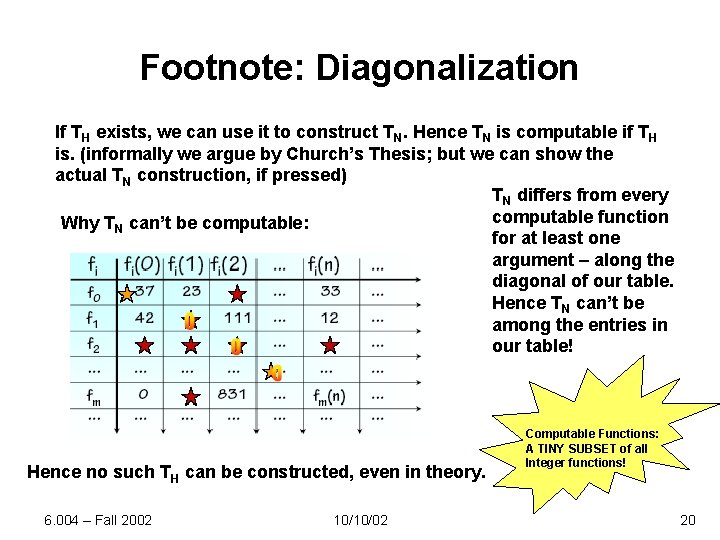
Footnote: Diagonalization If TH exists, we can use it to construct TN. Hence TN is computable if TH is. (informally we argue by Church’s Thesis; but we can show the actual TN construction, if pressed) TN differs from every computable function Why TN can’t be computable: for at least one argument – along the diagonal of our table. Hence TN can’t be among the entries in our table! Hence no such TH can be constructed, even in theory. 6. 004 – Fall 2002 10/10/02 Computable Functions: A TINY SUBSET of all Integer functions! 20
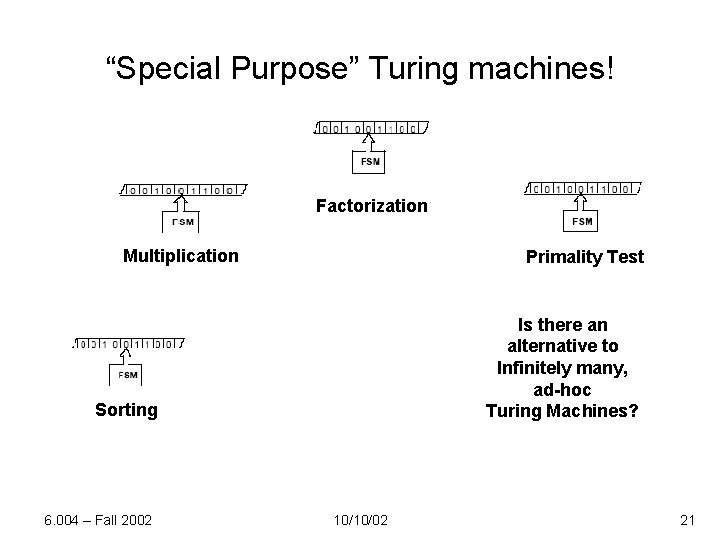
“Special Purpose” Turing machines! Factorization Multiplication Primality Test Is there an alternative to Infinitely many, ad-hoc Turing Machines? Sorting 6. 004 – Fall 2002 10/10/02 21
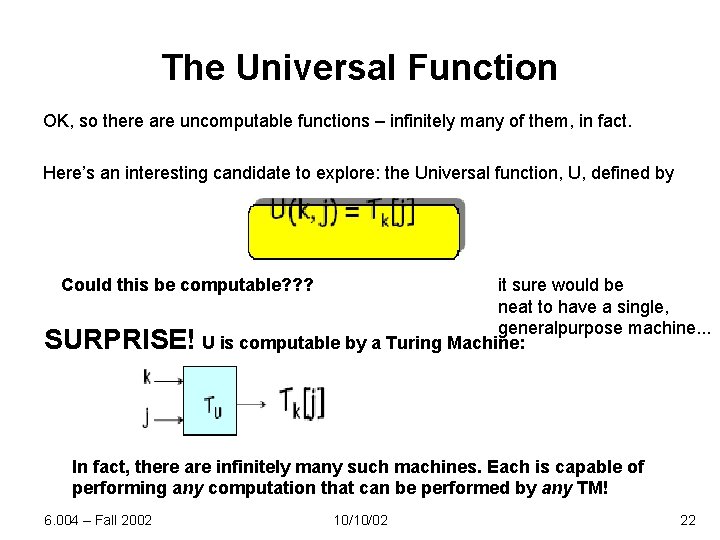
The Universal Function OK, so there are uncomputable functions – infinitely many of them, in fact. Here’s an interesting candidate to explore: the Universal function, U, defined by Could this be computable? ? ? it sure would be neat to have a single, generalpurpose machine. . . SURPRISE! U is computable by a Turing Machine: In fact, there are infinitely many such machines. Each is capable of performing any computation that can be performed by any TM! 6. 004 – Fall 2002 10/10/02 22
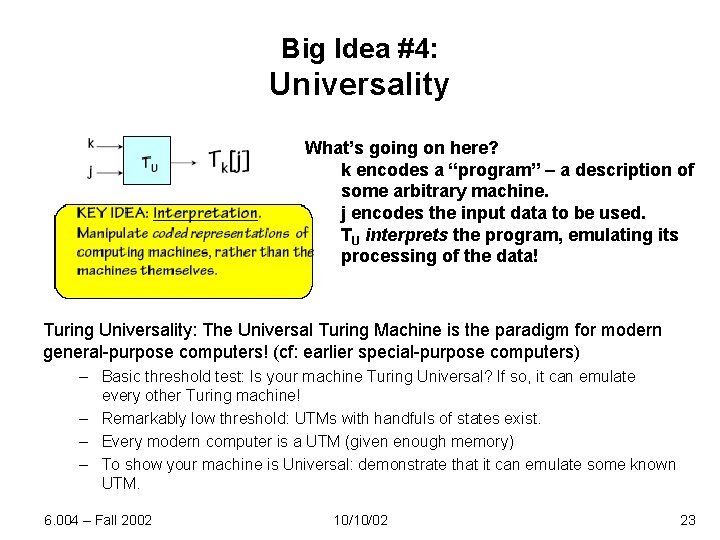
Big Idea #4: Universality What’s going on here? k encodes a “program” – a description of some arbitrary machine. j encodes the input data to be used. TU interprets the program, emulating its processing of the data! Turing Universality: The Universal Turing Machine is the paradigm for modern general-purpose computers! (cf: earlier special-purpose computers) – Basic threshold test: Is your machine Turing Universal? If so, it can emulate every other Turing machine! – Remarkably low threshold: UTMs with handfuls of states exist. – Every modern computer is a UTM (given enough memory) – To show your machine is Universal: demonstrate that it can emulate some known UTM. 6. 004 – Fall 2002 10/10/02 23
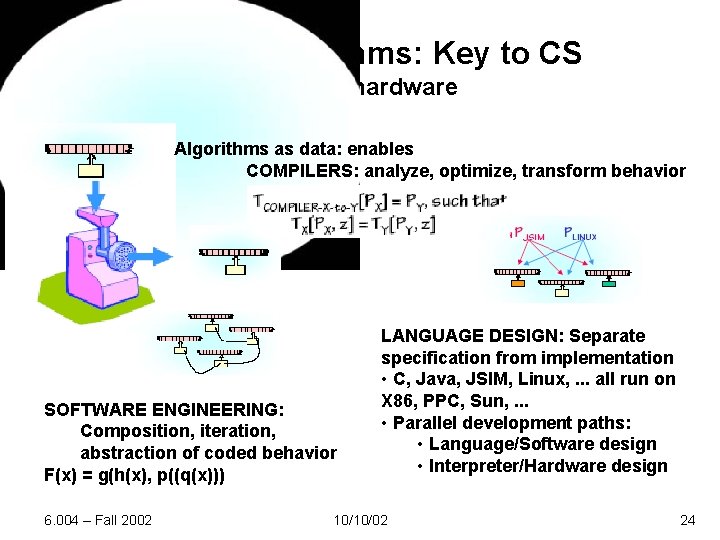
Coded Algorithms: Key to CS data vs hardware Algorithms as data: enables COMPILERS: analyze, optimize, transform behavior SOFTWARE ENGINEERING: Composition, iteration, abstraction of coded behavior F(x) = g(h(x), p((q(x))) 6. 004 – Fall 2002 LANGUAGE DESIGN: Separate specification from implementation • C, Java, JSIM, Linux, . . . all run on X 86, PPC, Sun, . . . • Parallel development paths: • Language/Software design • Interpreter/Hardware design 10/10/02 24
Summary • Formal models (computability, Turing Machines, Universality) provide the basis for modern computer science: – Fundamental limits (what can’t be done, even given plenty of memory and time) – Fundamental equivalence of computation models – Representation of algorithms as data, rather than machinery – Programs, Software, Interpreters, Compilers, . . . • They leave many practical dimensions to deal with: – Costs: Memory size, Time Performance – Programmability • Next step: Design of a practical interpreter! 6. 004 – Fall 2002 10/10/02 25
- Slides: 25