
Programando con Hilos POSIX Intel Software College Objetivos
Programando con Hilos POSIX* Intel Software College
Objetivos Explorar las funciones de la librería Pthreads para crear y sincronizar hilos Programming with POSIX* Threads 2 Copyright © 2006, Intel Corporation. All rights reserved. Intel and the Intel logo are trademarks or registered trademarks of Intel Corporation or its subsidiaries in the United States or other countries. *Other brands and names are the property of their respective owners.
¿Qué son los pthreads? Estándar POSIX. 1 c Interfaz en lenguaje C Los hilos existen dentro del mismo proceso Todos los hilos son pares • No es un modelo explícito padre-hijo • Excepto: “main thread” contiene toda la información del proceso Programming with POSIX* Threads 3 Copyright © 2006, Intel Corporation. All rights reserved. Intel and the Intel logo are trademarks or registered trademarks of Intel Corporation or its subsidiaries in the United States or other countries. *Other brands and names are the property of their respective owners.
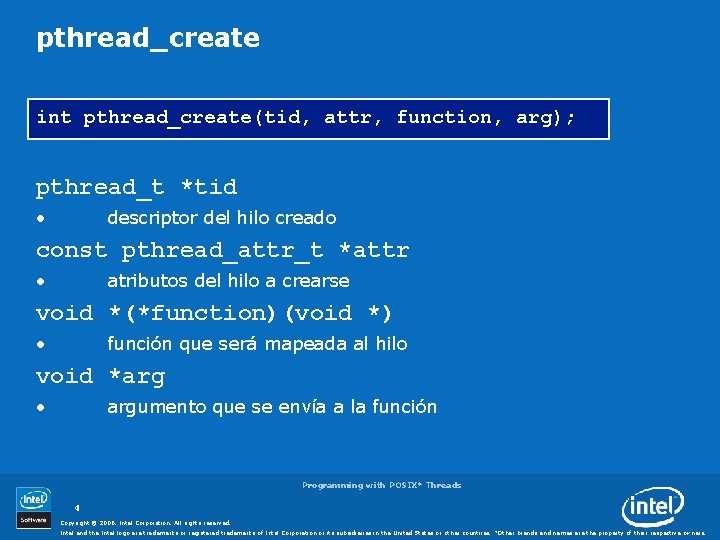
pthread_create int pthread_create(tid, attr, function, arg); pthread_t *tid • descriptor del hilo creado const pthread_attr_t *attr • atributos del hilo a crearse void *(*function)(void *) • función que será mapeada al hilo void *arg • argumento que se envía a la función Programming with POSIX* Threads 4 Copyright © 2006, Intel Corporation. All rights reserved. Intel and the Intel logo are trademarks or registered trademarks of Intel Corporation or its subsidiaries in the United States or other countries. *Other brands and names are the property of their respective owners.
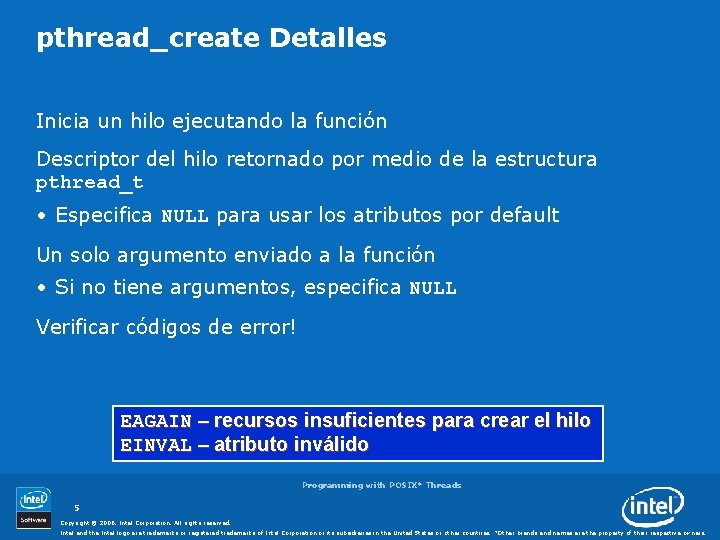
pthread_create Detalles Inicia un hilo ejecutando la función Descriptor del hilo retornado por medio de la estructura pthread_t • Especifica NULL para usar los atributos por default Un solo argumento enviado a la función • Si no tiene argumentos, especifica NULL Verificar códigos de error! EAGAIN – recursos insuficientes para crear el hilo EINVAL – atributo inválido Programming with POSIX* Threads 5 Copyright © 2006, Intel Corporation. All rights reserved. Intel and the Intel logo are trademarks or registered trademarks of Intel Corporation or its subsidiaries in the United States or other countries. *Other brands and names are the property of their respective owners.
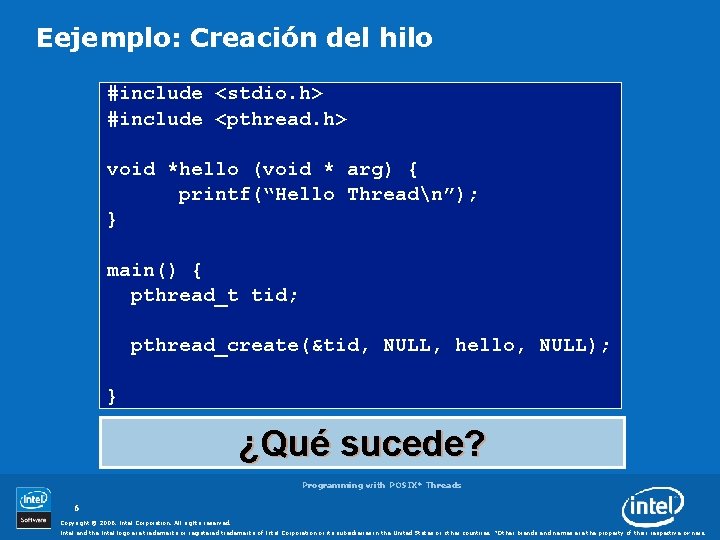
Eejemplo: Creación del hilo #include <stdio. h> #include <pthread. h> void *hello (void * arg) { printf(“Hello Threadn”); } main() { pthread_t tid; pthread_create(&tid, NULL, hello, NULL); } ¿Qué sucede? Programming with POSIX* Threads 6 Copyright © 2006, Intel Corporation. All rights reserved. Intel and the Intel logo are trademarks or registered trademarks of Intel Corporation or its subsidiaries in the United States or other countries. *Other brands and names are the property of their respective owners.
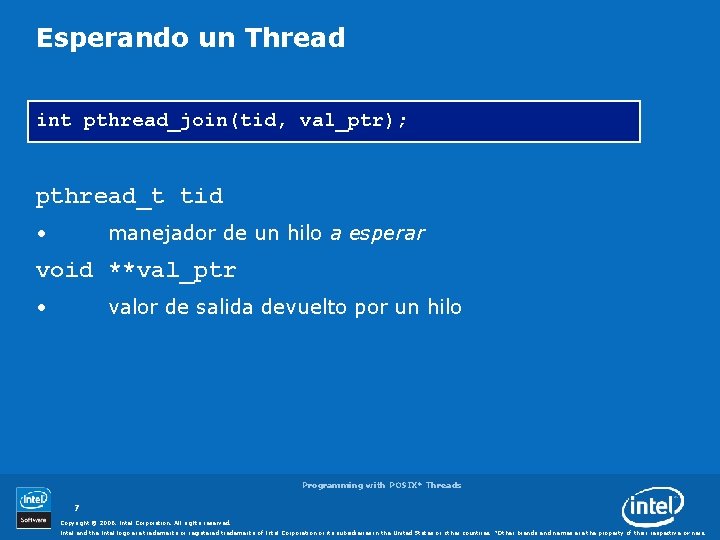
Esperando un Thread int pthread_join(tid, val_ptr); pthread_t tid • manejador de un hilo a esperar void **val_ptr • valor de salida devuelto por un hilo Programming with POSIX* Threads 7 Copyright © 2006, Intel Corporation. All rights reserved. Intel and the Intel logo are trademarks or registered trademarks of Intel Corporation or its subsidiaries in the United States or other countries. *Other brands and names are the property of their respective owners.
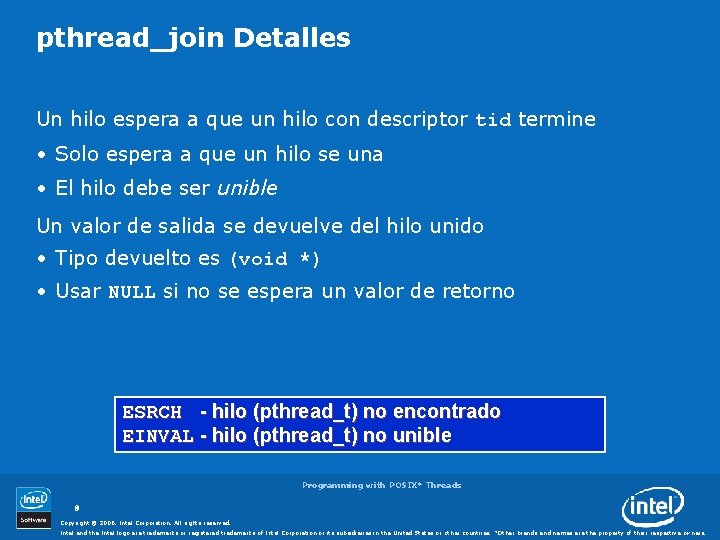
pthread_join Detalles Un hilo espera a que un hilo con descriptor tid termine • Solo espera a que un hilo se una • El hilo debe ser unible Un valor de salida se devuelve del hilo unido • Tipo devuelto es (void *) • Usar NULL si no se espera un valor de retorno ESRCH - hilo (pthread_t) no encontrado EINVAL - hilo (pthread_t) no unible Programming with POSIX* Threads 8 Copyright © 2006, Intel Corporation. All rights reserved. Intel and the Intel logo are trademarks or registered trademarks of Intel Corporation or its subsidiaries in the United States or other countries. *Other brands and names are the property of their respective owners.
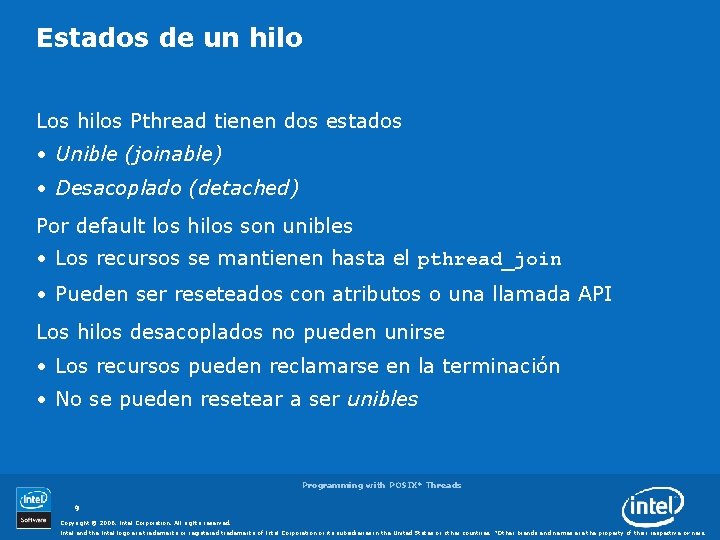
Estados de un hilo Los hilos Pthread tienen dos estados • Unible (joinable) • Desacoplado (detached) Por default los hilos son unibles • Los recursos se mantienen hasta el pthread_join • Pueden ser reseteados con atributos o una llamada API Los hilos desacoplados no pueden unirse • Los recursos pueden reclamarse en la terminación • No se pueden resetear a ser unibles Programming with POSIX* Threads 9 Copyright © 2006, Intel Corporation. All rights reserved. Intel and the Intel logo are trademarks or registered trademarks of Intel Corporation or its subsidiaries in the United States or other countries. *Other brands and names are the property of their respective owners.
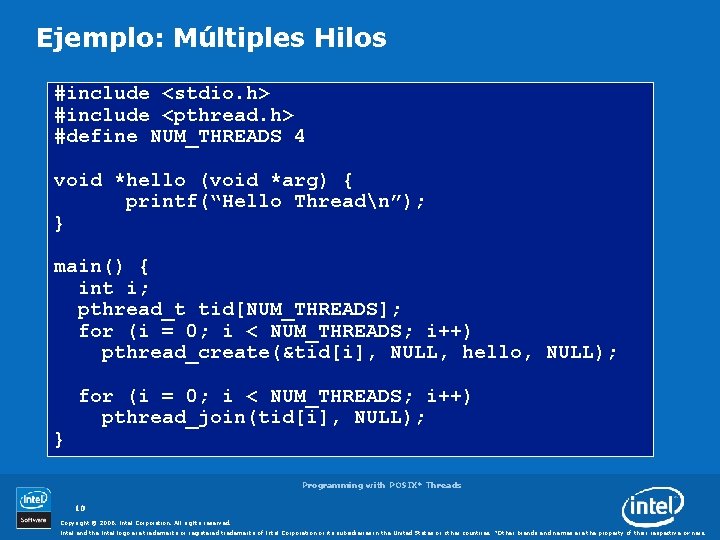
Ejemplo: Múltiples Hilos #include <stdio. h> #include <pthread. h> #define NUM_THREADS 4 void *hello (void *arg) { printf(“Hello Threadn”); } main() { int i; pthread_t tid[NUM_THREADS]; for (i = 0; i < NUM_THREADS; i++) pthread_create(&tid[i], NULL, hello, NULL); } for (i = 0; i < NUM_THREADS; i++) pthread_join(tid[i], NULL); Programming with POSIX* Threads 10 Copyright © 2006, Intel Corporation. All rights reserved. Intel and the Intel logo are trademarks or registered trademarks of Intel Corporation or its subsidiaries in the United States or other countries. *Other brands and names are the property of their respective owners.
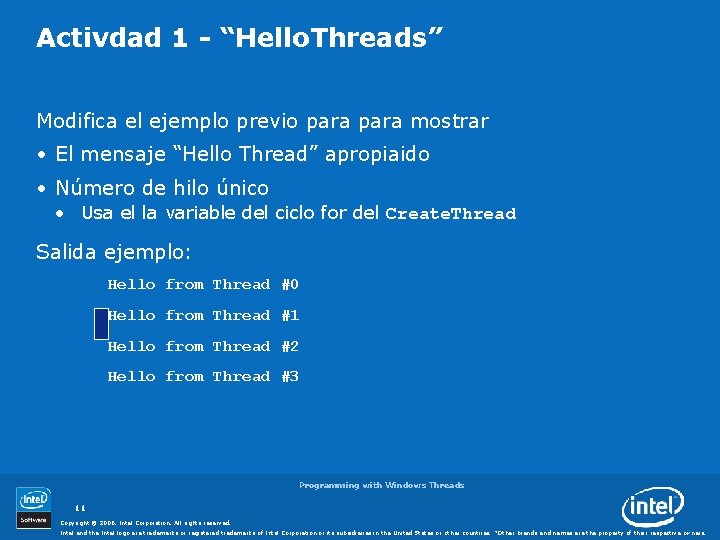
Activdad 1 - “Hello. Threads” Modifica el ejemplo previo para mostrar • El mensaje “Hello Thread” apropiaido • Número de hilo único • Usa el la variable del ciclo for del Create. Thread Salida ejemplo: Hello from Thread #0 Hello from Thread #1 Hello from Thread #2 Hello from Thread #3 Programming with Windows Threads 11 Copyright © 2006, Intel Corporation. All rights reserved. Intel and the Intel logo are trademarks or registered trademarks of Intel Corporation or its subsidiaries in the United States or other countries. *Other brands and names are the property of their respective owners.
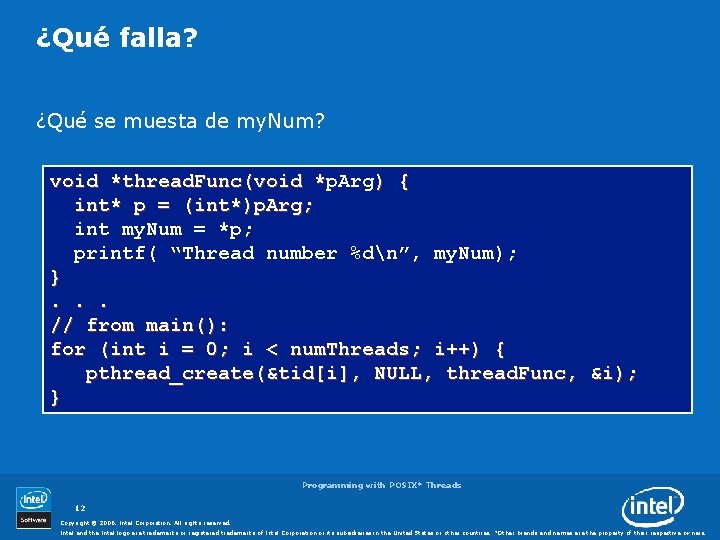
¿Qué falla? ¿Qué se muesta de my. Num? void *thread. Func(void *p. Arg ) { * int* p = (int*)p. Arg; int my. Num = *p; printf( “Thread number %dn”, my. Num); }. . . // from main(): for (int i = 0; i < num. Threads; i++) { pthread_create(&tid[i], NULL, thread. Func, &i); } Programming with POSIX* Threads 12 Copyright © 2006, Intel Corporation. All rights reserved. Intel and the Intel logo are trademarks or registered trademarks of Intel Corporation or its subsidiaries in the United States or other countries. *Other brands and names are the property of their respective owners.
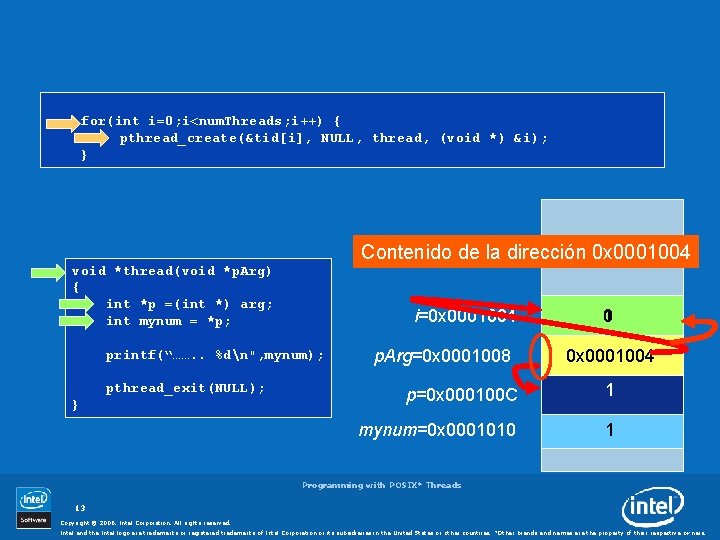
for(int i=0; i<num. Threads; i++) { pthread_create(&tid[i], NULL, thread, (void *) &i); } Contenido de la dirección 0 x 0001004 void *thread(void *p. Arg) { int *p =(int *) arg; int mynum = *p; i=0 x 0001004 printf(“……. . %dn", mynum); pthread_exit(NULL); } p. Arg=0 x 0001008 0 1 0 x 0001004 p=0 x 000100 C 1 mynum=0 x 0001010 1 Programming with POSIX* Threads 13 Copyright © 2006, Intel Corporation. All rights reserved. Intel and the Intel logo are trademarks or registered trademarks of Intel Corporation or its subsidiaries in the United States or other countries. *Other brands and names are the property of their respective owners.
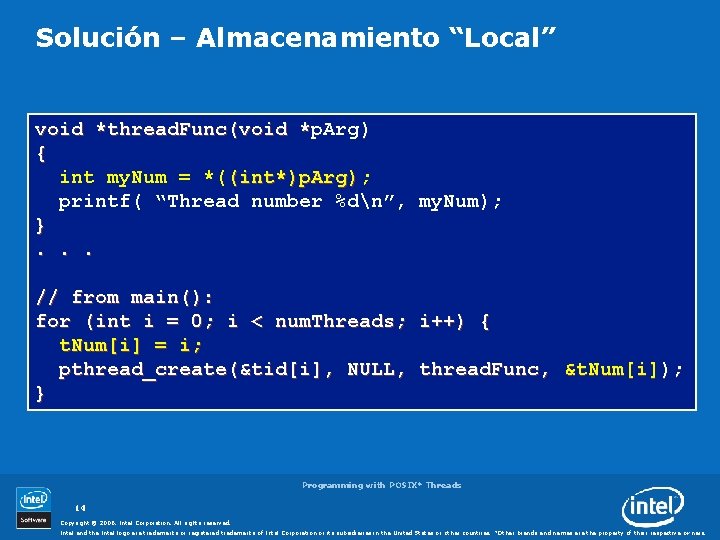
Solución – Almacenamiento “Local” void *thread. Func(void *p. Arg ) * { int my. Num = *((int*)p. Arg); (int*)p. Arg) printf( “Thread number %dn”, my. Num); }. . . // from main(): for (int i = 0; i < num. Threads; t. Num[i] = i; pthread_create(&tid[i], NULL, } i++) { thread. Func, &t. Num[i]); Programming with POSIX* Threads 14 Copyright © 2006, Intel Corporation. All rights reserved. Intel and the Intel logo are trademarks or registered trademarks of Intel Corporation or its subsidiaries in the United States or other countries. *Other brands and names are the property of their respective owners.
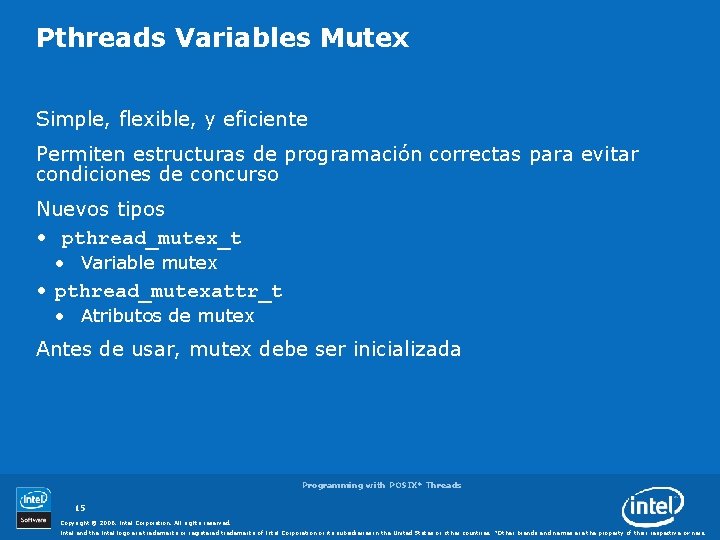
Pthreads Variables Mutex Simple, flexible, y eficiente Permiten estructuras de programación correctas para evitar condiciones de concurso Nuevos tipos • pthread_mutex_t • Variable mutex • pthread_mutexattr_t • Atributos de mutex Antes de usar, mutex debe ser inicializada Programming with POSIX* Threads 15 Copyright © 2006, Intel Corporation. All rights reserved. Intel and the Intel logo are trademarks or registered trademarks of Intel Corporation or its subsidiaries in the United States or other countries. *Other brands and names are the property of their respective owners.
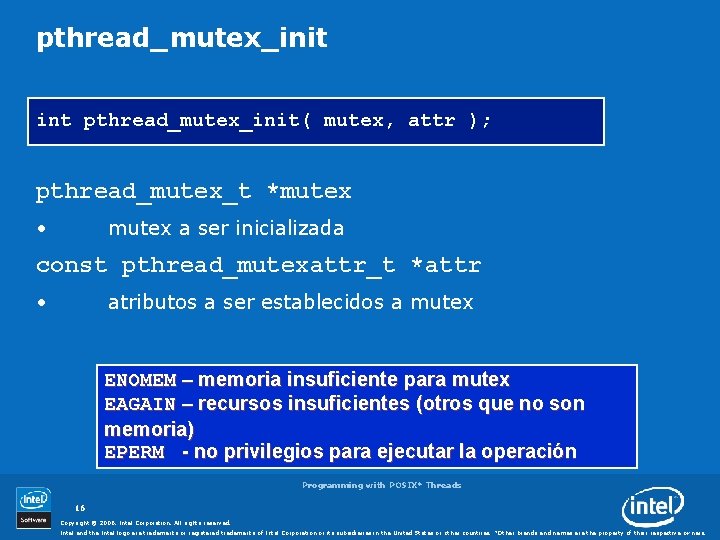
pthread_mutex_init int pthread_mutex_init( mutex, attr ); pthread_mutex_t *mutex • mutex a ser inicializada const pthread_mutexattr_t *attr • atributos a ser establecidos a mutex ENOMEM – memoria insuficiente para mutex EAGAIN – recursos insuficientes (otros que no son memoria) EPERM - no privilegios para ejecutar la operación Programming with POSIX* Threads 16 Copyright © 2006, Intel Corporation. All rights reserved. Intel and the Intel logo are trademarks or registered trademarks of Intel Corporation or its subsidiaries in the United States or other countries. *Other brands and names are the property of their respective owners.
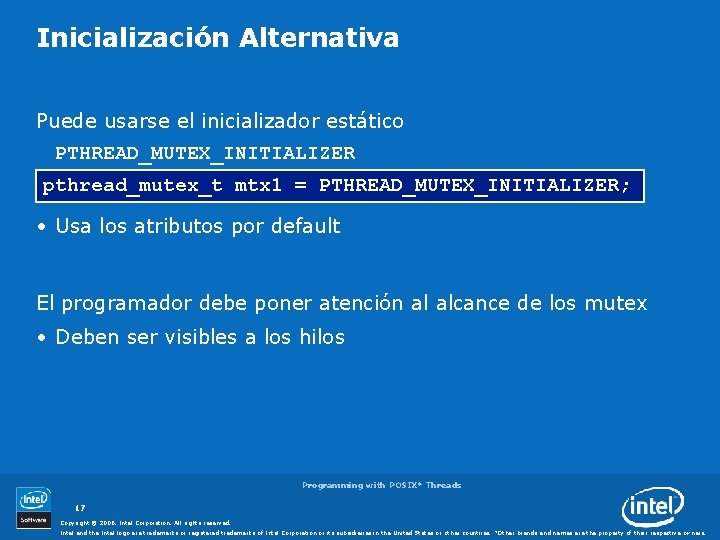
Inicialización Alternativa Puede usarse el inicializador estático PTHREAD_MUTEX_INITIALIZER pthread_mutex_t mtx 1 = PTHREAD_MUTEX_INITIALIZER; • Usa los atributos por default El programador debe poner atención al alcance de los mutex • Deben ser visibles a los hilos Programming with POSIX* Threads 17 Copyright © 2006, Intel Corporation. All rights reserved. Intel and the Intel logo are trademarks or registered trademarks of Intel Corporation or its subsidiaries in the United States or other countries. *Other brands and names are the property of their respective owners.
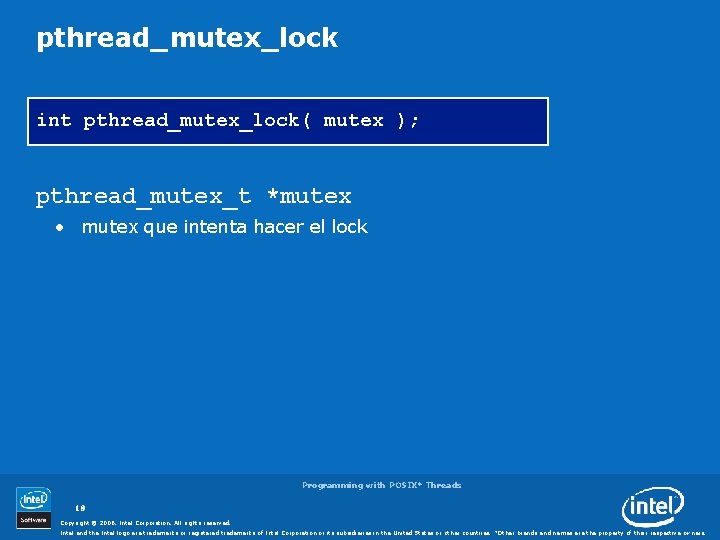
pthread_mutex_lock int pthread_mutex_lock( mutex ); pthread_mutex_t *mutex • mutex que intenta hacer el lock Programming with POSIX* Threads 18 Copyright © 2006, Intel Corporation. All rights reserved. Intel and the Intel logo are trademarks or registered trademarks of Intel Corporation or its subsidiaries in the United States or other countries. *Other brands and names are the property of their respective owners.
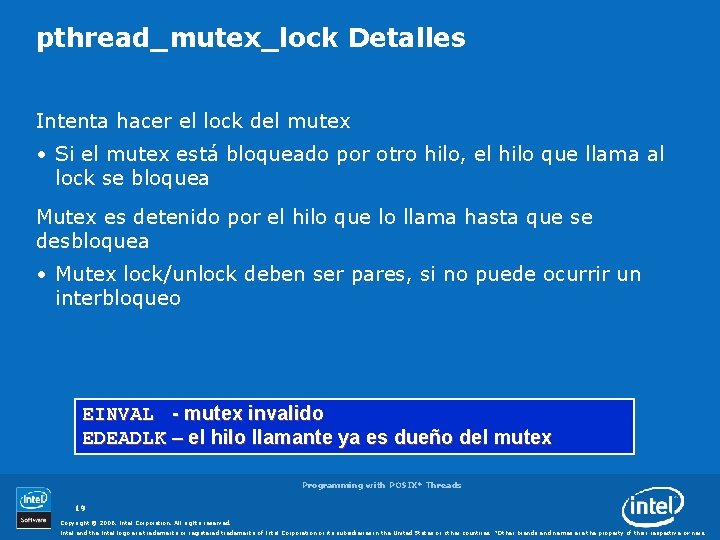
pthread_mutex_lock Detalles Intenta hacer el lock del mutex • Si el mutex está bloqueado por otro hilo, el hilo que llama al lock se bloquea Mutex es detenido por el hilo que lo llama hasta que se desbloquea • Mutex lock/unlock deben ser pares, si no puede ocurrir un interbloqueo EINVAL - mutex invalido EDEADLK – el hilo llamante ya es dueño del mutex Programming with POSIX* Threads 19 Copyright © 2006, Intel Corporation. All rights reserved. Intel and the Intel logo are trademarks or registered trademarks of Intel Corporation or its subsidiaries in the United States or other countries. *Other brands and names are the property of their respective owners.

pthread_mutex_unlock int pthread_mutex_unlock( mutex ); pthread_mutex_t *mutex • mutex a ser desbloqueado EINVAL - mutex es inválido EPERM - el hilo llamante no es dueño del mutex Programming with POSIX* Threads 20 Copyright © 2006, Intel Corporation. All rights reserved. Intel and the Intel logo are trademarks or registered trademarks of Intel Corporation or its subsidiaries in the United States or other countries. *Other brands and names are the property of their respective owners.
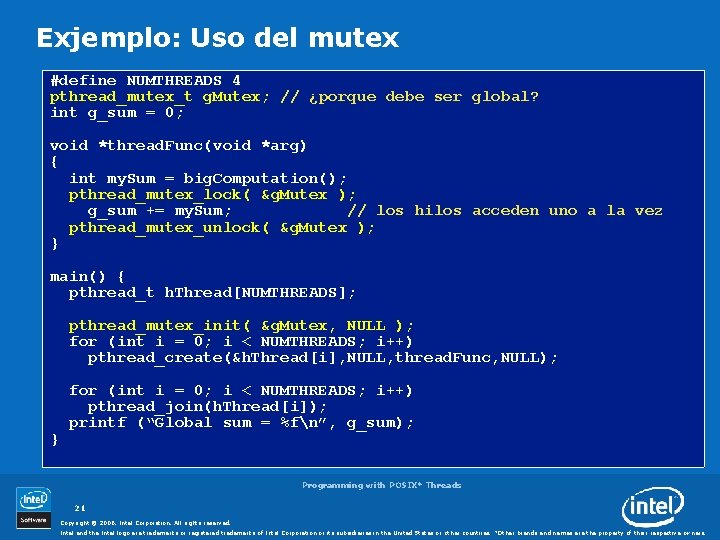
Exjemplo: Uso del mutex #define NUMTHREADS 4 pthread_mutex_t g. Mutex; // ¿porque debe ser global? int g_sum = 0; void *thread. Func(void *arg) { int my. Sum = big. Computation(); pthread_mutex_lock( &g. Mutex ); g_sum += my. Sum; // los hilos acceden uno a la vez pthread_mutex_unlock( &g. Mutex ); } main() { pthread_t h. Thread[NUMTHREADS]; pthread_mutex_init( &g. Mutex, NULL ); for (int i = 0; i < NUMTHREADS; i++) pthread_create(&h. Thread[i], NULL, thread. Func, NULL); } for (int i = 0; i < NUMTHREADS; i++) pthread_join(h. Thread[i]); printf (“Global sum = %fn”, g_sum); Programming with POSIX* Threads 21 Copyright © 2006, Intel Corporation. All rights reserved. Intel and the Intel logo are trademarks or registered trademarks of Intel Corporation or its subsidiaries in the United States or other countries. *Other brands and names are the property of their respective owners.
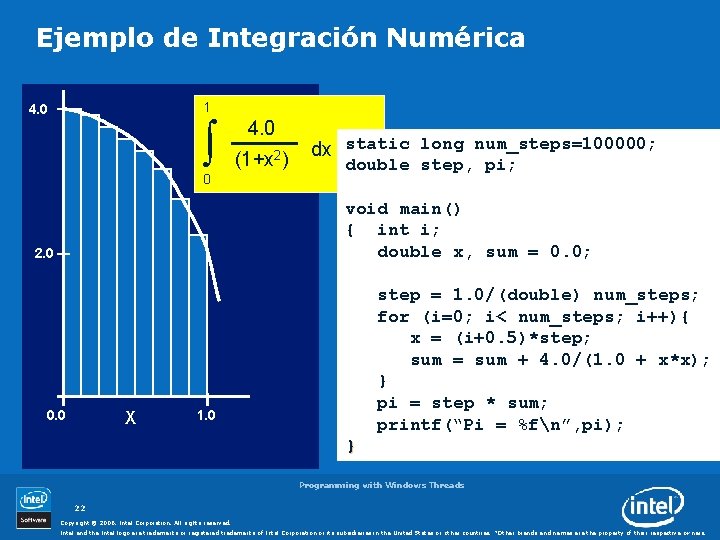
Ejemplo de Integración Numérica 1 4. 04. 0 long num_steps=100000; f(x) = 2 dx =static 2 (1+x ) ) (1+x double step, pi; 0 void main() { int i; double x, sum = 0. 0; 2. 0 0. 0 X step = 1. 0/(double) num_steps; for (i=0; i< num_steps; i++){ x = (i+0. 5)*step; sum = sum + 4. 0/(1. 0 + x*x); } pi = step * sum; printf(“Pi = %fn”, pi); 1. 0 } Programming with Windows Threads 22 Copyright © 2006, Intel Corporation. All rights reserved. Intel and the Intel logo are trademarks or registered trademarks of Intel Corporation or its subsidiaries in the United States or other countries. *Other brands and names are the property of their respective owners.
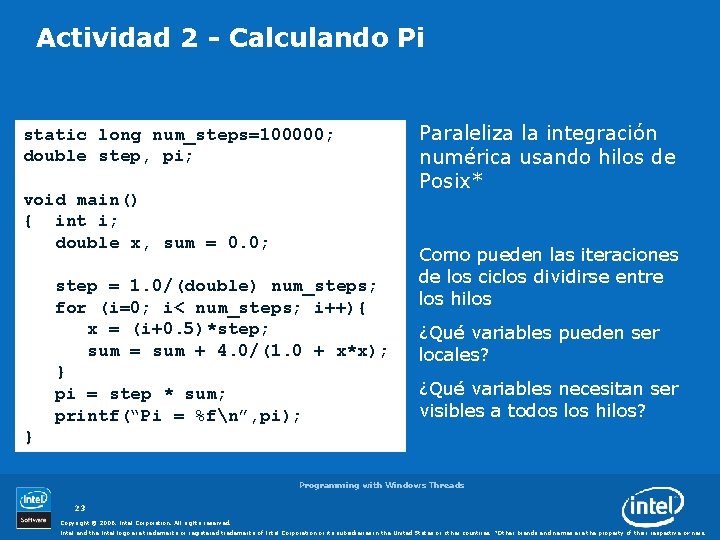
Actividad 2 - Calculando Pi static long num_steps=100000; double step, pi; void main() { int i; double x, sum = 0. 0; step = 1. 0/(double) num_steps; for (i=0; i< num_steps; i++){ x = (i+0. 5)*step; sum = sum + 4. 0/(1. 0 + x*x); } pi = step * sum; printf(“Pi = %fn”, pi); Paraleliza la integración numérica usando hilos de Posix* Como pueden las iteraciones de los ciclos dividirse entre los hilos ¿Qué variables pueden ser locales? ¿Qué variables necesitan ser visibles a todos los hilos? } Programming with Windows Threads 23 Copyright © 2006, Intel Corporation. All rights reserved. Intel and the Intel logo are trademarks or registered trademarks of Intel Corporation or its subsidiaries in the United States or other countries. *Other brands and names are the property of their respective owners.
Variables Condición Los semáforos son condicionales de acuerdo al contador del semáforo Las variables condición están asociadas con una condición arbitraria • Las mismas operaciones: wait y signal Proveen exclusión mutua Programming with POSIX* Threads 24 Copyright © 2006, Intel Corporation. All rights reserved. Intel and the Intel logo are trademarks or registered trademarks of Intel Corporation or its subsidiaries in the United States or other countries. *Other brands and names are the property of their respective owners.
Variable condición y Mutex Un mutex está asociado con una variable condición • Protege la evaluación de la expresión condicional • Previene condiciones de concurso entre los hilos que están enviando la señal y los hilos que esperan en la variable condición Programming with POSIX* Threads 25 Copyright © 2006, Intel Corporation. All rights reserved. Intel and the Intel logo are trademarks or registered trademarks of Intel Corporation or its subsidiaries in the United States or other countries. *Other brands and names are the property of their respective owners.
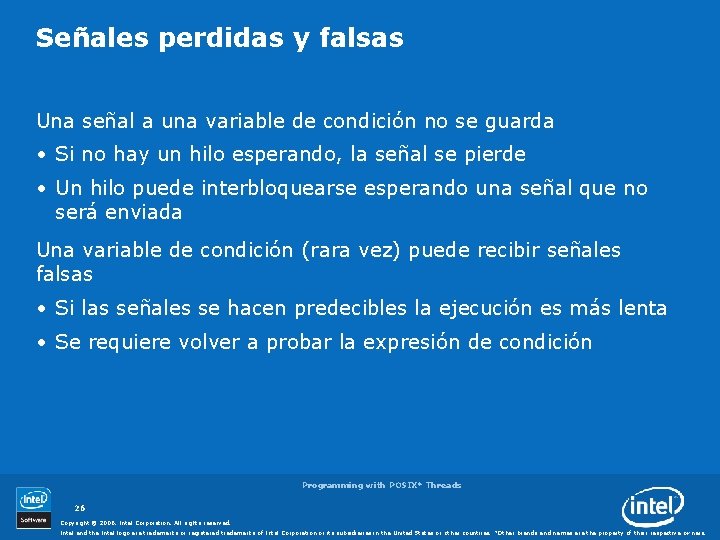
Señales perdidas y falsas Una señal a una variable de condición no se guarda • Si no hay un hilo esperando, la señal se pierde • Un hilo puede interbloquearse esperando una señal que no será enviada Una variable de condición (rara vez) puede recibir señales falsas • Si las señales se hacen predecibles la ejecución es más lenta • Se requiere volver a probar la expresión de condición Programming with POSIX* Threads 26 Copyright © 2006, Intel Corporation. All rights reserved. Intel and the Intel logo are trademarks or registered trademarks of Intel Corporation or its subsidiaries in the United States or other countries. *Other brands and names are the property of their respective owners.
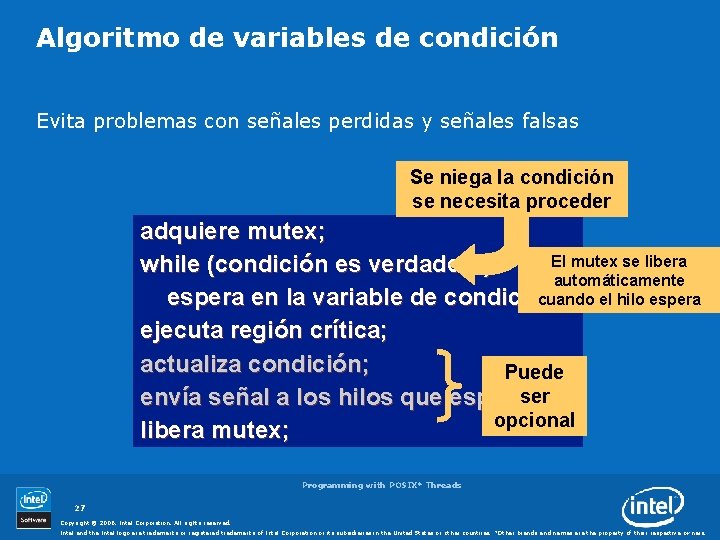
Algoritmo de variables de condición Evita problemas con señales perdidas y señales falsas Se niega la condición se necesita proceder adquiere mutex; El mutex se libera while (condición es verdadera) automáticamente cuando el hilo espera en la variable de condición; ejecuta región crítica; actualiza condición; Puede ser envía señal a los hilos que esperan; opcional libera mutex; Programming with POSIX* Threads 27 Copyright © 2006, Intel Corporation. All rights reserved. Intel and the Intel logo are trademarks or registered trademarks of Intel Corporation or its subsidiaries in the United States or other countries. *Other brands and names are the property of their respective owners.
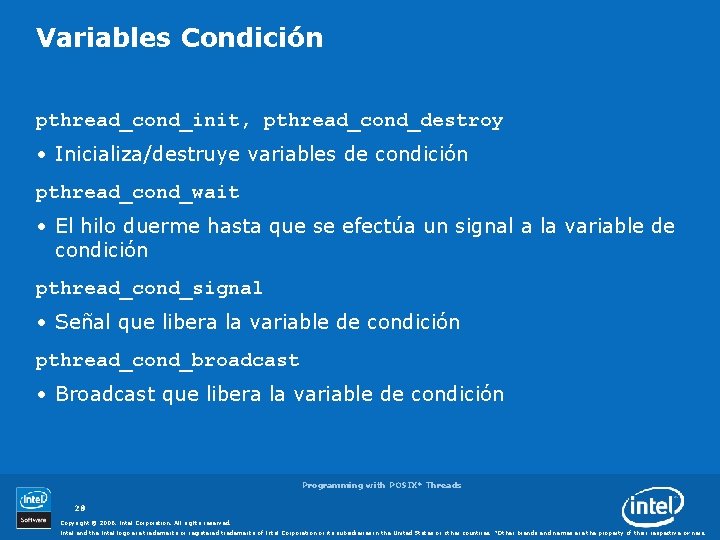
Variables Condición pthread_cond_init, pthread_cond_destroy • Inicializa/destruye variables de condición pthread_cond_wait • El hilo duerme hasta que se efectúa un signal a la variable de condición pthread_cond_signal • Señal que libera la variable de condición pthread_cond_broadcast • Broadcast que libera la variable de condición Programming with POSIX* Threads 28 Copyright © 2006, Intel Corporation. All rights reserved. Intel and the Intel logo are trademarks or registered trademarks of Intel Corporation or its subsidiaries in the United States or other countries. *Other brands and names are the property of their respective owners.
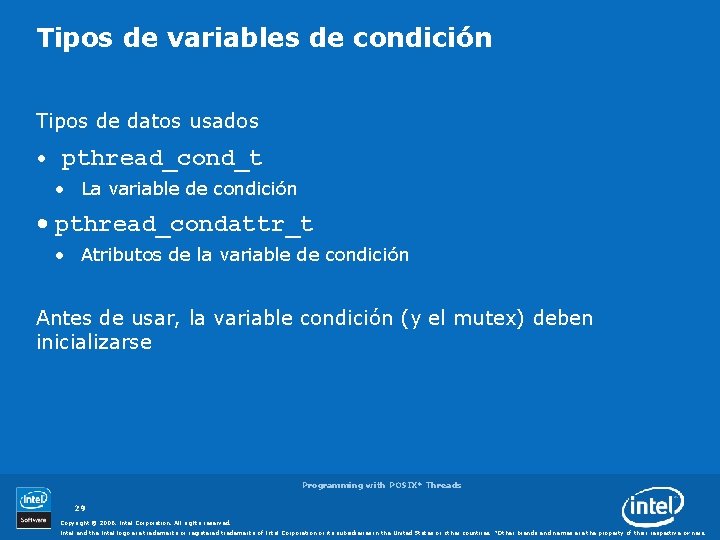
Tipos de variables de condición Tipos de datos usados • pthread_cond_t • La variable de condición • pthread_condattr_t • Atributos de la variable de condición Antes de usar, la variable condición (y el mutex) deben inicializarse Programming with POSIX* Threads 29 Copyright © 2006, Intel Corporation. All rights reserved. Intel and the Intel logo are trademarks or registered trademarks of Intel Corporation or its subsidiaries in the United States or other countries. *Other brands and names are the property of their respective owners.
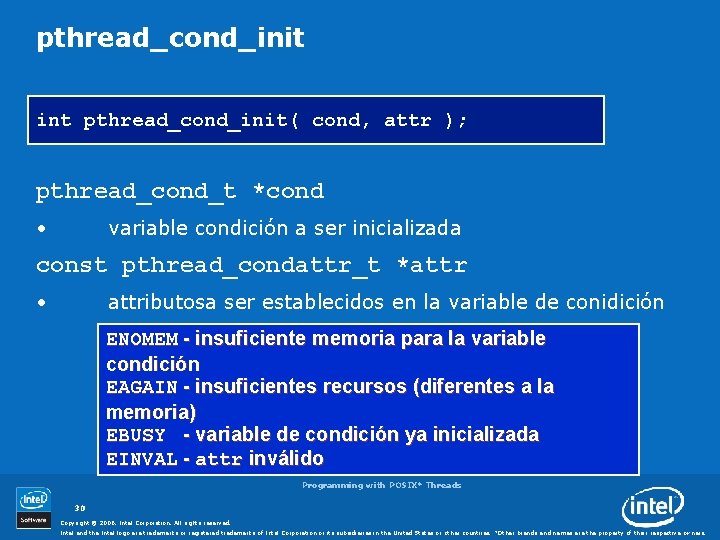
pthread_cond_init int pthread_cond_init( cond, attr ); pthread_cond_t *cond • variable condición a ser inicializada const pthread_condattr_t *attr • attributosa ser establecidos en la variable de conidición ENOMEM - insuficiente memoria para la variable condición EAGAIN - insuficientes recursos (diferentes a la memoria) EBUSY - variable de condición ya inicializada EINVAL - attr inválido Programming with POSIX* Threads 30 Copyright © 2006, Intel Corporation. All rights reserved. Intel and the Intel logo are trademarks or registered trademarks of Intel Corporation or its subsidiaries in the United States or other countries. *Other brands and names are the property of their respective owners.
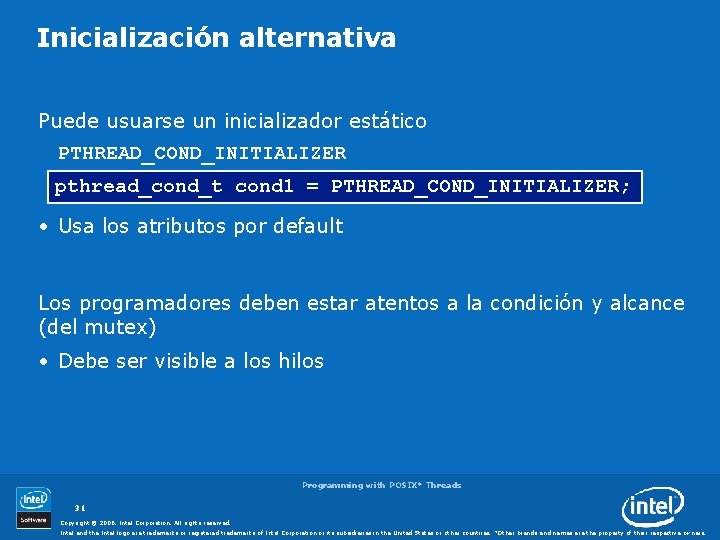
Inicialización alternativa Puede usuarse un inicializador estático PTHREAD_COND_INITIALIZER pthread_cond_t cond 1 = PTHREAD_COND_INITIALIZER; • Usa los atributos por default Los programadores deben estar atentos a la condición y alcance (del mutex) • Debe ser visible a los hilos Programming with POSIX* Threads 31 Copyright © 2006, Intel Corporation. All rights reserved. Intel and the Intel logo are trademarks or registered trademarks of Intel Corporation or its subsidiaries in the United States or other countries. *Other brands and names are the property of their respective owners.
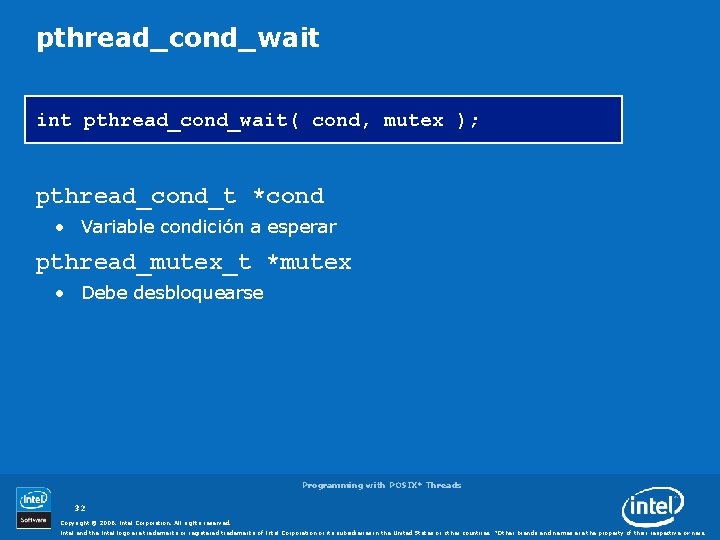
pthread_cond_wait int pthread_cond_wait( cond, mutex ); pthread_cond_t *cond • Variable condición a esperar pthread_mutex_t *mutex • Debe desbloquearse Programming with POSIX* Threads 32 Copyright © 2006, Intel Corporation. All rights reserved. Intel and the Intel logo are trademarks or registered trademarks of Intel Corporation or its subsidiaries in the United States or other countries. *Other brands and names are the property of their respective owners.
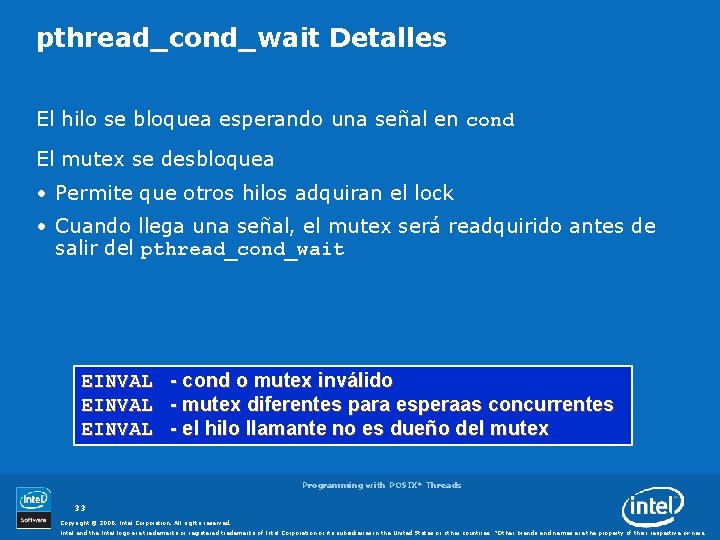
pthread_cond_wait Detalles El hilo se bloquea esperando una señal en cond El mutex se desbloquea • Permite que otros hilos adquiran el lock • Cuando llega una señal, el mutex será readquirido antes de salir del pthread_cond_wait EINVAL - cond o mutex inválido EINVAL - mutex diferentes para esperaas concurrentes EINVAL - el hilo llamante no es dueño del mutex Programming with POSIX* Threads 33 Copyright © 2006, Intel Corporation. All rights reserved. Intel and the Intel logo are trademarks or registered trademarks of Intel Corporation or its subsidiaries in the United States or other countries. *Other brands and names are the property of their respective owners.
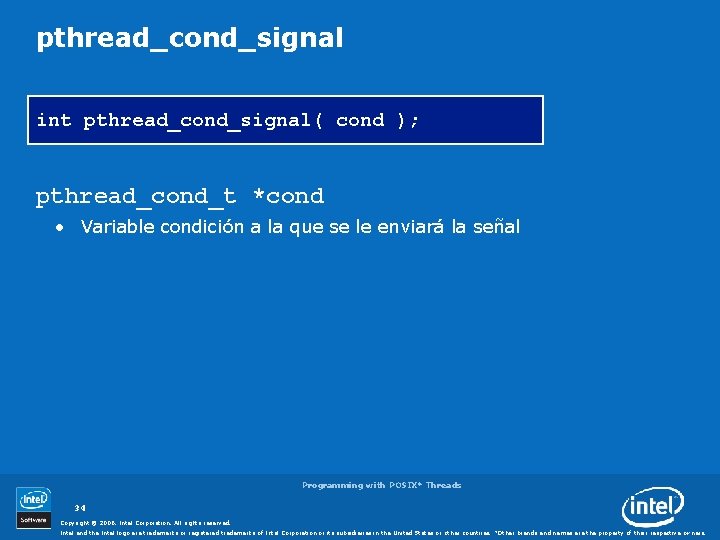
pthread_cond_signal int pthread_cond_signal( cond ); pthread_cond_t *cond • Variable condición a la que se le enviará la señal Programming with POSIX* Threads 34 Copyright © 2006, Intel Corporation. All rights reserved. Intel and the Intel logo are trademarks or registered trademarks of Intel Corporation or its subsidiaries in the United States or other countries. *Other brands and names are the property of their respective owners.
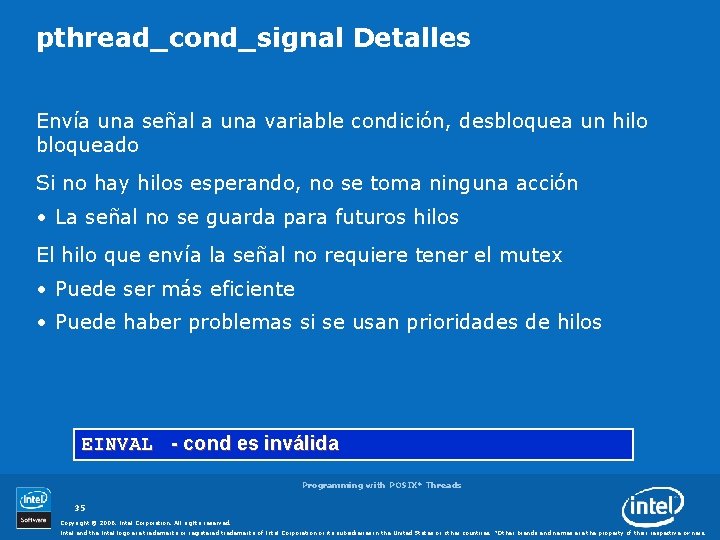
pthread_cond_signal Detalles Envía una señal a una variable condición, desbloquea un hilo bloqueado Si no hay hilos esperando, no se toma ninguna acción • La señal no se guarda para futuros hilos El hilo que envía la señal no requiere tener el mutex • Puede ser más eficiente • Puede haber problemas si se usan prioridades de hilos EINVAL - cond es inválida Programming with POSIX* Threads 35 Copyright © 2006, Intel Corporation. All rights reserved. Intel and the Intel logo are trademarks or registered trademarks of Intel Corporation or its subsidiaries in the United States or other countries. *Other brands and names are the property of their respective owners.
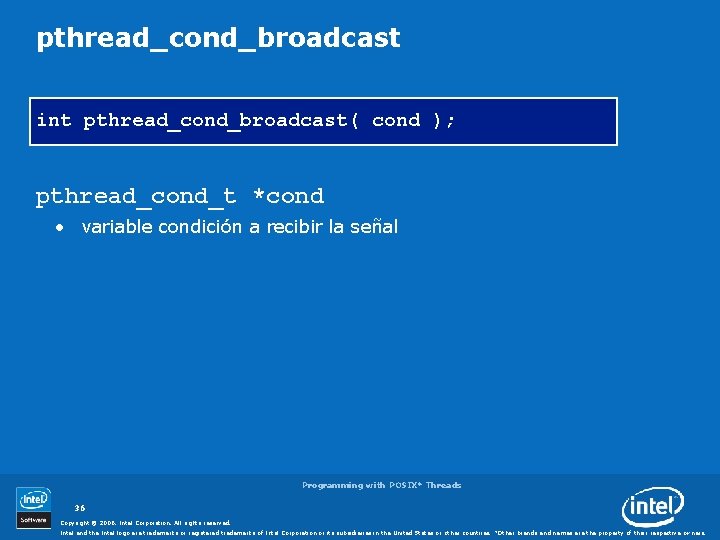
pthread_cond_broadcast int pthread_cond_broadcast( cond ); pthread_cond_t *cond • variable condición a recibir la señal Programming with POSIX* Threads 36 Copyright © 2006, Intel Corporation. All rights reserved. Intel and the Intel logo are trademarks or registered trademarks of Intel Corporation or its subsidiaries in the United States or other countries. *Other brands and names are the property of their respective owners.
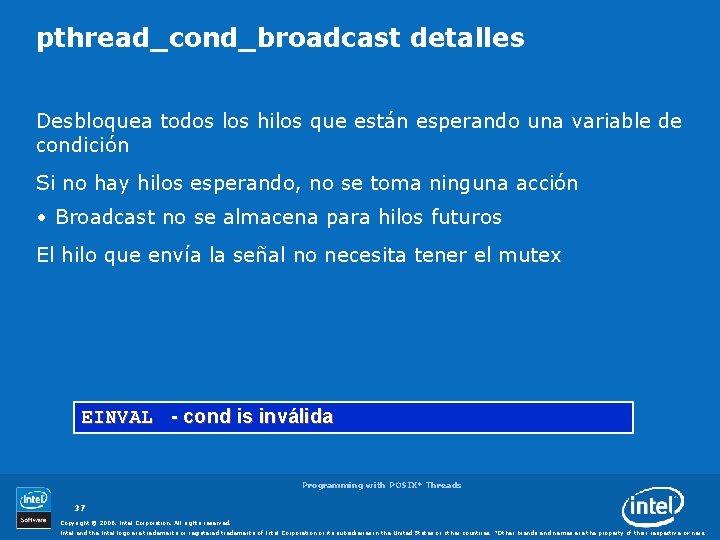
pthread_cond_broadcast detalles Desbloquea todos los hilos que están esperando una variable de condición Si no hay hilos esperando, no se toma ninguna acción • Broadcast no se almacena para hilos futuros El hilo que envía la señal no necesita tener el mutex EINVAL - cond is inválida Programming with POSIX* Threads 37 Copyright © 2006, Intel Corporation. All rights reserved. Intel and the Intel logo are trademarks or registered trademarks of Intel Corporation or its subsidiaries in the United States or other countries. *Other brands and names are the property of their respective owners.
Programando con hilos POSIX* Temas cubiertos Como crear hilos que hagan trabajo encapsulado dentro de las funciones Coordinar acceso compartido entre hilos para evitar condiciones de concurso Programming with POSIX* Threads 38 Copyright © 2006, Intel Corporation. All rights reserved. Intel and the Intel logo are trademarks or registered trademarks of Intel Corporation or its subsidiaries in the United States or other countries. *Other brands and names are the property of their respective owners.

Programming with POSIX* Threads 39 Copyright © 2006, Intel Corporation. All rights reserved. Intel and the Intel logo are trademarks or registered trademarks of Intel Corporation or its subsidiaries in the United States or other countries. *Other brands and names are the property of their respective owners.
- Slides: 39