
Program Slicing Tool for Effective Software Evolution Using


- Slides: 21
Program Slicing Tool for Effective Software Evolution Using Aspect-Oriented Technique Takashi Ishio Shinji Kusumoto Katsuro Inoue Osaka University {t-isio, kusumoto, inoue}@ist. osaka-u. ac. jp IWPSE 2003 Software Engineering Laboratory, Department of Computer Science, Graduate School of Information Science and Technology, Osaka University
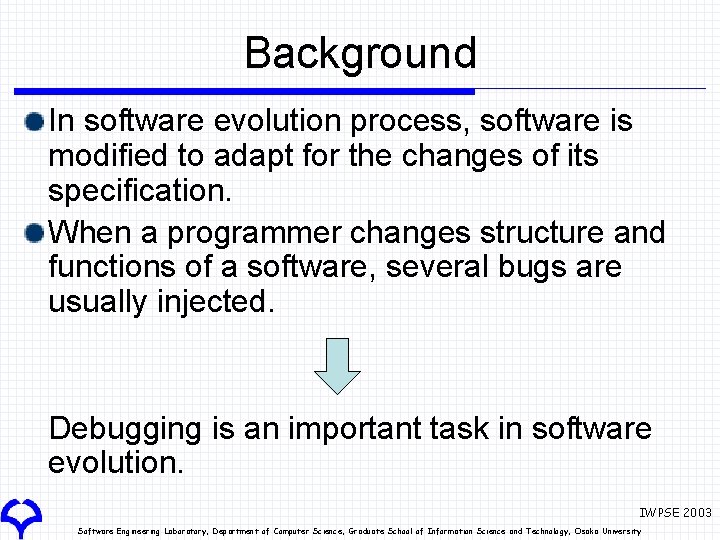
Background In software evolution process, software is modified to adapt for the changes of its specification. When a programmer changes structure and functions of a software, several bugs are usually injected. Debugging is an important task in software evolution. IWPSE 2003 Software Engineering Laboratory, Department of Computer Science, Graduate School of Information Science and Technology, Osaka University
Debugging Large Scale Software Large scale software is difficult to debug. Especially, fault localization needs much cost since the location where a program crushed is not always close to the fault. Executed codes for one test case are usually small pieces of the program. Excluding automatically unrelated codes is effective for fault localization. IWPSE 2003 Software Engineering Laboratory, Department of Computer Science, Graduate School of Information Science and Technology, Osaka University
Program Slicing extracts a slice of codes, which affects value of a specific variable. 1: 2: 3: 4: 5: 6: a = 5; b = a + a; if (b > 0) { c = a; } d = b; a slice based on slice criteria(6, b) 1: 2: 3: 4: 5: 6: a = 5; b = a + a; if (b > 0) { c = a; } d = b; Program Slicing excludes unrelated codes to aid fault localization. IWPSE 2003 Software Engineering Laboratory, Department of Computer Science, Graduate School of Information Science and Technology, Osaka University
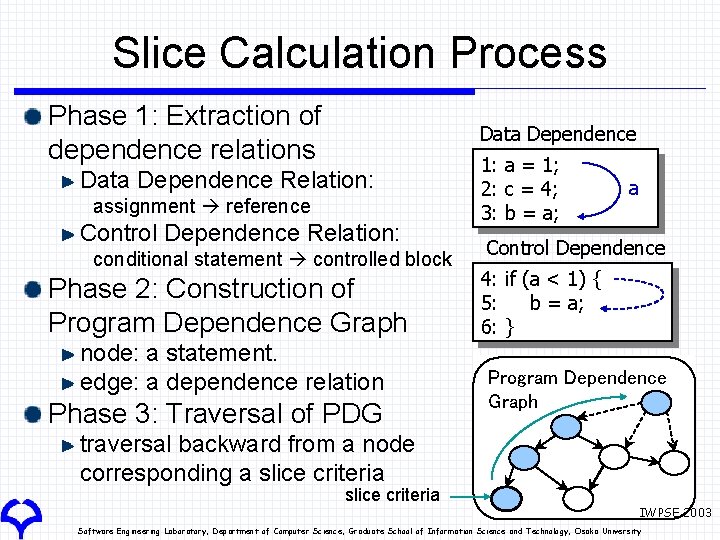
Slice Calculation Process Phase 1: Extraction of dependence relations Data Dependence Relation: assignment reference Control Dependence Relation: conditional statement controlled block Phase 2: Construction of Program Dependence Graph node: a statement. edge: a dependence relation Phase 3: Traversal of PDG 1: a = 1; 2: c = 4; 3: b = a; a Control Dependence 4: if (a < 1) { 5: b = a; 6: } Program Dependence Graph traversal backward from a node corresponding a slice criteria IWPSE 2003 Software Engineering Laboratory, Department of Computer Science, Graduate School of Information Science and Technology, Osaka University
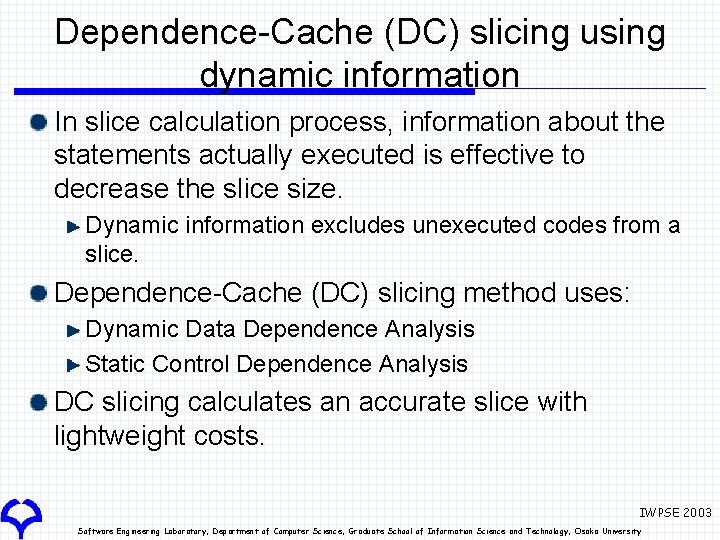
Dependence-Cache (DC) slicing using dynamic information In slice calculation process, information about the statements actually executed is effective to decrease the slice size. Dynamic information excludes unexecuted codes from a slice. Dependence-Cache (DC) slicing method uses: Dynamic Data Dependence Analysis Static Control Dependence Analysis DC slicing calculates an accurate slice with lightweight costs. IWPSE 2003 Software Engineering Laboratory, Department of Computer Science, Graduate School of Information Science and Technology, Osaka University
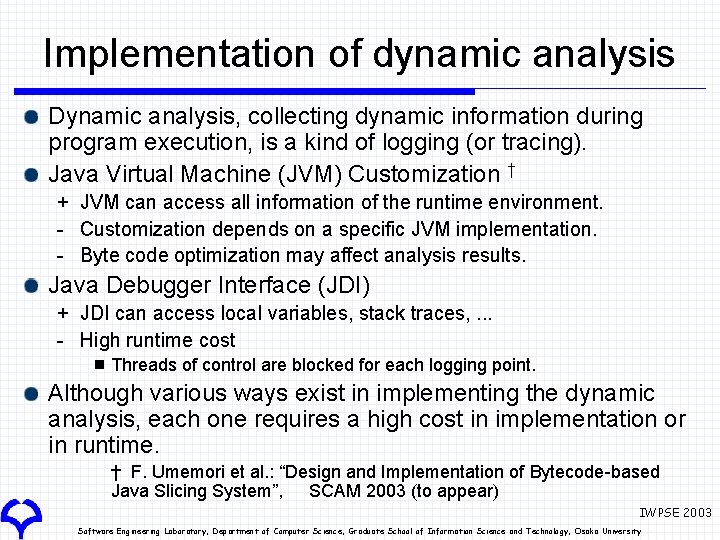
Implementation of dynamic analysis Dynamic analysis, collecting dynamic information during program execution, is a kind of logging (or tracing). Java Virtual Machine (JVM) Customization † + JVM can access all information of the runtime environment. - Customization depends on a specific JVM implementation. - Byte code optimization may affect analysis results. Java Debugger Interface (JDI) + JDI can access local variables, stack traces, . . . - High runtime cost Threads of control are blocked for each logging point. Although various ways exist in implementing the dynamic analysis, each one requires a high cost in implementation or in runtime. † F. Umemori et al. : “Design and Implementation of Bytecode-based Java Slicing System”, SCAM 2003 (to appear) IWPSE 2003 Software Engineering Laboratory, Department of Computer Science, Graduate School of Information Science and Technology, Osaka University
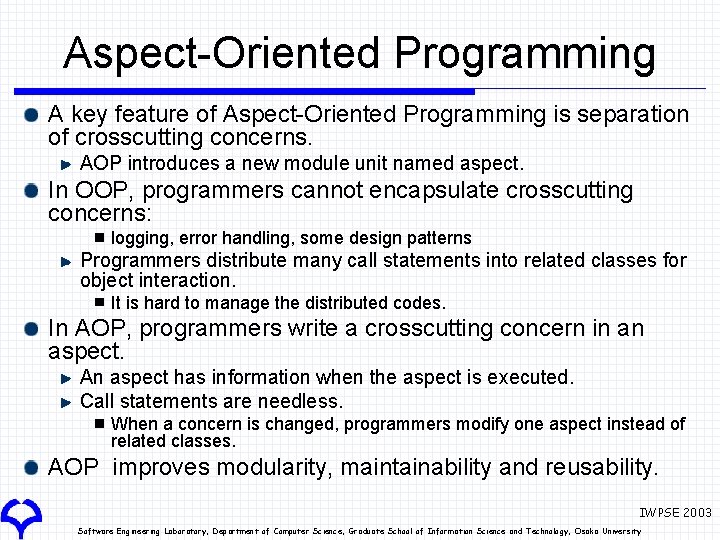
Aspect-Oriented Programming A key feature of Aspect-Oriented Programming is separation of crosscutting concerns. AOP introduces a new module unit named aspect. In OOP, programmers cannot encapsulate crosscutting concerns: logging, error handling, some design patterns Programmers distribute many call statements into related classes for object interaction. It is hard to manage the distributed codes. In AOP, programmers write a crosscutting concern in an aspect. An aspect has information when the aspect is executed. Call statements are needless. When a concern is changed, programmers modify one aspect instead of related classes. AOP improves modularity, maintainability and reusability. IWPSE 2003 Software Engineering Laboratory, Department of Computer Science, Graduate School of Information Science and Technology, Osaka University
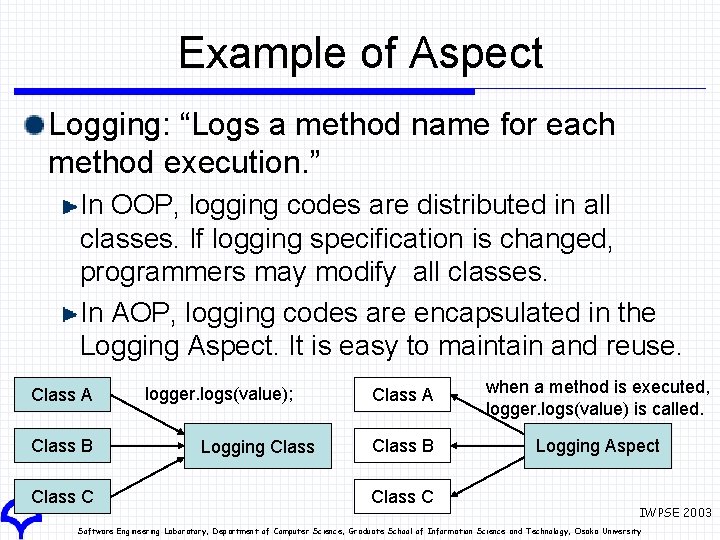
Example of Aspect Logging: “Logs a method name for each method execution. ” In OOP, logging codes are distributed in all classes. If logging specification is changed, programmers may modify all classes. In AOP, logging codes are encapsulated in the Logging Aspect. It is easy to maintain and reuse. Class A Class B Class C logger. logs(value); Logging Class A when a method is executed, logger. logs(value) is called. Class B Logging Aspect Class C IWPSE 2003 Software Engineering Laboratory, Department of Computer Science, Graduate School of Information Science and Technology, Osaka University
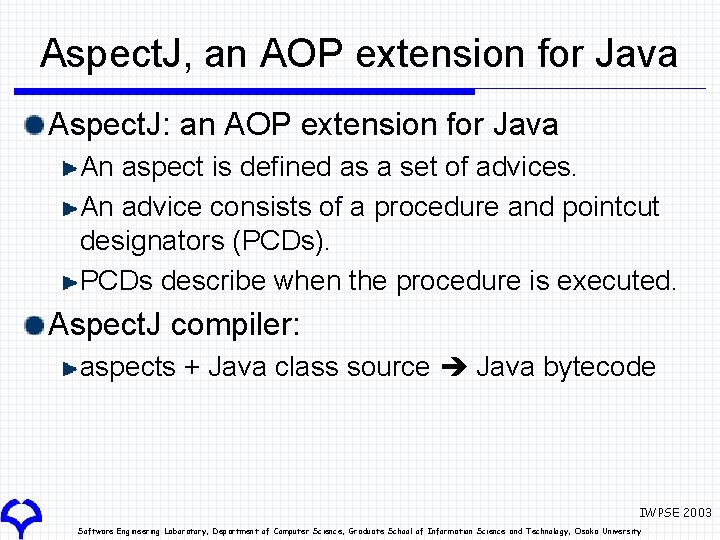
Aspect. J, an AOP extension for Java Aspect. J: an AOP extension for Java An aspect is defined as a set of advices. An advice consists of a procedure and pointcut designators (PCDs). PCDs describe when the procedure is executed. Aspect. J compiler: aspects + Java class source Java bytecode IWPSE 2003 Software Engineering Laboratory, Department of Computer Science, Graduate School of Information Science and Technology, Osaka University
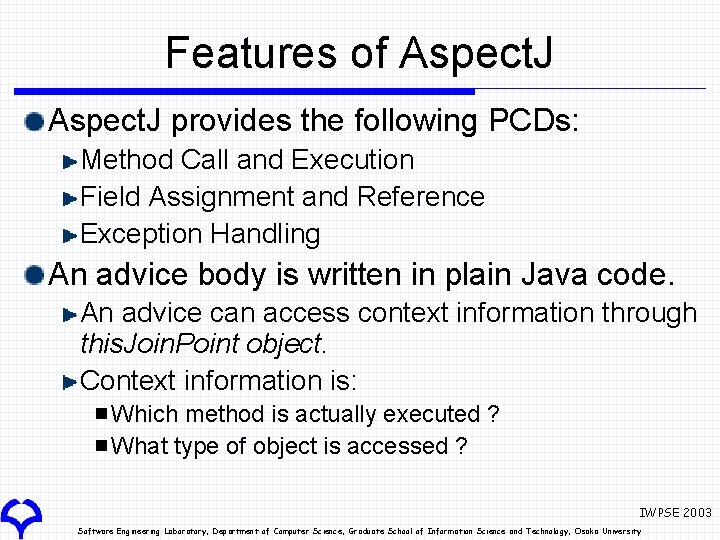
Features of Aspect. J provides the following PCDs: Method Call and Execution Field Assignment and Reference Exception Handling An advice body is written in plain Java code. An advice can access context information through this. Join. Point object. Context information is: Which method is actually executed ? What type of object is accessed ? IWPSE 2003 Software Engineering Laboratory, Department of Computer Science, Graduate School of Information Science and Technology, Osaka University
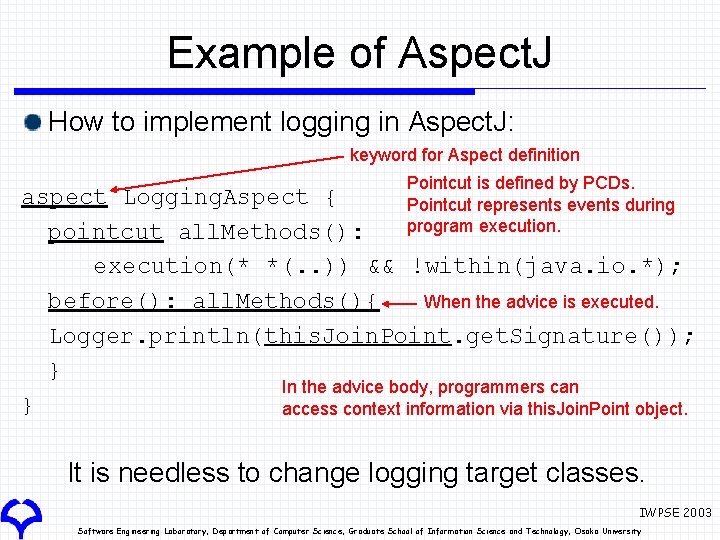
Example of Aspect. J How to implement logging in Aspect. J: keyword for Aspect definition Pointcut is defined by PCDs. Pointcut represents events during program execution. aspect Logging. Aspect { pointcut all. Methods(): execution(* *(. . )) && !within(java. io. *); before(): all. Methods(){ When the advice is executed. Logger. println(this. Join. Point. get. Signature()); } In the advice body, programmers can } access context information via this. Join. Point object. It is needless to change logging target classes. IWPSE 2003 Software Engineering Laboratory, Department of Computer Science, Graduate School of Information Science and Technology, Osaka University
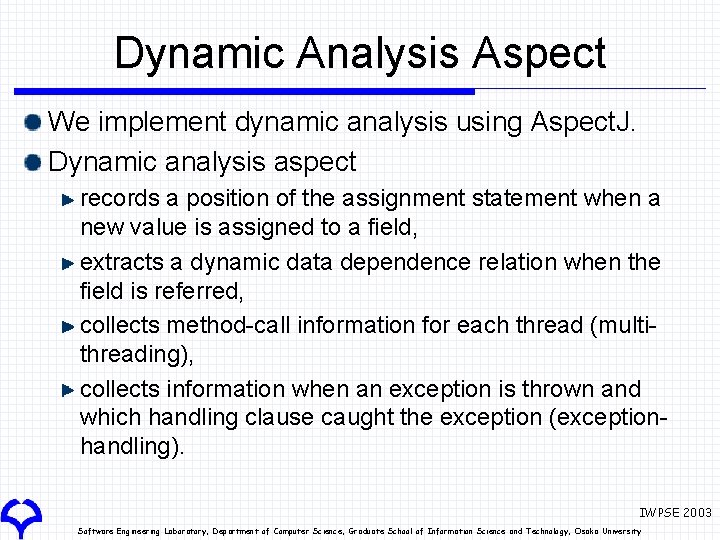
Dynamic Analysis Aspect We implement dynamic analysis using Aspect. J. Dynamic analysis aspect records a position of the assignment statement when a new value is assigned to a field, extracts a dynamic data dependence relation when the field is referred, collects method-call information for each thread (multithreading), collects information when an exception is thrown and which handling clause caught the exception (exceptionhandling). IWPSE 2003 Software Engineering Laboratory, Department of Computer Science, Graduate School of Information Science and Technology, Osaka University
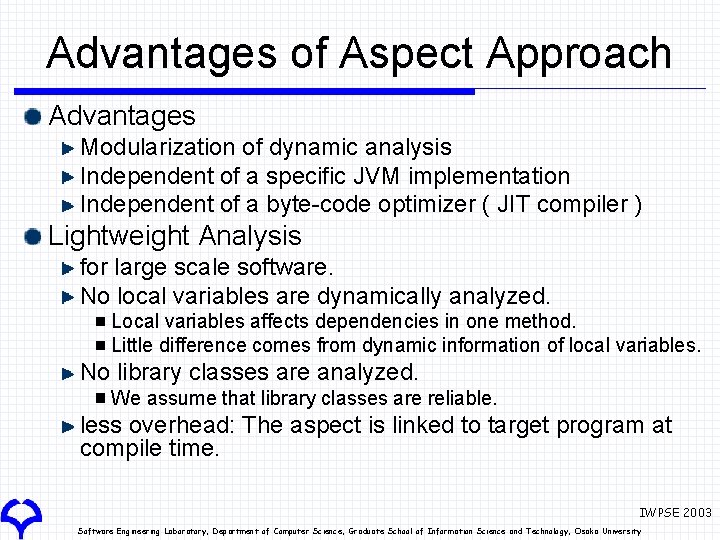
Advantages of Aspect Approach Advantages Modularization of dynamic analysis Independent of a specific JVM implementation Independent of a byte-code optimizer ( JIT compiler ) Lightweight Analysis for large scale software. No local variables are dynamically analyzed. Local variables affects dependencies in one method. Little difference comes from dynamic information of local variables. No library classes are analyzed. We assume that library classes are reliable. less overhead: The aspect is linked to target program at compile time. IWPSE 2003 Software Engineering Laboratory, Department of Computer Science, Graduate School of Information Science and Technology, Osaka University
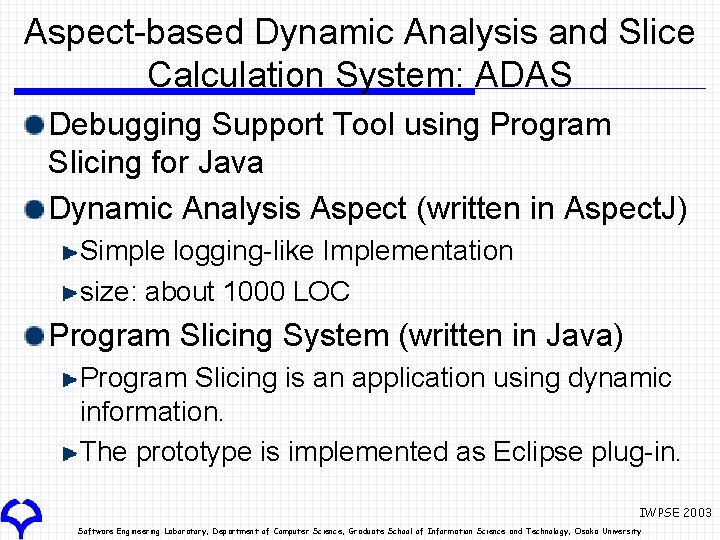
Aspect-based Dynamic Analysis and Slice Calculation System: ADAS Debugging Support Tool using Program Slicing for Java Dynamic Analysis Aspect (written in Aspect. J) Simple logging-like Implementation size: about 1000 LOC Program Slicing System (written in Java) Program Slicing is an application using dynamic information. The prototype is implemented as Eclipse plug-in. IWPSE 2003 Software Engineering Laboratory, Department of Computer Science, Graduate School of Information Science and Technology, Osaka University
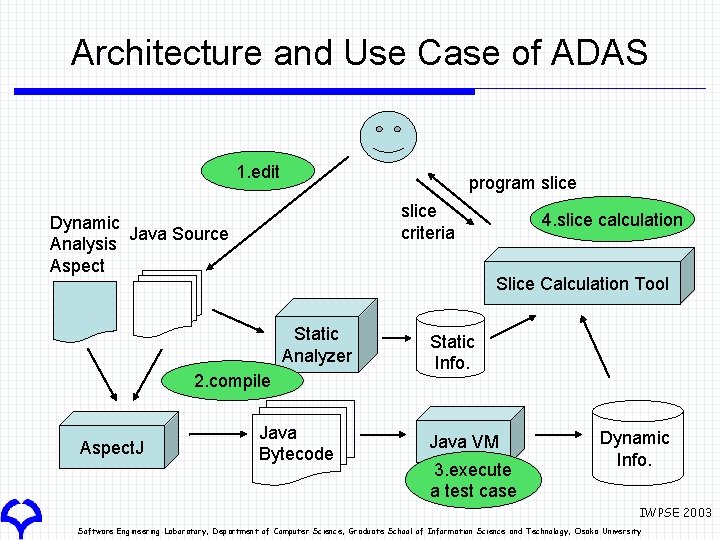
Architecture and Use Case of ADAS 1. edit program slice criteria Dynamic Java Source Analysis Aspect Slice Calculation Tool Static Analyzer 2. compile Aspect. J 4. slice calculation Java Bytecode Static Info. Java VM 3. execute a test case Dynamic Info. IWPSE 2003 Software Engineering Laboratory, Department of Computer Science, Graduate School of Information Science and Technology, Osaka University
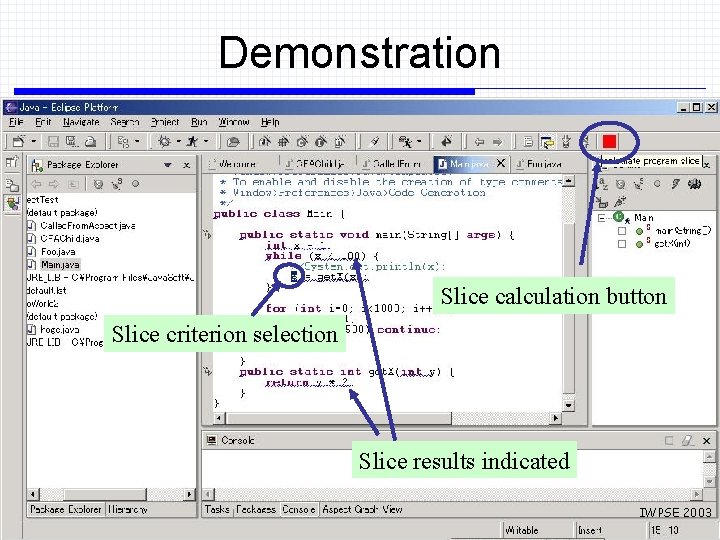
Demonstration Slice calculation button Slice criterion selection Slice results indicated IWPSE 2003 Software Engineering Laboratory, Department of Computer Science, Graduate School of Information Science and Technology, Osaka University
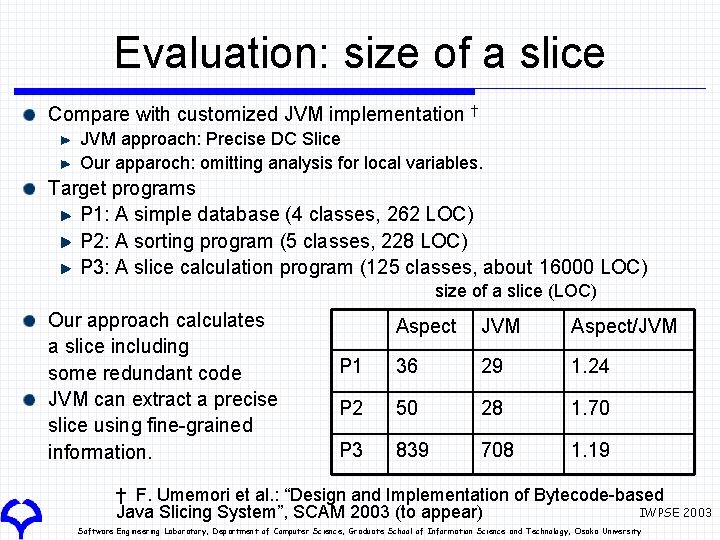
Evaluation: size of a slice Compare with customized JVM implementation † JVM approach: Precise DC Slice Our apparoch: omitting analysis for local variables. Target programs P 1: A simple database (4 classes, 262 LOC) P 2: A sorting program (5 classes, 228 LOC) P 3: A slice calculation program (125 classes, about 16000 LOC) size of a slice (LOC) Our approach calculates a slice including some redundant code JVM can extract a precise slice using fine-grained information. Aspect JVM Aspect/JVM P 1 36 29 1. 24 P 2 50 28 1. 70 P 3 839 708 1. 19 † F. Umemori et al. : “Design and Implementation of Bytecode-based IWPSE 2003 Java Slicing System”, SCAM 2003 (to appear) Software Engineering Laboratory, Department of Computer Science, Graduate School of Information Science and Technology, Osaka University
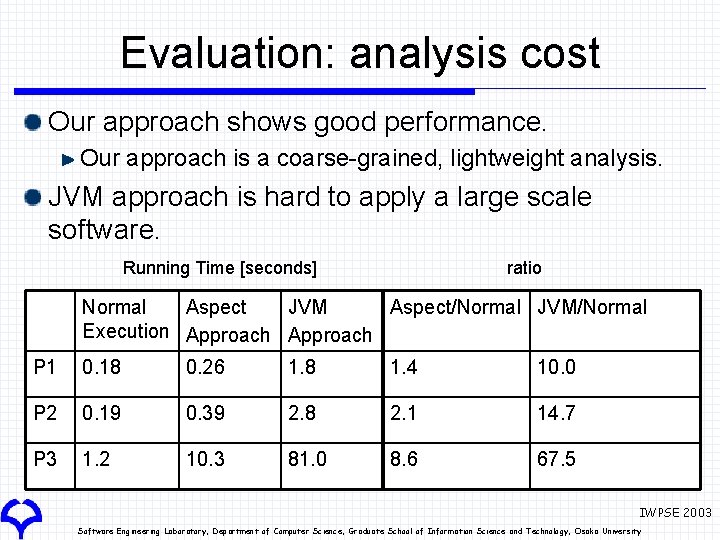
Evaluation: analysis cost Our approach shows good performance. Our approach is a coarse-grained, lightweight analysis. JVM approach is hard to apply a large scale software. ratio Running Time [seconds] Normal Aspect JVM Aspect/Normal JVM/Normal Execution Approach P 1 0. 18 0. 26 1. 8 1. 4 10. 0 P 2 0. 19 0. 39 2. 8 2. 1 14. 7 P 3 1. 2 10. 3 81. 0 8. 6 67. 5 IWPSE 2003 Software Engineering Laboratory, Department of Computer Science, Graduate School of Information Science and Technology, Osaka University
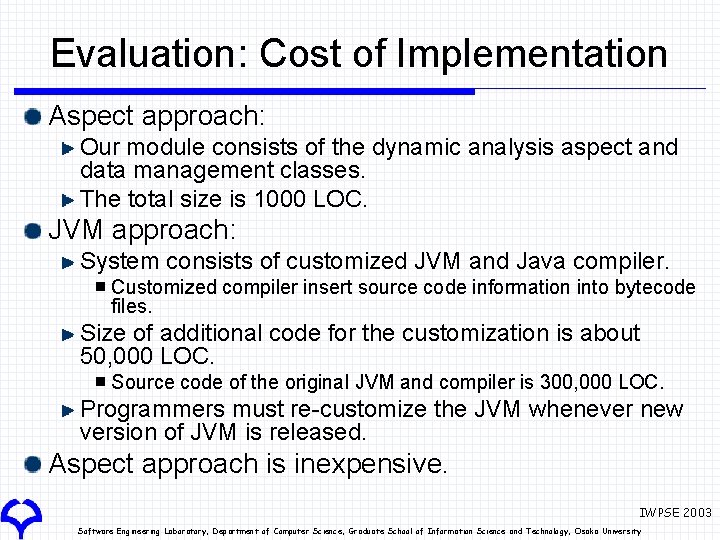
Evaluation: Cost of Implementation Aspect approach: Our module consists of the dynamic analysis aspect and data management classes. The total size is 1000 LOC. JVM approach: System consists of customized JVM and Java compiler. Customized compiler insert source code information into bytecode files. Size of additional code for the customization is about 50, 000 LOC. Source code of the original JVM and compiler is 300, 000 LOC. Programmers must re-customize the JVM whenever new version of JVM is released. Aspect approach is inexpensive. IWPSE 2003 Software Engineering Laboratory, Department of Computer Science, Graduate School of Information Science and Technology, Osaka University
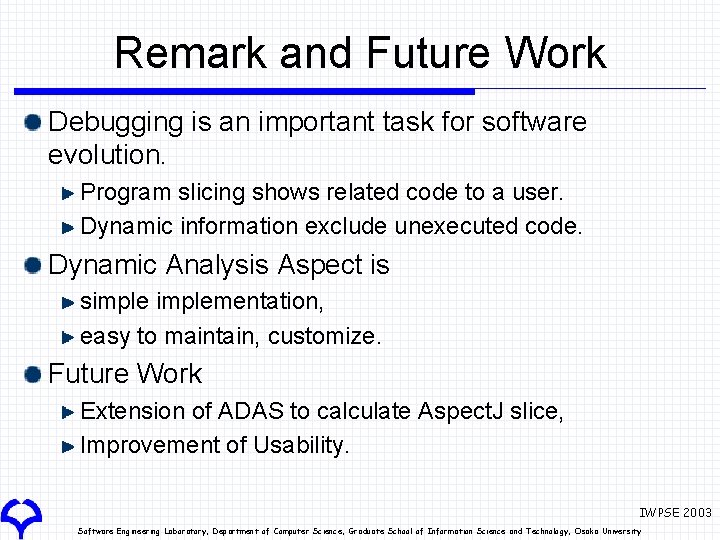
Remark and Future Work Debugging is an important task for software evolution. Program slicing shows related code to a user. Dynamic information exclude unexecuted code. Dynamic Analysis Aspect is simplementation, easy to maintain, customize. Future Work Extension of ADAS to calculate Aspect. J slice, Improvement of Usability. IWPSE 2003 Software Engineering Laboratory, Department of Computer Science, Graduate School of Information Science and Technology, Osaka University