
Program Overview Value Proposition 1 Performance Review Institute
- Slides: 35
Program Overview & Value Proposition 1 © Performance Review Institute
The materials provided online by Performance Review Institute may be used by Med. Accred customers solely for their internal use, but PRI requests that attribution be given by placing “(c) Performance Review Institute” in the work. Please be aware that the use of PRI materials for external publication, distribution or sale is prohibited unless express written permission has been granted by PRI. If you have any questions contact Connie Conboy, Director – Strategy and Business Development, cconboy@p-r-i. org, +1 724 772 7153. 2 © Performance Review Institute
Content • Value Proposition Objective • Program Risk Analysis • Current Medical Device Industry Challenges • Confidentiality of Information • Case Studies • Chronology • Next Steps • Benefits • 3 • Medical Device Industry OEMs • Medical Device Industry Suppliers Scope • Using Med. Accred for Critical Process Supplier Oversight • Critical Process Areas of Interest • Existing PRI Processes and Products © Performance Review Institute • • • Aerospace (Nadcap Subscriber Critical Process Escapes) • PRI Transportation & Power Generation Program (OEM) • Medical Device (Electronic Circuits – PCBA Hypothetical) Financials • Subscriber Fees / Supplier Audit Pricing • Template for Cost/Benefit Calculation Additional Information • PRI Contact & Future Meetings
Value Proposition Objective To demonstrate to the medical device industry the value of creating an industry managed supply chain oversight program (Med. Accred) that will reduce risk to patient safety, assure quality products and compliance with requirements as they apply to critical processes. 4 © Performance Review Institute
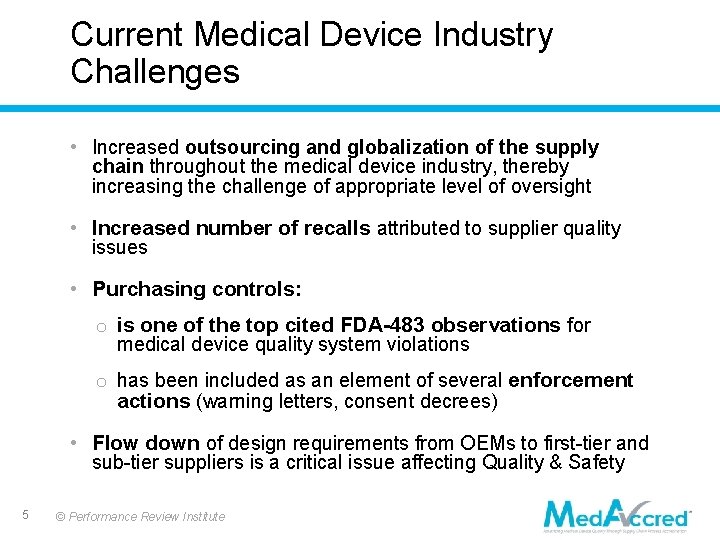
Current Medical Device Industry Challenges • Increased outsourcing and globalization of the supply chain throughout the medical device industry, thereby increasing the challenge of appropriate level of oversight • Increased number of recalls attributed to supplier quality issues • Purchasing controls: o is one of the top cited FDA-483 observations for medical device quality system violations o has been included as an element of several enforcement actions (warning letters, consent decrees) • Flow down of design requirements from OEMs to first-tier and sub-tier suppliers is a critical issue affecting Quality & Safety 5 © Performance Review Institute
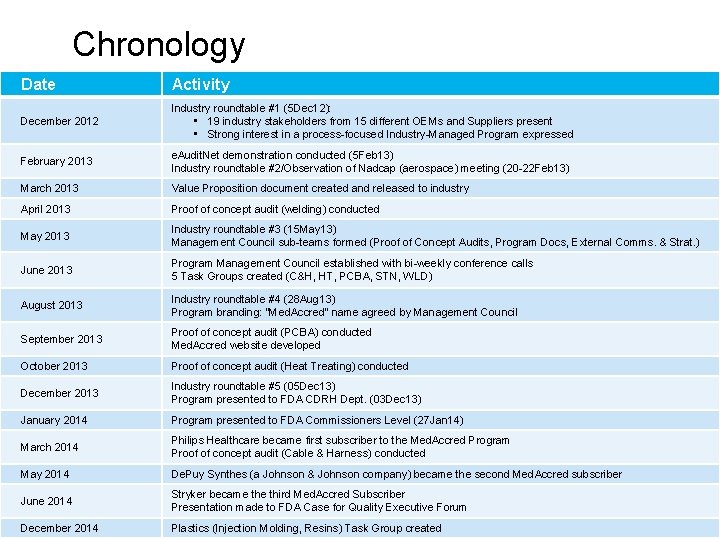
Chronology Date Activity December 2012 Industry roundtable #1 (5 Dec 12): • 19 industry stakeholders from 15 different OEMs and Suppliers present • Strong interest in a process-focused Industry-Managed Program expressed February 2013 e. Audit. Net demonstration conducted (5 Feb 13) Industry roundtable #2/Observation of Nadcap (aerospace) meeting (20 -22 Feb 13) March 2013 Value Proposition document created and released to industry April 2013 Proof of concept audit (welding) conducted May 2013 Industry roundtable #3 (15 May 13) Management Council sub-teams formed (Proof of Concept Audits, Program Docs, External Comms. & Strat. ) June 2013 Program Management Council established with bi-weekly conference calls 5 Task Groups created (C&H, HT, PCBA, STN, WLD) August 2013 Industry roundtable #4 (28 Aug 13) Program branding: “Med. Accred” name agreed by Management Council September 2013 Proof of concept audit (PCBA) conducted Med. Accred website developed October 2013 Proof of concept audit (Heat Treating) conducted December 2013 Industry roundtable #5 (05 Dec 13) Program presented to FDA CDRH Dept. (03 Dec 13) January 2014 Program presented to FDA Commissioners Level (27 Jan 14) March 2014 Philips Healthcare became first subscriber to the Med. Accred Program Proof of concept audit (Cable & Harness) conducted May 2014 De. Puy Synthes (a Johnson & Johnson company) became the second Med. Accred subscriber June 2014 Stryker became third Med. Accred Subscriber Presentation made to FDA Case for Quality Executive Forum © Performance Review Institute December 2014 Plastics (Injection Molding, Resins) Task Group created
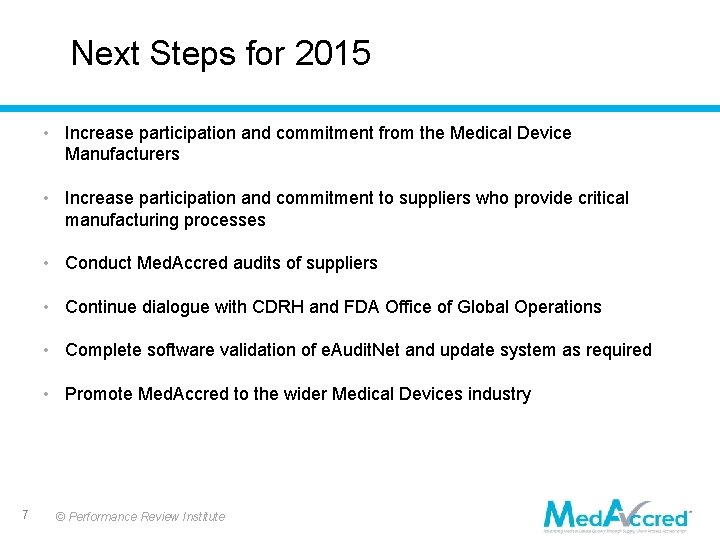
Next Steps for 2015 • Increase participation and commitment from the Medical Device Manufacturers • Increase participation and commitment to suppliers who provide critical manufacturing processes • Conduct Med. Accred audits of suppliers • Continue dialogue with CDRH and FDA Office of Global Operations • Complete software validation of e. Audit. Net and update system as required • Promote Med. Accred to the wider Medical Devices industry 7 © Performance Review Institute
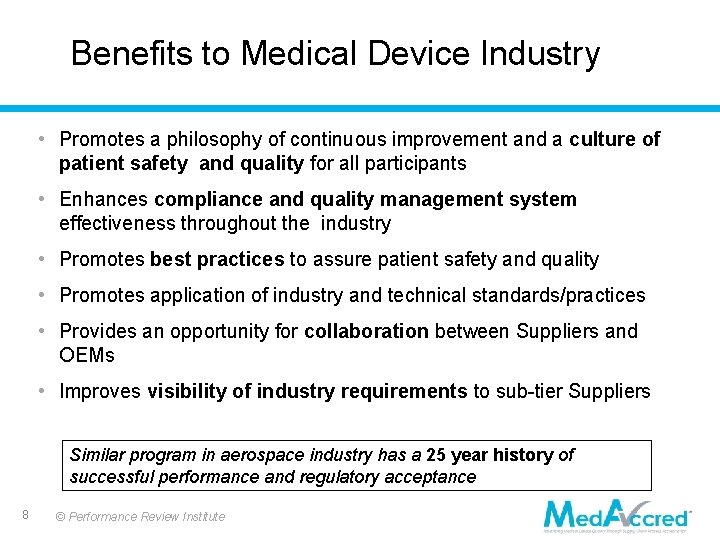
Benefits to Medical Device Industry • Promotes a philosophy of continuous improvement and a culture of patient safety and quality for all participants • Enhances compliance and quality management system effectiveness throughout the industry • Promotes best practices to assure patient safety and quality • Promotes application of industry and technical standards/practices • Provides an opportunity for collaboration between Suppliers and OEMs • Improves visibility of industry requirements to sub-tier Suppliers Similar program in aerospace industry has a 25 year history of successful performance and regulatory acceptance 8 © Performance Review Institute
Benefits to Medical Device Industry (cont. ) • Promotes least burdensome approach by reducing redundant process audits by multiple customers • Enables reallocation of resources to other areas requiring attention • Provides real-time and consistent visibility of supply chain quality • Aligns with FDA’s “Case for Quality” strategic initiative 9 © Performance Review Institute
Benefits to Medical Device Industry OEMs • Establishes stringent industry consensus audit criteria based on industry and specific OEM requirements that ensure compliance and quality of devices, reduce the risk to patient safety and will satisfy the requirements of all participants • Conducts in-depth special process audits that are compliant and consistent to accepted industry/technical standards and conducted by industry recognized and approved Subject Matter Experts. • Covers 3 areas: 1. Assess effectiveness of Suppliers’ QMS at the special process level; 2. Audits based on robust core and OEM-specific checklists; 3. Process-focused Product Audits 10 © Performance Review Institute
Benefits to Medical Device Industry OEMs (cont. ) • Provides greater visibility of the supply chain to all levels and sub-tiers that provide critical processes, consistent with regulatory requirements (e. g. FDA, ISO 13485, MDD, etc. ) • Identify and reduce risk of exposure to lower-quality Suppliers and reduction of costly recalls • Provides early warning notification to OEMs of supply chain quality issues • Provides complete visibility of audit results and corrective actions taken in a secure and retrievable format • Reduces cost of non-quality • Reduces cost of compliance 11 © Performance Review Institute
Benefits to Medical Device Industry OEMs (cont. ) • Releases OEM resources to focus on Supplier development opportunities and/or problem area resolution • Improves flow down of OEM requirements to sub-tier Suppliers • Makes the Supplier selection process more efficient • Global supply chain visibility through a web based system to support and improve efficiency in industry managed auditing and accreditation system (e. Audit. Net). • Supports procurement to identify accredited Suppliers (Qualified Supplier List) • Supports Supplier risk management activity • Creates a shared pool of trained, recognized and approved subject matter experts among OEMs 12 © Performance Review Institute
Benefits to Medical Device Industry Suppliers • Provides consistent/standardized critical process audits accepted by the medical device industry resulting in fewer redundant onsite audits by multiple OEMs • Can use accreditation to increase client-base and opportunities across the Medical Device Industry • Enhances the Supplier’s compliance status • Medical Device Industry-accepted and consistent technical requirements leading to process discipline, greater operational efficiency and continuous improvement resulting in higher quality and lower overall cost. 13 © Performance Review Institute
Benefits to Medical Device Industry Suppliers (cont. ) • Helps Suppliers develop a structured approach to special process and product • Provides opportunity to participate in development of audit criteria and the accreditation program • 85% of suppliers report quality improvements after accreditation, including reducing scrap rates, reworks, escapes and defective products (from aerospace survey data) 14 © Performance Review Institute
What is Med. Accred and it’s Scope • An industry-managed audit program that addresses critical manufacturing process issues in the supply chain and reduces risk to patient safety by enhancing compliance to critical process manufacturing requirements • Med. Accred is a tool for Medical Device OEMs to use in the oversight of their supply base while they maintain ultimate responsibility for quality and compliance • Med. Accred program provides in-depth, critical process, audits that are compliant and consistent to accepted industry/technical standards and conducted by industry recognized and approved Subject Matter Experts • Scope of audit o Critical, process-focused, technical audits with sampling of product audits to ensure process capability to meet requirements o Assesses effectiveness of suppliers’ Quality Management System (QMS) at the critical process level (e. g. PCBA, Heat Treating, Welding, Sterilization, etc. ) o Audits based on robust core and OEM-specific checklists 15 © Performance Review Institute
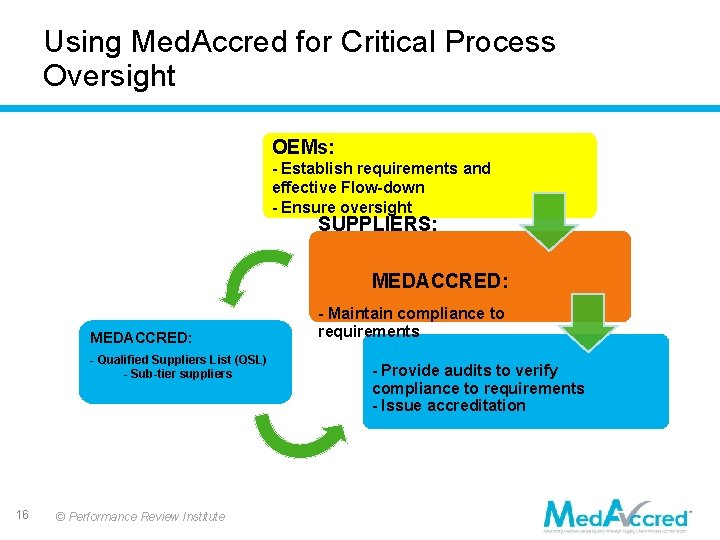
Using Med. Accred for Critical Process Oversight OEMs: - Establish requirements and effective Flow-down - Ensure oversight SUPPLIERS: MEDACCRED: - Qualified Suppliers List (QSL) - Sub-tier suppliers 16 © Performance Review Institute - Maintain compliance to requirements - Provide audits to verify compliance to requirements - Issue accreditation
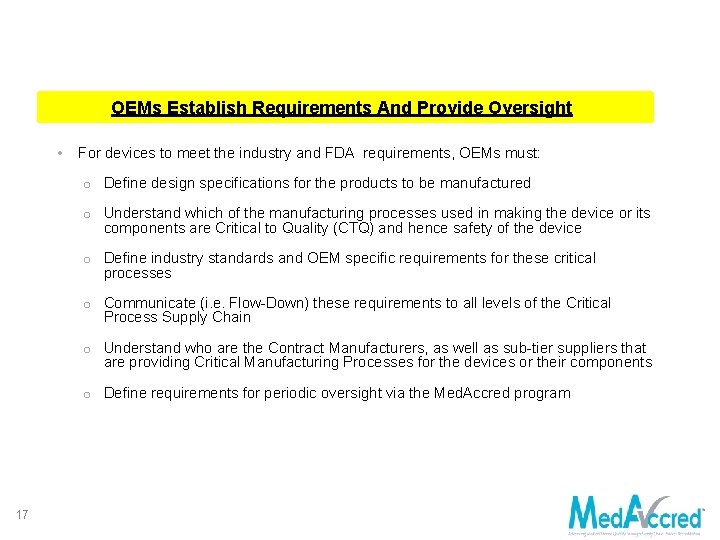
OEMs Establish Requirements And Provide Oversight • For devices to meet the industry and FDA requirements, OEMs must: o Define design specifications for the products to be manufactured o Understand which of the manufacturing processes used in making the device or its components are Critical to Quality (CTQ) and hence safety of the device o Define industry standards and OEM specific requirements for these critical processes o Communicate (i. e. Flow-Down) these requirements to all levels of the Critical Process Supply Chain o Understand who are the Contract Manufacturers, as well as sub-tier suppliers that are providing Critical Manufacturing Processes for the devices or their components o Define requirements for periodic oversight via the Med. Accred program 17
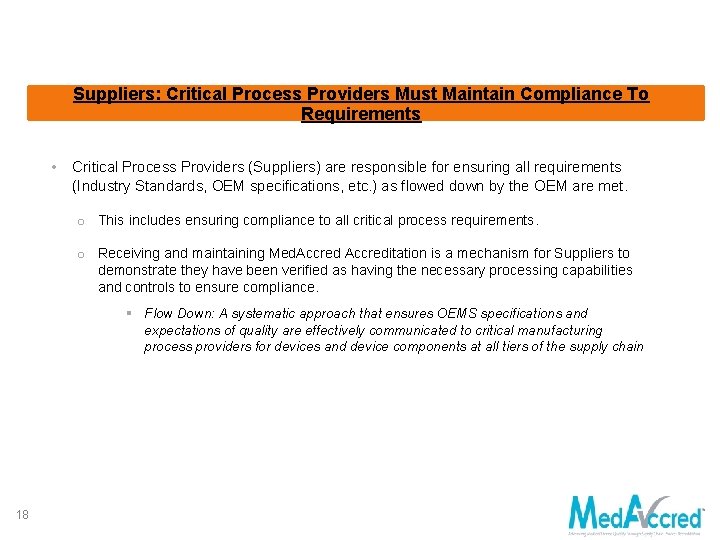
Suppliers: Critical Process Providers Must Maintain Compliance To Requirements • Critical Process Providers (Suppliers) are responsible for ensuring all requirements (Industry Standards, OEM specifications, etc. ) as flowed down by the OEM are met. o This includes ensuring compliance to all critical process requirements. o Receiving and maintaining Med. Accreditation is a mechanism for Suppliers to demonstrate they have been verified as having the necessary processing capabilities and controls to ensure compliance. § Flow Down: A systematic approach that ensures OEMS specifications and expectations of quality are effectively communicated to critical manufacturing process providers for devices and device components at all tiers of the supply chain 18
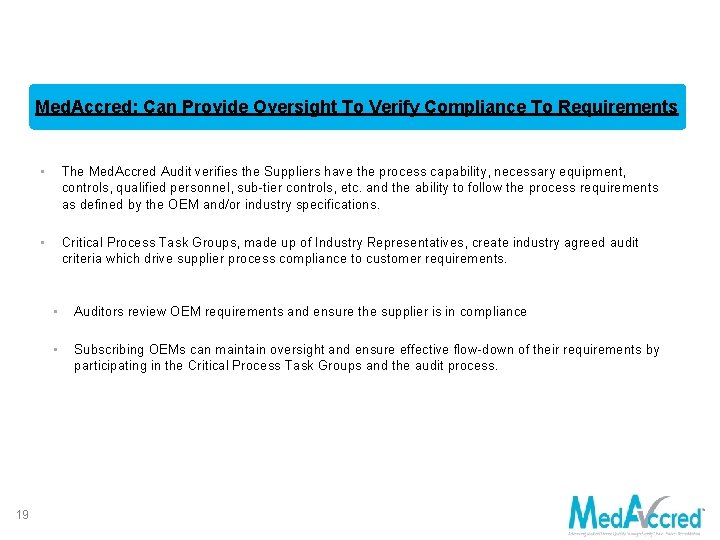
Med. Accred: Can Provide Oversight To Verify Compliance To Requirements • The Med. Accred Audit verifies the Suppliers have the process capability, necessary equipment, controls, qualified personnel, sub-tier controls, etc. and the ability to follow the process requirements as defined by the OEM and/or industry specifications. • Critical Process Task Groups, made up of Industry Representatives, create industry agreed audit criteria which drive supplier process compliance to customer requirements. 19 • Auditors review OEM requirements and ensure the supplier is in compliance • Subscribing OEMs can maintain oversight and ensure effective flow-down of their requirements by participating in the Critical Process Task Groups and the audit process.
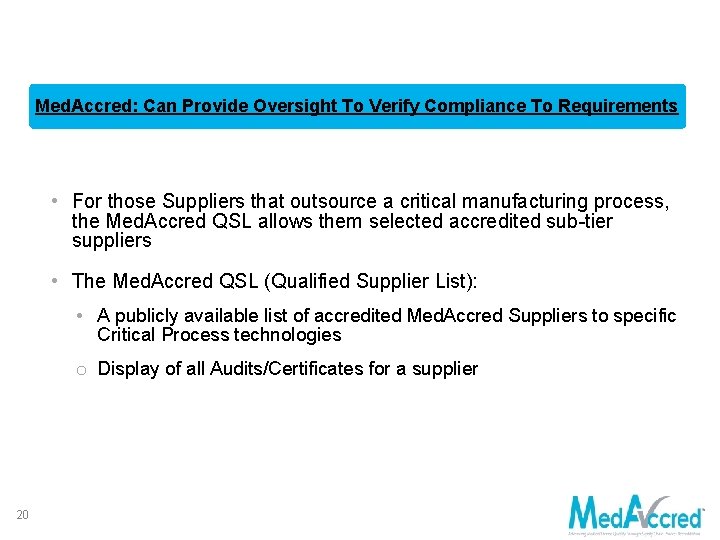
Med. Accred: Can Provide Oversight To Verify Compliance To Requirements • For those Suppliers that outsource a critical manufacturing process, the Med. Accred QSL allows them selected accredited sub-tier suppliers • The Med. Accred QSL (Qualified Supplier List): • A publicly available list of accredited Med. Accred Suppliers to specific Critical Process technologies o Display of all Audits/Certificates for a supplier 20
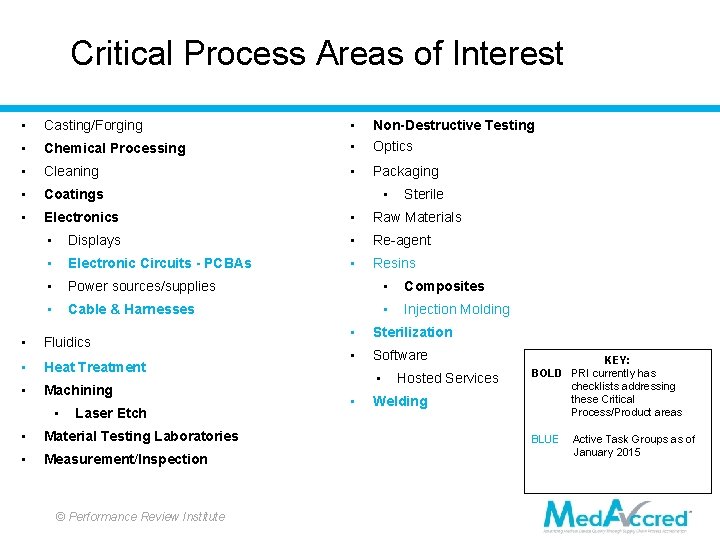
Critical Process Areas of Interest • Casting/Forging • Chemical Processing • • Non-Destructive Testing Optics • Cleaning • Packaging • Coatings • Electronics • Raw Materials • Displays • Re-agent • Electronic Circuits - PCBAs • Resins • Power sources/supplies • Composites • Cable & Harnesses • Injection Molding • Fluidics • Heat Treatment • Machining • Laser Etch • Material Testing Laboratories • Measurement/Inspection • Sterile • Sterilization • Software • • Hosted Services Welding KEY: BOLD PRI currently has checklists addressing these Critical Process/Product areas BLUE Active Task Groups as of January 2015 © Performance Review Institute
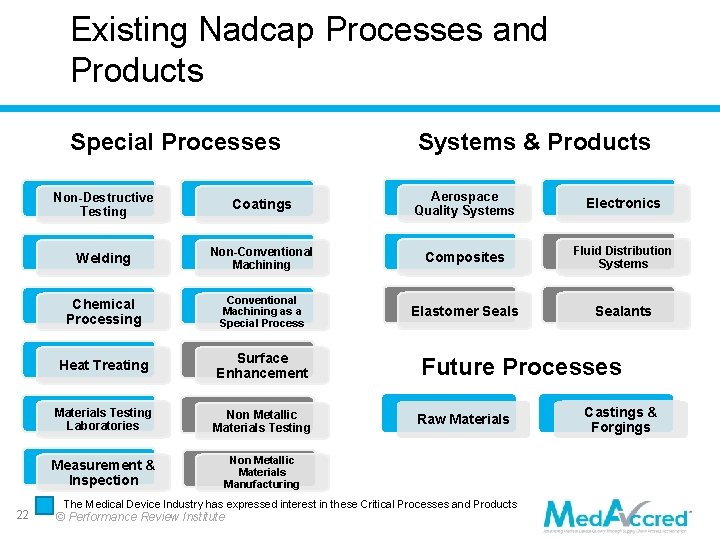
Existing Nadcap Processes and Products Special Processes 22 Systems & Products Non-Destructive Testing Coatings Aerospace Quality Systems Electronics Welding Non-Conventional Machining Composites Fluid Distribution Systems Chemical Processing Conventional Machining as a Special Process Elastomer Seals Sealants Heat Treating Surface Enhancement Materials Testing Laboratories Non Metallic Materials Testing Measurement & Inspection Non Metallic Materials Manufacturing Future Processes Raw Materials The Medical Device Industry has expressed interest in these Critical Processes and Products © Performance Review Institute Castings & Forgings
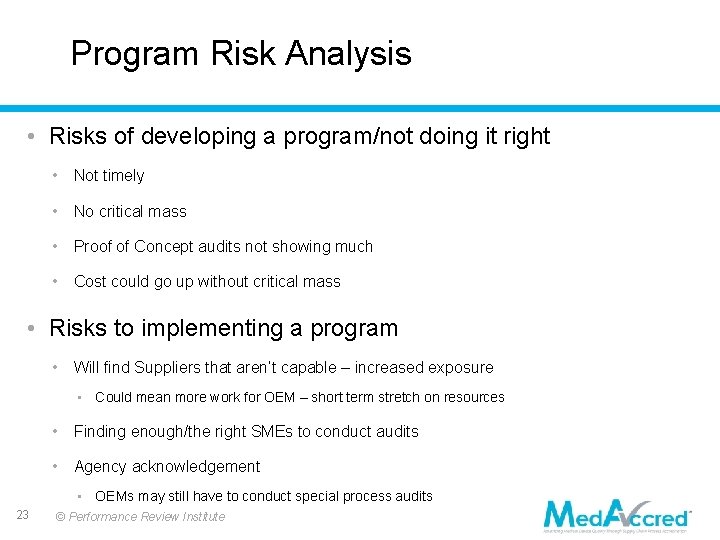
Program Risk Analysis • Risks of developing a program/not doing it right • Not timely • No critical mass • Proof of Concept audits not showing much • Cost could go up without critical mass • Risks to implementing a program • Will find Suppliers that aren’t capable – increased exposure • Could mean more work for OEM – short term stretch on resources • Finding enough/the right SMEs to conduct audits • Agency acknowledgement • OEMs may still have to conduct special process audits 23 © Performance Review Institute
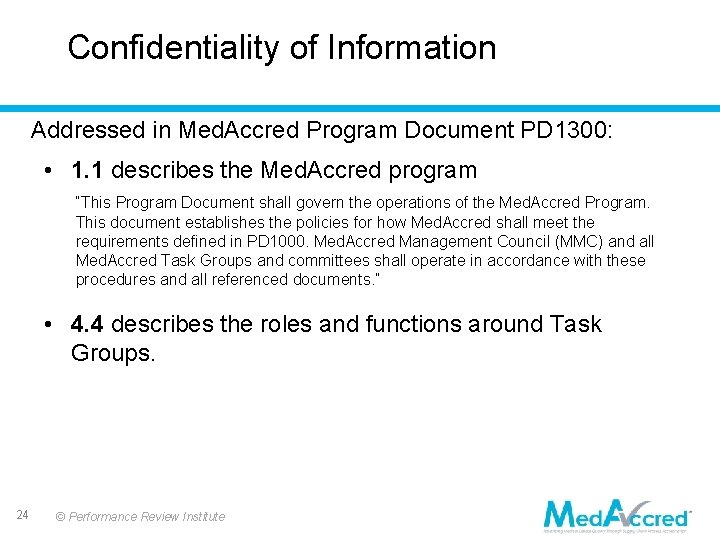
Confidentiality of Information Addressed in Med. Accred Program Document PD 1300: • 1. 1 describes the Med. Accred program “This Program Document shall govern the operations of the Med. Accred Program. This document establishes the policies for how Med. Accred shall meet the requirements defined in PD 1000. Med. Accred Management Council (MMC) and all Med. Accred Task Groups and committees shall operate in accordance with these procedures and all referenced documents. ” • 4. 4 describes the roles and functions around Task Groups. 24 © Performance Review Institute
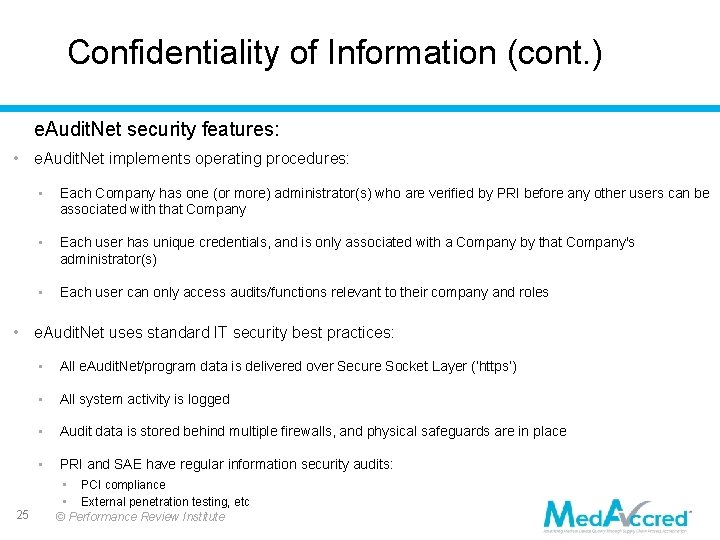
Confidentiality of Information (cont. ) e. Audit. Net security features: • e. Audit. Net implements operating procedures: • Each Company has one (or more) administrator(s) who are verified by PRI before any other users can be associated with that Company • Each user has unique credentials, and is only associated with a Company by that Company's administrator(s) • Each user can only access audits/functions relevant to their company and roles • e. Audit. Net uses standard IT security best practices: 25 • All e. Audit. Net/program data is delivered over Secure Socket Layer (‘https’) • All system activity is logged • Audit data is stored behind multiple firewalls, and physical safeguards are in place • PRI and SAE have regular information security audits: • PCI compliance • External penetration testing, etc © Performance Review Institute
Case Studies • Aerospace (Nadcap OEM – Critical Process Escapes) • Transportation & Power Generation (OEM) • Medical Device (Electronic Circuits - PCBA Hypothetical) 26 © Performance Review Institute
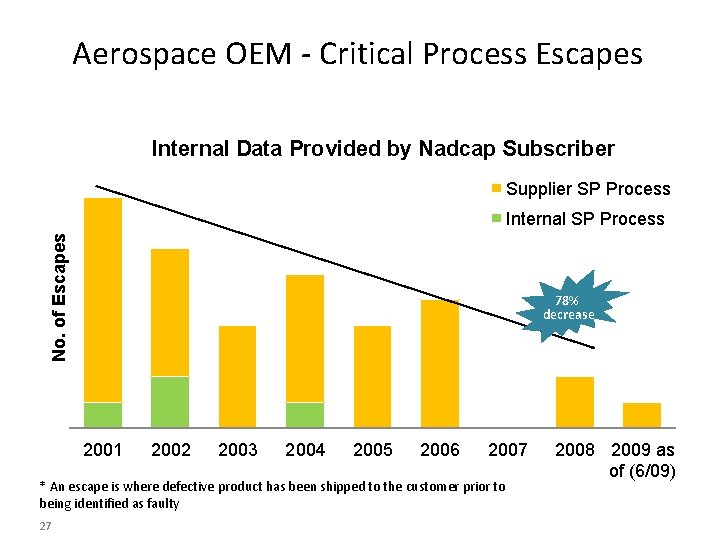
Aerospace OEM - Critical Process Escapes Internal Data Provided by Nadcap Subscriber Supplier SP Process No. of Escapes Internal SP Process 78% decrease 2001 2002 2003 2004 2005 2006 2007 * An escape is where defective product has been shipped to the customer prior to being identified as faulty 27 2008 2009 as of (6/09)
PRI Transportation & Power Generation (TPG) Program – Fastener Example • Event: OEM experienced a product escape due to a faulty fastener and were forced to make an expensive repair • Included in OEM Recourse: Requested a PRI NDT audit for their fastener Supplier • TPG Audit Results: NDT audit uncovered cracks not found during initial inspection and process control violations that would have prevented the cracks • Pre-TPG Program: Focus was on certifying the component (product-centric) 28 © Performance Review Institute
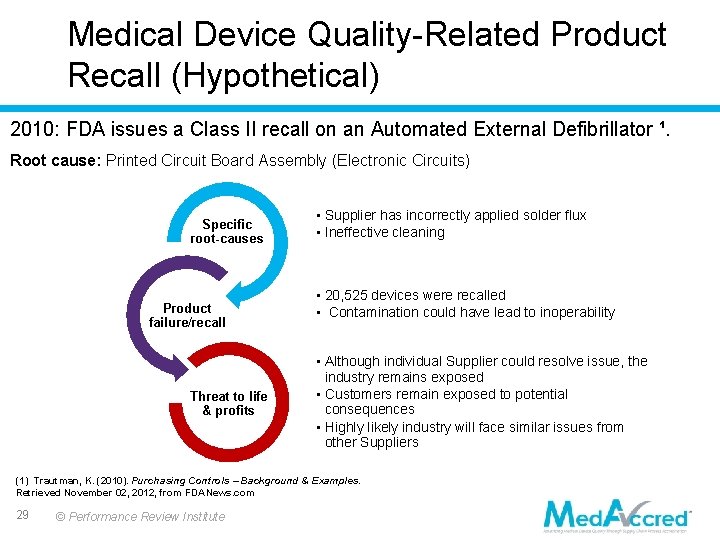
Medical Device Quality-Related Product Recall (Hypothetical) 2010: FDA issues a Class II recall on an Automated External Defibrillator ¹. Root cause: Printed Circuit Board Assembly (Electronic Circuits) Specific root-causes Product failure/recall Threat to life & profits • Supplier has incorrectly applied solder flux • Ineffective cleaning • 20, 525 devices were recalled • Contamination could have lead to inoperability • Although individual Supplier could resolve issue, the industry remains exposed • Customers remain exposed to potential consequences • Highly likely industry will face similar issues from other Suppliers (1) Trautman, K. (2010). Purchasing Controls – Background & Examples. Retrieved November 02, 2012, from FDANews. com 29 © Performance Review Institute
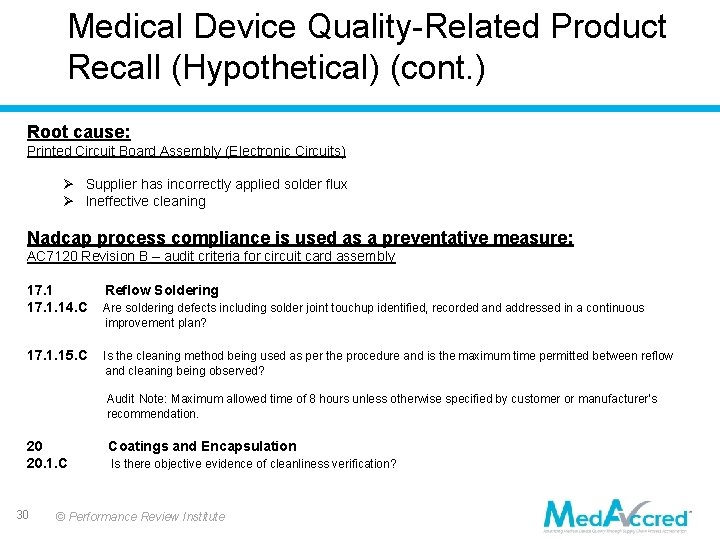
Medical Device Quality-Related Product Recall (Hypothetical) (cont. ) Root cause: Printed Circuit Board Assembly (Electronic Circuits) Ø Supplier has incorrectly applied solder flux Ø Ineffective cleaning Nadcap process compliance is used as a preventative measure: AC 7120 Revision B – audit criteria for circuit card assembly 17. 1 Reflow Soldering 17. 1. 14. C Are soldering defects including solder joint touchup identified, recorded and addressed in a continuous improvement plan? 17. 1. 15. C Is the cleaning method being used as per the procedure and is the maximum time permitted between reflow and cleaning being observed? Audit Note: Maximum allowed time of 8 hours unless otherwise specified by customer or manufacturer’s recommendation. 20 Coatings and Encapsulation 20. 1. C Is there objective evidence of cleanliness verification? 30 © Performance Review Institute
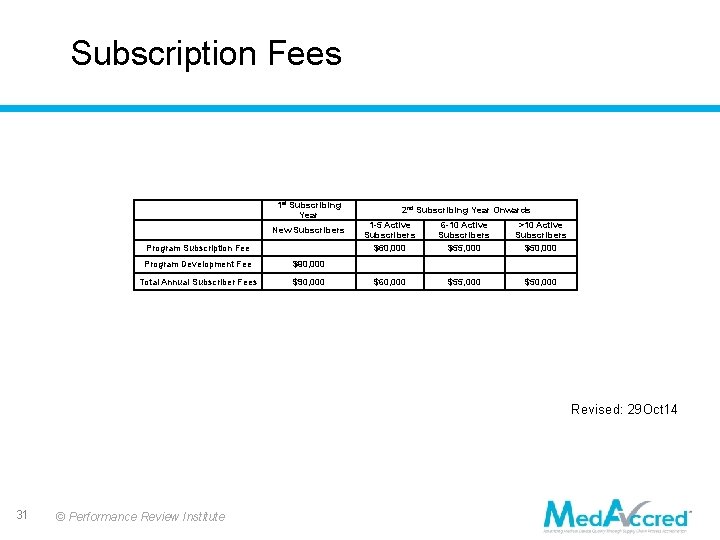
Subscription Fees 1 st Subscribing Year 2 nd Subscribing Year Onwards Program Subscription Fee 1 -5 Active Subscribers $60, 000 Program Development Fee $90, 000 Total Annual Subscriber Fees $90, 000 $60, 000 $55, 000 $50, 000 New Subscribers 6 -10 Active Subscribers $55, 000 >10 Active Subscribers $50, 000 Revised: 29 Oct 14 31 © Performance Review Institute
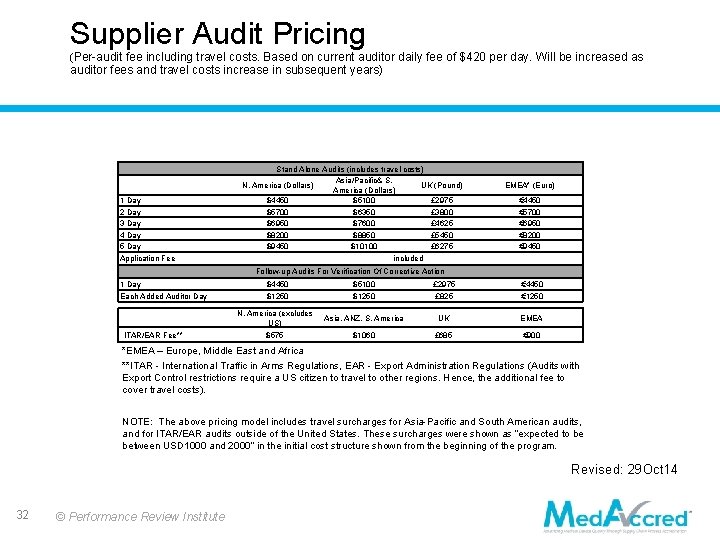
Supplier Audit Pricing (Per-audit fee including travel costs. Based on current auditor daily fee of $420 per day. Will be increased as auditor fees and travel costs increase in subsequent years) 1 Day 2 Day 3 Day 4 Day 5 Day Stand Alone Audits (includes travel costs) Asia/Pacific& S. N. America (Dollars) UK (Pound) America (Dollars) $4450 $5100 £ 2975 $5700 $6350 £ 3800 $6950 $7600 £ 4625 $8200 $8850 £ 5450 $9450 $10100 £ 6275 Application Fee EMEA* (Euro) € 4450 € 5700 € 6950 € 8200 € 9450 included Follow-up Audits For Verification Of Corrective Action 1 Day Each Added Auditor Day ITAR/EAR Fee** $4450 $1250 $5100 $1250 £ 2975 £ 825 € 4450 € 1250 N. America (excludes US) Asia, ANZ, S. America UK EMEA $575 $1060 £ 685 € 900 *EMEA – Europe, Middle East and Africa **ITAR - International Traffic in Arms Regulations, EAR - Export Administration Regulations (Audits with Export Control restrictions require a US citizen to travel to other regions. Hence, the additional fee to cover travel costs). NOTE: The above pricing model includes travel surcharges for Asia-Pacific and South American audits, and for ITAR/EAR audits outside of the United States. These surcharges were shown as “expected to be between USD 1000 and 2000” in the initial cost structure shown from the beginning of the program. Revised: 29 Oct 14 32 © Performance Review Institute
OEM Cost/Benefit Template • What number of Critical Process Audits currently performing? • How many can be eliminated? • What is the cost to conduct these audits? • Travel/Time savings? • Can the QMS audits currently being conducted by OEMs be reduced? • c. GMP compliance • Intangibles • Draw from entire med-tech industry expertise • OEM experts could observe audits conducted by Subject Matter Experts 33 © Performance Review Institute
Additional Information • Details on upcoming Med. Accred meetings, and access to supporting information on the program (including this presentation), can be found on the Med. Accred website: http: //www. p-r-i. org/other-programs/medaccred/ 34 © Performance Review Institute
Contact Details & Upcoming Meetings Joseph Pinto Executive Vice President & Chief Operating Officer, PRI jpinto@p-r-i. org +1 724 772 7175 Justin Mc. Cabe Research & Development Specialist, PRI jmccabe@p-r-i. org +1 724 772 8693 Bob Lizewski Manager Nadcap Program Quality and NUCAP, PRI rlizewski@p-r-i. org +1 724 772 8618 Upcoming Med. Accred meetings: • MMC Monthly Teleconference: January 14 at 10: 30 am - 11: 30 am EST • MMC Face to Face Meeting: February 17 (all day) in Memphis, Tennessee – Memphis Hilton 35 © Performance Review Institute