
Program Optimization Chapter 5 Overview Generally Useful Optimizations
![Reassociated Computation x = x OP (d[i] OP d[i+1]); ¢ What changed: § Ops](https://slidetodoc.com/presentation_image_h/7aafa1637077cacdec85c2d67c65609e/image-36.jpg "Reassociated Computation x = x OP (d[i] OP d[i+1]); ¢ What changed: § Ops")
![Separate Accumulators x 0 = x 0 OP d[i]; x 1 = x 1](https://slidetodoc.com/presentation_image_h/7aafa1637077cacdec85c2d67c65609e/image-39.jpg "Separate Accumulators x 0 = x 0 OP d[i]; x 1 = x 1")
- Slides: 55
Program Optimization (Chapter 5)
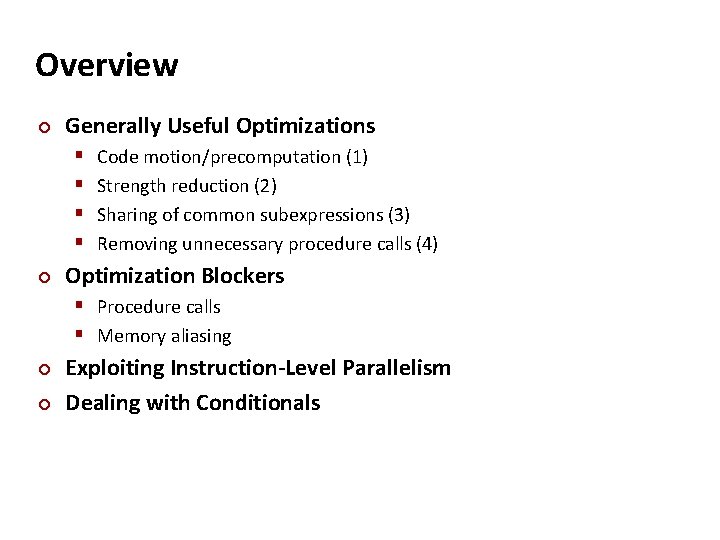
Overview ¢ Generally Useful Optimizations § § ¢ Code motion/precomputation (1) Strength reduction (2) Sharing of common subexpressions (3) Removing unnecessary procedure calls (4) Optimization Blockers § Procedure calls § Memory aliasing ¢ ¢ Exploiting Instruction-Level Parallelism Dealing with Conditionals
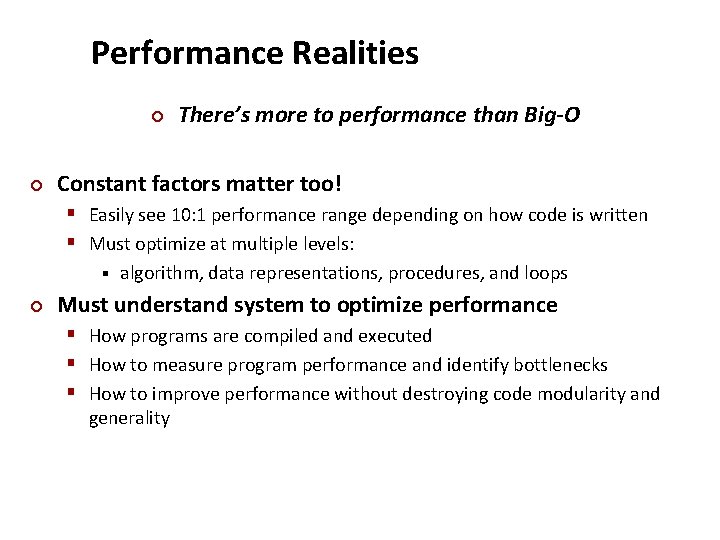
Performance Realities ¢ ¢ There’s more to performance than Big-O Constant factors matter too! § Easily see 10: 1 performance range depending on how code is written § Must optimize at multiple levels: § ¢ algorithm, data representations, procedures, and loops Must understand system to optimize performance § How programs are compiled and executed § How to measure program performance and identify bottlenecks § How to improve performance without destroying code modularity and generality
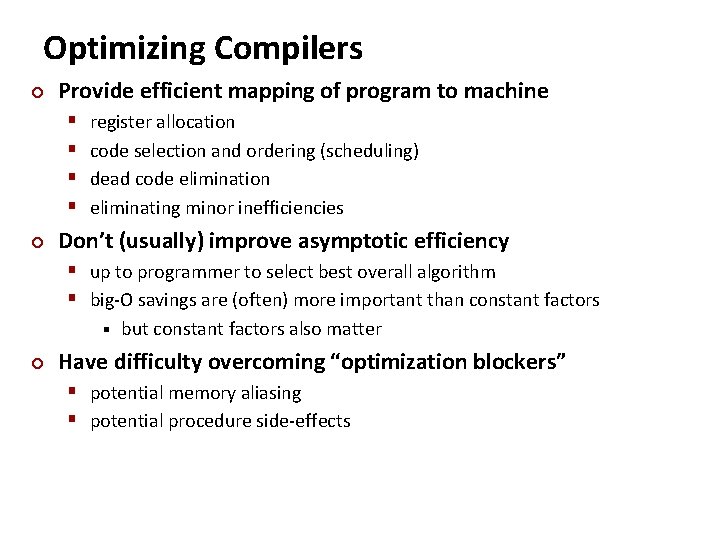
Optimizing Compilers ¢ Provide efficient mapping of program to machine § § ¢ register allocation code selection and ordering (scheduling) dead code elimination eliminating minor inefficiencies Don’t (usually) improve asymptotic efficiency § up to programmer to select best overall algorithm § big-O savings are (often) more important than constant factors § ¢ but constant factors also matter Have difficulty overcoming “optimization blockers” § potential memory aliasing § potential procedure side-effects
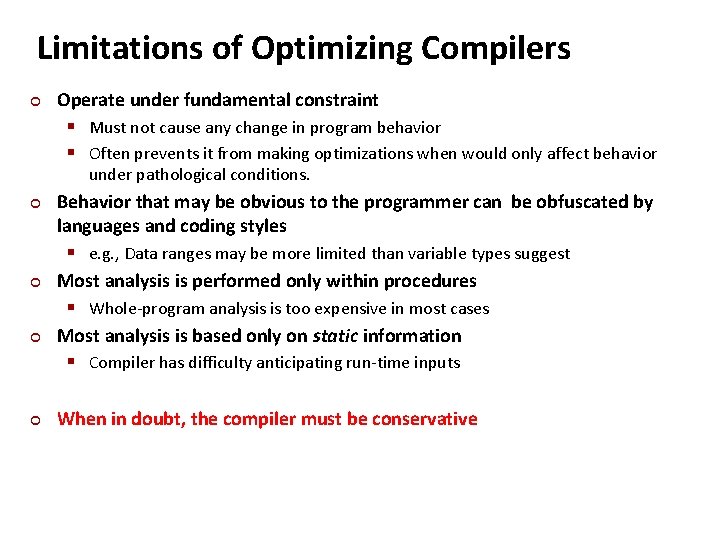
Limitations of Optimizing Compilers ¢ Operate under fundamental constraint § Must not cause any change in program behavior § Often prevents it from making optimizations when would only affect behavior under pathological conditions. ¢ ¢ Behavior that may be obvious to the programmer can be obfuscated by languages and coding styles § e. g. , Data ranges may be more limited than variable types suggest Most analysis is performed only within procedures § Whole-program analysis is too expensive in most cases Most analysis is based only on static information § Compiler has difficulty anticipating run-time inputs When in doubt, the compiler must be conservative
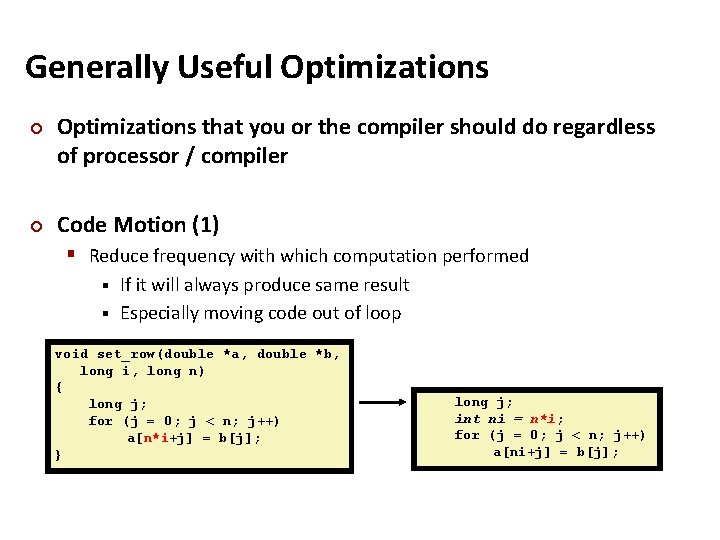
Generally Useful Optimizations ¢ ¢ Optimizations that you or the compiler should do regardless of processor / compiler Code Motion (1) § Reduce frequency with which computation performed If it will always produce same result § Especially moving code out of loop § void set_row(double *a, double *b, long i, long n) { long j; for (j = 0; j < n; j++) a[n*i+j] = b[j]; } long j; int ni = n*i; for (j = 0; j < n; j++) a[ni+j] = b[j];
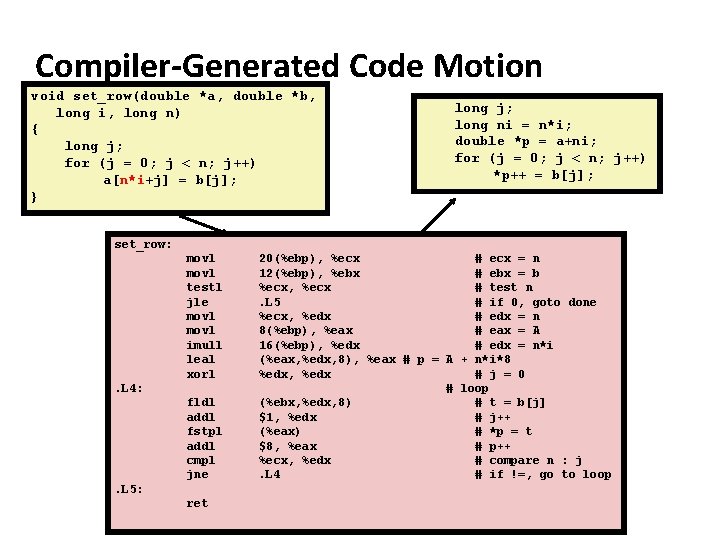
Compiler-Generated Code Motion void set_row(double *a, double *b, long i, long n) { long j; for (j = 0; j < n; j++) a[n*i+j] = b[j]; } long j; long ni = n*i; double *p = a+ni; for (j = 0; j < n; j++) *p++ = b[j]; set_row: movl testl jle movl imull leal xorl. L 4: fldl addl fstpl addl cmpl jne. L 5: ret 20(%ebp), %ecx # ecx = n 12(%ebp), %ebx # ebx = b %ecx, %ecx # test n. L 5 # if 0, goto done %ecx, %edx # edx = n 8(%ebp), %eax # eax = A 16(%ebp), %edx # edx = n*i (%eax, %edx, 8), %eax # p = A + n*i*8 %edx, %edx # j = 0 # loop (%ebx, %edx, 8) # t = b[j] $1, %edx # j++ (%eax) # *p = t $8, %eax # p++ %ecx, %edx # compare n : j. L 4 # if !=, go to loop
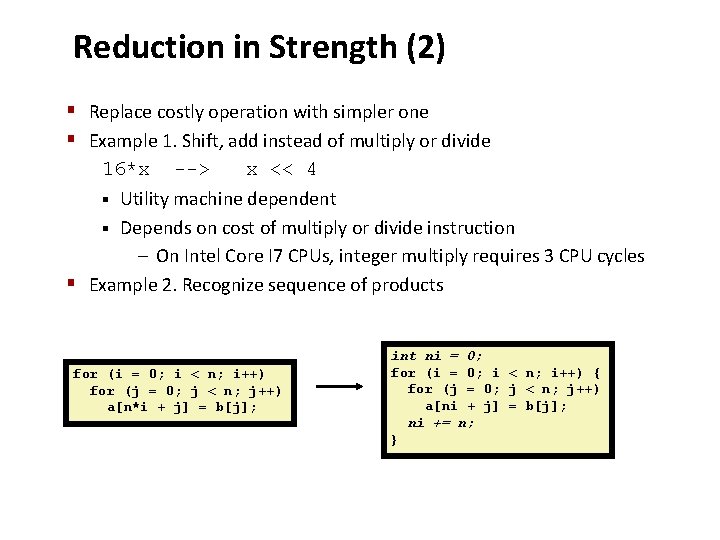
Reduction in Strength (2) § Replace costly operation with simpler one § Example 1. Shift, add instead of multiply or divide 16*x --> x << 4 § Utility machine dependent § Depends on cost of multiply or divide instruction – On Intel Core I 7 CPUs, integer multiply requires 3 CPU cycles § Example 2. Recognize sequence of products for (i = 0; i < n; i++) for (j = 0; j < n; j++) a[n*i + j] = b[j]; int ni = 0; for (i = 0; i < n; i++) { for (j = 0; j < n; j++) a[ni + j] = b[j]; ni += n; }
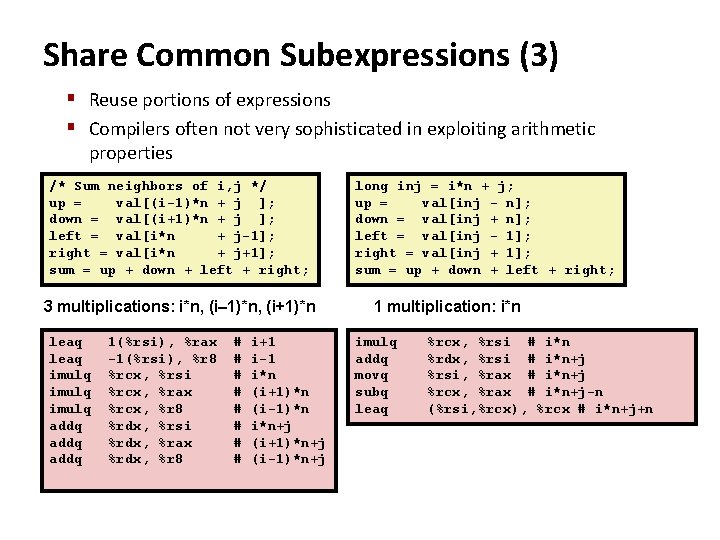
Share Common Subexpressions (3) § Reuse portions of expressions § Compilers often not very sophisticated in exploiting arithmetic properties /* Sum neighbors of i, j */ up = val[(i-1)*n + j ]; down = val[(i+1)*n + j ]; left = val[i*n + j-1]; right = val[i*n + j+1]; sum = up + down + left + right; 3 multiplications: i*n, (i– 1)*n, (i+1)*n leaq imulq addq 1(%rsi), %rax -1(%rsi), %r 8 %rcx, %rsi %rcx, %rax %rcx, %r 8 %rdx, %rsi %rdx, %rax %rdx, %r 8 # # # # i+1 i-1 i*n (i+1)*n (i-1)*n i*n+j (i+1)*n+j (i-1)*n+j long inj = i*n + j; up = val[inj - n]; down = val[inj + n]; left = val[inj - 1]; right = val[inj + 1]; sum = up + down + left + right; 1 multiplication: i*n imulq addq movq subq leaq %rcx, %rsi # i*n %rdx, %rsi # i*n+j %rsi, %rax # i*n+j %rcx, %rax # i*n+j-n (%rsi, %rcx), %rcx # i*n+j+n
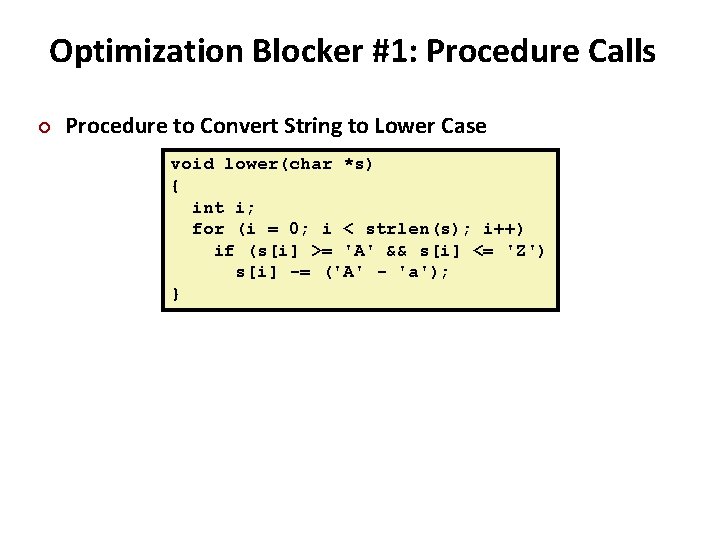
Optimization Blocker #1: Procedure Calls ¢ Procedure to Convert String to Lower Case void lower(char *s) { int i; for (i = 0; i < strlen(s); i++) if (s[i] >= 'A' && s[i] <= 'Z') s[i] -= ('A' - 'a'); }
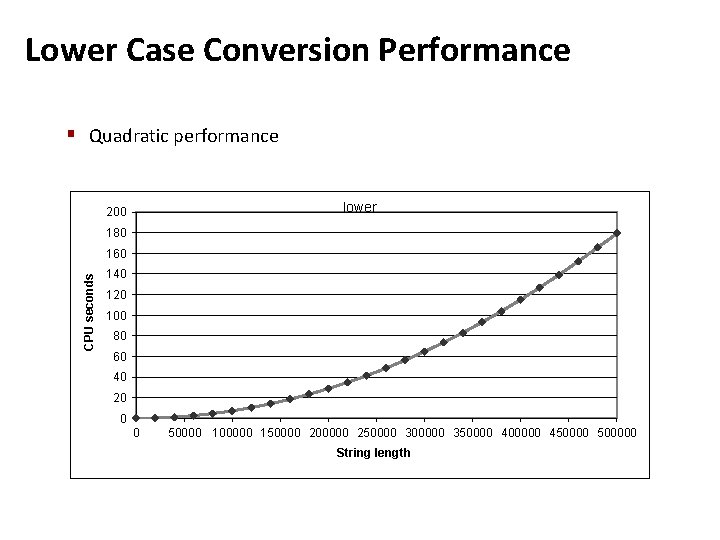
Lower Case Conversion Performance § Quadratic performance lower 200 180 CPU seconds 160 140 120 100 80 60 40 20 0 0 50000 100000 150000 200000 250000 300000 350000 400000 4500000 String length
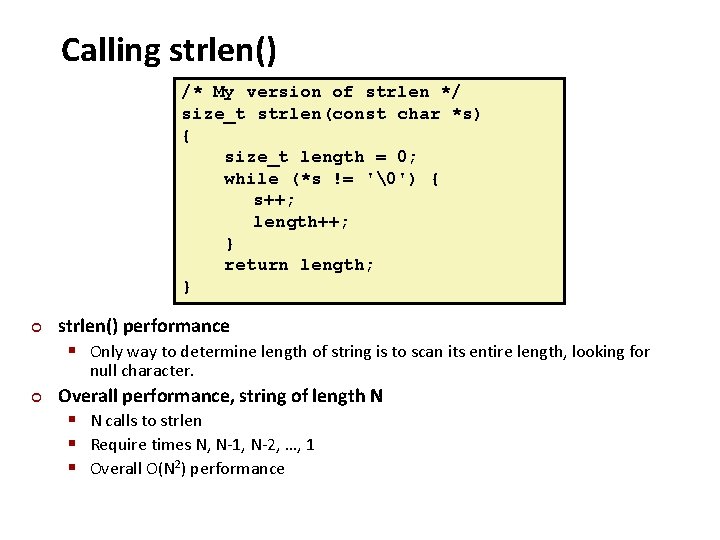
Calling strlen() /* My version of strlen */ size_t strlen(const char *s) { size_t length = 0; while (*s != '') { s++; length++; } return length; } ¢ strlen() performance § Only way to determine length of string is to scan its entire length, looking for null character. ¢ Overall performance, string of length N § N calls to strlen § Require times N, N-1, N-2, …, 1 § Overall O(N 2) performance
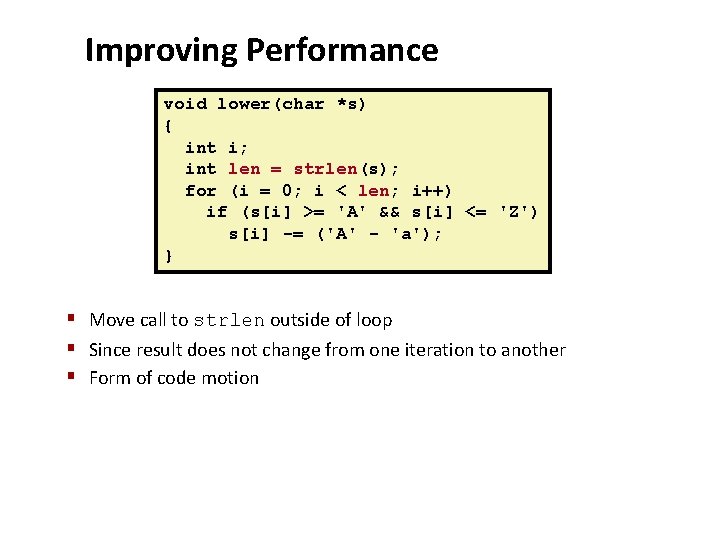
Improving Performance void lower(char *s) { int i; int len = strlen(s); for (i = 0; i < len; i++) if (s[i] >= 'A' && s[i] <= 'Z') s[i] -= ('A' - 'a'); } § Move call to strlen outside of loop § Since result does not change from one iteration to another § Form of code motion
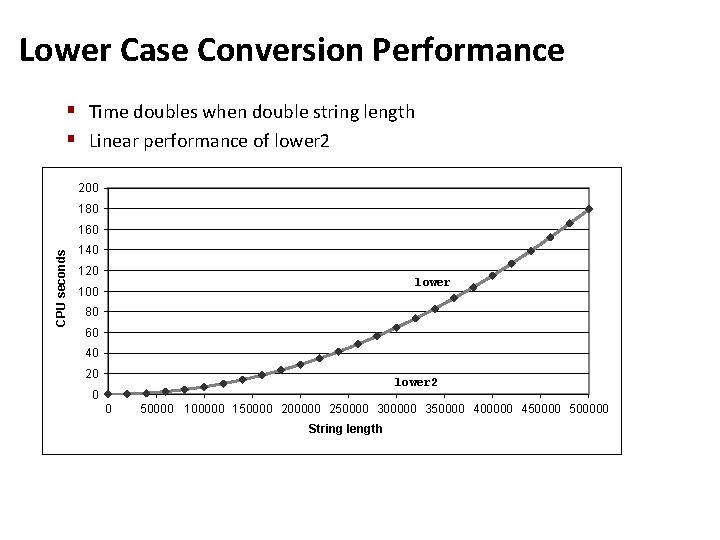
Lower Case Conversion Performance § Time doubles when double string length § Linear performance of lower 2 200 180 CPU seconds 160 140 120 lower 100 80 60 40 20 lower 2 0 0 50000 100000 150000 200000 250000 300000 350000 400000 4500000 String length
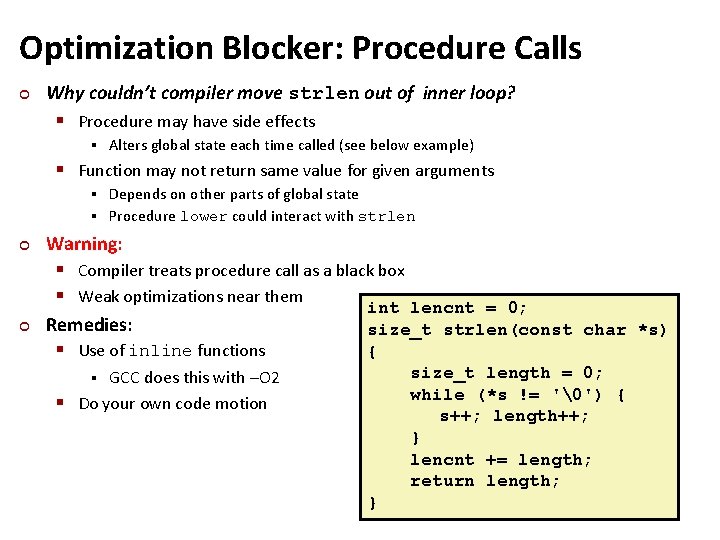
Optimization Blocker: Procedure Calls ¢ Why couldn’t compiler move strlen out of inner loop? § Procedure may have side effects § Alters global state each time called (see below example) § Function may not return same value for given arguments Depends on other parts of global state § Procedure lower could interact with strlen § ¢ ¢ Warning: § Compiler treats procedure call as a black box § Weak optimizations near them int lencnt = 0; Remedies: size_t strlen(const char *s) § Use of inline functions { size_t length = 0; while (*s != '') { s++; length++; } lencnt += length; return length; GCC does this with –O 2 § Do your own code motion § }
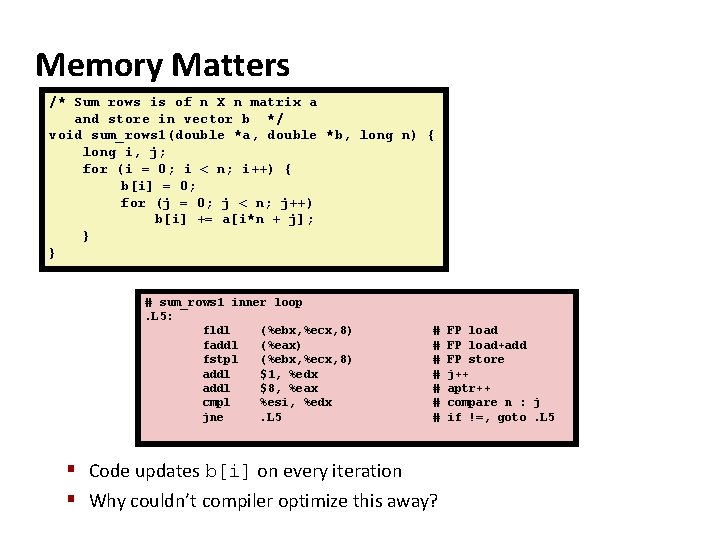
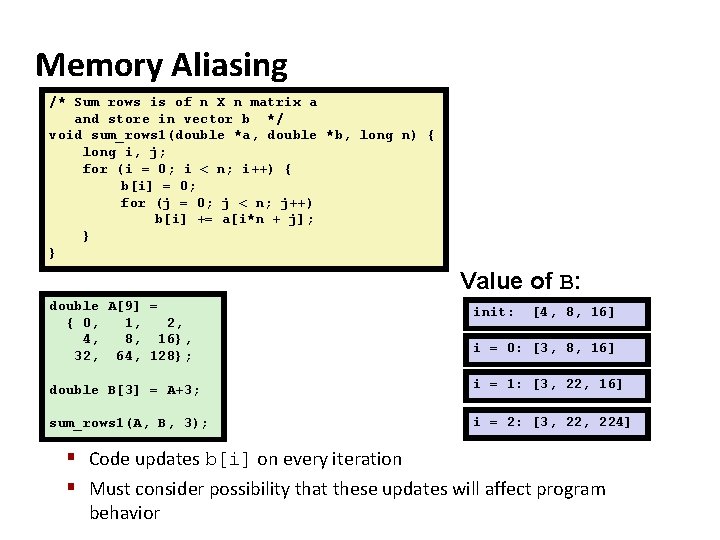
Memory Matters /* Sum rows is of n X n matrix a and store in vector b */ void sum_rows 1(double *a, double *b, long n) { long i, j; for (i = 0; i < n; i++) { b[i] = 0; for (j = 0; j < n; j++) b[i] += a[i*n + j]; } } # sum_rows 1 inner loop. L 5: fldl (%ebx, %ecx, 8) faddl (%eax) fstpl (%ebx, %ecx, 8) addl $1, %edx addl $8, %eax cmpl %esi, %edx jne. L 5 # # # # § Code updates b[i] on every iteration § Why couldn’t compiler optimize this away? FP load+add FP store j++ aptr++ compare n : j if !=, goto. L 5
Memory Aliasing /* Sum rows is of n X n matrix a and store in vector b */ void sum_rows 1(double *a, double *b, long n) { long i, j; for (i = 0; i < n; i++) { b[i] = 0; for (j = 0; j < n; j++) b[i] += a[i*n + j]; } } Value of B: double A[9] = { 0, 1, 2, 4, 8, 16}, 32, 64, 128}; init: double B[3] = A+3; i = 1: [3, 22, 16] sum_rows 1(A, B, 3); i = 2: [3, 224] [4, 8, 16] i = 0: [3, 8, 16] § Code updates b[i] on every iteration § Must consider possibility that these updates will affect program behavior
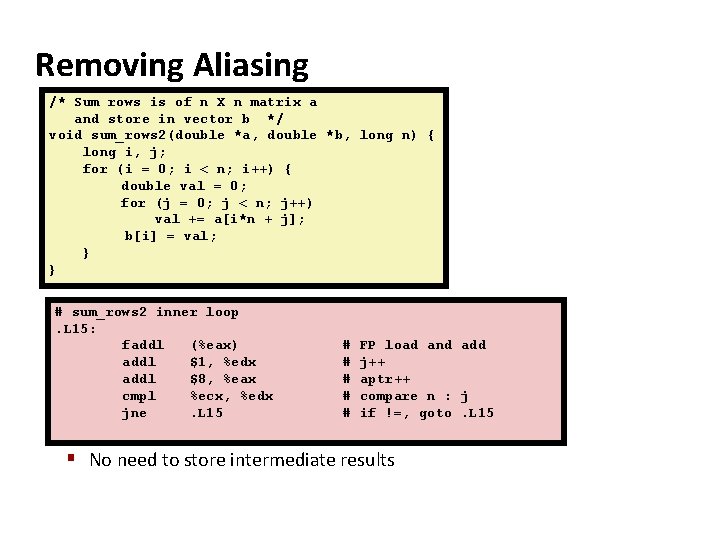
Removing Aliasing /* Sum rows is of n X n matrix a and store in vector b */ void sum_rows 2(double *a, double *b, long n) { long i, j; for (i = 0; i < n; i++) { double val = 0; for (j = 0; j < n; j++) val += a[i*n + j]; b[i] = val; } } # sum_rows 2 inner loop. L 15: faddl (%eax) addl $1, %edx addl $8, %eax cmpl %ecx, %edx jne. L 15 # # # FP load and add j++ aptr++ compare n : j if !=, goto. L 15 § No need to store intermediate results
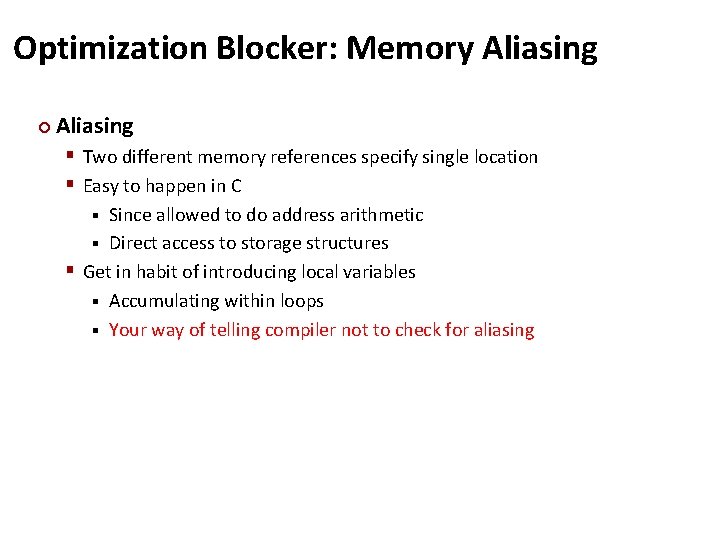
Optimization Blocker: Memory Aliasing ¢ Aliasing § Two different memory references specify single location § Easy to happen in C Since allowed to do address arithmetic § Direct access to storage structures § Get in habit of introducing local variables § Accumulating within loops § Your way of telling compiler not to check for aliasing §
Exploiting Instruction-Level Parallelism ¢ Need general understanding of modern processor design § Hardware can execute multiple instructions in parallel ¢ ¢ Performance limited by data dependencies Simple transformations can have dramatic performance improvement § Compilers often cannot make these transformations § Lack of associativity and distributivity in floating-point arithmetic
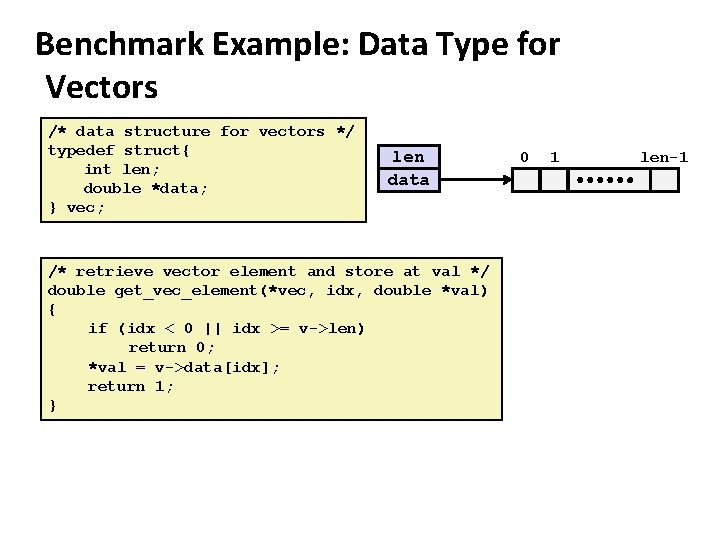
Benchmark Example: Data Type for Vectors /* data structure for vectors */ typedef struct{ int len; double *data; } vec; len data /* retrieve vector element and store at val */ double get_vec_element(*vec, idx, double *val) { if (idx < 0 || idx >= v->len) return 0; *val = v->data[idx]; return 1; } 0 1 len-1
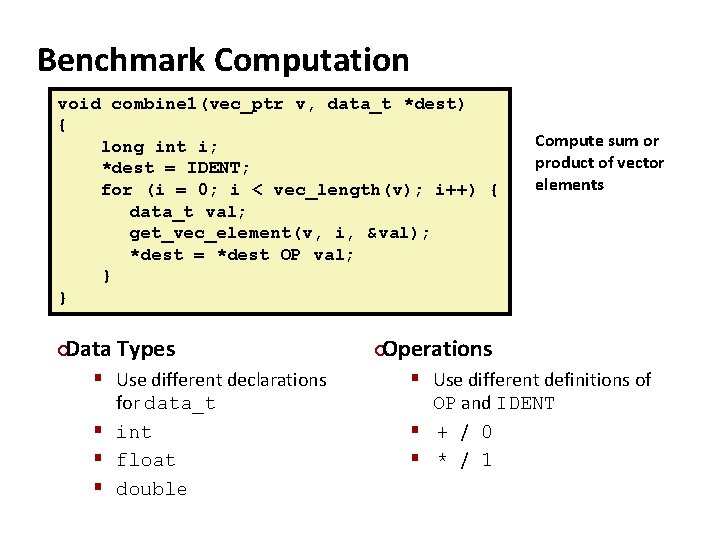
Benchmark Computation void combine 1(vec_ptr v, data_t *dest) { long int i; *dest = IDENT; for (i = 0; i < vec_length(v); i++) { data_t val; get_vec_element(v, i, &val); *dest = *dest OP val; } } Data Types ¢ § Use different declarations for data_t § int § float § double Compute sum or product of vector elements Operations ¢ § Use different definitions of OP and IDENT § + / 0 § * / 1
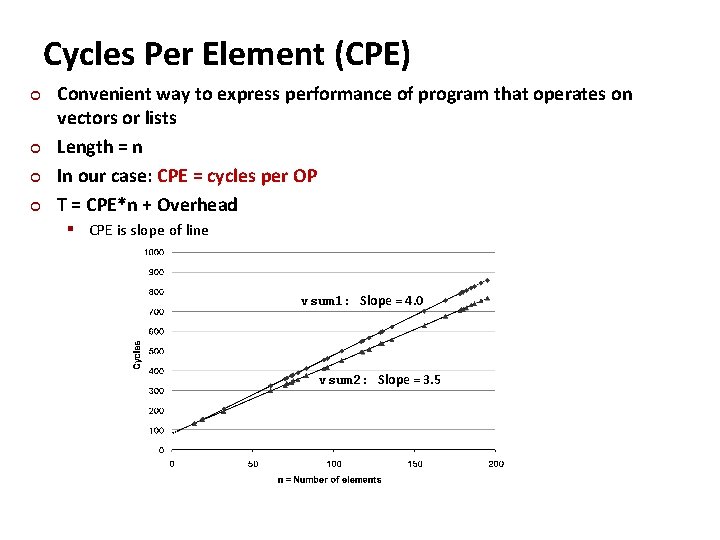
Cycles Per Element (CPE) ¢ ¢ Convenient way to express performance of program that operates on vectors or lists Length = n In our case: CPE = cycles per OP T = CPE*n + Overhead § CPE is slope of line vsum 1: Slope = 4. 0 vsum 2: Slope = 3. 5
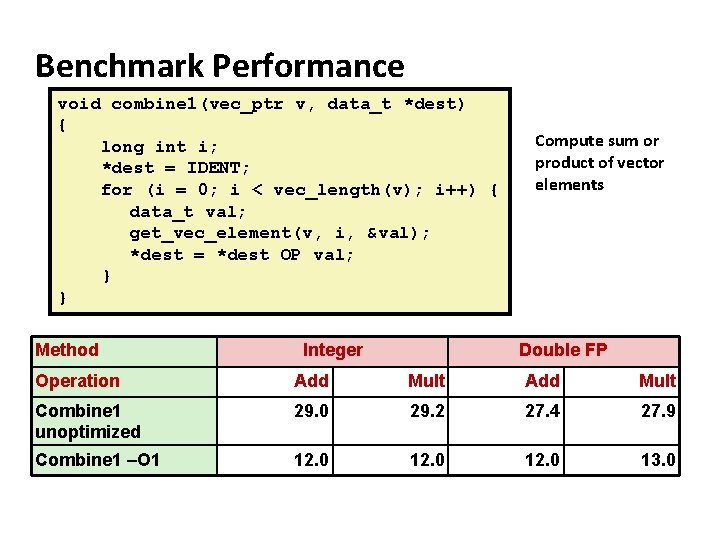
Benchmark Performance void combine 1(vec_ptr v, data_t *dest) { long int i; *dest = IDENT; for (i = 0; i < vec_length(v); i++) { data_t val; get_vec_element(v, i, &val); *dest = *dest OP val; } } Method Integer Compute sum or product of vector elements Double FP Operation Add Mult Combine 1 unoptimized 29. 0 29. 2 27. 4 27. 9 Combine 1 –O 1 12. 0 13. 0
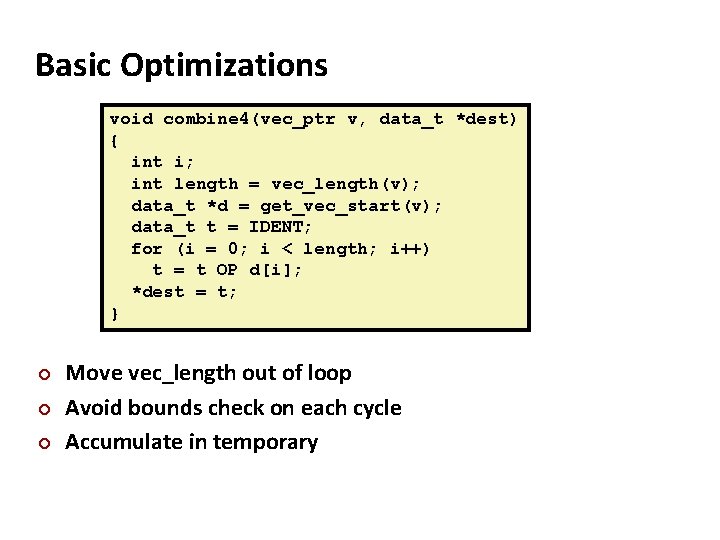
Basic Optimizations void combine 4(vec_ptr v, data_t *dest) { int i; int length = vec_length(v); data_t *d = get_vec_start(v); data_t t = IDENT; for (i = 0; i < length; i++) t = t OP d[i]; *dest = t; } ¢ ¢ ¢ Move vec_length out of loop Avoid bounds check on each cycle Accumulate in temporary
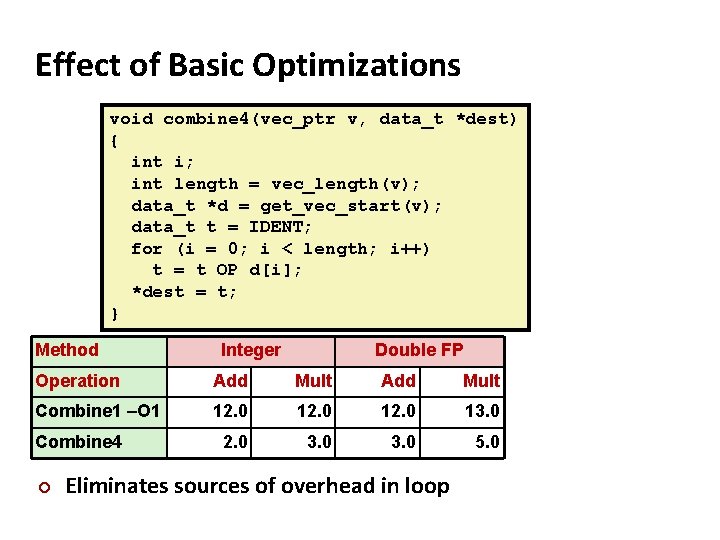
Effect of Basic Optimizations void combine 4(vec_ptr v, data_t *dest) { int i; int length = vec_length(v); data_t *d = get_vec_start(v); data_t t = IDENT; for (i = 0; i < length; i++) t = t OP d[i]; *dest = t; } Method Integer Double FP Operation Add Mult Combine 1 –O 1 12. 0 13. 0 2. 0 3. 0 5. 0 Combine 4 ¢ Eliminates sources of overhead in loop
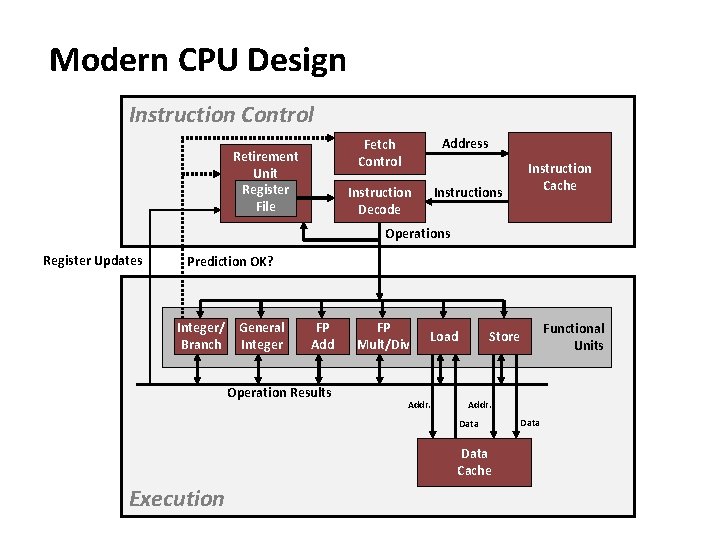
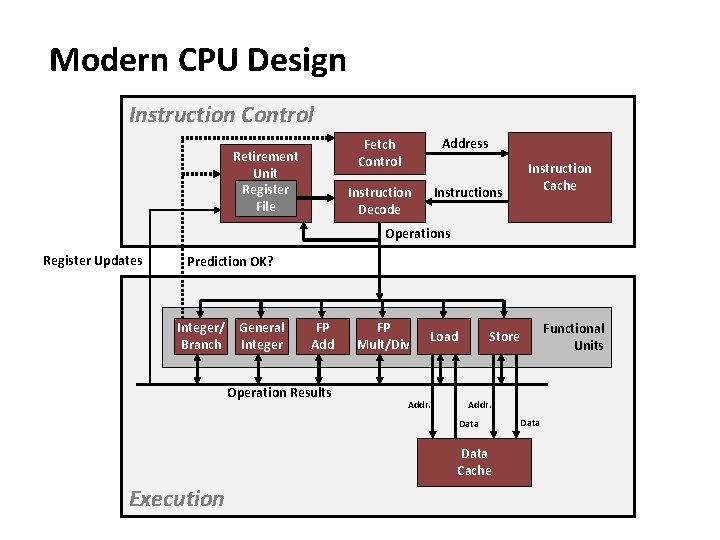
Modern CPU Design Instruction Control Retirement Unit Register File Fetch Control Address Instruction Decode Instructions Instruction Cache Operations Register Updates Prediction OK? Integer/ General Branch Integer FP Add Operation Results FP Mult/Div Load Addr. Data Cache Execution Functional Units Store Data
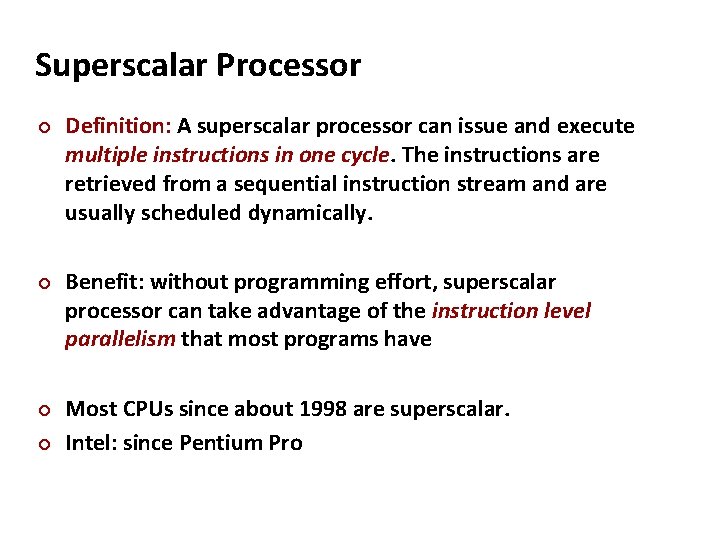
Superscalar Processor ¢ ¢ Definition: A superscalar processor can issue and execute multiple instructions in one cycle. The instructions are retrieved from a sequential instruction stream and are usually scheduled dynamically. Benefit: without programming effort, superscalar processor can take advantage of the instruction level parallelism that most programs have Most CPUs since about 1998 are superscalar. Intel: since Pentium Pro
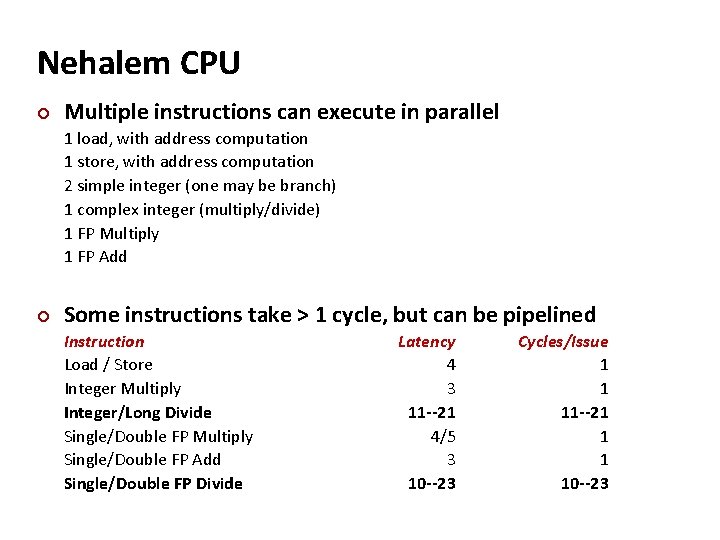
Nehalem CPU ¢ Multiple instructions can execute in parallel 1 load, with address computation 1 store, with address computation 2 simple integer (one may be branch) 1 complex integer (multiply/divide) 1 FP Multiply 1 FP Add ¢ Some instructions take > 1 cycle, but can be pipelined Instruction Load / Store Integer Multiply Integer/Long Divide Single/Double FP Multiply Single/Double FP Add Single/Double FP Divide Latency 4 3 11 --21 4/5 3 10 --23 Cycles/Issue 1 1 11 --21 1 1 10 --23
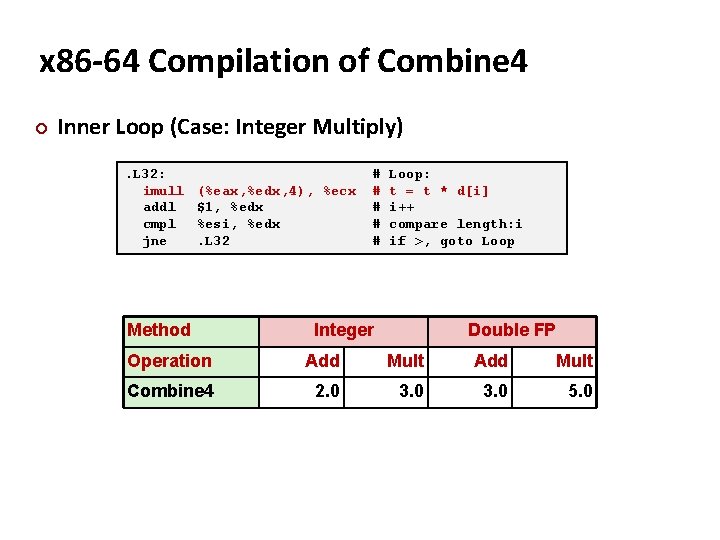
x 86 -64 Compilation of Combine 4 ¢ Inner Loop (Case: Integer Multiply). L 32: imull addl cmpl jne (%eax, %edx, 4), %ecx $1, %edx %esi, %edx. L 32 Method # # # Loop: t = t * d[i] i++ compare length: i if >, goto Loop Integer Double FP Operation Add Mult Combine 4 2. 0 3. 0 5. 0
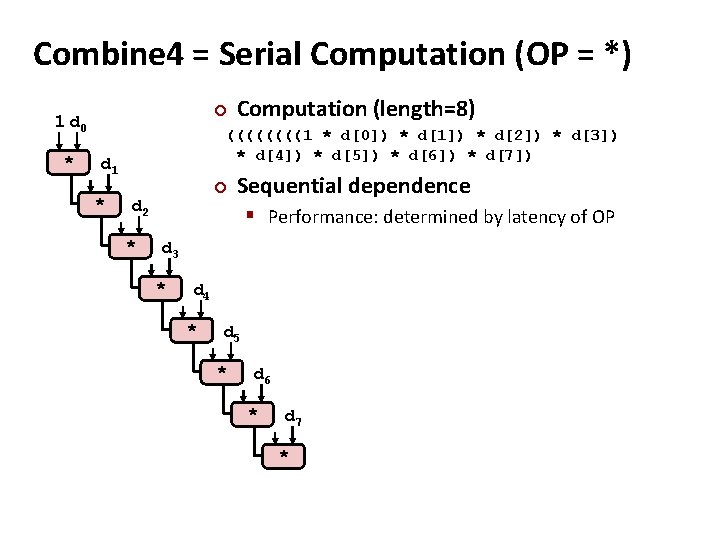
Combine 4 = Serial Computation (OP = *) ¢ 1 d 0 * ((((1 * d[0]) * d[1]) * d[2]) * d[3]) * d[4]) * d[5]) * d[6]) * d[7]) d 1 * Computation (length=8) ¢ d 2 * Sequential dependence § Performance: determined by latency of OP d 3 * d 4 * d 5 * d 6 * d 7 *
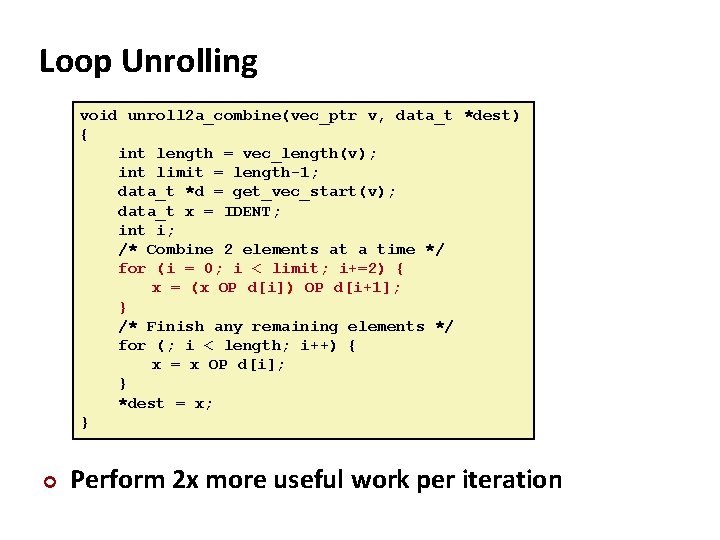
Loop Unrolling void unroll 2 a_combine(vec_ptr v, data_t *dest) { int length = vec_length(v); int limit = length-1; data_t *d = get_vec_start(v); data_t x = IDENT; int i; /* Combine 2 elements at a time */ for (i = 0; i < limit; i+=2) { x = (x OP d[i]) OP d[i+1]; } /* Finish any remaining elements */ for (; i < length; i++) { x = x OP d[i]; } *dest = x; } ¢ Perform 2 x more useful work per iteration
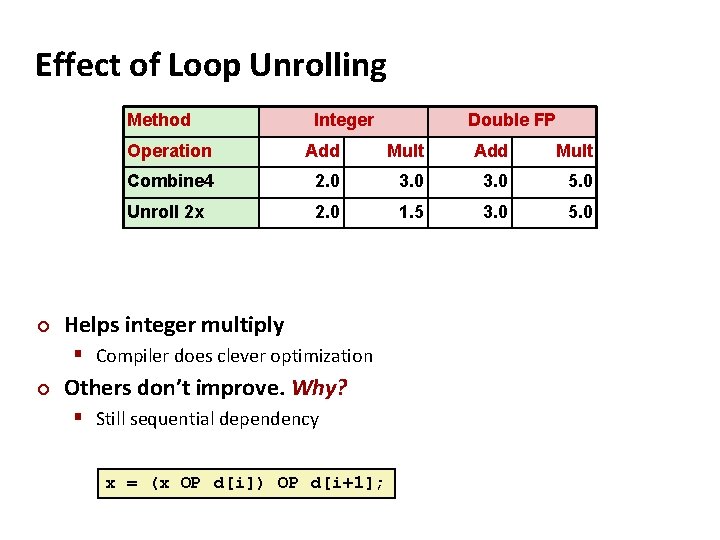
Effect of Loop Unrolling Method ¢ Integer Operation Add Mult Combine 4 2. 0 3. 0 5. 0 Unroll 2 x 2. 0 1. 5 3. 0 5. 0 Helps integer multiply § Compiler does clever optimization ¢ Double FP Others don’t improve. Why? § Still sequential dependency x = (x OP d[i]) OP d[i+1];
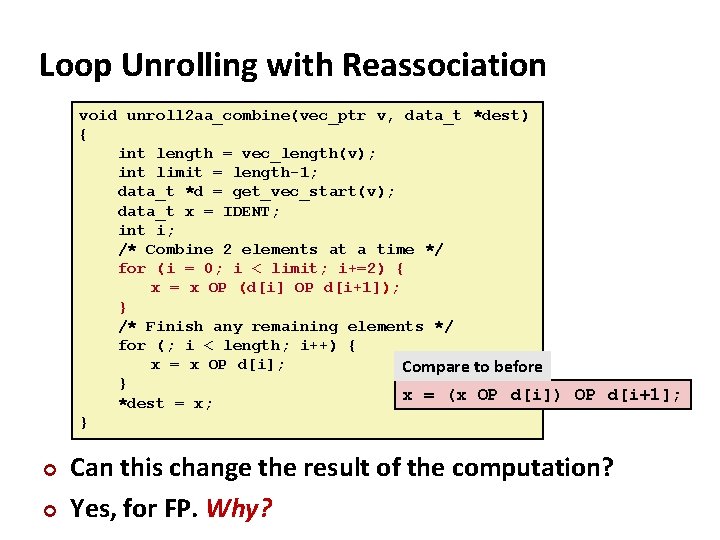
Loop Unrolling with Reassociation void unroll 2 aa_combine(vec_ptr v, data_t *dest) { int length = vec_length(v); int limit = length-1; data_t *d = get_vec_start(v); data_t x = IDENT; int i; /* Combine 2 elements at a time */ for (i = 0; i < limit; i+=2) { x = x OP (d[i] OP d[i+1]); } /* Finish any remaining elements */ for (; i < length; i++) { x = x OP d[i]; Compare to before } x = (x OP d[i]) OP d[i+1]; *dest = x; } ¢ ¢ Can this change the result of the computation? Yes, for FP. Why?
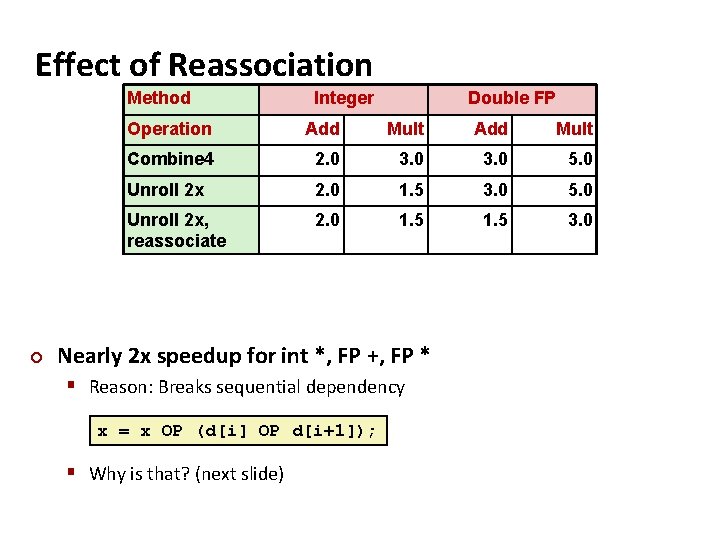
Effect of Reassociation Method ¢ Integer Double FP Operation Add Mult Combine 4 2. 0 3. 0 5. 0 Unroll 2 x 2. 0 1. 5 3. 0 5. 0 Unroll 2 x, reassociate 2. 0 1. 5 3. 0 Nearly 2 x speedup for int *, FP +, FP * § Reason: Breaks sequential dependency x = x OP (d[i] OP d[i+1]); § Why is that? (next slide)
Reassociated Computation x = x OP (d[i] OP d[i+1]); ¢ What changed: § Ops in the next iteration can be started early (no dependency) d 0 d 1 1 * ¢ d 2 d 3 * * § N elements, D cycles latency/op § Should be (N/2+1)*D cycles: d 4 d 5 * * Overall Performance d 6 d 7 * * * CPE = D/2 § Measured CPE slightly worse for FP mult
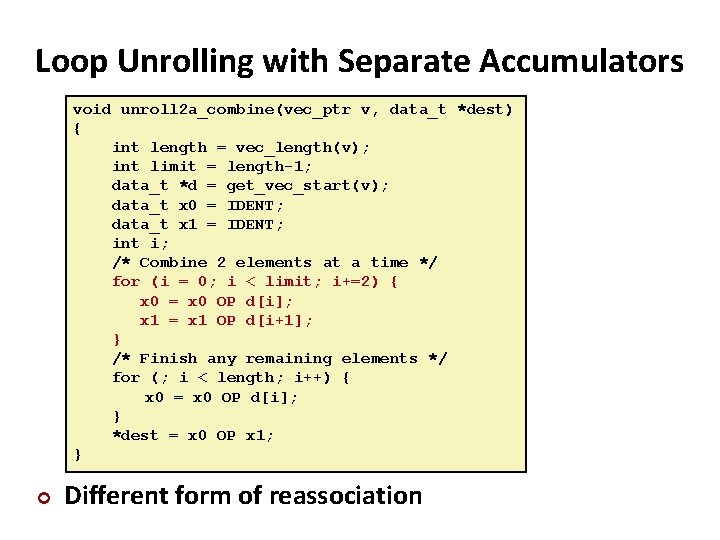
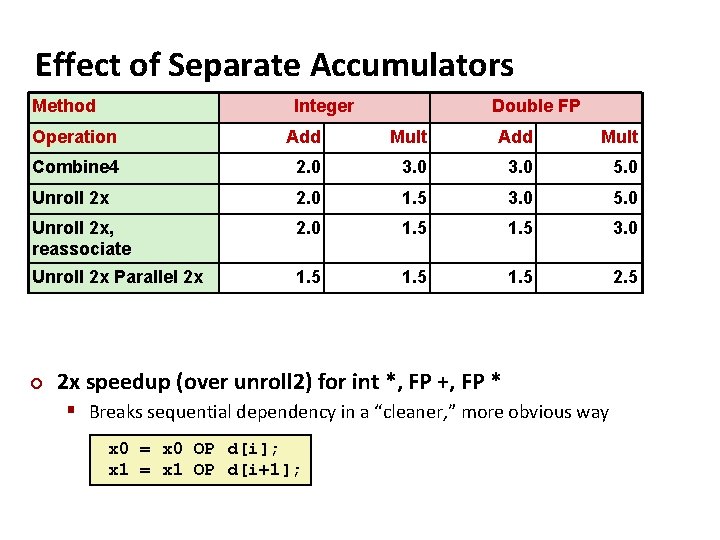
Loop Unrolling with Separate Accumulators void unroll 2 a_combine(vec_ptr v, data_t *dest) { int length = vec_length(v); int limit = length-1; data_t *d = get_vec_start(v); data_t x 0 = IDENT; data_t x 1 = IDENT; int i; /* Combine 2 elements at a time */ for (i = 0; i < limit; i+=2) { x 0 = x 0 OP d[i]; x 1 = x 1 OP d[i+1]; } /* Finish any remaining elements */ for (; i < length; i++) { x 0 = x 0 OP d[i]; } *dest = x 0 OP x 1; } ¢ Different form of reassociation
Effect of Separate Accumulators Method Integer Double FP Operation Add Mult Combine 4 2. 0 3. 0 5. 0 Unroll 2 x 2. 0 1. 5 3. 0 5. 0 Unroll 2 x, reassociate 2. 0 1. 5 3. 0 Unroll 2 x Parallel 2 x 1. 5 2. 5 ¢ 2 x speedup (over unroll 2) for int *, FP +, FP * § Breaks sequential dependency in a “cleaner, ” more obvious way x 0 = x 0 OP d[i]; x 1 = x 1 OP d[i+1];
Separate Accumulators x 0 = x 0 OP d[i]; x 1 = x 1 OP d[i+1]; 1 d 0 1 d 1 * * d 2 * operations ¢ * d 6 What changed: § Two independent “streams” of d 3 d 4 * ¢ § N elements, D cycles latency/op § Should be (N/2+1)*D cycles: d 5 * * d 7 * * Overall Performance CPE = D/2 § CPE matches prediction! What Now?
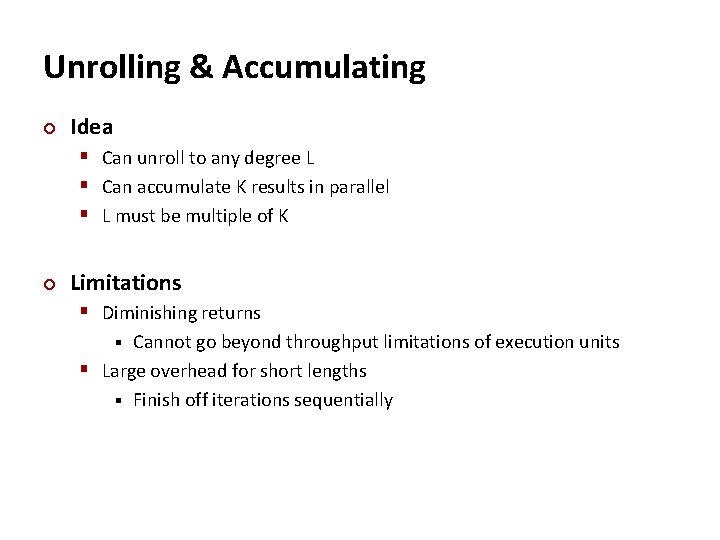
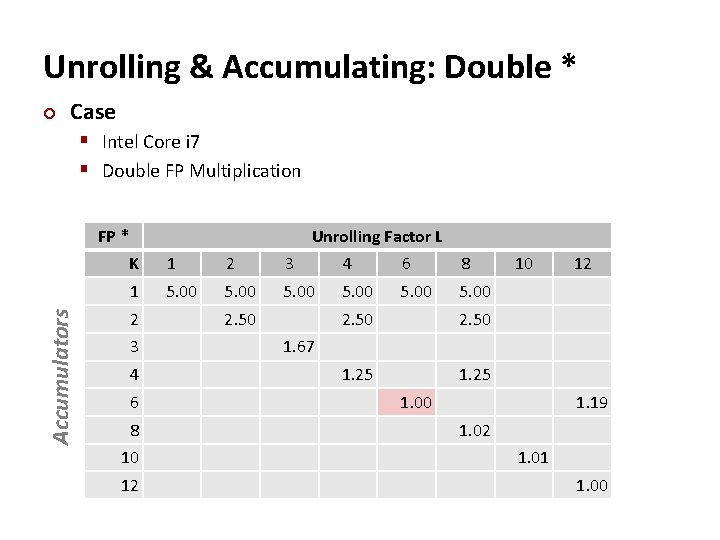
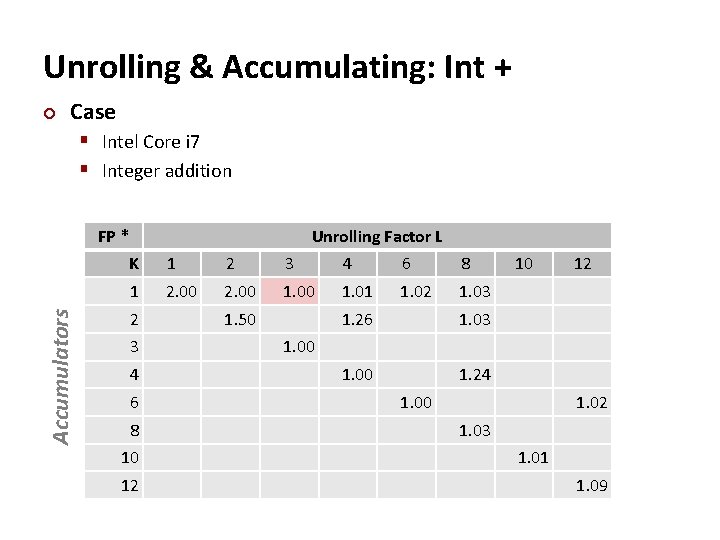
Unrolling & Accumulating ¢ Idea § Can unroll to any degree L § Can accumulate K results in parallel § L must be multiple of K ¢ Limitations § Diminishing returns Cannot go beyond throughput limitations of execution units § Large overhead for short lengths § Finish off iterations sequentially §
Unrolling & Accumulating: Double * ¢ Case § Intel Core i 7 § Double FP Multiplication Accumulators FP * Unrolling Factor L K 1 2 3 4 6 8 1 5. 00 2 3 4 6 8 10 12 2. 50 1. 25 10 12 1. 67 1. 00 1. 19 1. 02 1. 01 1. 00
Unrolling & Accumulating: Int + ¢ Case § Intel Core i 7 § Integer addition Accumulators FP * Unrolling Factor L K 1 2 3 4 6 8 1 2. 00 1. 01 1. 02 1. 03 2 3 4 6 8 10 12 1. 50 1. 26 1. 03 1. 00 1. 24 10 12 1. 00 1. 02 1. 03 1. 01 1. 09
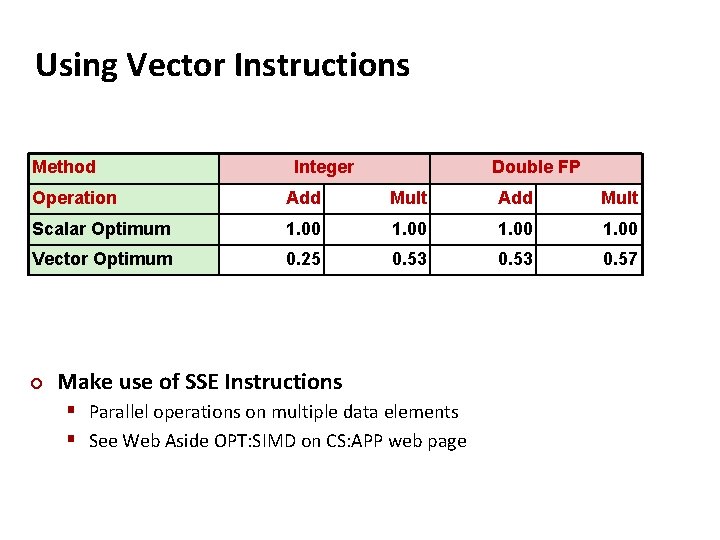
Using Vector Instructions Method Integer Double FP Operation Add Mult Scalar Optimum 1. 00 Vector Optimum 0. 25 0. 53 0. 57 ¢ Make use of SSE Instructions § Parallel operations on multiple data elements § See Web Aside OPT: SIMD on CS: APP web page
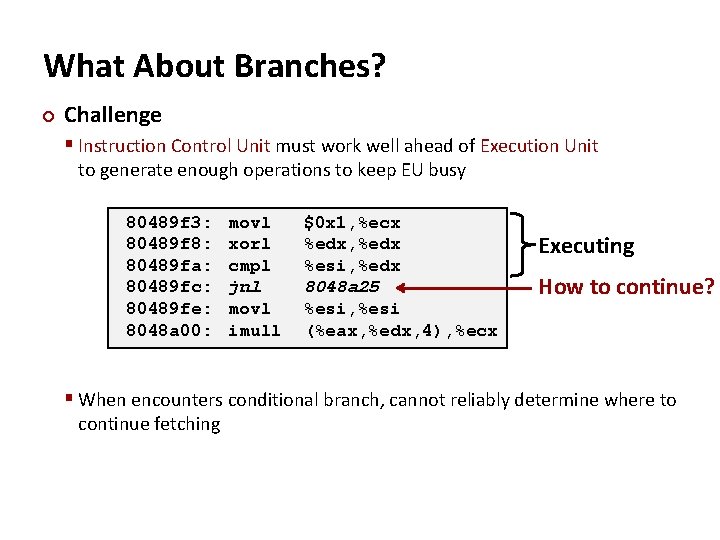
What About Branches? ¢ Challenge § Instruction Control Unit must work well ahead of Execution Unit to generate enough operations to keep EU busy 80489 f 3: 80489 f 8: 80489 fa: 80489 fc: 80489 fe: 8048 a 00: movl xorl cmpl jnl movl imull $0 x 1, %ecx %edx, %edx %esi, %edx 8048 a 25 %esi, %esi (%eax, %edx, 4), %ecx Executing How to continue? § When encounters conditional branch, cannot reliably determine where to continue fetching
Modern CPU Design Instruction Control Retirement Unit Register File Fetch Control Address Instruction Decode Instructions Instruction Cache Operations Register Updates Prediction OK? Integer/ General Branch Integer FP Add Operation Results FP Mult/Div Load Addr. Data Cache Execution Functional Units Store Data
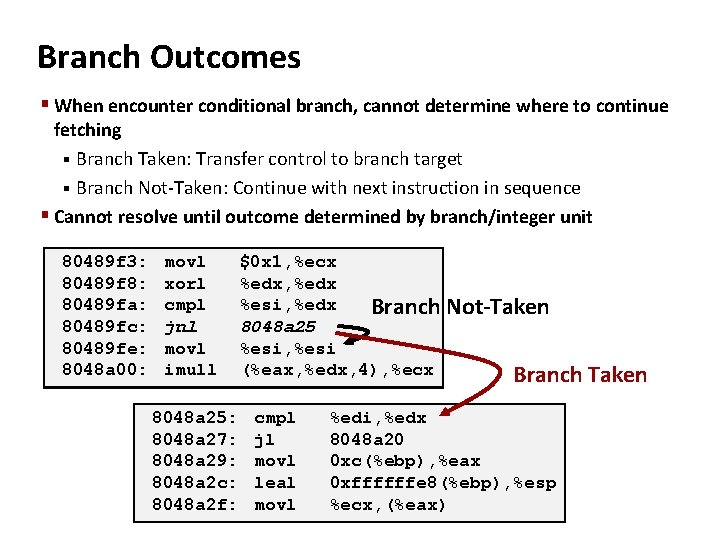
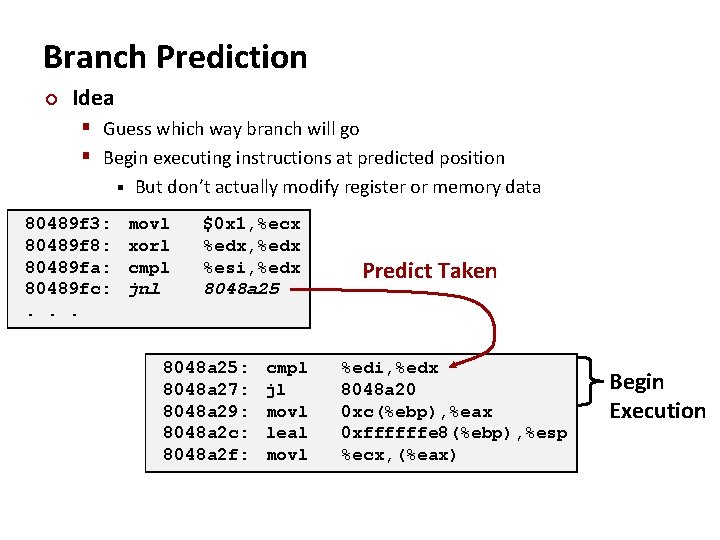
Branch Outcomes § When encounter conditional branch, cannot determine where to continue fetching § Branch Taken: Transfer control to branch target § Branch Not-Taken: Continue with next instruction in sequence § Cannot resolve until outcome determined by branch/integer unit 80489 f 3: 80489 f 8: 80489 fa: 80489 fc: 80489 fe: 8048 a 00: movl xorl cmpl jnl movl imull 8048 a 25: 8048 a 27: 8048 a 29: 8048 a 2 c: 8048 a 2 f: $0 x 1, %ecx %edx, %edx %esi, %edx Branch 8048 a 25 %esi, %esi (%eax, %edx, 4), %ecx cmpl jl movl leal movl Not-Taken Branch Taken %edi, %edx 8048 a 20 0 xc(%ebp), %eax 0 xffffffe 8(%ebp), %esp %ecx, (%eax)
Branch Prediction ¢ Idea § Guess which way branch will go § Begin executing instructions at predicted position § 80489 f 3: 80489 f 8: 80489 fa: 80489 fc: . . . But don’t actually modify register or memory data movl xorl cmpl jnl $0 x 1, %ecx %edx, %edx %esi, %edx 8048 a 25: 8048 a 27: 8048 a 29: 8048 a 2 c: 8048 a 2 f: cmpl jl movl leal movl Predict Taken %edi, %edx 8048 a 20 0 xc(%ebp), %eax 0 xffffffe 8(%ebp), %esp %ecx, (%eax) Begin Execution
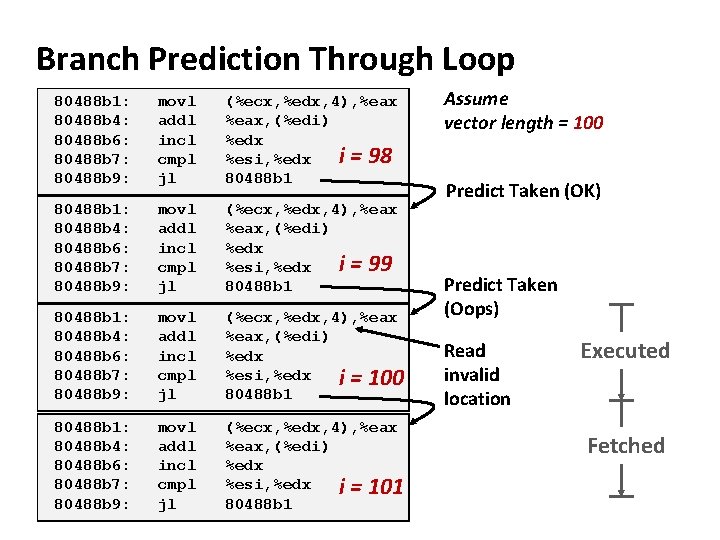
Branch Prediction Through Loop 80488 b 1: 80488 b 4: 80488 b 6: 80488 b 7: 80488 b 9: movl addl incl cmpl jl (%ecx, %edx, 4), %eax, (%edi) %edx i = 98 %esi, %edx 80488 b 1: 80488 b 4: 80488 b 6: 80488 b 7: 80488 b 9: movl addl incl cmpl jl (%ecx, %edx, 4), %eax, (%edi) %edx i = 99 %esi, %edx 80488 b 1: 80488 b 4: 80488 b 6: 80488 b 7: 80488 b 9: movl addl incl cmpl jl (%ecx, %edx, 4), %eax, (%edi) %edx %esi, %edx i = 100 80488 b 1: 80488 b 4: 80488 b 6: 80488 b 7: 80488 b 9: movl addl incl cmpl jl (%ecx, %edx, 4), %eax, (%edi) %edx %esi, %edx i = 101 80488 b 1 Assume vector length = 100 Predict Taken (OK) Predict Taken (Oops) Read invalid location Executed Fetched
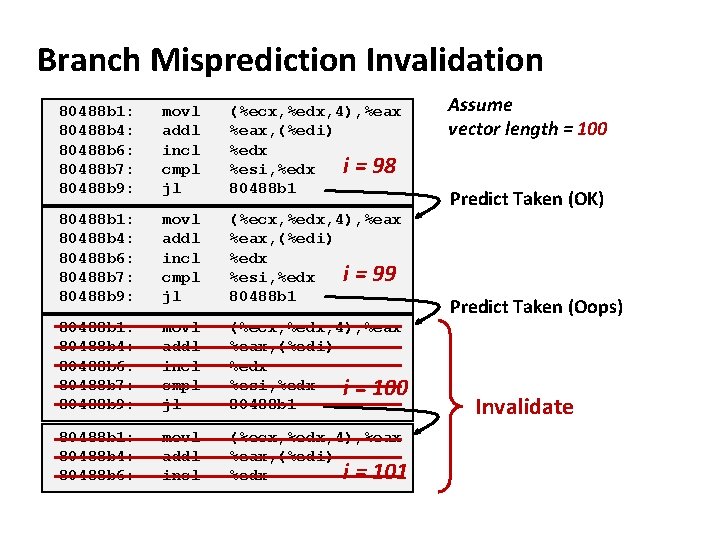
Branch Misprediction Invalidation 80488 b 1: 80488 b 4: 80488 b 6: 80488 b 7: 80488 b 9: movl addl incl cmpl jl (%ecx, %edx, 4), %eax, (%edi) %edx i = 98 %esi, %edx 80488 b 1: 80488 b 4: 80488 b 6: 80488 b 7: 80488 b 9: movl addl incl cmpl jl (%ecx, %edx, 4), %eax, (%edi) %edx i = 99 %esi, %edx 80488 b 1: 80488 b 4: 80488 b 6: 80488 b 7: 80488 b 9: movl addl incl cmpl jl (%ecx, %edx, 4), %eax, (%edi) %edx %esi, %edx i = 100 80488 b 1: 80488 b 4: 80488 b 6: movl addl incl (%ecx, %edx, 4), %eax, (%edi) i = 101 %edx Assume vector length = 100 Predict Taken (OK) Predict Taken (Oops) Invalidate
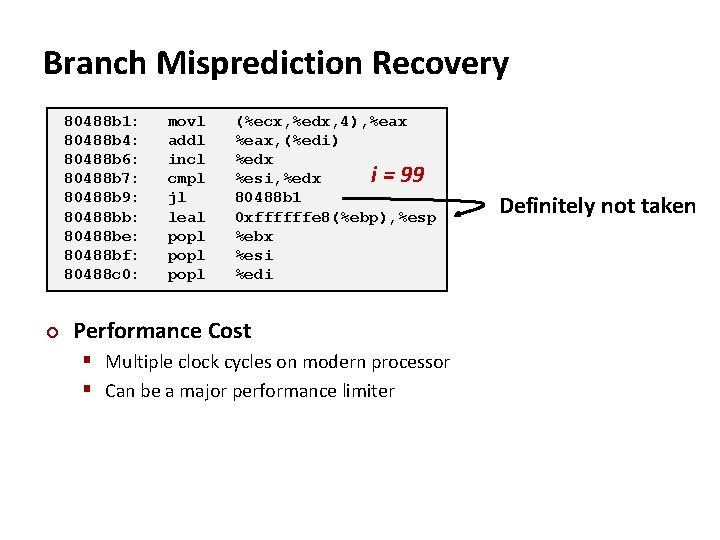
Branch Misprediction Recovery 80488 b 1: 80488 b 4: 80488 b 6: 80488 b 7: 80488 b 9: 80488 bb: 80488 be: 80488 bf: 80488 c 0: ¢ movl addl incl cmpl jl leal popl (%ecx, %edx, 4), %eax, (%edi) %edx i = 99 %esi, %edx 80488 b 1 0 xffffffe 8(%ebp), %esp %ebx %esi %edi Performance Cost § Multiple clock cycles on modern processor § Can be a major performance limiter Definitely not taken
Getting High Performance ¢ ¢ Good compiler and flags Don’t do anything stupid § Watch out for hidden algorithmic inefficiencies § Write compiler-friendly code Watch out for optimization blockers: procedure calls & memory references § Look carefully at innermost loops (where most work is done) § ¢ Tune code for machine § Exploit instruction-level parallelism § Avoid unpredictable branches § Make code cache friendly
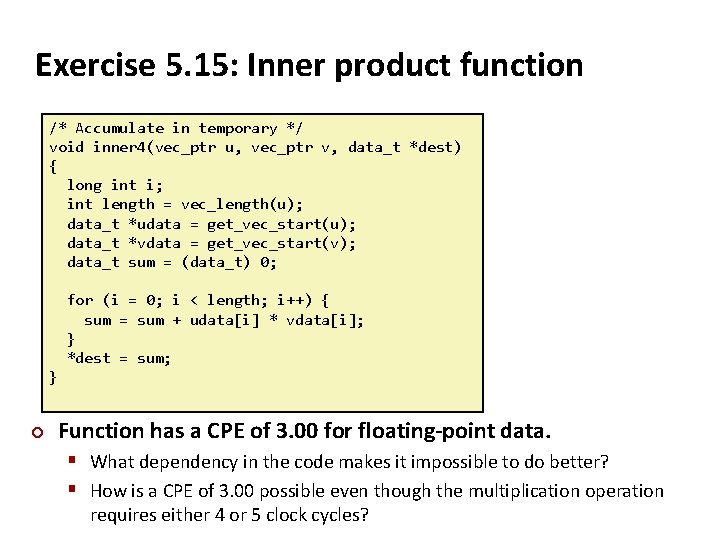
Exercise 5. 15: Inner product function /* Accumulate in temporary */ void inner 4(vec_ptr u, vec_ptr v, data_t *dest) { long int i; int length = vec_length(u); data_t *udata = get_vec_start(u); data_t *vdata = get_vec_start(v); data_t sum = (data_t) 0; for (i = 0; i < length; i++) { sum = sum + udata[i] * vdata[i]; } *dest = sum; } ¢ Function has a CPE of 3. 00 for floating-point data. § What dependency in the code makes it impossible to do better? § How is a CPE of 3. 00 possible even though the multiplication operation requires either 4 or 5 clock cycles?
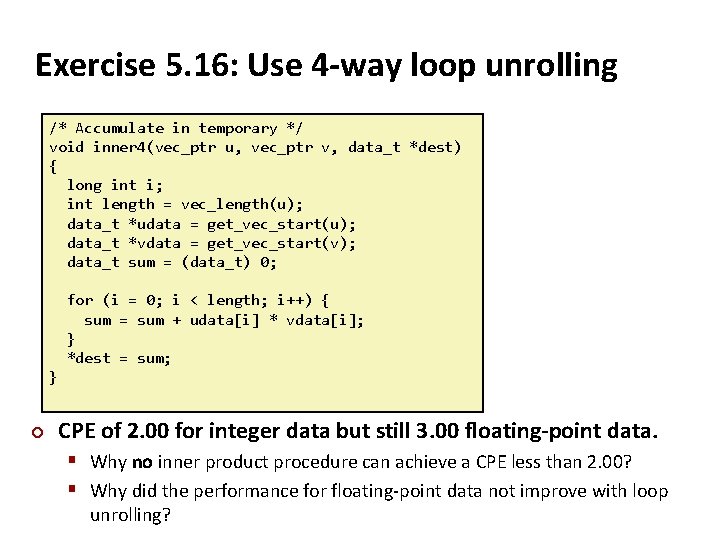
Exercise 5. 16: Use 4 -way loop unrolling /* Accumulate in temporary */ void inner 4(vec_ptr u, vec_ptr v, data_t *dest) { long int i; int length = vec_length(u); data_t *udata = get_vec_start(u); data_t *vdata = get_vec_start(v); data_t sum = (data_t) 0; for (i = 0; i < length; i++) { sum = sum + udata[i] * vdata[i]; } *dest = sum; } ¢ CPE of 2. 00 for integer data but still 3. 00 floating-point data. § Why no inner product procedure can achieve a CPE less than 2. 00? § Why did the performance for floating-point data not improve with loop unrolling?
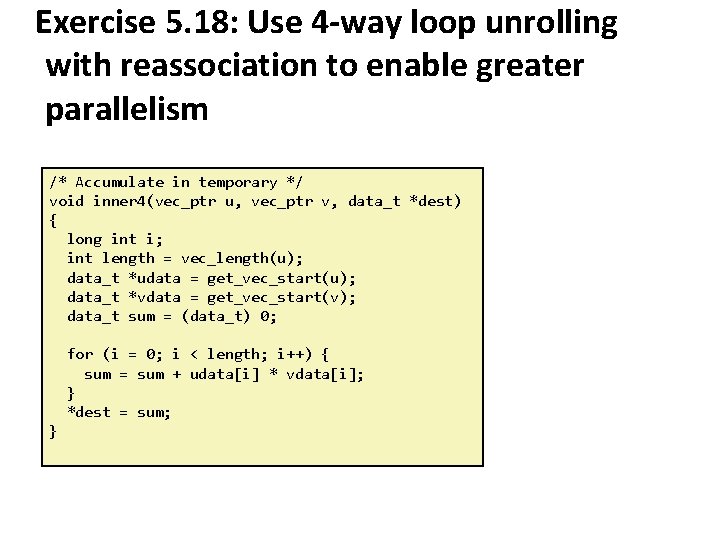
Exercise 5. 18: Use 4 -way loop unrolling with reassociation to enable greater parallelism /* Accumulate in temporary */ void inner 4(vec_ptr u, vec_ptr v, data_t *dest) { long int i; int length = vec_length(u); data_t *udata = get_vec_start(u); data_t *vdata = get_vec_start(v); data_t sum = (data_t) 0; for (i = 0; i < length; i++) { sum = sum + udata[i] * vdata[i]; } *dest = sum; }
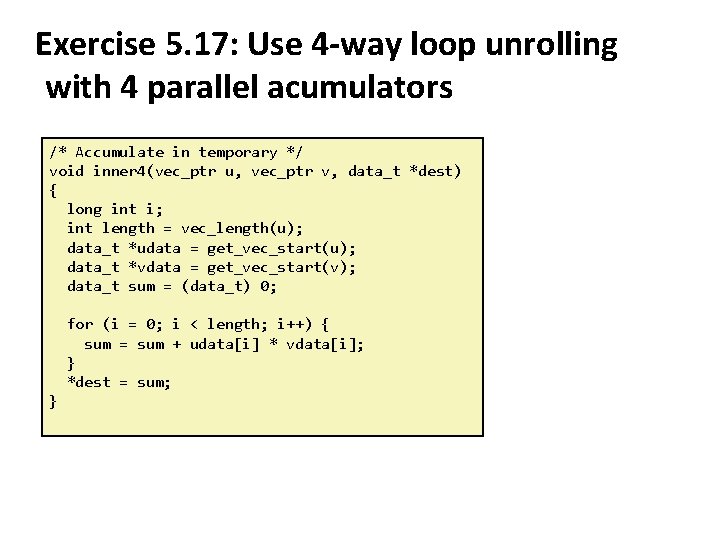
Exercise 5. 17: Use 4 -way loop unrolling with 4 parallel acumulators /* Accumulate in temporary */ void inner 4(vec_ptr u, vec_ptr v, data_t *dest) { long int i; int length = vec_length(u); data_t *udata = get_vec_start(u); data_t *vdata = get_vec_start(v); data_t sum = (data_t) 0; for (i = 0; i < length; i++) { sum = sum + udata[i] * vdata[i]; } *dest = sum; }