
PROGRAM OF PHYSICS Lecturer Dr DO Xuan Hoi


- Slides: 55
PROGRAM OF “PHYSICS” Lecturer: Dr. DO Xuan Hoi Room 413 E-mail : dxhoi@hcmiu. edu. vn
PHYSICS 2 (FLUID MECHANICS AND THERMAL PHYSICS) 02 credits (30 periods) Chapter 1 Fluid Mechanics Chapter 2 Heat, Temperature and the Zeroth Law of Thermodynamics Chapter 3 Heat, Work and the First Law of Thermodynamics Chapter 4 The Kinetic Theory of Gases Chapter 5 Entropy and the Second Law of Thermodynamics
References : Halliday D. , Resnick R. and Walker, J. (2005), Fundamentals of Physics, Extended seventh edition. John Willey and Sons, Inc. Alonso M. and Finn E. J. (1992). Physics, Addison-Wesley Publishing Company Hecht, E. (2000). Physics. Calculus, Second Edition. Brooks/Cole. Faughn/Serway (2006), Serway’s College Physics, Brooks/Cole. Roger Muncaster (1994), A-Level Physics, Stanley Thornes.
http: //ocw. mit. edu/Ocw. Web/Physics/index. htm http: //www. opensourcephysics. org/index. html http: //hyperphysics. phyastr. gsu. edu/hbase/HFrame. html http: //www. practicalphysics. org/go/Default. ht ml http: //www. msm. cam. ac. uk/ http: //www. iop. org/index. html. . .
Chapter 1 Fluid Mechanics 1. Variation of Pressure with Depth 2. Fluid Dynamics 3. Bernoulli’s Equation
Question What is a fluid? 1. A liquid 2. A gas 3. Anything that flows 4. Anything that can be made to change shape.
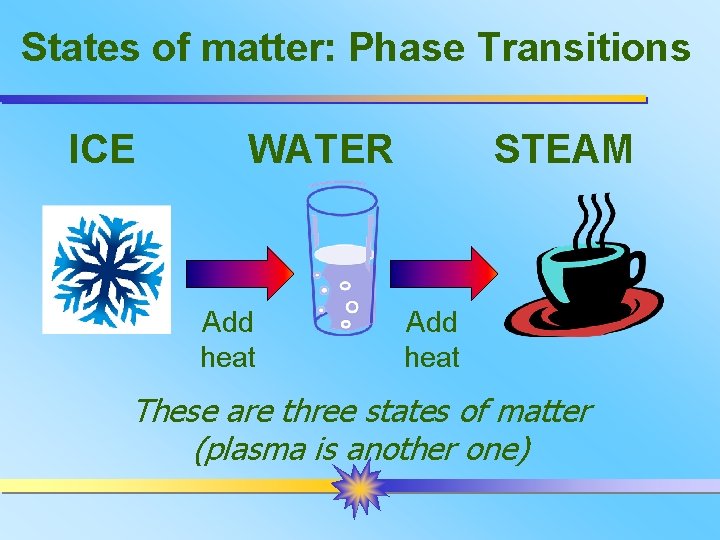
States of matter: Phase Transitions ICE WATER Add heat STEAM Add heat These are three states of matter (plasma is another one)
States of Matter ► Solid ► Liquid ► Gas ► Plasma
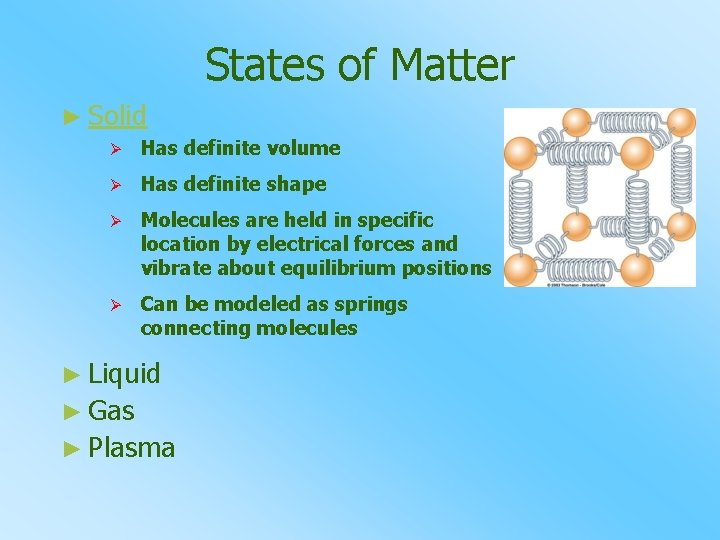
States of Matter ► Solid Ø Has definite volume Ø Has definite shape Ø Molecules are held in specific location by electrical forces and vibrate about equilibrium positions Ø Can be modeled as springs connecting molecules ► Liquid ► Gas ► Plasma
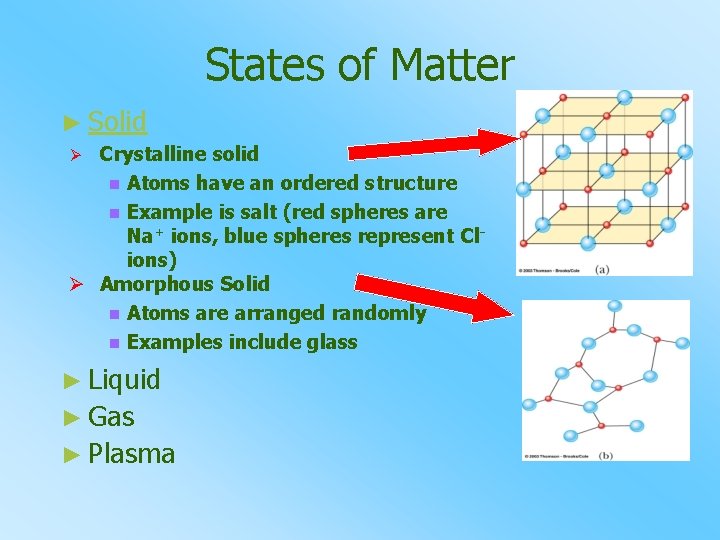
States of Matter ► Solid Crystalline solid n Atoms have an ordered structure n Example is salt (red spheres are Na+ ions, blue spheres represent Clions) Ø Amorphous Solid n Atoms are arranged randomly n Examples include glass Ø ► Liquid ► Gas ► Plasma
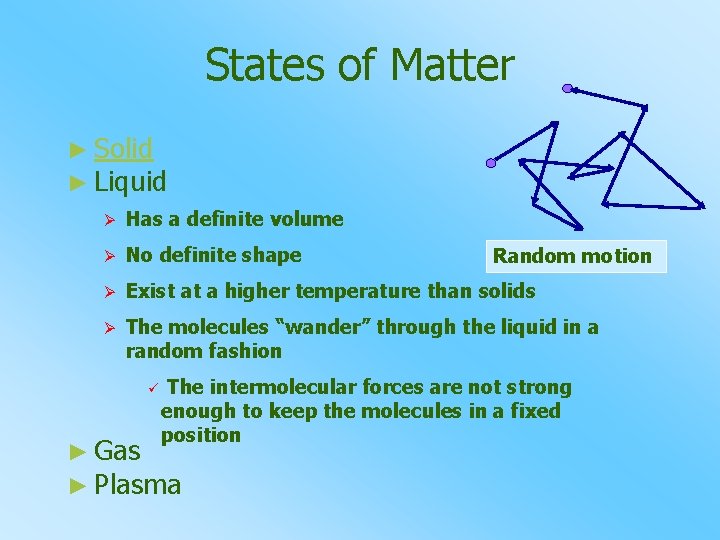
States of Matter ► Solid ► Liquid Ø Has a definite volume Ø No definite shape Ø Exist at a higher temperature than solids Ø The molecules “wander” through the liquid in a random fashion ü Random motion The intermolecular forces are not strong enough to keep the molecules in a fixed position ► Gas ► Plasma
States of Matter ► Solid ► Liquid ► Gas Ø Has no definite volume Ø Has no definite shape Ø Molecules are in constant random motion Ø The molecules exert only weak forces on each other Ø Average distance between molecules is large compared to the size of the molecules ► Plasma
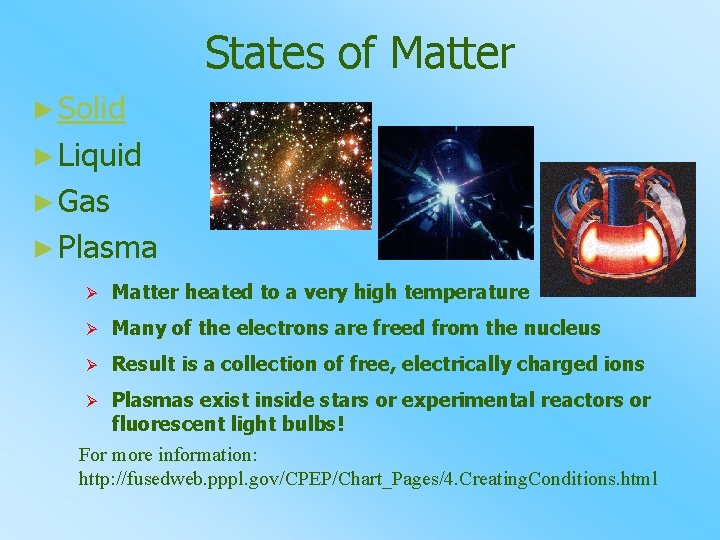
States of Matter ► Solid ► Liquid ► Gas ► Plasma Ø Matter heated to a very high temperature Ø Many of the electrons are freed from the nucleus Ø Result is a collection of free, electrically charged ions Plasmas exist inside stars or experimental reactors or fluorescent light bulbs! For more information: http: //fusedweb. pppl. gov/CPEP/Chart_Pages/4. Creating. Conditions. html Ø
Is there a concept that helps to distinguish between those states of matter?
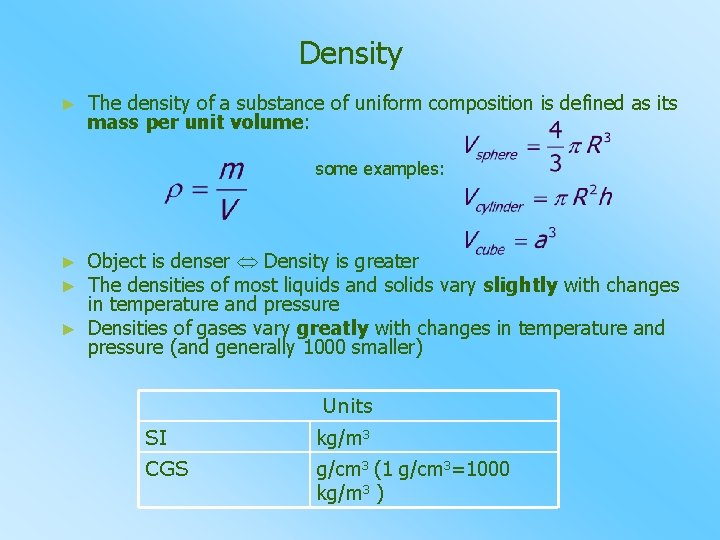
Density ► The density of a substance of uniform composition is defined as its mass per unit volume: some examples: Object is denser Density is greater The densities of most liquids and solids vary slightly with changes in temperature and pressure ► Densities of gases vary greatly with changes in temperature and pressure (and generally 1000 smaller) ► ► Units SI kg/m 3 CGS g/cm 3 (1 g/cm 3=1000 kg/m 3 )
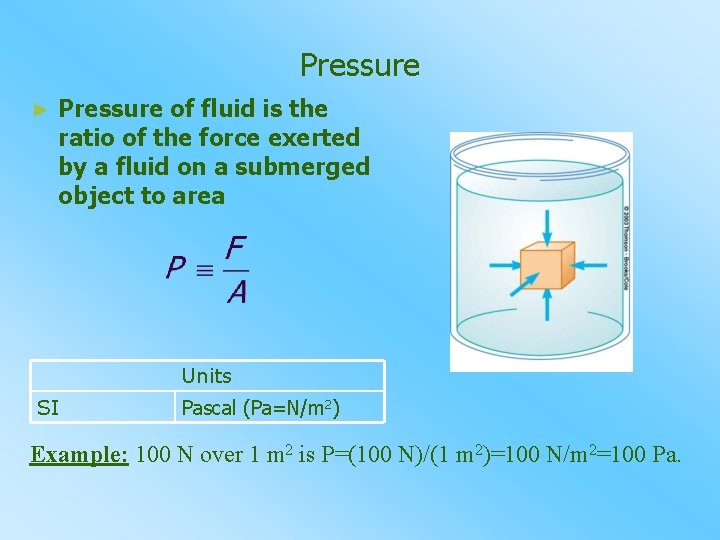
Pressure ► Pressure of fluid is the ratio of the force exerted by a fluid on a submerged object to area Units SI Pascal (Pa=N/m 2) Example: 100 N over 1 m 2 is P=(100 N)/(1 m 2)=100 N/m 2=100 Pa.
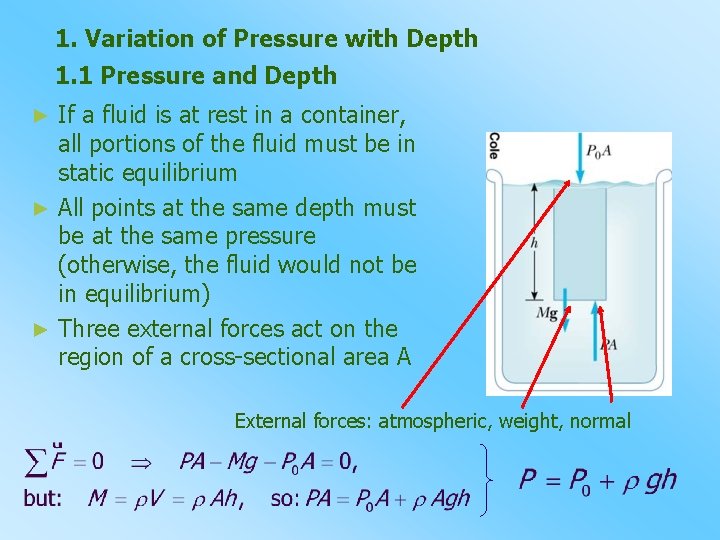
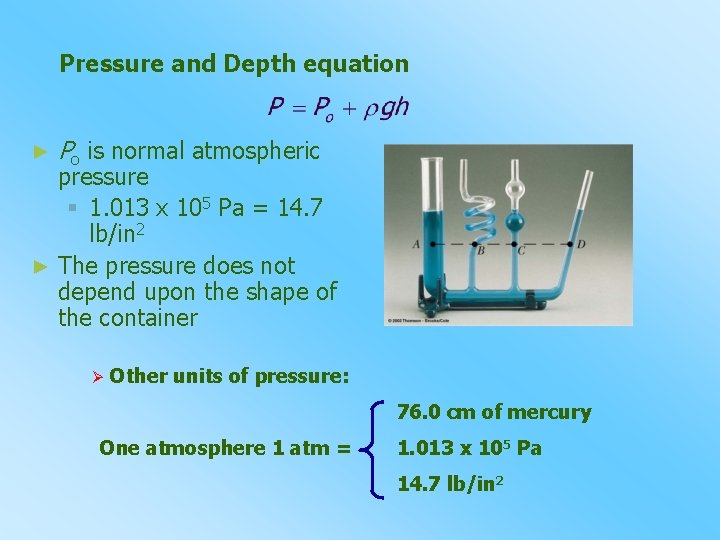
1. Variation of Pressure with Depth 1. 1 Pressure and Depth If a fluid is at rest in a container, all portions of the fluid must be in static equilibrium ► All points at the same depth must be at the same pressure (otherwise, the fluid would not be in equilibrium) ► Three external forces act on the region of a cross-sectional area A ► External forces: atmospheric, weight, normal
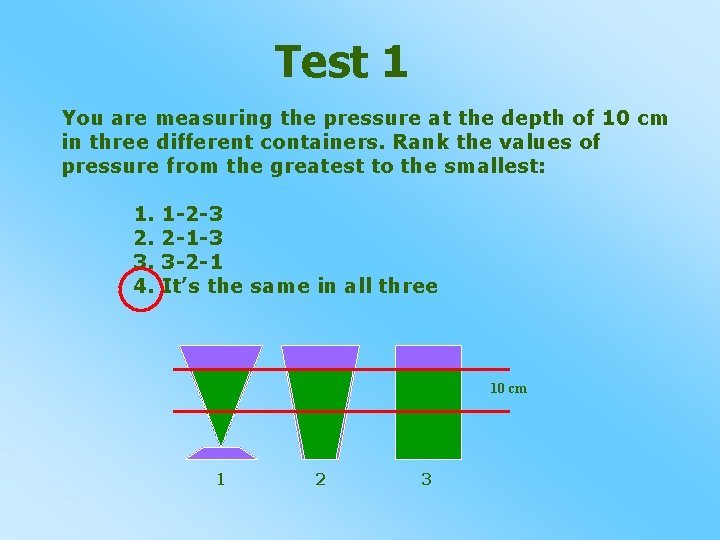
Test 1 You are measuring the pressure at the depth of 10 cm in three different containers. Rank the values of pressure from the greatest to the smallest: 1. 2. 3. 4. 1 -2 -3 2 -1 -3 3 -2 -1 It’s the same in all three 10 cm 1 2 3
Pressure and Depth equation ► Po is normal atmospheric pressure § 1. 013 x 105 Pa = 14. 7 lb/in 2 ► The pressure does not depend upon the shape of the container Ø Other units of pressure: 76. 0 cm of mercury One atmosphere 1 atm = 1. 013 x 105 Pa 14. 7 lb/in 2
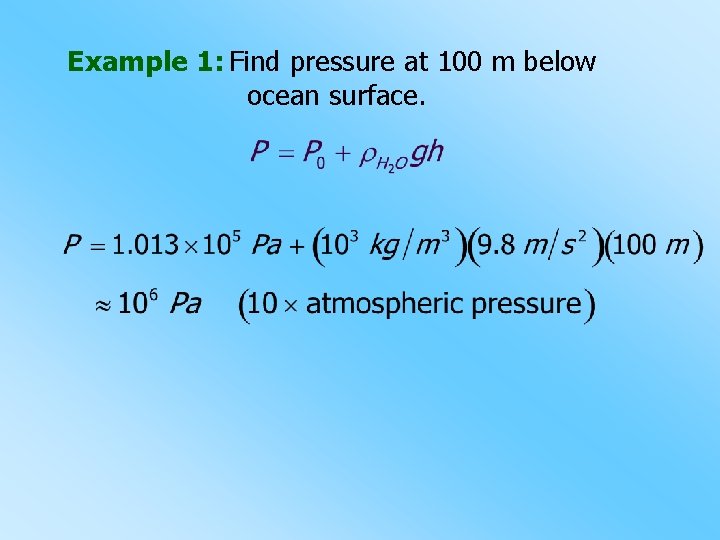
Example 1: Find pressure at 100 m below ocean surface.
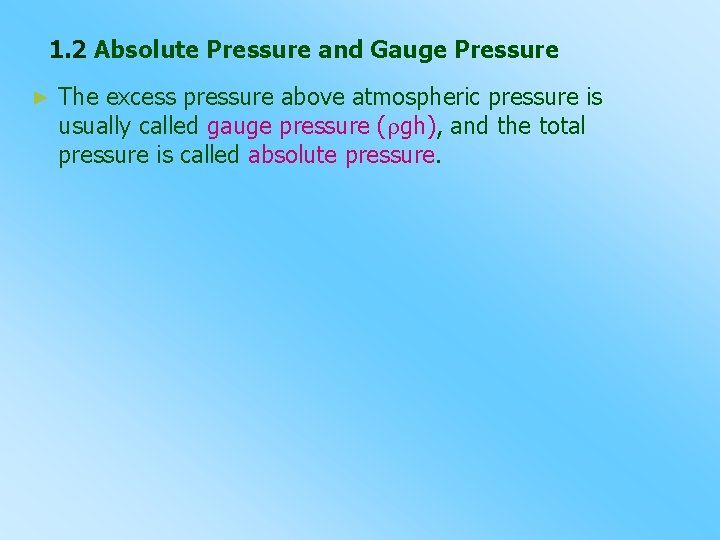
1. 2 Absolute Pressure and Gauge Pressure ► The excess pressure above atmospheric pressure is usually called gauge pressure ( gh), and the total pressure is called absolute pressure.
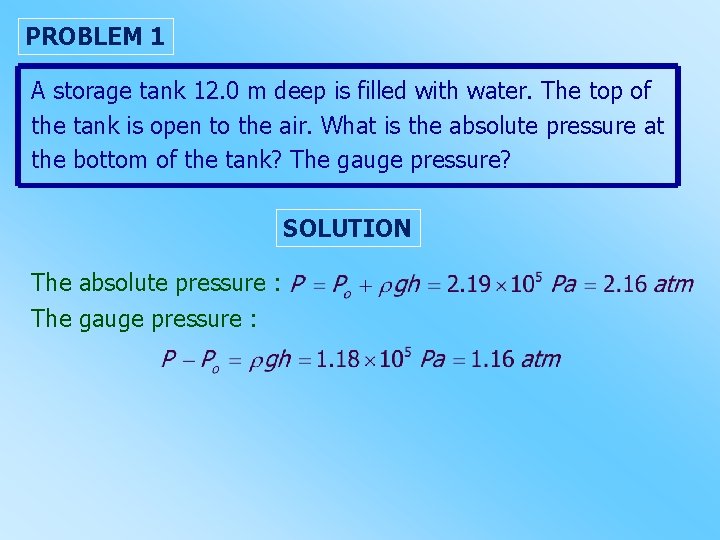
PROBLEM 1 A storage tank 12. 0 m deep is filled with water. The top of the tank is open to the air. What is the absolute pressure at the bottom of the tank? The gauge pressure? SOLUTION The absolute pressure : The gauge pressure :
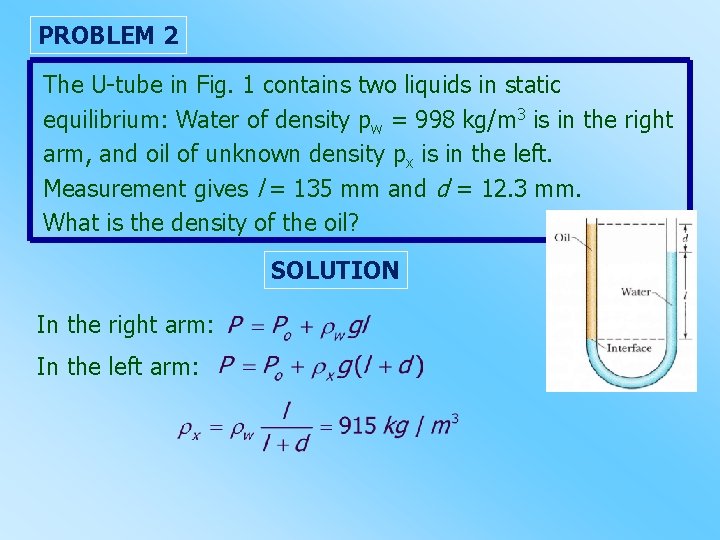
PROBLEM 2 The U-tube in Fig. 1 contains two liquids in static equilibrium: Water of density pw = 998 kg/m 3 is in the right arm, and oil of unknown density px is in the left. Measurement gives l = 135 mm and d = 12. 3 mm. What is the density of the oil? SOLUTION In the right arm: In the left arm:
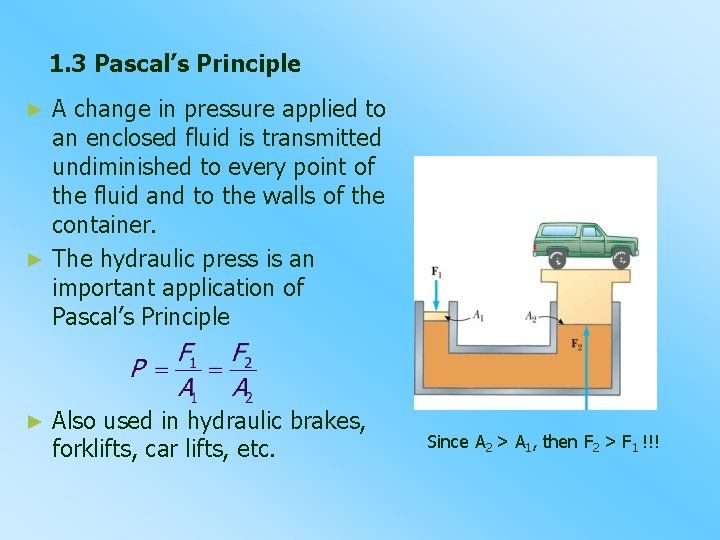
1. 3 Pascal’s Principle A change in pressure applied to an enclosed fluid is transmitted undiminished to every point of the fluid and to the walls of the container. ► The hydraulic press is an important application of Pascal’s Principle ► ► Also used in hydraulic brakes, forklifts, car lifts, etc. Since A 2 > A 1, then F 2 > F 1 !!!
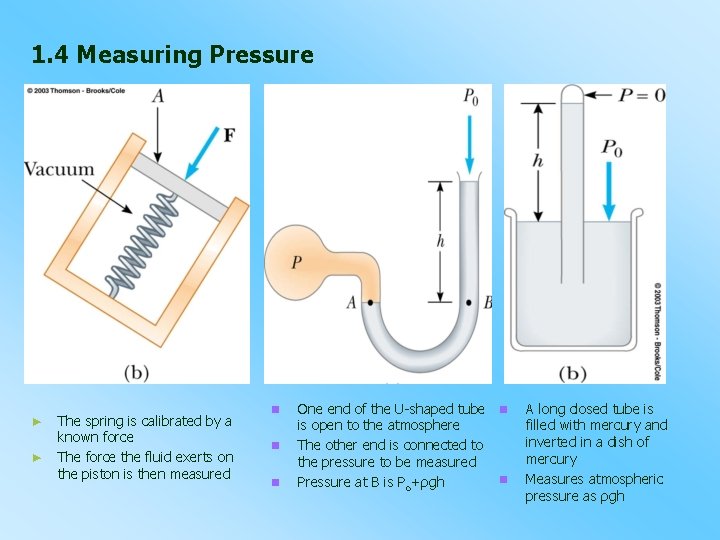
1. 4 Measuring Pressure ► ► The spring is calibrated by a known force The force the fluid exerts on the piston is then measured n n n One end of the U-shaped tube n is open to the atmosphere The other end is connected to the pressure to be measured n Pressure at B is Po+ρgh A long closed tube is filled with mercury and inverted in a dish of mercury Measures atmospheric pressure as ρgh
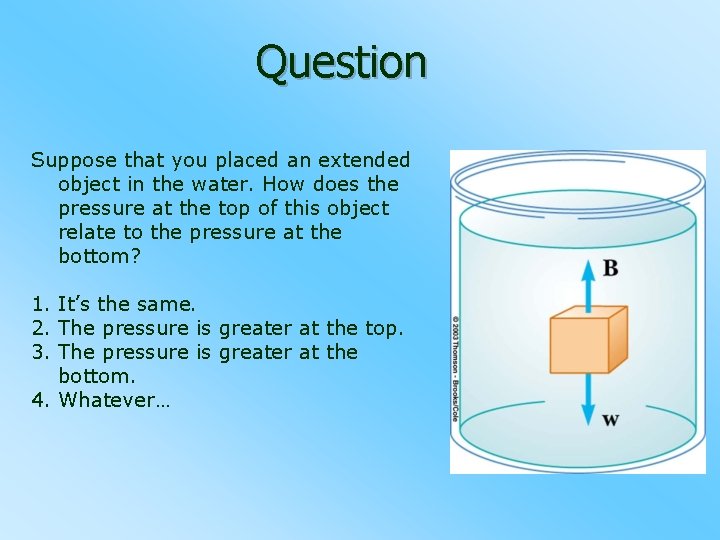
Question Suppose that you placed an extended object in the water. How does the pressure at the top of this object relate to the pressure at the bottom? 1. It’s the same. 2. The pressure is greater at the top. 3. The pressure is greater at the bottom. 4. Whatever…
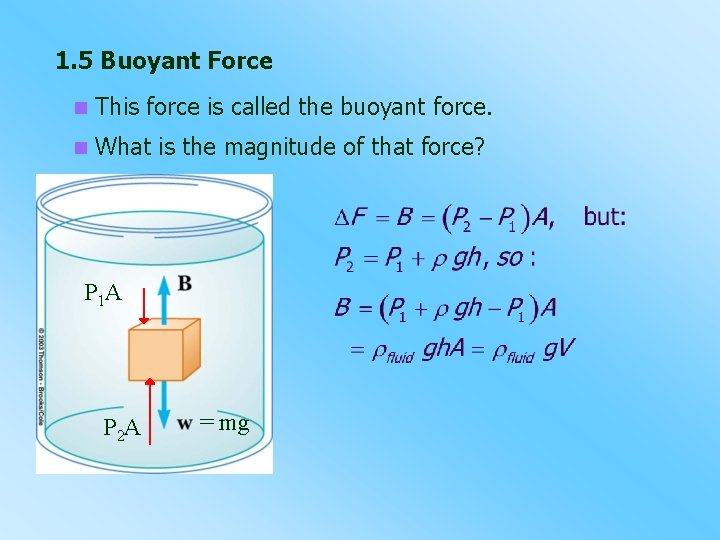
1. 5 Buoyant Force n This force is called the buoyant force. n What is the magnitude of that force? P 1 A P 2 A = mg
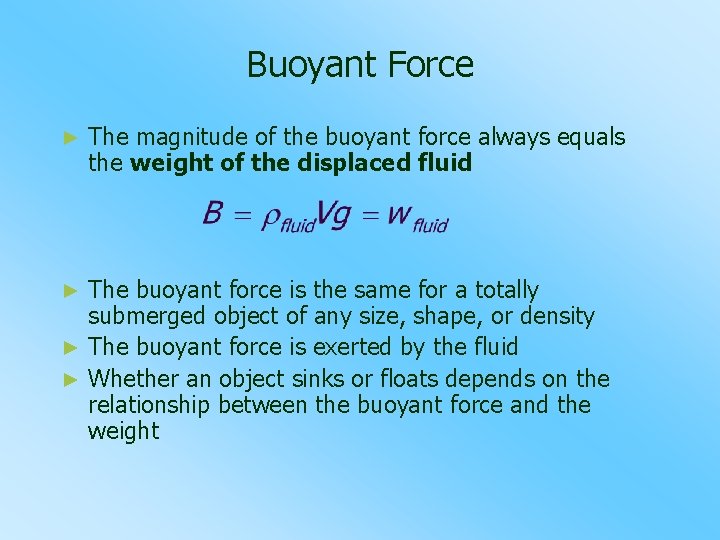
Buoyant Force ► The magnitude of the buoyant force always equals the weight of the displaced fluid The buoyant force is the same for a totally submerged object of any size, shape, or density ► The buoyant force is exerted by the fluid ► Whether an object sinks or floats depends on the relationship between the buoyant force and the weight ►
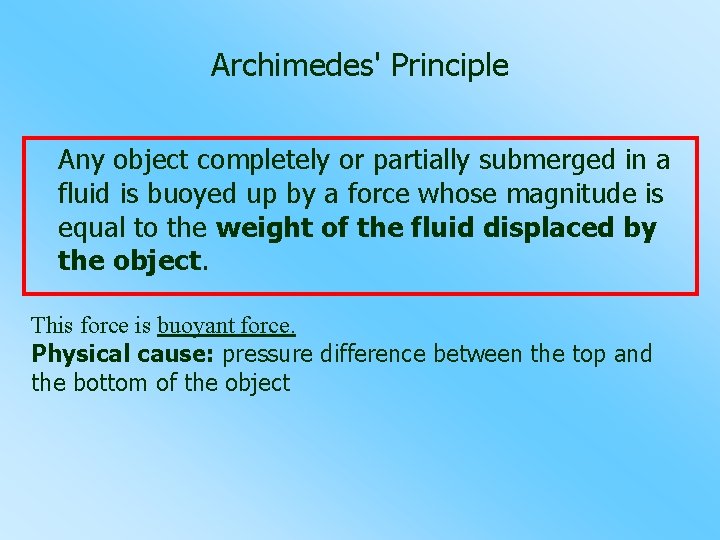
Archimedes' Principle Any object completely or partially submerged in a fluid is buoyed up by a force whose magnitude is equal to the weight of the fluid displaced by the object. This force is buoyant force. Physical cause: pressure difference between the top and the bottom of the object
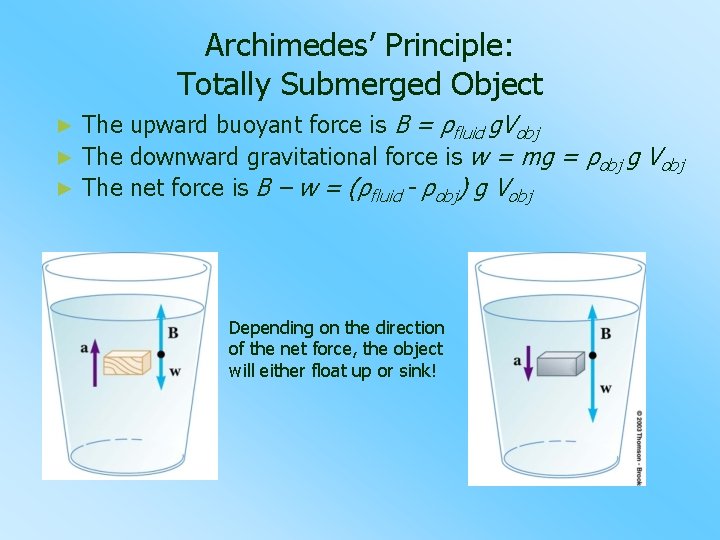
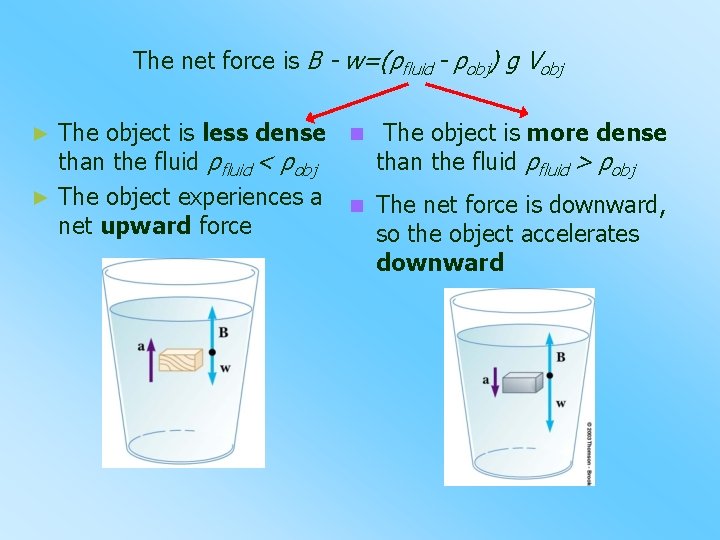
Archimedes’ Principle: Totally Submerged Object The upward buoyant force is B = ρfluid g. Vobj ► The downward gravitational force is w = mg = ρobj g Vobj ► The net force is B – w = (ρfluid - ρobj) g Vobj ► Depending on the direction of the net force, the object will either float up or sink!
The net force is B - w=(ρfluid - ρobj) g Vobj The object is less dense n The object is more dense than the fluid ρfluid < ρobj than the fluid ρfluid > ρobj ► The object experiences a n The net force is downward, net upward force so the object accelerates downward ►
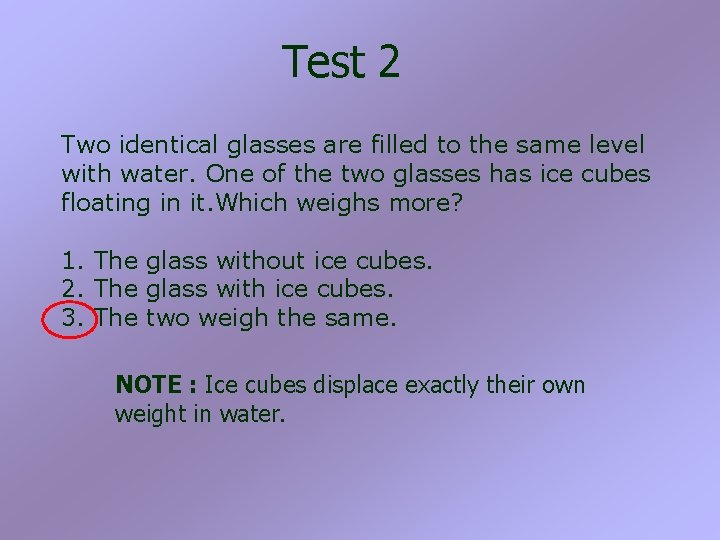
Test 2 Two identical glasses are filled to the same level with water. One of the two glasses has ice cubes floating in it. Which weighs more? 1. The glass without ice cubes. 2. The glass with ice cubes. 3. The two weigh the same. NOTE : Ice cubes displace exactly their own weight in water.
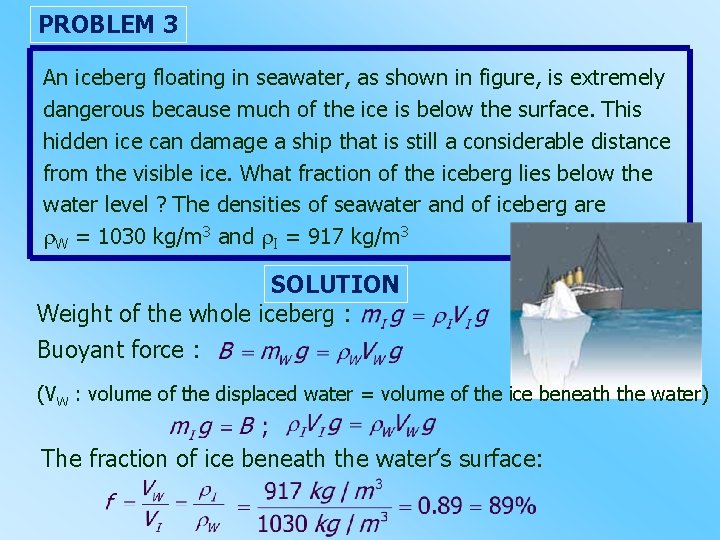
PROBLEM 3 An iceberg floating in seawater, as shown in figure, is extremely dangerous because much of the ice is below the surface. This hidden ice can damage a ship that is still a considerable distance from the visible ice. What fraction of the iceberg lies below the water level ? The densities of seawater and of iceberg are W = 1030 kg/m 3 and I = 917 kg/m 3 SOLUTION Weight of the whole iceberg : Buoyant force : (VW : volume of the displaced water = volume of the ice beneath the water) The fraction of ice beneath the water’s surface:
Chapter 8 Fluid Mechanics 1. Variation of Pressure with Depth 2. Fluid Dynamics
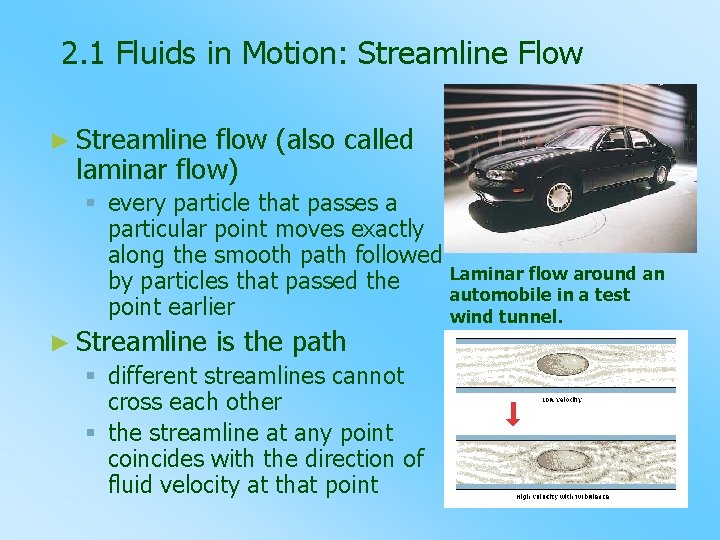
2. 1 Fluids in Motion: Streamline Flow ► Streamline flow (also called laminar flow) § every particle that passes a particular point moves exactly along the smooth path followed Laminar flow around an by particles that passed the automobile in a test point earlier wind tunnel. ► Streamline is the path § different streamlines cannot cross each other § the streamline at any point coincides with the direction of fluid velocity at that point
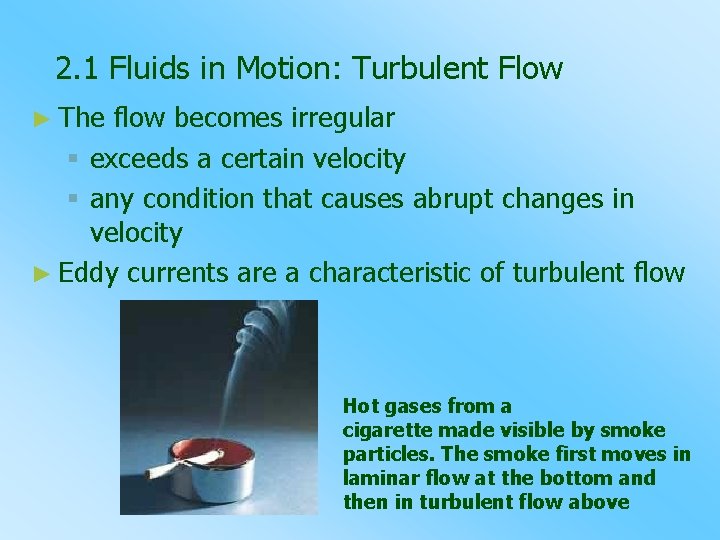
2. 1 Fluids in Motion: Turbulent Flow ► The flow becomes irregular § exceeds a certain velocity § any condition that causes abrupt changes in velocity ► Eddy currents are a characteristic of turbulent flow Hot gases from a cigarette made visible by smoke particles. The smoke first moves in laminar flow at the bottom and then in turbulent flow above
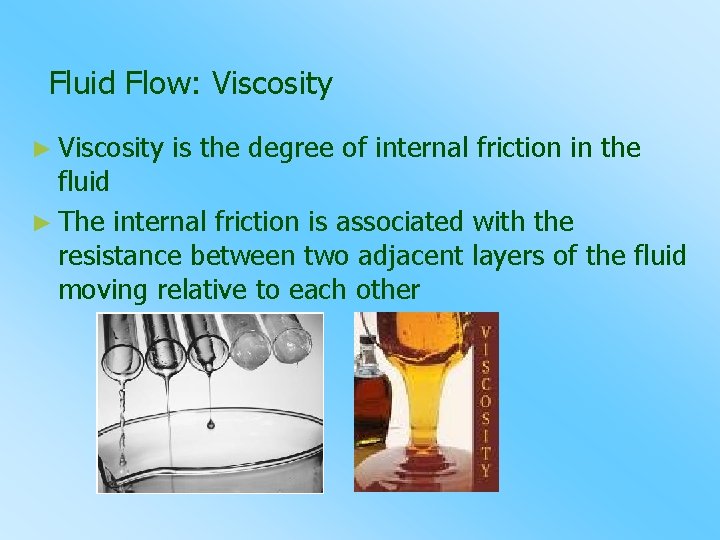
Fluid Flow: Viscosity ► Viscosity is the degree of internal friction in the fluid ► The internal friction is associated with the resistance between two adjacent layers of the fluid moving relative to each other
2. 2 Characteristics of an Ideal Fluid ► The fluid is nonviscous § There is no internal friction between adjacent layers ► The fluid is incompressible § Its density is constant ► The fluid is steady § Its velocity, density and pressure do not change in time ► The fluid moves without turbulence § No eddy currents are present
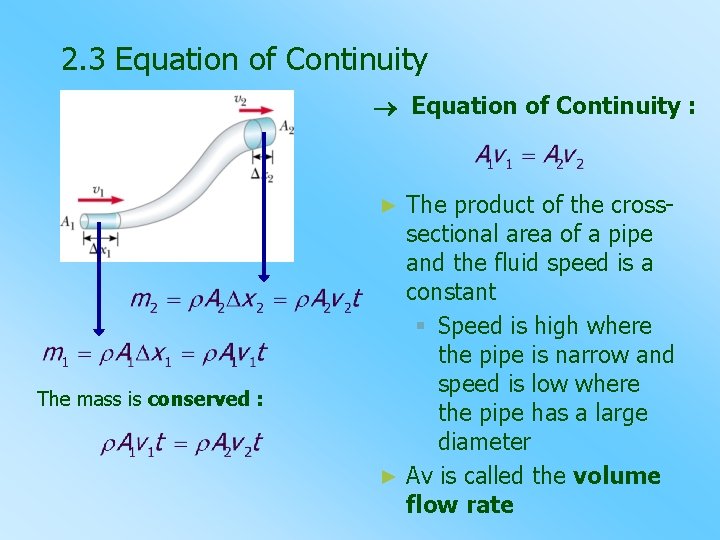
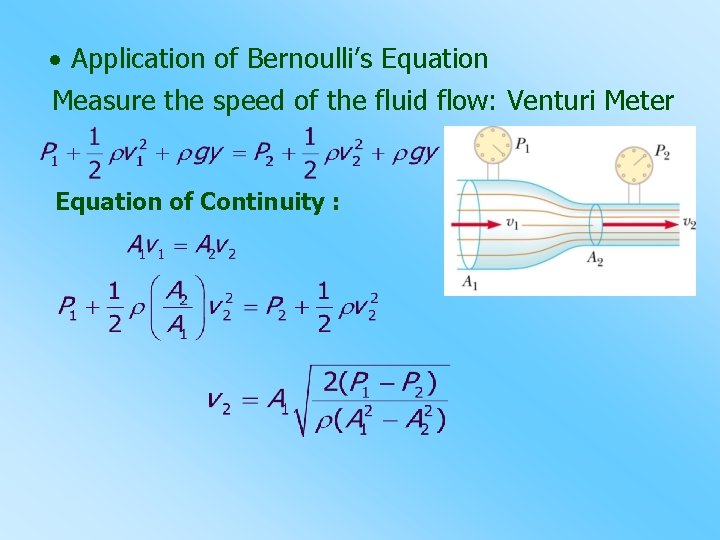
2. 3 Equation of Continuity : The product of the crosssectional area of a pipe and the fluid speed is a constant § Speed is high where the pipe is narrow and speed is low where the pipe has a large diameter ► Av is called the volume flow rate ► The mass is conserved :
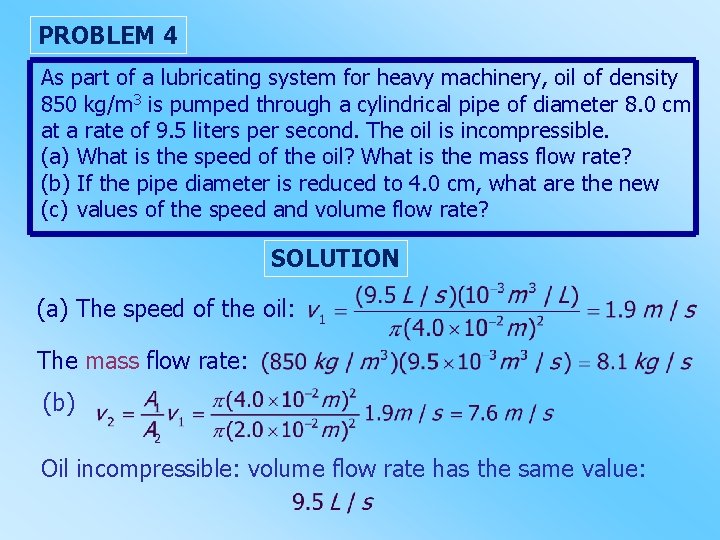
PROBLEM 4 As part of a lubricating system for heavy machinery, oil of density 850 kg/m 3 is pumped through a cylindrical pipe of diameter 8. 0 cm at a rate of 9. 5 liters per second. The oil is incompressible. (a) What is the speed of the oil? What is the mass flow rate? (b) If the pipe diameter is reduced to 4. 0 cm, what are the new (c) values of the speed and volume flow rate? SOLUTION (a) The speed of the oil: The mass flow rate: (b) Oil incompressible: volume flow rate has the same value:
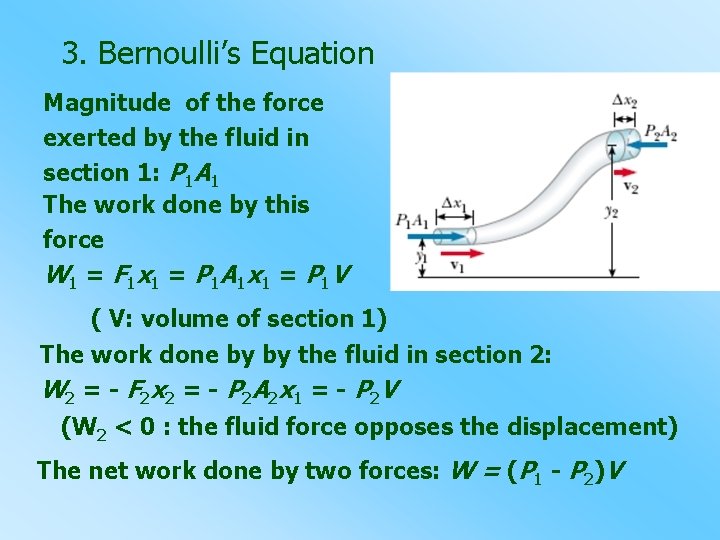
3. Bernoulli’s Equation Magnitude of the force exerted by the fluid in section 1: P 1 A 1 The work done by this force W 1 = F 1 x 1 = P 1 A 1 x 1 = P 1 V ( V: volume of section 1) The work done by by the fluid in section 2: W 2 = - F 2 x 2 = - P 2 A 2 x 1 = - P 2 V (W 2 < 0 : the fluid force opposes the displacement) The net work done by two forces: W = (P 1 - P 2)V
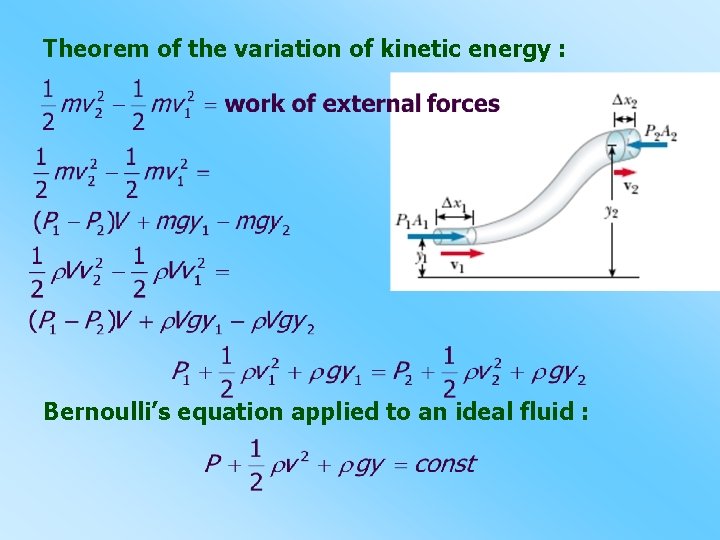
Theorem of the variation of kinetic energy : Bernoulli’s equation applied to an ideal fluid :
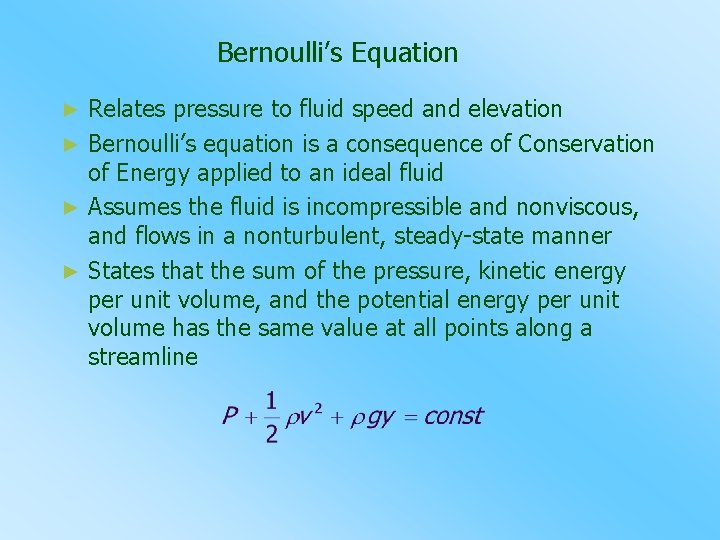
Bernoulli’s Equation Relates pressure to fluid speed and elevation ► Bernoulli’s equation is a consequence of Conservation of Energy applied to an ideal fluid ► Assumes the fluid is incompressible and nonviscous, and flows in a nonturbulent, steady-state manner ► States that the sum of the pressure, kinetic energy per unit volume, and the potential energy per unit volume has the same value at all points along a streamline ►
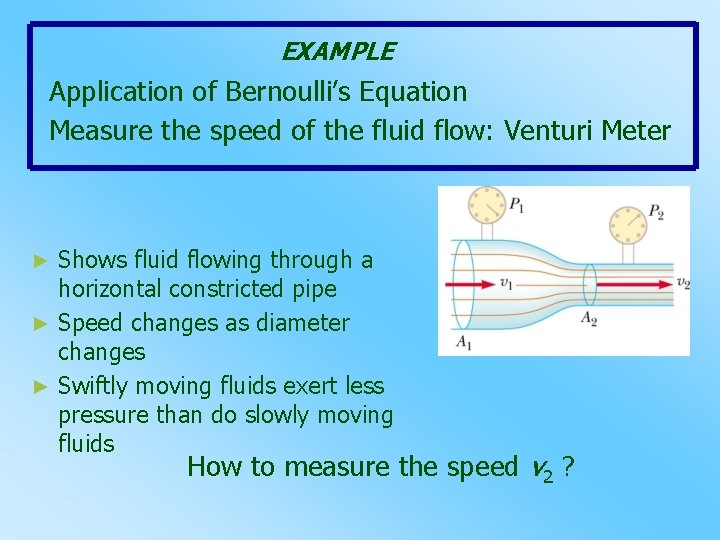
EXAMPLE Application of Bernoulli’s Equation Measure the speed of the fluid flow: Venturi Meter Shows fluid flowing through a horizontal constricted pipe ► Speed changes as diameter changes ► Swiftly moving fluids exert less pressure than do slowly moving fluids ► How to measure the speed v 2 ?
Application of Bernoulli’s Equation Measure the speed of the fluid flow: Venturi Meter Equation of Continuity :
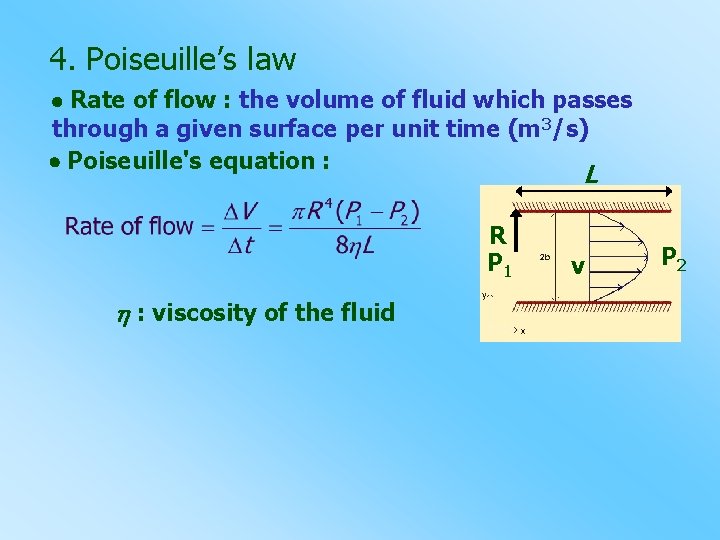
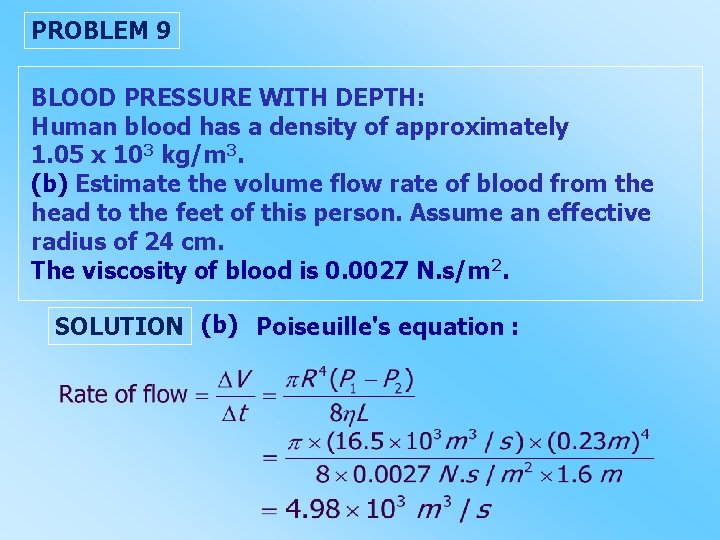
4. Poiseuille’s law Rate of flow : the volume of fluid which passes through a given surface per unit time (m 3/s) Poiseuille's equation : L R P 1 : viscosity of the fluid v P 2
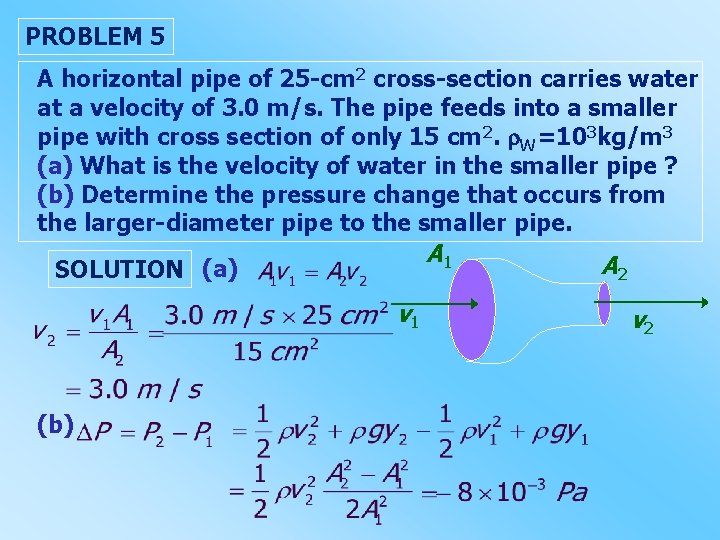
PROBLEM 5 A horizontal pipe of 25 -cm 2 cross-section carries water at a velocity of 3. 0 m/s. The pipe feeds into a smaller pipe with cross section of only 15 cm 2. W=103 kg/m 3 (a) What is the velocity of water in the smaller pipe ? (b) Determine the pressure change that occurs from the larger-diameter pipe to the smaller pipe. A 1 SOLUTION (a) v 1 (b) A 2 v 2
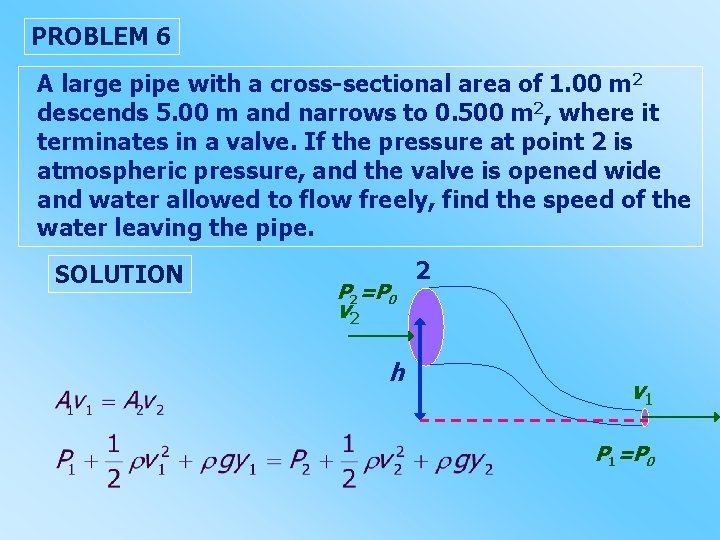
PROBLEM 6 A large pipe with a cross-sectional area of 1. 00 m 2 descends 5. 00 m and narrows to 0. 500 m 2, where it terminates in a valve. If the pressure at point 2 is atmospheric pressure, and the valve is opened wide and water allowed to flow freely, find the speed of the water leaving the pipe. SOLUTION P 2=P 0 2 v 2 h v 1 P 1=P 0
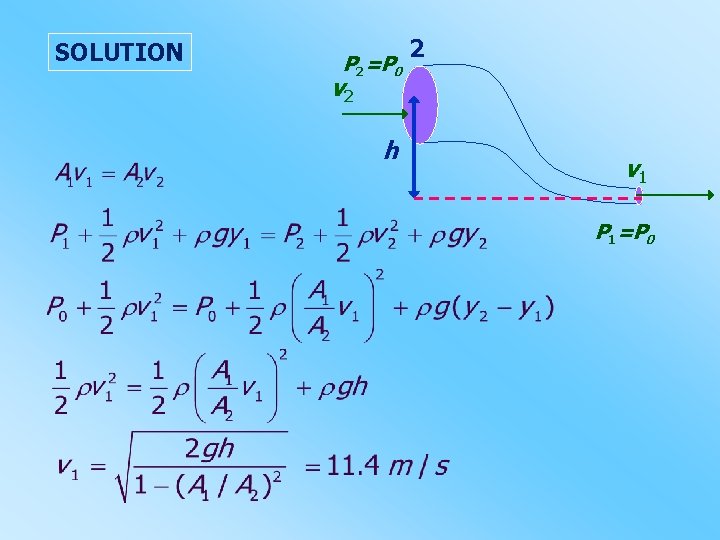
SOLUTION P 2=P 0 2 v 2 h v 1 P 1=P 0
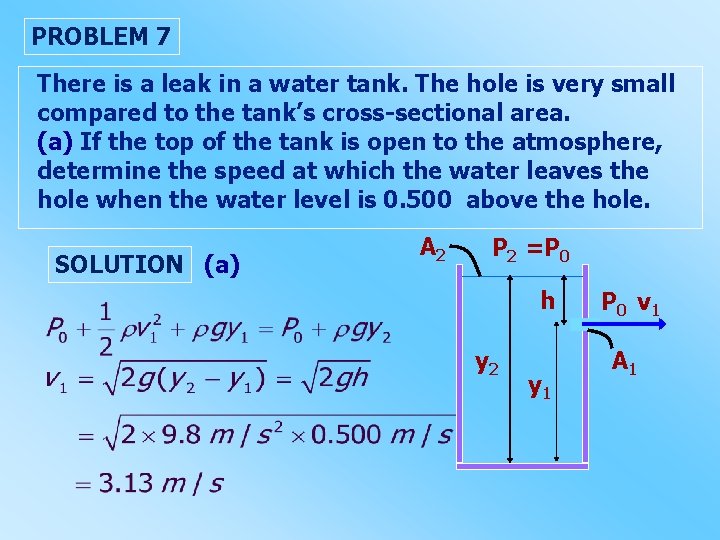
PROBLEM 7 There is a leak in a water tank. The hole is very small compared to the tank’s cross-sectional area. (a) If the top of the tank is open to the atmosphere, determine the speed at which the water leaves the hole when the water level is 0. 500 above the hole. SOLUTION (a) A 2 P 2 =P 0 h y 2 y 1 P 0 v 1 A 1
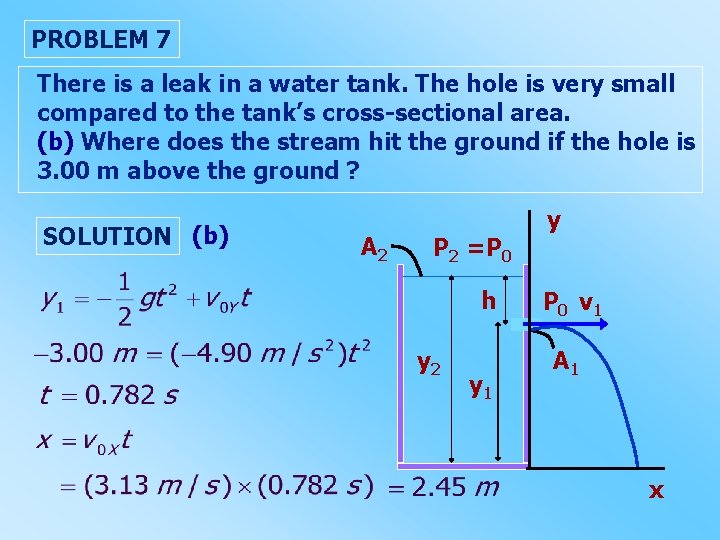
PROBLEM 7 There is a leak in a water tank. The hole is very small compared to the tank’s cross-sectional area. (b) Where does the stream hit the ground if the hole is 3. 00 m above the ground ? SOLUTION (b) A 2 P 2 =P 0 h y 2 y 1 y P 0 v 1 A 1 x
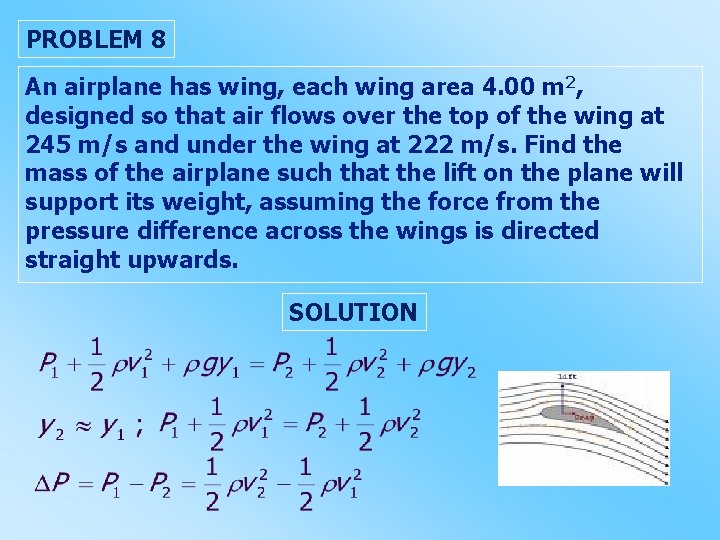
PROBLEM 8 An airplane has wing, each wing area 4. 00 m 2, designed so that air flows over the top of the wing at 245 m/s and under the wing at 222 m/s. Find the mass of the airplane such that the lift on the plane will support its weight, assuming the force from the pressure difference across the wings is directed straight upwards. SOLUTION
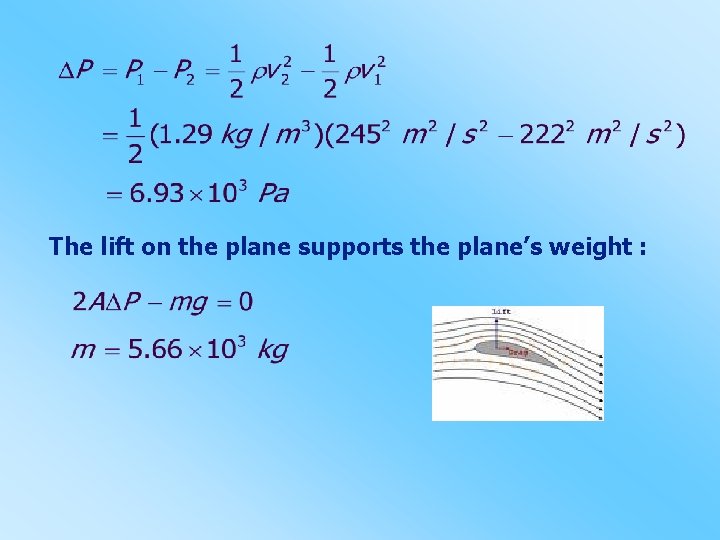
The lift on the plane supports the plane’s weight :
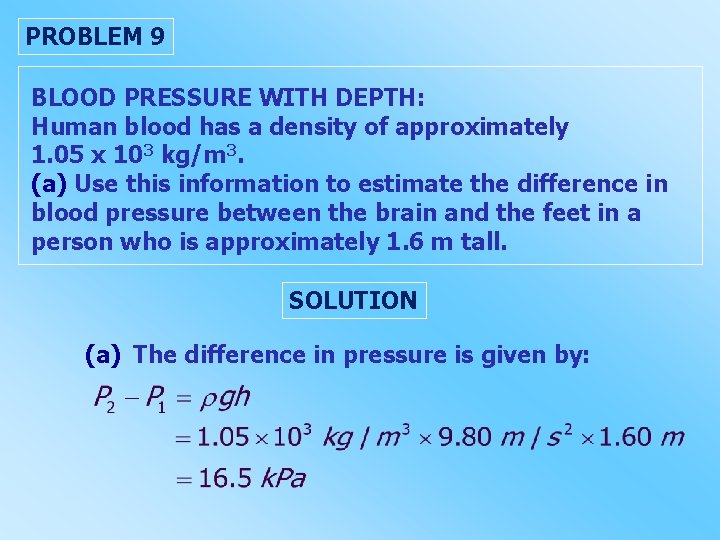
PROBLEM 9 BLOOD PRESSURE WITH DEPTH: Human blood has a density of approximately 1. 05 x 103 kg/m 3. (a) Use this information to estimate the difference in blood pressure between the brain and the feet in a person who is approximately 1. 6 m tall. SOLUTION (a) The difference in pressure is given by:
PROBLEM 9 BLOOD PRESSURE WITH DEPTH: Human blood has a density of approximately 1. 05 x 103 kg/m 3. (b) Estimate the volume flow rate of blood from the head to the feet of this person. Assume an effective radius of 24 cm. The viscosity of blood is 0. 0027 N. s/m 2. SOLUTION (b) Poiseuille's equation :