
Program Income Common Audit Findings Proper Disbursement in
Program Income: Common Audit Findings & Proper Disbursement in Federal Grants Ryan Oster, WSFR Systems & Training Branch Wildlife & Sport Fish Restoration Program Federal Assistance Coordinators National Conference March 30, 2021
Top Audit Findings – Program Income WSFR grants may have complex program income scenarios. Program income continues to be a common OIG finding in state audits. ü Did not report program income earned… ü Did not disburse program income on the grant it was earned… ü Improper drawdown of Federal funds due to errors associated with the disbursement of program income…
Program Income - Definition 2 CFR 200. 80 “gross income earned by the non-Federal entity that is directly generated by a supported activity or earned as a result of the Federal award during the period of performance. ” 50 CFR 80. 120 “gross income received by the grantee or subgrantee and earned only as a result of the grant during the grant period. ”
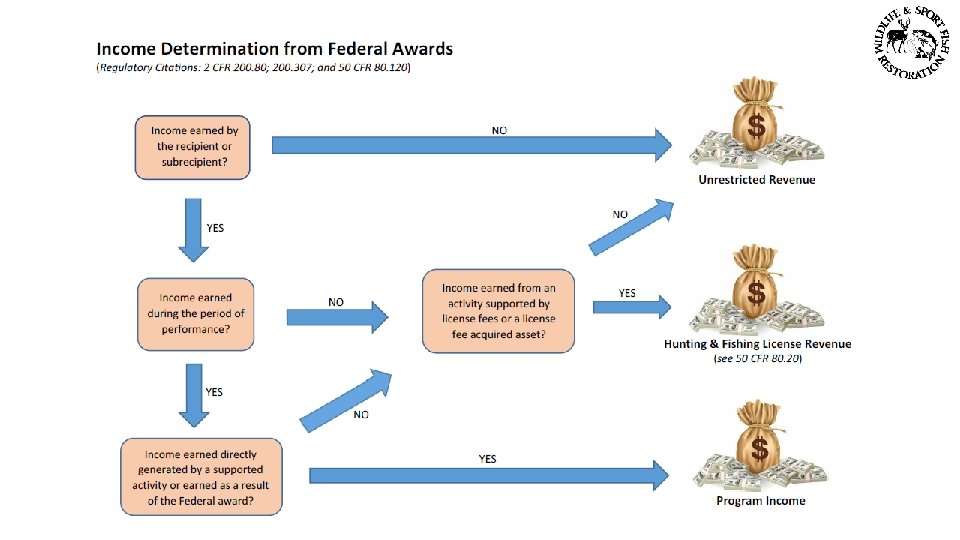
Common Program Income in WSFR Fees charged for services funded under WSFR grants. Use/rental of real/personal property acquired, constructed or managed under WSFR grants. Revenue from timber cut/sale where the activity is funded under WSFR grants. Income from fish hatchery feeders where the feeder/food are maintained/charged to SFR grants.
Is it a Good or Bad Thing? Non-Federal entities are encouraged to earn income to defray program costs where appropriate. Recipients must account for program income received in the project records and dispose of it according to the terms of the grant. How is your state tracking (monitoring) income earned under grants? What are your state policies/procedures concerning the accounting of income earned under grants? Are you disbursing income prior to your next draw? 2 CFR 200. 307 50 CFR 80. 121
Disbursement of Program Income “A State must minimize the time between the drawdown of Federal funds…and must time the disbursement to be in accord with the actual, immediate cash requirements of the State…Funds transfers must be as close as is administratively feasible to a State’s actual cash outlays for direct costs (including allocable indirect costs). ” (31 CFR 205. 33(a)) Program income must be spent within the grant period/program in which it is earned and before requesting additional Federal funds for the activity for which it is earned. 50 CFR 80. 123
Use of Program Income There are 3 disbursement methods: 1. Deductive Income is deducted from total allowable costs to determine net allowable costs. Default method for all recipient types except IHEs and non-profit research institutions. Note: Proper application of the deductive method requires some amount of Federal funds to remain unliquidated (not drawn by the recipient) at the close of the Federal grant.
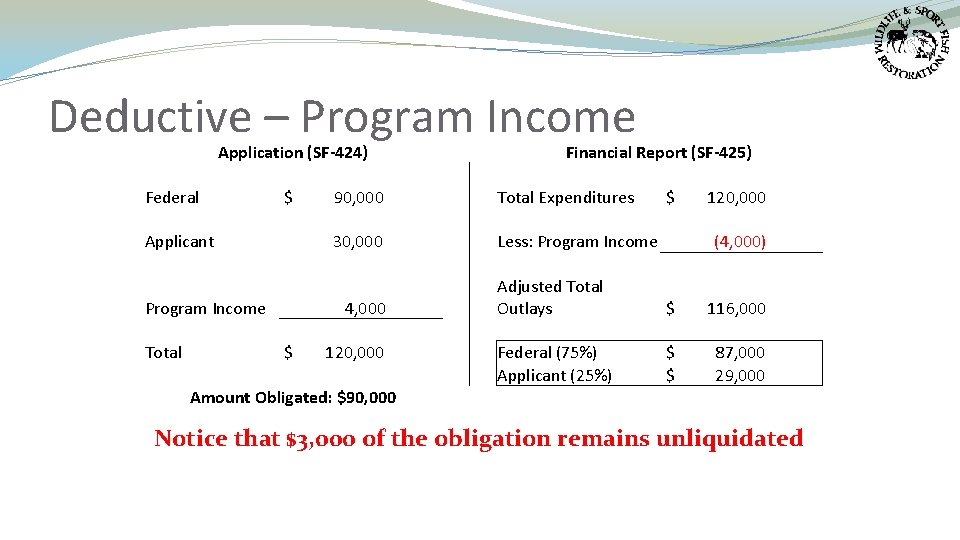
Deductive – Program Income Application (SF-424) Federal $ Applicant Program Income Total 90, 000 Total Expenditures 30, 000 Less: Program Income 4, 000 $ Financial Report (SF-425) 120, 000 $ 120, 000 (4, 000) Adjusted Total Outlays $ 116, 000 Federal (75%) Applicant (25%) $ $ 87, 000 29, 000 Amount Obligated: $90, 000 Notice that $3, 000 of the obligation remains unliquidated
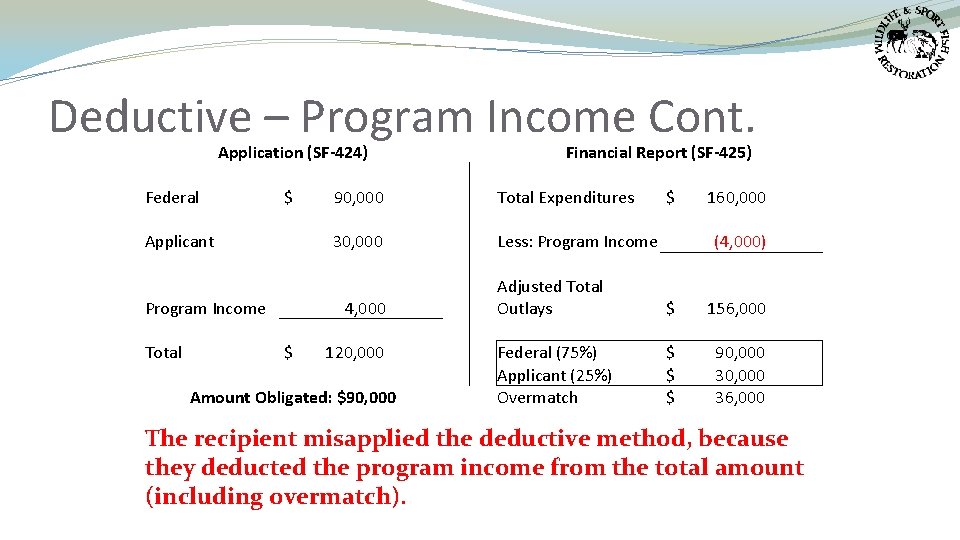
Deductive – Program Income Cont. Application (SF-424) Federal $ Applicant Program Income Total 90, 000 Total Expenditures 30, 000 Less: Program Income 4, 000 $ Financial Report (SF-425) 120, 000 Amount Obligated: $90, 000 $ 160, 000 (4, 000) Adjusted Total Outlays $ 156, 000 Federal (75%) Applicant (25%) Overmatch $ $ $ 90, 000 36, 000 The recipient misapplied the deductive method, because they deducted the program income from the total amount (including overmatch).
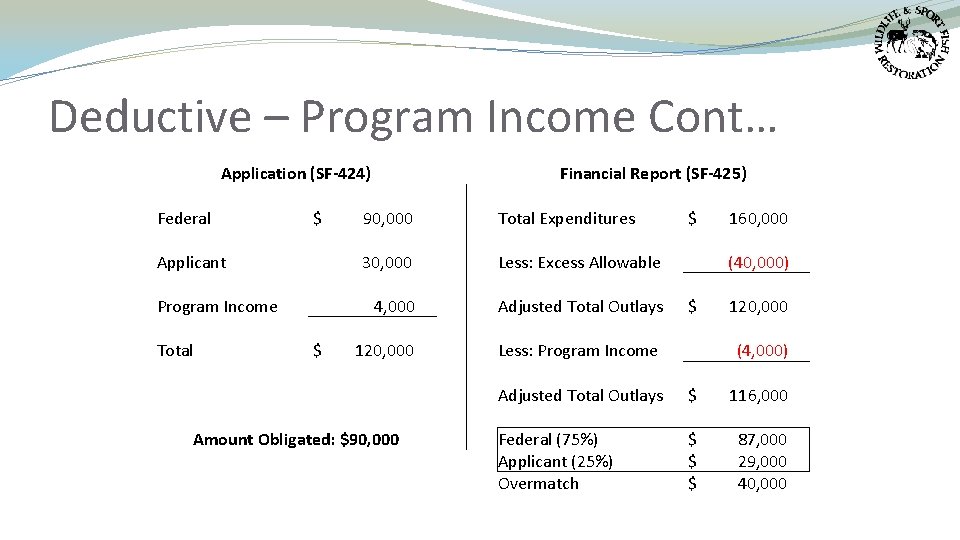
Deductive – Program Income Cont… Application (SF-424) Federal $ Applicant Program Income Total $ Financial Report (SF-425) 90, 000 Total Expenditures 30, 000 Less: Excess Allowable 4, 000 Adjusted Total Outlays 120, 000 Less: Program Income Amount Obligated: $90, 000 $ 160, 000 (40, 000) $ 120, 000 (4, 000) Adjusted Total Outlays $ 116, 000 Federal (75%) Applicant (25%) Overmatch $ $ $ 87, 000 29, 000 40, 000
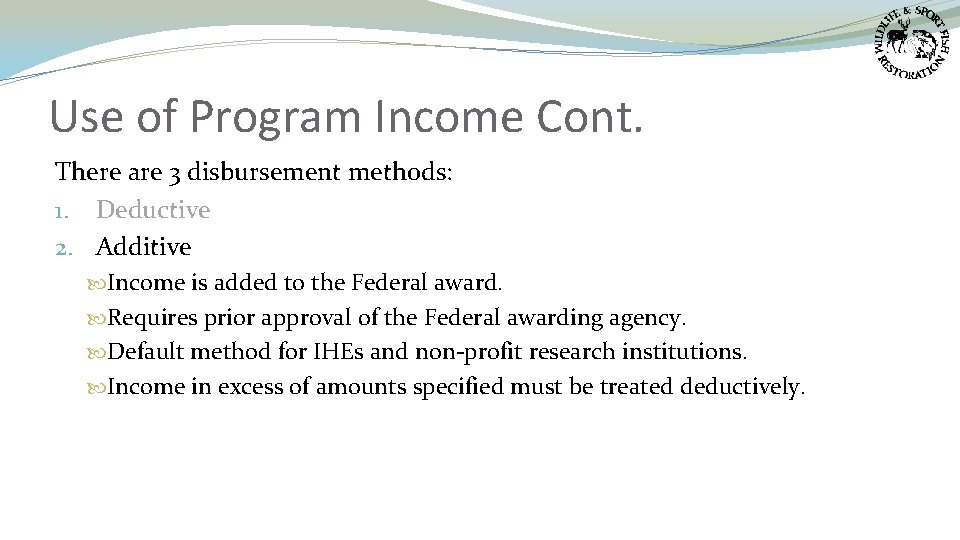
Use of Program Income Cont. There are 3 disbursement methods: 1. Deductive 2. Additive Income is added to the Federal award. Requires prior approval of the Federal awarding agency. Default method for IHEs and non-profit research institutions. Income in excess of amounts specified must be treated deductively.
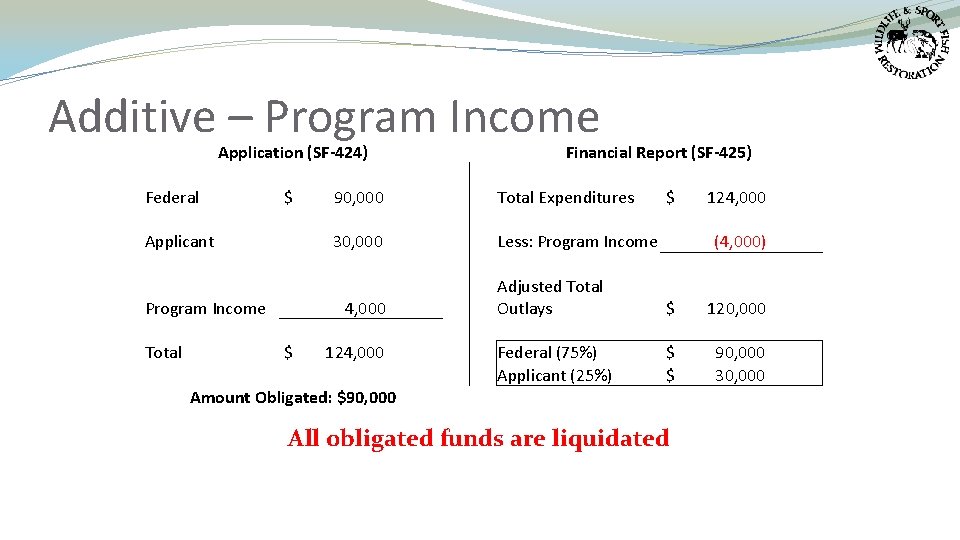
Additive – Program Income Application (SF-424) Federal $ Applicant Program Income Total 90, 000 Total Expenditures 30, 000 Less: Program Income 4, 000 $ Financial Report (SF-425) 124, 000 $ 124, 000 (4, 000) Adjusted Total Outlays $ 120, 000 Federal (75%) Applicant (25%) $ $ 90, 000 30, 000 Amount Obligated: $90, 000 All obligated funds are liquidated
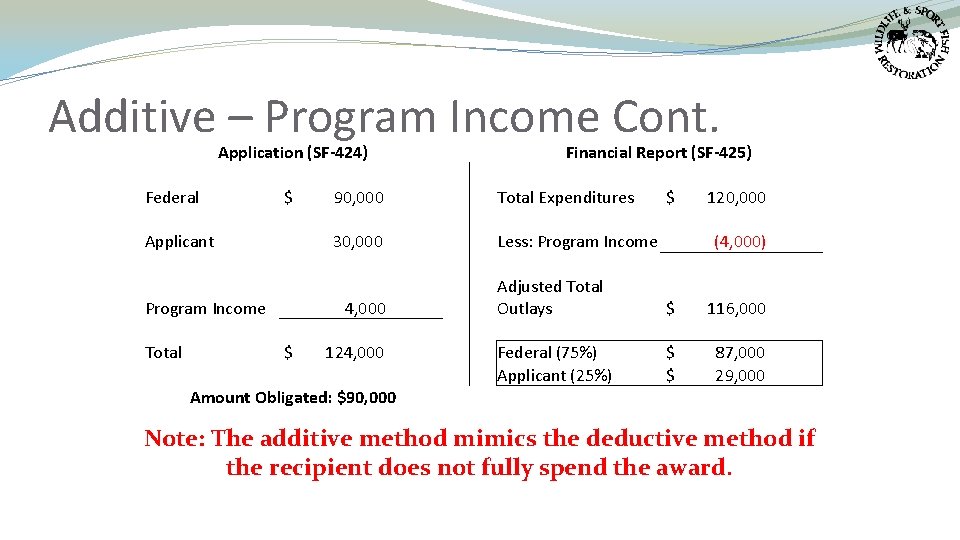
Additive – Program Income Cont. Application (SF-424) Federal $ Applicant Program Income Total 90, 000 Total Expenditures 30, 000 Less: Program Income 4, 000 $ Financial Report (SF-425) 124, 000 $ 120, 000 (4, 000) Adjusted Total Outlays $ 116, 000 Federal (75%) Applicant (25%) $ $ 87, 000 29, 000 Amount Obligated: $90, 000 Note: The additive method mimics the deductive method if the recipient does not fully spend the award.
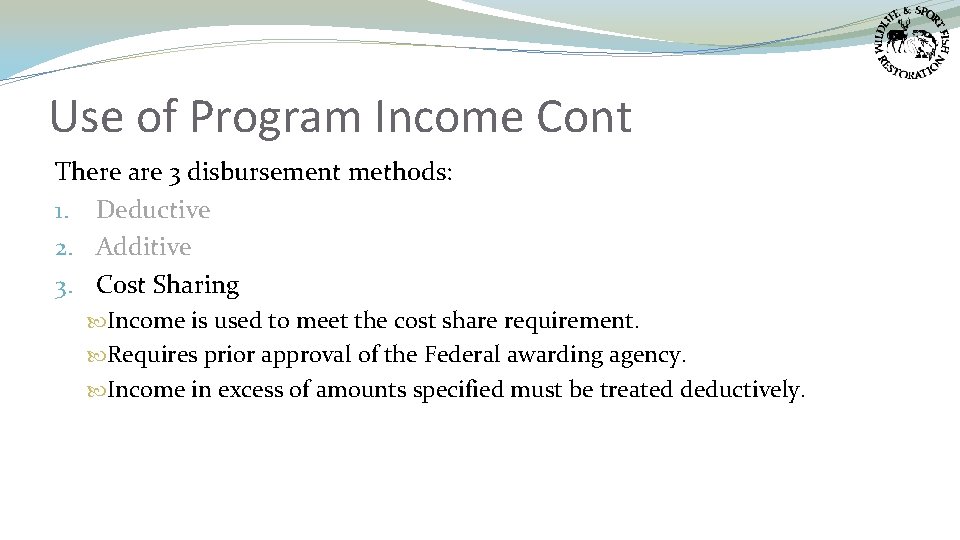
Use of Program Income Cont There are 3 disbursement methods: 1. Deductive 2. Additive 3. Cost Sharing Income is used to meet the cost share requirement. Requires prior approval of the Federal awarding agency. Income in excess of amounts specified must be treated deductively.
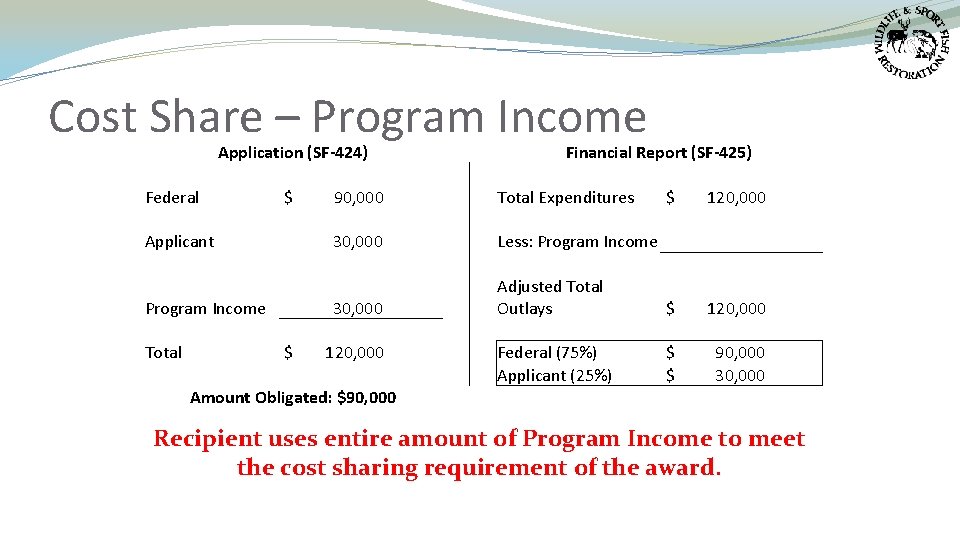
Cost Share – Program Income Application (SF-424) Federal $ Applicant Program Income Total $ Financial Report (SF-425) 90, 000 Total Expenditures 30, 000 Less: Program Income 30, 000 120, 000 $ 120, 000 Adjusted Total Outlays $ 120, 000 Federal (75%) Applicant (25%) $ $ 90, 000 30, 000 Amount Obligated: $90, 000 Recipient uses entire amount of Program Income to meet the cost sharing requirement of the award.
Program Income in Excess Remember, program income earned in excess of amounts anticipated must be treated deductively (unless you amend the award to request specific disposition use). Must not continue to treat excess PI additively or cost-share, without approval. May result in grant having multiple methods of program income disposal: Cost-share + deductive Cost-share + additive + deductive For example…
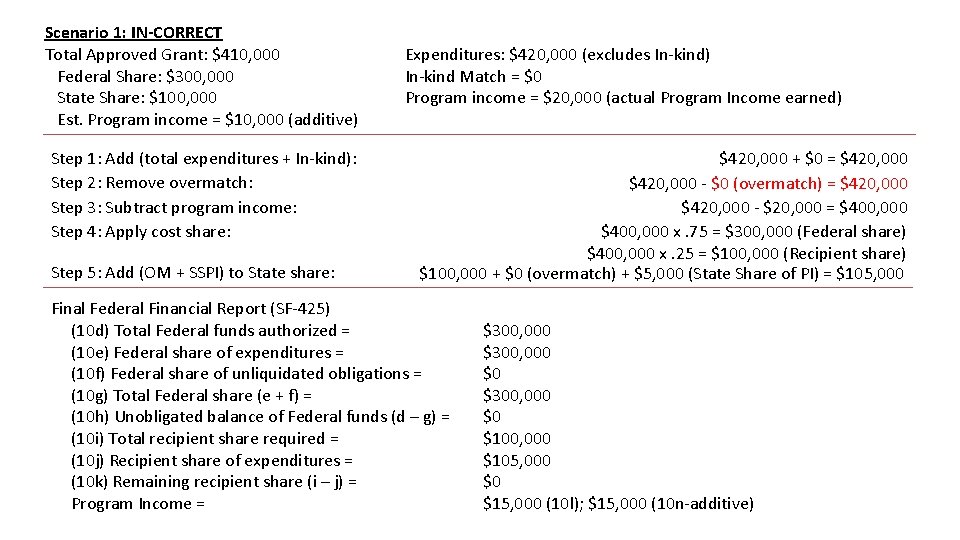
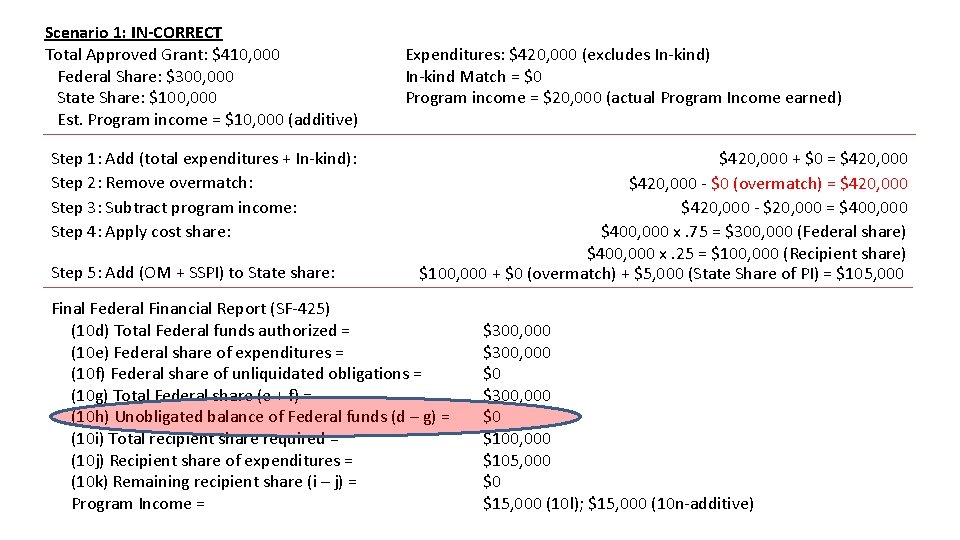
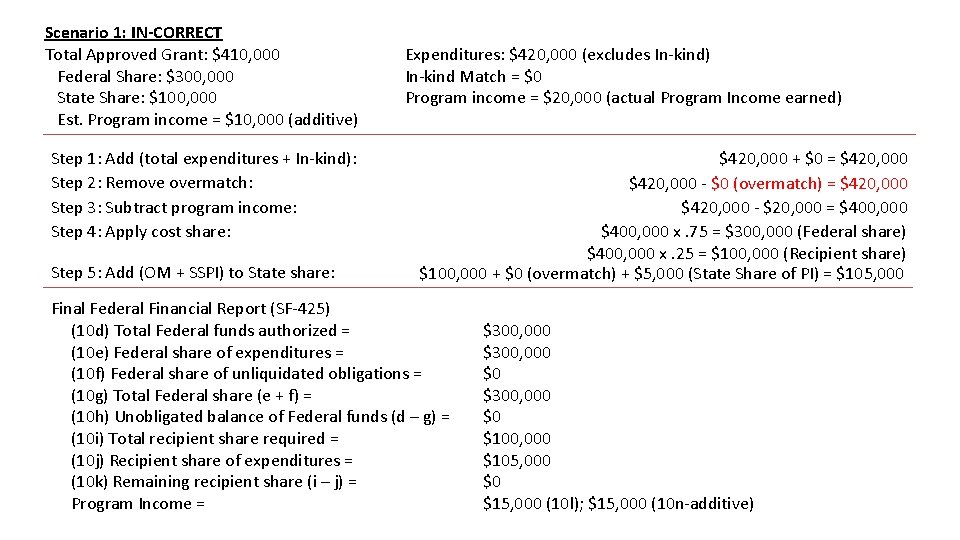
Scenario 1: IN-CORRECT Total Approved Grant: $410, 000 Federal Share: $300, 000 State Share: $100, 000 Est. Program income = $10, 000 (additive) Step 1: Add (total expenditures + In-kind): Step 2: Remove overmatch: Step 3: Subtract program income: Step 4: Apply cost share: Step 5: Add (OM + SSPI) to State share: Expenditures: $420, 000 (excludes In-kind) In-kind Match = $0 Program income = $20, 000 (actual Program Income earned) $420, 000 + $0 = $420, 000 - $0 (overmatch) = $420, 000 - $20, 000 = $400, 000 x. 75 = $300, 000 (Federal share) $400, 000 x. 25 = $100, 000 (Recipient share) $100, 000 + $0 (overmatch) + $5, 000 (State Share of PI) = $105, 000 Final Federal Financial Report (SF-425) (10 d) Total Federal funds authorized = (10 e) Federal share of expenditures = (10 f) Federal share of unliquidated obligations = (10 g) Total Federal share (e + f) = (10 h) Unobligated balance of Federal funds (d – g) = (10 i) Total recipient share required = (10 j) Recipient share of expenditures = (10 k) Remaining recipient share (i – j) = Program Income = $300, 000 $0 $100, 000 $105, 000 $0 $15, 000 (10 l); $15, 000 (10 n-additive)
Scenario 1: IN-CORRECT Total Approved Grant: $410, 000 Federal Share: $300, 000 State Share: $100, 000 Est. Program income = $10, 000 (additive) Step 1: Add (total expenditures + In-kind): Step 2: Remove overmatch: Step 3: Subtract program income: Step 4: Apply cost share: Step 5: Add (OM + SSPI) to State share: Expenditures: $420, 000 (excludes In-kind) In-kind Match = $0 Program income = $20, 000 (actual Program Income earned) $420, 000 + $0 = $420, 000 - $0 (overmatch) = $420, 000 - $20, 000 = $400, 000 x. 75 = $300, 000 (Federal share) $400, 000 x. 25 = $100, 000 (Recipient share) $100, 000 + $0 (overmatch) + $5, 000 (State Share of PI) = $105, 000 Final Federal Financial Report (SF-425) (10 d) Total Federal funds authorized = (10 e) Federal share of expenditures = (10 f) Federal share of unliquidated obligations = (10 g) Total Federal share (e + f) = (10 h) Unobligated balance of Federal funds (d – g) = (10 i) Total recipient share required = (10 j) Recipient share of expenditures = (10 k) Remaining recipient share (i – j) = Program Income = $300, 000 $0 $100, 000 $105, 000 $0 $15, 000 (10 l); $15, 000 (10 n-additive)
Scenario 1: IN-CORRECT Total Approved Grant: $410, 000 Federal Share: $300, 000 State Share: $100, 000 Est. Program income = $10, 000 (additive) Step 1: Add (total expenditures + In-kind): Step 2: Remove overmatch: Step 3: Subtract program income: Step 4: Apply cost share: Step 5: Add (OM + SSPI) to State share: Expenditures: $420, 000 (excludes In-kind) In-kind Match = $0 Program income = $20, 000 (actual Program Income earned) $420, 000 + $0 = $420, 000 - $0 (overmatch) = $420, 000 - $20, 000 = $400, 000 x. 75 = $300, 000 (Federal share) $400, 000 x. 25 = $100, 000 (Recipient share) $100, 000 + $0 (overmatch) + $5, 000 (State Share of PI) = $105, 000 Final Federal Financial Report (SF-425) (10 d) Total Federal funds authorized = (10 e) Federal share of expenditures = (10 f) Federal share of unliquidated obligations = (10 g) Total Federal share (e + f) = (10 h) Unobligated balance of Federal funds (d – g) = (10 i) Total recipient share required = (10 j) Recipient share of expenditures = (10 k) Remaining recipient share (i – j) = Program Income = $300, 000 $0 $100, 000 $105, 000 $0 $15, 000 (10 l); $15, 000 (10 n-additive)
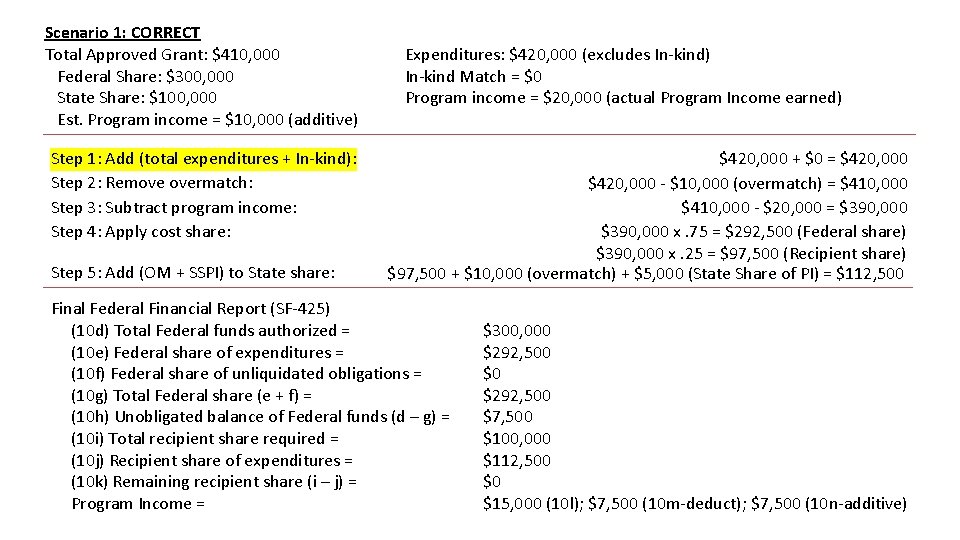
Scenario 1: CORRECT Total Approved Grant: $410, 000 Federal Share: $300, 000 State Share: $100, 000 Est. Program income = $10, 000 (additive) Step 1: Add (total expenditures + In-kind): Step 2: Remove overmatch: Step 3: Subtract program income: Step 4: Apply cost share: Step 5: Add (OM + SSPI) to State share: Expenditures: $420, 000 (excludes In-kind) In-kind Match = $0 Program income = $20, 000 (actual Program Income earned) $420, 000 + $0 = $420, 000 - $10, 000 (overmatch) = $410, 000 - $20, 000 = $390, 000 x. 75 = $292, 500 (Federal share) $390, 000 x. 25 = $97, 500 (Recipient share) $97, 500 + $10, 000 (overmatch) + $5, 000 (State Share of PI) = $112, 500 Final Federal Financial Report (SF-425) (10 d) Total Federal funds authorized = (10 e) Federal share of expenditures = (10 f) Federal share of unliquidated obligations = (10 g) Total Federal share (e + f) = (10 h) Unobligated balance of Federal funds (d – g) = (10 i) Total recipient share required = (10 j) Recipient share of expenditures = (10 k) Remaining recipient share (i – j) = Program Income = $300, 000 $292, 500 $7, 500 $100, 000 $112, 500 $0 $15, 000 (10 l); $7, 500 (10 m-deduct); $7, 500 (10 n-additive)
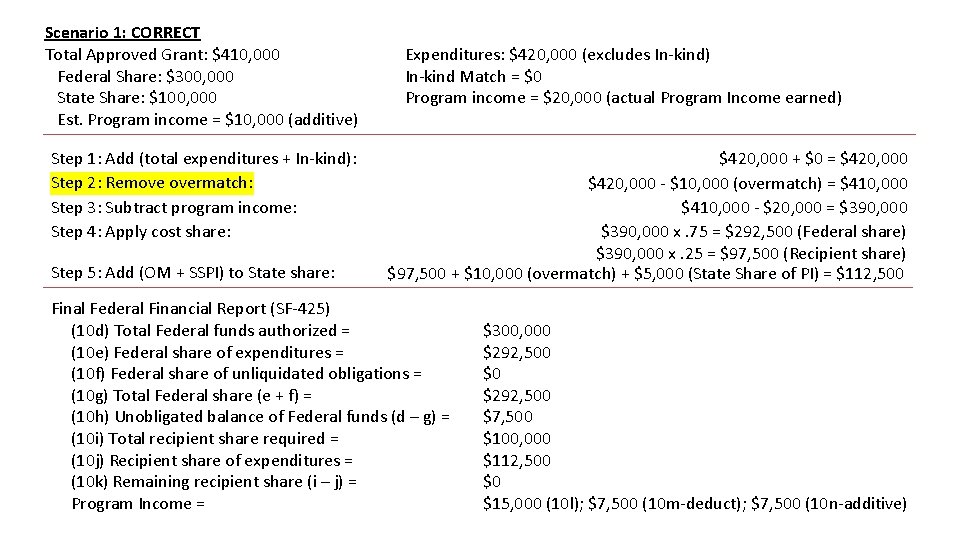
Scenario 1: CORRECT Total Approved Grant: $410, 000 Federal Share: $300, 000 State Share: $100, 000 Est. Program income = $10, 000 (additive) Step 1: Add (total expenditures + In-kind): Step 2: Remove overmatch: Step 3: Subtract program income: Step 4: Apply cost share: Step 5: Add (OM + SSPI) to State share: Expenditures: $420, 000 (excludes In-kind) In-kind Match = $0 Program income = $20, 000 (actual Program Income earned) $420, 000 + $0 = $420, 000 - $10, 000 (overmatch) = $410, 000 - $20, 000 = $390, 000 x. 75 = $292, 500 (Federal share) $390, 000 x. 25 = $97, 500 (Recipient share) $97, 500 + $10, 000 (overmatch) + $5, 000 (State Share of PI) = $112, 500 Final Federal Financial Report (SF-425) (10 d) Total Federal funds authorized = (10 e) Federal share of expenditures = (10 f) Federal share of unliquidated obligations = (10 g) Total Federal share (e + f) = (10 h) Unobligated balance of Federal funds (d – g) = (10 i) Total recipient share required = (10 j) Recipient share of expenditures = (10 k) Remaining recipient share (i – j) = Program Income = $300, 000 $292, 500 $7, 500 $100, 000 $112, 500 $0 $15, 000 (10 l); $7, 500 (10 m-deduct); $7, 500 (10 n-additive)
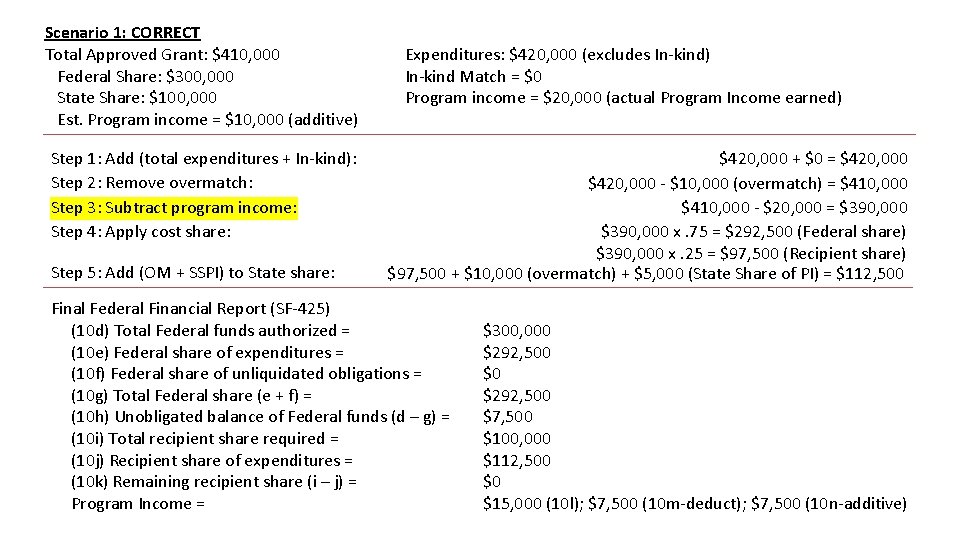
Scenario 1: CORRECT Total Approved Grant: $410, 000 Federal Share: $300, 000 State Share: $100, 000 Est. Program income = $10, 000 (additive) Step 1: Add (total expenditures + In-kind): Step 2: Remove overmatch: Step 3: Subtract program income: Step 4: Apply cost share: Step 5: Add (OM + SSPI) to State share: Expenditures: $420, 000 (excludes In-kind) In-kind Match = $0 Program income = $20, 000 (actual Program Income earned) $420, 000 + $0 = $420, 000 - $10, 000 (overmatch) = $410, 000 - $20, 000 = $390, 000 x. 75 = $292, 500 (Federal share) $390, 000 x. 25 = $97, 500 (Recipient share) $97, 500 + $10, 000 (overmatch) + $5, 000 (State Share of PI) = $112, 500 Final Federal Financial Report (SF-425) (10 d) Total Federal funds authorized = (10 e) Federal share of expenditures = (10 f) Federal share of unliquidated obligations = (10 g) Total Federal share (e + f) = (10 h) Unobligated balance of Federal funds (d – g) = (10 i) Total recipient share required = (10 j) Recipient share of expenditures = (10 k) Remaining recipient share (i – j) = Program Income = $300, 000 $292, 500 $7, 500 $100, 000 $112, 500 $0 $15, 000 (10 l); $7, 500 (10 m-deduct); $7, 500 (10 n-additive)
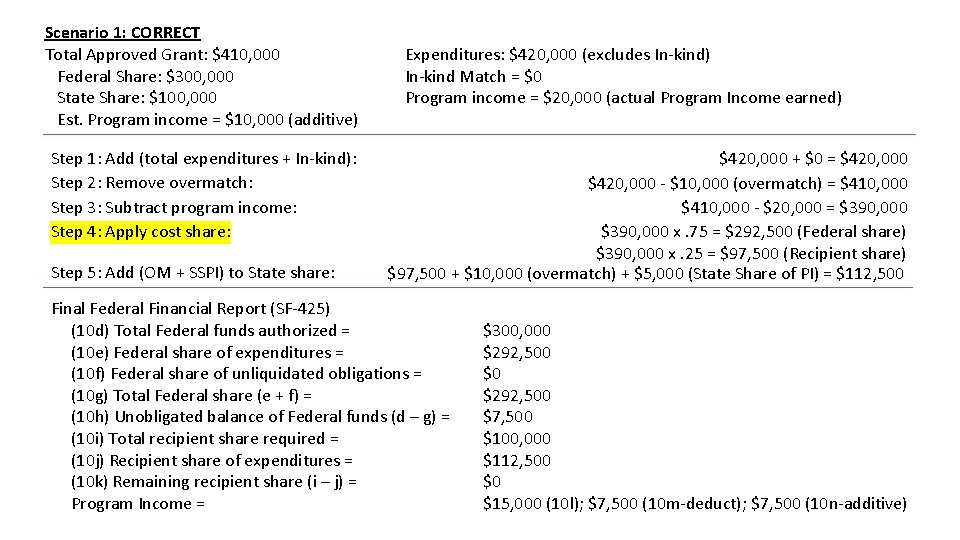
Scenario 1: CORRECT Total Approved Grant: $410, 000 Federal Share: $300, 000 State Share: $100, 000 Est. Program income = $10, 000 (additive) Step 1: Add (total expenditures + In-kind): Step 2: Remove overmatch: Step 3: Subtract program income: Step 4: Apply cost share: Step 5: Add (OM + SSPI) to State share: Expenditures: $420, 000 (excludes In-kind) In-kind Match = $0 Program income = $20, 000 (actual Program Income earned) $420, 000 + $0 = $420, 000 - $10, 000 (overmatch) = $410, 000 - $20, 000 = $390, 000 x. 75 = $292, 500 (Federal share) $390, 000 x. 25 = $97, 500 (Recipient share) $97, 500 + $10, 000 (overmatch) + $5, 000 (State Share of PI) = $112, 500 Final Federal Financial Report (SF-425) (10 d) Total Federal funds authorized = (10 e) Federal share of expenditures = (10 f) Federal share of unliquidated obligations = (10 g) Total Federal share (e + f) = (10 h) Unobligated balance of Federal funds (d – g) = (10 i) Total recipient share required = (10 j) Recipient share of expenditures = (10 k) Remaining recipient share (i – j) = Program Income = $300, 000 $292, 500 $7, 500 $100, 000 $112, 500 $0 $15, 000 (10 l); $7, 500 (10 m-deduct); $7, 500 (10 n-additive)
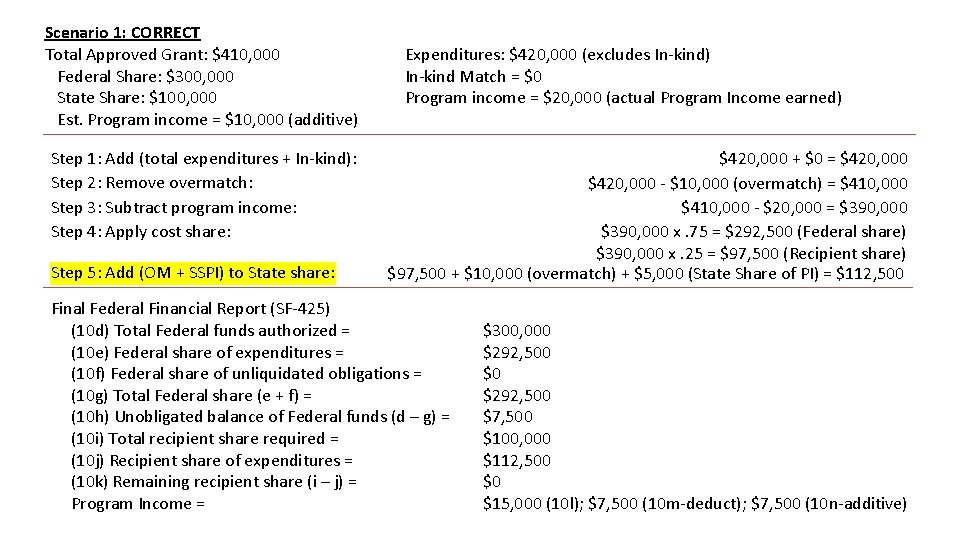
Scenario 1: CORRECT Total Approved Grant: $410, 000 Federal Share: $300, 000 State Share: $100, 000 Est. Program income = $10, 000 (additive) Step 1: Add (total expenditures + In-kind): Step 2: Remove overmatch: Step 3: Subtract program income: Step 4: Apply cost share: Step 5: Add (OM + SSPI) to State share: Expenditures: $420, 000 (excludes In-kind) In-kind Match = $0 Program income = $20, 000 (actual Program Income earned) $420, 000 + $0 = $420, 000 - $10, 000 (overmatch) = $410, 000 - $20, 000 = $390, 000 x. 75 = $292, 500 (Federal share) $390, 000 x. 25 = $97, 500 (Recipient share) $97, 500 + $10, 000 (overmatch) + $5, 000 (State Share of PI) = $112, 500 Final Federal Financial Report (SF-425) (10 d) Total Federal funds authorized = (10 e) Federal share of expenditures = (10 f) Federal share of unliquidated obligations = (10 g) Total Federal share (e + f) = (10 h) Unobligated balance of Federal funds (d – g) = (10 i) Total recipient share required = (10 j) Recipient share of expenditures = (10 k) Remaining recipient share (i – j) = Program Income = $300, 000 $292, 500 $7, 500 $100, 000 $112, 500 $0 $15, 000 (10 l); $7, 500 (10 m-deduct); $7, 500 (10 n-additive)
Wrap up Many WSFR grants continue to present complex scenarios involving multiple program income disposition methods. OIG auditors are paying attention to these complex scenarios. Reach out to your WSFR Regional Office if you have questions about program income. Come see us at a future Advanced Grants Management class where we walk staff through some of these complex scenarios.

Any Questions
- Slides: 27