
Program Evaluation The Holistic Life Foundation A Nonprofit
- Slides: 7
Program Evaluation: The Holistic Life Foundation A Non-profit organization on Yoga & Mindful Intervention (Afterschool Program) By: Nicole Fusaro EPSE 561 November 22, 2011 1
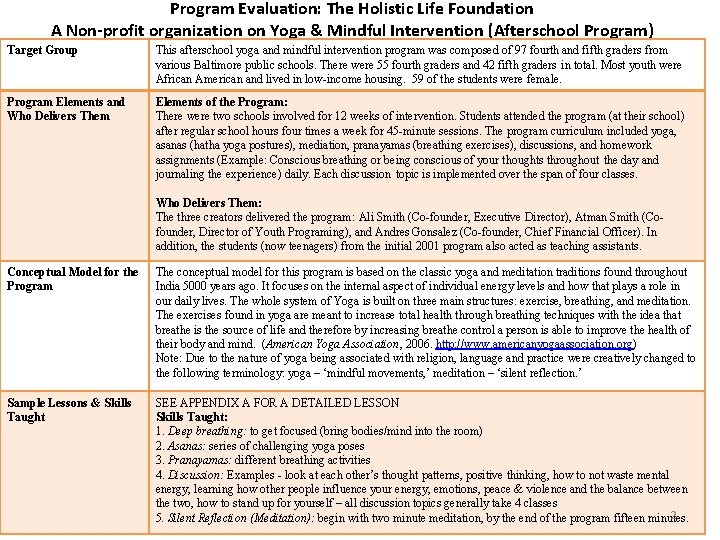
Program Evaluation: The Holistic Life Foundation A Non-profit organization on Yoga & Mindful Intervention (Afterschool Program) Target Group This afterschool yoga and mindful intervention program was composed of 97 fourth and fifth graders from various Baltimore public schools. There were 55 fourth graders and 42 fifth graders in total. Most youth were African American and lived in low-income housing. 59 of the students were female. Program Elements and Who Delivers Them Elements of the Program: There were two schools involved for 12 weeks of intervention. Students attended the program (at their school) after regular school hours four times a week for 45 -minute sessions. The program curriculum included yoga, asanas (hatha yoga postures), mediation, pranayamas (breathing exercises), discussions, and homework assignments (Example: Conscious breathing or being conscious of your thoughts throughout the day and journaling the experience) daily. Each discussion topic is implemented over the span of four classes. Who Delivers Them: The three creators delivered the program: Ali Smith (Co-founder, Executive Director), Atman Smith (Cofounder, Director of Youth Programing), and Andres Gonsalez (Co-founder, Chief Financial Officer). In addition, the students (now teenagers) from the initial 2001 program also acted as teaching assistants. Conceptual Model for the Program The conceptual model for this program is based on the classic yoga and meditation traditions found throughout India 5000 years ago. It focuses on the internal aspect of individual energy levels and how that plays a role in our daily lives. The whole system of Yoga is built on three main structures: exercise, breathing, and meditation. The exercises found in yoga are meant to increase total health through breathing techniques with the idea that breathe is the source of life and therefore by increasing breathe control a person is able to improve the health of their body and mind. (American Yoga Association, 2006. http: //www. americanyogaassociation. org) Note: Due to the nature of yoga being associated with religion, language and practice were creatively changed to the following terminology: yoga – ‘mindful movements, ’ meditation – ‘silent reflection. ’ Sample Lessons & Skills Taught SEE APPENDIX A FOR A DETAILED LESSON Skills Taught: 1. Deep breathing: to get focused (bring bodies/mind into the room) 2. Asanas: series of challenging yoga poses 3. Pranayamas: different breathing activities 4. Discussion: Examples - look at each other’s thought patterns, positive thinking, how to not waste mental energy, learning how other people influence your energy, emotions, peace & violence and the balance between the two, how to stand up for yourself – all discussion topics generally take 4 classes 2 5. Silent Reflection (Meditation): begin with two minute meditation, by the end of the program fifteen minutes.
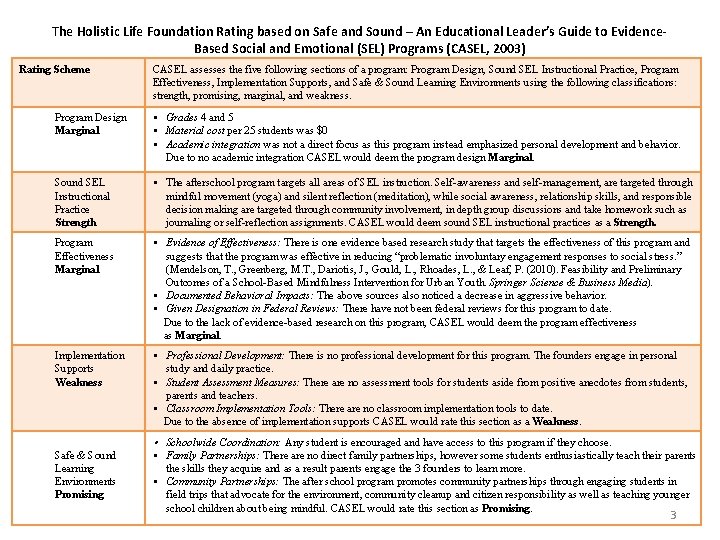
The Holistic Life Foundation Rating based on Safe and Sound – An Educational Leader’s Guide to Evidence. Based Social and Emotional (SEL) Programs (CASEL, 2003) Rating Scheme CASEL assesses the five following sections of a program: Program Design, Sound SEL Instructional Practice, Program Effectiveness, Implementation Supports, and Safe & Sound Learning Environments using the following classifications: strength, promising, marginal, and weakness. Program Design Marginal Grades 4 and 5 Material cost per 25 students was $0 Academic integration was not a direct focus as this program instead emphasized personal development and behavior. Due to no academic integration CASEL would deem the program design Marginal. Sound SEL Instructional Practice Strength The afterschool program targets all areas of SEL instruction. Self-awareness and self-management, are targeted through mindful movement (yoga) and silent reflection (meditation), while social awareness, relationship skills, and responsible decision making are targeted through community involvement, in depth group discussions and take homework such as journaling or self-reflection assignments. CASEL would deem sound SEL instructional practices as a Strength. Program Effectiveness Marginal Evidence of Effectiveness: There is one evidence based research study that targets the effectiveness of this program and suggests that the program was effective in reducing “problematic involuntary engagement responses to social stress. ” (Mendelson, T. , Greenberg, M. T. , Dariotis, J. , Gould, L. , Rhoades, L. , & Leaf, P. (2010). Feasibility and Preliminary Outcomes of a School-Based Mindfulness Intervention for Urban Youth. Springer Science & Business Media). Documented Behavioral Impacts: The above sources also noticed a decrease in aggressive behavior. Given Designation in Federal Reviews: There have not been federal reviews for this program to date. Due to the lack of evidence-based research on this program, CASEL would deem the program effectiveness as Marginal. Implementation Supports Weakness Professional Development: There is no professional development for this program. The founders engage in personal study and daily practice. Student Assessment Measures: There are no assessment tools for students aside from positive anecdotes from students, parents and teachers. Classroom Implementation Tools: There are no classroom implementation tools to date. Due to the absence of implementation supports CASEL would rate this section as a Weakness. Safe & Sound Learning Environments Promising Schoolwide Coordination: Any student is encouraged and have access to this program if they choose. Family Partnerships: There are no direct family partnerships, however some students enthusiastically teach their parents the skills they acquire and as a result parents engage the 3 founders to learn more. Community Partnerships: The after school program promotes community partnerships through engaging students in field trips that advocate for the environment, community cleanup and citizen responsibility as well as teaching younger school children about being mindful. CASEL would rate this section as Promising. 3
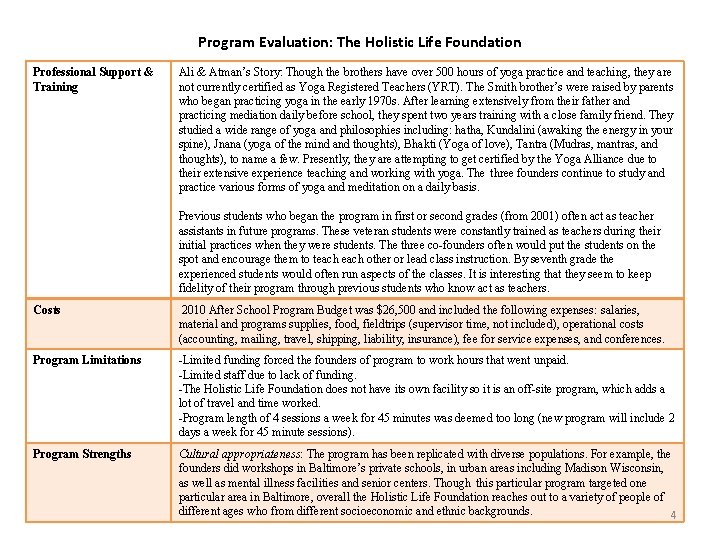
Program Evaluation: The Holistic Life Foundation Professional Support & Training Ali & Atman’s Story: Though the brothers have over 500 hours of yoga practice and teaching, they are not currently certified as Yoga Registered Teachers (YRT). The Smith brother’s were raised by parents who began practicing yoga in the early 1970 s. After learning extensively from their father and practicing mediation daily before school, they spent two years training with a close family friend. They studied a wide range of yoga and philosophies including: hatha, Kundalini (awaking the energy in your spine), Jnana (yoga of the mind and thoughts), Bhakti (Yoga of love), Tantra (Mudras, mantras, and thoughts), to name a few. Presently, they are attempting to get certified by the Yoga Alliance due to their extensive experience teaching and working with yoga. The three founders continue to study and practice various forms of yoga and meditation on a daily basis. Previous students who began the program in first or second grades (from 2001) often act as teacher assistants in future programs. These veteran students were constantly trained as teachers during their initial practices when they were students. The three co-founders often would put the students on the spot and encourage them to teach other or lead class instruction. By seventh grade the experienced students would often run aspects of the classes. It is interesting that they seem to keep fidelity of their program through previous students who know act as teachers. Costs 2010 After School Program Budget was $26, 500 and included the following expenses: salaries, material and programs supplies, food, fieldtrips (supervisor time, not included), operational costs (accounting, mailing, travel, shipping, liability, insurance), fee for service expenses, and conferences. Program Limitations -Limited funding forced the founders of program to work hours that went unpaid. -Limited staff due to lack of funding. -The Holistic Life Foundation does not have its own facility so it is an off-site program, which adds a lot of travel and time worked. -Program length of 4 sessions a week for 45 minutes was deemed too long (new program will include 2 days a week for 45 minute sessions). Program Strengths Cultural appropriateness: The program has been replicated with diverse populations. For example, the founders did workshops in Baltimore’s private schools, in urban areas including Madison Wisconsin, as well as mental illness facilities and senior centers. Though this particular program targeted one particular area in Baltimore, overall the Holistic Life Foundation reaches out to a variety of people of different ages who from different socioeconomic and ethnic backgrounds. 4
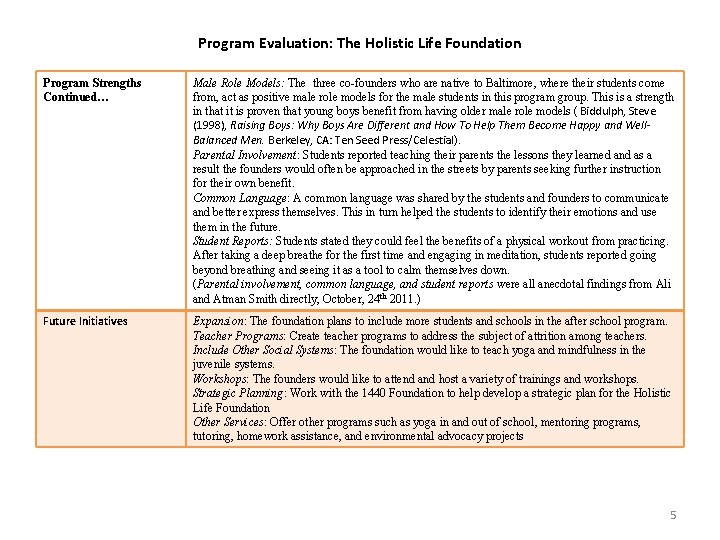
Program Evaluation: The Holistic Life Foundation Program Strengths Continued… Male Role Models: The three co-founders who are native to Baltimore, where their students come from, act as positive male role models for the male students in this program group. This is a strength in that it is proven that young boys benefit from having older male role models ( Biddulph, Steve. (1998), Raising Boys: Why Boys Are Different and How To Help Them Become Happy and Well. Balanced Men. Berkeley, CA: Ten Seed Press/Celestial). Parental Involvement: Students reported teaching their parents the lessons they learned and as a result the founders would often be approached in the streets by parents seeking further instruction for their own benefit. Common Language: A common language was shared by the students and founders to communicate and better express themselves. This in turn helped the students to identify their emotions and use them in the future. Student Reports: Students stated they could feel the benefits of a physical workout from practicing. After taking a deep breathe for the first time and engaging in meditation, students reported going beyond breathing and seeing it as a tool to calm themselves down. (Parental involvement, common language, and student reports were all anecdotal findings from Ali and Atman Smith directly, October, 24 th 2011. ) Future Initiatives Expansion: The foundation plans to include more students and schools in the after school program. Teacher Programs: Create teacher programs to address the subject of attrition among teachers. Include Other Social Systems: The foundation would like to teach yoga and mindfulness in the juvenile systems. Workshops: The founders would like to attend and host a variety of trainings and workshops. Strategic Planning: Work with the 1440 Foundation to help develop a strategic plan for the Holistic Life Foundation Other Services: Offer other programs such as yoga in and out of school, mentoring programs, tutoring, homework assistance, and environmental advocacy projects 5
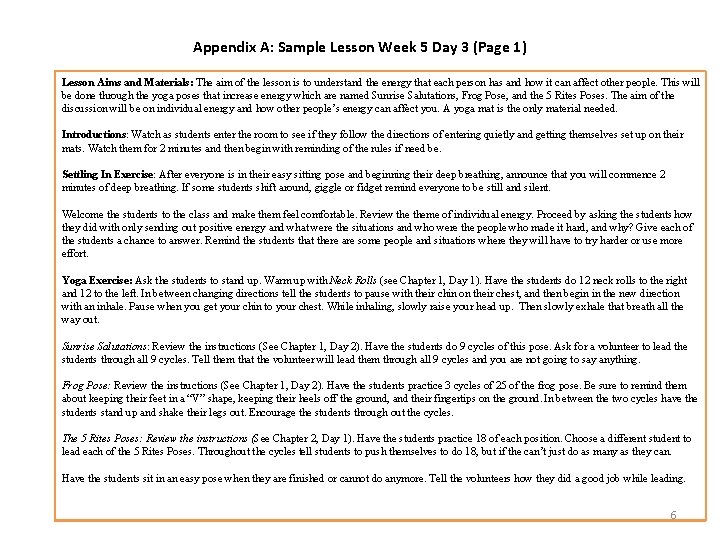
Appendix A: Sample Lesson Week 5 Day 3 (Page 1) Lesson Aims and Materials: The aim of the lesson is to understand the energy that each person has and how it can affect other people. This will be done through the yoga poses that increase energy which are named Sunrise Salutations, Frog Pose, and the 5 Rites Poses. The aim of the discussion will be on individual energy and how other people’s energy can affect you. A yoga mat is the only material needed. Introductions: Watch as students enter the room to see if they follow the directions of entering quietly and getting themselves set up on their mats. Watch them for 2 minutes and then begin with reminding of the rules if need be. Settling In Exercise: After everyone is in their easy sitting pose and beginning their deep breathing, announce that you will commence 2 minutes of deep breathing. If some students shift around, giggle or fidget remind everyone to be still and silent. Welcome the students to the class and make them feel comfortable. Review theme of individual energy. Proceed by asking the students how they did with only sending out positive energy and what were the situations and who were the people who made it hard, and why? Give each of the students a chance to answer. Remind the students that there are some people and situations where they will have to try harder or use more effort. Yoga Exercise: Ask the students to stand up. Warm up with Neck Rolls (see Chapter 1, Day 1). Have the students do 12 neck rolls to the right and 12 to the left. In between changing directions tell the students to pause with their chin on their chest, and then begin in the new direction with an inhale. Pause when you get your chin to your chest. While inhaling, slowly raise your head up. Then slowly exhale that breath all the way out. Sunrise Salutations: Review the instructions (See Chapter 1, Day 2). Have the students do 9 cycles of this pose. Ask for a volunteer to lead the students through all 9 cycles. Tell them that the volunteer will lead them through all 9 cycles and you are not going to say anything. Frog Pose: Review the instructions (See Chapter 1, Day 2). Have the students practice 3 cycles of 25 of the frog pose. Be sure to remind them about keeping their feet in a “V” shape, keeping their heels off the ground, and their fingertips on the ground. In between the two cycles have the students stand up and shake their legs out. Encourage the students through out the cycles. The 5 Rites Poses: Review the instructions (See Chapter 2, Day 1). Have the students practice 18 of each position. Choose a different student to lead each of the 5 Rites Poses. Throughout the cycles tell students to push themselves to do 18, but if the can’t just do as many as they can. Have the students sit in an easy pose when they are finished or cannot do anymore. Tell the volunteers how they did a good job while leading. 6
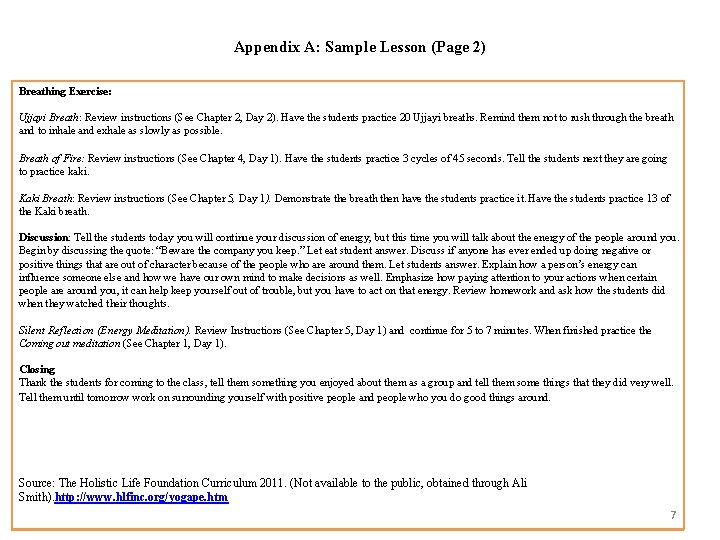
Appendix A: Sample Lesson (Page 2) Breathing Exercise: Ujjayi Breath: Review instructions (See Chapter 2, Day 2). Have the students practice 20 Ujjayi breaths. Remind them not to rush through the breath and to inhale and exhale as slowly as possible. Breath of Fire: Review instructions (See Chapter 4, Day 1). Have the students practice 3 cycles of 45 seconds. Tell the students next they are going to practice kaki. Kaki Breath: Review instructions (See Chapter 5, Day 1). Demonstrate the breath then have the students practice it. Have the students practice 13 of the Kaki breath. Discussion: Tell the students today you will continue your discussion of energy, but this time you will talk about the energy of the people around you. Begin by discussing the quote: “Beware the company you keep. ” Let eat student answer. Discuss if anyone has ever ended up doing negative or positive things that are out of character because of the people who are around them. Let students answer. Explain how a person’s energy can influence someone else and how we have our own mind to make decisions as well. Emphasize how paying attention to your actions when certain people around you, it can help keep yourself out of trouble, but you have to act on that energy. Review homework and ask how the students did when they watched their thoughts. Silent Reflection (Energy Meditation). Review Instructions (See Chapter 5, Day 1) and continue for 5 to 7 minutes. When finished practice the Coming out meditation (See Chapter 1, Day 1). Closing Thank the students for coming to the class, tell them something you enjoyed about them as a group and tell them some things that they did very well. Tell them until tomorrow work on surrounding yourself with positive people and people who you do good things around. Source: The Holistic Life Foundation Curriculum 2011. (Not available to the public, obtained through Ali Smith). http: //www. hlfinc. org/yogape. htm 7